Monday, August 05, 2024
Smilin' Jack Debuts ... Sorta

Smilin' Jack, the unique flying strip with a roll call of memorable characters and zany plotlines, was a fixture of the Chicago Tribune and a very healthy client list for just a hair shy of four decades. But it didn't start out with that name. The first Sunday, shown above, is how it debuted in the Tribune on October 1 1933. At the outset the strip was titled On The Wing, and the star of the show was a midwestern hayseed type named Mack.
How the strip got into the paper in this fetal stage I don't know, but according to creator Zack Mosley, it wasn't long before Colonel Patterson, that midwife of great Tribune comics, sat down with him and brainstormed how to turn this instantly forgettable copycat aviation strip into one that flew higher than the competition and outlasted it by decades.
Patterson took a cue from Mosley himself, whose nickname was Smilin' Zack, and decreed that the strip and its hero would be renamed Smilin' Jack. With that simple reader-attracting hook in place he encouraged Mosley to write the strip to his own strengths, which ran to the quirky and tongue-in-cheek. The strip was Sunday-only at this time, and between the installments of December 24 and 31 1933, the title and character name change were put in place. The strip did not immediately turn into its zany mature self, but Zack started loosening up his cartooning style, began evolving his hero into the dapper ladies man, and the boring flying school stories were dropped in favour of more exciting fare.
Labels: Firsts and Lasts


Monday, June 10, 2024
Firsts and Lasts: Kitty Higgins Less Than Dramatic Entrance and Exit

Comic strip fans like to talk about records, and the discussion of the longest lasting series is a favourite. We tend to ignore toppers when having these discussions, though, and of course there's a good reason for that -- without the main strip there's no need for a topper, so they are automatically disqualified from being the longest running series.
But what is the longest running topper? this can be a tough question in and of itself, because the longest running series were still being produced into the 1960s and even 1970s, but they appeared in vanishingly few papers. Some, I'm convinced, were produced but never ended up being printed anywhere.
By the 1960s the third page strip was the de facto standard, and that format almost never included a topper. By then you would generally only see a topper on some tab or half-page formats. So few papers used these formats, especially for strips that used toppers, which practically begged to be cut down, that tracking the toppers becomes next to impossible. In fact, for my research I've often had to base my end dates on original art, which is often the only place you're going to see toppers of these late years.
The Sunday strip of Moon Mullins added its topper Kitty Higgins* around the same time as the other Chicago Tribune strips. The first strip, seen above, ran on December 14 1930. The strip was quite obviously an afterthought, with the gags (even the very first) being real mouldy oldies. No doubt production of this strip was by Frank Willard's assistant Ferd Johnson, and neither of these guys wasted too much brain juice on the feature. Although the first strip was done in a two-tier format, it would quickly settle down into a one-tier affair for its many years underneath the main strip (yes, they're still called toppers when they run at the bottom of the page).
The Chicago Tribune-New York News Sunday strips hung onto their toppers much longer than the products of other syndicates. Most of their A-list strips kept doggedly including toppers into the early 1970s, even though they were used by maybe one out of a hundred papers that ran the main strip. For the longest time I thought Kitty Higgins ended in 1973, because that was the last year that it appeared in the Editor & Publisher Syndicate Directory. It wasn't until recent years that I saw the original art for the May 26 1974 strip, which included the topper and so upgraded the end date to sometime after that.
Finally I found a newspaper online that actually ran Moon Mullins consistently as a tab in 1974, the Elizabethton Star. The last Kitty Higgins I can find is the release of September 1 1974. The September 8 issue, sadly, is missing the comics section, but on the 15th the topper is gone, and Kitty is co-starring in the main strip -- perhaps she had an appearance contract?
What is either the final or penultimate Kitty Higgins is here, from digitized microfilm:

That gives Kitty Higgins a forty-four year run, a very impressive accomplishment, especially considering that no one, including the creators, really cared much about the strip for that whole time. Does Kitty get the crown as longest running topper? I can think of one or two toppers which might just possibly edge it out. What do you think?
* Technically that was not Moon Mullins' first topper, but that's a tale for another day.
Labels: Firsts and Lasts, Topper Features
Friday, May 03, 2024
Firsts and Lasts: The Final Flapping of Fanny

The first was Ethel Hays, whose jaw-droppingly elegant artwork was wasted on the tiny feature. Luckily NEA, the syndicate that distributed Flapper Fanny, recognized her genius and assigned a larger panel titled simply Ethel, and also had her regularly contributing colour covers for their Everyweek magazine section.
Hays passed the Flapper Fanny panel onto its second standout artist in 1930. Gladys Parker had already been published by Graphic Syndicate and United Feature, but both of those outfits were barely above the fly-by-night level in the 1920s. Parker put her own inimitable stamp on Flapper Fanny, and eventually also started her own NEA fashion panel, called Femininities. Her work was evidently received with some enthusiasm, and in 1932 Flapper Fanny added a Sunday strip version.
Parker worked on the Flapper Fanny daily and Sunday until December 1935 before calling it quits. Faced with bringing on a new artist, NEA decided to cut the Flapper Fanny Sunday. The third and final artist on the Flapper Fanny daily panel was Sylvia Sneidman, whose work was very fine, too, but was enough of a copy of Parker's style that I can't honestly offer her the same accolades as Hays and Parker.
Sylvia apparently did some lobbying and the Flapper Fanny panel was promoted to a 2-column affair, giving her a little more room to show off her artistic chops. But by 1936 the term 'flapper' was so far out of date that Sneidman might as well have been drawing the panel in a cell, patiently waiting for the firing squad. Why it didn't occur to NEA that a retitling of the series might be in order I cannot imagine.
Flapper Fanny gamely continued four and a half years under Sneidman's control, but finally the inevitable happened. With no fanfare, the last Flapper Fanny panel, seen above, ran on June 29 1940.
Labels: Firsts and Lasts
Monday, March 04, 2024
Firsts and Lasts: King of the Royal Mounted Rides Forth

Above is the seldom seen first Sunday of King of the Royal Mounted, which appeared on February 17 1935. The art on this inaugural Sunday was unsigned but by Allen Dean. I love how the story just jumps right in there and rockets right off. No intro, no explanatory dialogue, just slam-bang action.
As much as I should be well-versed in King of the Royal Mounted lore, being a Canuck and all, I must admit to having read very little of the strip. So I think I'll just shut up and ask you to keep reading over at Don Markstein's Toonopedia, where he gives you all the lowdown on this classic adventure strip. He'll even tell you Sergeant King's first name, and I bet there was a lotta reading went into finding that li'l factoid!
Labels: Firsts and Lasts
 : 3/04/2024 11:20 AM
 It would have seemed to be better to launch one of the new Tab features the week that the Hearst chain sections converted, on 3rd of February, but they waited until the 17th.
Years ago, Ron Goulart brought up the obscure "MEN OF THE MOUNTED" strip, syndicated by the Toronto Star, as ending on 16 February 1935, indicating that KFS may have had to wait for, or even somehow hasten, that ending, in order to clear the deck for another, presumably better, Mountie strip.
What do you think? I can see a natural fan base in Canada, of course, was it especially supported there? There were foreign clients, of course, I have comic books in Spanish, for instance, where he's "Rey De La Policia."
: 3/04/2024 2:39 PM 
That is a real head-scratcher about the Canadian strip. Do you need permission to feature a real public organization in a strip? If so, it makes perfect sense, as the RCMP might have said, effectively, "Get in line, chum." But I don't recall ever hearing that being a rule -- maybe just a smart and ethical business decision not to peeve the organization on which you're basing a strip.
Do you happen to know if "King..." paid any sort of royalties/commission/donation to the RCMP over the years? Did the RCMP keep tabs on the strip and provide guidance?
Gee, I wonder if "Crock" sought the okay of the French Foreign Legion?
--Allan
When it was launched, I think they had really high hopes for it, after all, it had Zane Grey's name on it, and some licensing and movie contracts appeared, thus avoid a direct competitor at the start to eliminate confusion.
Never ran across much promotional material for the strip, on either side of the border, that's why I was curious if there really was any special feeling by Canadians. I get the impression that it never rose above the status of mediocrity. Note that it was killed off in 1954, right in the middle of a story. No way to treat a strip that had a worthwhile fan or client list.
At some point early on, about 1940, Stephen Schlesinger's name started appearing in the copyright line, so maybe that's a reason for the course of the strip's history- he owned it and not King Features.
: 3/06/2024 2:48 PM --Allan
Wednesday, January 17, 2024
Firsts and Lasts: Gordo Says Adios


Gus Arriola wanted Americans to learn about and appreciate Mexican culture, and as we know, comic strips that seek to educate have a very steep hill to climb. By the time newspaper readers get to the funnies page they want to be entertained, not preached at. So Arriola had to become that most rare and precious of jewels, the cartoonist who is so good that readers want to enjoy their work even if it is *gasp* educational. Arriola's art is utterly divine, highly stylized and decorative while retaining the unpretentious touch of bigfoot cartooning. The writing is similarly balanced, successfully navigating that high-wire between education and entertainment. Arriola was an entertainer first and foremost, but once he had you hooked he offered you a comfortable and fun learning experience about Mexican history, the Spanish language and Latino culture.
With the strip about to be retired in 1985 after a 40+ year run, Arriola decided to give readers closure on confirmed bachelor Gordo's love life. After toying with an involved idea in which Gordo is cloned (!), Arriola decided on a simpler continuity. Gordo was trapped into an imminent forced marriage with the Widow Gonzalez and he takes the one escape route he could by proposing to his beloved Tehuana Mama. Faced with getting her wish after all these years, she decides to overlook the circumstance that is forcing Gordo's hand and accepts. The whole Gordo family rides off into the sunset.
In the final strip Arriola offers a generally warm goodbye message to his readers, but betrays just a hint of anger at either the end of Gordo, or at Mexican-US relations. I'm really not sure which.
Thanks to Mark Johnson, who supplied the syndicate proofs for Gordo's final week.
Labels: Firsts and Lasts
Gordo's biggest drawback was, perhaps because of the "educational" component, was the tendency to be very talky, and though in these examples, he obviously had a hard deadline for an "¡Adios!" strip, and had to explain a lot of story fast, through the years he did a lot of very text-heavy, action-light entries.
Nevertheless, Arriola is somewhat overlooked. He was capable of truly dazzling compositions that should have put him into the class of greatest penmen of the form. But I remember few papers that carried it, as if it were just beyond the number of UFS strips a client paper would take.
Might be that it would've been more popular in the Southwest, but I did my growing up in the Northeast.
: 1/17/2024 12:07 PM It's a shame we don't have more reprint collections. "Accidental Ambassador Gordo" is a combination of highlights and personal memoir; it includes some story arcs and leaves you wanting more. There was also "Gordo's Critters", a collection of late-period Sunday pages.
Monday, November 20, 2023
Firsts and Lasts: Dumb Dora's Not So Dumb ... But Cancelled Anyway

Dumb Dora was on its third artist, or more like a hundred and third if you count ghosts and assistants, when her strip was retired in January 1936. Bil Dwyer was the final credited artist on the strip, taking over in late 1932 from Paul Fung, who in turn had taken over from Chic Young.
Dwyer reportedly brought on a small army of helpers to get the Sunday and daily strip out on time, including Milton Caniff, who R.C. Harvey reports did much of the pencilling for the initial eighteen months of Dwyer's tenure, plus inking some of the girl characters. By the time Dumb Dora ended Caniff was long gone, but we can still easily see vestiges of his style on the dailies above, the last two of the series.
Dumb Dora had begun as a me-too flapper strip in 1924, but had the additional hook that Dora acts dumb but usually turns out to have a bean firing on all cylinders by the end of each gag. The concept is fine, but awfully repetitive. By the time Dwyer took over the conceit was well and truly played out, and flappers were long gone, so the strip had turned into a more generic "teen boys chasing the pretty girl" feature, which left it drowning in a sea of its betters -- Tillie the Toiler, Harold Teen, Winnie Winkle, Etta Kett, etc.
Mark Johnson supplied a scan of the last two rather rare dailies seen above, which offer no farewell or conclusion to the strip. So I went looking online to see if the Sunday, which ended the next day (January 5 1936), offered us some closure. Nope!

Labels: Firsts and Lasts
My guess is that the feature lasted as long as it did because Dora had been such famous character that her very name became part of the popular American idiom, everybody said it, there were "Dumb Dora Clubs" organised by college girls; a "Dumb Dora" was a shorthand description of a He said-she said joke or cartoon gag.
Thing is, though still well known, it became stale. It was corny. The name was associated with the 1920s.
It was like calling your strip "Oh You Kid" or "Sheik n' Sheba". And all those change of artists didn't help. There's nothing interesting story-wise, either.
Yung was the only one who really understood the character and material to suit her, perhaps Fung did as well to some extent, but by the time it was dumped on Dwyer's drawing board, the feature had lost its soul.
: 11/21/2023 1:02 AM Gene Rayburn: Dumb Dora is SO dumb . . .
Audience: HOW-DUMB-IS-SHE?
Rayburn: She thinks "Night School" is where you learn how to be a ______.
I never knew it was a comic strip reference. I wonder how many people did.
: 11/22/2023 12:53 AM https://comicskingdom.com/trending/blog/2015/09/10/ask-the-archvist-dumb-dora
: 11/22/2023 2:28 PM Wednesday, July 26, 2023
Firsts and Lasts: The Teenie Weenies Retire
%2002-15-1970.jpg)
William Donahey's very long-running Sunday page, The Teenie Weenies, would have been a half-century gold medalist except that it went on hiatus for two long spells, 1924-33 and 1935-41. But having debuted in 1914, when it ended on February 15 1970 the kiddies who read it from the start were now at retirement age.
Donahey died on February 1 1970 at age 87, and the final Sunday page was run on February 15. According to his obituary in the New York Times, Donahey penned this final installment in November 1969, planning to retire. Sadly he offered no farewell in that Sunday's episode, so it was a nice touch that the Chicago Tribune added the notice of his passing below the final episode.
Fun Fact: The Teenie Weenies cut-out characters were a standard feature of the Sunday page in its final run, 1941 to 1970. If you had cut out the character each week you would have had quite a tableau to organize for display -- there would have been 1496 little standing characters total.
Labels: Firsts and Lasts
: 7/26/2023 7:20 PM The short middle run in 1933-34 (a strip) I think was done because he needed the money, and as soon as his contract was over he dropped it again.
Only in 1941, when the Trib decided he could do it the way he liked, did he bring it back for the third and final long run.
--Allan
Wednesday, July 12, 2023
Firsts and Lasts: The Final Small Society

Thanks to Mark Johnson, here we have the last Small Society daily, which was published on February 27 1999.
The Small Society debuted in 1966, a sort of lightly editorial gag cartoon that focused on an everyman character trying to deal with modern society, politics and relationships. The marketing for this strip must have been masterful because it started with a very healthy client list, and managed to keep a decent roll call of papers right through the 1960s, 70s and even 80s despite the lack of strong characters or audience-grabbing hooks. Perhaps its popularity had something to do with it being an early adopter of the panel-in-strip-format look, but that seems a stretch. .
The strip was created by Morrie Brickman, who used a very pleasant minimalist style on this feature -- a change from his earlier more detailed cartooning work. Bill Yates began getting credit as co-creator in 1985, and then got sole credit starting in 1989, but the art and writing style of the strip never faltered.
In 1999 Yates was in poor health and decided to drop The Small Society. The final installment gave only an oblique nod to the end of the series. Thanks to Mark Johnson for supplying this final strip.
Labels: Firsts and Lasts
Friday, May 26, 2023
Firsts and Lasts: Hawkshaw the Detective Debuts on Sunday
.jpg)
Gus Mager had quite the little cottage industry going with his 'monk' characters. He started drawing weekday strips for the New York Evening Journal starring human-monkey hybrids in 1904. At first they skewed toward apedom, but later the 'monks' became more and more human, until new readers would no doubt be wondering about the point of the title. No matter, because the strips were a real hoot, starring a cast of characters named for their dominant characteristic -- you had Tightwaddo the cheapskate, Coldfeeto the timid guy, Boneheado the dummy, Braggo the ... well you get the idea.
In December 1910 a new pair of characters was added to the list, a brilliant detective named Sherlocko and his faithful companion, Dr. Watso. No internet points at all for being able to decode this not exactly sly take-off on Mr. Conan Doyle's famed creations. This wasn't by any means the first appearance of a super-sleuth in newspaper comics, which is hardly surprising because Sherlock Holmes was all the rage in this era. What Mager brought to the party, oddly enough, was an obviously great respect and enthusiasm for Holmes. While there was plenty of funny stuff going on in the Sherlocko strips, the simian detective himself played things straight -- his preternatural ability to find and interpret clues was handled with surprising fidelity to the original.
The new character was a hit, and became a fixture of Mager's 'monk' strip. Things went along their merry way until early 1913, when Mager decided to leave the Hearst stable in favour of the rival Pulitzer organization. One of the carrots held out to Mager was that his star character would be given the red carpet treatment, moving to a full page Sunday strip. At Hearst, Mager had pretty much been frozen out of the prestigious Sunday paper, appearing with only a few fill-in strips back in the mid-1900s.
The first Sherlocko the Monk Sunday appeared in Pulitzer's Funny Side Sunday section on February 23 1913, as seen above. But you'll notice one big difference -- our heroes are no longer Sherlocko and Watso; they are now Hawkshaw and the Colonel.Also note that the name changes were obviously made at the last minute -- the new names are shoehorned into the word balloons, obviously replacing the original ones.
In Bill Blackbeard's introduction to the Hyperion Press book Sherlocko the Monk 1910-1912 he posits that the Conan Doyle estate might have served Pulitzer with a cease and desist order just before the new Sunday feature debuted. I disagree -- it seems to me that if the Conan Doyle estate was going to object to the obvious copy of their characters they would not have waited over two years to do so. My guess, rather, is that in the legal tradition already established by Buster Brown, it was assumed (or ordered) that Mager could take his characters with him to a new syndicate, but the name was not allowed to go with it. The last minute nature of the change makes me think that a cease and desist letter was probably received from the Hearst organization just shy of press time, and therefore the awkward looking change.
Why 'Hawkshaw' though? Although anyone could be forgiven for thinking that Mager might have actually coined the term for a detective, he actually appropriated it from a detective in the 1863 stage play The Ticket-of-Leave Man. Apparently though the play was critically panned it was an audience favorite and was constantly revived during the Victorian era, and the name Hawkshaw became synonym with detectives.
The newly minted Hawkshaw the Detective had a long run in the Pulitzer Sunday section, ending its first run in 1922. The strip was then revived in 1931 to become the topper to the Pulitzer strip The Captain and the Kids, which ironically enough, was also a feature stolen from Hearst and renamed due to legal wrangling.Thus it continued until 1947, making a tremendous nearly half-century run and Gus Mager's contribution to the history books.
Labels: Firsts and Lasts
It would seem that Blackbeard information is not a reliable source. though the man had long runs of hundreds of newspapers, Especially, it seems, Hearst ones, he didn't really do the scholarship, his ability to research them consisted of often just making up the most interesting story. Emphasis on MAKING UP.
We had several heated go-rounds together when I called him on it.
In 1913, Conan Doyle was very much alive; Don't know if Pulitzer comics saw much play outside of the US, or comic strip satires were seen as having any possible threat to the Sherlock Holmes brand, such as it was. Doyle did almost no licensing, I believe he purposefuly resisted it.
Your speculation that the change was to avoid possible infringement of the Hearst version sounds right. perhaps Mager was happy to ditch the tired simian componant anyway.
: 5/26/2023 1:54 PM I happened to find an earlier cartoon by Mager in the Jul/4/1905 Pensacola Journal (chronicling america id sn87062268) in which a character stated that he was "Hawkshaw the Detective." The cartoon was titled Ruffles the Monk, but of course Mager's titles varied widely at that time. I cannot tell whether this was a recurring character with a different identity. The phrase "I am Hawkshaw the Detective" seems to have been sort of a general catch phrase in that period, probably due to the play.
(Bob Harris)
: 5/27/2023 9:11 PM : 5/27/2023 10:59 PM : 5/28/2023 12:17 AM : 5/29/2023 12:16 PM There was another, rare entry to add- Mager did another iteration of this Human character called "Sherlocko", with "Watso" in tow. This was a daily that appeared in the Urbana (Ills.)Daily Courier from 13 October 1924 to 20(?) March 1925. The last seen is a Friday, with a mystery-solving payoff due tomorrow, a day when that issue didn't make it to be bound in.
The Courier picked up a lot of cheap boilerplate International stuff, but this looks like it was from another source, maybe self-syndicated. No ident ever appeared.
Friday, May 19, 2023
Firsts and Lasts: Ernie Debuts
1.png)
2.png)
One of the best strips (in my humble opionion) to debut in the latter quarter of the 2000s was Ernie. Above find the first week of the strip, published the week of February 1 1988. The strip never got the sort of tremendous fan following it deserved, but it lasted for thirty years so it obviously kept readers happy in the places it did run.
A strip about a bunch of losers and cads living in a dark world of stupidity, callousness, ennui and casual violence may not seem like a great launchpad for daily fun, but creator Bud Grace takes such naked glee in putting his characters through this hellish world that unless your disposition is so incurably sunny that you consider Hallmark Cards a harsh dose of reality, you're going to laugh along with him.
If you missed out on Ernie (later renamed The Piranha Club) during its initial run, the good news is that Grace has recently self-published the entire run as a series of downright cheap books. Check them out here on Grace's website.
Labels: Firsts and Lasts
I personally loved the comic, having read it every day in Japan in the Daily Yomiuri newspaper. I'm glad that Bud Grace has reprinted the entire run. The strip barely got any reprints during its original run, so better late than never.
Hello Allan-
On 6 September 1998, Grace showed his cartoon self being outwitted by Ernie's scheming Uncle Sid, and forced to hand over control of the strip, who changed the name in favour of his lodge, which is filled with other low life leeches and con men.
: 5/19/2023 10:43 AM Thanks for the tip about the reprints!
: 5/19/2023 12:55 PM Wednesday, March 29, 2023
Firsts and Lasts: Mrs. Fitz's Flats is Condemned

To look at the strip, you'd be forgiven if you assumed it was by Mort Walker. And you'd be partly right. Frank Roberge, the superintendent of Mrs. Fitz's Flats, was an assistant to Walker in the 1950s. Walker came up with the idea of an apartment building full of weirdos, presided over by a widow lady landlord. He got approval from King Features to run with the concept and he handed the reins over to Roberge, already well-proven to be able to draw in the Walker style. The daily-only strip debuted on January 7 1957. It was long assumed that the Walker shop wrote the strip from beginning to end, but Mort Walker says that he handed off the writing to Roberge after a relatively short time*.
The strip was attractive and the gags, spread out among a host of regulars, were strong enough if a little staid. So why didn't the strip catch on? Author Maurice Horn believes it is because the cast was too big and readers never felt intimate with the characters, while King Features archivist Mark Johnson feels that the setting, which is almost boarding house-like, was too old fashioned. I think they're both right.
Roberge tried to revive the strip by having Mrs. Fitz marry the superintendant and move to a retirement community in Florida. After a few years of that with no better subscription numbers, back went Mrs. Fitz to the apartment building. Near the end of the strip's life, Roberge even modified his art style to try to differentiate it from the other omnipresent Walker strips. That didn't help either, and the strip came to an abrupt end on October 28 1972. As you can see above, the final week offers no hint that the strip was ending.
According to Mark Johnson, this is because Roberge died unexpectedly while golfing, and so the strip was cancelled after his last submission was run. However, Lambiek Comiclopedia disagrees with that, saying that Roberge died in 1976. As Wimpy would say, "let's you and him fight."
Thanks to Mark Johnson, who supplied the syndicate proof shown above.
* Source: "Mort Walker: Conversations".
Labels: Firsts and Lasts
Johnn Sajem told me similar with "The Evermores". According to him, Walker came up with the idea (called "The History of Mr. and Mrs."), and with the initial 24-strip submission, Walker wrote half while Sajem wrote the rest. After King accepted the strip, Sajem did both writing and drawing for the rest of the run. Presumably, though, King marketed the strip with Walker's name to get the initial list of papers.
Thanks for the link to my old blog, I worked hard on it. My mea culpa for the wrong date of Robergé's death is, well, information supplied by those that actually knew and worked with him. Can't trust nobody no more.
This indicates that The strip was cancelled because it was simply not paying off.
One might think, at first look, that it would be a well-thought out idea; a cast of disparate characters that would all have their own little worlds to interact with. It worked in radio shows, Fred Allen did well with it; it can work in comic strips, look at Mort's own "Boner's Ark". But maybe Mrs. Fitz just seemed somewhat artificial, pre-packaged, generic sitcom stuff using rather timeworn archtypical characters from old books, movies and vaudeville. The gags weren't bad, but the setting and inhabitants were not interesting. No fan base appeared. There's no comic books or licencing, for instance.
There's only so many desperate sea-changes a series will take before you have to conclude that it's ebbing client list was an irreversible slide.
: 3/31/2023 3:03 PM Re:EOCostello's obit saying the strip was still being syndicated in 1976
Is it safe to assume that King was syndicating the strip in reprints at that point, or could it actually have been new material? Or was the obit writer totally out in left field?
--Allan
: 4/01/2023 1:13 AM Friday, March 17, 2023
Firsts and Lasts: The Final Spat of Mr. & Mrs.

Mister & Mrs. is a truly odd success story, a strip that survived for over forty years with essentially no fan base that I am aware of, or, for that matter, that I can imagine.
The strip debuted in 1919, helmed at first by the great Clare Briggs. Mr. & Mrs. sure didn't have much of the touch of greatness that Briggs could impart, though. The strip was about a bickering couple, Joe and Vi Green, and was quite depressing in its horrifically negative view of marriage. The couple were constantly at each other's throats and honestly seemed to be just one more fight away from either divorce or even homicide. The regular tagline of the strip, in which the couple's young son meekly whispers to the adult combatants, "Papa love mama?", heartbreaking as it is, seems to say it all.
Why would anyone want to read this? If the reader is unmarried, this strip is scary enough to make them swear off the institution. If happily married, it's a horror show of what could eventually be. If unhappily married, a confirmation that this is a perfectly normal situation, not one that will ever likely improve.
But what do I know? People read and seem to love Andy Capp and The Lockhorns, which are more of the same. So perhaps there's some weird fascination, a "there but by the grace of God go I", that draws an appreciative audience.
My guess is that Briggs had little to do with the Sunday strip; he probably took primarily a supervisory role once the ball was rolling. When he unexpectedly died in 1930 the strip was taken over by a series of lesser creators, without even the guidance of a brilliant manager. The new creators seemed content to continue the formula as long as the paychecks kept coming.
The last creator was Kin Platt, whose work on the strip began as artist only, from scripts by Arthur Folwell, in 1948. Platt's work at the outset was marginally attractive, but by the mid-50s was looking so crude and slapdash that you might think he was a doddery octogenarian; he was actually just in his 40s.
Folwell dropped out in 1957, and the daily strip (added after Briggs' death) was dropped in 1958, but Platt kept up the Sunday until September 22 1963. You might expect that Platt would have finally given readers what I'm sure they were hoping for all those years, a nice day in divorce court for Joe and Vi. But no, he elected to end the strip with a breaking of the fourth wall episode, and some final bickering from Jo and Vi before they went forever back in the inkwell.
Labels: Firsts and Lasts
Maybe marital strife fascinates some folks. Other people's, even make believe ones, social agony is quite interesting to the busybodies of the world, that's why there's soap operas. Unhappy couples seems to be niche comedy genré, look at The Bickersons or the Honeymooners.
: 3/17/2023 3:03 PM The article says it's Capp railing against the treatment of Superman's creators, but it's focused tightly on newspaper comics so inspiration was probably closer to home. The evil syndicator rips off strip creators at every turn, finally by selling it to newspapers cheap -- if they buy an expensive feature by his own mother.
Is it possible Mr. & Mrs. served a similar function, a property owned outright by the syndicate (or an executive) that had to be bought to get more popular titles? Did every paper that bought it print it?
To EOCostello -- yes, and of all the platinum books out there, the Mr. & Mrs. is the one most often seen in really nice clean condition (mine was practically mint). Almost as if no one bothered to crack 'em open more than once.
--Allan
Wednesday, November 16, 2022
Firsts and Lasts: The Final Skippy Sunday Page

If you haven't read Jerry Robinson's biography of Percy Crosby (Skippy and Percy Crosby, Holt Rinehart Winston, 1978) you should -- it's one heckuva read describing a cartoonist's life of incredible highs and lows. In 1945 Percy Crosby was already depressed over a divorce, tax problems, the plummeting circulation of his strip, and the reduction of his Sunday from a full page to a lowly half. The final shoe dropped in December of that year when the Skippy comic strip was cancelled outright, a victim not just of lower popularity but of the syndicate being tired of dealing with its mercurial creator.
Here is the final Skippy Sunday, dated December 2 1945. I've been seeking these late Skippy strips for decades now and finally stumbled across this one recently. It ran in the Ashland Daily Independent.
According to Jerry Robinson, the daily ran one further week, ending on December 8. But Jeffrey Lindenblatt has proven beyond a reasonable doubt that is not so. He documented a half-dozen newspapers that all ended Skippy on November 17. This date actually make s a lot of sense if the syndicate fired Crosby and the strip ended with the material they had on hand. Sundays have a much more involved production process to run through before they see print, so King would have had at least a few more weeks of them than dailies. With that in mind, I have changed my end date for the Skippy daily based on Lindenblatt's proof.
Labels: Firsts and Lasts
Friday, March 18, 2022
Firsts and Lasts: There Oughta Be A Law ... against feature cancellations
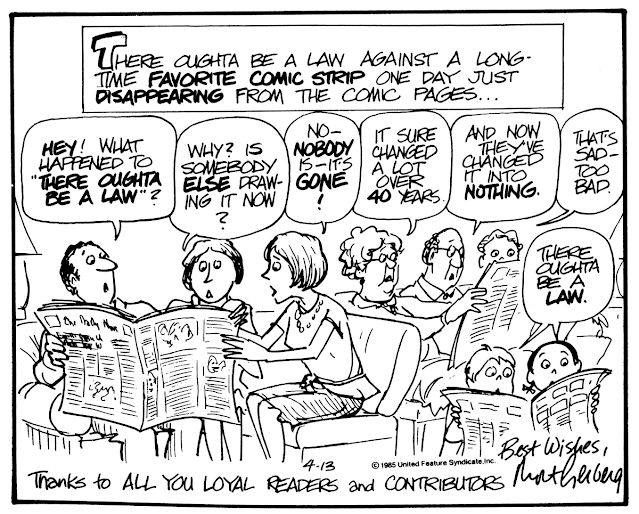
Here's the final daily panel of There Oughta be a Law, published on April 13 1985. Mort Gerberg, who had taken over the panel for the final year and a half of a forty year run, plucks skillfully at readers' heart-strings in the swan song.
Labels: Firsts and Lasts
: 3/18/2022 11:21 AM Wednesday, March 02, 2022
Firsts and Lasts: Robotman Debuts
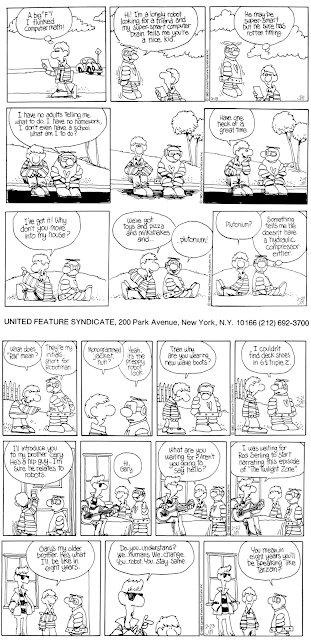
Robotman, debuting on February 18 1985, was intended to be nothing more than a coldly calculated money-grubbing tie-in to a music-playing plush toy. Kenner got together with United Feature to do the cross-marketing strip with no goal in mind except to stimulate toy sales. But what they hadn't counted on was that in tapping young cartoonist Jim Meddick to draw the strip, they'd inadvertently created a spin-off that was far greater than the toy they were trying to hawk.
Robotman the toy came and went pretty quickly, a marketing scheme that quickly fizzled, but the Robotman strip was good enough to find a decent client list (though assuredly nowhere near the 250-paper debut they claimed). Meddick was eventually left alone by the corporate suits at Kenner and the strip blossomed. He reshaped the strip, dumped the silly robot with the heart emblem on its chest, and renamed the strip in honor of its new human star, Monty. He created memorable new characters like Fleshy the hairless cat, Monty's buddy Moondog, and my personal favorite, the spoiled rich kid Sedgwick Nuttingham III. The strip turned into something quite wonderful that has now endured and become the classic that it is today.
For more on Jim Meddick and Robotman, check out this interview from Hogan's Alley.
Above, the first week of dailies of Robotman, showing little hint of the great strip it would one day become.
Labels: Firsts and Lasts
UFS originally urged Bill Waterson to include Robotman into a Clavin & Hobbes storyline, which he resisted, which lead to the decision to launch a seperate strip by Jim Meddick.
Meddich could finally ease Robotman from the strip and change it over to star his own character Monty in 2001, long after the Robotman toy was discontinued,a year after the Kenner Toys company was merged into oblivion, and one might guess, the Trade Mark for Robotman expired.
: 3/02/2022 8:03 AM Robotman debris: Long ago I turned on the TV before work one morning, and instead of the usual syndicated cartoon series there was "Robotman & Friends", evidently an unsold series pilot. It felt like another Care Bears clone, surrounding Robotman with marketable robot buddies and syrupy cuteness (Hearts! Rainbows! Love!). The human characters were realistically drawn, and there was zero connection with the strip. All in all a typical DIC production.
You'll find it on YouTube broken into pieces. No better than what I remembered.
While poking around also found a Robotman & Friends Move and Match game on eBay, plus a references to a Robotman float in the 1985 Macy's Thanksgiving Parade. Since it looked like big money was being spent, one wonders that there wasn't more effort to pull everything together. Even Carl Barks's epic adventures stayed true to the design and character of Donald Duck, grounding him in what felt like the world seen in the animated shorts.
