Wednesday, June 19, 2024
Selling It: National Health Agencies PSAs for 1964


The National Health Agencies was an umbrella organization for medical charities. It was created in the mid-1950s along with several other umbrella organizations to raise money from government employees. It was created to simplify fundraising from these employees, who had before been bombarded with many campaigns for many different organizations. In practice, of course, it just created a new layer of bureaucracy in which money intended for charitable purposes was swallowed by middlemen. Unlike the more familiar United Way, which was eventually disgraced by financial scandals, as far as I know the NHA was never outed for hinky finances. The NHA was eventually renamed Community Health Charities, and then all these organizations were further conglomerated as Combined Federal Campaigns.
Cartoonists and their syndicates were sometimes tapped to do PSA art for charitable organizations, and in the 1964 NHA fund drive many contributed panel cartoons. Above are some of the panels produced for that drive.
Here's an easy quiz for you -- just name all the characters above. I can't imagine Stripper's Guide readers not acing this quiz, but in case you're stumped just hover your cursor over the image that has you beat, and read the file name, where all will be revealed.
Labels: Public Service Features


 : 6/19/2024 10:24 AM
 Wednesday, July 13, 2022
Selling It: Safety Sallies

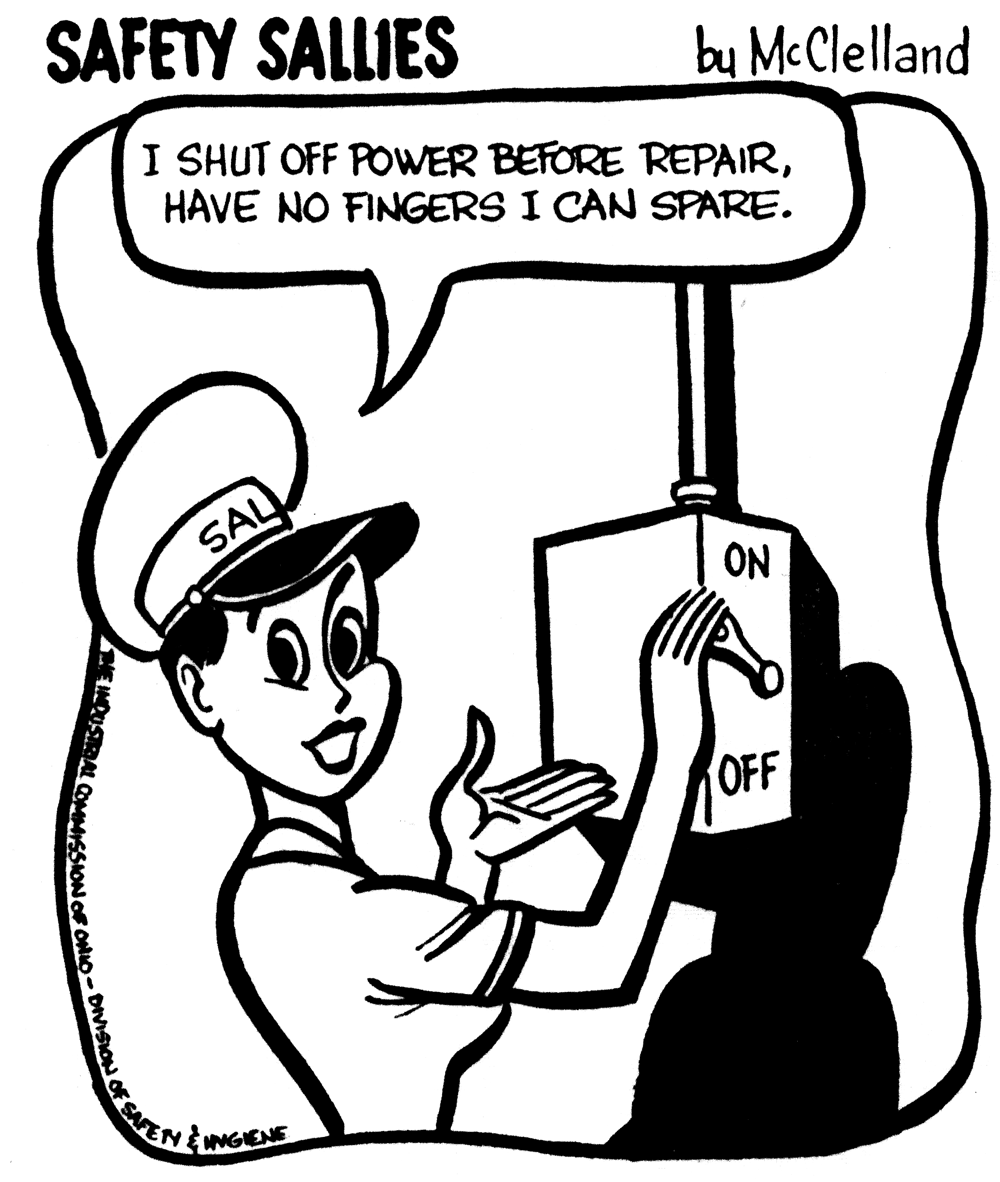

Industrial workplace safety seems an odd topic for a newspaper cartoon, but apparently the Division of Safety and Hygiene of the Industrial Commission of Ohio (phew!) felt the need to produce them, and a few Ohio papers deemed them worthy of unpaid space. The earliest I find Safety Sallies running is August 1958*, and the latest is March 1960**. I've documented over 20 different panels, but no paper I know of ran them consistently or often enough to get any feeling for how many were likely produced, whether there were multiple series of them provided to papers, or if there was an intended frequency of appearance.
What I do know is that artist Leland S. McClelland shows off some of the most sumptuous inking work you're ever going to set your peepers on in these masterfully done panels. Which is odd, because McClelland did not usually draw using such a flamboyant brush -- he typically went for a more realistic look to his cartoons, and even when he went full-on bigfoot, it was generally less exuberant than this.
McClelland produced a long-running local interest Sunday page for the Columbus Citizen called Cartoon Parade, which I'd love to feature here if I can ever get hold of some hardcopy samples. The Safety Sallies series was produced as that feature was in its waning days. McClelland is known to have worked at the Byer & Bowman ad agency around this time, and that's probably how he came to produce this very obscure but wonderful series.
* Source: New Philadelphia Daily Times
** Source: Lancaster Eagle-Gazette
Labels: Public Service Features

Monday, June 25, 2018
Public Service Features: The Color Guard


During World War II, the Office of War Information offered newspapers many free patriotic features designed to help with morale and sell war bonds. Among these were some comic strips and quite a few panel cartoon series. So far I've only found a single such feature that was designed to run in black newspapers, and that was The Color Guard.
The Color Guard was a panel series about heroic figures of black men and women of history, going heavy on those whose stories had either a patriotic or military component. The series was produced by a competent cartoonist who signed himself only Alston, and he did not get a byline. Alex Jay has discovered his identity, and we'll have his Ink-Slinger Profile tomorrow.
The earliest I've found this panel showing up was on January 16 1943*, and the latest I've seen it running in a paper that offered it on a regular weekly basis was April 9 1944**. The Atlanta World offered one additional panel on September 21 1944, but I'm guessing that was a repeat to fill a hole, since other papers ended the series in April as well.
The samples above are from the New York Age, which ran the series minus its title bars.
* New York Age
** Atlanta World
Labels: Obscurities, Public Service Features
