Friday, November 10, 2023
Selling It: Snake Oil? No, Fish Oil!

Scientific testing has proven that there is no special medical wonder inherent in cod liver oil. It is high in vitamins A and D, and so it is undeniably good for those who have a deficiency. But there was a day when it was considered an indispensible member of the family medicine cabinet, "good fer what ails ye," a cure-all for most any malady.
Preying on such beliefs, the Scott's Emulsion folks made claims that it had some special ability to ward off rickets in children. Which it would since rickets is caused by a vitamin D deficiency. But most kids get plenty of vitamin D from sunshine, and those who don't get any time outdoors in the sun probably have bigger problems that Scott's Emulsion won't fix.
Anyway, I digress. The October 1938 Sunday half-page ad shown above sports art by a wonderful newspaper and magazine cartoonist, an artist who I don't generally associate with advertising strips. Let's leave his name off this post for awhile and see if a Stripper's Guide reader can ID the artist whose work we see above.
UPDATE 11/13/2023: So, not much activity in the ranks. Alright, here's my ID, and I'm 98% sure it is accurate. The Uncle Dan ad is by R.B. Fuller, of Oaky Doaks fame. The unusual take on the woman's eyes is to me the dead giveaway of the ID.
Labels: Advertising Strips


(of course if one clicks on the image
the new tab hedder reads "Uncle Dan by Fuller.")
Now the question is R. B. or Ving?
Wednesday, September 20, 2023
Selling It: Along The Milky Way


I don't know which ad company sold Along The Milky Way, but they sure sold the heck out of it in the late 30s and 40s. The panels were drawn in a nice grease-pencil style by Gretchen Philips, who we met once before back in a 2007 post; she was the original artist on Style Smiles.
The earliest I can find Along The Milky Way appearing is in July 1939*, but according to a short article about Philips that ran in the Kearney Daily Hub (September 22 1939), she had been drawing the feature for two years by that point.
The panel seemed to be geared to approximately a weekly schedule, though of course once the backstock had built up the sky was the limit for an ambitious dairy. The last I see the panel being used is in 1948**, but that material could well have been years old by that time.
There's an interesting postscript about this ad panel. Around March 1942 the panel gained a new subtitle, Dairy Tales, a new artist, a continuing cast of kids, and a very different style. Here's a sample:

The art was sometimes signed with a scrawl that looks like "Cobb", but my bet is that these panels are the work of Ferd Johnson, assistant/ghost on Moon Mullins. His fingerprints are all over that art.
Why the panel got such an extreme makeover is anyone's guess, but it apparently didn't go down too well with many of the dairies buying the ads. Some dairies stopped running the panel and others used or re-used Gretchen Philips panels. The Dairy Tales version of the panel came and went like a flash -- the latest I can find it running is in May 1942.
UPDATE: Since this post ran I have found that the Dairy Tales panel was original sold in 1937-38 by National Features, or The Amsterdam Syndicate (both are credited on the promos I just unearthed). Maybe these old panels were sold off to the marketers of Along The Milky Way, where they got a short new lease on life. The original versions of the panels are distinctly signed with a stylized 'f', exactly the one used by Ferd Johnson in his sig, so case closed on the artist ID.
* Source: Indiana Evening Gazette, Hanover Sun.
** Source: Palm Beach Post.
Labels: Advertising Strips
 : 9/20/2023 9:54 AM
 Monday, April 03, 2023
Selling It: The Liber T. Loane Family
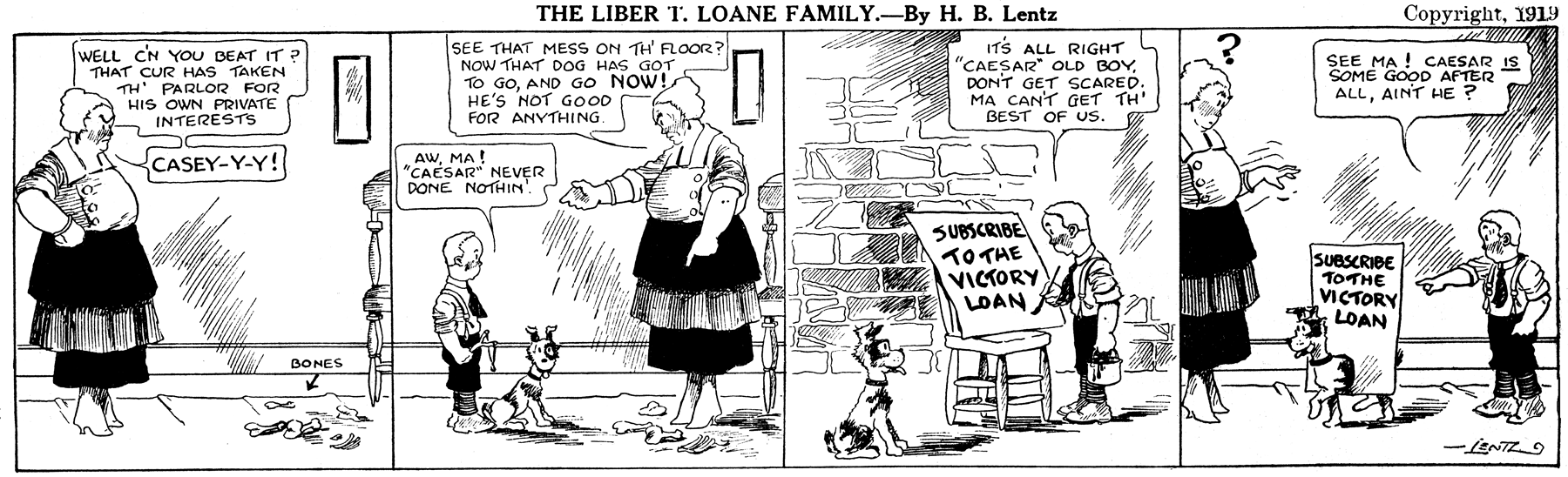
Wars are bloody, that's for sure, and they're bloody expensive, too. And one of the ways that governments pay for their little exercises in world domination is by making their own citizens foot the bill. They start by jacking up taxes, which is a good ploy, but that doesn't really give them access to savings, just income. And there's a LOT of money being wasted on stuff other than bullets and bandages, just whiling away the time in bank accounts and the stock market.
Governments that are a little shy of outright demanding that money often go with plan B, making citizens feel like heels if they don't pony up those savings to the government of their own free will. To make it most palatable, governments issue bonds that eventually pay a small dividend, assuming they manage to win the war.
Hmm. This is reading more like a rant than a blogpost so far. Let's try this...
In 1919, after World War I ended, governments still had huge bills pending for rebuilding. Even the U.S., never the home turf to the war, had soldiers to bring home, armed forces to rebuild, an economy to revitalize, and refugees to feed and clothe. Therefore, the 1919 U.S. Victory Loan (the ones during wartime were termed Liberty Loans) admonished citizens to dig deep one more time in aid of the nation. Newspapers were always important venues for the appeals to patriotism that formed the advertising for these fund drives. Famous illustrators and cartoonists were often called upon to lend their abilities to these drives.
In World War II comic strips and comic panels were often used for these drives, but I can't recall any comic strip used during World War I by the government to sell bonds, except for this one unearthed by Mark Johnson, The Liber T. Loane Family. The strip was penned by Harold B. Lentz, who later made a name for himself illustrating children's books, especially well-remembered for those of the pop-up variety.
Looking at the various digitized papers that used the series, it appears that there were eighteen installments, and the earliest users started it in April 1919*. Others used it later that year, and its running often coincides with a local push to sell bonds, often with lots of hoopla, speeches and entertainment in the town square and such.
Thanks to Mark Johnson for the sample strip!
* The earliest start date I found was April 4 1919 (mid-week) by the Wilmington Daily News.
Labels: Advertising Strips
Monday, July 25, 2022
Selling It: Li'l Abner Cleans Up His Act

A lot of comic character marketing tie-ins make no sense to me (like our recently featured Dick Tracy ad for caramels...), but here we have a marriage made in heaven. If anyone needs a good laundry detergent, and will put it through a torture test, it's gotta be the denizens of Dogpatch.
In June 1952, the good folks with Surf detergent paired up with Al Capp's characters for a $100,000 contest, where in order to win you just have to give Daisy Mae some magic words to say about the wonders of her detergent. It seems like a wonderful idea, but the weird part is that the newspaper campaign came and went in practically no time. Seems like for $100 grand (in 1952 dollars!) you'd want to beat this contest's drum for months and months, but the whole thing seems to have come and gone in a month or even less.
Weirder yet, after the contest was over, I could find only a single report about a Texas lady who won third prize. Her local paper showed the photo op of her getting the check. The Surf people put not one single dime into advertising the contest results, and if they did send out publicity releases, I can find not one single paper that ran them. So $100 large later, we never found out who won the $10,000 first prize, nor what honey-soaked words they'd written to win the contest. Can anyone find a source for the contest results somewhere?
Labels: Advertising Strips
: 7/25/2022 8:48 AM Wednesday, May 25, 2022
Selling It: Jest Laughs


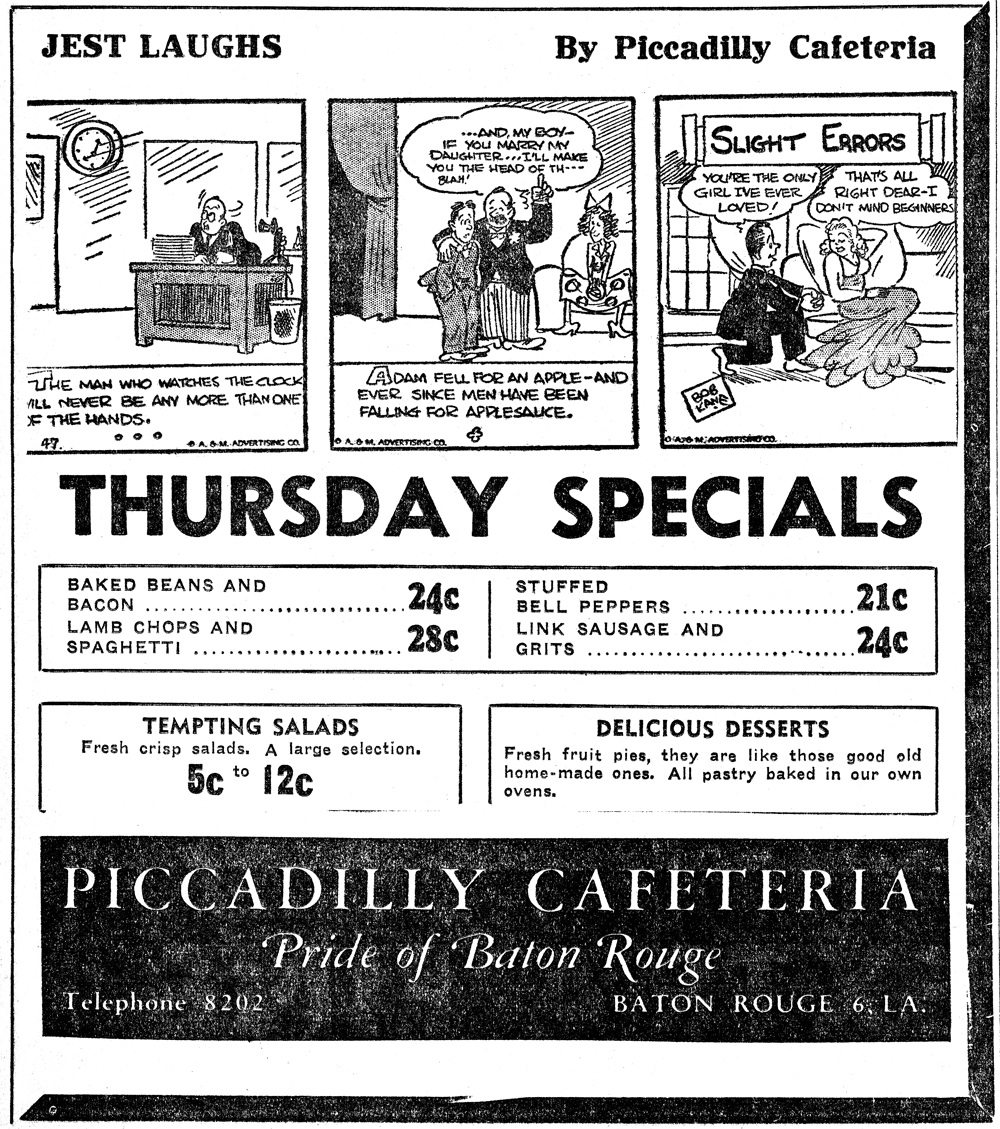
A & M Advertising of Dallas Texas offered quite a few newspaper advertising packages in which the ads attract attention through the inclusion of a comic strip or panel cartoon. These packages sold best in smaller markets, where an advertiser could negotiate a lower price for running their ads with the paper, under the reasoning that they were providing some entertainment -- a comic feature -- that the paper itself didn't have to pay for. Such are the ecomomics of running a small market paper.
Most of the A&M-based ads ran in the format you see above, in which the reader is presented with a strip at the top, boxed in with a constantly updated ad for the local business. Some of the comic features were tailored to the type of business -- laundromats, car repair, etc. -- and in those cases the name of the business could sometimes be pasted in at the proper spot in the word balloons.
Jest Laughs is not like that; it offered gags that weren't related to the type of business being advertised. In fact, although at first glance it appears to be a comic strip, each 'strip' was actually three individual gags, with the last one always headlined Slight Errors for no terribly good reason. This made Jest Laughs a real power-player in the A&M Advertising arsenal, because not only was it generic enough for any business, but each 'strip' could even be chopped up and a single gag panel used in three separate ads.
Now that we've gotten this far in my blathering, have you noticed the 800-pound gorilla in the room and are wondering when I'll ever get to it? No? Go take a look at the samples again ... I'll wait.
Yep, the signature on the feature is none other than Bob Kane, creator of Batman! The earliest I have found Jest Laughs used is in newspapers of May 1939*, coincidentally the cover date of Detective Comics #27, the event that caused Mr. Kane's life story to take a very sharp turn. What I find funny is that as hopelessly bad an artist as Kane was at doing 'realistic' comics, he was absolutely fine on bigfoot material, as we see above. In fact (as any serious comic book fan knows), most of Kane's pre-Batman comic book work was also humor, and also pretty darn capable. I'd say he missed his calling, but I imagine he would politely disagree.
A&M Advertising sold and resold Jest Laughs for many years; the latest appearances I've found are from 1948**. The feature was numbered, and the highest number I've ever seen is 46 -- I wouldn't be surprised if the total was 52, to provide a full year of weekly ad fodder. Why A&M didn't continue reselling it I don't know, but here is a possible reason...
Jest Laughs may or may not have had yet another life. In 1948, as A&M's use was winding down, H.T. Elmo, head of the bottom of the barrel Elmo Features Service, introduced a new feature to his stable called Jest Laffs. This feature was a single panel gag feature, and it was signed "Robert'. Now practically everything that Elmo syndicated was signed with a pen-name, so you might ask yourself, "did Bob Kane's overused panel cartoons get run yet again?" I mean, geez, 'Robert' for 'Bob', right?
In my book I say Jest Laffs was a bullpen type effort, exhibiting signs of H.T. Elmo himself, plus Jerry Iger and Ruth Roche. I frankly don't see any definite sign of Bob Kane there, 'Robert' signature notwithstanding. But, and here's a big but, take a look at this Heritage Auctions item. Here's a Jest Laffs panel signed by the man himself. Or is it? I have no idea if there is ironclad provenance on this item. So what do you think?
And while you're thinking, wonder also how in the world an advertising company in Dallas ended up distributing comics by the creator of Batman. Was the feature just a reuse of Kane material that was already sold to comic books? Was it a syndicated feature that never got picked up? Did Jerry Iger, who bought a lot of work from Kane in his early days, put the feature together?
* Source: North Adams Transcript
** Source: Atlanta World
Labels: Advertising Strips
Friday, April 29, 2022
Selling It: Safety Sonnets


Starting in the 1920s, as car ownership grew by leaps and bounds and better roads were being built all over the country, car accidents became a major and deadly problem.
Originally chartered to foster workplace safety in 1913, the National Safety Council expanded its mission to highway safety in the 1920s. The organization offered free material to newspapers, often in the form of cartoon series, to educate drivers -- or at least scold them -- about proper driving habits. One of their many series was Safety Sonnets, which offered twenty of what I call 'before-and-after' two panel cartoons by Sid Hix. The series was issued in November 1938. Though intended as a daily series, papers of course usually ran the little 1-column feature on an ROP basis.
Sid Hix (whose real name was spelled Hicks) was an interesting cartoonist. He specialized in advertising cartoons; though his work was seen in newspapers and magazines quite constantly from the 1930s to 1950s, as best I can tell he never got the bug to create a syndicated feature of his own -- he preferred that advertisers foot the bill for his print appearances. Nice work if you can get it!
Hix had a pleasant and lively style but he was also adept at aping other styles if clients requested something different. Safety Sonnets is an instance where he used what I think of as his native style.
Labels: Advertising Strips
: 4/29/2022 2:56 PM Monday, January 17, 2022
Selling It: American Heroes


The US Treasury Department, tasked with the relatively easy job of selling War Bonds during World War II, nevertheless wasn't above the hard sell to squeeze the last few dollars they could out of the wallets of those not in uniform.
The panel cartoon series American Heroes offered tales of heroism from the warfronts, always with a stinger about the need to buy War Bonds. The panels were presumably sent out in batches, and newspapers were free to use them as they wished, whether on a regular basis or to fill holes whenever needed.
The first batch went out in February 1943, and were bylined "by Leff." In my book I mistakenly assigned these to Mo Leff, but later I looked at the microscopic signatures that were inscribed on a few panels (most were unsigned) and see that it actually says "M & S LEFF", indicating that the brothers Mo and Sam both worked on the series, presumably with Mo pencilling and Sam inking.
The Leffs were responsible for most of the series, but with the batch that went out in November 1944, the new artist was Julian Ollendorff, who offered up the most hell-raising illustrations for the series (see above), showing that at 60-some years old he still had some lively ink left in his pen.
He didn't last long though, as the batch sent out in April 1945 switched to veteran cartoonist Wood (or Woody) Cowan. The batch by Cowan was the last batch sent out, as the war was soon over, though War Bonds did continue to be sold for awhile after the end of the conflict. Although newspapers continued running the panels well into 1946, I'm pretty confident that Cowan only produced a single lot of them.
I presume the series was weekly, but I confess I haven't beaten the bushes to figure out exactly how many panels were actually produced. There may not have been enough offered for that frequency. If someone wants to put in the work to figure that out, you'll find plenty of papers running them in online archives.
On a side note, I was able to verify the stories of the men cited in all the panels above except that of Henry G. Bohlen. No one by that name seems to have won a Silver Star, and I find no trace of the name in wartime newspaper accounts. Did Ollendorff make up a hero from whole cloth?
Labels: Advertising Strips
https://www.honorstates.org/index.php?id=44700 shows that he was indeed a Technical Sergeant from Osborne Co., Kansas with the 90th Infantry Division, 357th Infantry Regiment, and he won a *Bronze Star* (not Silver Star), and he was killed in action on July 6, 1944. He's buried in the cemetery at Colleville-sur-Mer, in France.
I have no explanation for this. It could have been something badly garbled, or it could be, shameful to say, an outright lie.
--Allan
Monday, September 27, 2021
Selling It: Uncle Abner Says


At first blush you'd think Uncle Abner Says, a panel that ran from 1936-38, is just another one of those ubiquitous panels of cracker-barrel wisdom like Abe Martin, Ching Chow or their many copycats. When you look over the gags, though, you find that ol' Abner is a bit of a one-note local yokel. He's pretty gosh darn unhappy about the gov'ment, specially the way they pick his pocket with them goldurn taxes. And not just his pocket, by cracky, he's fuming over the way that Roosevelt feller is taxing big corporations, too!
Hey, wait a minute now. A bewhiskered rustic like Abner complaining about taxes? Well, sure. But concerned about corporations? Hmm, that seems a bit out of character. I hate to even suggest it of such a kindly old soul as Abner, but .... could he be on the take?
I hate to be the one to break the news, but it's true; Abner is a shill. He doesn't say a word that isn't bought and paid for by secret interests. Not surprisingly, those interests just happen to be big corporations. To lay all the cards on the table, Uncle Abner Says was a production of Six Star Service, a newspaper syndicate created by the National Association of Manufacturers*, a trade association and lobbying group of big businesses. They sent out propaganda material like this to newspapers free of charge: the newspaper filled some space with something mildly entertaining for free, and the manufacturers got their message out surreptiously, without running ads that few would bother to read. You might call it a win-win situation, except there were losers involved -- the newspaper readers who got a daily brainwashing session from what seems like an innocuous panel cartoon.
This sort of hidden advertising material was usually sent out in small batches, but in the case of Uncle Abner Says it was a full blown daily panel that ran for a very long time. I can track it from June 22 1936 to April 30 1938**, an unheard of almost three year run.
For almost the first year the feature was unsigned, but finally in March 1937 Nate Collier was allowed to start signing his work. I'm a big fan of Collier, but his talents, which skew to the goofy, are utterly wasted on this panel. But hey, it put food on the table at the Collier household, no foul there. I also feel sorry for Nate if he was tasked with creating all these gags, which get pretty darn monotonous in their one-note dirge for lower taxes. Not only did Nate have to write six gags a week on the same subject, but undoubtedly had to submit them for review to some corporate minister of propaganda who last smiled when Herbert Hoover was elected.
* Source: reported in Pittsburgh Press, June 26 1936.
** Sources: start date from Belvidere Republican, end date from Edinburg Courier.
Labels: Advertising Strips
Odd you should, (in jest, naturally) mention a possible "corporate minister of propaganda" who would have some sort of oversight to a N.A.M. project. The Trotskyite weekly "THE MILITANT" shrilly decried said project, citing the Abner componant with feigned indignation that it was a COMIC STRIP! FOR CHILDREN!Like it was pornography or something. They concluded that Goebbles would be green with envy.
Obviously they didn't ever really see what they were outraged about, or care, really. The effectiveness of the panel utterly negligable. Goebbles would not be impressed. That The Militant made this observation in 1944,eight years after the N.A.M. news release about the project, and six years after Abner ended, makes one wonder what they're bothering about.
Collier, however, was happily content to keep putting out toons for the N.A.M.,with a new batch of one-shot editorial panels offered by them just after the war. Don Herold contributed too.
: 9/28/2021 12:46 AM --Allan
Though, if we were to be strictly in keeping with seeking obscure strips, There's an untapped Pyrite mine of them in the leftist papers like the various iterations of the Daily Worker, the New York Call, etc. I used to have a batch of them, and they are indeed, joyless things. Though they look like regular comic strip art, the funny, cartoony characters do cringemaking treks to join the Wobblies or to Tom Mooney rallies, or kids that tell'em where to get off at a Dies committee hearing. Maybe the funniest part is they're so deadly serious about it.
: 9/29/2021 11:46 PM Wednesday, May 12, 2021
Selling It: Mrs. Drear and Mrs. Cheer


After a long and lucrative career, Rose O'Neill by 1932 was out of fashion and becoming financially strapped. The creator of the Kewpie doll was reduced to taking a job illustrating a series of Oxydol ads under the running title Mrs. Drear and Mrs. Cheer. O'Neill did excellent art for these ads, but to add insult to injury, some of the ads in this series have her signature cut off. Evidently her name was not considered any particular draw.
O'Neill produced twelve ads for the series. It must have been considered a successful campaign, because the series was run three times; March to May 1932, then September to October, then March to May 1933. In all three series the ads were the same batch, just reruns.
Labels: Advertising Strips
Monday, March 04, 2019
Clare Briggs' Kids All Cleaned Up to Sell Clothes

Clare Briggs was not above using his characters in marketing, as can be seen in this 1917 ad for the B&M clothing store in Iowa City. Briggs' kids are usually a bit ragged around the edges and in need of a bath, but he's cleaned them up here and decked them out in the finest the B&M has to offer.
Given that a small clothing store in Iowa City is unlikely to have made a deal with Briggs on their own, I guess the cartoonist was offering niche-specific pre-made cuts through a marketing firm. He probably got the idea from Richard Outcault, who made a very nice cottage industry out of selling cuts of the Yellow Kid and Buster Brown to local stores of various specialties.
Thanks to Cole Johnson for the scan.
Labels: Advertising Strips
This will show you how annoying and petty someone with time on his hands can be.
You mention above that My brother sent you the Briggs ad from an Iowa City paper. He, or I never had papers from that town, though I had a run of a Dubuque paper of that vintage. So I did a little research to see if that paper carried ads for a town twenty or more miles distant. But the problem is, there's no such address in either city, outside of very rural, very short country lane that would never have had a store on it.
In fact, I found "The B & M" clothing store at 201-3 S Adams Street is (or was) in Peoria, Ills. The ad had to have come from a small batch of the Peoria Journal-Transcript we had from the opening months of 1917. I "Google Map"ed the address, and whatever the "B & M" store looked like, it's been replaced by a bland, modern two story structure bearing the words "Illinois Central College" on it's surface. Fugit inreparabile tempus.
: 3/04/2019 9:15 AM Well, if I have to make a mistake, mislocating a long-defunct midwest clothing store is exactly the sort of fact I'd like it to be on!
Thanks, Allan
Tuesday, May 22, 2018
Advertising Strips: Dulcy the Beautiful Dumb-Bell


Movies have advertised themselves by way of comic strips practically since the two mediums were initially popularized. In the early 1920s and before, the tendency was to advertise the characters rather than the movie plot per se, and Dulcy the Beautiful Dumb-Bell follows in that direction.
The 1923 silent film Dulcy starred Constance Talmadge as a scatterbrained young beauty who tries to help her husband get ahead in business through a wacky scheme. This scenario is about as tired a plot device as you can imagine, but in the hands of George S. Kaufman, who co-wrote the original play, and Anita Loos, co-screenwriter, I imagine it was a fun film. Sadly, the film is now considered lost.
The advertising comic strip, which seems to have run for 24 installments, or four weeks of dailies, advertises the character of Dulcy by trotting our some of the most basic jokebook 'dumb blonde' jokes and managing to execute them badly. The joke writer, whoever it was, plays a mean trick by assigning writing credit to movie star Talmadge, who should have sued for defamation. Luckily, the strip looks fabulous. Lauren Stout has never been on my radar before, but the lively and highly stylized art on these strips makes certain I won't soon forget his name.
Although these ad strips were handed out to newspapers for free, I have yet to find a paper that could stomach running all 24 episodes. The earliest appearance I have found is in the Harrisburg Evening News, and based on that appearance I assign 'official' running dates of July 31 to August 27 1923, though don't hold your breath looking for such an actual appearance.
Labels: Advertising Strips, Obscurities
(I'd love to see a long post or two on early flip takes!)
Tuesday, February 20, 2018
Advertising Features: It's True!


Among all the handout freebies that were offered to newspapers, few were as handsomely drawn as Wiley Padan's It's True. The feature was distributed by the Metro-Goldwyn Mayer studio, and it offered up interesting little factoids about the stars in the studio's current movie offerings. Usually this sort of advertising feature was run only by the smaller dailies and weeklies, but this one was so attractive that it can be found popping up in major city newspapers on occasion. This would seem like a great score for MGM, except that newspapers also had a habit of running these panels whenever the mood hit them, and that was frequently long after the movie that was being hawked had left theatres. Oh well, this was in the days of the studio system, so at least the panels were keeping the public thinking about the stars in the MGM stable.
Based on the numbering of examples I have on hand, I get the impression that It's True was offered at the rate of about one panel per week (I used to think two per week, but digital archives show otherwise). According to my book the feature ran from the mid-1930s to mid-1940s, but Alex Jay has dug up better information on the start date, which you can come back tomorrow to read in his Ink-Slinger Profile of Wiley Padan. As for the end date, the last new movies I can find advertised in It's True are from 1948, but though credited to Padan, the art does not look to be his. The latest I find Padan's work appearing is for 1947 films. The highest numbered panels I've found are in the high 500s.
Labels: Advertising Strips
Monday, January 08, 2018
Advertising Features: This Is America!


Here's a feature that inhabits a weird gray zone between ad features and public service features. This is America!, penned by veteran illustrator John V. B. Ranck, was a series of panels and strips that told the stories of successful American entrepreneurs. As best I can determine it began as a weekly offering in 1944 (although this bio of Ranck claims he started it in 1941), changed to a strip around 1946, then went back to a panel, and the frequency was reduced to monthly through 1949 at least.
There's no doubt in my mind that this series was offered as a freebie to newspapers, because you'll find it running haphazardly as a space filler in some of the smallest rural papers. Usually these features are either trying to sell a product, or are issued by a government or other non-profit entity as a public service. This is America! definitely isn't trying to sell a product, and it didn't come from the government. That leaves it in that curious genre of features that were given away by some entity in order to push their ideas, rather than their products, on the public. This one evidently is trying to push the idea of entrepreuneurship, so perhaps it was commissioned by the Better Business Bureau or some similar organization. We cannot find out anything more based on the feature itself, as there was no syndicate/source identified. The only clue we get is the 1949 edition of Editor & Publisher's Syndicate Directory, in which This Is America! makes its sole appearance. The listing there credits something called the Independent Press Service. Unfortunately that has been a dead end for me, as I can find no information about this organization.
Labels: Advertising Strips
Wednesday, January 11, 2017
Advertising: Another 1927 Wrigley / Hearst Collaboration

Way back in 2011, we ran a three part series (part 1, part 2, part 3) here on the blog showing some wonderful Sunday comic section ads. In this series, the big Hearst comic strip characters shill for Wrigley's PK chewing gum. Most of the series has a whole strip devoted to one character, but we had one really neat jam page ("A Picnic in the Sky") that brought a bunch of characters from different strips together. As far as we knew at the time, it was the only one like that.
Now Pierre-Henry L'Enfant (of Togo!) has sent me an additional installment of the series, another great jam page. This one features the characters from Katzenjammer Kids, plus Happy Hooligan, Tillie the Toiler and Mac, Freddie the Sheik and Dumb Dora. It ran in some Hearst comic sections on April 10 1927.
Thanks Pierre-Henry! Warms my heart to know that there are old comic strip fans even in far-flung places like Togo!
Labels: Advertising Strips
Monday, February 15, 2016
Advertising Features: Metropolitan Moments


When the U.S. entered World War II there came a pressing need for alcohol in various industrial capacities. Therefore the government curtailed much of the private alcohol production for human consumption. Luckily there was no immediate danger of running out of spirits entirely, because Ireland was still producing and exporting whiskey, and many American liquor companies, reading the writing on the wall, had reserved quite a bit of their production for just such a situation.
The smartest distillers stockpiled not whiskeys, rums, and other specific spirits, but instead created stores of 'neutral spirits' -- grain alcohol -- which they could use to blend with smaller stockpiles of American whiskeys and imported Irish spirits. What was produced was then termed a 'blend', and while it was universally reviled as rotgut, well, beggars can't be choosers, and so Americans held their noses, lived with pounding headaches the morning after, and kept on drinking.
Spirits were advertised heavily during the war, generally with the marketing hype trying to convince buyers that their brand was just as good as the pre-war stuff -- which of course it wasn't. Calvert was on that bandwagon, and they came up with a long-term newspaper campaign for Calvert Reserve Blended Whiskey that interests us here on Stripper's Guide. Starting in January 1942, they inaugurated a series titled Metropolitan Moments, featuring cartoons by some of the leading lights of the magazine gag cartoon world.
In the samples above, you see a roughly chronological sampling of the Metropolitan Moments ad campaign. We start with Jaro Fabry, the great magazine 'pretty girl' cover artist, who provided almost all of the cartoons through about September 1942. Then he disappeared, and the panel was taken over by someone pseudonymously identified as "Wisdom". Wisdom's work is sort of generic New Yorker style of the day, with elements of William Steig, Charles Addams and Peter Arno. Would love it if someone could offer a positive ID on this fellow.
"Wisdom" was credited with all of the panels through 1944, then the byline changed to "Ely". Ely's work sure looks a lot like Wisdom's to me, so I'm not sure why the credit was changed. The main difference I do see is that Ely had a fondness for a clubby, tuxedoed older gentleman who became a regular in the cartoons during his tenure.
In 1945, the panel got much more interesting. All of a sudden there were other cartoonists contributing, mostly really high-end New Yorker level folks. I've found panels by Abner Dean, Chon Day and Garrett Price, as well as a lesser known fellow named Herbert Roese, and someone with whom I'm unfamiliar, who went by the moniker H. Williamson. The new star of the show, though, was the great Richard Taylor, who produced far more of the panels than anyone else.
The panel finally stopped appearing in May 1947 after a five and a half year run. In some papers the panels appeared almost daily, others got them much less often. However, don't take that to mean that somehow the cartoonists came up with 300-odd different gags concerning Calvert Reserve Whiskey each year. The panels were definitely re-used, though based on my own collection there sure were a lot of different panels to choose from -- definitely in the realm of the hundreds.
Labels: Advertising Strips
