Saturday, September 30, 2006
Stripper's Guide Bookshelf: The Comic Strip Jack Kirby
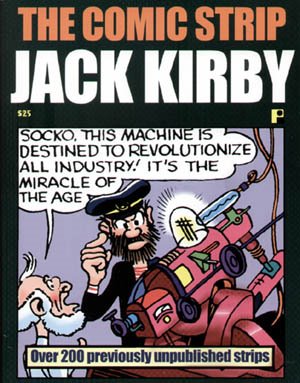
The Comic Strip Jack Kirby (ISBN 1-56685-028-2) is hot off the presses from Greg Theakston's Pure ImaginationPublishing. I've been eagerly awaiting this volume for, oh, about ten years now, since Greg told me he intended to publish a full book of Kirby's rare newspaper comic strips.
Theakston whet our appetites back in the late 80s with his Jack Kirby Treasury volume, and this book admittedly covers much the same ground. A lot of the editorial matter is repeated from there with some new stuff here and there. This is a disappointment for me, since I was hoping to learn more about Lincoln Features, the H.T. Elmo syndicate that employed Kirby in 1936-39. However, considering the paucity of information out there about the syndicate I can't hold this against Theakston.
This volume reprints quite a bit of Lincoln Features material, most of it from syndicate proofs in Kirby's own collection, so it looks great. The editorial cartoons, very few of which had been printed in the earlier book, are especially wonderful. I do have to take issue, however, with some of the material that Theakston represents as Kirby's work. While I am admittedly no expert in identifying art styles, I'm convinced that some material, and keep in mind that it was all signed with pseudonyms, is not Kirby but in fact the work of Elmo and others in his stable. For example, some of the Your Health Comes First panels, and all of the Laughs From The Days News are, in my opinion, the work of other hands. No matter, really, though, since I for one am certainly in the market to see any of the rare Lincoln strips.
The other problem with the Lincoln material, at least from this researcher's standpoint, is that being from proofs we don't know if it ever actually ran in any newspapers, and Theakston doesn't seem to have found any proof either, since the editorial matter is sometimes vague on that point. Of course we can enjoy such strips as Cyclone Burke and The Black Buccaneer no less for it.
In addition to the Lincoln Features material, we also get a run of Blue Beetle dailies from Fox Feature Syndicate. The book reprints the strip from the first, 1/8/40, through 3/9/40. The reproduction on some strips is excellent, others are pretty awful, and obviously from microfilm or really bad tearsheets. For some reason this run is followed with a reformatted run translated into French. Considering the awful scripting, reading the French version might be a good choice.
Finally we get what I gather is a complete reprinting of Kirby's Lightnin' and the Lone Rider strips. These most likely never made it into newspapers, though that was the initial intention, but ran in the Famous Funnies comic book. Kirby was definitely improving as a cartoonist by this time, and the art here is excellent. The material is well reproduced for the most part, but where Kirby applied tones it tends to turn into a muddy mess.
While the book is far from perfect, it is nevertheless an impressive collection of extremely rare material, and I can only hope that you'll purchase a copy. Send a signal to publishers that there is a market for something other than the seemingly endless reycling of Caniff and Herriman strips!
Labels: Bookshelf


I am only sorry I couldn't get the additional Health panels to Greg before the book went to the printer (and that the quality of my micro-fiche copies is so poor). The later Health panels had a series called Health through the ages, which was great.
As for art identification, Greg told me once that he used the lettering as an indicator as well. All of Kirby's stuff has the horse-shoe shaped letter U.

Seems to me that the shape of a U is a pretty thin thread upon which to hang an art ID. I think even early in his career Kirby's style is recognizeable enough that I'd want something more definitive. These U's seem like pretty conventional lettering to me...
Fwiw, I have cleaned up a lot of microfilm material in my day and I think you did a creditable job with what you must have had to work with.
Best, Allan
Friday, September 29, 2006
Buck O'Rue, Part 2

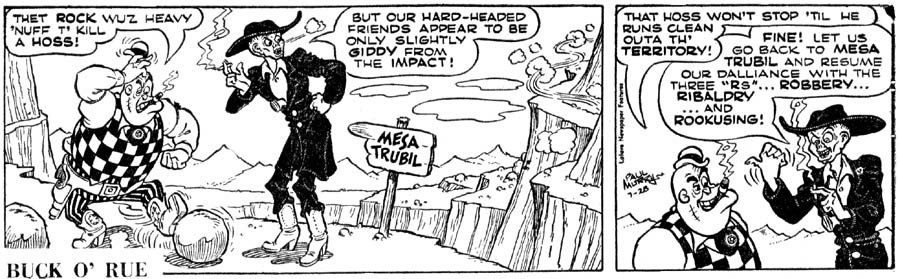

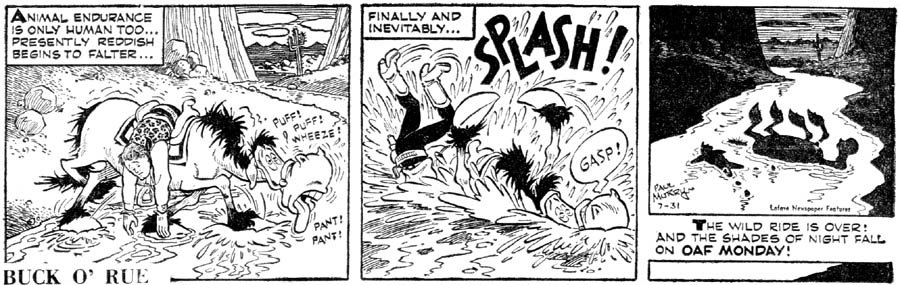
Thursday, September 28, 2006
Buck O'Rue, Part 1

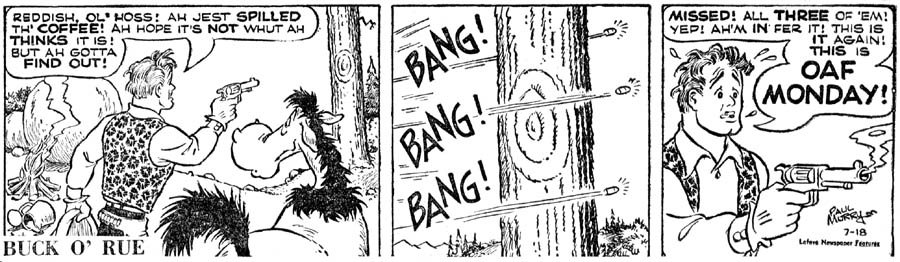
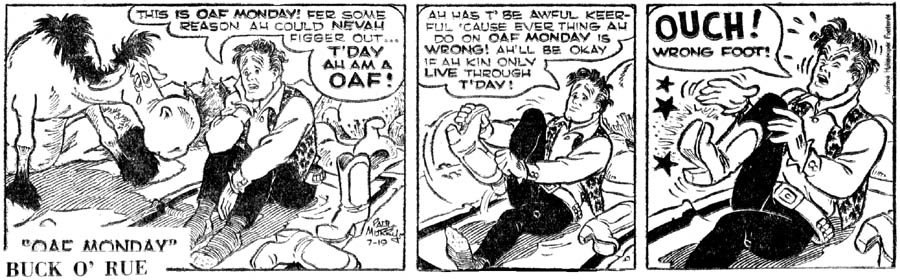
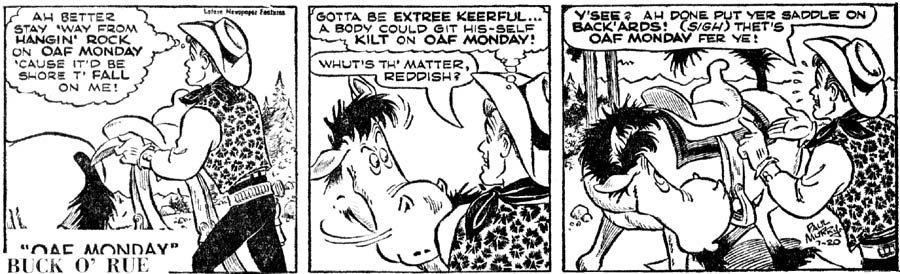

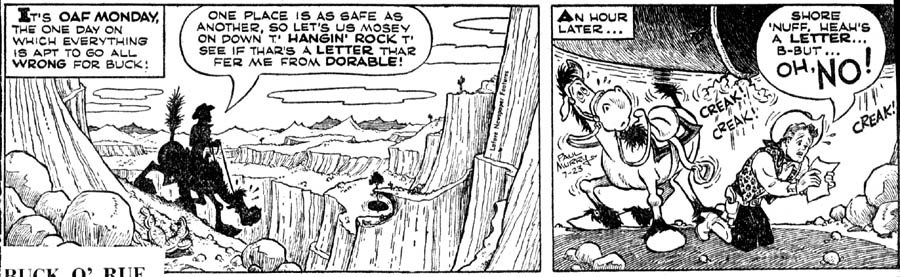
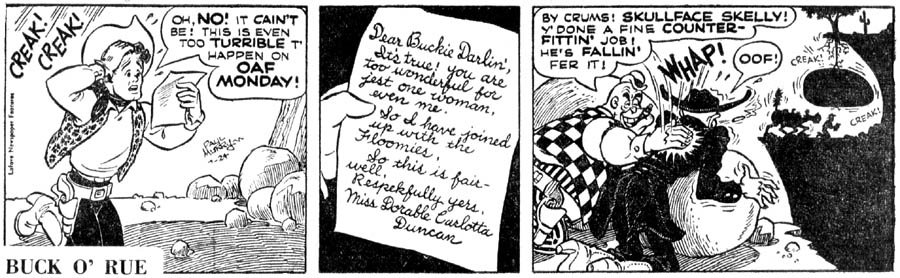
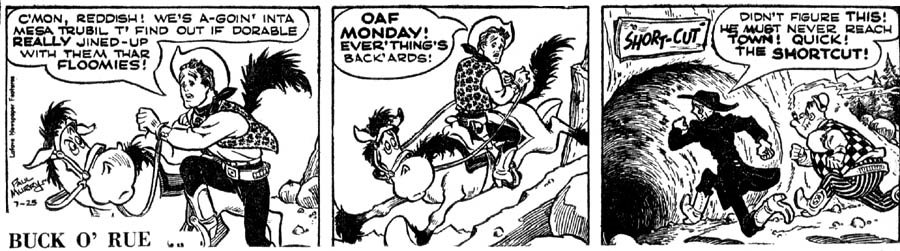
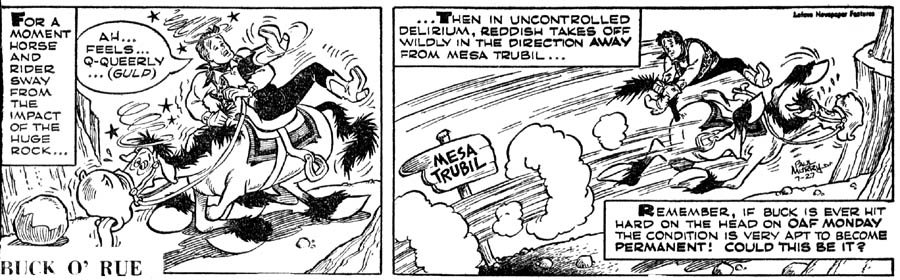
Time to take a breather from the E&P material. I made a promise awhile back to some Paul Murry fans that I'd run a sequence of Buck O'Rue dailies. Frankly I think the writing on the strip is awful, so I could do without, but Murry's art, if you are a fan, is certainly up to his usual standard.
This short sequence of 13 strips concerns "Oaf Monday", a fine example of bad comic strip writing. Don't confuse your readers by stating that your hero is struggling through a Monday when they're reading the strips throughout the week. It jars the reader out of the story, and it's not necessary - why not call it Oaf Day? Problem solved.
Worse yet, the preceding two weeks to this sequence have Buck off-stage the entire time (hiding from a lonely-hearts club). Not a good idea to hide your main character that long on a strip that's just six months old.
Rest of the sequence to be posted tomorrow. Oh, and sorry about the image quality. The paper these are from did a pretty bad job of hacking the strip edges. They also failed to clean their presses regularly and some strips were impossible to clean up through the haze of ink smudges.
Details, details... It ran 1/15/51 through sometime in 1953. Syndicated by Lafave. Paul Murry fans would love an exact end date.
Best, Allan
Tuesday, September 26, 2006
E&P 1939: United Cartoonist Pics
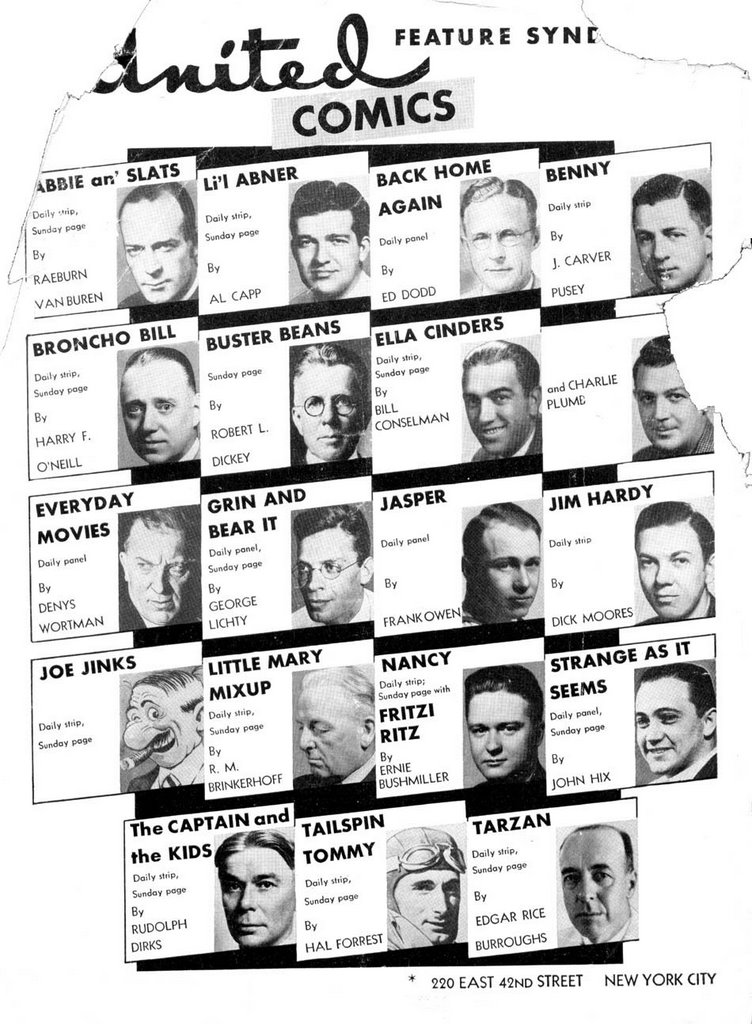
Here's an ad that United Feature Syndicate ran in the E&P 1939 Syndicate Directory with pics of most of their cartoonists. This was on the back cover and has sustained some damage over the years as you can see. Note that poor Henry Formhals got the shaft on Joe Jinks - he wasn't allowed to sign the strip until a couple years later, so no pic for you Hank!
Labels: News of Yore
E&P 1939: Robert Edgren Obituary
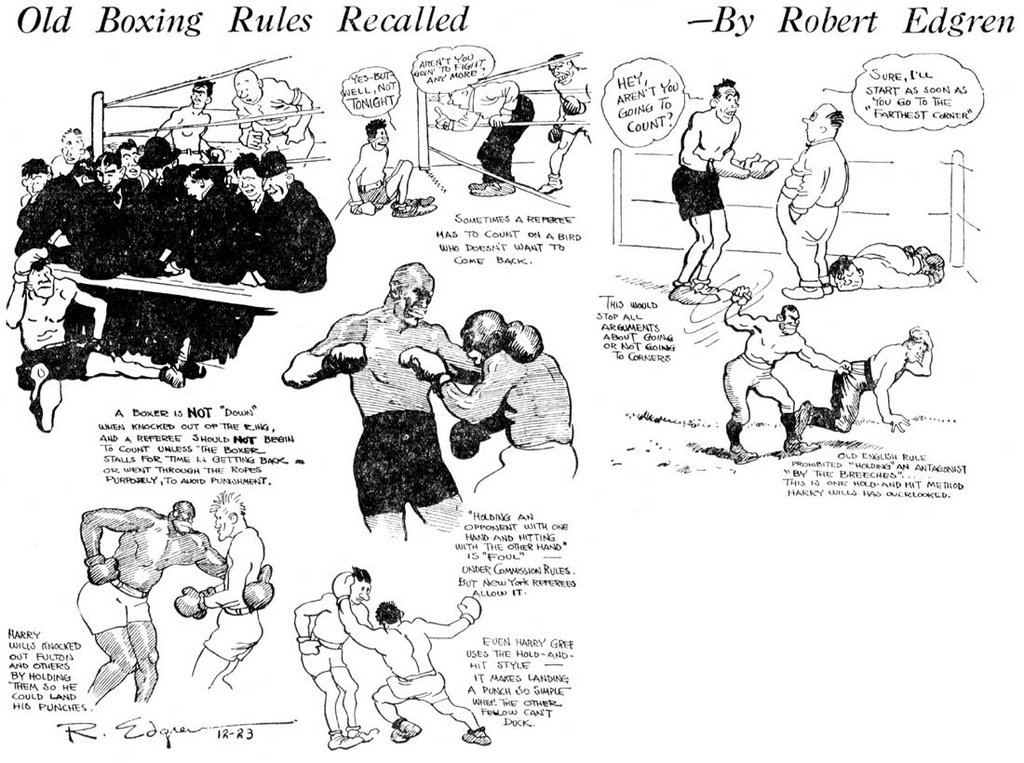
Robert Edgren, Cartoonist, Dies on Coast
Famed Sports Editor, 65. Started with Hearst Newspapers
Robert W. Edgren, 65, sports editor and cartoonist, whose work was syndicated by Bell Syndicate in the U. S. and by the syndicate's Canadian representative, Dominion News Bureau, in Canada, died Sept. 9 at his home in Carmel, Calif., after a series of heart attacks.
Although best known in recent years for his syndicated column and cartoons, known as "Miracles of Sport," he was at one time a political cartoonist, and was court-martialed by Spanish authorities for drawings he sent from Cuba during the Spanish-American War.
Began on S. F. Examiner
Mr. Edgren began his newspaper career in San Francisco in 1895, when he joined the staff of the Examiner, the original W. R. Hearst newspaper. From the Examiner he was transferred to the old Evening Journal in New York and appointed political cartoonist. During his Spanish adventures, his drawings, "Sketches from Death," printed in the Journal and other Hearst papers, were chiefly war atrocities.
They were so extreme that Mr. Hearst wired the cartoonist: "Don't exaggerate so much." Angered, Mr. Edgren proceeded to collect 500 photographs to prove the accuracy of his work.
The pictures were subsequently displayed before Congress, and caused considerable excitement.
Was Independently Wealthy
He became associated with the old New York Evening World in 1904 as sports editor. In addition to a daily column and sports cartoon, he was executive editor in the sports section when that paper was the leading authority in the field of sports in America.
He returned to live in California after the World War, and built a home on the Monterey Peninsula. He was appointed to the California Boxing Commission by Governor Rolph, resigning in 1932 because of ill health.
Mr. Edgren was made independently wealthy by a kindness to a friend, to whom he loaned money before the World War to help his struggling leather goods business. When the war started, the cartoonist's friend repaid the loan with stock that tremendously increased in value.
Surviving are his wife, a son, Robert Durant Edgren, and three sisters. Funeral services were held Sept. 13 at Del Monte, Calif.
The cartoonist's son, who had been collaborating with him in recent years, will continue the feature, Bell Syndicate told E & P.
Labels: News of Yore
Monday, September 25, 2006
E&P 1939: Merrill Blosser Bio

NEA's "Freckles" Enters 25th Year With Blosser
At eight o'clock Wednesday morning, Sept. 25, Merrill Blosser, NEA service creator-cartoonist of "Freckles and his Friends," sat down to his drawing board and began working on his strip. He sketched until two that afternoon, covered his board and relaxed. It was his way of observing "Freckles" and himself entering their 25th year as a daily newspaper feature.
"Freckles" made his first appearance in strip form (he had appeared a few weeks earlier as a panel) on Sept. 20, 1915, and very few of the present-day readers would be able to recognize him. When he made his newspaper bow, "Freckles" was about six or seven years old. Now he is 17, a high school senior, and captain of the football team.
Blosser Is NEA "Old-Timer"
In point of service, Blosser is the "old-timer" among NEA Service comic artists, "Freckles" being the oldest NEA strip. Yet Blosser, in his middle forties, looks 10 years younger both in his appearance and outlook. Enthusiastic, he has the drive and love for fun of the high school youngsters he draws.
His chief hobby, he tells you, is "living." He likes to take moving pictures, to go to football games, to mingle with kids, go for long automobile drives, which he and his wife do several times a week.
He closes up shop every day at about two in the afternoon, which leaves him the rest of the day for recreation.
Because he is able to do this, Blosser is the envy of virtually every other comic artist of his acquaintance, not one of whom has been able to master the deadline bugaboo the way he has.
Has Licked Deadline Bugaboo
In nearly a quarter of a century of drawing for daily publication, Blosser never has permitted himself to get behind. He tells you that he realized early in his career that he would never have any fun, or peace of mind, unless he licked the deadline problem at the start by staying religiously ahead of his schedules.
Consequently, he sets aside a certain period each day for drawing and planning and sticks to it as meticulously as though he were punching a time-clock in an office.
The NEA cartoonist was born in Nappanee, Ind., where he grew up in a small town community much like the Shadyside locale of "Freckles and His Friends." For the last dozen years or so he and his wife have lived in Los Angeles.
Blosser's daily strip now is used by more than 500 newspapers, while his Sunday page appears in 130, NEA says.
Note from Allan: actually Freckles and his Friends debuted on August 16, 1915.
Labels: News of Yore
--Allan
You're not going to find in-depth bios in the standard references -- they just don't have room. But they're excellent jumping off spots. For instance, I see that he spent most of his later life in Pasadena. I'd check to see if he has any living relatives who could talk to you -- could very well be some still living there. Since he was working at the Plain Dealer in 1915 (again, from a standard reference) I might order up the microfilm of that paper to see if they did a profile on him when he graduated to doing Freckles (a long shot, but possible). You might also contact OSU to see if they can offer any help based on their vast collection. Have you checked to see if he left his papers to some library? And what about Henry Formhals' family? Maybe you can track down one of them.
--Allan
 : 5/28/2012 12:51 PM
 Sunday, September 24, 2006
E&P 1939: Martin Branner Bio

Branner Enters 20th Year With "Winnie"
by Stephen J Monchak, 8/5/39
Martin Branner believes that modern married couples who work have very little time to devote to marriage. Because this condition prevails in a great many of the country's urban centers, he illustrates this phase of life in his comic strip "Winnie Winkle, the Breadwinner," which is syndicated by the Chicago Tribune-New York News Syndicate.
Instead of showing the irate wife bouncing a rolling pin off her husband's head (a type of comic dealing with married folks years ago), Mike (as he is known to his friends), tells the financial status, budget troubles, in-law interference and the other travail that enters the lives of young married folks.
125 Papers Take His Strip
And newspaper readers like it. This month, as he looks back on 19 years of successful strip characterization, satisfying results appear on the black side of the ledger. One note reads: The strip appears in 125 newspapers in America and Europe, with a circulation of more than eight and a half million.
On the eve of entering his 20th year of continuous employment with the syndicate, Mike, drawing on some of his own experiences, is illustrating what can be called a cartoon biography of himself and Mrs. Branner. Now 51, the cartoonist ran away and got married to a professional dancer, Edith Fabbrini, when he was 18 and she was 15.
He spent his next 15 years playing stock, musical comedy and vaudeville on the Keith Orpheum and Pantages circuits, and some lesser ones. They hit the Palace Theater on New York's Broadway the second week it opened and often after that. Their dancing act was called "Martin and Fabbrini."
The work was hard and the earnings little. Two shows a day was rapidly changing to three and more and bookings became scarce during and after the war. Between jobs, Mike resumed his drawing, interrupted when he got married. Shortly after the Armistice, he got an offer from the Bell Syndicate to do a daily cartoon called "Louie the Lawyer."
Capt. Patterson Named Strip
He accepted but earned so little that he went back to vaudeville, continuing with his comic, making deadlines in dressing rooms, hotel rooms and between train connections. When his contract ran out, he did a Sunday page called "Pete and Pinto" for the New York Sun and the old New York Herald. This comic ran 20 weeks and paved the way for his recognition by his present employers.
Shortly after the birth of the New York News in 1919, Captain Joseph M. Patterson, publisher, who closely supervises the syndicate's comic strips, was shopping around for a working girl comic. Mike made the grade with his samples of an average stenographer.
Captain Patterson gave the strip its title, the same it bears today. The News publisher has taken a keen interest in the Branner strip and recently suggested that Winnie and her husband, Will Wright, become dancers. Their marriage has been a series of hard-luck stories.
Mike started his present continuity of the Wrights several weeks ago and currently has them on the eve of their big chance to break into the professional dancing field. But it won't be easy going for the Wrights; it wasn't easy going for the Branners.
The dancer-cartoonist hasn't changed much through the years, his colleagues say, except for his greying hair and a slight bulge amidships. He still looks as if he could beat a pretty good toe tattoo on the boards. Devoted to his family, he spends his time away from the drawing board with Mrs. Branner and their two young sons, Bernard Donald, 16, and Robert Jay, 11. With them, his summers are passed boating and swimming in Connecticut.
Labels: News of Yore
I was just wondering whether you might be able to tell me the issue of Editor & Publisher in which it appeared.. and perhaps the page number? I would really appreciate it.
: 5/19/2007 9:29 AM Saturday, September 23, 2006
E&P 1939: Burris Jenkins Bio

Noted Preacher-Editor's Son Won Success in Cartooning
Burris Jenkins, Jr., Whose Father Edited K. C. Post, Noted for Sports Work, Sees Big Field for Pro and Con Editorial Cartoons
Burris Jenkins, Jr., of the New York Journal-American, who has an enviable reputation as a sports cartoonist and also does outstanding work on news assignments in his serious moments, is one of the few metropolitan newspaper artists who writes as cleverly as he draws.
Son of the one-time preacher-editor of the Kansas City Post who today is the Missouri metropolis' "first citizen," 42-year-old Burris Jenkins, Jr., inherited his father's ability to drive home a point. Dr. Jenkins still is spellbinding the largest congregation in Kansas City every Sunday. In New York, every day except Sunday, his son uses pen and ink to send home to readers his unusual sports ideas with the impact of a baseball against a catcher's mitt.
Literary Sentimentalist
A literary sentimentalist if ever there was one, Mr. Jenkins long ago left the beaten path of sports cartooning and many of his verses turned out with his daily cartoon sparkle with a spontaneity seldom displayed by writing artists.
His wide following among sports readers of the old New York World, where he broke into metropolitan journalism in 1921, and of the New York Journal and the Journal-American since 1931, has grown with a succession of rib-ticklers like one he did last May on the eve of the Kentucky Derby. Entitled "If Wishes Were Horses," it was Jenkins' parody of the current song hit, "Three Little Fishes," illustrated cleverly with Chico, Challedon and Technician in piscatorial roles as the "Three Little Wishes" looking down from the opening bars of the song on the verse and an equine shark named Johnstown. Here's how it ran:
Burp Burp Gittem Uppem Gettem Whoa!!
THREE LITTLE WISHES
(NOT by Saxie Dowell, to Whom We Apologize)
Down in a meadow where the grass grows blue
Stood three little WISHES (and a Big Wish too!)
"Run," said the little Wishes, "Run if you can,"
And dey ran and dey ran and dey ran and dey ran.
One little Wish is for "Chico" (So?)
One is a "Challedon" fan (Well!)
One loves a horsie called Technician (Whew!)
So dey ran and dey ran and dey ran and dey ran.
"Stop!" said a little Wishie, "This is far enough
"You must lay it on the line or I'll call your bluff!"
Then the three little Wishers went out on a spree
And dey dwank Mint Juleps till half past three.
One had Bourbon in his Julep (Bloop)
One had 40 year Rye (Gulp)
One had mountain dew corn (Burp)
And dey dwank and dey dwank without batting an eye.
"Whee!" yelled the little Wishes, "Here's where I win!"
"We'll dwink and we'll dwink till my wish comes in!"
So they dwank and they dwank from dawn till dark
Till all of a sudden they met The SHARK!
Clop clop whatten what-tha hel-lum (Whoa)
Clop clop-gettum up and gettem (Go)
Clop clop-just try-em ketchum (Oh)
And dey ran and dey ran and dey ran and dey ran.
"Help!" cried the little Wishes, "Gee! he's out for blood!
"He swept past us like the Johnstown flood!
"But we'll keep on running just as fast as we can."
So dey ran and dey ran and dey also ran.
Gulp gulp give-em up-em ketchem!
Gulp gulp justem gottem quittem!
Gulp gulp fillum up-em and drinkem!
So dey dwank and dey dwank until it didn't
make any difference any more . . .
Writes as Spirit Moves Him
A "daily double" like that may wow the sports fans, but it's a little too much to expect any newspaperman to do the trick every day. So his contract with the Journal-American - his fourth signed with the Hearst evening paper - requires Jenkins to do a twin trick at typewriter and drawing board only twice a week. In recent months, however, the artist has done fewer than two articles weekly. Instead of a story or verse he turns in an extra cartoon, under an arrangement with the newspaper. He writes as the spirit moves him, several times a month.
Because his batting average for timely topics is 1.000 and his cartoons with few exceptions pack the punch of a ring champion, it was surprising to hear that this outstanding sports cartoonist seldom attends sporting events. To him every baseball game is the same old story - something he's seen before. He hasn't seen many full baseball games in recent years, and even World Series games fail to interest him after the 7th inning.
Jenkins attends principally the championship fights and the most important races and football games, yet his cartoon always has the dramatic touch of a dyed-in-the-wool devotee of that particular sport.
His own sports cocktail consists of yachting and golf - and frequently he delays work on the next day's cartoon while he pursues the elusive pill and an even more elusive 80 on a golf course near his home in Pelham, N. Y. He has broken 80 but several times in his life and it's a sure bet his copy will arrive late at the Journal-American on the day he thinks he's going to break 80 again.
Deadline a Daily Adventure
Making his deadline is a daily adventure for Jenkins and his secretary, Herbert Storlie. His cartoon is supposed to be at the Journal-American office at 9 each evening, but it seldom arrives earlier than 11 p.m. Sometimes it's the wee small hours of the morning of publication that Storlie dashes into the Journal-American to catch a bit of engravers' hell to be passed on to his boss.
Jenkins has an unusual temperament when it comes to his drawing board. Often he cannot get started until darkness descends on the Hudson River and casts its peculiar spell on the artist fighting his deadline in a thirteenth floor studio on Riverside Drive. His mind works best at night, and the late sunsets now often find him just beginning his next day's cartoon after long pursuit of an idea through the afternoon.
Right now cartoonist Jenkins is trying to "reform" with respect to his unorthodox working hours, and has set 11 a.m. as the time for his arrival at the studio from his home at Pelham, Westchester county. He reports progress but the 9 p.m. deadline is still a daily bugaboo.
Occasionally Mr. Jenkins delves into serious topics. At such times he faces his ever-recurring dilemma- whether to hit heavy subjects daily or to continue skimming the cream off the sports subjects upon which his reputation has been built.
A night of indelible memory for newspapermen and parents, May 12, 1932, when the body of kidnapped Charles A. Lindbergh, Jr., was found, brought this cartoonist's pen into swift action. After hearing the radio bulletin in his home, Jenkins poured a father's hatred of the unknown murderer into a dramatic cartoon which he rushed to the Journal for publication the following day. It depicted Uncle Sam holding aloft Old Glory and the battered body of the Lindbergh child above the quotation:
"My Country 'Tis of Thee."
During the trial of Richard Bruno Hauptmann, Mr. Jenkins did a notable series of cartoons on courtroom scenes. For here he was in his element - interpreting the drama of a significant news event into a news cartoon with a few pungent captions to give the busy reader the entire situation for the day at a glance. Last year, at the trial of Jimmy Hines, he also found an opportunity to do his unusual reporting in keynote sketches and captions.
Sees Big Field for News Cartoons
Mr. Jenkins believes there is a big field for news cartoons and for pro and con editorial cartoons-giving both sides of a question presented to the reader.
"I couldn't say that cartooning in general needs a renaissance," he said in answer to a question, "but I do think a fresher and more forthright presentation in cartooning would be more convincing to a public educated above the old-fashioned school of cartooning."

Cartooning, he continued, is the "quickest way" of putting over an idea. "The visual reaction can hit you so much quicker than a column of type. A well thought out cartoon can tell the reader the story in a second. One that sticks out in my mind is one Rollin Kirby did after a submarine disaster some years back. It showed a diver tapping on the side of the lost submarine and was titled 'Taps.' One word and a picture, and you've got it all."
By an "educated public," the cartoonist explained, he means "a public, brought up on radio, that is greatly interested in and is familiar with politics." People have a more thorough knowledge of what is going on about them, "so that if you throw the old type of cartoon at them with only one viewpoint presented, they just don't believe it.
"The public's got to believe again that a newspaper can have ideals and a heart. There are two sides to any argument and the side a newspaper has decided is right can be stressed along with a fair presentation of the other side in such a way as not to insult the public's intelligence.
"Cartoonists should be on the level and not hold anything back from the public. Nowadays the readers often think there must be something in it for the paper or it would not be plugging a certain policy."
Two Brothers Are Newspapermen
Burris, Jr., is one of three sons of Dr. Jenkins, who was the Kansas City Star's war correspondent before he became editor and publisher of the Kansas City Post under the Bonfils and Tammens ownership. All three sons have become newspapermen. Burris' younger brothers, Paul A., 40, and Logan, 28, are owner-publisher and city editor, respectively, of the El Centra (Cal.) Imperial Valley Post-Press. Paul worked on the Post and Star in Kansas City before he went to California three years ago. Logan started as a reporter on the Denver Post under Bonfils.
Dr. Jenkins was president of the University of Indianapolis when Burris, Jr., was born Oct. 8, 1897. The preacher took the editorship of the Kansas City Post shortly after the war to fight the enemies of the Wilsonian ideals of international relationships. He quit at the end of 1920 when Bonfils fired his son "over his head" for a pessimistic Christmas cartoon which the paper's owner had described as "the last straw."
Burris, Jr., didn't know until 10 years later that he had been fired from his first newspaper job. The cartoonist, then on the road to success, was telling his father in New York that "every newspaperman should be fired from his first job because it does him good." He was expressing regret that he had never been fired, when Dr. Jenkins let the cat out of the bag. As his son explains the incident, Dr. Jenkins was apparently dissatisfied because Bonfils and Tammens had not given him the free hand that was promised in the conduct of the Post. When the editor heard that Bonfils had told Dick Smith, managing editor, "This is the end! Don't print another one of those cartoons," Dr. Jenkins told the owner, "You can accept my resignation, too," and then induced his son to make a trip abroad.
Got Job on N. Y. World
It was this trip to Europe and the Near East, long planned by young Jenkins, that finally landed him in metropolitan journalism. He had saved $900 from his pay on the Kansas City Post after his graduation from Harvard, and by traveling steerage most of the way he stretched the trip into eight months. He wrote an article, illustrated with his own cartoons, on the Jewish situation in Palestine, and this material was exactly what the New York World had been looking for, so he was hired to do a series.
The late Jack Tennant, managing editor, might have fired Jenkins when the last of the Palestine articles was written, but blustery Jack Rainey, then city editor, liked the newcomer and told him, "I'm going to make you or break you." He gave Jenkins a job as police reporter. For a year Jenkins covered the West Side and eventually he began to illustrate his own feature stories. Late in 1922 he started doing sports cartoons, modeling his creations after those of the famous Bob Edgren. Gradually he developed his own distinctive style, in which he mixes sentiment with an interpretation of the sports subject covered, and his rise became rapid as sports readers welcomed his deviation from the unemotional cartoons of the old school of artists.
Within a few years his police reporter's weekly stipend grew into $210, plus $25 for each column he wrote and illustrated-and there were usually two of these every week. His contract with the World had a year to run when the paper was acquired by Scripps-Howard.
Believing himself out of a job, Mr. Jenkins answered a call from E. D. Coblentz, of the New York American, to discuss terms, but landed instead in the office of William A. Curley, editor of the Evening Journal, when he got off at the wrong floor. A contract was signed with the Journal, instead of the American, but there followed a legalistic tug-of-war between the Journal and the World-Telegram over the cartoonist because of the unexpired contract with the old World. After three days Jenkins was released from the old contract and he has been with the Journal and Journal-American ever since.
Reunion in France
Two unusual incidents involving father and son are worth brief mention. While Dr. Jenkins was in France as war correspondent for the Kansas City Star writing stories on the numerous fatalities among aviators, his son was "somewhere in France" with the air service, completing his training before going to the front. Dr. Jenkins, fearing he might never see his son alive again, appealed to the night editor of the Paris edition of the New York Herald to publish a brief notice for his son to meet him for a final farewell. It brought them together.
Labels: News of Yore
: 7/17/2013 12:42 AM : 8/27/2013 12:56 PM I am looking to get in touch with someone from the Jenkins family to get permission to use a painting in a scholarly publication. Might anyone have some contact information?
Tom, you mentioned you were in contact with an author - perhaps he have family contacts? Feel free to email me a jarring at gmail.com. Cheers, AR
Do you have that person contact information?
I have some originals that he did for the NY State Police.
: 11/03/2013 8:30 PM : 8/18/2018 10:23 AM : 3/22/2020 9:22 AM https://www.amazon.com/Cartoonist-Burris-Jenkins-ebook/dp/B096HCJKXS/ref=sr_1_1?crid=284XDRJMSS1ZR&dchild=1&keywords=the+cartoonist+burris+jenkins&qid=1623256273&sprefix=the+cartoonist%3A+Burris+Jenkins%2Caps%2C1112&sr=8-1
Thanks
Danielle and family
323-360-5698
: 11/20/2022 11:30 AM : 10/03/2023 11:33 AM Friday, September 22, 2006
E&P 1939: Buck Haney Announced
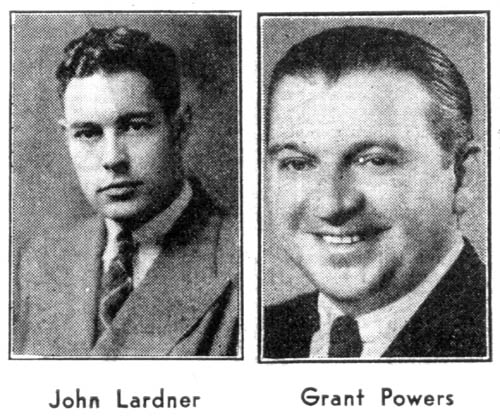
Lardner, Powers To Do Comic Strip For Bell
by Stephen J. Monchak, 8/19/39
A new sports writer - artist team entered the syndicate field this week with announcement by Bell Syndicate that it has prepared for release Aug. 21 "Buck Hanson of the Badgers," a daily cartoon strip depicting the adventures of a baseball player.
The writer-artist team is made up of John Lardner, North American Newspaper Alliance syndicated sports writer, and Grant Powers, veteran sports cartoonist.
They Know the Game
Friends for years but working together for the first time, both Lardner and Powers bring to their strip a first hand knowledge of the great American pastime gathered during years of covering the major league teams. Their character, who will cavort in the strip the year around, Lardner describes as "a southpaw pitcher with a southpaw brain but a right-handed heart."
Lardner, 28, a newspaperman since he left Harvard in 1929, has established himself as a leading sport columnist in 10 years. He first went to work for the Paris Herald, European edition of the New York Herald Tribune, and got his early newspaper training under Stanley Walker, then Herald Tribune city editor, now editor of the Philadelphia Evening Ledger.
With an unusual style of sports reporting, Lardner has acquired a reputation as a humorist, following, it appears, in the footsteps of his father, the late Ring Lardner, famous American humorist. NANA has distributed young Lardner's column, "From the Press Box," since 1933. He also writes a weekly column, "Sport-Week," for Newsweek magazine. Married, he is the father of one child.
Powers Now Free-Lancing
Starting out to be an architect, Cartoonist Powers' career was sidetracked by the World War and he was assigned to mapping the war's battlefields for the National Museum. During those days, he also was a regular contributor to Stars and Stripes.
He joined the staff of the New York Daily News in 1921, and remained there for 17 years, illustrating the sports columns of Paul Gallico and others and covering sports on assignment.
The Buck Hanson strip (then titled Buck Haney - Allan) appeared for a time in both the New York Daily News and the Chicago Tribune in 1937. Resigning last year from the News to free-lance, Powers does his work in his cottage at Auburn, Maine.
Bell this week also announced Sept. 18 as the release date for "Old Timer", a daily panel drawn by Ed Wheelan, creator of the comic "Minute Movies" for King Features Syndicate, believed to be the first comic strip to introduce serious continuity and straight drawings.
Wheelan, veteran penman, after leaving behind the art editor's post on the Cornell Widow, college monthly humor publication, drew cartooons for the old Brooklyn Standard-Union. He subsequently worked for the New York Journal, San Francisco Examiner, San Francisco Call, and the New York American. It was on the latter paper that his "Minute Movies" strip was created.
Note from Allan - has anyone seen "Old Timer"? I've never found a sample.
Labels: News of Yore
Thursday, September 21, 2006
E&P 1939: T.E. Powers Obituary
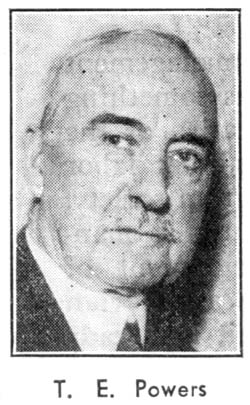
T. E. Powers, 69, Retired Hearst Cartoonist, Dies
Favorite of Presidents, His Political Cartoons Were Nationally Known
Thomas E. Powers, 69, political and satirical cartoonist for the Hearst newspapers for nearly 40 years until his retirement in 1937, died Aug. 14 at his home in Long Beach, Long Island, N. Y., after a long illness. His wife, Mrs. Louise H. Powers, two brothers and a sister survive.
Mr. Powers' political cartoons had a wide following and two elflike characters, "Joy" and "Gloom," with which he enlivened his drawings-always signed "T. E. Powers"-became one of the trademarks of his work during a career which made him one of the country's best known and most successful cartoonists.
Favorite of Presidents
A favorite cartoonist of the late President Theodore Roosevelt, his work attracted the attention of other Presidents, and the late Calvin Coolidge was so amused by one caricature of himself that he asked the cartoonist for the original. That letter, on White House stationery, was one of Mr. Powers' most cherished mementos.
Mr. Powers first attracted the attention of Theodore Roosevelt when he pictured the President threatening tall, silk-hatted figures labeled "The Trusts" with the then famous "big stick." His satirical thrusts at "grafting politicians" or others whose right to public office he challenged, however, usually were tempered with broad humor.
The veteran penman's cartoon series, syndicated to Hearst papers in many states, included "Mrs. Trubble," "Never Again," "The Down-and-Out Club," "Sam the Drummer," "Married Life From the Inside" and "Charlie and George."
The veteran cartoonist retired two years ago because of illness, though up until last September he turned out an occasional drawing at home. Since early this year he had been confined to bed or a wheel chair. On Saturday he took a turn for the worse. His butler found him dead early Monday.
Using a relatively simple line drawing technique, which looked easy to duplicate but was not, Mr. Powers had a gift for caricature. His pungent comment in pen and ink drawings on the fads and foibles of the day enlivened the editorial pages of Hearst newspapers from coast-to-coast. Possessor of a keen wit and a sage philosophy, he had the ability to transfer these qualities into a biting picture editorial with a few sure, quick strokes of the pen.
Mr. Powers was born in Milwaukee on July 4, 1870. He moved to Kansas City, where he was educated in public schools and got his start working for a lithographer at $2 a week. In 1906, after his cartoons had attracted nation-wide notice, he gave an Editor & Publisher interviewer the following account of his youth:
"I was born in Milwaukee . . . but before I was old enough to appreciate the product on which the 'fame' of that fair city rests, my 'cruel' parents dragged me away to Kansas City. I had to stay in the latter place until I could earn enough money to make a 'get away.'
"I began to draw pictures at a very early age. One of my first efforts was a portrait of my teacher sketched on the schoolroom blackboard. I was too modest to sign the picture but the teacher discovered its author and I received my reward.
"When I was about 17 years of age I went to work for a lithographer who estimated that I was well worth $2 a week. I also received a goodly amount of advice on the subject of saving money. But, in spite of all he said, I squandered my money, with carelessness, recklessness, and negligence.
"My employer said that I would never be able to draw. I was offended and resigned. My first newspaper work was in Chicago on Victor Lawson's Daily News. I brought in some sketches and submitted them to Lawson, who accepted them and offered me a permanent position."
Mr. Powers later worked for the old Chicago Herald and in 1894 was offered a job in New York with the Evening World, after the late Arthur Brisbane had seen and liked his work. When Mr. Brisbane entered the Hearst service in 1896, Mr. Powers transferred with him to the old New York Evening Journal.
The characters "Joy" and "Gloom" which he used so often, cavorted in the corners of his cartoon. If optimism was in order, "Joy" chased "Gloom," and vice versa. "Gloom" was a mournful imp with a black beard, and "Joy" wore an eternal grin.
Mr. Powers also drew "John Q. Taxpayer," stripped down to a barrel.
For many years Mr. Powers had owned a farm near Norwalk, Conn., but since his illness became serious, he had not visited the place. He once wrote: "My favorite recreation is farming."
Note from Allan: not mentioned in this obit is Powers' distinction as the first American to draw a newspaper color comic strip.
Labels: News of Yore
: 9/29/2006 4:16 PM A non-American was the first to draw a color newspaper strip? who/when/where was that?
tim
: 10/02/2006 2:14 PM Would love to hear from anyone who can tell us about the Petit Journal.
--Allan
: 12/23/2008 2:31 PM Petit Journal was a daily paper with an illustrated weekly supplement. From what I've seen of the supplements (just the covers) they were more in the vein of news magazines -- I'm thinking the Harper's or Leslies type, not Time or Newsweek. Maybe the insides were all cartoons though.
The real question, though, is whether these supplements were printed on newspaper on high-speed presses. That is an important part of the definition of color newspaper comics. I've been told that the Petit Journal supplements may qualify, but don't know how far I can trust my source, who just mentioned it in passing. I really need to order a few of the supplements on eBay, but its quite a pain to order them, typically from France, and get the right sort of dates, which would be 1892 or before for my purposes.
Just another item on my long To Do list.
--Allan
I just came across a newspaper clipping from The New York Evening Journal May 14th 1903, "What Shall They Do With The Man?"by TE Powers and On the back is a document on the wounded and starving jews in streets. Do you have any information regarding this cartoon.
: 3/27/2009 1:33 PM : 7/21/2013 7:37 AM Wednesday, September 20, 2006
E&P 1939: Bill Holman Bio

Holman Renews Contract; To Do New Daily Panel
by Walter E. Schneider
Editor & Publisher, 7/8/39
Holmania, a virulent but harmless form of in(s)anity rampant in recent years in "Foo Clubs" of adolescents and detected in the high school generation’s jargon expressing the comic page “foo-losophy” of cartoonist Bill Holman, seems to be spreading. The Chicago Tribune-New York Daily News Syndicate July 1 renewed the Holman contract for two years and this week added to "Smokey Stover" and "Spooky," the Sunday half-page comic strip vehicles for the cartoonist's "foosayings," a new daily panel named "Nuts and Jolts."
The new comic, two and three columns in size, will consist of Holman gags and his inexhaustible supply of "fool-osophic" mottoes. "Zipper," a nondescript dog with a curiosity complex who has cut capers heretofore in one of Mr. Holman's numerous daily comic strips, will appear Thursday as a panel under its own name.
"Nuts and Jolts" Included
The syndicate, Mr. Holman explained, is concentrating his cartooning efforts in the daily field under the titles "Nuts and Jolts" and "Zipper" because the numerous titles used previously were "somewhat confusing." These included "Problems Made Easy," "It's All in Fun," "There's One in Every Family," "Something Ought to Be Done About This," among others.
To look at Mr. Holman you'd never suspect that he's the man behind all this zany humor appearing now on the comic pages of some 90 daily and Sunday newspapers. Thirty-six, and a bachelor with his eye on the right girl, he grins quite innocently all the way up to his bald spot above his forehead, as he confesses he "thinks so much about this foo stuff that I'm beginning to lose my own identity."
During the interview Mr. Holman let us in on his secret - the origin of the word "foo" which tickles juvenile funnybones when it appears in such mottoes as "Fifty-four Forty or Foo," to use one of his fooier (fooey, he's got us doing it) tomfooleries.
"It's just a silly word that doesn't mean anything," the cartoonist confided. "About ten years ago when I was doing a panel for Collier's I needed a name for a car and used 'Foo.' It tickled me and I started using it often on badges or license plates or wherever a space filler was needed."
It's a Mania
The word insinuated itself into every Holman cartoon. It became a sort of mania with him and by the time he signed his first contract with the Tribune-News Syndicate in 1935 to do "Smokey Stover," his "foosayings" were decorating the walls of every drawing in that strip. With the dog with the gloved tail and all manner of mice and men carrying signs inscribed with his nonsensical mottoes, the comic with a firehouse background went like a house afire with the younger generation.
Within the last foo years scores of Foo Clubs have been organized independently by high school and college boys whose first official act is to elect cartoonist Holman "honorary foo" or honorary president. Fraternity dances often take on a foo motif with Holmanisms plastered all over the walls and at one of these hops recently a huge cardboard "Spooky" was made the vehicle for announcing dance numbers and amusing the dancers with Holman "foo-losophies." To wit:
"A critic says a sharp nose indicates curiosity. A flattened nose indicates too much curiosity."
The Holman brand of humor is strictly slapsick, of the "Hellza-poppin" variety. Anything goes, so long as it is considered funny. It reminds one of the custard pie throwing of early film comedians.
Foo Fans, Foo Pipes
According to Mr. Holman, more than 100,000 copies of 10 cent "Big Little Books" on Smokey and his firehouse chief, "Cash U. Nutt," who smokes a double pipe, have been sold. Nickel and penny books also have appeared with these and other Holman characters. Foo has made such an impression on blase New Yorkers that a metropolitan tobacco shop makes up to order the fire chief's familiar foo pipe and a number have been sold at $2.50 each to foo fans. And speaking of foo fans, an Indiana admirer of the strip turned out last fall a silly symphony called "What This Country Needs Is Foo."
Considering the fact that Holman started from scratch four years ago as a syndicate cartoonist and today is earning in the neighborhood of $1,500 a month, his career might be called successful. It began at birth, Holman insists, and in his typical cartoon screwballese here's his autobiography:
"To make a long Foo short, here is the dope, and I do mean me. I was born in the state of frenzy, but for present purposes let's make it Indiana. At an early age my father died and I was sent out into the world to make a living for my mother, one cat with a sore tail, and no kitten. This all happened in Napanee, Indiana.
His Autobiography
"My first job was running a popcorn machine for the local dime store. This is considered excellent training for a comic artist and no doubt accounts for a certain corny touch which so many of my gags seem to have. At 16 I was working in the art department of the Chicago Tribune. Having lost my eraser, I realized I could afford to make no more mistakes so Scripps-Howard made the next one and hired me. For the next two years I drew no crowds but plenty of drawings. My strip act laid an egg, the art editor threw it at me and I was on my way to New York.
"After seven years of itch and drawing a kid comic for the New York Herald Tribune I entered the magazine field. The following five free lance years were happy and profitable. Hundreds of my drawings infested the pages of Collier's, Saturday Evening Post, Life, Judge and Everybody's Weekly of London. This work drew the attention of the Tribune-News Syndicate and I was asked to submit a Sunday feature. The outcome was "Smokey Stover,' 'Spooky,' the cat, seven daily cartoons and Foo.
"I have always liked firemen. And now that I'm being paid to draw about their adventures, I can tell you I'm just crazy about them."
Note from Allan: the 'new' panel Nuts And Jolts mentioned here was the one Holman took over from Gaar Williams on his death. Holman took over the panel in July 1935, and, as described here, originally used a number of different titles. The panel did indeed settle down to be called Nuts And Jolts on July 3 1939.
Labels: News of Yore
This has nothing to do with Holman, but I'll get round to it. I posted this on a yahoo group about comic publshers: "I recently bought two issues of a pocket book sized cartoon magazine which I believe to be from the early years of WWII. The first issue is called The Nirth Of A Nation, is published by Reminton Morse and has a note saying 'this entire book was created and produced by Harry A Chesler Jr. Features Syndicate. It has letters from a Private Bill and other material that all seems to be gathered from syndicated stuff. Some of the cartoons seem to be by Jack Cole, but there are two sorts... the older ones about a group of hillbillies called The Dewlittle Family, which only vaguely remind me of Cole and a couple of newer ones, which clearly are his work, even though they are signed. There are also a couple of cartoons that are not by Cole. There are also ten numbered columns by a Vera Smart under the heading My Daze.
The other one is Private Bill #3 and seems to be a continuation of the same series, with letters by Private Bill under the heading First Class Male. There are no more contributions by Jack Cole, it seems. As in the first issue Private Bill sometimes seems to write to living people and get ansers from them, similar to a couple of books that were done in the eighties by Henry Root and an American comedian who posed as a 'father'. In this issue, he writes to Fred Allen and gets a funny reply.
I did not know Chesler had a features syndicate as well and although it doesn't surprise me Jack Cole did cartoons for him, the dates seem a bit off. The Dewlittle Family cartoons are in Cole's oldest style and fit in with the time period of his work at Chesler's studio. The four of five later cartoons are more like his 1942 style and bear resemblance to the Ralph Jones material he did for Quality."
Anything you can add is welcomed.
As for the Holman link.. in the same lot I had a comedy magazine by Dell from the late thirties that had a couple of Holman cartoons. They looked very rough. I'd be curious to see his Nuts and Bolts from that early period.
Holman's Nuts And Jolts was done in the same style as Smokey Stover artwise. The jokes, though of the zany variety, were a little more down to earth than the humor in Smokey.
As for Chesler, I've seen a few of his digests with what appear to be newspaper strip attempts, also a prospectus that he issued for an adventure strip (the name I can't recall at the moment), but the only Chesler material known to have actually made it into a newspaper is his revival of Little Nemo (by Winsor McCay Jr) that ran at least 16 weeks in a few papers in 1937. Of his many other apparent attempts at newspaper strip sales I have never been able to find a printed example.
Best, Allan
Dan Hastings? He's listed in your Mystery Strips "D".
In Comic Book Culture Ron Goulart says that when it was first published in Star Comics #1 in 1937 it contained a 1935 copyright. From there he conjectures that Chesler probably tried, without success, to syndicate it then (1935).
: 9/20/2006 9:57 PM Good eye, that would be the one. A sales letter with samples of Dan Hastings was auctioned on eBay something like a year ago. I recall that it went for big bucks. I refrained from bidding because I could see no indication on the letter that the strip was actually successfully syndicated (for instance, something to the effect of "...already a favorite in the Dungville Shoveler and other fine papers").
Best, Allan
Tuesday, September 19, 2006
E&P 1939: Navy Bob Steele Strip Announced
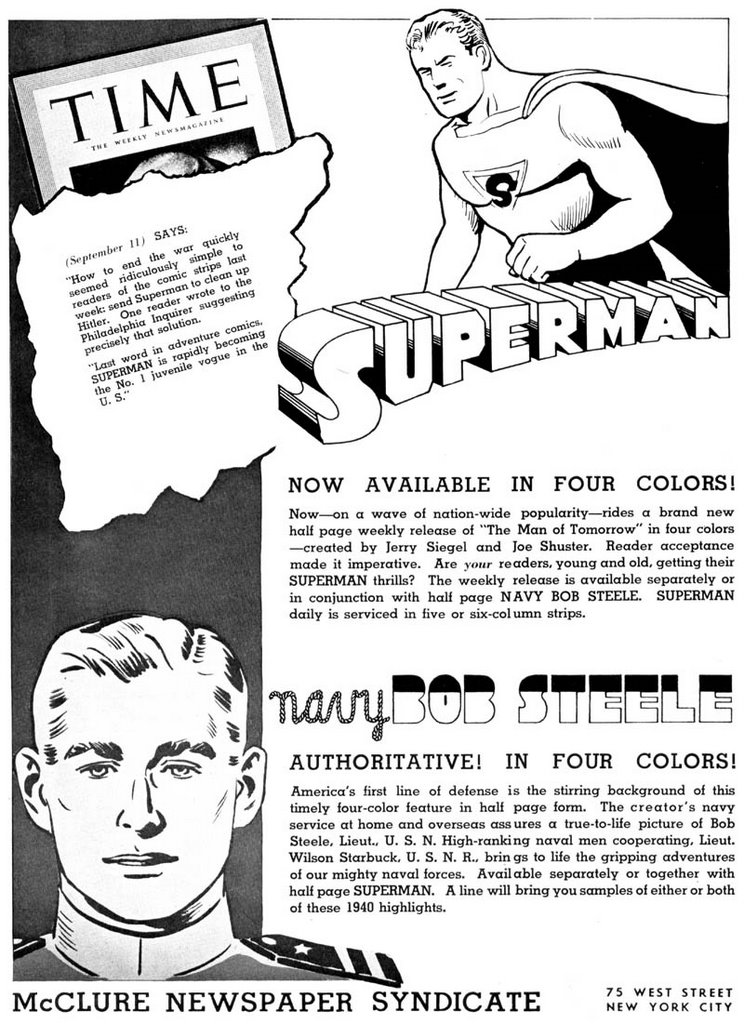
Half-Pages by McClure (9/23/39)
"Navy Bob Steele," a half page Sunday strip in full color, by Lieut. Wilson Starbuck, U.S.N.R., is being offered by McClure Newspaper Syndicate. Its introduction will come in mid-November, the syndicate said, at the same time that "Superman," now a daily strip distributed by McClure, appears in Sunday half page size. The latter comic, by Jerry Siegel and Joe Shuster, of Cleveland, was introduced last January.
The Bob Steele strip, which will be sold separately or with "Superman," will be "the inside story of the United States Navy," according to the announcement. Many of the incidents were inspired by active service experiences of Lieut. Starbuck, who at the age of 19 won a commission and was placed in command of U.S. submarine chaser No. 20 at New York in 1917. During the war he also served on the U.S.S. Shawmut and engaged in mine laying in the North Sea. After the armistice he was transferred to the air detachment of the Atlantic Fleet, where he learned to fly. He is now a senior grade lieutenant in the Naval Reserve.
"Superman"’s debut in the fall as a Sunday strip will bring new laurels to two youths in their early twenties who conceived the idea for their strip during their days in Cleveland high school. The strip deals with the adventures of the sole survivor of a cataclysm on a distant planet, sent to earth as a baby on a small rocket ship. In manhood "Superman" becomes a reporter and uses his gifts of strength and super-intelligence to combat evil-doers. Shuster is the artist and Siegel does continuity on the strip.
Labels: News of Yore
Sunday, September 17, 2006
Obscurity of the Day: Heine Himmelbleu

Here's one last Philadelphia Record strip before we change the subject. Heine Himmelbleu is just another in a practically infinite series of strips ridiculing Germans. This one portrays accents so thick that the reader has to decode the dialogue almost like a puzzle. In this case the work is worth it as the gag is well and skillfully told.
The strip ran on the Record's Sunday humor page 1/28 to 5/19/1912, and was penned by a fellow who signed himself R.Pechner (when he bothered to sign at all). Pechner's only other known comic strip credit was Highbrow McAllister, a short-lived feature that ran in the New York Evening World in 1909.
Labels: Obscurities
Thanks,
- Hy
Obscurity of the Day: Cousin Sammy Green
 Continuing with our Philadelphia Record strips, here's an interesting one. As we discussed way back when, Willie Green was the Record's marquee strip - it ran for at least two decades starting in 1907. However, back in the days when cartoonists were allowed vacations, Willie Green cartoonist Harris Brown began occasionally taking time off in 1911. In place of the vacationing Willie Green strip came this strip, Cousin Sammy Green.
Apparently the Record considered Willie Green to be a big draw for their Sunday edition, so the replacement strip, by John F. Hart, was designed to be its doppelganger. The premise was that Willie had a cousin, Sammy, who engaged in the same sort of adventures as did Willie. Sammy would relate his escapades in the form of letters to Willie.
Cousin Willie Green debuted on December 10 1911, and would continue to spell Brown's strip on a regular basis through at least 1916 (the extent of my research thus far).
Labels: Obscurities
Cynthia Curry
: 8/21/2020 1:32 PM Hello, This is Danielle Burris Jenkins Jr. and I wanted to share with Burris Jenkins Jr.
The autobiography that he and his father wrote.
Please contact me at the website above.
Friday, September 15, 2006
Obscurity of the Day: Chilly Cholly's Ice Cream Dream
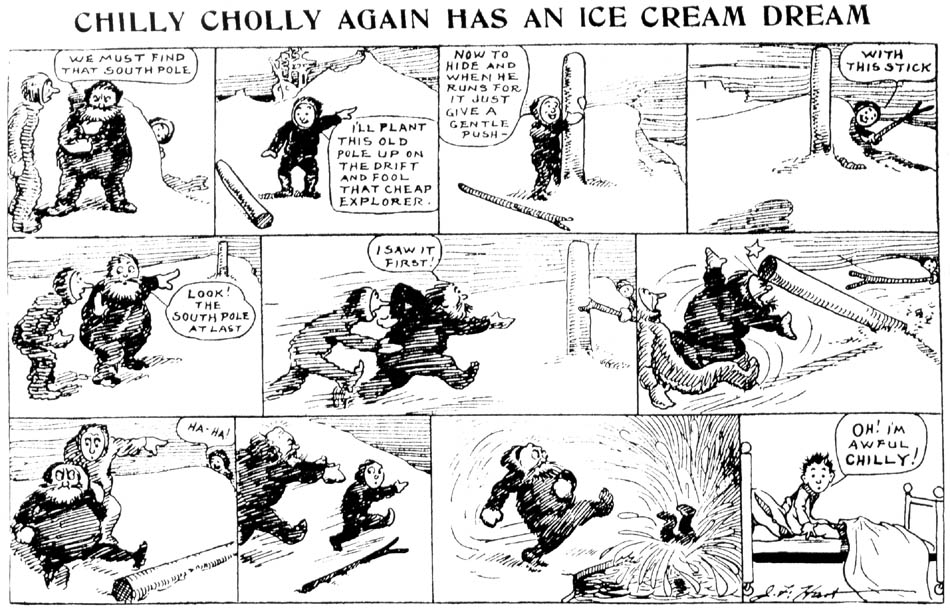 Here's another J.F. Hart production from the Philadelphia Record, titled Chilly Cholly's Ice Cream Dream. This one is a pretty blatant rip-off of the Little Nemo plot, even down to the archetypical final panel. The art on this one may look rushed, but the real problem was that this strip was printed very tiny in the Record. The size you're seeing it on the screen (before clicking on the image to enlarge it) is already larger than it ran in the paper. Cholly's chills apparently weren't good for his health, because he went to sleep permanently after just six episodes (10/29 - 12/3/1911).
Labels: Obscurities
: 2/18/2014 5:02 PM : 8/21/2020 1:37 PM Obscurity of the Day: Andy and Agnes
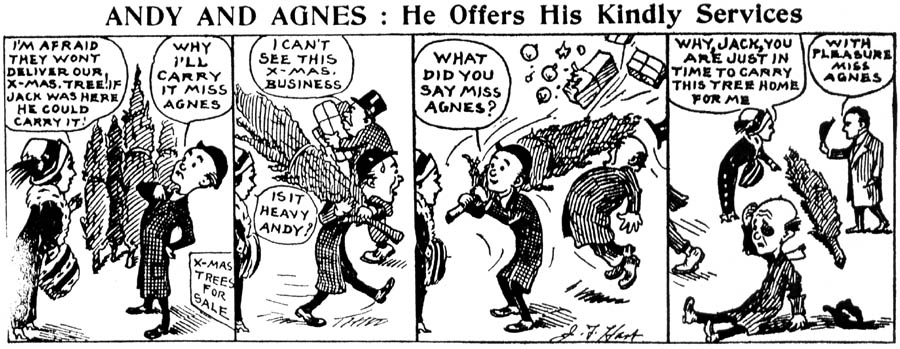
Time to take a breather from the mystery strips; the letter M promises to be a long list. So today instead we have Andy and Agnes, a strip by John F. Hart which ran in the Philadelphia Record from December 17 1911 to February 4 1912. Though formatted like a daily, the strip ran weekly on the the Record's Sunday humor and cartoon page. The Record resolutely resisted the higher circulation figures promised by adding daily strips and a color Sunday comic section for years after all the other Philly papers hopped on the bandwagon. Instead they stuck with their black-and-white half-page Sunday strip Willie Green plus an assortment of cartoons, humor, and comic strips on the other half page.
J.F. Hart was an excellent cartoonist who seems to have spent almost his entire career at the Philadelphia papers (the Record mostly, but he did work for others as well). His specialty was cartoon puzzles, and he produced a series of them that ran for years in Philadelphia and were syndicated around the country. The puzzles took the form of a series of cartoons, and the reader was to deduce a common phrase, a geographical landmark, a famous person, or what have you, from the clues in each drawing. For instance, a washerwoman working her way through a huge pile of dirty clothes might have the answer Washington. The puzzles were often quite tough, but apparently the audience was up for the challenge.
Labels: Obscurities
Thursday, September 14, 2006
E&P Mystery Strips: Letter L
Laff It Off - Vance van Demark - Thompson Service - daily panel - 1941
Laff Toons - Mike Gray and Bob Moore - Nationwide Features - weekly panel - 1949-50 [Charles Thompson supplies proof that Nationwide was a producer of advertising strips; not eligible for SG listing]
Laff Track - Marty Brucella - R-GAB Features - daily panel - 1980
Lamentin' Luke - Art Gates - self-syndicated - daily strip - 1956
Land of the Midnight Fun - Sarge O'Neill - Southern Cartoon Syndicate - daily strip - 1974
Larger Than Life - David Gallagher - Public Syndicate - daily panel - 1992-93
Larry Brannon - Winslow Mortimer - National Newspaper Syndicate - daily strip - 1961-68 (Alberto Becattini says it ran in the Toronto Star - did it appear in any US newspapers? Yes, it ran in the Kingsport Post!)
Lars And June - Ray Rhamey - Rayr Thoughts - daily strip - 1977-78 (found! by Jeffrey Lindenblatt in Philadelphia Daily News)
The Last Straw - Dan Juravich - Superior Features - weekly strip - 1983-present
The Late Late War - Fred Fredericks - Adcox Associates - daily strip - 1960 (found in Hayward Review)
Laughing Gas - Bill Freyse - Feature Sales Syndicate - daily strip - 1937-38
Laura Good - Ellis Eringer and Russ Manning - Crown Features - Sunday strip - 1960 (Alberto Becattini says it ran in Shopping Bag/Family Funnies, a weekly magazine distributed in southern California supermarkets)
Law And Disorder - George Koukos - Creators Syndicate - daily strip - 2000
The Law - Charles Schwab - Unicorn Features - daily panel - 1972-73
Lefty Betts - Bob York - Globe Syndicate - daily strip - 1948
Legal Laffs - Rube Weiss - Blackstone Press Features - weekly panel - 1971-76
Leisure Hour - Newton Pratt - Globe Syndicate - daily panel - 1950
Lemont Brown - Darrin Bell - Continental News Service - weekly strip - 1996-99 (D.D. Degg says this ran in the UC Berkeley Daily Californian, a college paper, before it was renamed "Candorville" on syndication)
Les Moore - Philip Jewell - self-syndicated - daily panel - 1992-96
Lest We Forget - Joe Archibald - Wheeler-Nicholson - daily panel - 1926
Let's Go - Grace Brown and Marion Moran - Conde Nast - daily strrip - 1929
Let's Go Town - William Spear Jr. - Western Newspaper Union - weekly panel - 1927, 1936-37
Li'l Chief Hot-Shot - Frank Stevens - Associated Features - daily and Sunday strip - 1945-46
Li'l Peanut - Lou Paige - Al Smith Service - weekly strip - 1951 (found! in Audubon News-Guide)
Li'l Philosopher - Constance Bannister - Miller Services - daily panel - 1960-62
Libby - Jeff Sinclair - Kartooning Advertising - daily strip - 1980-81
Life Lines - L.C. (Les?) Carroll - Crosby Newspaper Syndicate - daily panel - 1938
Life's Little Dramas - Bart Hodges Jr. - NY Post Syndicate - twice weekly panel - 1946-47 (D.D. Degg reports that this was a text column with a caricature graphic, not eligible for SG. Thanks DD!)
Life's Little Temptations - Phil Hummerstone - Words & Pictures Service - daily panel - 1949-50
Life-Laffs - Ralph Hershberger - Century Features - daily panel - 1937
Lippy The Yippy - Sarge O'Neill and Bill Wright - Southern Cartoon Syndicate - daily panel - 1970-76
Listen Ladies - Mark Beebe - NY Herald-Tribune - daily panel - 1953
Little Evy - Evy Caroll - King Features - daily panel - 1945 (found! in New York Mirror)
Little Ezra - Ed Jona - Allied Features - daily/weekly strip - 1938
Little Folks of Circleville - Rome Siemon - N.E.W.S. - daily and Sunday strip - 1949
Little Green Man - Jaime Diaz - Ed Marzola & Associates - daily and Sunday strip - 1976
Little Ideas That Grew Big - Frank Cheesman - North America Sportsmens Bureau - thrice weekly panel - 1938
Little Island - Collins Clive - United Press International - daily strip - 1984
Little Jackie - Stanley Miller - Matz Features - daily strip - 1936
A Little Leary - Bill Leary - National Newspaper Syndicate - daily panel - 1963-86 (doesn't qualify for listing, art was reused from day to day on this homilies panel - thanks to Bill Mullins for sample)
The Little Major - Bob Kane - General Features - weekly strip - 1937-42 [found! by Art Lortie in Hastings News]
The Little Man - Ray Salmon - self-syndicated - daily panel - 1980-2001
Little Moonfolks - Rome Siemon - Associated Press - daily and Sunday strip - 1952 [Jeffrey Lindenblatt has found the daily running in the Greenwood (MS) Commonwealth. Thanks Jeffrey! Anyone find the Sunday?]
Little Otto - H.T. Elmo - Wheeler-Nicholson - daily strip - 1926
Little People of the Air - Isabelle Stewart Way - Giblin Features - daily panel - 1925 (doesn't qualify for listing, turns out to be an illustrated text column about birds - thanks to Bill Mullins for sample)
Little Rodney - Jimmy Caborn - Arthur J. Lafave - weekly panel - 1937-39 (FOUND! in Cleveland Plain Dealer)
Little Rowdies - Marsh and Mulholland - Thompson Service - daily strip - 1934
Little Sampson - Paschall - Graphic Syndicate - daily - 1925
Little Strokes - Elena - self-syndicated - daily and Sunday panel - 1973
Little Wild-Heart - Carl Moon - Independent Syndicate - weekly strip - 1930
Live 'n Laff - Rube Weiss - Blackstone Press Features - weekly panel - 1967-76 (Found! by Robert Brooke in Eastern Oklahoma Journal)
Live It Up - Tony Victorian - World News Syndicate - daily panel - 1973
Lola - Inigo - Picadilly Press - daily strip - 1966-68
Lonely Heart - Herc Ficklen - Avalon Features - daily panel - 1968-79
Long Shots - Frank Hill - Continental Features - daily panel - 2003-present
Looking Around - Sid Hathaway - Al Smith Service - weekly panel - 1970 (Ray Bottorff Jr finds that this was actually a text column, listed in the wrong E&P section. Thanks Ray!)
Looney Land - Jim Navoni - Premier Syndicate - daily panel - 1926 (Found! by Bill Mullins in the Lowell Sun. Thanks Bill!)
Loony Limericks - Jerry Schiller - Blackstone Press - weekly panel - 1957-61
Loop Carew - Ted Miller - Press Alliance - daily - 1940-48
Lord, I Said - Hank Hartmann and Martha Merrill - LA Times Syndicate - daily panel - 1978 (Found! in Kokomo Tribune, Carlisle Sentinel, Alexandria Town Talk -- but it was self-syndicated, not thru LA Times -- thanks to Ray Bottorff Jr.)
The Losers - Bob Kane - Ledger Syndicate - daily panel - 1966
Love And Laughter - Maria Molnar - Oceanic Press Serv ice - weekly strip - 1983-95
Love, Love, Love - Chuck and Gwen Bowen - Universal Press - daily panel - 1970-71 (found! in Sacramento Union)
Lucky Breaks - C.R. Miller - Distinctive Features - daily panel, Sunday strip - 1930
Labels: Mystery Strips
the title was changed to "Candorville".
Has anyone ever seen a Continental Features/Continental News Service strip syndicated to a daily paper?
: 9/14/2006 7:13 PM "Continental Features/Continental News Service encourages writers, cartoonists and photographers to apply for sponsorship in syndication"
Sorta sounds to me like they might put aspiring writers and cartoonists into their magazine for a fee. Not to cast aspersions without proof, but this has the smell of a scheme to part amateurs with some of their cash in exchange for giving them 'exposure'. Maybe I'm just reading it with a a too jaundiced eye.
--Allan
Darrin Bell has two different comics named "Rudy Park" (from United Features) and "Candorville" (from Washington Post Writers' Group). Just a note.
: 6/06/2007 11:38 AM Thanks for the offer, but original art is no guarantee that the strip actually ran, so we need tearsheets to get a strip off the mystery list.
--Allan
In 1955 Art Gates had a comic book series for Charlton called Hillbilly comics, drawn in a Mort Drucker style. This may be an outcome of that.
But it was a short column featuring an incident in the life of some well-known personality. The only art was a caricature of the celebrity.
D.D.Degg
: 10/26/2018 7:42 AM https://www.newspapers.com/clip/73424090/chalk-talk-cartoonist-ted-miller/
my best
Ray Bottorff Jr
The Newton Graphic (Newton, Massachusetts), Thursday, March 30, 1950, page 3 "Annual Meeting of Auburndale Woman's Club to be Held April 12" (https://archive.org/details/NewtonGraphicMar_1950/page/n51/mode/2up?q=Loop+Carew). Per the text:
"Mrs. Thomas E. Crosy, day chairman, will introduce the speaker, Mr. Ted Miller, cartoonist, who will take for his subject, "This Funny Business.” He will tell the story behind the comic strips. He created the comic strip "Loop Carew” for the Haverhill Evening Gazette prior to his enlistment in the AAF. During the war he contributed regularly to "Yank.” His cartoons have appeared in such publications as and Better Homes and Gardens and he recently became associated with the Christian Science Monitor as artist and author of 'The Diary of Snubs Our Dog.'"
So figure Loop Carew appeared in the Haverhill Evening Gazette from sometimes during 1938-1942-ish.
my best
Ray Bottorff Jr
https://www.newspapers.com/clip/73426243/looking-around-with-sid-hathaway/
https://www.newspapers.com/clip/73426727/new-feature-starts-today-lord-i/
Looks like an outlier as a May 9th dated strip showing up in October 1979:
https://www.newspapers.com/clip/73426760/lord-i-said-by-hank-hartmann-strip/
I get the feeling this strip may not have been run every day by these papers.
my best
-Ray
https://www.newspapers.com/clip/73426938/vallejoan-cited-for-patriotism-ray/
(The Napa Valley Register (Napa, California) Friday, May 9, 1980).
No appearance of the strip shown yet, but I wonder since he self-syndicated, maybe his work only appeared in the local newspaper, the Vallejo Times-Herald?
http://danjuravich.com/html/bio1.html
Clipped an ad cartoon he did for Pittsburgh Post-Gazette:
https://www.newspapers.com/clip/73427385/the-dawn-patrol-dan-juravich/
my best
Ray Bottorff Jr
https://www.newspapers.com/clip/73427619/egad-friends-major-hoople-sends/
No mention of what papers his work appeared in.
my best
-Ray Bottorff Jr
https://www.newspapers.com/clip/73427766/public-defenders-offbeat-cartoons-take/
my best
-Ray Bottorff Jr
Thanks for pushing me to take a second look at Lord I Said -- it ran 4/3/78-8/18/79 as a daily, then was distributed in reprints for another year or so.
Juravich's comic strip "Norm" ran in the Pittsburgh Post for one month in 1983; I still can't find any of the weekly strips and panels he claims on his website, but Suburban Features stuff is always hard to pin down.
Thanks very much for your many bits of info on the mystery strips lately; with so much coming onto digital these days, you never know what might turn up.
--Allan Holtz
"Little Buddy" by Bruce Stuart. Copyright by Lincoln Newspaper features, Inc. Numbered, not dated. A generic little boy/family strip, he looks like "Freckles" of ca. 1915. (it appears as "Bruce Stuart" might be HT Elmo) Seen as early as 17 May 1935 and as late as
6 October 1939 in the Cayuga Chief,(Weedsport, NY), which formally announced it and "The Goofus Family" were being replaced in the 13th October issue with "Nappy" and "Socco The Seadog."
: 5/25/2022 5:53 PM Tuesday, September 12, 2006
E&P Mystery Strips: Letter K
Here's the list of undocumented strips for the letter K. Help!
Keeping Up With The Kids - J.R. Harington - International Features - daily strip - 1950
The Kid From Brooklyn - Woody Gelman - McCay Features - daily and Sunday strip - 1945-46
Kidbits - J.H. Kerber - Select Features - daily strip - 1962-63
Kidoodles - Leo White - self-syndicated - daily strip - 1984-90 (found! by Charles Brubaker in Lynn Item)
The Kids Next Door - Sarge O'Neill - Southern Cartoon Syndicate - daily strip - 1971
The Kids - Joe Buresch - self-syndicated - weekly panel - 1973-86
Kilroy, The Cartoon - Jack Anderson et al - Associated Features - daily panel - 1993-2001
Kingston - Evan Tweed - International Syndicate Group - daily - 1987
Kith And Kin - Becky - Chicago Tribune-NY News - Sunday panel - 1946-50 (found! in Chicago Tribune)
Kitten Kaye - Leo Beroth - self-syndicated - daily strip - 1957-61 (existence verified in Hayward Daily Review by Todd Hillmer - thanks Todd!!)
Knowing Gnome - Beatrice D. Miller - Independent Features - daily - 1965-66
Komical Cartoons - Stanley Matz - self-syndicated - weekly strip - 1941
Kool Roo - Peter Dare - Al Smith Service - weekly strip - 1987-89 (found! in Langley Advance)
Koopersmith's Kreative Kingdom & Kalendar:Return To Utopia - Adrienne Sioux Koopersmith - self-syndicated - thrice weekly - 1999-2000
Krass & Bernie - G. Trosley - Oceanic Press Service - weekly strip - 1976-95 (Charles Brubaker says this was a feature in CARToons magazine)
Krazy Cat - James Rodriguez - United Cartoonist Syndicate - daily - 1988-95
As far as I know, the strip was never syndicated.
In any case, that's an interesting nugget of knowledge. These oddball syndicates like Oceanic seemed to advertise things for years and years, yet I've never found ANY of their advertised strips in newspapers. Same goes for Dickson-Bennett Features, Southern Cartoon Syndicate, United Cartoonists, etc.
--Allan
: 12/26/2008 9:30 PM --Allan
https://imgur.com/a/59d5sqL
Monday, September 11, 2006
Mystery Strips of E&P: Letter J
Today we cover the mystery strips of the letter J:
Jack And Tyler - Mark Tonra - King Features - daily and Sunday strip - 1995 (Found! in Deseret News)
Jack Knife & T. Spoon - Sarge O'Neill - Southern Cartoon Syndicate - 1970-78
Jackie - Al Smith - Al Smith Service - weekly strip - 1951-52 (turns out this is the original title of Smith's "Rural Delivery", which is not a mystery strip)
Jackson's Law - Pedro Moreno - United Cartoonist Syndicate - 1981-84
Jason - Foster Moore - Al Smith Service - weekly strip - 1993-99
Jasper of the Jungle - Eric Erickson - George Matthew Adams Service - daily strip - 1948-50
Jellybean - Bennett and Burkhardt - Press Alliance - weekly panel - 1982
Jennifer - Art Gates - Gates Features - weekly panel - 1968-69
Jericho Jones - Stephen Graham and Kirk Luehrs - Telefriends - daily strip - 1974-76 (found - apparently an alternate title of "Pilgrims")
Jerry Junior Air Warden - Al Zere - Bell Syndicate - daily strip - 1942
Jerry Dare - Clark de Ball - United Features - daily - 1933
Jerry The Giraffe - Ralph Matz - Matz Features - daily panel - 1945
Jes' Smith - Johnny Pierotti - Columbia Features - daily strip - 1953-73 (Hans Kiesl found Greensburg Tribune ran two weeks of syndicate samples -- still looking for a more substantial run on this one)
Jest A Moment - Hugh Kennedy and Bert Nelson - Buffalo Courier-Express Syndicate - daily panel - 1962-64
Jest For Fun - Christine Decker - Lloyd James Williams - daily panel - 1937
Jest For Laffs - Audie Bransford - Centurion Press - daily and Sunday panel - 1972-79
Jest For Laughs - Paul Fung Jr. - Al Smith Service - weekly strip - 1978-83
Jest For You - Robert Orben - Comedy Center - weekly panel - 1977
Jewish Panorama - Sauberman - Seven Arts Features - weekly strip - 1935
Jill And Judy - Gene McNerney - Watkins Syndicate - daily strip - 1938-40
Jimmy Rivers' Adventures - Joe Buresch - Matz Features - daily strip - 1937
Joe Blow - William J. Miller - Miller News Services - daily panel - 1939
Joe Briggs - Dennis Austin - Bell Syndicate - daily and Sunday strip - 1948
Joe Fann - C.T. Jones - American International Syndicate - daily panel - 1980-81
Joe Gish - Terry Gilkison - Publishers Autocaster Service - weekly panel - 1930-34 Found! by D.D. Degg in the Cass City (MI) Chronicle - thanks DD!
Joe And Judy - Walsh - National Catholic Welfare Conference - weekly strip - 1940-57
John Dough - Susan Wyatt - Mid-Continent Features - thrice weekly - 1976-77
The John Smiths - Harold Magin - Federated Press - weekly strip - 1937-40 (Found! by Hans Kiesl in Kenosha Labor and other labor newspapers)
Johnnie Jones - Bill Savage - Federated Press - weekly strip - 1946
Johnny Scribe - Schaub - Thompson Service - daily strip - 1933-34
The Jones Sisters Ed Gillum - The Comic Factory - weekly - 1991-93
Joshua Trust - Cash Orcutt - Crown Syndicate - Sunday strip - 1960 (ran in Shopping Bag/Family Funnies, a weekly magazine distributed in southern California supermarkets and was done by Russ Manning under this pseudonym)
Judge Pudge - David Watkins - Suzerain Syndicate - daily strip - 1992-93
Julian of the Jungle - Frederick Toran - Editorial Board Syndicate - weekly strip - 1967-68
Julius - Harry, Joan and Nelson - Oceanic Press Service - weekly strip - 1982-94
Junior - Bob Moore - Nationwide Features - daily panel - 1949-50 [Charles Thompson supplies proof that Nationwide was a producer of advertising strips; not eligible for SG listing]
Junior Hall of Fame - Kenneth Cromwell - Junior Features - daily strip - 1935-37
Juniors Viewpoint - C. Mozier - Associated Press - daily strip - 1935
Just Add Walter - Tim Faherty - King Features - daily and Sunday strip - 1992 [found! in Lakeland Ledger]
Just Imagine - Fola - Transworld Features - daily and Sunday strip - 1952-58
Just Like Junior - Stan Asch - McClure Syndicate - daily panel - 1937-38
Just Once - Bob Orso - Feature Associates - weekly - 1979-80
Just So Happened - Kern Pederson - Al Smith Service - weekly panel - 1980 [found! as "It Just So Happened" in Marengo Beacon-News]
Just For Fun - Ram Onas - Sun News Features - daily panel - 1960-63
"Mark: "Jack and Tyler" was my first syndicated strip, distributed by King Features Syndicate (1995-96). It got my foot in the door and left me there!"
You can read the interview at http://www.astronerdboy.com/comic-strips/kiosks/advice/MarkTonra.htm
Regarding his comments on "Jack And Tyler", on the surface it sounds like a slam dunk, but there is a possibility that the strip only sold to a few foreign markets, or the few US papers that bought did it only to make it unavailable in their market (yes, a truly nutty concept, but papers in the few big cities left with multiple newspapers actually do it). That's why I'm really inflexible on the tearsheet rule. If I don' see it on newsprint it doesn't qualify for Stripper's Guide.
Thanks -- Allan
Well, since not many newspapers picked the strip up, you'll have to ask Tonra. It could've ran in his hometown newspaper.
He has a website www.tonra.com
--Allan
--Allan
Did you get his email yet, Allan?
"You asked about Jack and Tyler. I remember the Kansas City paper (KC
Star?) called King to complain that I was late one week, so you might want
to start looking there. I don't think J&T ever had more than 20 papers and
I have no memory of what they were. It definitely didn't run in Manhattan
where I lived. I do remember that the LA times was the first paper to pick
it up, but I'm almost sure they never added it to their page. As for the
launch date, I'm guessing it launched in September of 1995 and ended the
following summer -- June maybe. It ran just shy of a year. All of my J&T
files are packed away somewhere, so I don't have this info at my
fingertips, unfortunately."
Sounds like our only lead is Kansas City. Unfortunately Missouri is one of the states that doesn't have any friendly microfilm lending libraries. Anyone in Missouri that can check the film?
--Allan
LA Times didn't actually run "Jack and Tyler" in their comics page, since I couldn't find the strip in a website that lists every comic-strip LA Times ran at one point or another (it's a very detailed site, complete with the dates when these strips ran in the paper).
p.s. nice site
in my cartoon strip
pilgrims
it was sydicated by catholic news
services and then by telefriend
i have some tears from the
capital jurnal in salem or
kirk luehrs
: 4/17/2007 12:15 AM Thanks for the info! If you could send me some photocopies from the Salem paper we can 'de-mysterify' your strip and I'll send you a goodie box of neat stuff.
Please contact me privately at stripper@rtsco.com
--Allan
In the book "Indiana's Laughmakers", editorial cartoonist William B. Robinson is credited with creating the panel cartoon, Josephine.
Haven't seen many references to this around...
: 9/23/2009 1:48 PM but I did stumble upon a magazine comic strip
of his from almost 20 years earlier:
http://blog.modernmechanix.com/comic-about-overzealous-maker-kid/
D.D.Degg
Looks like Stan Asch's comic strip, Just Like Junior (which may not have been published as a comic strip), did get published in early DC Comics' titles, form 1938 to 1941. Since McClure had a relationship with DC later through Superman, I guess this makes sense.
Here is the listing of the feature from the GCD:
["No M'am, I'm not playing hooky. Teacher says I've got the measles!"]
Just Like Junior / cartoon / 2 pages US New Adventure Comics (1937 series) #24
February 1938 DC
["If this medicine is just like candy..."]
Just Like Junior / cartoon / 1 page US Detective Comics (1937 series) #13
March 1938 DC
["Won't this be a joke on his stenographer"]
Just Like Junior / cartoon / 1 page US New Adventure Comics (1937 series) #25
March-April 1938 DC
["I shoot at his nose, but I always hit the apple!"]
Just Like Junior / cartoon / 1 page US More Fun Comics (1936 series) #31
May 1938 DC
["What does the lion make him do now?"]
Just Like Junior / cartoon / 1 page US More Fun Comics (1936 series) #33
July 1938 DC
["Oh Pop, I just got through washin' th' dishes fer Mom-"]
Just Like Junior / comic story / 2 pages US More Fun Comics (1936 series) #34
August 1938 DC
["There's a bottle of castor oil on the top shelf"]
Just Like Junior / cartoon / 1 page US More Fun Comics (1936 series) #35
September 1938 DC
["Hurry, Junior - or you'll be late for school..."]
Just Like Junior / comic story / 2 pages US More Fun Comics (1936 series) #37
November 1938 DC
["Say Uncle Ed, Missus Jones nex' door just gimme a job to give you paintin' her garage..."]
Just Like Junior / comic story / 2 pages US Adventure Comics (1938 series) #34
January 1939 DC
["Gee, Mom, I'm fed up with piano lessons..."]
Just Like Junior / comic story / 1 page US More Fun Comics (1936 series) #41
March 1939 DC
["Young man, I want a good caddy..."]
Just Like Junior / comic story / 2 pages US Adventure Comics (1938 series) #55
October 1940 DC
["Bal-loons five-a cents..."]
Just Like Junior / comic story / 2 pages US Batman (1940 series) #3
Fall 1940 DC
["Oh, hello, Oswald..."]
Just Like Junior / comic story / 2 pages US Adventure Comics (1938 series) #56
November 1940 DC
["Can you handle th' circus alone..."]
Just Like Junior / comic story / 2 pages US Action Comics (1938 series) #33
February 1941 DC
["Gee, I wish I could go to th' circus..."]
Just Like Junior / comic story / 2 pages US World's Best Comics (1941 series) #1
[Spring] 1941 DC
I wonder if many of these were reprints of the strip offered for syndication...
my best
Ray Bottorff Jr
Interesting that McClure seemed to have had that ongoing relationship with DC that early. Thanx for the info! --Allan
Here's a "J" one...maybe. I'm sure you've seen it, but "it's JOAN by Reichhold, 5 December 1927-17 March 1928. This is a local only strip in the Pittsburgh Press. Reichhold was their staff cartoonist, who did three panels, "Rambling With Reichhold" "Mrs. Babble Broadcasting" and "Oh,Lady,Lady!", but this was the only strip. It's about a working girl, who might interact with the Press, the city of Pittsburgh and Reichhold himself, but very soon is centered on another character, a young, weird looking ne'er d well boyfriend named Spider.
: 11/05/2021 12:33 PM --Allan
Sunday, September 10, 2006
Obscurity of the Day: Mr. Always Wright
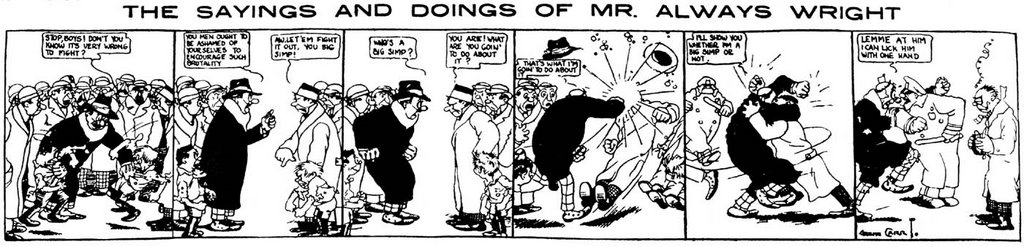 Here's another of the strips that ran in the New York (Morning) World (on which I refer you to my comments in yesterday's post). This one may really be the last continuing comic strip to appear there, at least in the mid-teens. Gene Carr's The Sayings and Doings of Mr. Always Wright ran February 12 through March 13 1914. I've indexed the World through August of that year, and there are no more strips to be found in that timeframe.
Labels: Obscurities
In pencil on the back appears to be 71/100....and I am assuming a quantity of 100 were created and I have #71
: 4/21/2016 10:10 PM Saturday, September 09, 2006
Obscurity of the Day: The Morning After
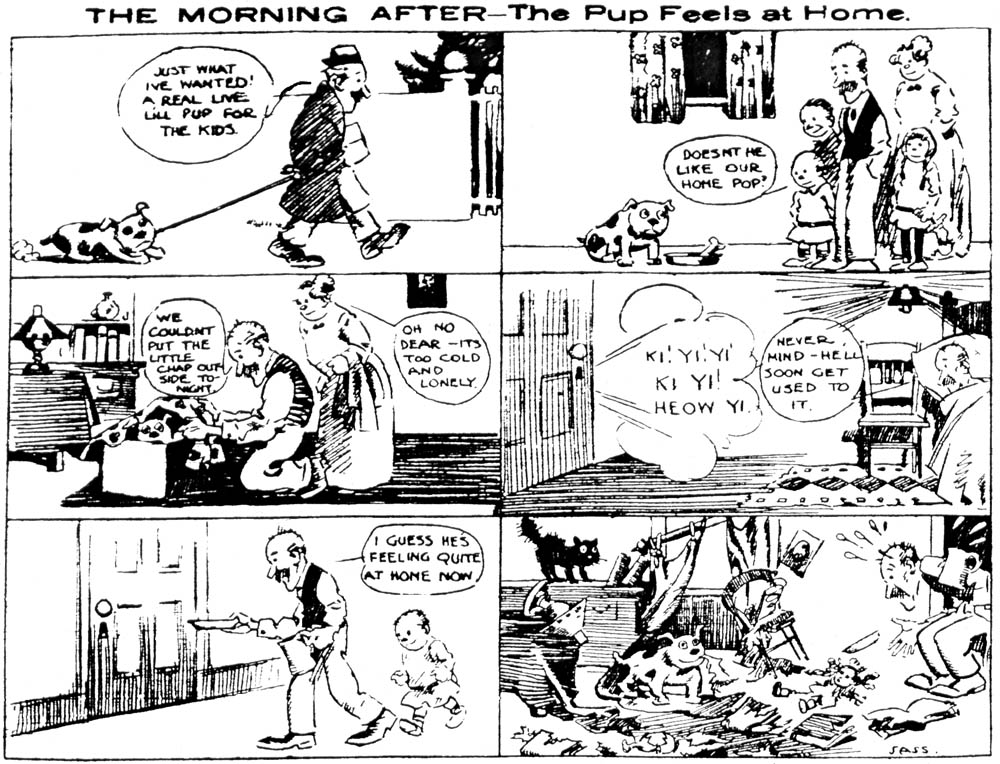
In the 1900s and 1910s it was the fashion among many papers to print comic strips only in their afternoon/evening editions. The reasoning behind this is a mystery to me. My best guess is that the evening editions were designed to appeal to the casual buyer on the street. In addition to the inclusion of comic strips, evening papers also tended to contain more sports coverage, the headlines more punchy, and the stories shorter and snappier. These differences might have been to make the paper more attractive to people on their way home from work who were looking to be entertained by the paper in addition to being informed.
In any case, when faced with a paper sporting two editions, I normally don't even bother looking at the morning paper - the good stuff is almost invariably found in the afternoon editions. The New York World is a case in point. The Evening World was brimming with comic strips, while the morning edition (just titled The World) was, I thought, bereft of such delights. Well, turns out that my comic strip radar was a little off, because the World did on occasion run comic strips in the 1910s. Based on my research so far, no more than one strip ran per day, and on many days there were no strips at all. In fact, it appears that the comics pretty much petered out entriely in 1914, with the exception of the panel cartoon Metropolitan Movies (know outside of New York as Everyday Movies) , which ran in the morning edition for many years.
One of the last strips to run in the morning edition was The Morning After. It was penned by someone who signed themselves Alex Sass. Sass seemed to specialize more in news cartoons (not editorial cartoons, but cartoon depictions of real news events), a cartooning genre that pretty well died out in the 'teens. The Morning After ran just five times in January 1914, and was Sass' only continuing comic strip for the World.
EDIT: Thanks to Sara Duke at the Library of Congress, who adds:
Sass, Alex (Williams), d. 1923
English-born Australian artist and cartoonist. He drew cartoons for Melbourne Punch from 1890 to1912. He moved to New York, where he cartooned for The Globe and The New York World. He returned to Australia after two years to work in advertising. He was the third artist to join the art staff of Smith’s Weekly and served as the newspaper's original art editor. He died in Sydney in 1923, while on the staff of Smiths’ Weekly.
Info from: “History of the ACA,” The Australian Cartoonists Association web site, viewed online: http://www.cartoonists.org.au/?page=214, 03/14/2010
Labels: Obscurities
Friday, September 08, 2006
Marquis Waxes Eloquent on Toonerville
The Toonerville Trolley (to F. Fox)
by Don Marquis in N. Y. Evening Sun, July 1916
When I get a little bit older
I'd like to be done with hard knocks,
And I think I’ll apply for a job to
The well-known cartooner, F. Fox;
For I want to hire out as the Skipper
(Who dodges life's stress and its strains)
Of the Trolley, the Toonerville Trolley,
The Trolley that Meets all the Trains.
It runs (when its humor's for running)
Through a country that's sweetly at rest -
Through a country that loafs with its coat off
And three buttons gone from its vest,
And I want to hire out as the Skipper
Who, whether it shines or it rains,
Runs the Trolley, the Toonerville Trolley,
The Trolley that Meets all the Trains.
Unhurried, unflurried, unworried,
By Chronos completely unvext,
If I should miss a train I would murmur:
"Perhaps I'll connect with the next!"
If I then missed the next one, no matter!
I shouldn't go blowout my brains
If the Trolley, the Toonerville Trolley,
Should fail to meet some of the trains.
In the end, when I met up with Charon,
Waiting there by the Stygian bank,
I'd remark to him, "Oarsman immortal,
You can't impress me with your swank!
You treat me as Skipper to Skipper-
My corpse is no common remains!
For I ran the Trolley, the Toonerville Trolley,
The Trolley that Met all the Trains!"
Thursday, September 07, 2006
Obscurity of the Day: The Shanghai Twins
 The Minneapolis Journal didn't have a Sunday edition way back when, so they simply ran the traditional Sunday features on Saturday (much like those Minnesota neighbors, the Canadians, do).
Charles "Bart" Bartholomew was the sole overworked cartoonist on the Journal in the early years of the century, and he made quite a name for himself in the midwest as an editorial cartoonist. But he also contributed features to the children's section of the paper on Saturdays. His usual dose was a front page panel cartoon, a few additional illustrations inside the section, and a large comic strip or panel cartoon for the back cover. Most of these back page features were one-shots, but he also indulged in the occasional series, of which today's Shanghai Twins was the first. It first appeared on October 27 1900, and ran four times, the last on February 2 1901. In this period all of Bart's back page features took the same form, two panels with rhyming text. The rhymes were likely supplied by W.A. Frisbie, who didn't take credit on these early features but did later on.
Bart's most lasting claim to fame was his correspondence cartooning school, whose ads were fixtures in Cartoons Magazine and elsewhere.
Labels: Obscurities
Tuesday, September 05, 2006
Obscurity of the Day: Patty-Jo 'n' Ginger

Jackie Ormes has acquired some interest from comic strip fans for her Torchy Brown series (see a sample here), mainly because of the strip reproduced in an old issue of Nemo. But Torchy was hardly more than a blip on Ormes' map. Patty Jo 'n' Ginger was her bread-and-butter cartoon, and it lasted more than a decade in the Pittsburgh Courier and other papers. I trust that the appeal of the panel needs no explanation.
Patty-Jo 'n' Ginger started on September 1 1945 and ended on September 22 1956. Near the end of the run the panel appeared only sporadically in the Courier.
Labels: Obscurities
Friday, September 01, 2006
Obscurity of the Day: Louie The Lawyer
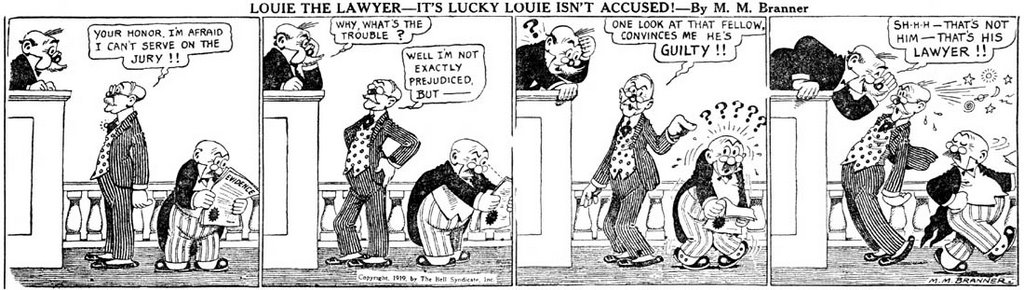
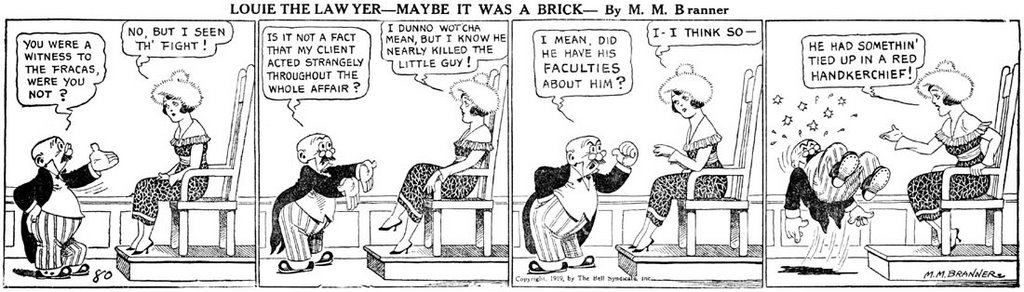
Before Martin Branner hit the jackpot with Winnie Winkle, he did this short run daily for the Bell Syndicate. Louie The Lawyer was a fun strip but seems to have never caught on with newspaper editors - I've been searching for samples of the strip for years before finally finding some in the Cleveland Press. Finding them in that of all papers is a headscratcher in itself, since the Press was the home paper of the NEA syndicate. Someone at the Press must have been a big supporter of Louie to put him in the paper, bumping one of their own NEA strips.
Louie The Lawyer ran from July 14 1919 until sometime in 1920 (anyone have an end date?). The character was later revived as the star of Looie Blooie, the long-running topper strip to the Winnie Winkle Sunday page.
Is it just me or do Branner's male heads remind you of Carl Barks' dog characters from the Donald Duck comic books?
Labels: Obscurities
