Tuesday, October 31, 2006


Obscurity of the Day: Viewpoint


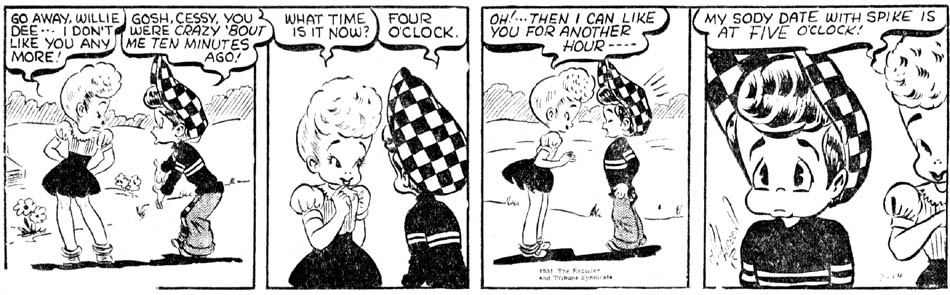
Before Dave Gerard brought his magazine cartoon Will-yum to the daily comics page, he created the panel cartoon Viewpoint. This panel in a way harkened back to the days of top hats and corsets in that it employs a 'he said-she said' narrative, much out of vogue by the 1950s.

Viewpoint began on January 9 1950 and from the start was viewed by most newspapers as strictly filler material, not worthy of a regular daily spot on the comics page, but used most often to plug a hole elsewhere in the paper.

To go along with its caption heavy style, Gerard renamed the feature to the klunky It's All in the Point of View on March 3 1952. This move, hardly a marketing plus, was probably at the insistence of some syndicated newspaper columnist who shared the original title.

Either Gerard or the Dille Syndicate came to its senses in 1953, and gave Viewpoint the heave-ho. It was replaced by Gerard's Will-yum, which had some success as a recurring magazine cartoon in The Woman's Home Companion, and ran with decent success for almost fifteen years.

Labels:


Comments:
Hello Allen:
in looking at viewpoint I thought I saw the style of a cartoon book I use to have that was about hunting and sports. I specifically remember duck hunting and fishing cartoons in it. The characters were a lot like these in viewpoint. Is there another artist of a similar style? Or was is Gerard?
 
I'm going to take a wild guess that you're thinking of Woody's World by John Holm. Similar style and about hunting and fishing. A reprint book of that was published in 1968.

--Allan
 
Post a Comment

Monday, October 30, 2006


Obscurities of the Day: Specs and Shaggy


Two obscurities for the price of none today -- two more of the New York Herald-Tribune's Sunday filler strips. These two were executed by cartoonists who chose to by somewhat anonymous.

Specs, credited to R. Gustafson, ran 5/12/46 - 5/25/47, not every week of course because it was a filler. This could, I suppose, be Bob Gustafson, but I assume he had his hands full at the time assisting/ghosting Tillie the Toiler for Russ Westover.

Shaggy ran intermittently 10/7/45 - 7/11/48. It was credited only to 'Gould'. I think I'm safe in guessing that neither Chester nor Will were involved.

Labels:


Comments:
Allan,

Have you compared Shaggy to Gould's later companion strip about a family with a pet crow? He wasn't above using a fast and cartoony style there.
 
Fair 'nuff, Ger, but I can't see ol' Chet moonlighting to the NYHT for the pittance they would have paid for these strips.

That would be like Donald Trump trying to make a few extra bucks on a stupid reality TV series. Oh, wait...

--Allan
 
Post a Comment

Sunday, October 29, 2006


Obscurity of the Day: Pookie


We first discussed the New York Herald-Tribune filler strips back on this post. These one-tier strips were mostly pretty bad, with a few notable exceptions. Pookie isn't anything particularly special, except that it replaced Mal Eaton's long-running 'regular' Sunday, Peter Piltdown.

Peter Piltdown ran in the Herald-Tribune's Sunday comic section for over a decade, and Pookie was a character in that strip. Eaton's full-size strip, though it had a healthy run, was never a syndication success, and that's probably the reason for its demise. Pookie, as a filler strip, wasn't offered for syndication. It ran, space permitting, from 12/22/47 through 2/29/48, in addition to Eaton's new full-sized strip Tizzy, also not a syndication success.

Labels:


Comments:
Is this really obscure, when Peter Pitdown and Pookie moved over to BOY'S LIFE magazine - the official Boy Scout magazine, as Rocky Stoneaxe (hope i have that right) around 1950 - lasting at least 20 more years?

Steven Rowe
 
Casting aspersions on my obscurities, eh? I didn't know that the Pookie character continued in Rocky Stoneaxe, but a quick check of the files did bear that out. Of course, the obscurity here was the filler strip, not the character, but thanks for the info on its continuation. Interesting that Eaton had to change the name of his main charcater, but that Pookie was allowed to go on as before.

--Allan
 
Post a Comment

Saturday, October 28, 2006


Obscurity of the Day: Oh, That New York! What It Doesn't Do To You!

Herb Roth is best known for his book and magazine cartoons, as well as being the assistant/ghost to H.T. Webster. Here, though, is an early work in comic strip form. In fact, it's the only continuing comic strip that I have been able to document by this otherwise very prolific artist.

Roth obviously wasn't trying to conserve printer's ink when he came up with the title Oh, That New York! What It Doesn't Do To You!, and yes, every episode bore that rather ungainly title. The strip appeared on the second page of the New York World's Sunday Metropolitan section (we'd call it an arts and entertainment section these days) from January 12 through March 23 1913.

The title was the only ungainly thing about this strip. The art, sort of an art deco meets cubist meets naive style that Roth used to good effect for years, was already in full flower, a real delight to behold. Startlingly modern for newspaper art in 1912, it apparently seemed so sophisticated to the World's editors that it deserved a special place of honor in a section otherwise illustrated with glamorous photos of Broadway stars and reproductions of great artworks.

The strip chronicled the travails of those who visited or moved to the Big Apple. Roth, like most New Yorkers, seemed to revel in the unhealthy conditions, high prices, crime and assorted other blights of New York, essentially daring visitors to make it 'like us' in the big city. In Roth's comic strip none are successful, always hightailing it out of town at the end of the strip. New Yorkers were and still are a special breed, button-busting proud of the city that they proudly proclaim is a hellhole worse than the prison of Calcutta.

In response I say to New Yorkers, "have you visited Gary Indiana lately?"

Labels:


Comments: Post a Comment

Friday, October 27, 2006


Obscurity of the Day: Optimistic Oswald


Perennial and prolific comic stripper Charles W. Kahles produced Optimistic Oswald for the New York World just a handful of times from 11/4 to 12/5/1912. The strip may well have been intended as a Sunday feature - the panel layout and size of the caption text seems more suited to larger Sunday reproduction. However, it was one of the few features that ran in the morning edition of the daily World (as opposed to the evening editions which were chock full of cartoon treasures).

The premise is as standard as it comes for the era. Give your lead character one standout trait, in this case naive optimism, name the strip after the trait, and fire away. Strips with such simplistic premises as these had limited lifespans, but that was an accepted mode in those days, and helped to fuel the fierce creativity that was rampant on the daily comics pages. Sure there were lots of clinkers in the load, but there was also the occasional gold nugget among the coal. Optimistic Oswald is decidedly of the carboniferous variety.

Labels:


Comments: Post a Comment

Thursday, October 26, 2006


The Nut Brothers, Version 1.0


Yesterday's post on The Nut Brothers was apparently swallowed by Blogger, never to be seen. So you've missed out on the fascinating and informative essay that I slaved over. Today you get sloppy seconds. Boiled down, what we have here is the original daily version of The Nut Brothers, which later was revived as the perennial topper to Our Boarding House. Gene Ahern started this early version on 12/19/1921, then handed it off to Edgar Martin sometime in 1922. The two-panel Nut Brothers stacks ended 10/14/1922.

Holtz out!

Comments: Post a Comment

Tuesday, October 24, 2006


Obscurity of the Day: Mister Ex

We discussed the Chicago Tribune Comic Book in this blog entry; here's another of the new strips that was created especially for it. Mister Ex was a secret agent, forever embroiled in international intrigue of all sorts. His gimmick, that he was a master of disguise, seldom figured into the plotlines in any significant way.

Bert Whitman was the creator of the strip, after having failed to get off the ground with a Green Hornet strip (which yours truly is still trying to determine if it ever actually made it into a paper). Mr. Ex started in the Trib's comic book on January 19 1941 and ran until the end of that special section on April 4 1943. The strip was one of the few that survived, and it was graduated to the regular comic section. This reprieve, however, was short-lived. The strip ended in the Trib on July 4.

But that's not quite the end of the story. In the final panel of that July 4 Sunday it was announced that the strip would continue, renamed The Whizzer. However, the next Sunday no whizzing was to be found in the Trib's comic section. It wasn't until September 5 that a strip bearing that name appeared. The renamed strip only ran once more, on September 26, before it disappeared for good. Question is, did The Whizzer appear on a regular basis elsewhere? All I can say is that I haven't found it anywhere. Anyone?

Labels:


Comments: Post a Comment

Monday, October 23, 2006


Obscurity of the Day: Little Johnny and the Teddy Bears


Little Johnny and the Teddy Bears (9/1/1907 - 2/28/09) is one that makes me scratch my head. Not for the subject matter, which was nothing particularly noteworthy. We have a kid whose teddy bears have come to life. Their misadventures are told in rather pedestrian verse, supposedly to appeal to the younger kids. (By the way, I don't recall having any particular preference for stories told in rhyme as a youngster - I'm not sure how this convention originated in the funnies.)

What's odd is that this Sunday comic strip was copyrighted to Judge Inc. (the noted political humor magazine), and the verse was written, at least initially, by Robert D. Towne, the editor of the magazine. Now anyone who has read Judge would agree that it did not cater at all to juvenile audiences, so I don't really see why they would have been producing and distributing this sort of strip. I've read a few episodes of the strip, thinking that maybe the teddy bears are a commentary on Roosevelt, but I see no undercurrent of political opinion.

Anyway, the strip seems to have been distributed by the North American Company (syndication arm of the Philadelphia North American), and the strip was very well-drawn by J.R. Bray, later to make a name for himself in the animation game. Robert Towne wrote the verses until March 1 1908, then Constance Johnson took over the duties for the remainder of the run.

The strip either wasn't marketed all that well, or the subject matter didn't appeal, because you won't find this strip running in very many papers. On the other hand, until the 1910s it was a bit unusual for papers to mix strips between different syndicates in their comic sections. Most just bought the standard 4 pages of material from one source and didn't put any brain juice into picking and choosing the best individual strips. So an oddball strip like this, sold as a special item to take over the front page of a paper's comic section from the regular fodder probably caught a lot of editoors wondering, "Why bother?"

Labels:


Comments:
Nice blog, I didn’t know of it. Though, it is what I was looking for. A case of serendipity.
I’ m Italian, I am very fond of comic strip and dream to become a scholar like you in this matter. I write some review about classic comic strips having a look on the Italian scene too. You can find them on www.lastriscia.net, a site where you may see some Italian comic strip from a group of authors I collaborate with.
Together with a friend of mine, Giuseppe Scapigliati, a skilled cartoonist but also a great collector of original comic strips (perhaps you have heard of him), I am thinking of a blog like yours dedicated to comic strips. Obviously, for Italian readers. May we count on your help?
You are on my bookmarks, all my compliments.
I beg your pardon for my poor English.

Massimo Olla
 
Hi Max -
Always room for one more in the blogosphere! Please let us know when you start your comics blog and I'm sure we'll all come over to take a gander.

Best, Allan
 
Hello, Allan---LITTLE JOHNNY AND THE TEDDY BEARS originally was the feature on the back page of Judge magazine. In 1909 Judge launched their own short-lived comic syndicate,reprinting their old strips, mostly with recurring characters like James Montgomery Flagg's NERVY NAT and C.W. Kahles' THE YARNS OF CAPTAIN FIBB. Bray was there again, only with a new feature, LITTLE JOHNNY AND THE TAFFY POSSUMS. ("Billy Possum" was the long-forgotton William Howard Taft equivillant of the Theodore Roosevelt "Teddy Bear") It looks like Judge only syndicated four half-page strips a week.---Cole Johnson.
 
Hi Cole -
I've never seen Kahles' Yarns of Captain Fibb or Bray's Taffy Possums in newspapers - where did you find them?

--Allan
 
Post a Comment

Sunday, October 22, 2006


Obscurity of the Day: Kessler Cartoons


Best of luck to anyone trying to track the career of Camillus Kessler. Here was a guy who was all over the map, usually treading with little cat feet that leave little mark.

Kessler first pops onto the radar doing a few short-run comics in St. Louis in 1904-06. He then goes on to do editorial cartooning for the St. Louis Times for some period (I can only vouch for 1911, but my files are scanty, as they are for all of Kessler's output).

Kessler hit the big time (or semi-big time, anyway) when he got his start at the New York Press in 1914 during that paper's short-lived bid to become a major player. The Press added a whole litany of special features that year (including their own homegrown Sunday comics section), and Kessler found work doing weekly half-page cartoons to accompany the poetry of Frank M. O'Brien. This feature ran just six months.

I lose track of Kessler now for a full six years, but I suspect he might have been doing editorial cartoons for the New York Globe and Advertiser for some portion of the time. In 1922, though, he first pokes his head onto the national stage with a new syndicated panel feature for the Metropolitan Newspaper Service. The panel is in the Briggs-Webster mode with no traditional title, rather a revolving set of titles keyed to the subject of the day.

The titles are mostly standard issue, following closely on the models of his betters. Big Moments in Little Lives, Home Sweet Home, Making The Grade, Into Each Life Some Rain Must Fall, One Man In A Thousand, etc. His one title that breaks the mold is At The Bottom of the Ladder, wherein Kessler tells an anecdote from the lives of great men and women, usually from their childhood or early experiences, and accompanies the story with a suitable cartoon. These cartoons were collected in a massive reprint volume in 1926 by Lippincott.

Kessler's panels were dropped by Metropolitan in 1925, but he took the feature over to the New York Evening Graphic, and they continued it until November 1926. Then he made another syndicate jump, this time to the bottom of the barrel Payne Syndicate, which syndicated the feature for awhile in 1927. The panels produced for Metropolitan, though, are resold to reprint syndicates who will hawk them to small papers for decades to come.

Kessler's back in the big time in 1928, now with a matrimonial strip titled In For Life for the New York World. The big time's call, though, is fleeting. The strip lasts for less than a month.

Kessler next finds the Bell Syndicate willing to revive his panel cartoon, this time as a weekly feature. The new weekly run extends from 1930 to 1932. Bell has better success with a new Kessler daily panel titled Twenty Five Years Ago Today. This feature lasts at least through 1935, and possibly later.

Once agin Kessler disappears for awhile. In 1939, though, the Consolidated News Service brings his panel back one last time. Here Kessler goes with a regular title, Seems Like Yesterday. Restless as always, though, the official title is changed to Home Town Echoes around 1942, and soon reverts to a revolving set of titles, bringing things full circle. I've only seen this panel running on a weekly basis, but it was advertised as a daily. The panel was advertised through 1950, but I've never seen any later than 1944.

Kessler's artwork remained consistent throughout his career, workmanlike but with no stylistic flourish or panache. His gags are of the 'smile and nod' type, seldom if ever going for the big laugh. He was often grasping for the nostagic deja vu effects that were mastered by Briggs and Webster, but rarely succeeded as well as them. But if Kessler was a minor figure in cartooning lore, we have to give him his due - he was a working newspaper cartoonist for nearly fifty years, and how many can make that claim?

Labels:


Comments:
Nice blog, I didn’t know of it. Though, it is what I was looking for. A case of serendipity.
I’ m Italian, I am very fond of comic strip and dream to become a scholar like you in this matter. I write some review about classic comic strips having a look on the Italian scene too. You can find them on www.lastriscia.net , a site where you may see some Italian comic strip from a group of authors I collaborate with.
Together with a friend of mine, Giuseppe Scapigliati, a skilled cartoonist but also a great collector of original comic strips (perhaps you have heard of him), I am thinking of a blog like yours dedicated to comic strips. Obviously, for Italian readers. May we count on your help?
You are on my bookmarks, all my compliments.
I beg your pardon for my poor english.

Massimo Olla
 
Post a Comment

Saturday, October 21, 2006


Obscurity of the Day: Laugh and Learn


Yet another New York Evening Graphic find, Laugh and Learn ran in 1926. What a shame that this is Kerry Conway's only newspaper cartooning credit. That art is absolutely top-notch. His anatomy and expressions are obviously not the product of an untrained hand, and I love the style, which seems to harken back to a look that was popular way back in the mid-19th century.

Anyone know what happened to Kerry Conway?

Labels:


Comments:
No luck on finding out what happened to Kerry.

I did found out, though, that "Laugh and Learn" was apparently collected in a book format once, in 1930.

http://www.amazon.com/exec/obidos/tg/detail/-/B0008ASZLS?v=glance
 
Hi Charles -
Thanks extra much for the info on this book. It must be quite a rarity as there wasn't a single copy on ABE. I'll definitely have my eye peeled for it, though.

I guess if Conway had a book published in 1930, there must be more to the story than a short-run strip in the Graphic in 1926!

--Allan
 
Post a Comment

Friday, October 20, 2006


Obscurity of the Day: The Little Old Wise Man


Here's a neat strip from 1922 called The Little Old Wise Man. It was sold in batches by Ad Art Service to newspapers that wanted to stimulate their classified ad sales. As you can see the wise man had an answer to all life's problems, and the answer was invariably to place a classified ad. Delightful art was supplied by Lawrence Redner.

Labels:


Comments: Post a Comment

Thursday, October 19, 2006


Obscurity of the Day: Jolly Jumpers


Hard to believe that anything by Harrison Cady could qualify as an obscurity, but yet here we are. The Jolly Jumpers Sunday pages were produced for the mysterious Publishers Press syndicate. I have found precious little information about this company, or it's manager C.J. Mar, to whom all the strips were copyright. I do know that Mar was in 1910 a manager of the Hearst Syndicate, and this new venture was I gather his bid to start his own newspaper syndication company. Publishers Press also seems to have gone by the name Western Newspaper Syndicate during its short life.

Whatever the name, the syndicate seems to have been started in July 1911 with just one strip - Zoo-Illogical Snapshots by Harold Knerr. Harrison Cady came on board with Jolly Jumpers on May 19 1912, at first signing the strip as Gordon Curtis. Cady soon dropped the nom de plume. Jolly Jumpers was often run as a half page with another Cady effort filling the remainder. There were a number of these, including Bunker Blinks, Jungle Jinks, and the earliest comic page appearance of Peter Rabbit.

The syndicate and the strip ended sometime in 1914, having run in just a few major papers (Boston Post is one, and they dropped it early on). The syndicate actually produced enough material for a full comics section, but the only paper I've ever found that ran their section in its entirety is the Bellingham (WA) American Reveille. Sadly, the microfilm for this paper includes only a scant few of the comics sections.

If anyone knows more about C.J. Mar, Publishers Press, or knows of papers that ran the complete section, I'd love to hear from you.

Labels:


Comments:
Hello, Allan---The St. Paul Pioneer Press ran the the whole four-page section in early 1913. It's a pre-printed section, on different paper than the rest of the paper, and the SPPP's masthead printed in odd approximation type.---Cole Johnson.
 
Post a Comment

Tuesday, October 17, 2006


Happy Anniversary to Me!

Airhead that I am, it took DD Degg to remind me that I have been doing this blog for a year now. My inaugural post was on October 5 2005, so I've already overshot the mark by a bit.

The blog has been a lot of work, but it has been more than repaid by your comments, criticisms and information submissions. Your participation is the main reason I do the blog - I love to hear what you folks have to say - both fellow researchers and fans, and the occasional 'outsider' who chances across the site (like the relative of Clare Briggs who just contacted me with a lovely note yesterday).

It has also been a wonderful little daily break from what has been a long, hard year for me personally and professionally. Sometimes the hour a day I spend scanning and writing up blog entries may have been the only thing keeping me from going bonkers.

So here's to another year of miscellaneous ramblings through the dusty corridors of comic strip history. I hope you'll come along for the ride, and be sure to tell a friend or two. The more the merrier! And to celebrate the anniversary I hereby grant myself a day off. See you on Thursday!

Comments:
That's quite a coincedence. I started the Daily Cartoonist on the same day last year. I didn't find your blog until April of this year (or at least that's when I first mentioned it on my blog).

Congratulations! And here's to another great year.
 
I guess the only thing for you to do now, Allan, is give us a complete index of every proper noun that has appeared in you blog for the past year and when it appeared.
 
Alan, that is pretty wild that we started on the same day. Great minds think alike...?

I love your Daily Cartoonist blog and check in often. I don't envy you the amount of work it must take to keep it updated every day. Makes me seem like a real piker!

As to DD's suggestion that the site be indexed, Blogger does this automatically. There's a search option in the blogger bar at the top of the page.

--Allan
 
Hi, Allan.

Please hang in there. This page is a must go to destination for me every day. I have very little to comment about on the earlier stuff, but it is interesting and educational.

And if I may suggest a subject: I recently came across a couple of sundays for Bob Powell's Teena-a-go-go, a misguided, but nicely drawn feature for Bell-McClure in 1966. I would like to know more about it. Was there a daily version and does anyone have the dates it ran? What's also interesting (Michael Gilbert pointed it out to me) is that it was produced during Will Eisner's tenure at Bell-McClure. He has always stated that he had little succes with developing comic strips and mostly dealt with the columnists, but Bob Powell was his old studio mate...! Was he hiding a disappointment? And what other strips did Bell-McClure start in 1966? Are there more surprises hidden there?
 
Re Teena A Go-Go, a daily supposedly started in June 1966, the Sunday on August 14 1966 (I haven't seen a daily). It seems doubtful that either made it to 1967. The Sunday ran in the Houston Post, and one of these days I'll order the film to see how long it ran there.

What dates are your Sundays, Ger? And from what paper?

--Allan
 
My dates are from november and december 1966, so that would fit. Michael T. Gilbert (who is as much into Powell as I am) didn't know of the feauture, but did have a comic book or magazine reproduction of it, which he thought was the original. At the end of that year Powell fell ill and the strip was abandoned. My copies are from a different paper (which I haven't got with me right now) and I have already looked up a library that has it, to order the film. That's why I needed the dates. The daily will be especially interesting. I am also curious to see how they adjusted to Powell's death. I have a july issue from that same sunday by the way, which doesn't have Teena yet. I can send copies of my four sundays, if you like. How big is your mailbox?
 
Hi Ger -
Re Teena, you say you have a July Sunday that "doesn't have Teena yet." But it's called Teena A Go-Go?? I'd certainly like to see that Sunday!

Also, you and E&P say it was syndicated by Bell-McClure. My Sundays are copyrighted to something called Publication House. Mean anything to you?

-- Allan
 
Allan,

Michael T. has a strip Powell did for the magazine Teen Life in februari 1966 in a similar style. I googled Publication House and found a copyright notice indicating it was also the publisher of TV Picture Life. So maybe they owned Teen Life as well? In which case they may have been the one to set up the whole teen comic strip thing with Bell-McClure.
 
Post a Comment

Monday, October 16, 2006


Obscurity of the Day: Hy Score


This post was written in pain. A certain fast food joint (whose logo just might include a red-haired girl) served me a caesar salad today. Said salad was apparently made by an employee who thought those signs in the restroom about washing hands were mere suggestions. So if this post is made in haste my apologies. The porcelain goddess calls (and calls and calls...).

Hy Score was one of the new features introduced in the Chicago Tribune Comic Book. In 1940 the Trib inaugurated a new Sunday feature in addition to their regular comic section, a pair of standard newspaper sheets that when folded and cut formed a 16 page "comic book". The new addition was presumably added in response to the burgeoning popularity of newsstand comics. I guess the Trib thought they could connive kids into begging dad to buy the Tribune just because they'd be able to cut apart the funnies to make a little booklet.

As unlikely as it seems, I guess the comic book was somewhat of a success because it remained a part of the Tribune for three years. The gimmick had to be what kept it alive, because the contents tended to be less than inspired. Case in point is Hy Score, which was added to the comic book on June 30 1940. At first this feature was truly awful, with ridiculously text-heavy narratives and exposition laden plots.

Mr. Score was an FBI agent who got into all the familiar scrapes of the genre. He solved murder mysteries, foiled espionage, and generally brought all sorts of miscreants to justice. The strip was penned by George Merkle, of whom I know nothing. Merkle's stories improved over the life of the strip, as he slowly but surely pared away at the paragraphs long captions. His art was alright, except that he had a real blind spot (heh) about drawing eyes. Most of his characters run around with eyes firmly shut, and when he did attempt to draw them open you can understand why.

Hy Score must have had a little bit of a following, because it actually managed to outlast the Tribune comic book, albeit for just half a year. The strip was put to bed on 10/31/43.

And now if you'll excuse me, I must once again call Ralph on the commode-a-phone.

Labels:


Comments:
According to Jerry Bails "Who's Who of American Comic Books" George Merkle was a pen name for George A. Marko.
Marko did comic books from the late 30s to the mid 40s. His comic strip credits include also include something called "Mighty O'Malley" 1947 - 1949.
From elsewhere he supposedly did a 1945 comic strip called "Underground".

By the way, though it is belated, I want to wish your high entertaining and educational blog a happy one year anniversary and thank you for the effort for the past year.
 
Thanks much DD for the anniversay reminder!

As for Merkle, you caught me in the throes of intestinal distress, unable in my delirium to do proper research. Yes, you're absolutely right, Markle did indeed do "Underground". He also did "Stories Stamps Tell" back in 1935. I haven't, however, heard of "Mighty O'Malley". Anyone?

--Allan
 
Post a Comment

Sunday, October 15, 2006


Obscurity of the Day: Efficiency Ed


This delightful strip had a criminally short run; just a little over two months.

Edgar Martin was still the new kid on the block at NEA when he came up with Efficiency Ed in 1922, two years before he created the classic Boots and her Buddies. The strip began on January 2nd and ended on March 18th when Martin took over The Nut Brothers from Gene Ahern.

The efficiency expert was a new profession, borne of the assembly line. Their jobs were to ensure that production lines moved along as smoothly as possible, with no wasted motion of operator or item being manufactured.

The efficiency expert was looked upon with loathing by workers. Not only did the profession seem to dehumanize labor, it was often responsible for eliminating jobs through increased efficiency. Those who were lucky enough to keep their jobs found their labor now quantified with quotas and benchmarks. These systems punished workers for low production, and the reward for higher production was often nothing more than further increased production demands.

Most of the humor concerning efficiency expertswas pretty rough stuff since there was no love lost for these individuals. Edgar Martin, however, opted for a softer approach in Efficency Ed. Ed is a pretty loveable fellow, and his desire for efficiency is treated more as a loveable quirk of character than something sinister. Martin makes it obvious that Ed is no real threat when he engages in a long sequence where Ed tries to apply principles of efficiency to catching a mouse in his home. The mouse, of course, outwits him at every turn. I think that Martin could have had a nice long run on this strip if the syndicate had stuck with it.

Labels:


Comments: Post a Comment

Saturday, October 14, 2006


Stripper's Guide Bookshelf: Great Cartoonists and their Art


Great Cartoonists and their Art, by Art Wood, Pelican Publishing, 1987 (ISBN 0-88289-476-5). Out of print but available from various sellers on ABE Books website.

This book sat unread on my bookshelf for years. A friend of mine who will remain nameless has nothing but bad things to say about the author, Art Wood, and this book, so I didn't bother to read it until just recently.

Beyond my friend's personal dislike of Wood, he poo-poos the book as being rife with errors. And on that count he does have a point. To cite a few examples, Wood talks about Windsor McCay, and says Li'l Abner ended in 1967.

But Wood makes no argument that he is a cartooning scholar. He is rather an unabashed fan of cartooning, and has been since he was a kid. This book is really about his various sojourns to visit with and collect art from his heroes.

Wood started collecting original cartoons when he was 12, and thanks to an indulgent father who encouraged and abetted him, got to visit many cartooning greats. Art would first make contact with cartoonists by mail, asking if he might visit them, and when positive responses were received, dad would take Art on road trips to New York, Washington and elsewhere to make good on the invitations.

Art was not a bit bashful about asking for originals, and the art reproduced in this book, mostly bearing inscriptions to him, speaks to his success. But the real treats are Wood's reminiscences of his visits with these legendary cartoonists. Wood's stories are unvarnished - some cartoonists were kind and friendly to a fault, others were gruff, even belligerent. Some are terribly sad - his visits with Bud Fisher and Richard 'Moco' Yardley are painful to read.

So if you yearn to know a little bit more about the people behind the pretty pictures, this book is definitely for you. If you take the history lessons with a pinch of salt you'll find the book endlessly entertaining.

Labels:


Comments: Post a Comment

Friday, October 13, 2006


Obscurity of the Day: Gordon Fife

Gordon Fife was one of the first products of the Watkins Syndicate. For years I thought Watkins was the syndication division of the Brooklyn Eagle because the Eagle ran much of their material, and both Maurice Horn and Ron Goulart claimed there was a connection. I just recently learned that assumption could be wrong. According to the E&P Syndicate Directory of 1939, Watkins was based in Philadelphia, not New York. So at this point I don't know whether Watkins was associated with some paper or not. I do know that I haven't seen their material running in any Philadelphia papers, but that could easily be explained by gaps in my research or collection. What I really need to do is cross-reference the syndicate's address (2214 Chestnut Street) with the addresses of Philadelphia newspapers to see if I come up with a match. So if anyone has information on Watkins I'd love to hear from you. Watkins is a very interesting syndicate not only for the material I have found, but even more so for the interesting strips I haven't. In 1939 Watkins advertised a whole batch of interesting titles in the E&P Syndicate Directory - Air Sub DX, Fantom of the Fair, Masked Marvel, Skyrocket Steele, etc. Comic book fans will recognize these names as characters from the Centaur comic book company. What's the connection? I dunno.

Anyway, back to Gordon Fife. The strip started as a daily titled Gordon Fife, Soldier of Fortune. Horn says it was alternatively titled Gordon Fife and the Boy King - this must have been very early on because it was changed by February 1936, from which my earliest examples. The strip was written by Bob Moore and initially drawn by Jim Hales. Carl Pfeufer took over the art duties in December 1936. Pfeufer had a sketchy style that showed a lot of Alex Raymond influence (okay, swipes). To really enjoy Pfeufer's work it's important to pay attention to the great backgrounds - he loved to draw fanciful art deco buildings and machinery. The sample above includes several neat Pfeufer touches.

Gordon Fife was an amateur adventurer, constantly stumbling into intrigue of one sort or another. As the title suggests he started out as a soldier for hire, later on he took on any adventure that fell into his lap, which, of course, they did with stunning regularity. The continuities, though far-fetched, were quite well-written in comparison with many others of this burgeoning genre. The success of Terry and the Pirates and the Captain Easy character in the Wash Tubbs strip seemed to have had everyone jumping on the adventure bandwagon at the time.

The daily, which is exceedingly rare, ran until 3/27/1941 in the Brooklyn Eagle according to Jeffrey Lindenblatt. Horn says it lasted until July, apparently citing the same paper as source. I'd say trust Jeffrey, but his date is a Thursday, so I have to say the matter could use a confirmation one way or the other.

A Gordon Fife Sunday was added on August 11 1940, and was soon being sold as a new companion strip to Don Dixon when that strip lost its long-running topper Tad of the Tanbark, which ended in November or December of 1940.

According to Maurice Horn, the Gordon Fife Sunday also ended in July 1941, which it did in the Brooklyn Eagle, but actually it ran until January 11 1942, at least in the San Francisco Chronicle.

Labels:


Comments:
Jeffrey Lindenblatt called to tell me that he stands behind his daily end date cited above, and adds that the strip, which had a letter and number system to demark stories, ended in the Eagle with strip R-80. So if anyone is going to dispute the date they need only find a higher numbered strip. Jeffrey also mentions that Gordon Fife was replaced by the Eagle the next Monday with Tarzan.

Thanks Jeffrey!

--Allan
 
Post a Comment

Thursday, October 12, 2006


Oddball Photo-Comics


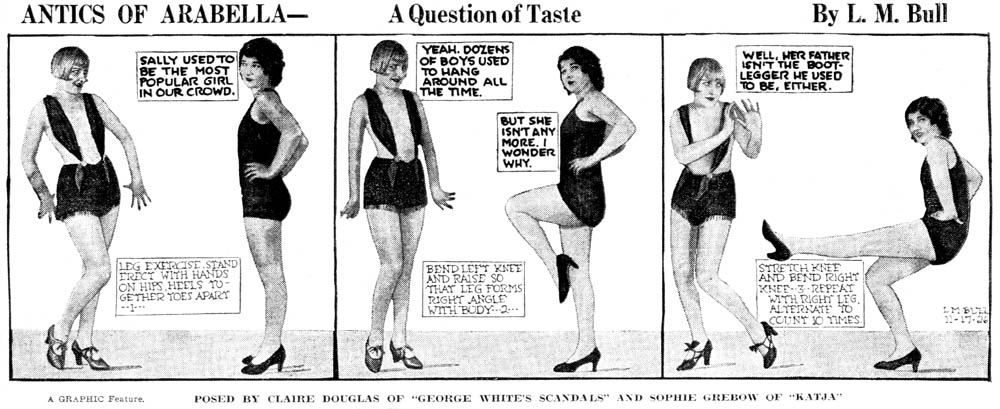
The New York Evening Graphic was really enamored of photo comics. In addition to Antics of Arabella, here's two that appeared in the paper in 1926. The Hall-Mills case photo-comic went on for a long time, describing in minute detail that sensational case. You can read the lurid details of the case on Wikipedia here. This 'strip', by the way, doesn't qualify for the Stripper's Guide index because I classify it as more of a heavily illustrated news story. In the oughts and teens the big papers got cartoonists to do similar duty, illustrating the details of certain stories in strip format, but to my knowledge the Graphic was the only one that regularly committed their most sensational stories to photo strip form.

The other photo comic is a serial summarization of the then new movie The Return of Peter Grimm (imdb link). These photo comics were supplied by the movie studios, and it's an advertising gimmick that was used sporadically right through the 40s at least. They seem to pop up in fits and starts; there doesn't seem to have ever been a standing order at any studio for films to be serialized in this way.

Labels:


Comments: Post a Comment

Wednesday, October 11, 2006


Will Gould's Asparagus Tipps

Thrillmer responded to my post about Asparagus Tipps (scroll down two posts) saying that he was under the impression that Will Gould penned the feature. That idea somehow sounded familiar, so I did some research and found the following in Sauce For The Gander, a memoir of the New York Evening Graphic by Frank Mallen (Baldwin Books, 1954):

Those of us who were acquainted with Will Gould, popular sports cartoonist on
the Graphic in its early days, were never able to understand why he abandoned
the drawing board, after achieving considerable success at it, to disappear in
Hollywood. He had shown promise of becoming one of the greatest artists in the
business and had a tremendous following.
Gould left the Graphic to join King Features. There he drew a daily sports
panel and a detective comic strip serial called Red Barry, which were widely
distributed. Then suddenly he chucked it all.

"I got bored too easily," was his recent explanation, "especially when
I discovered California and that delightful narcotic known as golf." He now
works for TV and radio.

One of the first jumps in Graphic circulation came when he introduced
Asparagus Tipps, a racing strip that suggested winners. With beginner's luck he
hit six straight long shots in one week. This phenomena had track circles agog.
Asparagus Tipps was extensively promoted on the sides of trucks and billboards,
in front page headlines, and in racing journals. The circulation department said
it had added 35,000 readers.

Asparagus Tipps became the subject of wide discussion and many track
followers ignored the statistics and advice of racing forms to put their money
on the horses it recommended. The story of this popular feature of the times is
told here by Gould:

"I created the strip because Gauvreau asked me, urged, cajoled and did
everything but threaten. I had at first refused, the reason being because I
thought it would be an infringement of Ken Kling's Joe and Asbestos running in
the Mirror, although I knew that Bud Fisher, in creating Mutt and Jeff, first
started them as track picking winners. When Gauvreau finally told me that he was
doing a column which was an imitation of Brisbane's Today and asked why I should
be so squeamish I left his office and came back in ten minutes with the title
Asparagus Tipps. Months later Jim Jennings of the sports staff returned from the
six day bike races at the Garden and said that Ken Kling was blowing his top
because I had swiped his idea. In those days I really could get redheaded at
what I interpreted as an injustice. With Gauvreau's permission I drew a strip
that would quiet Mr. Kling. Every now and then when I would pick more than one
horse, and didn't do so well, I naturally blamed it on Asparagus. Felix O'Fan,
another character in the strip, would give him a lecture on being swell-headed
and over-confident. In this particular strip Felix said: 'After all, even being a comic-strip character who picks the winners of horse races isn't new. Bud Fisher originated that 35 years ago.'

"Once Kling and I had the same horse, the same day. It was called
Canter. Because of our touting, it was backed down to 5 to 1. It broke Frank
Erickson's Jersey book. Then it came to pass that all the horses I tipped in the
strip were being scratched, the owners figuring they couldn't get much of a
price if the whole town went in on it. Finally we suspected a leak at the
engraving plant that was making our cuts. It was decided that I leave the name
of the horse out and then have it set up in type just before we went to press.
That worked for a while and then the scratches started all over again. I got
tired and dropped it. Years later it shrunk to a single panel and finally was
discontinued."

Little things used to make big doings on the Graphic in Gould's time.
He tells of one incident concerned with the fighting game that had temperament
flying all over the place and which resulted in his departure from the
paper.
"My righteous indignation," said Gould, "exploded one Friday night
when I returned from the fights at Madison Square Garden and found the following
note in my typewriter: 'Dear Gould ... In the future please do not devote so
much space to unknowns as Sully Montgomery.' It was signed by Gauvreau.

"Being a nonconformist to the nth degree, a rebel at any type of
regimentation, I resented any type of inter-office memo. Besides I had three
offers for my services, two from King Features and one from Payne, Managing
Editor of the Mirror. I told Jennings, who happened to be around, that if
Gauvreau had anything to say he could say it to me in person. At that time I had
a mental picture of Gauvreau in tears, pacing the floor, and pleading with me to
turn down the offers on the ground that Hearst was trying to break up the
Graphic. I went looking for Gauvreau while Jennings tried to reason with me.
When I found him I let go with the blast: 'The guy who wrote that note doesn't
know prize-fighting from hemstitching and I've got a good mind to blow this
sheet once and for all.' Gauvreau listened intently as I proceeded to prove that
Sully Montgomery was first in line for a shot at the heavyweight title. I could
have done the same with any bantamweight. Here's how heavyweight contenders are
made, Gould style, I told him. Take a bantamweight. Somewhere along the line
he's licked a guy who became a featherweight, the featherweight later licked a
guy who later licked a middleweight, etc., and in the end you have a 118 pounder
with some type of 'moral victory' over a 220 pounder who is now the leading
contender for the world heavyweight crown. With Montgomery this wasn't that much
involved but I am sure I had Gauvreau thoroughly confused. In the end I finally
ran out of steam and was looking for an exit-line. It came. Being sharp and
nimble with the ad lib I managed to wind up my tirade with one word 'Nuts' and
fairly flew out of the office before he could figure it all out.

"Actually the real reason for using Sully Montgomery in a feature
cartoon was because I'd kidded around all day and had less than half an hour to
make the deadline. So I used an old 'head' of Sully, pasted it on a fresh sheet
of bristol board, drew a few comic figures around it and sent it to the
engravers. The following morning some remorse set in over my tirade and so I
went down to the Graphic and asked my friend Lester Cohen if Gauvreau was sore
after I had left. Cohen happened to be present during my flare-up. Deadpanned,
he asked if I'd really like to know. With some trepidation I said yes. His reply
was 'Gauvreau said there goes one helluva good sports writer.' And being a boy
then all I could do was gulp."

Labels:


Comments:
Much as I would like to be given credit for remembering such trivia, it was Thrillmer who brought up the subject.
 
Right you are! Thanks. Mind like a steel sieve, that's me.
 
Post a Comment

Tuesday, October 10, 2006


Obscurity of the Day: Hilo Hank


Local panel Hilo Hank appeared only in the Hilo (Hawaii) Tribune-Herald. Wish I could claim that my researches extended to such far-flung papers, but actually I found this feature only through the little pamphlet shown above.

According to the introduction, reporter Ron Bennett produced this weekly panel cartoon as a sideline to his regular duties on the paper. The booklet is copyrighted 1949, and is mute concerning the length of time the panel had run thus far. Any blog readers out there in the Aloha State able to tell us more about Bennett or his delightful little feature?

Labels:


Comments: Post a Comment

Monday, October 09, 2006


Obscurity of the Day: Asparagus Tipps


What a great title! This little horse racing tip panel was syndicated by the Graphic Syndicate, and was variously attributed to Irv Papp and someone who preferred to be known only as 'Tony'.

The panel had limited interest outside New York so it is rarely, if ever, seen outside the Evening Graphic. Its main reason for being was to give plungers a hot tip of the day for a New York area track. To garner interest outisde New York, a lucky number was also included (for those whose gambling obsession ran to the numbers games). Unfortunately, the creators didn't take into account that numbers games were played mostly in the black community, so the racist depiction of the panel's star didn't exactly endear the feature to black readers.

Asparagus Tipps started sometime in 1926, and lasted until at least 1929.

Labels:


Comments:
For some reason I thought Will Gould (of Red Barry fame) was behind Asparagus Tipps. Do you know if he worked on an earlier or later version of this title?
 
Thrillmer, your comment tickled the far-reaches of my memory. I did some homework on the subject, and will answer your question at length in tomorrow's post. Stay tooned!

--Allan
 
Post a Comment

Sunday, October 08, 2006


Obscurity of the Day: Things To Come


The American fascination with technology came to the comics not just through Buck Rogers and Flash Gordon. There were also more down-to-earth features that sought to emulate the style of such magazines as Popular Science. Things To Come, perhaps the first feature to regularly concentrate on speculative technology, was later joined by the more outlandish Closer Than We Think (blogged here) and the very successful Our New Age.

Things To Come, named after the H.G. Wells book The Shape of Things to Come (which you can read in its entirety here) , was an Associated Press Sunday feature that started in 1941 or '42. It was written and drawn by Hank Barrow, whose masterful work deserved a far larger audience than it received. Barrow left the feature in 1949 or 1950 and it was taken over by Jim Bresnan, whose style, shown here in our sample, was bold and appealing.

For reasons unknown the AP Sundays were never good sellers, and Things To Come was no exception. It really is a shame that this excellent feature was never exposed to a wider audience. The feature ended on January 30 1955.

Labels:


Comments:
Barrow also did editorial cartoons for AP in 1936 when Sickles was doing them. Both were succeeded by Morris. Barrow then took over Caniff's The Gay Thirties in a style that was remarkably close to Caniff's previous one.
 
Post a Comment

Saturday, October 07, 2006


Obscurity of the Day: Daddy Dusk, The Sandman

From the pages of the New York Evening Graphic, a newspaper so racy that it was nicknamed the Porno-Graphic, we find ... a strip for the kiddies.

Daddy Dusk, The Sandman was thus doomed from the start. Few copies of the Graphic would ever fall into the hands of children. This paper was bought by single men, and by commuters looking for a stimulating read on their way home from work. A paper to be deposited in the trashcan at the train station.

Though the strip had an awkward name, the art and story were surprisingly well done. Jack Smith, perhaps a pseudonym, did an excellent job on the strip, obviously inspired by the fantasy world of Winsor McCay's Little Nemo. Hard to say, though, whether Smith was creating a minor classic, because his stewardship on the strip lasted only a little over a month. The strip began on November 15 1926 and Smith last signed it on Christmas day of the same year.

Frank Hopkins, creator of the long-running Scoop The Cub Reporter, may have been falling on hard times, because he took over the orphan strip on December 27. He kept it going until May 14 1927. The veteran Hopkins was not inspired by the concept and the strip, true to its name, sleepwalked through the remainder of the run.

Labels:


Comments: Post a Comment

Friday, October 06, 2006


Obscurity of the Day: Buckley
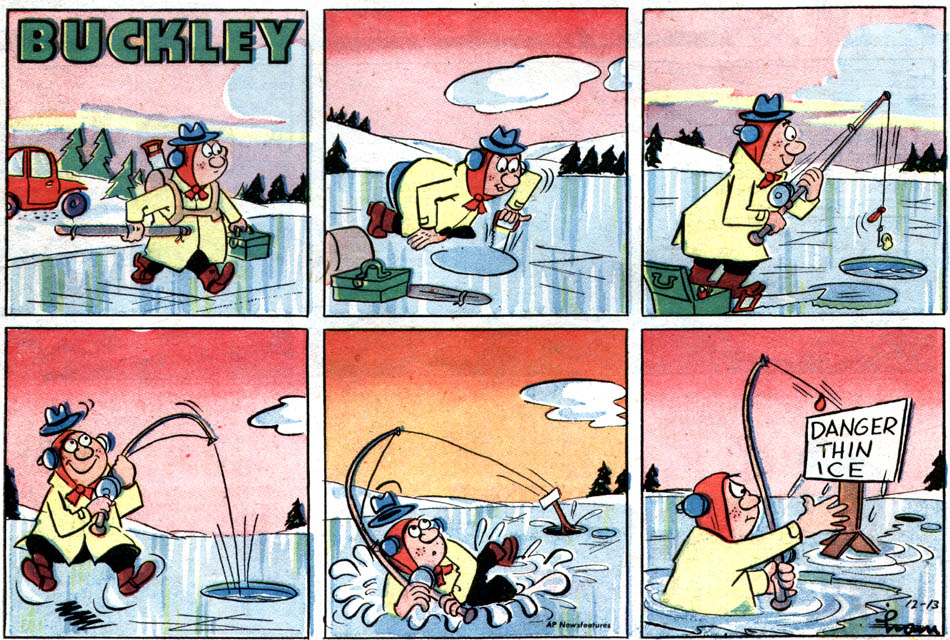

Going back to the AP beat today, we have Buckley by Joe Cunningham. The daily version of the feature, a panel cartoon, began on January 6 1947 as Hit 'n Run. The Sunday followed, starting on January 26. Sometime around 1951, at least according to the E&P listings, the strip was renamed Slice 'o Ham, a reference to Cunningham's signature on the feature, which was 'ham'. The Sunday was, however, named Buckley by 1950 (my earliest example), and my guess is that the Sunday was probably so titled from its inception.

Again going from the E&P listings, the strip was renamed to Buckley on both the Sunday and daily in 1953, and the title hopscotch was now put to rest. The Sunday ended on 3/6/1955, but the daily continued on to 1961, probably surviving until the end of comic syndication by the AP on 12/30/1961.

My files on this feature are awfully spotty, so if anyone has any dailies or Sundays in their collection that would help to pin down the titles I'd love to hear from you.

Labels:


Comments: Post a Comment

Thursday, October 05, 2006


Graphic Gems Revisited


Recently purchased a 1926 issue of the New York Evening Graphic, so time to share a few more Graphic gems. Here we have a May and June strip (first blogged here), but this one is by the original creator Harold MacGill. As a bonus, MacGill treats us to an appearance by his old stalwart characters the Hallroom Boys.

And here's another Antics of Arabella strip, previously blogged here. No particular reason to show this one except I sense that our visitors are fans (nudge, nudge, wink, wink).

Labels:


Comments: Post a Comment

Wednesday, October 04, 2006


Obscurity of the Day: Sport Slants
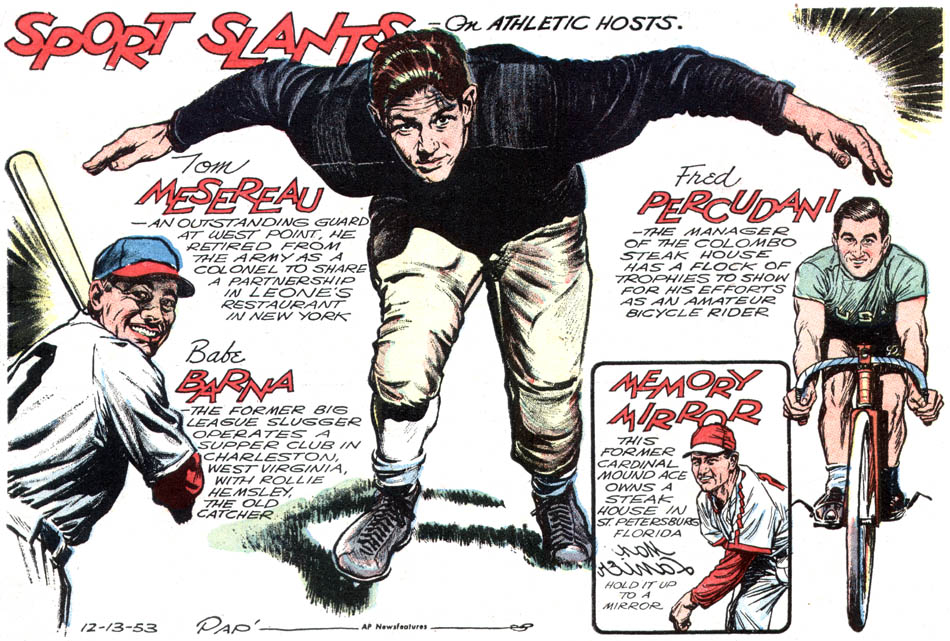

With the possible exception of Oaky Doaks, I think it's fair to say that all the Associated Press Sunday comics qualify as obscurities. The AP inaugurated their new Sunday comics line-up in either 1941 or 1942 (no one has come up with proof of a definite start date), and the client list never rang up healthy numbers. Yet the AP, for reasons unknown, doggedly continued to offer them to the bitter end when they finally gave up and dropped their comic strip business completely 1961.

Sport Slants, a sports editorial cartoon masquerading as a comic feature, started along with the new Sunday offerings, and ran until March 6 1955. Tom Paprocki, who signed himself Pap, was the AP sports cartoonist for so long that this almost decade and a half run probably seemed like a blip on the map to him. The art, as always with Pap, was inspired, the commentary on the untimely side since the lead time for Sunday pages is so long.

Labels:


Comments:
I've frequently heard that AP shut down their comics operation in 1961, but never heard the day.
Do you, or anyone, know what was the last day AP strips appeared and what were the strips that appeared that day?
 
Hi DD -
Jeffrey Lindenblatt's research indicates that the last AP dailies appeared on 12/30/61. The end date of the Sundays is a bit of a mystery - they were listed as available in E&P until the bitter end, but no one I know of has managed to find any samples later than 1956.

As to which AP strips lasted until the end, we believe they are:

Oaky Doaks
Modest Maidens
Scorchy Smith
Buckley (probably)

-- Allan
 
Post a Comment

Tuesday, October 03, 2006


Obscurity of the Day: Mamie


While no work by Russell Patterson is really all that obscure, his last hurrah in newspaper work certainly comes closest to meriting the distinction. Mamie was a Sunday only strip distributed by United Feature Syndicate, and ran in very few papers. The strip began on 7/23/1950 and ended 3/6/1955. About the only paper of consequence that ran it was the New York Post (from which these dates were determined).

Patterson was primarily an illustrator of pretty girls, and some credit him as the originator of the archetypical flapper girl of the 1920s. His fame was primarily in magazine illustration and cartooning, but he also did newspaper work. For newspapers his specialty was Sunday magazine section covers, mostly for the Hearst American Weekly, and these were often done as serialized comic strip stories. The stories invariably involved the exploits of pretty girls, fully exploiting Patterson's specialty.

Mamie, Patterson's first 'conventional' newspaper comic strip, returns to the standard pretty girl theme, but by the 1950s the Patterson style had gotten so highly stylized that the intended titillation of pretty girls in spicy togs was utterly lacking (at least in my opinion). Apparently a lot of newspaper editors agreed with my assessment because the strip is rarely seen.

Labels:


Comments: Post a Comment

Monday, October 02, 2006


Obscurity of the Day: Willie Dee


Today's obscurity proves that most every strip has its fans. The first time I met R.C. Harvey, in the midst of chatting about classic comic strips, he asked if I had any Willie Dee strips - he described it as a long-lost favorite of his childhood.

Willie Dee by Vic Green ran from May 10 1948 until sometime in 1952 (anyone have an end date?). Don't know much anything about the cartoonist other than that he produced a booklet of GI cartoons during World War II. But based on the style, which was a favorite of comic book artists during the 40s, I'd be willing to bet that he had some credits under his belt from that business.

The strip is pretty innocuous except for Willie's lisping parrot. Strips featuring that character are unfortunately plentiful, and in my opinion, headache-inducing.

Labels:


Comments:
Just catching up on some archives and ran across this. I'm in the process of doing a historical review of the contents of the Birmingham, Alabama, newspapers, with a web interface to the information so far in the link below. Willie Dee ran in the Birmingham News until November 15, 1952. There's no guarantee that the strip ended overall on that day, of course, but it does set a starting point for discussion.
 
Hi Boyd -
Thanks for the info. That's later than anything I have. Could you provide that link you referred to in your msg?

--Allan
 
Post a Comment

Sunday, October 01, 2006


Stripper's Guide Bookshelf: Illustrated History of Union County


Illustrated History of Union County, Fantagraphics Books, 2005, $19.95; ISBN 1-56097-721-3

Why would Fantagraphics issue a complete reprinting of an obscure local history comic strip? Apparently, when the art is by a very young Frank Thorne.

Thorne produced this strip for the Elizabeth Daily Journal in 1950. According to the book's introduction, the strip was printed on a daily basis. This is astounding, if true. Thorne was attending art school at the time, so researching the history of this New Jersey county plus drawing a daily strip of this size (three tiers of multiple panels) seems to me a herculean task. I wonder a bit, though, since the cited start date is a Sunday. Has anyone first-hand knowledge of the strip's frequency?

Frankly my interest in New Jersey history was not up to the task of reading the entire book (the strip ran for 173 text-heavy installments), but what I did read was impressive. Thorne was just a callow youth, yet the prose is smooth and well-paced. The research, by all appearances, is impeccable.

The artwork, though not as lively in style as Thorne would later produce, shows amazing polish. Faces tend to be a bit wooden, but this is hard to avoid when working from period portraits and photos, as I assume he was. No one looking at this work would ever guess that it was produced by a teenage art student.

Is it worth a spot on your shelves? Certainly if you're a Thorne fan it will be a thrill to see this early work. The reproduction, retouched by Thorne himself from tearsheets of the Elizabeth Journal, is excellent. It would have been a wonderful bonus if Thorne had also written an introduction, but no such luck. If you're not a Thorne fan or a New Jersey history buff the work is esoterica, but as I often say, if you are into newspaper comics and want to see more obscure material reprinted then vote with your dollars.

Labels:


Comments: Post a Comment

This page is powered by Blogger. Isn't yours?

Subscribe to
Posts [Atom]

Tell me when this blog is updated

what is this?