Friday, August 23, 2024
Obscurity of the Day: Professor Knix


Here to close out our mad professor week is Professor Knix, a Jimmy Swinnerton short run series that appeared in the Hearst Sunday comics from April 3 to July 17 1904*. As seems to happen to all of our mad professors, Professor Knix can depend on having the you-know-what beat out of him by the end of each instalment, whether as a side effect of his invention, or by the innocent bystanders he enrages.
What I find interesting about this strip, and other early strips featuring mad professors, is that it is common for them to have German accents. I would have thought that trope, the idea that Germany was a fertile ground for off-the-wall geniuses, would have blossomed in the aftermath of Albert Einstein. But evidently Einstein only served to feed an already existing stereotype, and perhaps focus it with the wacky unkempt hair adding to the picture.
*Source: Atlanta Constitution
Labels: Obscurities


Wednesday, August 21, 2024
Obscurity of the Day: Professor Si N. Tific

Norman Ritchie (who signed himself just 'Norman') was the longstanding editorial cartoonist of the Boston Post. When comic strips became the new rage he was pressed into service to provide homegrown Sunday funnies for the paper as well. A few months ago we covered one of his earliest strip series, 1904's Exploits of Mama's Angel Pet, and I pointed out that he was still feeling his way with this new assignment, and that his grasp of how to construct a good comic strip gag was still in the early stages.
Well, here we are less than a year later in 1905, and Norman Ritchie has figured out how to produce a good and proper Sunday comic. I won't say that Professor Si N. Tific is a lost masterpiece by any means, but I think it interesting to see just how fast an old pro like Norman Ritchie (he was about 40 at this time) was able to adapt to his new job.
Professor Si N. Tific ran in the Boston Post Sunday comcs section from April 16 to September 24 1905.
Labels: Obscurities

Monday, August 19, 2024
Obscurity of the Day: Scientific Sam -- Have You Met Him?

It's Mad Professor week here on Stripper's Guide, featuring three, count 'em, three, wacky genius inventors. Leading off with ...
It's impressive to me that there was a time when a freelance cartoonist, probably a kid who had just completed a mail order course, could walk into a newspaper of the first stature, like the New York World, get an appointment to see the features editor, and sell him on a new comic strip series.
I know basically nothing about E. Burton Johnson, the cartoonist of today's obscurity, but given that Scientific Sam - Have You Met Him? is his only known newspaper credit, it seems likely that he somehow managed to get that much sought after audience with an editor, and with a not particularly original series, and decent though by no means spectacular cartooning, got himself a berth in one of the globe's highest circulation papers. Wow, that's an incident that would strain the credulity of even Horatio Alger
I suppose you could say the same thing is possible today, but the odds against you seem almost infinitely worse. But as far as I know, you can still show up at The New Yorker and get yourself an audience with the cartoon buyer. Or, with a lot of chutzpah and luck, you could see a features editor at the New York Times, or the Washington Post, and maybe, just maybe, they might take pity on you. But you better arrive with something a lot better than Scientific Sam!
Anyhow, Scientific Sam - Have You Met Him? ran as an occasional weekday feature in the New York Evening World from August 16 to October 6 1909. What happened to Mr. E. Burton Johnson after that? Did he keep on as a cartoonist in some other capacity? Sorry, I haven't a clue. But hopefully he didn't use up his whole lifetime's quota of luck at the New York World, and the rest of his career was also replete with bright spots.
Labels: Obscurities
Wednesday, August 14, 2024
Obscurity of the Day: Alabama Oddities

Robert Ripley didn't know what he was unleashing on the newspaper world when he created his Believe It Or Not series, offering readers entertaining odd and unusual factoids. Not only was he copied whole cloth by a long list of me-too cartoon series, but he was followed also by a whole industry of specialty imitations, where the creators limited themselves to some niche subject.
The most popular niche, by far, were the Believe It or Not clones which limited their subject to a specific state, region or locality. I admit I'd be hard pressed to prove it, but I feel reasonably confident that there was no point on the U.S. map that was not served by one of these newspaper series at one time or another.
Today we take a look at one of these series that (at first) covered the state of Alabama. Clint Bonner, a Birmingham artist and sign painter created his first newspaper panel series in 1931 for the Birmingham News. How He Got There was a full pager that ran on Sundays, telling the backgrounds of local politicos, celebrities and businesspeople.
This rather dry feature went on for the better part of three years, but then Bonner decided it was high time to do a cartoon that could sell to more than one paper. Thus he came up with a new weekly panel called Alabama Oddities, which sold to clients including the Birmingham News and Montgomery Advertiser. It debuted on May 12 1935. As the name implies, it offered intersting factoids about the state, its history and its people.
Bonner proved to have a restless hankering for changing the name and focus of his feature. On March 15 1939 it was rechristed When The Stars Fell, a reference to the book and song When The Stars Fell On Alabama, a tale about a spectacular meteor shower seen throughout the state in 1833. The subjects of the weekly cartoon remained pretty much the same.
But then on April 14 1940 the title changed again, this time to Debunking The Bunk. Now the feature began to cover historical and scientific fallacies, and the local aspect of the feature was dropped. Presumably Bonner hoped that his new subject would allow him to sell the feature outside Alabama. Evidently that wish did not turn into reality, and may have also annoyed his existing subscribing papers who wanted local content, not this essentially new feature.
Bowing to client demand, a year later on April 20 the title and subject was changed back to Alabama Oddities. But Bonner was still chafing, hoping to sell the feature outside the state, so on January 4 1942 the title changed to Southern Oddities, taking in all the surrounding states. Apparently this opening of the scope didn't antagonize his Alabama subscribing papers nearly as much.
On April 26 1942 a very slight title change was enacted, changing it to Oddities of the South. My guess is that someone else owned copyright to the title Southern Oddities and had complained. But Bonner still didn't seem to be gaining the client base he so fervently wanted, so a few months later he rejiggered the weekly page into a set of six separate equally sized panels. This layout allowed him to sell the feature either as a large weekly feature or as a daily panel.
Another seemingly good idea, but yet another marketing failure. Bonner finally threw in the towel and the feature appears to have ended on January 31 1943, or February 6 for the daily-style version*. By this time Bonner had a new gig as a radio host going in Birmingham and he was running the Gulf States Art Schools; perhaps those proved the more rewarding activities.
The ever-restless Clint Bonner would come back after the war with several additional newspaper features, but none of them proved to be his pot o' gold, either. One was a revival of this feature, but throwing it open to factoids about the entire country. Titled American Oddities, in the only paper I can find it (Montgomery Advertiser) it ran only January 6 to February 17 1946.
* Source: Tallahassee News-Democrat.
Labels: Obscurities
Monday, August 12, 2024
Obscurity of the Day: Little Abe Corncob


Little Abe Corncob was yet another Katzenjammer Kid rip-off, but of the low rent sort who couldn't even muster a brother to assist him in his pranks. What he did have, though, was a setting in farm country and he used that to great effect, enlisting farm animals to do the heavy lifting on many of his escapades.
The strip debuted in the C.J. Hirt version of the McClure Syndicate Sunday comics section on October 18 1903*. The strip was very rarely signed, in fact the only time I know for sure it was signed was on the very first strip. A.D. Reed signed that installment, and I'm confident he was responsible for it throughout the run, which ended on June 17 1906**. That end date is when the Hirt copyright was last seen, and the next week the section was revamped and now copyrighted by Otis F. Wood.
Little Abe Corncob reprints were sometimes used by McClure to fill holes in the 1910s, when their bullpen of artists was so shallow that they sometimes couldn't fill the four pages. Known reprint appearances include occasions in 1912*** and February 8 to March 8 1914****.
* Source: Chicago Inter-Ocean
** Source: Washington Star
*** Source: Battle Creek Moon-Journal
**** Source: St. Paul Pioneer Press.
Labels: Obscurities
Friday, August 02, 2024
Obscurity of the Day: Hans and Gretchen

Hans and Gretchen ran in the Philadelphia Inquirer from September 23 to November 4 1906*. It's an odd strip on several counts.
The strip is about a couple of stereotypical Dutch children, dressed in traditional garb right down to the wooden shoes. The strip tells its little storybook tales in verse, and the level of the writing and plots seems to be intended for very young children -- very simplistic, very banal. While this sort of material, meant for the smallest kiddies, wasn't totally unknown in the Sunday comics sections, in most cases it was jazzed up just enough so that the older kids and adults didn't feel cheated. In this series the stories are so shallow I'm really surprised that the Inquirer would run them. Of course, none of that criticism applies to the sample above, which was (perhaps not surprisingly) the final installment. I've certainly seen plenty of strips about cannibals in these early comics, but never witnessed a case of them actually chomping on a little girl. And in a strip that had, up until then, been intended for the smallest children, too! Get ready for kiddies having nightmares tonight, ma.
The other weird thing is that this series by "Allen" would seem likely to be T.S. Allen in some ways but not in others -- there's a number of pros and cons to that ID. The signature could pass for his, though its not quite a dead ringer. Also, T.S. Allen was famed for his cartoons of tough slum kids, not namby-pamby fairy tale children. The art is not typical for him -- he favoured a more sketchy style -- but he was definitely capable of modifying his style when the situation required. The timing of the strip's appearance is perfect for him, though, as late 1906 is when he seems to have been dropped by Hearst in New York, and he was very soon to spend some time at the Philadelphia Press. So a stopover at the Inquirer would be very reasonable. So is this T.S. Allen? In my book I gave him the credit, but now I'm not so sure...
* In my book I say it lasted until November 18, but it turns out on digital review that the extra strip on that end date is a one-shot titled The Little Hollander; nothing to do with this series other than the nationality of the subject. So nice to be able to compare strips without having to dig out a different microfilm reel!
Labels: Obscurities
Wednesday, July 31, 2024
Obscurity of the Day: Buddy and Banty

Among the many comic strip series George Frink created for the Chicago Daily News was Buddy and Banty. At first glance it seems like yet another Katzies rip-off, but the plot had a little extra nuance to it in that Banty is a mischievous halfwit, and Buddy is a comparative angel. Of course in any setup of this type, the inevitable upshot is that poor Buddy pays dearly for Banty's hellraising.
Even though this isn't exactly grade-A Frink material, he employs his gift for portraying anarchy to relatively good effect. In this sample strip, I particularly like the graphic device of being able to see an X-ray view between the two floors of the house, a nice touch.
Buddy and Banty ran on occasional weekdays on the Chicago Daily News back page from June 9 to September 22 1906. Then after a long layoff it came back for a single engagement on February 21 1908.
A footnote on this sample strip is that Frink had a series starring Uncle Bellamy back in 1902-03. But this doesn't seem to be a return appearance of his old character, who had rather unique muttonchops that stuck out from his head like overgrown cat whiskers.
Labels: Obscurities
Friday, July 26, 2024
Obscurity of the Day: The Hoodoo Nickel - Who Gets It Next?


The little remembered cartoonist Foster Follett occupies a pretty high standing in my mind, a cartoonist who really knew his stuff and made the most of what he did. For instance, without bothering to read the strips above, and trying to ignore that awful printing quality, look at the animation and energy of the characters, the staging of the panels, the seemingly effortless, even careless, drawing. Follett never wowed us with pyrotechnics, but he was a quiet and assured master of the form. Which makes it doubly unfortunate that his work was presented like this above, with bad printing and parts of panels lopped off*.
The Hoodoo Nickel - Who Gets It Next? is a rare 1900s foray into comic strip continuity. Follett traces the adventures of a cursed nickel, which gets anyone who has it into serious hot water. Each week the nickel moves from one victim to another, telling a continuous story, but with a self-contained gag in each strip. We aren't told why the nickel has a "hoodoo" on it, but eventually the series personifies the curse with a flying ghoul who watches the proceedings with apparent glee. The series finally ends when one recipient recognizes that it is cursed and disposes of it for good.
The Hoodoo Nickel - Who Gets It Next? ran as a quarter-page strip in Pulitzer's New York World from October 13 to December 15 1907.
One melancholy comment about this strip. For many years I felt that Frank King's Gasoline Alley topper, That Phoney Nickel, was an overlooked stroke of genius. However, when I finally saw examples of this rare Follett strip, and the similar 1909 strip Adventures of a Bad Half-Dollar, I reluctantly had to downgrade King's strip into a mere revival of a great idea that had a much earlier life. Sorry Frank, this is one laurel you may not wear, as it belongs to Mr. Follett ... or are there even earlier versions?
* You can thank the Detroit Free Press for this execrable work. No doubt the strips were presented properly in the New York World.
Labels: Obscurities
 : 7/26/2024 3:12 PM : 7/26/2024 10:42 PM : 7/27/2024 1:42 PM
 Wednesday, July 17, 2024
Obscurity of the Day: Ain't It?

Even though Gus Mager had a very popular series going with his 'monk' strips in the New York Hearst papers, he was constantly trying out other ideas. One very short-lived entry in this long list of experiments was Ain't It?, which had a lifespan comparing only slightly favorably to a mayfly's. This series, whose title is also the punchline, was extant from March 2 to March 10 1909 in the New York Journal*.
* Source: Dave Strickler's New York Journal index.
Labels: Obscurities
Monday, July 15, 2024
Obscurity of the Day: Alex in Wonderland


I've opined on the subject of the hapless Copley News Service here before, and no doubt will again in the future as long as I can still bang on a keyboard and dig up samples of their wares. But let's recap: Copley owned a chain of newspapers, primarily in California, and starting in 1955 they began trying to syndicate some of their features to other papers.
Sounds okay, right? But that statement deserves some caveats. First, at least in regard to comics it should be pointed out that much of what Copley syndicated, in fact almost all of it, did not appear in their own newspapers. And second, the syndicate was downright spectacular in its ability to NOT sell features. So, taking those two facts into account, I am left with head in hands, sobbing quietly, wondering what the point of it all was. If you didn't want these features for your own papers, and the client list for the features hovered very close to zero, what was the point? Surely you couldn't have done it JUST to drive comics historians crazy looking for this stuff!
I'll be okay. Just give me a moment to dry my eyes, and we'll talk about today's Copley obscurity, Alex in Wonderland. This strip by Bob Cordray is about a kid, Alex, trying to understand the perplexing adult world. Alex's parents are MIA, so his main foil is his uncle, who goes by 'Unk'. The gags, as you can see above, are light social and political commentary, and Alex is the Candide-type who generally starts the ball rolling by asking a question, giving Unk the excuse to deliver the punchline.
The strip is by no means fabulous, but Bob Cordray's wonderfully simplified art style and quick, pithy gags puts it over, giving readers an instantly digested seconds-long daily experience.
Cordray had a long-running strip before this called Smidgens, but it died when the syndicate (National Newspaper Syndicate) shut down in 1975. A few of National's remaining properties went to United Feature, but they apparently took a pass on Smidgens. Left without a meal ticket, Cordray started shopping around and ended up creating this new feature for Copley.
The strip seems to have debuted on April 5 1976, though its only known client at the time, the Chicago-based Daily Calumet, started it a day late and dropped it after a two-week tryout. Which is about par for the course with Copley strips.
Playing to an audience of practically none, Alex In Wonderland soldiered on until 1980, ending on June 14*. Copley continued to offer the strip in reprints at least through 1986, but for some bizarre reason they offered it only as a weekly. Figure out the logic of that, I dare you.
* Source: San Pedro News-Pilot.
Labels: Obscurities
Friday, June 28, 2024
Obscurity of the Day: The Red Creek School

There were plenty of kids caught trying to play hooky from school in the early newspaper comics, so when the great George Frink cast his eye on that hoary old plotline, he decided to shuffle the deck. What if those kids, rather than playing hooky, kept the schoolteacher from getting to the school? Then not going to school is no crime -- there's no school to go to!
George Frink was the undeniable king of the Chicago Daily News cartoonists, and he created many weekday series there from 1901 to 1915. The Red Creek School was just a passing fancy, lasting only from May 22 to July 24 1906, but it had Frink's signature boisterous and subversive energy. In each strip the boys, dubbed the Redskins Three, put their combined intellects up against that of the teacher, Professor Whack, and inevitably came up the victors each time.
Labels: Obscurities
Monday, June 24, 2024
Obscurity of the Day: Fun with Fenwick

Ian Fenwick was an accomplished British cartoonist who in the 1930s was published in Punch and other top flight venues. When Britain went to war Fenwick went all in, campaigning in North Africa and Italy while still producing wonderfully droll cartoons now on mostly military subjects.
His fame didn't really spread to the U.S., but somehow the editor of Hearst's Pictorial Weekly got wind of his work and liked it very much. The Sunday magazine insert began a series of weekly cartoon pages featuring his work, titled Fun With Fenwick, debuting in their August 6 1944 issue.
Tragically, Fenwick never got to enjoy his new notoriety across the pond. At the time Pictorial Weekly was preparing to show off his work he was behind enemy lines assisting the French resistance. He was killed in action one day after his first appearance in the magazine.
Due to the circumstances of his death, the news took awhile to filter through to the Hearst people in New York. The weekly Fun With Fenwick ended with the September 3 1944 issue, and perhaps due to wartime secrecy, there was no explanation offered for the feature's disappearance.
Here is a good capsule bio of Fenwick which highlights his lovely covers for some P.G. Wodehouse novels. It also provides links to more detailed information.
Labels: Obscurities
Friday, June 21, 2024
Obscurity of the Day: What's The Use?
.png)
Hard for me to believe that we've not offered George Westcott a moment in the spotlight yet. He penned a goodly number of series for the New York Evening Telegram from 1905 to 1911. Oh, well, I suppose that would be the reason ... finding tearsheets of Evening Telegram material is like discovering a double-yolk egg -- it happens, but it's a mighty rare occurrence. The paper's material was offered in syndication, but it is so rarely seen I'd guess that there was little effort put into marketing.
I don't know much about Mr. Westcott. A few tidbits have surfaced, though -- in 1905 when he debuted with the Telegram he was supposedly just 19 years old. He graduated from Yale with honours. He claims to have penned and published a duplicate of Charles Dana Gibson's famed "The Eternal Question" before Mr. Gibson did his. All these factoids come from a promotional piece done for Evening Telegram features in 1907, the only bit of marketing I've ever seen.
Today we look at What's The Use?, an inspired bit of off-the-wall slapstick and wordplay that should whet anyone's appetite for more of Mr. Westcott's offerings. Sadly, this is the only decent sample I have to show -- the rest in my files are blurry microfilm prints. In each installment the unnamed fella in the stove-pipe hat corners some unlucky mark and proceeds to rhyme his way into their bad graces, generally ending up physically assaulted. The feature ran on occasional weekdays from April 25 to September 12 1910.
Labels: Obscurities
Monday, June 17, 2024
Obscurity of the Day, Revisited: Terry and Tacks


Well, once again your senile ol' Stripper cleaned up some mouldy oldies for Obscurity of the Day only to find out that it already got featured here, in the case of Terry and Tacks a decade and a half ago. Oh well, as the popular saying goes, a happy life depends on a new dose of Terry and Tacks every decade or so.
So let's see if I can tell you anything about the strip that wasn't covered back when my blog was just a wee little infink. Hmm...
Okay, here's sumthin ... Joe Farren pretty much disappears off my radar after the 1910s, and it turns out that's because he got a job in the New York Times art department in the 1920s -- no series comics coming out of there of course. And a decade later I found a sports cartoon penned by his kid, Joe Farren, Jr. Who he was working for I dunno, looks like a grade-Z syndicated thing, an evergreen panel about Joe Louis.
Factoid the second ... I think I've now nailed down the reprint runs of Terry and Tacks in the World Color Printing sections. How about July 15 1923* to March 15 1925**, and October 6 1929 to June 22 1930***. Dates have been 'normalized' to Sundays as some of these papers printed their Sunday sections on other days.
* Source: Pomona Progress
** Source: San Luis Obispo Tribune
*** Source: Mexico Intelligencer
Labels: Obscurities
Friday, June 14, 2024
Obscurity of the Day: The Clown Folks

Perhaps the most daunting job you could ever have as a newspaper cartoonist is to be chosen as the replacement for Winsor McCay. And that's the thankless task tackled by Ap Adams* when Winsor McCay jumped ship from the Cincinnati Enquirer. McCay had drawn the minor classic A Tale of the Jungle Imps for the Enquirer for a little less than a year before the inevitable happened and he was summoned to the big time in New York City.
Faced with an empty page of their Sunday comics, which were a combination of syndicated and local content (two pages versus one page), the Enquirer picked "Ap" Adams out of the art bullpen and handed him the reins to the local page on November 15 1903. Initially he collaborated with "Felix Fiddle", the writer of the Jungle Imp tales, whose real name was George Randolph Chester. The first few episodes of The Clown Folks were very prose-rich productions, just like the Imps tales. Then 'Fiddle' decided to change over to a more normal comic strip approach, with one line descriptions under each panel.
I'm guessing that Adams decided that Mr. Fiddle's services were of dubious use when he was writing just a few short captions, and on the Sunday page of January 24 1904 the name Felix Fiddle is dropped for the remainder of the series. Neither Fiddle nor Adams was at this point very adept at comic strip writing, so Enquirer readers probably didn't notice much difference.
What Adams lacked in writing chops he made up for with lovely art. It wasn't good enough to make anyone forget McCay, but it was delightful on its own terms. While The Clown Folks didn't last long, ending on April 19 1904, Enquirer readers would enjoy the delightful art of Adams on a succession of Sunday strips lasting until late 1908.
* I have seen Mr. Adams' full first name given as Apworth, Anthorp, and Apthorp. I have no idea which is correct.
Labels: Obscurities
Wednesday, June 05, 2024
Obscurity of the Day: Robin Hood


We've covered some of the series that were rushed into print when Hearst decided to experiment with tabloid Sunday comics in 1935, and here's one of the most obscure of the bunch. Bearing some hallmarks of a series that was produced in a hurry, Robin Hood nevertheless had a lot going for it. Charles Flanders was a terrific adventure strip cartoonist, but he's obviously not up to his usual level of work here. The art rather reminds me of Dick Calkins on a time-reversed Buck Rogers -- very stiff, flat and tableau-like. But I suppose you could make a case that Flanders was trying to evoke the sort of art that was produced in the medieval period, and if so, I'd say he rang that bell.
The story is of course just a rehash of a few episodes in the Robin Hood legend, and so readers don't need a lot of blah-blah-blah to follow along. As befits a Sunday-only strip featuring a well-known character, the story progresses at a breakneck pace and the action is non-stop. You'd almost swear it was influenced by Errol Flynn's The Adventures of Robin Hood, but that movie was still three years away from hitting the theatres.
Robin Hood was a fun strip, but it evidently was only there to take up space while other projects were developed. The strip ran less than three months, from March 24 to June 16 1935*.
* Source: All dates from Jeffrey Lindenblatt based on New York Journal and New York American.
Labels: Obscurities
The Hearst tab-only fiasco of 1935 required a lot of new titles, I suppose this was considered an attraction of the new size tab size Puck section, appearing only in the Hearst chain. But all these new strips were inconsistent in quality,(ever see "Pebbles, the Stone-Age Kid?") and were apparently too many to appear in all the papers. Most of America never saw a lot of these new ones.
Rose O'Neill's revamped Kewpies strip I've only seen in the Boston Advertiser, Dr. Seuss's "Hadji" was in the Seattle Post-intelligencer, but I never saw it anywhere else.
Most of these new titles didn't even last as long as the Tabloid experiment. The only one of them that ever became a success and joined the regular line up was Mandrake the Magician.
: 6/05/2024 12:46 PM Monday, June 03, 2024
Obscurity of the Day: Children's Letters to God

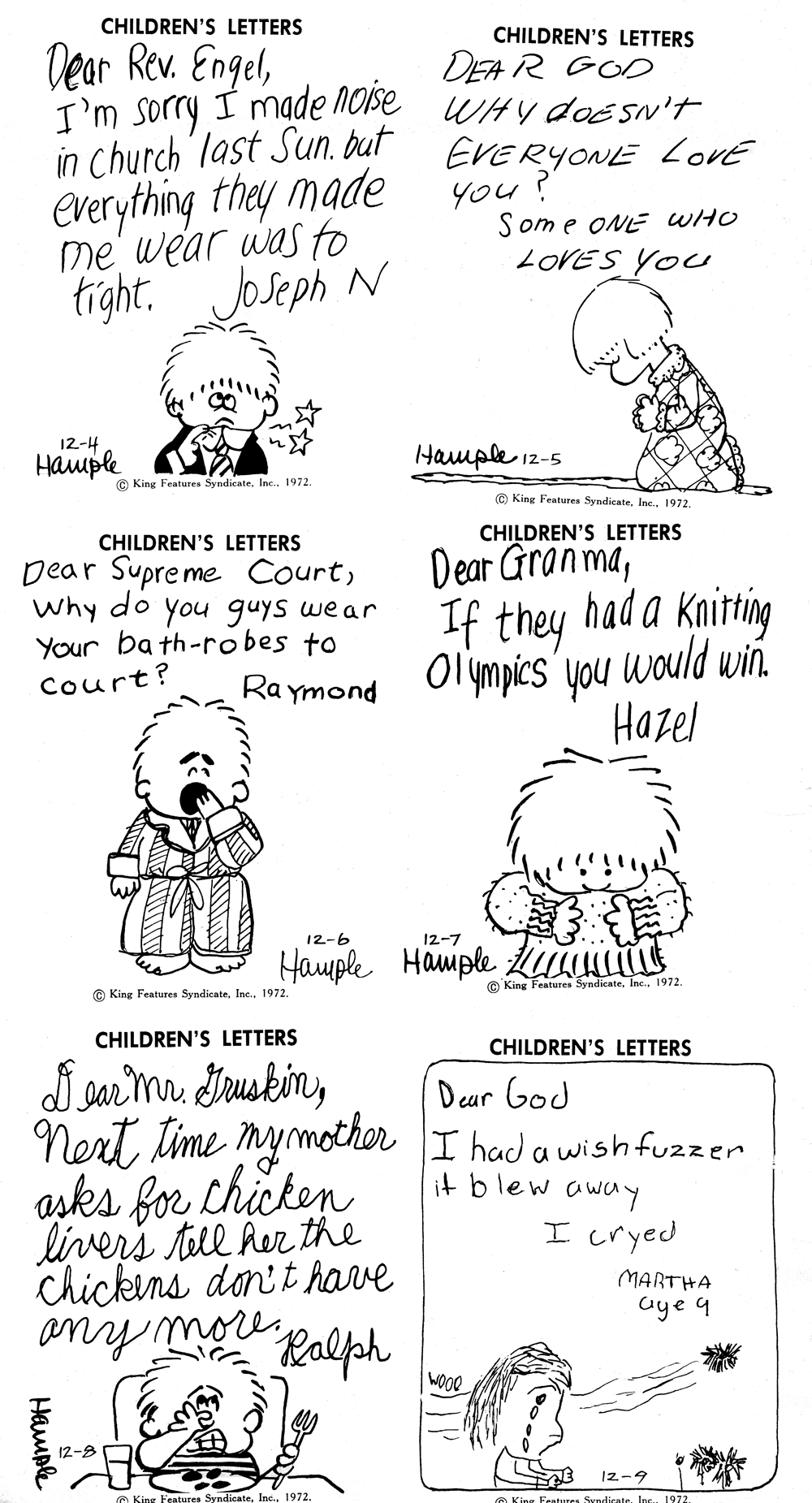
Among his many other projects inside and outside of the world of comics, Stu Hample hit some minor paydirt with a paperback book titled Children's Letters to God, published in 1967. The book, which he claimed was a compilation of real children's letters, offered material to elicit laughs, occasional tears, but mainly supplied lots and lots of treacle. Art Linkletter had been mining this sort of material for years, but Hample managed to piggyback on the "kids say the darnedest things" gravy train successfully by throwing in a religious component.
The book soon spawned a second collection, but of more interest to us is that it was adapted into a daily cartoon panel by Hample, sold to King Features and began syndication on June 24 1968*. The feature was never a big syndication success, but evidently did manage to attract enough clients to make it a worthwhile effort. Unlike the books, the newspaper feature made no claims to being real letters -- points to Hample and King for not breaking a commandment for the newspaper version, at least.
After three years of making up letters to God Hample felt his creative well starting to run dry. On March 22 1971** the title of the feature was changed to just Children's Letters, and the the kids could now freely write to non-dieties, though God still remained a favourite pen pal.
The necessarily rather repetitive material seemed to be on the way to going on forever, but luckily Hample found a better star on which to hitch his wagon. In 1976 he began development of the Inside Woody Allen comic strip, which promised far greater rewards than he could hope for by scrawling yet more faux children's letters. The feature was retired on January 17 1976***.
Thanks to Mark Johnson, who supplied the syndicate proof sheet for the very first week of the feature.
* Source: King Features Microfilm Catalog
** Source: Muncie Evening Press
*** Source: York Dispatch
Labels: Obscurities
: 6/03/2024 8:14 AM Obviously, the Woody Allen strip was a more interesting concept, but it never really worked well. In my old KFS blog, I was denied the use of that one.
: 6/04/2024 5:45 PM Wednesday, May 22, 2024
Obscurity of the Day: Charles Dana Gibson's Latest Pictures


I know that Stripper's Guide readers need no introduction to Charles Dana Gibson, perhaps the most celebrated and successful penman of his day. So I can go directly on to the sad fact that after becoming the top illustrator/cartoonist of the 1890s, a legend in his own time, his popularity was on the wane by the mid-1910s. He was still a respected illustrator, of course, but his work no longer inspired quite the level of adulation and awe it once had. The fickle public had moved on.
So in 1915 he was no longer the latest fad, but Gibson's name was still a draw. Life Magazine tried to capitalize on it by offering a series to newspapers with the simple and direct title Charles Dana Gibson's Latest Pictures. The series did not sell tremendously well, and I'm guessing that was because the pricing of the feature reflected Gibson's worth more circa 1900 than 1915.
The series offered was ten weekly drawings*, each accompanied by the humorous poetry of Boston Post newspaper writer/humorist Joe Toye. Many papers that took the series unceremoniously lopped off Mr. Toye's verses, leaving the pictures with a certain lack of context. The drawings were wonderful, of course, and the seldom seen verses by Toye weren't bad either. But sales were underwhelming, and the series came and went, the last time such a newspaper offering would be made of Mr. Gibson's drawings. Although some copyright slugs noted 1914 as the publication year, actually the earliest known running dates for the series are January 24 to March 20 1915**.
* Some mentions claim that there would be twelve installments, but ten seems to have been the actual number.
** Source: Atlanta Constitution, St. Louis Post-Dispatch, etc.
Labels: Obscurities
Monday, May 20, 2024
Obscurity of the Day: Petey, the Growler, the Old One and the Goat


The Detroit News had some really interesting homegrown material in the 1900s and 1910s. Unfortunately I have never had the opportunity to take a long leisurely indexing run through the microfilm, and as far as I know, the paper does not yet exist on the web. So for now all I can offer is based on the samples from my personal files.
Burt Thomas had pretty much just arrived at the Detroit News in 1906 when he penned the series Petey, The Growler, The Old One and The Goat. My few samples are from September of that year, and though a daily-style strip, seemed to have run only in the Sunday editions. If the present samples are a fair indicator, Thomas's black kids use the near-required mushmouth dialect and the typical moon-faces, but otherwise they are just a group of kids having some fun and inevitably getting into trouble.
I don't know if Detroit had a large black population in the early 1900s (the major influx of blacks apparently happened in the 1910s and later) but by comparison with how blacks were represented in many other black strips this was practically an outreach to Detroit's black community.
UPDATE: Jeffrey Lindenblatt informs me that the News is indeed on the web, but unfortunately at the GenealogyBank website, whose slowness and bad interface make indexing a practically impossible job. Sigh. I did manage to get running dates for this series though; it ran from August 19 1906 to October 21 1906 on the Sunday children's page. The first two installments were accompanied by long text stories by "N.T", but the strips can stand on their own. Thanks Jeffrey!
Labels: Obscurities
Friday, May 17, 2024
Obscurity of the Day: Exploits of Mamma's Angel Pet

Ritchie would eventually become quite adept at producing funnies, but in the early days of his new job he was still feeling his way. Exploits of Mamma's Angel Pet was in this early period, and you'll find in the sample above a gag that perhaps had some possibilities, but Ritchie couldn't zero in well enough on the important facts of the case and the gag ends up falling flat.
Exploits of Mamma's Angel Child ran in the Boston Post Sunday comics section from October 16 1904 to April 9 1905.
Labels: Obscurities
Maybe the girl saw some sheet music with head shots of performers on the cover. Cutting up the screen makes it resemble the cover montage. Seems far-fetched.
Does anyone out there know what she's talking about?
"The 'song sheet' is a white drop on which is painted the musical staff of five lines, and is punctured with holes representing notes which give the music of the chorus. The drop serves as a background for the performer who is to sing the song. Through the holes in the canvas the heads of colored men with melodious voices protrude, and they sing the chorus in harmony."
https://books.google.com/books?id=oYzNAAAAMAAJ&pg=PA148
The article is "The Vogue of the Vaudeville", by B. F. Keith.
: 5/18/2024 11:32 PM 