Thursday, June 29, 2006


Ryan Walker, Part II


Hello again, comrades! Here is part two of our look at Ryan Walker. Above you'll find another Bill Worker strip from the Daily Worker; below you'll find his obituary and another memorial article, both real heavy on the whole proletariat-bourgeoisie-revolutionary jazz. Not to mention the occasional non sequiturs due to bad editing. Can you imagine anyone reading a daily paper where every single article every single day was written just the same way? It's exhausting, I tell ya!

As mentioned in the obit, Walker was indeed a big wheel for awhile at the St. Louis Republic - he was responsible for much of the content of their locally produced color comics circa 1901. There he created a comic strip title that makes me giggle any time I think of it -- The Automopig Family. The strip itself isn't much to speak of, but I do love that title. I'll have to dig one out sometime to share with you. Y'know, I can't help but think that it might be a good premise today. Big fat porkers driving around in their gas-guzzling Escalades. An idea whose time has come!

6/25/32
Ryan Walker's Life and Work Built Around Struggles of American Labor
Revolutionary Artist Was Known to Thousands of U.S. Workers

Born at Springfield, Ky., on December 26, 1870, Ryan Walker's early life was spent on a hilly, rolling farm. His people were of the early English settler stock, with a dash of Scotch and Irish.

Early Talented
At a very early age Ryan Walker developed the traits which had such a decided influence upon his career. To think for himself and express his own ideas, to read and reach out beyond his narrow environment, to draw pictures on every scrap of paper he could find, and to have a warmth for working folk -- the twenty miles from a railroad in the days before the telephone, radio or automobile.

Ryan's particular delight was to print with a pencil and draw cartoons for a little newspaper, and his mother used to help him print the words. From his mother he acquired that fine sympathy and understanding which made him rebel against the hidebound religious bigotry and rotten injustice, which later found a definite expression in his intensity as a Communist.

Studies Art
Ryan went to Texas with his parents. Later his father died and his mother remarried and went to Kansas City. Ryan attended the public schools in Kansas City and then spent two years studing art in New York.

He sold his first political cartoon to Judge when he was sixteen years old. Upon finishing his art schooling, he returned to Kansas City, where he took his first newspaper job with the Kansas City Star. It was on the Kansas City Times that Ryan's cartoons began to attract national attention and be copied in publications all over the world. The country was at high pitch over the Bryan-McKinley campaign, and Ryan's pictures of McKinley as puppet Napoleon on a hobby-horse and Mark Hanna dressed in a dollarmark checked suit created a great demand and many copies were distributed in the campaign.

Ryan then went to the St. Louis Republic and developed the first color section for that paper. His work by this time was well-known throughout the newspaper world and he began to get offers to come east. About this time he married Maud Davis.

Comes East
Ryan came to New York in 1901, and during the following years contributed work to a large number of newspapers and magazines. Later for three years he was the art director of the New York [Evening] Graphic.

For a number of years he was a regular contributor to the Appeal To Reason, creating the comic strip Henry Dubb which became famous. Henry Dubb was reprinted in booklet form and hundreds of thousands of copies were distributed. He illustrated many tracts and booklets which were sent out by thousands. Ryan developed a series of chalk talks which went over big with thousands of workers and farmers all over the U.S. and Canada. These talks were very popular and rolled up thousands of subscriptions for the Appeal To Reason. Then Ryan devoted his efforts to the New York Call, before the left wing split in 1919.

The Truth Seeker printed many of Ryan's cartoons and he illustrated a booklet for them entitled Funny Bible Stories which was widely circulated.

While Ryan had no children of his own, he was very fond of children. He used to have great fun in mill and mining towns, drawing little Henry Dubb sketches for crowds of children who would gather round him. The frightful condition of children in these towns touched him very deeply, and stirred him to greater activity.

Joins Communist Party
In the autumn of 1930 after several years of isolation from the revolutionary movement, Walker joined the Communist Part of the United States.

Several months previously he had already come to the Daily Worker as one of its staff artists. With characteristic fervor and enthusiasm, he threw himself into his work creating the new character Bill Worker which became known to thousands of miners, farmers and workers in the shops and mills.

Loved By Children
His juvenile characters Red Pepper and Joe Jr. were especially loved by the children, and the Young Pioneers of the country claimed Ryan Walker as their own. At the time, too, his chalk talks again were in great demand among the workers.

Will Be Remembered
Ryan Walker will live in the hearts of the workers and particularly those who knew him. He had a most lovable and charming personality. He was unselfish and a loyal fighter in the ranks of the working class. His visit to the Soviet Union , though being then quite ill, was the crowning adventure of his colorful career. He had travelled 16,000 miles over the U.S.S.R., seeing the great work of Socialism, and glorying in the realization of his dream, the triumph of the workers.


6/25/32
A Co-Worker Writes About Ryan Walker
Jacob Burck, "Daily" Staff Artist, Tells of His Day-to-Day Work With Him


In the rush of daily struggle we do not always stop to think of the qualities of those working with us. The death of a comrade brings home sharply what we have lost. In the last couple of years of acute strife, many of our comrades have fallen on picket lines, in protest demonstrations and on the no-man's land of the coal barons. Ryan Walker would have preferred to have died that way. He was that sort of revolutionist. Instead he daily stuck to his drawing board and sent out his Bill Worker, Red Pepper and John Henry to carry on the fight with those comrades.

Ryan Walker is dead. He died in the Soviet Union, the land where Bill Worker rules. Born on a small Kentucky farm in 1870, he grew up with the labor movement which was beginning to assert itself alongside the rise of big industry. He was still in his 'teens when the Haymarket martyrs went to the scaffold. Thomas Nast was making the Tammany tiger squirm with his savage drawings. Ryan Walker had just begun to draw. There were practically no art schools then; no young artists with false grandiose notions removed from actual life. If there were, the social consciousness and fire in young Walker could not have been drowned out by fallacious teachings. He was Irish-American -- a fighter. His homespun technique expressed exactly what he felt with no frills or trimmings.

Quite naturally he found himself in the company of other American fighters. Mother Jones, Bill Haywood, Mother Bloor [?] and Eugene Debs. There he found his real function. And so Henry Dubb the strip character known to all old revolutionaries was created and lived for years.

The war was over. The socialist party divided into two camps; the red and the yellow. Things were moving fast. The Soviet Union became an established fact. Ryan Walker found himself in a whirlwind of emotions. Old friendships proved disillusioning, old ideas had to give way to new. Ryan Walker had to readjust himself. He stopped drawing until he could see his way clear again.

The big ,crash came -- 1929. The Communist Party organized the big March 6th demonstration against hunger and unemployment. Workers and intellectuals became aware that the Party showed the only way out of this insane, vicious system. The rebellious spirit in Comrade Walker could not be quieted. Almost 60, he decided to cut himself completely off with old friends and strike out on a new revolutionary road continuing where he left off after the war. He joined the...
[microfilm illegible for most of a paragraph]
...of the Daily Worker and was admitted to the Communist Party.

It was then that I met him. The surprise was that this peppy, youthful man with a head that resembled very much that of a curly-headed child, was well past middle age.

Walking to Thompson's for a coffee and hamburger, it was I, less than half his age, who felt the older, hearing him get explosive at seeing a young bootblack chased by a cop, or a young girl slaving away in a restaurant. Like most artists he was extremely emotional, but unlike them he was keenly aware of the sort of world in which he lived. His work showed the same blending of qualities. He was like a mischievous kid running after a person it disliked and taunting him with embarrassing truths. Full-Belly-Hoover, Lord Cut-The-Dole-MacDonald, Hey-Gin-Broon, etc.

His cartoon strips were drawn in his own inimical [sic] manner. They were carefree, full of spirit, untainted by any art snobbery, uninfluenced by any of the stereotyped techniques characterizing most strip artists. They were not 'great' drawings according to the standards of the art critics. But they were genuine; part of the man himself. And what is more, part and parcel of the lives and struggles of thousands of workers. I say that is real art!

We have lost an artist and fighter. The younger artists who are now working in the movement can learn from Ryan Walker what qualities make working-class art.

Labels:


Comments: Post a Comment

Wednesday, June 28, 2006


The Last Hurrah of Ryan Walker

Ryan Walker, the Communist cartoonist, was well known in their circles for his tireless cartooning in service of The Cause. His Henry Dubb character, created in the 1910s, was considered a classic of the genre. His last comic strip offering was The Adventures of Bill Worker, which ran in the Daily Worker 9/8/1930 - 10/21/1931. Submitted here for your perusal, an example from that series.

In my latest work at indexing the Worker I also found Walker's death notice, obituary and an article of remembrance by a friend. The microfilm is almost unbelievably bad, but I've managed to transcribe the material. Here's the death notice; tomorrow I'll post the other material and another Bill Worker cartoon.

A few sites of note; here's one that has Henry Dubb cartoons (long load time; dial-ups beware!), and here's one that reprints an article written about Walker in 1905.

6/24/32
Ryan Walker Is Dead
Revolutionary Artist for 32 Years


Moscow, U.S.S.R., June 23 -- Ryan Walker died yesterday in Rotkinsky hospital of pleuro-pneumonia. He was a staff cartoonist for the Daily Worker and a member of the Communist Party of U.S.A.

Ryan Walker had been active in the revolutionary movement for 32 years. He worked on the New York Call and the old Leader and other Socialist Party dailies. He toured the United States for the Socialist Party giving chalk talks on current political topics.

After the Bolshevik revolution in Russia, Ryan Walker broke with the Socialist Party and gave his support to the Soviet Union and the program of Lenin.

In the autumn of 1930 Ryan Walker joined the Communist Party. He became also an active member of the John Reed Club and gave all his great talent and energy to the revolutionary movement.

In October 1931 Walker went to the Soviet Union, being then quite ill, but determined to see the Worker's Fatherland. After a tour of the U.S.S.R. he contracted pneumonia in Moscow, and was sent to the hospital where four months later he died.

Labels:


Comments: Post a Comment

Monday, June 26, 2006


Obscurity of the Day: Noogie Elementary


Chattanooga Times editorial cartoonist Bruce Plante tried his hand at the comic strip genre in the 90s with a strip produced for that paper. Noogie Elementary ran approximately September 1991 to February 1996.

I found a clip of this strip in a pile of miscellany recently. I knew nothing about it, so I sent an email to Plante asking him if he could give me some information on the strip. He responded with the dates given above. I've bemoaned the lack of interest that most cartoonists have in supplying details about their defunct strips here before, so I was pleased as punch that he took the time to respond. Unfortunately, I think he responded mostly because he misunderstood my interest in the strip. He seemed to think that I might be a syndicate or publisher's rep, and that perhaps I had an interest in reviving or reprinting the strip.

I really did nothing to encourage that misunderstanding, but it has me thinking that I may have to try that ruse (intentionally) in the future!

Labels:


Comments:
Is it me or does Frank Godwin have the same joke?
 
Post a Comment

Sunday, June 25, 2006


Frank Godwin - Sports Cartoonist


I was indexing the 1907 Washington Star when I chanced upon this sports cartoon. The signature is of none other than the great Frank Godwin! Turns out on reading his bio in Goulart's Encyclopedia of American Comics that Godwin's first job was at the Star starting in 1906 at the tender age of 16. Godwin father, it says there, was the editor of the Star.

Since I was unaware of Godwin's tenure at the Star when I was indexing, this cartoon may very well not be his first, but it is the first I noticed in my perusal of that paper. I don't pay all that much attention to sports and editorial cartoons, so I may have missed quite a few. Anyway, this one was published on May 2, 1907.

Comments: Post a Comment

Saturday, June 24, 2006


Huge Book Sale for Blog Readers Only!

I have been an ABE bookseller for a long while, and my sales there have been consistently good but a mite slow for my pecuniary needs these days; those hospital bills are monsters! So, in my first round of trying to raise cash I'm making a special offer to you blog readers. My ABE prices are already quite low, but I've taken all my inventory off there and I'm offering everything to you at 50% off my ABE prices (in many cases, less than I paid). To see the list of over 1000 titles follow this link.

My specialties on ABE are newspaper bound volumes, sci-fi pulps, vintage fiction and lots of miscellaneous good non-fiction. You'll find some books related to cartooning as well, but they were never my focus on ABE. The list, I'm sorry to say, is unsorted (well, it's sorted by title) but hopefully that will make the hunt that much more fun.

Note that the prices you'll see on the books are the ABE prices. When you order everything will be 50% off. My shipping rates and payment options are listed at the top of the sales list. If you have any questions or want to place an order you'll find all my contact information there.

Happy hunting! Once again, click on this link!

Comments: Post a Comment


1903 Chicago Chronicle Comics; Part IV


Here's the last of the Chronicle comics (at least until I see more microfilm). We have another Lederer offering, titled Maudie's Beau (the careless typesetter notwithstanding), plus an episode of The Tweedledum Triplets by none other than William F. Marriner. The appearance of Marriner was the big surprise for me since I've not seen any of his work running in Chicago before. Looking over his other credits, though, it does seem possible that he left the New York Hearst camp for awhile in 1903 (this is where he worked before and after this tangent in 1903). How he ended up in Chicago working for the Chronicle is anyone's guess.

I forgot to mention yesterday that those two strips ran in all three dates I've been able to see (2/1, 3/15, 3/22) as did the two for today.

Labels:


Comments: Post a Comment

Friday, June 23, 2006


1903 Chicago Chronicle Comics; Part III


Here are two more of the comic strip series from the Chronicle, Musical Maurice by Fred Lewis and Red Squab by Charles Lederer. Lederer kicked around in Chicago newspaper circles for many years and was also a long-time seller of 'how to draw' books. Lederer contributed more material to the Chronicle section than the others on staff, and usually did the cover drawing for the magazine.

Notice that the Red Squab story is to be continued next Sunday - that's a real rarity in such an early comic strip.

Labels:


Comments:
Any relation to Charles Lederer the theatre and movie writer?
 
Hi Ger -
According to imdb, that Lederer was born in 1906, so it couldn't be the same guy.

--Allan
 
Post a Comment

Thursday, June 22, 2006


1903 Chicago Chronicle Comics Part II


Here's another pair of the Chronicle's Sunday comics. Silas Shrewd was by C.E. Ashbrook and Bluffer The Bully was by Fred Lewis. The Bluffer gag is micron thin, but what a wonderful art style! Too bad this Lewis fellow apparently didn't continue his cartooning career (leastways I've never heard of him).

From my thin sampling of sections, both Silas Shrewd and Bluffer The Bully ran on 3/15 and 3/22.

Labels:


Comments:
Alan,

Not my aera of expertise, but I am glad to have you back.
 
Post a Comment

Wednesday, June 21, 2006


1903 Chicago Chronicle Sunday Comics; Part I


Awhile back Alfredo Castelli alerted me that he had discovered a comic section, dated 1903, from the Chicago Chronicle. The Chronicle was a very minor Chicago paper; it existed only 1895-1907. The banker who started it had to shut it down when his bank went belly-up. It was definitely not the sort of paper in which I would have expected to find anything interesting. At best it was the sort of paper that would, if it had color comics at all, run the preprint section from World Color Printing.

But that's not the case. Amazingly enough, in 1903 the Chronicle was running a 16-page color "Illustrated Weekly", a section of comics, humor, and stories. Better yet, all the material, as they proudly proclaimed, was created "by Chicagoans for Chicagoans" - all locally produced material, no syndicate stuff!

Naturally I wanted to know more, so I ordered up the microfilm which just came in recently. Unfortunately the microfilm I received, which covered January 1 - May 16 1903, only included three of the illustrated weekly sections. The section definitely ran every week, though, as it was advertised on the front page of the Sunday issues. The rest just weren't microfilmed.

So what I can tell you of the Chronicle in early 1902 is severely limited, but even with just those three sections (dated 2/1, 3/15 and 3/22) I found eight different continuing series! I'll show samples of each here, two per day. Keep in mind when looking at these that they came from microfilm, which is unkind to color material even in the best circumstances, and this film was pretty old and battered. I cleaned up the images about as much as was practical.

Today we'll start off with Algy The Angel and Annie The Cook And The Funny Boys, both by C.E. Ashbrook, who signed himself 'Ash'. Ashbrook's only other known work is for the Chicago Daily News, where he contributed to their daily comics page from 1906-1909. Both of these strips ran in the 3/15 and 3/22 sections.

Does anyone out there have any Chicago Chronicle Sunday sections? If you do, please share a list of the contents with me!

Labels:


Comments: Post a Comment

Sunday, June 18, 2006


Back To Blogging

Hi Folks; I'm back (sorta).

Thanks very much to those of you who sent replies and emails of encouragement. It meant a lot to me that you took a few moments to write words of encouragement to a person many of you know only through a blog.

To bring you up to date, Judy's operation was a success and she is recuperating quickly, up and about and in great spirits. However, she is also going to need months of follow-up treatment.

I apologize for being obscure about her situation. This is necessary because Judy and I are self-employed in a business in which our customers depend on our being available to help them. If they get the idea that Judy's health issues might cause us to close or curtail our business (which is NOT the case), some of them may well decide to get proactive and jump ship. That we definitely can't afford, especially considering the humongous medical bills that we now have to pay.

Of course I don't tell our customers about my blog, which has no relation to our business, but I suspect that some of them might chance upon it by Googling my name. I have, in fact, received a few phone calls from customers who acted a bit odd, as if they were aware that something was up. Maybe I'm just being paranoid, but better safe than sorry. If any of you want specific information, feel free to email me.

Anyhow, about the blog. This summer is going to be very hectic; beyond business and Judy's treatments, we are also in the middle of a big development project for the business, and I'll be using much of my free time to post a lot of comics material on eBay to help raise money for our astronomical medical bills. This leaves little time for blogging, so I'm going to play it by ear. From what I've heard, many of you have RSS feeds or other methods to know when the blog is updated, so until things calm down around here I'm just going to post when I have something that I really want to share. In addition, I'll be posting notifications on the blog whenever I put items on eBay. Don't let my medical bills influence your bidding, he said, laying on the guilt trip ;-)

Comments:
Great news about Mrs. Strippersguide!

A little alarmed that you got a real
job. I thought all you comic historians
were independently wealthy :)

Anyway, while we'll miss the daily
postings rest assured that we all
know where your priorities should be.

Take care of her!!
 
Post a Comment

Saturday, June 03, 2006


Stripper's Guide Blog Temporarily on Hold

Hi folks -
On Monday my wife Judy will be having major surgery. The surgery, and the reason for it, were pretty big surprises. We learned of the need for it just a few weeks ago after Judy went in for what was expected to be a routine examination. It's a scary time for her, and I must confess to being a bit of a wreck, too.

Since getting the news I've kept up my daily Stripper's Guide blog posts. It's a good way to get my mind off this whole situation for a little while every day. But now I have to focus on it 100%, and Stripper's Guide posts are going to have to take a short hiatus. Judy and I fully expect that the surgery will be a success and her recovery will be quick and complete, and that means I'll be back here very soon, nattering on once more about obscure comics.

If you're like me, you hate checking a blog every day only to find that there's no new post. If you'll look a little ways down on the sidebar, you'll find an icon for blogarithm.com. These folks have a neat service where they notify you via email when a blog (or any website for that matter) posts new content. I highly recommend the service, and if you want to be notified when the new posts are back here on the blog, they can take care of that for you.

See you soon...

Comments:
I use bloglines myself, so I'll be waiting for your return.

And you have my prayers and best wishes for a successful outcome.
 
yes, hope things go real smooth

(and you use rss feeds, so any of us who use rss readers can see when you post something new)

StevenRowe
 
I was new here, but learned to love it quickly. All the best in coming period for you and your wife.
 
I read via RSS, too, and love your blog. Best wishes to you and your wife!
 
Joining in wishing the best for the missus and yourself.

In the meantime, can someone tell me why
Allan's Comic Strip Barons card set
won't download for me anymore.
http://cagle.msnbc.com/hogan/webextras/issue12cards/home.html

D.D.Degg
 
Dear Allan, have my warmest wishes for your wife and also for you, as from personal experience I know that one must be strong in these situations. Hope everything will end up in the best of the ways, and we'll all be able to enjoy a fast return of your blog, meaning everything is ok. A kiss to Judy: get well fast!
Alfredo
 
Best of luck and all prayers to the two of you.
 
I completly understand, we will keep your family in our prayers, also I have you in my Comic RSS feed so i'll know when the next post is published. Keep up the awesome work. -Steve
 
Forgetting the blog for a moment, keep us informed of how things are going with your wife.
 
Post a Comment

Friday, June 02, 2006


Obscurity of the Day: Jerry MacJunk
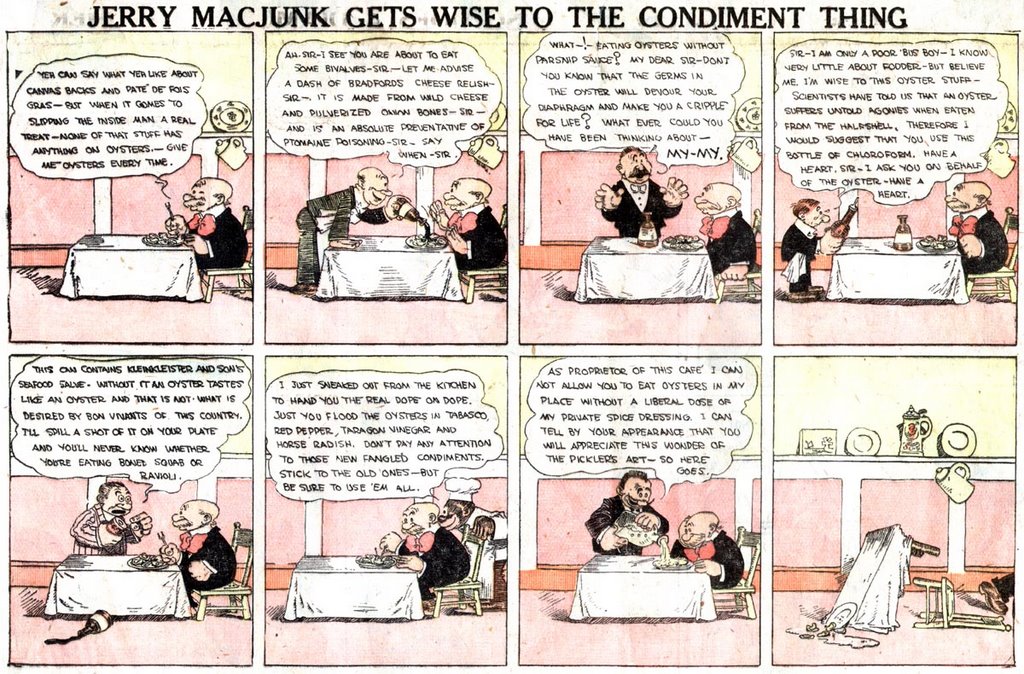

Walter Hoban's first known syndicated strip was Jerry MacJunk from the North American Syndicate, publishers of the Philadelphia North American.

According to the World Encyclopedia of Comics, Hoban was born and bred in Philadelphia, and started as an office boy at the North American with no particular interest in pursuing a career in cartooning. However, his abilities in this area were noted and he was pressed into service as a sports cartoonist. In 1910, May 1st to be exact, he made the jump to the Sunday funnies with Jerry MacJunk. Hoban was just 20 years old.

Jerry was a put-upon everyman, a Born Loser type that has always been a fixture of the comics page. What distinguished this strip was Hoban's energetic drawing style; a style that seemed to spring fully-formed from the young Hoban, and would serve him well over his 30 year newspaper cartooning career.

Jerry MacJunk was a successful strip, running every Sunday in the North American and their few syndicated client papers until January 11, 1914. The strip came to a halt when Hoban left Philadelphia for the higher paychecks of the Hearst organization in New York (not 1912 as claimed in Bill Blackbeard's Hoban entry in the World Encyclopedia). There Hoban found much wider success with another Jerry, Jerry On The Job.

The Jerry MacJunk strip had a second life when World Color Printing obtained the rights to reprint much of the North American's output of the early teens. The strip ran in the WCP preprint section from 1915-1918.

Labels:


Comments: Post a Comment

Thursday, June 01, 2006


Frank King's The Rectangle
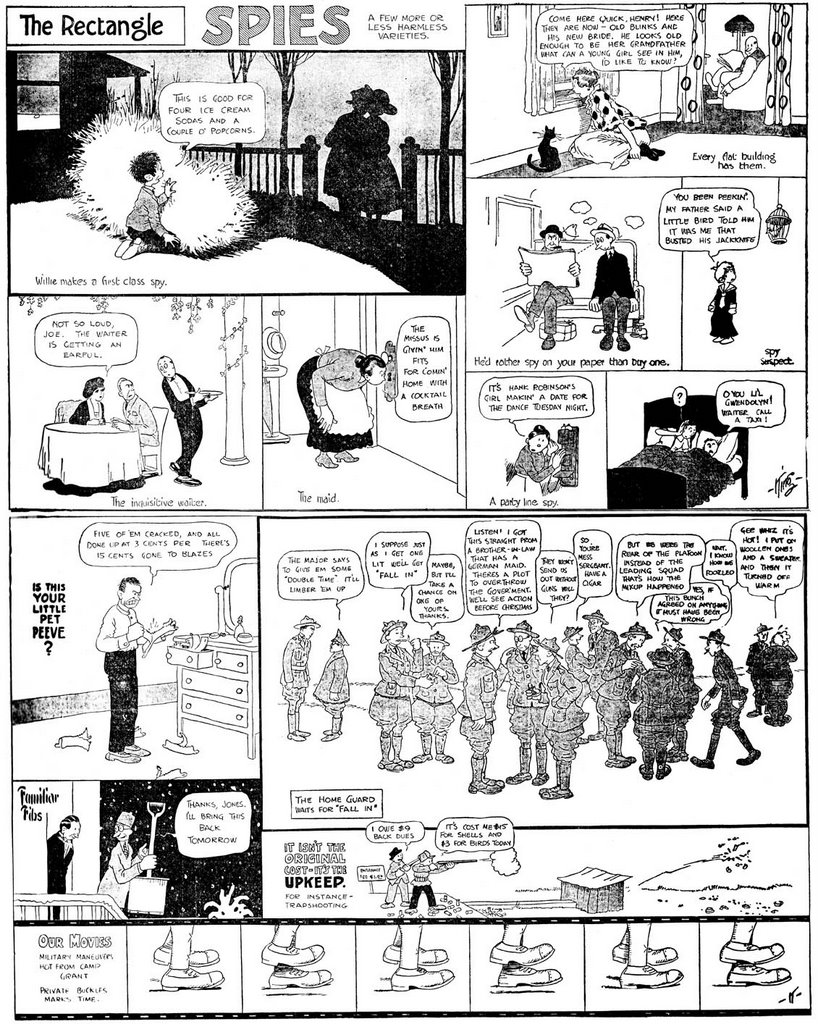

I was about to file this page away when it occurred to me that I've never seen a complete The Rectangle page reprinted anywhere. Maybe my recollector just isn't working well enough, but in any case I thought surely all you Frank King fans wouldn't mind seeing one even if a few have seen the light of day elsewhere.

The story is well-known that the denizens of Gasoline Alley were born in the compartmentalized patchwork of the The Rectangle, King's Chicago Tribune Sunday page normally printed in black-and-white outside the comics section. But they were a late addition to a page that had been running for years. King's page first ran under the Rectangle name on 12/27/1914, but had been running for quite awhile before that as an untitled feature. The untitled version was usually run at a smaller size, and I have so far not traced it back to find the ultimate start date. Anyone with access to the Trib online care to take up the chore?

The Rectangle was retired on 2/8/1920 after having run sporadically starting in 1919 when King added the daily Gasoline Alley strip to his workload.

Comments:
We've got a boatload of Rectangles up at Barnacle Press, on our Frank King page.

http://www.barnaclepress.com/comics/archives/various_artists/frank_king/index.html
 
I stand corrected, Holmes! So how about that start date, since you've got access to the Trib on Proquest?

--Allan
 
I think it was Jan 9, 1913 (link below).

I pulled King's works thoroughly from that era, and on the previous Sunday, there was just his "Do you mean what you say?" panel. The next week was the full page "Hints to Husbandettes," which was the first with the familiar bounded rectangle containing themed "unpanel" gags. It wasn't until February of '14 that the Rectangle pages appeared with regularity.

Of course, the PQ database isn't 100% complete, so some of the holes you see on Barnacle Press' page might well still be represented.

http://www.beyondbelief72.com/comics/FrankKing/king130109.jpg
 
Thanks, Holmes!! Good sleuthing, as it were.

--Allan
 
Great Blog
Good luck to you and your wife.

My question is kind of off-topic, but I have asked it on many sites and message boards without getting an answer.
In the upper right hand panel, rather than a door, there are drapes at the entryway. This was the fashion in the early part of the century and you can see it in many strips of the time, such as Little Nemo.
When did this stop being the norm and why? I suspect it had something to do with health issues, but that is just my guess.
 
Hi Bruce -
The doorway draperies were a Victorian style. Beyond the aesthetic value, I would guess that they were mostly used to get some privacy from the prying eyes of maids and servants, a common fixture in even homes of moderate means in the day. As hired help slowly faded away as the norm, so presumably did the privacy curtains.

--Allan
 
Post a Comment

This page is powered by Blogger. Isn't yours?

Subscribe to
Posts [Atom]

Tell me when this blog is updated

what is this?