Monday, January 05, 2009
Obscurity of the Day: Children's Tales


This obscure Sunday series is aptly described by its title. The McNaught Syndicate feature was designed to appeal to the younger set, featuring multi-part stories that were meant to interest elementary school readers. In addition to original material, some stories were adapted from contemporary children's books, others from classics, and yet others featured well-known animated cartoon characters.
The information on this series has been terribly hard to track down because it ran in very few papers. This wasn't really a reflection on the quality of the material, though. The strip had two problems that made it unappealing to editors. First, it was offered only in half-page and tab formats in an era when most strips were being run as thirds. Second, because the stories were always multi-parters, the strip could never be bumped from the comics section to accommodate an ad (a problem that also hastened the downfall of Sunday continuity strips).
It took me the better part of a decade to get the story list as complete as you see below, but its been worthwhile as a number of famous illustrators made their only Sunday funnies appearances in this feature. Later in the run the big name talent disappeared and most stories were written and drawn by the ever able Frank Bolle.
I would be VERY interested in hearing from anyone who knows of any earlier or later stories in this series. As far as I know the list below represents the complete run of the feature, but only because this is all I've been able to track down.
| Start | End | Title | Writer | Artist |
| 10/17/65 | 10/24/65 | The Little Red Caboose | Marian Potter | Tibor Gergely |
| 10/31/65 | 11/14/65 | Sylvester The Mouse With The Musical Ear | Adelaide Holl | N.M. Bodecker |
| 11/21/65 | 12/5/65 | Tinker And Tanker In Africa | Richard Scarry | Richard Scarry |
| 12/12/65 | 12/19/65 | The Night Before Christmas | Clement Moore | Frank Bolle |
| 12/26/65 | 1/9/66 | Paul & Arthur Search For The Egg | Anne Rockwell | Anne Rockwell |
| 1/16/66 | 1/23/66 | Where's Willie? | Seymour Reit | Erik Blegvad |
| 1/30/66 | 2/13/66 | Jeremiah Octopus | Margaret Stone Zilboorg | Hilary Knight |
| 2/20/66 | 3/6/66 | The Dragon In The Clock Box | M. Jean Craig | Kelly Oechsli |
| 3/13/66 | 3/20/66 | The Happy Man And His Dump Truck | Miryam | Tibor Gergely |
| 3/27/66 | 4/10/66 | Borka - The Adventures of a Goose with No Feathers | John Burningham | John Burningham |
| 4/17/66 | 5/1/66 | Tobias And His Big Red Satchel | Sunny B. Warner | Sunny B. Warner |
| 5/8/66 | 5/22/66 | Henry The Uncatchable Mouse | Sidney Simon | Nola Langner |
| 5/29/66 | 6/5/66 | Pear-Shaped Hill | Irving A. Leitner | Bernice Myers |
| 6/12/66 | 6/26/66 | The King Who Learned To Smile | Seymour Reit | Gordon Laite |
| 7/3/66 | 7/10/66 | The Little Red Hen | Uncredited | J.P. Miller |
| 7/17/66 | 7/31/66 | The Log and Admiral Frog | B. Wiseman | B. Wiseman |
| 8/7/66 | 8/21/66 | Thumbelina | Uncredited | Gustaf Tenggren |
| 8/28/66 | 9/11/66 | Lolly's Pony Ride | Charlotte Steiner | Charlotte Steiner |
| 9/18/66 | 10/2/66 | The Upside-Down Man | Shan Ellentuck | Shan Ellentuck |
| 10/9/66 | 10/23/66 | Old Gray And The Little White Hen | Paul Francois | Lucile Butel |
| 10/30/66 | 11/13/66 | The Whale Hunt | Kenneth S. Norris | Claude Humbert |
| 11/20/66 | 12/4/66 | The Good Friends | Paul Francois | Gerda |
| 12/11/66 | 12/25/66 | The Little Stowaway Reindeer | Frank Bolle | Frank Bolle |
| 1/1/67 | 1/15/67 | Trubloff | John Burningham | John Burningham |
| 1/22/67 | 1/29/67 | The Animals Search for Summer | Natha Caputo | Gerda Muller |
| 2/5/67 | 2/19/67 | Kangaroo & Kangaroo | Kathy Braun | Jim McMullan |
| 2/26/67 | 3/12/67 | A Pickle For A Nickel | Lilian Moore | Susan Perl |
| 3/19/67 | 4/9/67 | Noisy Nancy Norris | Louanna Gaeddert | Gioia Fiammenghi |
| 4/16/67 | 4/30/67 | A Dog's Life | Mido | Gerda |
| 5/7/67 | 5/21/67 | Runaway John | Leonore Klein | Sunny B. Warner |
| 5/28/67 | 6/11/67 | Around The Corner | Jean B. Showalter | Roger Duvoisin |
| 6/18/67 | 7/9/67 | Anna Amelia's Apteryx | Mary O'Neill | Burt Groedel |
| 7/16/67 | 7/30/67 | The Saggy Baggy Elephant | K. & B. Jackson | Gustav Tenngren |
| 8/6/67 | 8/27/67 | Little Boy With a Big Horn | Jack Bechdolt | Aurelius Battaglia |
| 9/3/67 | 9/17/67 | Honey-Duck | Frank Bolle | Frank Bolle |
| 9/24/67 | 10/8/67 | Mister Dog | Margaret Wise Brown | Garth Williams |
| 10/15/67 | 10/29/67 | The Seven Sneezes | Olga Cabral | Tibor Gergely |
| 11/5/67 | 11/19/67 | The Bear Who Became Sheriff | Frank Bolle | Frank Bolle |
| 11/26/67 | 12/10/67 | Did You See What I Said? | Shan Ellentuck | Shan Ellentuck |
| 12/17/67 | 12/24/67 | A Snowflake For Christmas | Frank Bolle | Frank Bolle |
| 12/31/67 | 1/14/68 | Gwendolyn and the Weathercock | Nancy Sherman | Edward Sorel |
| 1/21/68 | 2/4/68 | Little Yip-Yip And His Bark | Kathryn & Byron Jackson | Tibor Gergely |
| 2/11/68 | 2/25/68 | Scuffy The Tugboat | Gertrude Crampton | Tibor Gergely |
| 3/3/68 | 3/17/68 | Mrs. Ticklefeather | Dorothy Kunhardt | J.P. Miller |
| 3/24/68 | 3/31/68 | Home For A Bunny | Margaret Wise Brown | Garth Williams |
| 4/7/68 | 4/21/68 | The Big Brown Bear | Georges Duplaix | Gustaf Tenggren |
| 4/28/68 | 5/12/68 | The Merry Shipwreck | Georges Duplaix | Tibor Gergely |
| 5/19/68 | 6/2/68 | The Sailor Dog | Margaret Wise Brown | Garth Williams |
| 6/9/68 | 6/23/68 | Little Peewee | Dorothy Kunhardt | J.P. Miller |
| 6/30/68 | 7/14/68 | Benjamin Budge and Barnaby Ball | Florence Parry Heide | Sally Mathews |
| 7/21/68 | 8/4/68 | Not This Bear! | Bernice Myers | Bernice Myers |
| 8/11/68 | 8/25/68 | The Elves and the Shoemaker | Frank Bolle | Frank Bolle |
| 9/1/68 | 9/15/68 | Sam and the Impossible Thing | Tamara Kitt | Brinton Turkle |
| 9/22/68 | 10/6/68 | The Note That Wouldn't Play | Nick Meglin | Frank Bolle |
| 10/13/68 | 10/27/68 | The Princess And The Pea | Frank Bolle | Frank Bolle |
| 11/3/68 | 11/17/68 | The Cow Went Over The Mountain | Jeanette Krinsley | Feodor Rojankovsky |
| 11/24/68 | 12/8/68 | Mister Puffer-Bill | Leone Arlandson | Tibor Gergely |
| 12/15/68 | 12/22/68 | The Twelve Days of Christmas | traditional | Frank Bolle |
| 12/29/68 | 1/12/69 | Fun For Hunkydory | May Justus | Sue D'Avignon |
| 1/19/69 | 2/2/69 | Scotty and the Story-Teller | Nick Meglin | Frank Bolle |
| 2/9/69 | 2/23/69 | Hazel Was an Only Pet | John Hamberger | John Hamberger |
| 3/2/69 | 3/16/69 | Peter Potamus | Carl Memling | Hawley Pratt, Bill Lorencz |
| 3/23/69 | 4/6/69 | The Golden Egg | Margaret Wise Brown | Lilian Obligado |
| 4/13/69 | 4/27/69 | Thistle | Era Zistel | uncredited (Frank Bolle) |
| 5/4/69 | 5/18/69 | Ruff and Reddy Go To a Party | Uncredited | Harvey Eisenberg, Neil Boyle |
| 5/25/69 | 5/25/69 | The Fox and the Crow | Frank Bolle | Frank Bolle |
| 6/1/69 | 6/15/69 | 3910 16th Avenue | Nick Meglin | Frank Bolle |
| 6/22/69 | 7/6/69 | Mushmouse and Punkin Puss, the Country Cousins | Jay Freeman | Peter Alvarado, R. Jacobs |
| 7/13/69 | 7/13/69 | My Shadow | Frank Bolle | Frank Bolle |
| 7/20/69 | 7/27/69 | Wally Gator - Guess What's Hiding at the Zoo? | Eileen Daly | Mel Crawford |
| 8/3/69 | 8/17/69 | The Day of the Trucks | Nick Meglin | Frank Bolle |
| 8/24/69 | 9/7/69 | Rumpelstiltskin | Frank Bolle | Frank Bolle |
| 9/14/69 | 9/21/69 | We Like Kindergarten | Clara Cassidy | Eloise Wilkin |
| 9/28/69 | 9/28/69 | The Horse and the Lion | Frank Bolle | Frank Bolle |
| 10/5/69 | 10/12/69 | Sam the Firehouse Cat | Virginia Parsons | Virginia Parsons |
| 10/19/69 | 10/19/69 | The Kid and the Wolf | Frank Bolle | Frank Bolle |
| 10/26/69 | 11/9/69 | Doctor Dolittle Stops the Bullfights | Frank Bolle | Frank Bolle |
| 11/16/69 | 11/30/69 | Percy the Plain Old Spruce Tree | Nick Meglin | Frank Bolle |
| 12/7/69 | 12/21/69 | A Christmas Carol | Frank Bolle | Frank Bolle |
| 12/28/69 | 12/28/69 | The Hare And The Tortoise | Frank Bolle | Frank Bolle |
| 1/4/70 | 1/11/70 | When I Grow Up | Ilse-Margret Vogel | Ilse Margret-Vogel |
| 1/18/70 | 2/1/70 | Doctor Dolittle - The Dog Ambulance | Uncredited | Uncredited |
| 2/8/70 | 2/22/70 | Ricochet Rabbit - Showdown at Gopher Gulch Bakery | Patrick Hagen | Al Anderson, Peter Alvarado |
| 3/1/70 | 3/15/70 | Snagglepuss - The Way To Be a King | William Johnston | Art Seiden |
| 3/22/70 | 4/5/70 | Touche Turtle and the Fire Dog | Jean Lewis | Mel Crawford |
| 4/12/70 | 4/19/70 | The Tiny Tawny Kitten | Barbara Hazen | Jan Pfloog |
| 4/26/70 | 5/3/70 | The Boy With A Drum | David L. Harrison | Eloise Wilkin |
| 5/10/70 | 5/10/70 | The Lion and the Mouse | Frank Bolle | Frank Bolle |
| 5/17/70 | 5/31/70 | The Siren Hound | Patricia Boyd | Frank Bolle |
| 6/7/70 | 6/14/70 | The Wonderful School | May Justus | Hilde Hoffmann |
| 6/21/70 | 6/21/70 | The Cat and the Mice | Linda Moggio | Frank Bolle |
| 6/28/70 | 7/12/70 | Huckleberry Hound The Rainmaker | Uncredited | Uncredited |
| 7/19/70 | 7/19/70 | The Fox And The Grapes | Linda Moggio | Frank Bolle |
| 7/26/70 | 8/9/70 | Peter Potamus and the Pirates | Jean Lewis | Howard Forsberg |
| 8/16/70 | 8/30/70 | Cinderella | Linda Moggio | Frank Bolle |
| 9/6/70 | 9/13/70 | The Trophy | Nick Meglin | Frank Bolle |
| 9/20/70 | 10/4/70 | Touche Turtle | Carl Memling | Bill Lorencz, Norm McGary, Al White |
| 10/11/70 | 10/25/70 | A Gift For Ted | Nick Meglin | Frank Bolle |
| 11/1/70 | 11/15/70 | The Duck and the Leaves | Linda Moggio | Frank Bolle |
| 11/22/70 | 12/6/70 | The Sleeping Beauty | Linda Moggio | Frank Bolle |
| 12/13/70 | 12/20/70 | The Night Before Christmas (1965 reprint?) | Clement Moore | Frank Bolle |
| 12/27/70 | 1/10/71 | The Lazy Fox and the Little Red Hen | Linda Moggio | Frank Bolle |
| 1/17/71 | 1/31/71 | Prairie Pup | Linda Moggio | Frank Bolle |
| 2/7/71 | 2/21/71 | Matilda the Cow | Linda Moggio | Frank Bolle |
| 2/28/71 | 3/14/71 | Hansel and Gretel | Linda Moggio | Frank Bolle |
| 3/21/71 | 4/3/71 | The Special Mister Reggie Frog | Linda Moggio, Frank Bolle | Frank Bolle |
| 4/10/71 | 4/25/71 | Clever Trevor and his Bag of Tricks | Frank Bolle | Frank Bolle |
| 5/2/71 | 5/16/71 | The Funny Little Squirrel | Linda Moggio | Frank Bolle |
| 5/23/71 | 5/30/71 | The Boy Who Couldn't Rhyme | Nick Meglin | Frank Bolle |
| 6/6/71 | 6/20/71 | The Crabby Crab | Frank Bolle | Frank Bolle |
| 6/27/71 | 7/11/71 | Jack and the Beanstock | Linda Moggio | Frank Bolle |
| 7/18/71 | 8/1/71 | Clever Trevor and the Forbidden Island | Frank Bolle | Frank Bolle |
| 8/8/71 | 8/15/71 | A Short Dog Story | Linda Moggio | Frank Bolle |
| 8/22/71 | 8/29/71 | My Own Room | Nick Meglin | Frank Bolle |
| 9/5/71 | 9/12/71 | The Snappy Turtle | Frank Bolle | Frank Bolle |
| 9/19/71 | 9/26/71 | Errol Digs Adventure | Frank Bolle | Frank Bolle |
| 10/3/71 | 10/10/71 | Goldilocks and the Three Bears | Linda Moggio | Frank Bolle |
| 10/17/71 | 10/24/71 | The School of Fish | Linda Moggio | Frank Bolle |
| 10/31/71 | 11/7/71 | A Ride In Space | Linda Moggio | Frank Bolle |
| 11/14/71 | 11/14/71 | The Paper | Frank Bolle | Frank Bolle |
| 11/21/71 | 11/21/71 | That's Why | Frank Bolle | Frank Bolle |
| 11/28/71 | 11/28/71 | One Track Mind | Frank Bolle | Frank Bolle |
| 12/5/71 | 12/5/71 | The Easel | Frank Bolle | Frank Bolle |
| 12/12/71 | 12/19/71 | A Snowflake For Christmas (reprint of 1967 story) | Frank Bolle | Frank Bolle |
Labels: Obscurities


Comments:
Just wanted to post a note to say thank you for these invaluable insights; I've been doing some research for a small curatorial project and your notes have been completely invaluable. I'm both really impressed and quite grateful. Thank you!
# posted by  : 1/05/2009 4:13 AM
: 1/05/2009 4:13 AM
Hi Alan,
Judging from the titles and artists on this strip, it appears to be repurposed artwork from Golden Books/Whitman publications. Do you have any examples of the earlier strips in the series such as THE LITTLE RED CABOOSE by Tibor Gergeley or THE LITTLE RED HEN by J.P. Miller? Thanks for all your great research, Mark Kausler
Judging from the titles and artists on this strip, it appears to be repurposed artwork from Golden Books/Whitman publications. Do you have any examples of the earlier strips in the series such as THE LITTLE RED CABOOSE by Tibor Gergeley or THE LITTLE RED HEN by J.P. Miller? Thanks for all your great research, Mark Kausler
# posted by : 1/05/2009 2:26 PM
: 1/05/2009 2:26 PM
Hi Allan,
Please excuse the mispelling of your name.
All best, Mark K.
Please excuse the mispelling of your name.
All best, Mark K.
# posted by : 1/06/2009 1:40 AM
: 1/06/2009 1:40 AM
I agree with Mark that alot of the titles seems to be repurposed from the Golden Books series, especially in stories that appears to feature Hanna-Barbera characters (Peter Potamus, Huckleberry Hound). The artists listed, such as Hawley Pratt, is also a tipoff.
Pratt is best known for directing a bulk of the "Pink Panther" cartoons. He was a layout artist for Friz Freleng during the "Looney Tunes" days, doing most of the character layouts for him.
Pratt is best known for directing a bulk of the "Pink Panther" cartoons. He was a layout artist for Friz Freleng during the "Looney Tunes" days, doing most of the character layouts for him.

My grandfather used to cut these comics out of the newspaper every week and glued them into a "scrapbook" made from an old magazine. I have all of them through Runaway John Part 3. I wish I had more, but he got sick and passed away in 1972 when I was 9. My comic book scrapbook is a very precious memory of lazy days spent with a grandfather I adored.
# posted by : 1/11/2009 2:56 PM
: 1/11/2009 2:56 PM
Hi Caryn -
Do you know what newspaper he clipped them from? Does your scrapbook include any that pre-date "The Little Red Caboose"?
Thanks, Allan
Post a Comment
Do you know what newspaper he clipped them from? Does your scrapbook include any that pre-date "The Little Red Caboose"?
Thanks, Allan
Monday, July 03, 2017
Ink-Slinger Profiles by Alex Jay: Frank Williams

In the 1920 U.S. Federal Census, Williams, his widow mother and younger brother Claude were in his maternal grandmother’s household which included Williams’s uncle and aunt. Williams’s father was a Michigan native and mother a Canadian emigrant who was a stenographer at the Readi-Cut House Manufacturing Company. The families resided in Bay City at 220 Stanton Street.
Williams’s mother remarried to William W. Rehmus. According to the 1930 census, the couple lived at the same Bay City address. However, Williams and his brother were not there; they have not yet been found in this census.
The Free Press said Williams “attended the now-defunct Detroit Art Academy. In 1933 he began working as a copy editor at the Bay City Times, where he also drew cartoons. He worked for Booth Newspapers from 1935 to 1943, when he started at the Free Press. His early days at the newspaper included drawing cartoons for the sports department.”
The Michigan marriage records, at Ancestry.com, said Williams married Eleanor Hogan on November 12, 1937 in Bay City. Williams had been living in Grand Rapids, Michigan.
American Newspaper Comics (2012) said Williams, William Fanning and Max Rasmussen were the artists on Edward Geller’s The Story of an Ambitious Man Who Made Jobs for Thousands Through Free Enterprise which began December 7, 1947. The strip was published and syndicated by the Free Press.
Williams was the editorial page cartoonist for the Free Press for 35 years until his retirement in 1978. The Free Press said “Williams was honored several times with citations from the Freedoms Foundation and the National Safety Council. His trademark small man with a wide grin and bushy black moustache, who often appeared in his work tagged John Q. Public, was a caricature of himself….” One of his hobbies was flying model planes.
A Williams cartoon was reprinted in Life, October 21, 1957 and Jet, March 17, 1960.
Williams passed away April 12, 1992, at his home in Canadian Lakes, Michigan, according to the Free Press, which said his wife died in 1987 and was survived by two sons, a daughter, five grandchildren, and a brother.
—Alex Jay
Labels: Ink-Slinger Profiles
Comments:
Thank you for the article. The Williams family lived down the street from us in the 1940s. Mrs. Williams was my den mother in Cub Scouts.
Post a Comment
# posted by : 10/27/2022 9:28 PM
: 10/27/2022 9:28 PM Wednesday, June 28, 2017
Ink-Slinger Profiles by Alex Jay: Edward and Irene Geller
The story of Edward Joseph Geller and his wife, Irene Caplan, is sketchy. A family tree at Anestry.com has the birth, marriage and death information for Geller. He was born in Toronto, Canada, on June 11, 1893. Geller married Caplan on December 25, 1932, in Detroit, Michigan. They had a daughter, Shoshana in 1933.
A border crossing document at Ancestry.com said Geller entered the United States at Detroit on April 30, 1917. The manifest said Geller was a cigar salesman and listed his father, Samuel Geller at 51 Pelessier Street, Windsor, Ontario. From 1908 to March 31, 1917, Geller had been in Chicago, Detroit and Kansas City, Missouri. Geller’s destination was Detroit where his brother Max lived at 185 Delmar Avenue.
Geller has not been found in the censuses.
The 1942 Royal Oak, Michigan city directory listed Geller as a Detroit Free Press salesman who resided at 4320 Hampton Boulevard.
The Detroit Free Press, February 23, 1951, reported the Freedoms Foundation medal awarded to Geller.
Edward Geller, creator of “The Story of An Ambitious Man” which appears in The Detroit Free Press Sunday comic section, was presented an honor medal by Freedoms Foundation. The feature won second place in the cartoon strip category.American Newspaper Comics (2012) said Geller created The Story of an Ambitious Man Who Made Jobs for Thousands Through Free Enterprise for the Detroit Free Press. He was assisted with the writing by his wife and Len G. Shaw. The artists were Frank Williams, William Fanning, and Max Rasmussen. The series began December 7, 1947.
Geller was among 850 individuals and organizations honored for “speaking up for freedom.” Presentation of awards and the principal address were made by Gen. Omar N. Bradley, chairman of the joint chiefs of staff.
…Geller does the research into the lives of his subjects. He is aided in writing the stories by Len G. Shaw, drama editor emeritus of the Free Press. Cartoonists are Frank Williams and William Fanning, of the Free Press, and Max Rasmussen, commercial artist.
Geller, 57, has been a creator of special pages for the Free Press for 15 years. He lives at 3298 Virginia Park with his wife and daughter, Shona.
The family tree said Geller passed away in 1954 in Detroit. However, the Free Press, October 16, 1955, had this line: “For space on these pages, phone Edward Geller, Detroit Free Press”. Geller passed away January 1, 1957 according to an obituary in the Detroit Free Press, January 2.
 |
| Detroit Free Press Obituary courtesy of Art Lortie |
A family tree at Ancestry.com said Caplan, Geller’s wife, was born in Baltimore, Maryland, on September 7, 1899. According to the Social Security Death Index, Caplan passed away June 1968, in Huntington Woods, Michigan.
—Alex Jay
Labels: Ink-Slinger Profiles
Comments:
Post a Comment
Monday, May 23, 2016
Heritage Internet Auction Opens Today
I have a great assortment of original art in this week's Heritage Internet
Comic Auction. The auction opens today and closes on May 29 (Sunday).
To view and bid on any of my lots in this week's auction follow this link.
Here are photos and my thoughts on this week's auction items:


To view and bid on any of my lots in this week's auction follow this link.
Here are photos and my thoughts on this week's auction items:
 |
| Great large color piece Al Smith did for the National Cartoonist Society's 10th anniversary, with all the Mutt & Jeff characters plus a self-caricature! |
 |
| The best Boots & Her Buddies original I've ever found -- by which of course I mean it has LOTS and LOTS of gorgeous gals! |
 |
| Superb patriotic July 4 panel by Briggs, with endless detail. The discoloration they seem to show in the photo I think is mostly an artifact. It was on my wall for years and I never noticed that. |
 |
| Two Bughouse Fables panels by DeBeck, who usually signed these "Barney Google". Great wall decor for you cigar smokers. |
 |
| Buz Sawyer daily with great aviation content -- check out that 'saucertop' radar plane! |
 |
| Early signed limited edition print by modern master Dan Clowes. Cool, man, cool. |
 |
| I can hardly believe I consigned this. This great Jay Disbrow piece hung on my programming office wall for decades, and was a prized possession. |
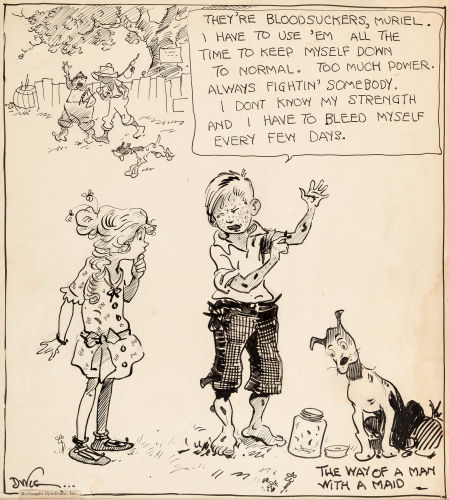 |
| Nice early Tom Sawyer / School Days daily by Dwig. He really did manage to perfectly embody the Mark Twain ideal in this long-running panel series. |
 |
| Beautiful Gasoline Alley daily with Skeezix reviewing his life, so typical of the great Frank King. Custom framed in beautiful hardwood. |
 |
| Delightful Gaar Williams daily. A neglected master. |
 |
| Another nice Gaar Williams piece, this one a very dramatic image with a horde of airplanes taking over the globe. |
 |
| Great Leo Garel color cartoon was chosen as the cover for a Lawrence Lariar "Best Cartoons" collection. |
 |
| Classic Rube Goldberg -- should have been saved for one of their major auctions imho. |
 |
| Can't afford a Nell Brinkley original? Here's an H.B. Gordon piece that gives Ms. Brinkley a run for her money. What incredible detailed linework! |
 |
| A very rare find -- a Bill Holman gag cartoon original from the 1930s, this predates Smokey Stover and has most of the classic Holman elements. Museum quality framing, too. |
 |
| I love, love, love H.T. Webster's work, and there are two superb Caspar Milquetoast originals going this week. These are really hard to find, don't miss out. |


 |
| Three unpublished C.H. Wellington try-out pages from the mid-1910s, all in one lot. What a great title, "The Jims of Jamland"!! How did this not sell to a syndicate? |
 |
| The great J.R. Williams tells us one of the million reasons why mothers get gray. Neat train content, too. |
 |
| A sweet young thing has a yen for the teacher, beautiful drawn by Stan Drake in this early Heart of Juliet Jones daily. |
 |
| Another rarity that should be in a marquee auction. Very early Sherlocko the Monk strip by Gus Mager! |
 |
| The "you look just like Margie" guy in a rare foreground appearance in George McManus' Bringing Up Father. |
 |
| Ken Mitchroney created a character in his Space Ark comic book as an homage to Jim Ivey! This piece was presented to Jim many moons ago. |
 |
| A classic Mr. Oswald strip by Russ Johnson. What an incredible artist he was. I just adore his work, which is very hard to come by, but I have several of them going to new homes in this week's auction. |
 |
| See above, a nice Mr. Oswald golf gag. |
 |
| Amazing detail and terrific expressions in this 1890 Fred Opper original from Puck. I wish I knew the caption! |
 |
| Opper again, this time with a Puck story illustration. |
 |
| And here's a really terrific Opper multi-panel cartoon about the trusts. Trimmed unfortunately, but hey, it's 120+ years old! |
 |
| Delightful Robert Day cartoon from Collier's. Nicely framed too. |
 |
| The incomparable Frank Godwin. I was given my choice of one from a big stack of Rusty Riley originals, I chose this one for that great middle panel and the lovely bookending effect. |
 |
| The great Jim Scancarelli shows that it's not only Frank King who can do those delightful chiaroscuro panels. Sweet nostalgic Sunday page. |
 |
| That Son-In-Law of Pa's by C.H. Wellington, a nice early example, and huge! |

 |
| Three Spuddle's Sport Shop pages by the great Russ Johnson. Very few people realize that he did another series for a sporting goods retailer magazine -- just as fine as his Mr. Oswald pages. |
 |
| The other Timid Soul daily by H.T. Webster (see above) , this one featuring a rare appearance in that era of an Asian on the daily comics page. |
 |
| The great W.E. Hill at the height of his powers, I prefer his 1950s stuff to his earlier work. Those finely drawn faces are so haunting! |
 |
| A huge Winnie Winkle Sunday page, lots of shapely Winnie, plus the very popular Perry. |
 |
| Three super-rare gun safety posters by Will Eisner. Very cool images, especially if you are a hunter. |
 |
| Is this the worst condition (complete) copy of Showcase #4 in existence?! Why they slabbed this is beyond me. Buy it, remove it from its coffin, and enjoy it! |
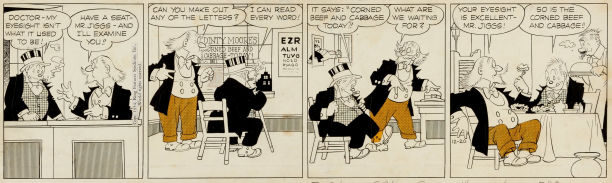 | |
The great Zeke Zekley, still not allowed to sign his work even after the death of McManus. This was just a month after McManus' last signed dailies, and Zekely would be kicked off very soon. Man, that C.A. Voight could draw the gorgeous gals, couldn't he? Fabulous! |
Wednesday, June 10, 2009
News of Yore 1942: War Work of the Cartoonists
Cartoonists Important Factor In Keeping Nation's Morale
Knights of the Syndicate Drawing Boards Are Doing Valuable Work for U. S - All Serving Gladly Without Remuneration
By S. J. Monchak (E&P 9/19/42)
The knights of the drawing board are doing their bit to help Uncle Sam speed the day of victory over the Axis.
The nation's syndicate cartoonists whose material appears in newspapers over the land have enlisted for the duration to aid in doing the job of keeping up the morale of the fighting men and the folks here at home. And they're performing a valuable service, government officials say.
Aid in Every Way
It's impossible to compute how many millions of dollars worth of War Bonds and Stamps have been sold through the constant plugging of the cartoonists in their daily releases, or how many pints of blood have been donated to the Red Cross through their efforts, or to arrive at results directly attributable to their other war promotions.
But it can safely be assumed that these figures, if there was a way to arrive at them, would show the cartoonists up near the top among the various agencies now doing similar work throughout the country, if only for the fact that so many millions of persons read the comics daily and are influenced by them.
All of the top-flight cartoonists and many others are giving their services without stint and recompense other than the satisfaction of knowing that they are doing their bit for the cause.
One artist even has given his life in the struggle for freedom. Young Bert Christman, who drew "Scorchy Smith," an aviation strip, for Wide World Features, gave up his drawing board in 1938 for a pilot's job in the Navy. Joining the Flying Tigers, he was one of the first U. S. pilots to die in the defense of Burma shortly after we entered the war last December. His plane was shot down and Christman's body was riddled with machine gun bullets as he parachuted to earth.
Heeded U. S. Call
When Christman gave up drawing to be a pilot, Frank Robbins took over the strip (actually Robbins took over about a year later - ed.). Scorchy is, for the present, in the thick of the battles, ferrying bombers across the Pacific and is headed for the Russian front.
Government officials early saw the possibilities inherent in newspaper comics as a medium for getting their morale-building messages across to the people, and long before Pearl Harbor the cartoonists were called upon to do the job.
They responded magnificently, not only through their own daily creations but with extra-curricular activities. Many have drawn special posters, others have entertained the
service men, all are doing something for the war effort.
Incidentally, the Office of War Information has arrangements with the larger syndicates to be supplied each week with proofs of the more widely syndicated comics. These comics are short-waved weekly by OWI to the fighting men in foreign lands.
For example, Ed Reed, author of the Register and Tribune Syndicate gag panel "Off the Record," is head of the Treasury Department's organization of cartoonists assisting the sale of War Bonds. During the past year Reed has devoted the bulk of his time in organizing the nation's cartoonists in this respect, has traveled extensively across the country doing a bang up job. He is a dollar a year man for Uncle Sam.
Another outstanding contribution has been that of Ham Fisher, McNaught Syndicate cartoonist and creator of "Joe Palooka." He was the first cartoonist to introduce the war motif in his continuity. Late in 1939 he made a tour of Army camps, equipped with a letter of introduction from the Under Secretary of War, in order to obtain background material.
Shortly after—even prior to the draft law's enactment, Joe Palooka gave up his championship boxing title and joined the Army to contribute his bit in the fight for democracy. So authentic was the material used in the comic that Palooka soon became known throughout the ranks as the soldier's best friend.
In recognition of this fact, the Army's morale department has on many occasions requested Fisher's cooperation in bringing to the attention of the men various phases of training. Several months ago the strip, at the request of numerous soldiers as well as officers, devoted a whole release to outlining procedure for an enlisted man's entrance into officers' training school. Fisher is one of the most ardent anti-Axis haters in the country. Incidentally, Fisher's strip is a "must" in Stars and Stripes being delivered to the soldiers in Ireland.
Fisher spends every possible moment away from his drawing board appearing at War Bond rallies, entertaining men at service clubs and Army camps and directing the activities of the "Joe Palooka Smokes & Entertainment Fund."
Perhaps the most fitting tribute to Fisher's work comes from Elizabeth Knaust, formerly connected with the Berlin propaganda bureau. She fell into disfavor with the Nazis and managed to escape from the Reich to Lisbon where she secured passage on one of the refugee ships. Upon her arrival here she was asked by a newspaper man what medium Goebbels considered to be the most effective anti-Axis propaganda. She promptly replied, "Joe Palooka."
The artists of NEA Service and the service itself, are 100% in serving behind the morale effort. That goes for Jim Williams ("Out Our Way"), Merrill Blosser ("Freckles and His Friends"), Edgar Martin ("Boots and Her Buddies"), Roy Crane ("Wash Tubbs"), Fred Harman ("Red Ryder"), V. T. Hamlin, ("Alley Oop"), Bill Freyse and Bill Braucher ("Our Boarding House"), Galbraith ("Side Glances"), R. A. Herschberger ("Funny Business"), and Howard Boughner ("Hold Everything").
Treasury Aided
Herblock, NEA's editorial cartoonist, is another who has been making regular contributions.
In addition to producing their quota of special posters for the Treasury Department, these cartoonists also prepare scores of cartoons which NEA issues in its service in two-column size to all its clients.
NEA is outstanding in its efforts toward the Treasury's end. Last May 21, the syndicate received a letter from Burns Lee of the department, saying: "Every one here is greatly enthusiastic about the way in which NEA has gotten behind the war saving campaign. It was a joy to behold all those mentions of bonds and stamps throughout your cartoon material. We like this effort on your part so well that we are planning to make up a special presentation for Secretary Morgenthau showing what you have done."
The Treasury also called upon Jim Williams recently for an "extra special" cartoon for the bond campaign. This assignment was important enough for a Treasury official to call up the cartoonist on the 'phone all the way out to his ranch in California.
Williams, by the way, has just finished a poster which is being distributed by the National Safety Council. Great emphasis is being placed upon the importance of accident prevention in the war industries and Williams made that the theme of his poster, part of a nationwide campaign.
Artists have done their bit also in assisting the scrap metal drive, emphasizing the need for household economy and conservation, campaigning for rubber conservation and less consumption of gasoline.
Forest Service a Beneficiary
NEA also has a daily cartoon release which was inaugurated last June 1. Each day the service releases a one-column drawing of one of its artists. These drawings all carry a patriotic appeal. Each of them represents a little extra effort on the part of the cartoonists.
Even the U. S. Forest Service has called upon NEA and Fred Harman drew a special fire prevention poster which was adopted as the keynote of this year's campaign against fire prevention. NEA received a letter of thanks from every Regional Forester in the country.
Several of the NEA comic characters are on the fighting fronts, while others stress what is going on around the home front.
At "United Feature Syndicate, also, the cartoonists are doing an all-out job. Probably the most spectacular is Al Capp, author of "Li'l Abner." When the Treasury called for cartoons to boost War Bonds, Capp created a Sunday color page called "Small Fry," a. regular running feature distributed by the Treasury free to newspapers.
It appears every-other-week from coast-to-coast and the Treasury has advised United that the feature is the most important and effective individual feature in the sale of bonds.
Jack Sparling, who draws Drew Pearson's comic, "Hap Hopper," also has a regular running feature for the Treasury. This is a cartoon called "Penny-Wise," distributed nationally and shows the housewife how she can save money and put her savings into War Stamps. Sparling also contributes special editorial cartoons to the Treasury.
Ernie Bushmiller, author of "Nancy" and "Fritzi Ritz," has not only contributed many cartoons to the War Bond drive, but the continuity in his features has frequently centered on campaigns to collect salvage, to sell bonds, to emphasize the importance of "sealed lips," etc.
John Hix, with "Strange As it Seems," has found the feature particularly adaptable to wartime exploitations. He has cooperated especially with the Office of Emergency Management which has supplied about 70 ideas that he has worked into the feature.
In addition to supplying Treasury cartoons, Robert M. Brinkerhoff, author of "Little Mary Mixup," has done many posters, including 30 for a Red Cross sale at Captiva Island, Fla., where they were sold for charity at fabulous prices.
Originals Requested
Paul Berdanier, UFS editorial cartoonist, had three posters in the memorable exhibition of war posters at the Salamagundi Club. He also has done posters for Army Emergency Relief and contributed especially to Full Speed Ahead, the Navy publication which is distributed to shipyard workers. His daily cartoons on various phases of the war effort bring many request for originals from high officials in Washington.
Alan Maver, UFS sports cartoonist, has contributed cartoons to the Treasury, works with the Coordinator of Inter-American Affairs, and does posters for his local Civilian Defense unit. Bud Rosser, author of "Race Riley and the Commandos," is the artist who drew one of the most remarkably effective USO posters which has had wide distribution throughout the country both as a poster and as an ad.
Burne Hogarth, who draws the "Tarzan" Sunday page, has a full schedule of Civilian Defense activities. He works with the West Side (New York) Defense Council on salvage collections and various other activities, and has organized a unit to work on drawings for the Red Cross. He has also contributed posters to the Army Emergency Relief.
Rex Maxon, who draws the "Tarzan" daily strip, contributes posters to the Civilian Defense organization at Port Washington, Long Island, which was recently congratulated by Commissioner Landis for raising its own funds for Civilian Defense without asking for federal aid.
Raeburn Van Buren, author of "Abbie an' Slats," has also contributed local defense posters at Great Neck, Long Island, and has done a series of special cartoons for the Treasury. Ed Dodd, author of "Back Home Again," also draws posters for the local OCD group. Harry O'Neill, author of "Broncho Bill," reports that the job of which he is proudest is contributing his three husky sons to the Army. The three boys are now on active service. O'Neill has also been very active in contributing foreign propaganda ideas to the OWI. Rudolph Dirks, author of "The Captain and the Kids," has likewise contributed his only son to the service. John Dirks, recently out of Yale, is now with the Army in Great Britain.
Henry Formhals, who does the "Joe Jinks" Sunday page, is a zone air raid warden in Altadena with 150 wardens in his area. He has reflected his experiences in the Sunday pages giving readers first-hand information on phases of Civilian Defense. He also did a poster for the Altadena "Hospitality House" which is posted all over Southern California to invite service men to drop in when they are in that section. Gus Arriola, author of "Gordo," has been a steady contributor of cartoons to the Los Angeles defense efforts.
Contribute Defense Cartoons
Charlie Plumb, who draws "Ella Cinders," has been sending his defense cartoons from his home in Cuernavaca, Mexico. Denys Wortman, author of "Everyday Movies," has also contributed defense cartoons. Frank Owen, author of "Jasper," is drawing posters for "Artists for Victory," has got out a book of cartoons satirizing Hitler's Russian campaign, and is enrolled as an Auxiliary policeman in his home town of Ridgewood, New Jersey.
Dick Moores, author of "Windy and Paddles," got an actual taste of war when the submarine shelled Santa Barbara where he lives. Moores is the creator of "Herkimer Gain," a special war feature symbolizing the typical un-American American; the man who hoards anything there might be a shortage of, who continues to drive his car fast without regard for the rubber, who chisels with the rationing Board and cheers on the war effort but never contributes a penny. Moores has also created "Oscar Thumbs Up" to symbolize the citizen who is taking all war sacrifices with a smile. Both cartoons are widely distributed in California. (as far as I know these were characters introduced in Moores' regular strip -- has anyone seen them in a special series? - ed)
Virtually all of the comic strips have sequences dealing with the war or with the war effort. The gag strips have been particularly effective as a medium for boosting war bonds and stamps.
Cartoonists "All Out"
Wide World's "Strictly Private," drawn by Quin Hall, was among the first strictly military panels in the field. Since his inception, "Private Peter Plink," the panel's rookie hero, has found himself an adoptee of several Army camps.
All of WWF comic artists have been cited by the Treasury for their aid in the War Bond drive, and war has taken a real place in the lives of the comics characters. Even Don Flowers' sophisticated "Modest Maidens" are having adventures with victory gardens, learning first aid, entertaining soldiers and sailors, serving as wardens and lookouts.
"Dickie Dare," a Tom Sawyer gone to sea, has already rounded up several spies, captured a submarine and presently is trailing a treasure in Latin America where he spreads the good neighbor spirit. He proposes to give the treasure to the war effort.
Charley Raab's bright-eyed little actress, "Patsy," bade goodbye to her swashbuckling friend, "Skidd," who joined the Navy, while Fred Locher's blunder-puss, "Homer Hoopee," is trailing spies. Tom (Pap) Paprocki's "Sports Slants" pay frequent tribute to sports figures in their country's service, while Milt Morris' old "Hoss-feathers Peters" has taken up jiu-jitsu for self defense.
Staff artist Joe Cunningham and Comics Editor Frank Reilly are both in the Army and Coulton Waugh, a New York Guard, burns the midnight oil doing war posters and cartoons.
The veteran Fontaine Fox, who draws "Toonerville Folks" for McNaught, has done much along conservation lines and recently George H. Lyons, Chief of Press and Periodicals in the Office of Emergency Management, wrote him: "That's a grand bunch of clips. They drive home exactly the points we are anxious to have made and so all of us are standing up and cheering for you."
"Mickey Finn," Lank Leonard's strip, has urged the importance of civilian defense activities by building continuity around First Aid classes, auxiliary police training and air raid warden duties. All this background has been gained by Leonard the hard way—that of signing up himself for these activities in his home town of Port Chester, N. Y.
Some Have Timely Continuity
Frank Tinsley's "Captain Yank" strip and page prior to Pearl Harbor concerned itself principally with "Yank's" activities as a flying explorer on secret missions and later as a special investigator for the government in sabotage cases. When war broke out, Tinsley had "Yank" recalled to his command with the U. S. Marines and given orders for Commando service in the Far East. In building up this continuity, Tinsley had "Captain Yank" train for several weeks on the West Coast and it was during this period that he defeated a plan for a Jap submarine to fire on a West Coast city. The day he blew up the submarine that was to do the job, all of our papers carried the headlines detailing the attack on the southern California town.
"Dixie Dugan," the creation of Striebel and McEvoy, being a pretty girl, cannot join up in the armed forces but she does much in her daily and Sunday activities to promote the cause of the American Red Cross, the U.S.O., and the purchase of War Bonds. She has visited training camps, air fields and canteens in her efforts to boost morale and her creators have made every effort to keep up with the demand for life-size portraits to be hung in the recreation rooms of camps and ships.
Frank Beck, creator of the "Bo" daily strip and page as well as the "All in a Lifetime" panels, is daily contributing to the war effort by bringing to the attention of his readers the need for everyone's cooperation in the present conflict. His panels depict many amusing incidents in the civilians' activities to conserve tires, gasoline, old metal, etc., and their efforts to cooperate to the fullest extent in civilian defense work. "Bo" and his master "Junior" are at present on the trail of several spies and saboteurs and their juvenile efforts in the past have done much to assist the local police officers to avert the dynamiting of important bridges, the broadcasting of short wave propaganda, etc.
Many people call Milt Caniff, creator of "Terry and the Pirates" for the Chicago Tribune-New York News Syndicate, "America's No. 1 Jap Fighter." He prophesied the Jap-Nazi hookup long before it happened and long before Pearl Harbor—he used Japs but called them "The Invaders" for State Department reasons. Now he calls them by name.
Caniff was one of the first dollar-a-year men to volunteer his services to Uncle Sam, turning out posters, illustrating booklets, etc. He is continually making speeches for some war or relief project and his special full-page color illustration on "How to Fight a Jap" feature is now being used by the government for educational purposes.
As one cartoonist who really knows flying, a pilot himself with more than 700 solo hours to his credit, Zack Mosley, creator of "Smilin' Jack," enlisted with the Civil Air Patrol at the very start of its organization. He now is stationed with the Florida Air Patrol as a Lieutenant and also is attached to CAP Task Forces and Public Relations, flying seven days a week. His continuity includes war adventures and his strip is a favorite with the U. S. Army Ferrying Command.
Junior Commando's Started
"Skeezix," hero of Frank King's "Gasoline Alley," is a selectee and King currently is introducing women's part in the war effort—Skeezix's girl friend is working on the home front as a farmerette. "Food and More Food," is her slogan.
Walter Berndt's "Smitty" currently is in a bond drive with his smaller brother, "Herby," as the principal. Berndt has done posters, appeared as lecturer, etc.
Harold Gray, "Little Orphan Annie" creator, has done one of the biggest jobs to date for the scrap drive. His "Junior Commando" project which he inaugurated some months ago, has caught on all around the country and tons of scrap have been collected and contributed to the campaign. The kids sell the scrap and the proceeds are turned into stamps and bonds. Gray, by the way, has some of his strip characters on secret government missions.
Martin Branner has "Winnie Winkle" characters tied-in with the Army, and other artists who are doing their bit in one way or another, include Gus Edson ("The Gumps"), George Clark ("The Neighbors"), Chester Gould ("Dick Tracy"), Stanley Link, Frank Willard ("Moon Mullins"), Carl Ed ("Harold Teen"), and Bill Holman.
The Register and Tribune's Herc Ficklen, while on active service with the Army, delivers a daily gag panel, "You're in the Army Now," while Monte Barrett and Russell Ross ("Jane Arden") have had their heroine cooperating with the FBI in running down saboteurs. Ted Ashby and Walt Depew ("Ned Brant") have just enlisted their hero in the Navy.
Help in Many Ways
The drawing-board brigade of Bell Syndicate, Associated Newspapers, and Consolidated News Features needed no call from any draft board to come to the aid of its country. The roar from Pearl Harbor had hardly died down when it was announced that Frank V. Martinek's "Don Winslow of the Navy" was in the fight for the duration; that Technical Sergeant Frank H. Rentfrow and his brainchild, "Sergeant Stony Craig, Marine," were on active duty with the Devil Dogs; that "Flyin' Jenny Dare" had been engaged by the War Department for special missions; that "Pamela Potter" had been accepted by the FBI in its fight against enemy sabotage and espionage.
Also in the vanguard, was "Mutt and Jeff," who've had a fling in the Navy and got in their slaps at the Japs. Gluyas Williams has had his characters in various civilian defense roles. "Reg'lar Fellers" also are helping to collect scrap through their R.F.A. "Reg'lar Fellers Army."
The "True Comics" strips and pages have been publicizing the current heroes in the armed forces on all the fronts and in the production forces on the home front. Fred Neher's "Life's Like That" panels and Roland Coe's "Crosstown" panels have been important morale builders. Not forgetting J. Millar Watt's "Pop." Pop was in the Army long before Pearl Harbor, while Stanton's panel, "Tin Hats," sees the service through the eyes of a rookie. Many of these artists have been active in creating special posters.
Martinek is a former lieutenant commander in the Navy Reserve who in 1917 went to Washington, D. C., and organized the Physical, Chemical and Photographic Laboratory for the Office of Naval Intelligence. In 1918 he was sent to the Far East as Fleet Intelligence Officer attached to the staff of Admiral William L. Rogers, then Commander-in-Chief of the Asiatic Fleet.
Later he delved into international intrigue when President Masaryk of Czechoslovakia approved Martinek's appointment as liaison officer between the American forces and the Czechoslovak army in Siberia where he had to report accurately what was doing along the eastern coast of Asia between Vladivostok and Singapore. After World War 1, Martinek became a special agent in the Department of Justice, for which he spent four years criss-crossing the country tracking criminals while studying criminology. Later he joined Standard Oil as manager of personnel and statistics, and is now contact man between Standard Oil Company and all defense units— Army, Navy, Coast Guard, F.B.I.—and has been placed in charge of all sabotage and espionage work.
Technical Sergeant Frank H. Rentfrow, creator of "Sergeant Stony Craig," is now on active duty along with Craig. Rentfrow served overseas during World War 1 and remained in the National Guard until 1928, when he enlisted in the Marine Corps. Called to active duty with the Leathernecks, Rentfrow has continued to keep Stony Craig in action—on land, at sea and in the air.
King Artist with OWI
King Features Syndicate's big-name artists and others are doing their bit in the morale drive. Darrell McClure, who draws "Little Annie Rooney," is with the Coast Guard's sea frontier patrol, serving part-time with the fleet. He also does a page of drawings each month for the Coast Guard Bulletin.
Ray Moore, who draws "Mandrake the Magician," is in the Air Corps Reserve undergoing training and soon will be assigned either to the Transport or Ferry Command. Lee Falk, creator of "Mandrake" and "The Phantom," is a dollar a year man as Chief for Radio, Foreign Language Division, Office of War Information.
One of the best known comic characters, the irrepressible "Popeye," who was adopted officially last year as mascot for the Navy, has been appearing in his role as morale builder in special posters and panels. He also is a standby in Full Speed Ahead, official Navy publication for shipyard workers. Popeye also is doing his bit in the Treasury drive and Army and Navy relief.
Ad Carter ("Just Kids") recently revived his safety campaign in connection with the National Safety Council's nationwide drive to prevent accidents on the home front.
Incidentally, "Snuffy Smith," Billy De Beck's creation, brought about a term now common in the Army— "Yardbird" (there are Yardbird clubs in camps throughout the country). Another Popeye distinction is that RAF pilots call their Wellington bombers "Wimpys."
Chic Young ("Blondie") also has been doing war work, as has Clyde Lewis ("Private Buck"), Alex Raymond ("Flash Gordon") and Otto Soglow ("The Little King"). Russ Westover has "Tillie the Toiler" in the WAAC's and Westover now is in Des Moines getting material for his feature.
Sid Hoff and George McManus ("Maggie and Jiggs") are doing special work for Uncle Sam, and Olson and Johnson, comedians, have "Elza Poppin" serving in the Army as a hostess. "Secret Agent X-9" appears with an anti-sabotage theme and "Tim Tyler's Luck," drawn by Lyman Young, revolves around life in the Coast Guard.
Walt Disney has created a number of insignia for the Army Air Corps and also has done special work, while Bob ("Believe It or Not") Ripley also is aiding. The H.M.S. Ripley, British destroyer, has placed an original of the ship done by Ripley in its wardroom. "Jungle Jim" also is fighting the Japs in its present continuity.
Reg Manning, Phoenix Republic & Gazette Syndicate editorial cartoonist, has turned his pen to helping the cause and he holds a Treasury Department citation for "distinguished service rendered in behalf of the National War Savings Program."
Manning also conducts "The Big Parade," a weekly current event cartoon page (now beginning its 17th year of publication), in which he has been able to contribute to the Arizona effort in a manner not possible in an editorial cartoon. Since the Arizona National Guard was called into service he has conducted a "roll call" section in the Big Parade which is devoted exclusively to letters and cards from the soldiers—and the urging of the home folks to send mail to their boys (and, lately, their girls) on the fronts or in the camps. His letters have come from Alaska, Wake Island, Midway Island, Corregidor-Philippines, India, Australia, Africa, England, and many other nearer points—Canal Zone, South America.
Manning gives chalk talks, once traveling 2,000 miles to make talks to the boys at Camp Barkeley, Texas. He has delivered talks to local camps and also, just before the war, made an appearance before fliers at a Salt Lake City base who later fought in the battles of Java, Australia, etc.
"Ruff Riter," a strip cartoon carried weekly in the Big Parade, has been engaged in counter espionage since before the war. A campaign carried on in this page resulted in the formation of a camp library from contributions of the readers, sent to former National Guardsmen of Arizona. This was months before the national drive which was later conducted. Manning is a state vice-chairman of the Arizona Council of Civilian Defense.
"Superman" and "Navy Bob Steele," McClure Newspaper Syndicate's two most popular comic strip characters, are aiding the war effort on both land and sea. "Superman," the phenomenal man of tomorrow, is devoting his tremendous strength and remarkable powers to stamping out saboteurs and spies on the home front, using his popularity with millions of fans throughout the country to stress the importance of conserving vital war materials.
Another cartoonist doing his bit is Press Alliance artist Bob Dunn, whose "Brassband Bixby" enlisted in the armed forces shortly after Dec. 7. The hero is in Navy Intelligence. Dunn has made many personal appearances at Army camps and U.S.O. centers making caricatures of the officers and men as well as entertaining them with his amateur magician and card tricks.
Saunders and Woggon, who do "Chief Wahoo," have their characters fighting the Axis, and, long before Pearl Harbor, one of the strongest villains was "Mr. Watsiki," who embodies the more unlovely traits of the Japanese character. The cartoonist team also is doing its bit to help U.S.O., the scrap, Treasury drives, etc.
Knights of the Syndicate Drawing Boards Are Doing Valuable Work for U. S - All Serving Gladly Without Remuneration
By S. J. Monchak (E&P 9/19/42)
The knights of the drawing board are doing their bit to help Uncle Sam speed the day of victory over the Axis.
The nation's syndicate cartoonists whose material appears in newspapers over the land have enlisted for the duration to aid in doing the job of keeping up the morale of the fighting men and the folks here at home. And they're performing a valuable service, government officials say.
Aid in Every Way
It's impossible to compute how many millions of dollars worth of War Bonds and Stamps have been sold through the constant plugging of the cartoonists in their daily releases, or how many pints of blood have been donated to the Red Cross through their efforts, or to arrive at results directly attributable to their other war promotions.
But it can safely be assumed that these figures, if there was a way to arrive at them, would show the cartoonists up near the top among the various agencies now doing similar work throughout the country, if only for the fact that so many millions of persons read the comics daily and are influenced by them.
All of the top-flight cartoonists and many others are giving their services without stint and recompense other than the satisfaction of knowing that they are doing their bit for the cause.
One artist even has given his life in the struggle for freedom. Young Bert Christman, who drew "Scorchy Smith," an aviation strip, for Wide World Features, gave up his drawing board in 1938 for a pilot's job in the Navy. Joining the Flying Tigers, he was one of the first U. S. pilots to die in the defense of Burma shortly after we entered the war last December. His plane was shot down and Christman's body was riddled with machine gun bullets as he parachuted to earth.
Heeded U. S. Call
When Christman gave up drawing to be a pilot, Frank Robbins took over the strip (actually Robbins took over about a year later - ed.). Scorchy is, for the present, in the thick of the battles, ferrying bombers across the Pacific and is headed for the Russian front.
Government officials early saw the possibilities inherent in newspaper comics as a medium for getting their morale-building messages across to the people, and long before Pearl Harbor the cartoonists were called upon to do the job.
They responded magnificently, not only through their own daily creations but with extra-curricular activities. Many have drawn special posters, others have entertained the
service men, all are doing something for the war effort.
Incidentally, the Office of War Information has arrangements with the larger syndicates to be supplied each week with proofs of the more widely syndicated comics. These comics are short-waved weekly by OWI to the fighting men in foreign lands.
For example, Ed Reed, author of the Register and Tribune Syndicate gag panel "Off the Record," is head of the Treasury Department's organization of cartoonists assisting the sale of War Bonds. During the past year Reed has devoted the bulk of his time in organizing the nation's cartoonists in this respect, has traveled extensively across the country doing a bang up job. He is a dollar a year man for Uncle Sam.
Another outstanding contribution has been that of Ham Fisher, McNaught Syndicate cartoonist and creator of "Joe Palooka." He was the first cartoonist to introduce the war motif in his continuity. Late in 1939 he made a tour of Army camps, equipped with a letter of introduction from the Under Secretary of War, in order to obtain background material.
Shortly after—even prior to the draft law's enactment, Joe Palooka gave up his championship boxing title and joined the Army to contribute his bit in the fight for democracy. So authentic was the material used in the comic that Palooka soon became known throughout the ranks as the soldier's best friend.
In recognition of this fact, the Army's morale department has on many occasions requested Fisher's cooperation in bringing to the attention of the men various phases of training. Several months ago the strip, at the request of numerous soldiers as well as officers, devoted a whole release to outlining procedure for an enlisted man's entrance into officers' training school. Fisher is one of the most ardent anti-Axis haters in the country. Incidentally, Fisher's strip is a "must" in Stars and Stripes being delivered to the soldiers in Ireland.
Fisher spends every possible moment away from his drawing board appearing at War Bond rallies, entertaining men at service clubs and Army camps and directing the activities of the "Joe Palooka Smokes & Entertainment Fund."
Perhaps the most fitting tribute to Fisher's work comes from Elizabeth Knaust, formerly connected with the Berlin propaganda bureau. She fell into disfavor with the Nazis and managed to escape from the Reich to Lisbon where she secured passage on one of the refugee ships. Upon her arrival here she was asked by a newspaper man what medium Goebbels considered to be the most effective anti-Axis propaganda. She promptly replied, "Joe Palooka."
The artists of NEA Service and the service itself, are 100% in serving behind the morale effort. That goes for Jim Williams ("Out Our Way"), Merrill Blosser ("Freckles and His Friends"), Edgar Martin ("Boots and Her Buddies"), Roy Crane ("Wash Tubbs"), Fred Harman ("Red Ryder"), V. T. Hamlin, ("Alley Oop"), Bill Freyse and Bill Braucher ("Our Boarding House"), Galbraith ("Side Glances"), R. A. Herschberger ("Funny Business"), and Howard Boughner ("Hold Everything").
Treasury Aided
Herblock, NEA's editorial cartoonist, is another who has been making regular contributions.
In addition to producing their quota of special posters for the Treasury Department, these cartoonists also prepare scores of cartoons which NEA issues in its service in two-column size to all its clients.
NEA is outstanding in its efforts toward the Treasury's end. Last May 21, the syndicate received a letter from Burns Lee of the department, saying: "Every one here is greatly enthusiastic about the way in which NEA has gotten behind the war saving campaign. It was a joy to behold all those mentions of bonds and stamps throughout your cartoon material. We like this effort on your part so well that we are planning to make up a special presentation for Secretary Morgenthau showing what you have done."
The Treasury also called upon Jim Williams recently for an "extra special" cartoon for the bond campaign. This assignment was important enough for a Treasury official to call up the cartoonist on the 'phone all the way out to his ranch in California.
Williams, by the way, has just finished a poster which is being distributed by the National Safety Council. Great emphasis is being placed upon the importance of accident prevention in the war industries and Williams made that the theme of his poster, part of a nationwide campaign.
Artists have done their bit also in assisting the scrap metal drive, emphasizing the need for household economy and conservation, campaigning for rubber conservation and less consumption of gasoline.
Forest Service a Beneficiary
NEA also has a daily cartoon release which was inaugurated last June 1. Each day the service releases a one-column drawing of one of its artists. These drawings all carry a patriotic appeal. Each of them represents a little extra effort on the part of the cartoonists.
Even the U. S. Forest Service has called upon NEA and Fred Harman drew a special fire prevention poster which was adopted as the keynote of this year's campaign against fire prevention. NEA received a letter of thanks from every Regional Forester in the country.
Several of the NEA comic characters are on the fighting fronts, while others stress what is going on around the home front.
At "United Feature Syndicate, also, the cartoonists are doing an all-out job. Probably the most spectacular is Al Capp, author of "Li'l Abner." When the Treasury called for cartoons to boost War Bonds, Capp created a Sunday color page called "Small Fry," a. regular running feature distributed by the Treasury free to newspapers.
It appears every-other-week from coast-to-coast and the Treasury has advised United that the feature is the most important and effective individual feature in the sale of bonds.
Jack Sparling, who draws Drew Pearson's comic, "Hap Hopper," also has a regular running feature for the Treasury. This is a cartoon called "Penny-Wise," distributed nationally and shows the housewife how she can save money and put her savings into War Stamps. Sparling also contributes special editorial cartoons to the Treasury.
Ernie Bushmiller, author of "Nancy" and "Fritzi Ritz," has not only contributed many cartoons to the War Bond drive, but the continuity in his features has frequently centered on campaigns to collect salvage, to sell bonds, to emphasize the importance of "sealed lips," etc.
John Hix, with "Strange As it Seems," has found the feature particularly adaptable to wartime exploitations. He has cooperated especially with the Office of Emergency Management which has supplied about 70 ideas that he has worked into the feature.
In addition to supplying Treasury cartoons, Robert M. Brinkerhoff, author of "Little Mary Mixup," has done many posters, including 30 for a Red Cross sale at Captiva Island, Fla., where they were sold for charity at fabulous prices.
Originals Requested
Paul Berdanier, UFS editorial cartoonist, had three posters in the memorable exhibition of war posters at the Salamagundi Club. He also has done posters for Army Emergency Relief and contributed especially to Full Speed Ahead, the Navy publication which is distributed to shipyard workers. His daily cartoons on various phases of the war effort bring many request for originals from high officials in Washington.
Alan Maver, UFS sports cartoonist, has contributed cartoons to the Treasury, works with the Coordinator of Inter-American Affairs, and does posters for his local Civilian Defense unit. Bud Rosser, author of "Race Riley and the Commandos," is the artist who drew one of the most remarkably effective USO posters which has had wide distribution throughout the country both as a poster and as an ad.
Burne Hogarth, who draws the "Tarzan" Sunday page, has a full schedule of Civilian Defense activities. He works with the West Side (New York) Defense Council on salvage collections and various other activities, and has organized a unit to work on drawings for the Red Cross. He has also contributed posters to the Army Emergency Relief.
Rex Maxon, who draws the "Tarzan" daily strip, contributes posters to the Civilian Defense organization at Port Washington, Long Island, which was recently congratulated by Commissioner Landis for raising its own funds for Civilian Defense without asking for federal aid.
Raeburn Van Buren, author of "Abbie an' Slats," has also contributed local defense posters at Great Neck, Long Island, and has done a series of special cartoons for the Treasury. Ed Dodd, author of "Back Home Again," also draws posters for the local OCD group. Harry O'Neill, author of "Broncho Bill," reports that the job of which he is proudest is contributing his three husky sons to the Army. The three boys are now on active service. O'Neill has also been very active in contributing foreign propaganda ideas to the OWI. Rudolph Dirks, author of "The Captain and the Kids," has likewise contributed his only son to the service. John Dirks, recently out of Yale, is now with the Army in Great Britain.
Henry Formhals, who does the "Joe Jinks" Sunday page, is a zone air raid warden in Altadena with 150 wardens in his area. He has reflected his experiences in the Sunday pages giving readers first-hand information on phases of Civilian Defense. He also did a poster for the Altadena "Hospitality House" which is posted all over Southern California to invite service men to drop in when they are in that section. Gus Arriola, author of "Gordo," has been a steady contributor of cartoons to the Los Angeles defense efforts.
Contribute Defense Cartoons
Charlie Plumb, who draws "Ella Cinders," has been sending his defense cartoons from his home in Cuernavaca, Mexico. Denys Wortman, author of "Everyday Movies," has also contributed defense cartoons. Frank Owen, author of "Jasper," is drawing posters for "Artists for Victory," has got out a book of cartoons satirizing Hitler's Russian campaign, and is enrolled as an Auxiliary policeman in his home town of Ridgewood, New Jersey.
Dick Moores, author of "Windy and Paddles," got an actual taste of war when the submarine shelled Santa Barbara where he lives. Moores is the creator of "Herkimer Gain," a special war feature symbolizing the typical un-American American; the man who hoards anything there might be a shortage of, who continues to drive his car fast without regard for the rubber, who chisels with the rationing Board and cheers on the war effort but never contributes a penny. Moores has also created "Oscar Thumbs Up" to symbolize the citizen who is taking all war sacrifices with a smile. Both cartoons are widely distributed in California. (as far as I know these were characters introduced in Moores' regular strip -- has anyone seen them in a special series? - ed)
Virtually all of the comic strips have sequences dealing with the war or with the war effort. The gag strips have been particularly effective as a medium for boosting war bonds and stamps.
Cartoonists "All Out"
Wide World's "Strictly Private," drawn by Quin Hall, was among the first strictly military panels in the field. Since his inception, "Private Peter Plink," the panel's rookie hero, has found himself an adoptee of several Army camps.
All of WWF comic artists have been cited by the Treasury for their aid in the War Bond drive, and war has taken a real place in the lives of the comics characters. Even Don Flowers' sophisticated "Modest Maidens" are having adventures with victory gardens, learning first aid, entertaining soldiers and sailors, serving as wardens and lookouts.
"Dickie Dare," a Tom Sawyer gone to sea, has already rounded up several spies, captured a submarine and presently is trailing a treasure in Latin America where he spreads the good neighbor spirit. He proposes to give the treasure to the war effort.
Charley Raab's bright-eyed little actress, "Patsy," bade goodbye to her swashbuckling friend, "Skidd," who joined the Navy, while Fred Locher's blunder-puss, "Homer Hoopee," is trailing spies. Tom (Pap) Paprocki's "Sports Slants" pay frequent tribute to sports figures in their country's service, while Milt Morris' old "Hoss-feathers Peters" has taken up jiu-jitsu for self defense.
Staff artist Joe Cunningham and Comics Editor Frank Reilly are both in the Army and Coulton Waugh, a New York Guard, burns the midnight oil doing war posters and cartoons.
The veteran Fontaine Fox, who draws "Toonerville Folks" for McNaught, has done much along conservation lines and recently George H. Lyons, Chief of Press and Periodicals in the Office of Emergency Management, wrote him: "That's a grand bunch of clips. They drive home exactly the points we are anxious to have made and so all of us are standing up and cheering for you."
"Mickey Finn," Lank Leonard's strip, has urged the importance of civilian defense activities by building continuity around First Aid classes, auxiliary police training and air raid warden duties. All this background has been gained by Leonard the hard way—that of signing up himself for these activities in his home town of Port Chester, N. Y.
Some Have Timely Continuity
Frank Tinsley's "Captain Yank" strip and page prior to Pearl Harbor concerned itself principally with "Yank's" activities as a flying explorer on secret missions and later as a special investigator for the government in sabotage cases. When war broke out, Tinsley had "Yank" recalled to his command with the U. S. Marines and given orders for Commando service in the Far East. In building up this continuity, Tinsley had "Captain Yank" train for several weeks on the West Coast and it was during this period that he defeated a plan for a Jap submarine to fire on a West Coast city. The day he blew up the submarine that was to do the job, all of our papers carried the headlines detailing the attack on the southern California town.
"Dixie Dugan," the creation of Striebel and McEvoy, being a pretty girl, cannot join up in the armed forces but she does much in her daily and Sunday activities to promote the cause of the American Red Cross, the U.S.O., and the purchase of War Bonds. She has visited training camps, air fields and canteens in her efforts to boost morale and her creators have made every effort to keep up with the demand for life-size portraits to be hung in the recreation rooms of camps and ships.
Frank Beck, creator of the "Bo" daily strip and page as well as the "All in a Lifetime" panels, is daily contributing to the war effort by bringing to the attention of his readers the need for everyone's cooperation in the present conflict. His panels depict many amusing incidents in the civilians' activities to conserve tires, gasoline, old metal, etc., and their efforts to cooperate to the fullest extent in civilian defense work. "Bo" and his master "Junior" are at present on the trail of several spies and saboteurs and their juvenile efforts in the past have done much to assist the local police officers to avert the dynamiting of important bridges, the broadcasting of short wave propaganda, etc.
Many people call Milt Caniff, creator of "Terry and the Pirates" for the Chicago Tribune-New York News Syndicate, "America's No. 1 Jap Fighter." He prophesied the Jap-Nazi hookup long before it happened and long before Pearl Harbor—he used Japs but called them "The Invaders" for State Department reasons. Now he calls them by name.
Caniff was one of the first dollar-a-year men to volunteer his services to Uncle Sam, turning out posters, illustrating booklets, etc. He is continually making speeches for some war or relief project and his special full-page color illustration on "How to Fight a Jap" feature is now being used by the government for educational purposes.
As one cartoonist who really knows flying, a pilot himself with more than 700 solo hours to his credit, Zack Mosley, creator of "Smilin' Jack," enlisted with the Civil Air Patrol at the very start of its organization. He now is stationed with the Florida Air Patrol as a Lieutenant and also is attached to CAP Task Forces and Public Relations, flying seven days a week. His continuity includes war adventures and his strip is a favorite with the U. S. Army Ferrying Command.
Junior Commando's Started
"Skeezix," hero of Frank King's "Gasoline Alley," is a selectee and King currently is introducing women's part in the war effort—Skeezix's girl friend is working on the home front as a farmerette. "Food and More Food," is her slogan.
Walter Berndt's "Smitty" currently is in a bond drive with his smaller brother, "Herby," as the principal. Berndt has done posters, appeared as lecturer, etc.
Harold Gray, "Little Orphan Annie" creator, has done one of the biggest jobs to date for the scrap drive. His "Junior Commando" project which he inaugurated some months ago, has caught on all around the country and tons of scrap have been collected and contributed to the campaign. The kids sell the scrap and the proceeds are turned into stamps and bonds. Gray, by the way, has some of his strip characters on secret government missions.
Martin Branner has "Winnie Winkle" characters tied-in with the Army, and other artists who are doing their bit in one way or another, include Gus Edson ("The Gumps"), George Clark ("The Neighbors"), Chester Gould ("Dick Tracy"), Stanley Link, Frank Willard ("Moon Mullins"), Carl Ed ("Harold Teen"), and Bill Holman.
The Register and Tribune's Herc Ficklen, while on active service with the Army, delivers a daily gag panel, "You're in the Army Now," while Monte Barrett and Russell Ross ("Jane Arden") have had their heroine cooperating with the FBI in running down saboteurs. Ted Ashby and Walt Depew ("Ned Brant") have just enlisted their hero in the Navy.
Help in Many Ways
The drawing-board brigade of Bell Syndicate, Associated Newspapers, and Consolidated News Features needed no call from any draft board to come to the aid of its country. The roar from Pearl Harbor had hardly died down when it was announced that Frank V. Martinek's "Don Winslow of the Navy" was in the fight for the duration; that Technical Sergeant Frank H. Rentfrow and his brainchild, "Sergeant Stony Craig, Marine," were on active duty with the Devil Dogs; that "Flyin' Jenny Dare" had been engaged by the War Department for special missions; that "Pamela Potter" had been accepted by the FBI in its fight against enemy sabotage and espionage.
Also in the vanguard, was "Mutt and Jeff," who've had a fling in the Navy and got in their slaps at the Japs. Gluyas Williams has had his characters in various civilian defense roles. "Reg'lar Fellers" also are helping to collect scrap through their R.F.A. "Reg'lar Fellers Army."
The "True Comics" strips and pages have been publicizing the current heroes in the armed forces on all the fronts and in the production forces on the home front. Fred Neher's "Life's Like That" panels and Roland Coe's "Crosstown" panels have been important morale builders. Not forgetting J. Millar Watt's "Pop." Pop was in the Army long before Pearl Harbor, while Stanton's panel, "Tin Hats," sees the service through the eyes of a rookie. Many of these artists have been active in creating special posters.
Martinek is a former lieutenant commander in the Navy Reserve who in 1917 went to Washington, D. C., and organized the Physical, Chemical and Photographic Laboratory for the Office of Naval Intelligence. In 1918 he was sent to the Far East as Fleet Intelligence Officer attached to the staff of Admiral William L. Rogers, then Commander-in-Chief of the Asiatic Fleet.
Later he delved into international intrigue when President Masaryk of Czechoslovakia approved Martinek's appointment as liaison officer between the American forces and the Czechoslovak army in Siberia where he had to report accurately what was doing along the eastern coast of Asia between Vladivostok and Singapore. After World War 1, Martinek became a special agent in the Department of Justice, for which he spent four years criss-crossing the country tracking criminals while studying criminology. Later he joined Standard Oil as manager of personnel and statistics, and is now contact man between Standard Oil Company and all defense units— Army, Navy, Coast Guard, F.B.I.—and has been placed in charge of all sabotage and espionage work.
Technical Sergeant Frank H. Rentfrow, creator of "Sergeant Stony Craig," is now on active duty along with Craig. Rentfrow served overseas during World War 1 and remained in the National Guard until 1928, when he enlisted in the Marine Corps. Called to active duty with the Leathernecks, Rentfrow has continued to keep Stony Craig in action—on land, at sea and in the air.
King Artist with OWI
King Features Syndicate's big-name artists and others are doing their bit in the morale drive. Darrell McClure, who draws "Little Annie Rooney," is with the Coast Guard's sea frontier patrol, serving part-time with the fleet. He also does a page of drawings each month for the Coast Guard Bulletin.
Ray Moore, who draws "Mandrake the Magician," is in the Air Corps Reserve undergoing training and soon will be assigned either to the Transport or Ferry Command. Lee Falk, creator of "Mandrake" and "The Phantom," is a dollar a year man as Chief for Radio, Foreign Language Division, Office of War Information.
One of the best known comic characters, the irrepressible "Popeye," who was adopted officially last year as mascot for the Navy, has been appearing in his role as morale builder in special posters and panels. He also is a standby in Full Speed Ahead, official Navy publication for shipyard workers. Popeye also is doing his bit in the Treasury drive and Army and Navy relief.
Ad Carter ("Just Kids") recently revived his safety campaign in connection with the National Safety Council's nationwide drive to prevent accidents on the home front.
Incidentally, "Snuffy Smith," Billy De Beck's creation, brought about a term now common in the Army— "Yardbird" (there are Yardbird clubs in camps throughout the country). Another Popeye distinction is that RAF pilots call their Wellington bombers "Wimpys."
Chic Young ("Blondie") also has been doing war work, as has Clyde Lewis ("Private Buck"), Alex Raymond ("Flash Gordon") and Otto Soglow ("The Little King"). Russ Westover has "Tillie the Toiler" in the WAAC's and Westover now is in Des Moines getting material for his feature.
Sid Hoff and George McManus ("Maggie and Jiggs") are doing special work for Uncle Sam, and Olson and Johnson, comedians, have "Elza Poppin" serving in the Army as a hostess. "Secret Agent X-9" appears with an anti-sabotage theme and "Tim Tyler's Luck," drawn by Lyman Young, revolves around life in the Coast Guard.
Walt Disney has created a number of insignia for the Army Air Corps and also has done special work, while Bob ("Believe It or Not") Ripley also is aiding. The H.M.S. Ripley, British destroyer, has placed an original of the ship done by Ripley in its wardroom. "Jungle Jim" also is fighting the Japs in its present continuity.
Reg Manning, Phoenix Republic & Gazette Syndicate editorial cartoonist, has turned his pen to helping the cause and he holds a Treasury Department citation for "distinguished service rendered in behalf of the National War Savings Program."
Manning also conducts "The Big Parade," a weekly current event cartoon page (now beginning its 17th year of publication), in which he has been able to contribute to the Arizona effort in a manner not possible in an editorial cartoon. Since the Arizona National Guard was called into service he has conducted a "roll call" section in the Big Parade which is devoted exclusively to letters and cards from the soldiers—and the urging of the home folks to send mail to their boys (and, lately, their girls) on the fronts or in the camps. His letters have come from Alaska, Wake Island, Midway Island, Corregidor-Philippines, India, Australia, Africa, England, and many other nearer points—Canal Zone, South America.
Manning gives chalk talks, once traveling 2,000 miles to make talks to the boys at Camp Barkeley, Texas. He has delivered talks to local camps and also, just before the war, made an appearance before fliers at a Salt Lake City base who later fought in the battles of Java, Australia, etc.
"Ruff Riter," a strip cartoon carried weekly in the Big Parade, has been engaged in counter espionage since before the war. A campaign carried on in this page resulted in the formation of a camp library from contributions of the readers, sent to former National Guardsmen of Arizona. This was months before the national drive which was later conducted. Manning is a state vice-chairman of the Arizona Council of Civilian Defense.
"Superman" and "Navy Bob Steele," McClure Newspaper Syndicate's two most popular comic strip characters, are aiding the war effort on both land and sea. "Superman," the phenomenal man of tomorrow, is devoting his tremendous strength and remarkable powers to stamping out saboteurs and spies on the home front, using his popularity with millions of fans throughout the country to stress the importance of conserving vital war materials.
Another cartoonist doing his bit is Press Alliance artist Bob Dunn, whose "Brassband Bixby" enlisted in the armed forces shortly after Dec. 7. The hero is in Navy Intelligence. Dunn has made many personal appearances at Army camps and U.S.O. centers making caricatures of the officers and men as well as entertaining them with his amateur magician and card tricks.
Saunders and Woggon, who do "Chief Wahoo," have their characters fighting the Axis, and, long before Pearl Harbor, one of the strongest villains was "Mr. Watsiki," who embodies the more unlovely traits of the Japanese character. The cartoonist team also is doing its bit to help U.S.O., the scrap, Treasury drives, etc.
Labels: News of Yore
Comments:
Hello, Allan----It seems we were a healthier nation when we clearly depicted and mocked our enemies, as in WWII, WWI, Spanish-American war, etc. There'a a December, 1940 BARNEY GOOGLE in which Snuffy has a nightmare about a marauding Japanese and Hitler figure. Could this be the first depiction of our enemies-to-be, a year later?----Cole Johnson.
Post a Comment
# posted by : 6/12/2009 9:49 AM
: 6/12/2009 9:49 AM 