Wednesday, November 30, 2005
Albert Carmichael: McManus Impersonator, Pupil, Muse
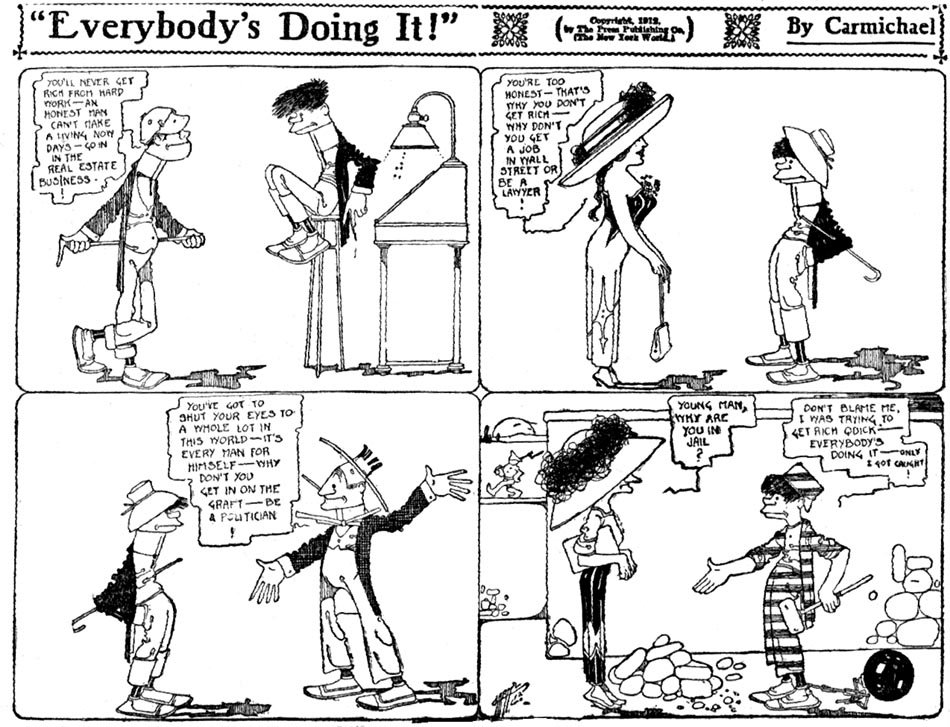
What can I tell you about Albert Carmichael? Of his life, essentially nothing. I know that he is rumored to have died in 1917, a victim of the great influenza epidemic. That is the breadth of my knowledge of his life.
Of his art I can tell you more, and it is, I think, an intriguing story, tantalizing in the possible answers to the mysteries involved. The bare facts are these; Albert Carmichael's first known published work is a strip titled Why Be Discontented? that ran just a handful of times in August 1907 in the New York Evening World. The strip was nothing memorable, and Carmichael's art was rough.
Carmichael may have been freelancing, because he continued to appear in the World on occasion but not nearly often enough to indicate that he had a steady job. Perhaps he did, though; often newspaper artists were kept busy with photo retouching, drawing maps, and the many other less glamorous art jobs that a newspaper affords. The interesting thing about Carmichael's cartooning work at the World was that it began to look more and more like the style of George McManus. And since McManus was one of the star cartoonists at the World, that may very well mean that McManus had taken young Carmichael under his wing and was tutoring him.
As time went on, Carmichael's art becomes almost indistinguishable from McManus'. By 1910 or so something amazing was happening - Carmichael, though still closely mirroring McManus' style, began to surpass the master. McManus' work at this time, though excellent in its own right, was still hampered by minor stylistic flaws, occasional questionable draftsmanship, and a certain cookie-cutter approach. Meanwhile Carmichael was honing the style, making his line more fluid, his characters move better, his draftsmanship becoming impeccable. McManus' art, meanwhile, does not likewise progress.
In 1912 McManus finally responds to the siren call and wide open coffers of Hearst. Hearst, since the 1890's, had made a habit of not nurturing talent from within his organization, but instead simply wooing away the best people from other papers. On McManus' departure his flagship World strips The Newlyweds And Their Baby and Spareribs And Gravy are reassigned to the obvious choice - who else but Carmichael to be his successor? Carmichael takes over the strips, now a valued newspaper cartoonist of the first rank. However, he is not allowed a byline on these new strips, and rarely does his signature on them survive to be printed in the paper (but we do know he signed them from the original art that pops up from time to time). Laboring in virtual anonymity, Carmichael continues to enhance his cartooning skills, now producing a version of McManus' style that clearly overshadows the originator.
Over at the Hearst camp, McManus gets off to a slow start but finally hits the bullseye in January 1913 when he creates Bringing Up Father. McManus continues trying out other strips for several years, but by 1918 Jiggs and company are firmly entrenched as his claim to fame.
In December 1916 Carmichael's version of The Newlyweds And Their Baby comes to an abrupt halt at the World. Whether for lack of interest or because of the rumored impending death of Carmichael I simply don't know. In any case, Carmichael's work for the World ends, and he does not go anywhere else that anyone has been able to find.
The eerie conclusion to the story is that starting around 1918, a year after Carmichael's presumed death, we start to see a change in McManus' art style. It begins, ever so slowly, to take on the qualities of Carmichael's art. Over the next half a decade or so, McManus hones his own skills in the same direction taken by his former impersonator. By 1925 or so McManus has shaken off all the rough edges and bloomed into his elegant yet superbly comedic mature style - a style that looks very much like Carmichael's.
Is this simply the natural progression of a cartoonist? Or is it some sort of tribute to the fallen student who surpassed his master? Or, if we prefer a supernatural explanation, could Carmichael have been reaching beyond the grave to guide the hand of his mentor?
Any biographical information you can share about Albert Carmichael would be most enthusiastically and gratefully received.
Oops - almost forgot. The sample strip above was published in 1912, not long before Carmichael took over McManus' strips.


Wednesday, December 10, 2014
News of Yore 1908: George McManus' Newlyweds Dissected

Most Popular Couple in America
Mr. and Mrs. Newlywed Celebrate Their Fourth Anniversary – With the Baby
Labels: News of Yore
Thursday, January 14, 2010
News of Yore 1925: McManus Receives Extravagant Gift

What Jiggs and Maggie Did for George
Quaint Characters Aroused Enthusiasm of Persian Art Connoisseur to Such a Pitch That He Had Made a Beautiful Rug as Gift for Creator of "Bringing Up Father"
(from Circulation, February 1925)
Not least of the advantages of creating a newspaper feature which achieves world circulation is that princes and potentates in remote parts of the world find out about you—and that now and then one of them signifies his estimate of your work in truly princely fashion.
Among the Yule-tide gifts to reach George McManus, creator of "Bringing Up Father," was a silk rug of gorgeous color and texture sent by Ahmad Khan of Persia, a famous art connoisseur and collector who is the most ardent Jiggs and Maggie fan east of Suez.
The rug is a reproduction of a cover drawn for Circulation of February, 1922, and is one of the most unusual specimens of rug weaving ever made in the Orient. It is of silk, about six feet long by five wide, and was woven at the order of Ahmad Khan by the celebrated Abdul Hamid Keshany whose looms have for thirty years produced the famous Kazan-sha silk rugs which are the envv of collectors of modern Persian rugs in every country.
The Jiggs and Maggie rug was sent to Mr. McManus in token of a friendship between him and its donor which had its origin six years ago through a fugitive copy of the China Press of Shanghai which found its way to Teheran, Persia. The China Press is one of the newspapers of the Far East which has published "Bringing Up Father" for a number of years.
Ahmad Khan saw the newspaper and immediately became enthusiastic. He wrote Mr. McManus a letter, care of the China Press, praising the wit and art of the cartoon and expressing the hope that he and the artist might meet some time. The letter was the beginning of a correspondence which has since ripened into warm friendship.
Ahmad Khan was educated at Oxford and visits London and Paris every few years. In the summer of l922 he and Mr. McManus met in Paris, and Mr. McManus gave him several of his original drawings, among them the panel in colors of which the rug is a reproduction.
Experts who have seen the rug pronounce it a specimen of the highest art known anywhere in rug making today. It is in what is called the 30 x 33 stitch, or a hand weave which requires the tying of 990 knots to the square inch. Two years of continuous work by the most expert weavers have been required for its making. Mr. McManus has been assured that its dyes will hold their colors for centuries and that, if he chooses, he may expose it to the strongest sun-light indefinitely without damaging its unrivalled colors or impairing its changeless lustre.
The picture design of the rug shows Maggie in court dress with a long crimson train, walking in majesty up a flight of steps leading to the garden of a palace. Two girl pages hold her train while Jiggs stands aside in old flannel shirt and trousers gazing in amazement at her entry into the precincts of privilege. The background of the picture is a reflection of the fine taste and knowledge of Mrs. McManus, for it was she who suggested to her husband the scheme of castle, hill, and forest which make up its composition.
In the course of their world travels Mr. and Mrs. McManus have been given many rare art objects by friends in many countries. But of all their trophies, though all are rare and beautiful, none quite measures up in magnificence and personal significance with the resplendent Jiggs and Maggie rug from Keshan in distant Persia.
Nt the least part of Mr. McManus's delight in his gift was occasioned by the complete surprise incident to its arrival; for in all the two years it was on the looms its giver never mentioned it, although he wrote from Persia everv month.
Allan's Note: I recall that this incredible rug came up for sale at a comic memorabilia auction back in the 80s or 90s. Being a McManus enthusiast I naturally coveted it, but the price was well beyond my means. Anyone know its current whereabouts? Not that I can afford it now, either...
I do actually have in my collection Jiggs and Maggie represented in rug form, but that's a story for another day.
Labels: News of Yore
Monday, September 01, 2008
News of Yore 1922: McManus, Celebrity Cartoonist
This is an account of McManus' week in Detroit—of seven days of hardy public tribute to a man who has filled the world with wholesome laughter; of seven days of wholehearted acclaim, of unstinted welcome, of loud and resounding cheers.
George McManus, creator of "Bringing Up Father" betook himself to Detroit recently in connection with the appearance of his famous cartoon in the Detroit Times. McManus, on leaving New York, believed that the concerns which took him to Detroit might detain him there two days, certainly not more than three.
In figuring to go right out to Detroit and come right back again McManus reckoned without his personal fame.
It was as he stepped off the train at the Michigan Central station that a crescendo of cheers, rolling from a regiment or two of railroad employees massed about the station and train sheds, told him that his private character, if he had one, had been left behind in New York.
"Hello, George "—" Hello, Jiggs"— "How is Maggie ?"—and " Where is Dinty Moore ? "
And as McManus looked about him to grasp the reasons for all this, he found that he was the principal personage in a parade.
For the middle west has an outright, uproarious way of doing things not familiar in restrained and dignified New York.
Detroit had planned a parade. With ingratiating but inflexible determination several of her leading citizens laid hands upon our cartoonist and led him to an automobile, and within four minutes he was on his way to the City Hall by a circuitous route, which wound through all the city's main thoroughfares, with all sorts and conditions of vociferous Detroiters vociferating from more than two hundred other cars following behind.
Whereafter, under a flawless sky, and on the sunlit steps of the City Hall, he was vested with the freedom of the city and the keys thereof placed in his hands.
To appear successfully, in a community where you are a stranger, as the principal attraction at a series of gatherings, meetings, banquets, theatre performances, ball games, band concerts, and rallies, and to say the right thing each time at the right moment and leave behind you a warmth of enthusiasm and an uproar of cheering requires more gift than is included in the equipment of even the most versatile of men. It is also incredibly fatiguing. Or so most people will find it.
But not McManus.
"Mr. McManus has a room here," said the clerk of the Hotel Statler when a delegation that wanted him for a special meeting went there one day to invite him, "but I can't attempt to tell you when you will find him in it. He's on the go day and night; if he sleeps at all I haven't noticed it."
"Oh, well," said McManus when the delegation finally caught up with him, "it isn't as though this were work. I'm having no end of a party! This is really a vacation for me."
Five times he addressed gatherings of children at theatres; joyous, blissful, light-hearted aggregations of boys and girls who roared at his quips and yelled their approval while he drew them cartoons of the famous Jiggs household and told them incidents and anecdotes of the days when he, too, sat on a school bench out in St. Louis, where he was born and grew up. One of these meetings overflowed into the open air where, mounted on a motor truck, he tossed away 12,000 ice cream cones and cracked a new joke with every fling.
Between whiles he visited the sick and afflicted in hospitals, infirmaries, asylums and settlement houses, was guest at police and fire headquarters, and dined as "one of the outfit " at the penitentiary of Jackson County.
A feature of his visit was "Jiggs Day " at all the leading hotels and restaurants, by arrangement among the proprietors of all these places, who made corned beef and cabbage the principal dish on their menus and announced at the top of the cards that Dinty Moore, from his famous kitchen in New York, had telegraphed the necessary recipe.
His last public appearance in Detroit took on something of the character of one of those monster festivals which we read about in chronicles of ancient Rome.
His final day was spent as the guest of the city at a demonstration, of which the main purpose was "to let the people see him." A stand was erected by order of the city council in Grand Circus Park. McManus rode up to it with the Mayor in the Mayor's official car, with platoons of police preceding and a squadron of cavalry behind. An escort of 3,500 school children took position about the reviewing stand and sang the national anthem. Then McManus, with the Mayor beside him, reviewed a parade of clubs, orders, associations and trade unions that was nearly two hours passing that given point. Then he made a speech that was a 'knock out,' in the opinion of all the experts present, and at sundown was escorted to his train.
"Detroit," said he, as the train pulled for New York, "is a real town. If they like you, nothing's too good. I had a street car wait for me once in New York and was told that was high recognition. But here all the wheels of commerce and government stopped. That's not only recognition but WELCOME."
[Note: the original article was accompanied by a page of photographs which unfortunately were unreproducible. What little of them I can discern, though, assures me that the amazing reception described above did in fact take place more or less as described -- it's not just marketing hype]
Labels: News of Yore
 : 8/31/2009 8:11 AM
 Thursday, January 24, 2013
Obscurity of the Day: The Whole Blooming Family

Unlike other similar situations however, there seems to have been no litigation regarding the ownership of The Newlyweds. Perhaps by 1912 Pulitzer and Hearst had gone through the kabuki dance enough times that in the case of McManus' feature they couldn't be bothered to waste legal fees, since they had a pretty good idea of how things would work out.
McManus, however, must have chafed over the fact that he was in weekly direct competition with another Newlyweds series. It certainly couldn't have helped matters that Albert Carmichael was a gifted cartoonist as well as an accomplished imitator of McManus -- one might even say he improved on McManus (in fact I did, at length).
When McManus decided to drop Their Only Child in early 1916, one must wonder why he did it. Was he just tired of maintaining a series he had been working with a for a decade? Did the competition finally make him wave the white flag? Did the Hearst higher-ups make the decision for him? Was there some legal wrangling that ended the series? Or did he need the space for a great new strip idea?
I can't speak to the other possibilities with any certainty, but I can say that the "great new strip idea"certainly wasn't the case. On February 13 1916, the week after his last Their Only Child strip ran in the Hearst papers, The Whole Blooming Family debuted, an effort of no great originality.
The Whole Blooming Family brings us into the lives of a family of slightly repellant soft-headed idiots. Father is our protagonist, the only member of the family with any brains or wit, and he only looks good in comparison to the rest of his loser family. As domestic comedy it just didn't really have anything special to recommend it, and no characters were especially interesting or memorable.
Thankfully, McManus sensed pretty quickly that he had a stinker on his hands, and the series was dropped after just eight months, on October 22, in favor of a new series, Rosie's Beau.
Perhaps the only really interesting thing about The Whole Blooming Family is that it is tied, at least by title, to an earlier fad. Back around 1905-06, there was a spate of merchandise and recordings featuring The Whole Dam Family -- a film (note that the linked video is not the complete film), a record, many postcards (some with very nice cartoon art, though sadly none at this link are signed), and who knows what else. Obviously this is where McManus got his title, and perhaps more of the concept for the strip.The Whole Dam Family, a bit of wordplay in which references are made to the Dam father, the Dam housekeeper and so on, was somewhat risque in a day when even a "drat" said with too much venom could make some women faint dead away with horror. The gag, Cole Johnson tells me, is a lot older -- he can trace it back to 1883 at least (Atlanta Constitution, May 3 1883) -- but for some reason it really went viral in 1905-06.
McManus certainly had this in mind with his title. One has to wonder if he tried to talk the Hearst folks into letting him use the name Dam, and was forced to settle for 'blooming', a total dud by comparison.
Just for the record, a very obscure cartoonist working for a very obscure syndicate did resurrect The Whole Dam Family, complete with shocking name, a while later. But that's the subject for another day.
: 1/24/2013 8:23 PM Monday, April 15, 2024
Toppers: Snookums Has a Growth Spurt
George McManus' juggernaut comic strip Bringing Up Father featured the topper strip Rosie's Beau for many years. But in 1944 after a run of nearly twenty years sitting above Jiggs and Maggie, I guess McManus decided it was time to try something fresh.
The new strip, Snookums, might have been new as a topper, but it was anything but actually fresh. Snookums the spoiled baby had come onto the comic strip landscape nearly forty years earlier in 1906.
One of McManus' earliest successes was a strip called The Newlyweds, which was about a pair of lovebirds who are so heady with romance that nothing else matters to them. After a few years of playing with that subject, McManus decided it was time for Mr. and Mrs. Newlywed to take their next step in life. He dropped the strip for a little over nine months, and then brought it back in late 1906 as The Newlyweds and their Baby.
What had been a popular strip all of a sudden became a hit on the level of the biggest titles of the day. The Newlywed's new baby, Snookums, despite being butt-ugly, was of course the apple of his parents' eyes. Mr. and Mrs. Newlywed took adoration of their baby to off-the-chart levels, producing hilarious strips that made the baby into a pop culture phenomenon.
This strip ran until 1916 and had the rare honour of running with two syndicates at the same time from 1912 to 1916. McManus had created the strip for the Pulitzer organization, but when he jumped ship for Hearst in 1912 the strip was considered too valuable to lose. Albert Carmichael continued the original version for Pulitzer, while McManus renamed it Their Only Child for the Hearst version.
In 1944 you would have had to be about forty years old or more to remember the original series, and I have no doubt that the newly minted Snookums topper was a great hit of nostalgia for middle-aged and better newspaper readers. The new topper strip featured a modernized Mr. and Mrs. Newlywed and baby, but otherwise the gags pretty much followed the same pattern.
Okay, so I told you all that so I could tell you this. In 1951 either McManus, his superb assistant Zeke Zekley (who probably did 90% of the work on the topper), or the syndicate decided that the strip needed a shake-up. It was decided that baby Snookums, who was about 45 years old in reality years, needed to grow up a bit. But how do you do that? You can't very well just have Snookums as a baby one week, and then next week advance his age until he's in elementary school, now can you? Well, I suppose you could, but McManus and Zekley took a sneakier approach. Here is the Snookums topper for May 6 1951 featuring the familiar baby version:

And here is the next Sunday, May 13, and all of a sudden baby Snoiokums is a toddler, looking pretty comfortable in the upright position:

Another week passes, and on May 20 the toddler has advanced to growing a mop of hair:

Things now slow down a bit, letting Snookums settle in a bit at what I guess would be the terrible twos. But he continues to age and by September 16 (below) he's now reading, placing him I guess at the age of six at the least?

By October 21 Snookums miraculous growth spurt finally ends, placing him in elementary school, where he will stay for the rest of the strip's life:

So now that we've had this fun little jaunt through the remaking of a comic strip character, we end with a mystery. According to King Features' internal records, the Snookums topper was dropped at the end of 1956. But that's wrong, because I have found samples as late as 1961. My wild guess based on no evidence is that the King Features date might reflect the end of Snookums being distributed as a topper to Bringing Up Father, and after that perhaps the strip was sold on its own merits as a standalone feature?
But no matter how the marketing went on, the important question is this: When did this important strip end? Can anyone help?
Labels: Topper Features
 : 4/17/2024 1:31 AM
 Tuesday, February 23, 2010
Strip Teasers: Bringing Up Father From Sea to Shining Sea

Bringing Up Father: From Sea to Shining Sea
IDW Publishing, 2009
Hardcover, 11" x 10", 277 pages, $50
ISBN 978-1600105081
What a wonderful treat to have two high quality reprint books of George McManus' masterwork available after so many years with not a peep from Jiggs. First there was NBM's reprinting of the first two years of the series, both historic and wildly entertaining, and now IDW enters the market with arguably some of the very best of the strip in its greatest era, the mid-30s to mid-40s.
Being a big fan of McManus I'm thrilled with both books, of course. Not only that but I had the privilege of working on both, a thrill in itself. For the IDW book I did the restorations on the majority of the dailies, a job which only increased my admiration for McManus' superb clean-line style.
This whopping fat book reprints not only the famous cross-country sequence of the strip from late 1939 through mid-1940 but also the balance of 1939. While the tour sequence is justly famous, I'm glad editor Dean Mullaney chose also to reprint what might unjustly be called more mundane material from earlier in the year. 1939 is a great example of how humor strips operated back in the days when the adventure strip was king. Instead of strict gag-a-day material, Bringing Up Father and most humor strips weaved the gags into storylines. In 1939 we have the arrival of Jiggs' grandson providing comedy fodder in a long story, plus great short sequences like Jiggs trying to rid himself of an always-snoozing brother of Maggie's and a hilarious series with Jiggs waiting for Maggie to get off an interminable phone call. McManus had a gift for juxtaposing the reasonable and the surreal in these sequences that is magical to behold.
If the book were sold on infomercials this would be the point at which Ron Popeil would gleeful tell you "... but wait, there's more!" Not only do you get a year and a half of Bringing Up Father dailies, but we're throwing in all the Sundays from the same period! Of course the tour sequence just wouldn't be complete without those glorious Sundays, a few of which you've undoubtedly encountered in survey-type books. The Sundays, restored here to their original brilliance, are a joy to behold. Zeke Zekley, McManus' assistant and a master in his own right, claimed that one of the Sundays took them two weeks to produce and I don't doubt it for a second. They are not to be missed.
Rounding out the book we have two intros, by Brian Walker and Bruce Canwell, which supply some interesting nuggets, a subject index by Randall Scott, and a sampling of 11 strips from the Bringing Up Father "Remember When" sequence of Jiggs' and Maggie's younger days in the Irish ghetto (a series which richly deserves reprinting, too).
My impression is that, despite reasonably strong sales, NBM has no immediate plans for a follow-up to their Bringing Up Father book, so if you're a McManus fan then you really need to show the folks at IDW that you want more of this material. This McManus fan certainly encourages you to buy multiple copies!
Labels: Strip Teasers
Monday, July 10, 2023
Obscurity of the Day: Mr. Broad of Wall Street


It's been a long, long time since we trained the spotlight on Charles McManus here at Stripper's Guide, since 2007 to be precise. As you may know, he was the considerably less talented brother of George McManus, creator of Bringing Up Father.
Of course when you have a brother who produces the most popular comic strip in the U.S., and probably the world, you have a significantly better chance of getting your work published than just any Tom, Dick or Gertrude, and Charles certainly took advantage of his position. But in a way, his work did have a very definite value -- it looks somewhat like George's work to the untrained eye, and it was marketed to smaller papers that couldn't afford a bunch of high-profile stuff. That sort of paper could see the value in running a McManus comic strip, never mind that the given name was wrong. And quite a few smalltown papers did take Charles' strips, probably under the presumption that McManus' brother was better than no McManus at all.
It has long been assumed, by me and many others, that Charles got a lot of help on these strips from his famous brother. The art is a klunky imitation of the George McManus style, and the repetition of wooden character poses makes one wonder if Charles didn't just trace his work from model sheets produced by George. That theory holds up well when we consider how the backgrounds and props are minimalistic and often out of perspective. There was a day when I thought Charles actually had a bunch of rubber stamps made up for the characters, but having since seen some original art of these strips, that guess turns out to be wrong.
Mr. Broad of Wall Street was Charles' second strip, joining his first, Dorothy Darnit, at Bell Syndicate. The strip debuted on November 21 1921*. It is about a fellow who works in a stockbroker's office, and the gags are often about him trying to cadge stock tips. But Charles was not one to be a slave to details, and so Mr. Broad can show up in just about any sort of business office, or, if no business-related gag came to mind, in just about any other situation you can imagine, too. He can even be found coexisting with Dorothy Darnit on occasion (see last example), giving Charles the luxury of producing one strip that can be run with both series.
For unclear reasons the title of the strip was changed to Freddie the Financier on March 27 1922. Why this was deemed necessary I can't begin to guess. The gags and (lack of) focus seem to change not one iota.
Because we are dealing with Bell Syndicate here, notorious for reselling material in those days, coming up with an end date is tricky. As near as I can figure, the series ended on April 7 1923**, but Bell seemed to immediately start selling the strip in reprints; perhaps even before the end of the original run. They not only sold it in reprints themselves, but when they tired of flogging it to ever small papers, they sold it off to an unknown reprint syndicate, where it went through further rounds of selling until the papers they marketed to got so small as to be non-existent. The latest I have found the strip appearing is in 1932***, almost a decade after the original run ended.
* Source: Buffalo Express
** Source: New York Evening Telegram
*** Source: Stuart Daily News
Labels: Obscurities
You say you didn't train the spotlight on brother Charlie since 2007, but you forgot that you covered "Mr. Broad" once before. (1 February 2011).
Once I did a blog on some other of Charlie's chuckles:
https://comicskingdom.com/trending/blog/2013/08/07/ask-the-archivist-brother-charlie
: 7/10/2023 2:34 PM Thursday, March 22, 2012
Ink-Slinger Profiles: Zeke Zekley
In the 1920 U.S. Federal Census, the family of four lived in Detroit, Michigan at 336 Goodwin. The enumerator spelled the family as "Zekely ". The parents were Hungarian emigrants; Alex arrived in 1913, then Mary in 1914. Their youngest son was Fred, who was born in Michigan. The father was a machinist in the auto industry.
The family was recorded in Detroit at 1994 Clements Street, in the 1930 census. The family name was spelled "Szkly". Zekley's father was a plumber. On the National Cartoonists Society (NCS) website, Zekley said:


McManus, ever the storyteller, used his 1952 Collier's article to serve up his own embellishment on Zeke's early years: “My assistant, Zeke Zekley...says he began to draw because of a picture in a Detroit paper. It showed a yacht riding anchor at the Saint Clair River and the caption described it as the yacht of 'George McManus, the cartoonist.' Zeke says he figured if cartoonists could own yachts like that, cartooning was the life for him. So he began to draw, imitating my style.” After recounting the chance encounter between Zeke and brother Charlie, McManus served up this capper: “[Charlie] brought Zeke to me and I hired him. “But I never owned a yacht.”
The California Death Index said his parents and brother passed away in Los Angeles. It's not clear if the family had moved together or if Zekley went first and the family followed.
On February 5, 1942 his father passed away. Zekley enlisted in the army on May 6, 1943; he had a year of college and was married. On the NCS website, Zekley said, "...WWII; in army, but luckily stationed nearby—was able to work on B.U.F., as well as cartoons for the military—1944, now collaborator!..."
On the NCS website, Zekley said, "...created Dud Dudley for McNaught—it didn't fly—later, Peachy Keen and Popsie. I still had Sponsored Comics (McDonalds—Squirrel's Club (10 yrs.), U.S. Army's P.S. magazine—others—produced animated TV spots in partnership with Friz Freleng—many awards—Hobbies: collecting fine art and golf!
Labels: Ink-Slinger Profiles
Friday, June 22, 2012
News of Yore 1955: Vern Greene Profiled
Bringing Up Greene

Twenty years ago Vernon Greene was hunched over a drawing board in the offices of King Features Syndicate in New York. In the manner of cartoonists he was scratching his head and groaning as he struggled to think of something funny to draw.
Then he was interrupted by a harried editor who shoved a drawing under his nose. "Draw something to tie in with this quick!"
Greene looked at the sketches. "Now wait a minute," he said. "This is Maggie and Jiggs. You got me mixed up with George McManus. In case you can't tell us apart any other way, look at the paychecks. You pay McManus over $100,000 a year while I get—"
"Save the gags for your strips," retorted the editor. "I know it's Jiggs. There's been a delay in the mails and George's next batch of drawings hasn't got here. We are right on deadline and can't wait any longer. Draw something and draw it quick!"
Greene made a page of drawings to bridge the gap. He was somewhat uneasy about how McManus, who originated the comic strip, would take the idea. But the famous humorist was so pleased when he saw the results that he offered Greene a job as his assistant.
Greene was flattered, but felt that he would do better on his own. However, after 18 years drawing everything from The Shadow to an Army life panel called Charlie Conscript, he came back to a full time job of drawing Jiggs for the famous strip Bringing Up Father, one of the most popular comics in the Sunday comio pages of Pacific Stars and Stripes.
The 47-year-old artist has been drawing seriously for 42 years and got into newspaper work in his teens as a staff artist for the Portland (Ore.) Telegraph. During the 1920s he knocked around the country until he went to work for King Features in 1935.
He left King to do other types of work and became interested in medical photography. During World War II, his hobby became a full time job with the Air Force. But after his discharge as a buck sergeant in 1945, he went back to cartooning.
Shortly after George McManus died in 1954, Greene was visiting friends at the syndicate. Recalling how he had once filled in for McManus 19 years before, they told him that several artists were trying out for the job of continuing the adventures of Greene also submitted some samples. Two weeks later he was told that the job wag his. He now draws the Sunday strip which appears in Stars and Stripes. In addition to several hundred newspapers in the States, Maggie's struggles to make a gentleman out of Jiggs appear in 27 foreign countries.

Although the cartoon is known as Maggie and Jiggs to most readers, its real name is Bringing Up Father.
The name originated before World War I when the cartoon started. At that time they were a newly rich family. Maggie had social ambitions, and the strip revolved around her efforts to bring him up to her level. Over 40 years have passed and she's still trying.
Greene says that the most common question asked about the characters is what is Jiggs' occupation? He has to answer that nobody knows for sure. Jiggs seems to have a lot of friends in the construction business and McManus once told a group: "I've made a million dollars and all I ever had for capital was a retired hod carrier with a love for corn beef and cabbage." All this leads to the suspicion that Jiggs is a retired contractor, but that is only supposition.
Whenever Greene can get a few strips ahead in his work he likes to join Special Services tours to entertain servicemen in overseas bases. In addition to the trip he just completed to the Far East, he has entertained in Alaska, Germany, France and England.

An ardent photographer, Greene has a collection of over 100 cameras. He is rarely seen without three or four hanging around his neck. In between his shows here, he managed to expose several thousand negatives of Japan and Korea. But, despite this enthusiasm for the lens, like all artists he insists that it will never replace the drawing pencil. An incident in Japan definitely proves this.
He and Stu Moldrem, Stars and Stripes sports cartoonist, stopped at a Japanese restaurant to catch up on a breakfast they missed while traveling between bases while accompanying the cartoonist's show. The proprieter couldn't speak a word of English and their combined Japanese vocabulary of a dozen words wasn't equal to the job of ordering a simple plate of ham and eggs. Time was running out. Their train was almost due.
But this was where cartooning turned out to be a most practical art. Greene drew a picture of what they wanted on the wall with chalk.
They got what they wanted, but Greene hopes that nobody will hear about it. You see, he's not supposed to eat ham and eggs. The public for some reason always associates an artist or writer with his characters. And Jiggs, in the public mind, is associated with corn beef and cabbage.
"It's a fine dish. In fact, you can accurately say that it is my meal ticket." Greene said. "But I like an occasional steak, too, you know."
Friday, February 02, 2024
Obscurity of the Day: Snoozer


Normally it's a treat for me to feature George McManus on the blog as he's one of my favorites. Today's obscurity by McManus, though, is such a misfire that I half want to sweep it under the rug and pretend it never happened. But Cole Johnson sent me scans of this rare series, so after letting it sit and grow moldy for years, I'm going to air it out and let you have a look. It proves, I guess, that even a genius like McManus can have his off days.
McManus already had a pair of really popular stips running at the World in 1906, The Newlyweds and Panhandle Pete. Nevertheless he was still throwing new ideas up to see if anyone would salute. Suffice to say there was little saluting going on when Snoozer started appearing in the New York World's Sunday comic section on January 28 1906*. The plot is that this kid Snoozer falls asleep a lot. We see his dreams, we see the trouble caused by him falling asleep, and then we get the big zinger when Snoozer says, "Not Yet!" Not one aspect of which manages to be funny in this strip series.
Snoozer ran until May 6 1906*, and you can bet no one missed him when he stopped showing up in The Funny Side. Especially since he got canned in favour of a new McManus strip that was anything but a clunker, Nibsy the Newsboy in Funny Fairyland.
* Source: Ken Barker's New York World index in StripScene #14.
Labels: Obscurities
: 2/02/2024 12:00 PM Monday, July 29, 2019
Toppers: It's The Gypsy In Me

George McManus quickly settled down to Rosie's Beau as his topper for the Bringing Up Father Sunday page, but come 1933 the Hearst syndicates decided that one topper just wasn't enough. Some Hearst Sunday pages added activity features, like puzzles and paper dolls, but McManus chose a single panel cartoon to be his new third feature. His panel cartoons changed titles pretty frequently, and the last in the series was It's The Gypsy in Me.
The panel was loosely based around the common thread of a person who'd like to run away from his or her current situation, or already had run away and was finally enjoying life.
This topper began with the Sunday page of May 26 1935, but was replaced by another topper panel, What'll I Do Now, after December 22 of that year. The new topper apparently didn't stimulate McManus' creative juices for long though, and It's The Gypsy In Me returned with the page of March 22 1936. The panel thereafter ran every week until April 25 1937, when McManus swore off the three feature dictum and went back to offering Rosie's Beau as the sole topper for Bringing Up Father.
Labels: Topper Features
Monday, April 10, 2006
Ghoul News - Cartoonist Death Notices
Here's a group of cartoonist death notices, all gleaned from the Washington Post.
12/31/39
Walter Blackman, Cartoonist, Dies
Cleveland, Dec.29 - Walter W. Blackman, 65, for 21 years political cartoonist for the Birmingham, Ala., Age-Herald, died today at his home in Willowick, Ohio, east of here. He was a member of the Gridiron Club and the National Press Club of Washington.
Originator of one of the first animated motion picture cartoons, he used the idea in connection with the Government's Liberty Loan campaigns. Years ago he obtained a patent on a process for making motion pictures in natural color. While a cartoonist for the Birmingham Age-Herald he was sent by his paper to campaign on political issues.
11/23/39
"Jerry on the Job"Artist Dies at 49
New York, Nov.22 - Walter C. Hoban, 49, widely known comic artist and cartoonist, died last night after a two-month illness. He was with King Features Syndicate for more than 20 years. He was best known perhaps for his comic strip "Jerry on the Job."
8/15/39
Powers, Noted Cartoonist, Dies
New York, Aug.14 - T.E. Powers, 69, noted political cartoonist of the Hearst newspapers for more than 40 years, died today after a two-year illness.
One of the earliest political caricaturists of modern journalism, Powers was the favorite political cartoonist of President Theodore Roosevelt.
Powers retired several years ago due to ill health.
9/11/39
Bob Edgren, Sports Cartoonist, Dies
Carmel, Calif., Sept. 10 - Bob Edgren, 65, famous sports editor and cartoonist, died here last night after a series of heart attacks.
Edgren for many years was sports editor of the old New York World.
Surviving are his wife, a son and three sisters.
1/10/39
Joseph McGurk Dies
Philadelphia, Jan. 9 - Joseph W. McGurk, 52, illustrator and one-time sports cartoonist, died last night.
3/7/38
McDougall, 80, First Cartoonist in U.S., Suicide
White House Writer in Days of First Roosevelt Shoots Self
Waterford, Conn., March 6 - Walt McDougall, 80, dean of American cartoonists, author and humorist, was found dead today on a couch in his Fern Lane farmhouse.
Dr. Frank Dunn, medical examiner, said McDougall's right hand clutched an old-fashioned "horse pistol" and that his death was suicide.
McDougall, generally regarded as the first American [daily newspaper] cartoonist, contributed to the old New York World and to the Philadelphia North American. He also did strips for the McClure Syndicate and nationally known magazines.
Among his better known ones were "Absent Minded Abner," "Fatty Felix," "Hank The Hermit," "Teddy In Africa" and the Rambillaux Series.
His cartoon "The Feast of Belshazzar" was credited with helping to elect Grover Cleveland president.
McDougall was once rebuked by the Supreme Court of the United States for drawing a cartoon showing justices of the high court chewing tobacco behind the bench.
He was a personal friend of the late Theodore Roosevelt and covered the White House as a newspaperman in his Presidential regime.
10/17/37
Will Chapin Dies
Hollywood, Calif., Oct. 15 - Will E. Chapin, 80, cartoonist and writer, died at his home here yesterday.
8/28/37
Frederick Opper Dies at 80; Happy Hooligan's Creator
New Rochelle, N.Y., Aug. 27 - Heart disease brought death today to Frederick Burr Opper, 80, creator of Happy Hooligan, Alphonse and Gaston, and other comic strip characters read around the world.
He was forced by failing eyesight a few years ago to retire from active work for newspapers with which he had been connected since 1899.
Born in Madison, Ohio, the son of an Austro-Hungarian immigrant, Opper left school at 14 to work on the Madison Gazette, a weekly newspaper. A year later he went to New York.
When he submitted some of his sketches to magazines they were promptly purchased. Then Col. Frank Leslie hired him as a staff artist for Leslie's weekly. Three years later he went to Puck, with which he remained until engaged for the New York Journal.
With the rise of the syndicate system, his cartoons were circulated throughout the world.
In 1900 he created the tramp with the tin hat, Happy Hooligan, best known of his characters.
Opper for many years was an outstanding political cartoonist, during the McKinley and Theodore Roosevelt campaigns. His "Willie and Teddy" series had the nation roaring.
12/28/36
Cartoonist Weed Dies of Pneumonia
New York, Dec. 27 - Clive Weed, artist and political cartoonist, died today in a hospital here of pneumonia. He was 52.
Weed studied art at the Pennsylvania Academy of Fine Arts, where he was a favorite pupil of the late Thomas Pollock Anshutz, instructor of many noted American artists.
In 1910 he joined the staff of the Philadelphia Record, and a year later went to the Philadelphia Press, where his chief work was illustrating news stories. He joined the New York Evening Sun in 1912, and one of his first assignments was to sketch the survivors of the Titanic disaster.
He became political cartoonist for the old New York Tribune, the Philadelphia Public Ledger, and editorial cartoonist for the magazine Judge. His drawings also appeared in Colliers, the American Magazine, Leslie's and Life.
Weed returned to newspaper work in 1927 as cartoonist for the New York Evening World, and once the last edition of that paper was published he had been with the King Features Syndicate.
7/5/36
Charles C. Reese, Cartoonist, Dead
Glendale, Calif., July 4 - Charles Chandler Reese, 74, newspaper illustrator and cartoonist, died at a hospital yesterday of the infirmities of age.
His career included prominent posts of New York, Pittsburgh and Philadelphia newspapers. During the Spanish-American war his sketches on the field of action in Cuba appeared in the New York World, drawing wide attention.
Reese claimed to have been the first artist to have a picture reproduced as a double-truck, or two-page, illustration in a newspaper.
Born in Pittsburgh, Reese lived in the East until he came here six years ago. He was prominent in the Elks and was past exalted ruler of lodges at Hackensack, N.J., and Staten Island, N.Y.
10/21/35
Creator of 'Gumps' Is Killed in Crash
Sidney Smith Had Been on Outing Celebrating New Contract
Chicago, Ill., Oct. 20 - Sidney Smith, 58, creator of "The Gumps," one of the most popular of all newspaper cartoons, was killed at 3:45 a.m. today in an automobile collision near Harvard, Ill., a few miles from the Wisconsin boundary.
Smith, at the time of the accident, was alone. The previous afternoon he had been on a gay outing at Lake Geneva, Wisc., in celebration of a three-year extension of his $150,000-a-year newspaper syndicate contract.
He had gone from his home in Chicago to the Wisconsin resort to meet with syndicate officials and sign the contract extension. He then invited the syndicate men to spend Sunday at his nearby 2,200 acre Shirland farm.
When they preferred to return to Chicago Smith drove them to the city, then started back toward the farm. It was late at night. To break the long, solitary drive, the cartoonist stopped at the Bubbling-Over Tavern, 6 miles south of the point where he met his death.
At the roadhouse Smith entertained the patrons by drawing pictures of the cartoon characters he made famous throughout the world. About 3:30 a.m. he started on the last lap of his journey.
He was driving a small sedan. Another sedan, headed south and driven by Wendell Martin, of Waukesha, Ill., collided with Smith's car. Although there were no witnesses it is believed the two machines met almost on the center line of the highway. Smith's car was whirled around, thrown off the road and against a telephone pole. The top of the cartoonist's head was crushed in. Marlin suffered a broken hip, fractured jaw, and other injuries.
Smith's body was brought to a Chicago undertaking parlor and from there will be taken to his Chicago residence, 1500 Lake Shore Drive. Funeral services will be held at his home Wednesday. Internment will be in Rose Hill Cemetary here.
Survivors are his wife, a son, Robert Sidney Smith, 25, of Phoenix, Ariz., and a daughter, Mrs. Gladys Lucknow, of Lauderdale, Wis.
Smith's first wife, Gentraude Craddock, of Pittsburgh, died in 1924. His second marriage took place in 1926.
Preferred To Draw
Sidney Smith was born in Bloomington, Ill., on February 13, 1877, the son of Dr. T.H. and Mrs. Francis A. Shafer Smith. His father was a dentist and wanted the son to follow him in his profession. But Sidney, from boyhood, showed an inclination to spend most of his time bending over a drawing board. When he was 18 he was drawing for the Bloomington Sunday Eye.
From Bloomington he went to Indianapolis, where he joined the staff, first of the News, then of the Press. Later he went to the Philadelphia Inquirer, the Pittsburgh Post, the Pittsburgh Press, the Indianapolis Sentinel and the Toledo News Bee. But his drawings for all these papers were centered around a human goat called "Old Doc Yak."
Not until 1917, when he was on the art staff of the Chicago Tribune, did Smith conceive the now-famous Gump family. Between the birth of Andy and the burial of Old Doc Yak, several other series, including "The Bunk of a Busy Brain," "Self-Made Heroes" and "Light Occupations" wandered across the cartoonist's drawing board.
Won World Recognition
But it was with the Gumps -- Andy, Min, Chester, Uncle Bim -- that Sidney Smith won world recognition. The strip has been published throughout the United States, in Canada, Europe, Hawaii and Australia.
In keeping up the daily and Sunday production the cartoonist was forced to build up a staff of artists and idea men.
It was on March 15, 1922, that Smith signed the first $1,000,000 contract ever given a comic strip artist. The agreement was to cover a 10-year period and as a bonus, the creator of the Gump strip was given a Rolls Royce.
At the time of the artist's death the comic was drawn three months in advance. His staff hopes to continue the adventures of the Gump household.
7/19/35
Mother of McManus, Noted Cartoonist, Dies
Hollywood, July 18 - Mrs. George McManus, 82, mother of George McManus, cartoonist, died here today.
Born in Limerick, Ireland, she came to the United States when she was a small girl. Her first home was in St. Louis, but she went to New York after her marriage to George McManus, Sr., stage actor. She came here a year and a half ago. She is survived by one other son, Charles McManus, of New York. George lives here.
Labels: News of Yore
: 4/10/2006 1:56 PM --Allan
Tuesday, May 07, 2019
Toppers: Good Morning, Boss!

George McManus' classic Bringing Up Father offered us several long-running toppers over the years, but before he settled down to a decade and a half run of Rosie's Beau, followed by Snookums, he experimented with a couple other titles in the early days of the form.
Good Morning, Boss! was his second attempt at a topper, and had a really short run, from May 16 to June 6 1926; a mere four episodes. In each episode our hero, never named, tries to break out of his humdrum job into something more exciting and better-paying. In each attempt he finds that the grass is not so green when viewed close up. The concluding panel finds our man back at his desk.
McManus was a disciple of the 'empty-eyes' school of cartooning, but for Good Morning, Boss he offered us a rare look at a character equipped with pupils. Our hero looks perpetually surprised as a result, but maybe this was McManus depicting him as a 'deer in the headlights', as he most assuredly was.
Labels: Topper Features
Tuesday, September 06, 2011
Ink-Slinger Profiles: Ed Grinham


Labels: Ink-Slinger Profiles
: 9/06/2011 9:31 AM https://billiongraves.com/grave/EDWARD-GRINHAM/30998263
: 4/30/2022 9:17 PM 