Wednesday, June 20, 2012
Ink-Slinger Profiles: Elmer Wexler
Elmer Wexler was born in Bridgeport, Connecticut, August 14, 1918, according to an interview in Alter Ego #36. In the 1920 U.S. Federal Census, he was the only child of Harry and Sarah. (His name was recorded as "Alma" and classified as "daughter".) They lived in Bridgeport at 445 Maplewood Avenue. His father was a merchant in the tailor trade. Wexler said, "…My father came from Lithuania and my mother came from Poland. They got married when they met in the United States…."
They remained in Bridgeport but at a different address, 633 Colorado Avenue, according to the 1930 census. Wexler was the oldest of three children. His father, Morris (Harry was his middle name), was a tailor. Wexler said:
…I went to Pratt Institute and graduated in 1938. [He received a certificate in Pictorial Illustration at the School of Fine and Applied Art, according to the New York Times, June 9, 1938.] It was a three-year course. The first year was general courses: we studied illustrations, advertising layout, copywriting, and architecture….The second year, we had to make a decision about what we were going to specialize in. I was interested in illustration.
I was very lucky that I was knowledgeable about drawing, and I was offered a free night class. The art director was the head of Street & Smith magazines, which were popular at that time….The only students who allowed to take this class were those the director thought would make it. I started illustrating for Street & Smith even before I graduated….
…I was illustrating for pulp magazines when I graduated: Street & Smith, Popular, and Standard. They were the biggest pulp publishers at the time, and I worked for them all. A year later after I got out of Pratt, the bottom fell out of the pulp business because the war started in Europe. Comic books came in to fill the void and I switched to comics….
…In those days, we were getting ten to fifteen dollars an illustration for the pulps. When I worked for the studios, I was charging the same, and that wasn't making me wealthy by any means. I had moved to New York City by then and needed to do better. Borge and I and two other friends were renting a house when I got a call from P.M. magazine, which was a liberal newspaper. A lady there had seen my work in comic books and wanted to know if I'd try my hand at comic strips. I asked who'd do the writing, and she got a guy by the name of Kermit Jaedeker [sic—Jaediker, 1911–1986, Social Security Death Index] and someone else [Charles Zerner according to Ron Goulart, The Funnies (1995)]. The strip was called Vic Jordan and it was fun to do.Some of his comic book credits are at the Grand Comics Database. Vic Jordan debuted December 1, 1941 (below).

The New York Times, November 10, 1943, reviewed the exhibition, "Marines Under Fire", at the Museum of Modern Art. Wexler's piece, "The Japanese Enemy", was mentioned. His art was included in the show, "The War Against Japan", at the National Gallery of Art in Washington, D.C., from May 27 to June 19, 1945. An issue of Editor & Publisher, Volume 98, 1965, said: "…During World War II he served as a combat artist with the U.S. Marine Corps. His drawings at Okinawa, Guadalcanal, Bougainville and other battles were sent back to Washington for publication in newspapers and such magazines as Look and Life…." Harold Helfer's story "The Beautiful Bungalow" was published in The Field Artillery Journal, November-December 1948. He was in the same outfit as Wexler. His story can be read here (scroll down to page 275).
The Trenton Times-Advertiser (New Jersey), August 18, 1946, published this item: "Elmer Wexler, free-lance artist and an illustrator of Houghton, Mifflin Company juveniles, was chosen to record the recent atomic last at Bikini. His vantage point was in front of a television set in New York City. During the war Wexler sketched the Bougainville and Okinawa landings as Marine Corps combat artist." In 1946, he also drew the strip Jon Jason; samples from October 5, 11, 12, 18, 24, and 28.
Wexler said, "…After I got out of the service, I went to work in advertising and illustration and left comics behind. I did a lot of work for Johnstone and Cushing…", a studio that produced comics advertising. He added, "…I started my own studio after Johnstone and Cushing…." In 1967 he was the editor and publisher of Dimensions in Living, a monthly newspaper supplement. Lack of advertising caused the supplement's demise after three issues. He and Mae were granted a divorce January 19, 1972. Later, he remarried to Pauline.
Wexler passed away October 3, 2007 in Norwalk, Connecticut, according to the Social Security Death Index. The Field Guide to Wild American Pulp Artists profiled Wexler. Who's Who of American Comic Books 1928–1999 has an overview of his work.
Labels: Ink-Slinger Profiles


Monday, June 05, 2023
Obscurity of the Day, Revisited: Jon Jason


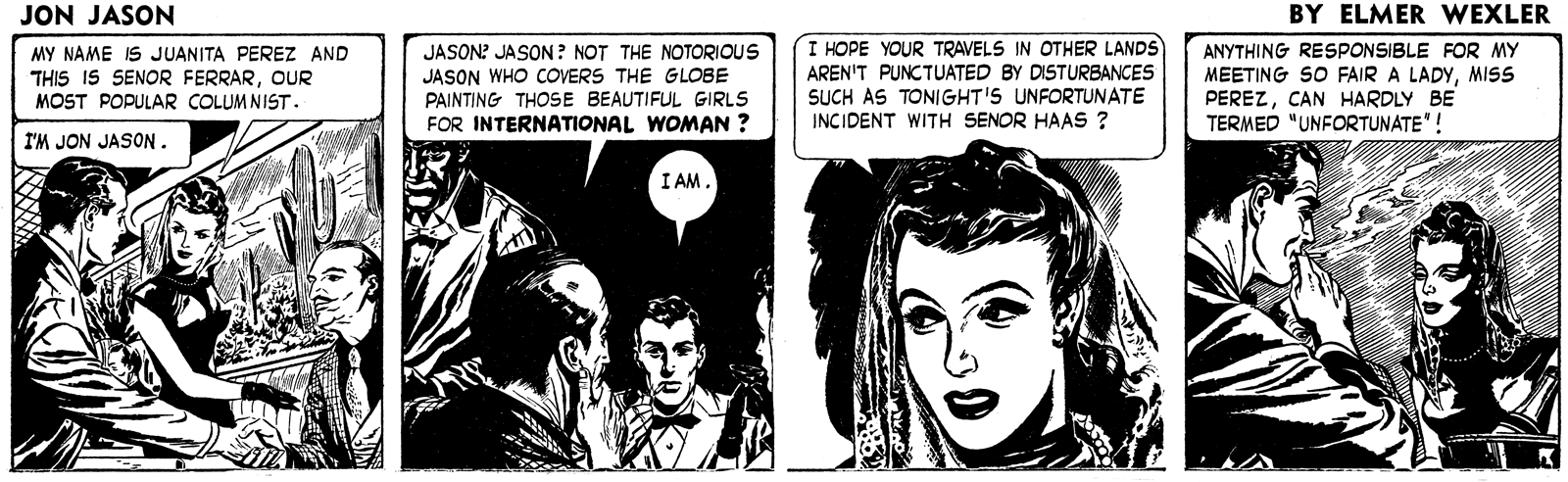


NOTE: Jon Jason was an Obscurity of the Day way back in 2012, and at that time I candidly admitted that my review was based on only the scattered strips I was able to find then, Now with a substantial run of the strip, I'd like to give it another whack.
~~~~~~~~
Take this quiz before you read the sample strips above. Which is the most unlikely cover profession for a globe-trotting government agent:
a) Plumber
b) CPA
c) Dog Catcher
d) Magazine Illustrator
If you picked (d), you not only picked a pretty fair answer but also the profession of Jon Jason, titular hero of today's Obscurity of the Day. Yes, Mr. Jason is a world-travelling magazine illustrator; the reason he's always visiting foreign countries is that he works as a cover artist for International Woman magazine, and of course he has to go to foreign countries to find the most beautiful women to pose for him. It actually makes some sort of twisted sense, if one ignores the fact that photography had been invented a hundred years earlier. And Jason is indeed really a magazine illustrator, he just has a little side gig as a government agent searching out Nazis hiding from justice after the war.
This was Elmer Wexler's second comic strip, but the first that he wrote. During the early days of World War II he was the original artist on Newspaper PM's Vic Jordan, and he did a fine job on it until he went into the Marines. Coming back from the war, Newspaper PM offered him a new strip. Keen to take on the job as a solo project, Wexler took a writing course and with that under his belt, began Jon Jason on February 4 1946. Unfortunately his lack of experience showed; his stories were labyrinthine, following too many characters and too many subplots. A really good writer might have managed to pull it off, but Wexler just didn't quite have the chops. But evidently Wexler put a lot of time into the writing, because the art, by comparison to his earlier work on Vic Jordan, looks very rushed. It gets the job done, but it isn't the pleasure to behold that we know he could produce.
Jon Jason was available in syndication, but there were very few takers. Not only wasn't the strip itself quite up to snuff, but since Newspaper PM was a far left liberal paper, no papers with a right-leaning editorial stance would have considered it even if it was the next Terry and the Pirates. Wexler and Newspaper PM waved the white flag after one year, ending the strip on February 8 1947. Wexler ended the strip by welcoming its replacement to Newspaper PM, Elmo, in the final strip. Evidently by that time there were no syndicated clients, or perhaps Wexler produced a different farewell strip for them.
Labels: Obscurities

-Allan
Tuesday, June 19, 2012
Obscurity of the Day: Jon Jason


When Elmer Wexler got back from the war, he seems to have been rarin' to start up a new comic strip to replace the one he left behind, Vic Jordan. Wexler had gotten in barely five months on the feature, which appeared primarily in Newspaper PM, before he entered the Service for World War II.
On his return, Wexler pretty much took up where he left off. Vic Jordan, his old strip, had been cancelled in 1945 after going through a number of creative hands, but Wexler's new strip, Jon Jason, basically read as if Vic Jordan had come back from the war and was now hunting Nazis more as a hobby.
The series only lasted one year, from February 4 1946 to February 8 of the following year. It was daily-only, as were most Newspaper PM strips, and had about as much success as other strips from that newspaper in syndication -- that is, darn little.
As to the content of the strip, well, I'm perhaps not the best informed source. Although I have a substantial number of strips from the series (about 50), they are from scattered dates. From what I can gather, Jon is a Marine pilot back from the war, and his day job is portrait painter and illustrator for the magazine* International Woman. Somehow he seems to continually stumble on hidden Nazis and run off to exotic adventures tracking them down. Late in the series he hooks up with a gorgeous lady reporter, who gets him started on his adventures in a more plausible manner. However, according to Ron Goulart in The Funnies, Jason was a private detective, and of that plot device I see no evidence. But that doesn't mean Goulart has it wrong. See, the thing is, the strip's major failing is that there never seems to be any attempt to recap or bring readers up to speed on the story. Woe to the reader who misses seeing the strip for a few days, or the new reader who would like to jump in. I can well believe that Jason was a private dick in addition to a 'cover' job as an illustrator and I just haven't read any episode in which that comes up.
* Update 12/28/2022: I've just read the first six months of the strip. Jason is indeed a painter, employed by International Woman magazine to paint cover portraits. His constant wrangling with Nazis is a product of his travels to paint his exotic subjects. The stories are slow-moving and not terribly well-plotted.
I don't have any overwhelming desire to read the entire continuity of the strip, but I sure would like to see the first week or two. I can't imagine Goulart got it wrong about the premise of the strip, and I'd like confirmation that Jason was indeed set up as a detective of some sort.
Thanks, Allan
--Allan
Monday, July 21, 2008
Obscurity of the Day: Vic Jordan


One of the better though less well-known of the war strips was Vic Jordan. American publicist Jordan was caught in Paris when the Nazis took over and he became a member of the French resistance. The strip was several notches more realistic and better-written than the standard fare. Vic doesn't defeat a whole battalion at his whim, like many wartime strips, but he did engage in smaller and more realistic assignments like blowing up bridges, smuggling out downed airmen, and, in our story above, help to blow up a munitions factory that has been taken over by French workers. When France was liberated in 1944 Jordan took his base of operations right into Nazi Germany where he continued his derring-do until victory in Europe ended his career.
The daily and Sunday strip started the week before Pearl Harbor on December 1 1941. It was ostensibly written by 'Tom Paine', who was in actuality the team of Kermit Jaediker and Charles Zerner. The strip went through a succession of artists; the first was Elmer Wexler. Wexler went into the military but managed to finish out six months on the strip; his last daily was May 30 1942, his last Sunday June 14. When Wexler left the Sunday was dropped.
Paul Norris then took over the art duties until he in turn went into the military. His stint lasted until July 10 1943. Our samples above are from his tenure. Norris was replaced by a fellow by the name of D.H. Moneypenny who hung on until February 12 1944. He was in turn replaced by someone who signed himself Robinson (Jerry perhaps?) for a two week stint ending February 26. The final artist was the excellent Bernard Baily, better known for his comic book work. He brought the strip to its conclusion on April 28 1945.
The strip was syndicated by the great liberal paper Newspaper PM. The paper was funded by Marshall Field, whose Chicago paper, the Sun, also ran the strip. Few other papers ran Vic Jordan, which is a shame. The intellectualism of PM shows through in this strip, where Nazis are never shown as bloodthirsty monsters as they are in most strips -- they are the enemy, of course, ruthless and efficient in their machinations, but nevertheless human. This alone sets Vic Jordan apart as a higher quality strip, interested more in providing realistic adventure with fleshed out characters than in mindless propaganda.
Labels: Obscurities
I'm afraid I have no examples of the strip in my collection. I indexed it, of course, but the library where I worked on PM had no photocopying facilities.
Perhaps you'd like to do a guest post about it?
--Allan
http://patoruzu-web.com.ar/patoruzu_internacional.html
--Allan
Vic Jordan was still running on August 21 1944 but disappeared by October 6 1944, replaced by Candy (there is a fap in the Post-Gazette scans between those dates, but the Candy comic strip by Harry Sahle apparently debuted on October 2, 1944)
 : 8/31/2009 5:39 AM
 I think that's supposed to be a catchy headline for the announcement.
And yup, Candy did start on that date.
--Allan
: 8/31/2009 7:40 AM : 8/31/2009 8:13 AM 