Thursday, November 22, 2012
Ink-Slinger Profiles: O.P. Williams

Orville Peter Williams was born in Vassalboro, Maine on March 7, 1876. His full name and birth date came from his World War I draft card, and his birthplace was named in a profile published in the St. Albans Daily Messenger (Vermont), April 24, 1903. In the 1880 U.S. Federal Census, he was the third of five children born to Peter and Margaret. They lived in Vassalboro, where his father worked in a woolen mill. The family eventually moved to Boston where he attended English High School and won a drawing prize, which was noted in Annual Report of the School Committee of the City of Boston, 1894: “For Drawing. — First Prizes. — (First Class) — William F. Howes, Orville P. Williams.” The preface to Elements of Botany (1896) said: “…The illustrations drawn from nature, or redrawn expressly for this book, are mostly by Orville P. Williams or Francis M. West, recent graduates of the English High School….” He was credited in Adobeland Stories (1899) for his title page illustration, which, unfortunately, cannot be seen due to the quality of the scan. The Boston Herald, January 3, 1944, said he attended the Boston Museum of Art.
In the 1900 census, he and his brother Samuel lived with their mother, a widow and head of the household. They resided in Boston, Massachusetts at 23 Mansfield Street. Both brothers were woolen merchants. The Strand Magazine, November 1902, reported Williams abrupt change of careers.
That Williams cares not for the bludgeon is sufficiently proved by the delicacy of his work here reproduced. One or two of these cartoons are already well known to the people of the United States, owing to their repetition in papers outside Boston. That showing Russia and France hoeing together in the Chinese potato patch, with the Kaiser enviously watching from the top of a ladder perched against the sign in the background, tells an excellent little story, although few cartoons could exceed in merit that which represents Uncle Sam and his ink-stained hat standing in an attitude of reproof before the bad and wicked boys from France, Italy, Germany, and Austria. The Herald, in the person of its cartoonist, has had several sly digs at the foreign Powers who tried so energetically to prove that during the Spanish-American War each was Uncle Sam’s best friend….
He was one of several newspaper artists named in a 1902 issue of The Studio. The St. Albans Daily Messenger profile said:
Maine Boy’s Success.
But 26 years old and chief cartoonist of The Boston Herald, is the place that Orville P. Williams, born and brought up in Vassalboro, Me., has made for himself, and it is predicted by heads of art departments all over the country that he will some day outrank any cartoonist America has ever produced. This is but one of the many instances constantly coming up that show what Maine boys are made of and make one proud of their Pine Tree state.
Mr. Williams began as an artist, but owing to the failure of his father’s health “had" as he says, “to quit and take up the woolen business which his father owned,” and adds with significance “that having but little heart in the business my career was a large and elegant fizzle.” He, therefore, returned to his art and at once attracted attention by his humorous drawings. His original and unique style quickly “caught on” and his sketches were soon in demand by newspapers and comic weeklies. But he was not satisfied with simply being funny, but sought the more serious side of comic illustrating—the cartoon. His cartoons now appearing daily in The Boston Herald are reproduced by newspapers and magazines everywhere. His work is delicate, his style original, and as a leading New York publisher said, “one of his cartoons tells more than a column editorial could.” The Strand magazine, in a recent article, “The American Cartoonist and His Work,” placed him in the front rank of our cartoonists. His work is sought after by book publishers and comic weeklies, but he prefers to give his time to his cartoons. As he says, “If I spread my work everywhere it will become commonplace and I had rather make the mistake of giving the public too little of it than too much.” It was, therefore, quite a surprise when it became known that he had drawn a series of comic illustrations to be used as advertisements by The Quinona company. The bright verses have given Mr. Williams an excellent opportunity to caricature the funny situations. His 14 illustrations published in book form, although an advertisement, have made a big hit and are well worth looking over. Each drawing will bring a laugh and that is worth a good deal these days. The Quinona company, Hartford street Boston, had placed these booklets in all the retail drug stores where one can be had free for the asking or one will be sent you by sending your name to their Boston office.
Williams was one of seven vice-presidents of the Newspaper Artists’ Association, according to the American Art Annual, 1903–1904, Volume 4. The Literary Digest, February 13, 1904, paired cartoons by him and Luther D. Bradley. According to the Pennsylvania, Church and Town Records, 1708-1985, at Ancestry.com, Williams married Grace Nelson Woodfall on March 10, 1906 at the Holy Trinity Episcopal Church in Philadelphia, Pennsylvania. One of his Philadelphia Public Ledger cartoons of Theodore Roosevelt was published in the book, T.R. in Cartoon (1910), on page 208. The Fourth Estate, March 20, 1909, said: “O.P. Williams, the cartoonist who in 1904 went from the Boston Herald to the Philadelphia Public Ledger, is again drawing cartoons for the Boston Herald.”
In 1910, Williams, Grace and their three children lived in Boston at 74 Carruth Street. He was a newspaper cartoonist. During his time in Boston he produced many strips including Mrs. Fret-Not. The National Magazine, August 1912, said, “…‘Papa Buys Some Diamonds’ will be illustrated by Orville P. Williams, the cartoonist who came into national prominence through his ‘Claribel’ series of comics….” He signed his World War I draft card on September 3, 1918. His address was 218 Summer Street in Malden, Massachusetts. The cartoonist worked for Star Publishing, a Hearst company in New York City. His description was medium height and build with blue eyes and brown hair.
According to the 1920 and 1930 censuses, Williams lived in Brooklyn, New York at 130 East Nineteenth Street, where he continued as a cartoonist; he was an editorial cartoonist for the New York Evening Graphic through the mid- to late-1920s. His panel, Rare Oddments of Sportsdom, appeared briefly in the Evening News (Tonawanda, New York) in 1930 and 1931. Readers were encouraged to send their suggestions to him at “P.O. Box 77, Varick Street Station, New York, N.Y.” At some point, he moved back to Massachusetts.
The 1940 census recorded him and his wife in Rockport, Massachusetts at 33 School Street, where his mother-in-law was head of the household. He was a newspaper cartoonist who had four years of high school education. Williams passed away January 2, 1944, in Gloucester, Massachusetts. The Boston Herald reported his death the following day.
Orville Williams, Cartoonist, Dies
Rockport Jan. 2—Orville P. Williams, for many years staff cartoonist for The Herald and The Traveler, died today at the Addison Gilbert Hospital in Gloucester. He was 67, and lived at 33 School street, Rockport.
He was born in North Vassalboro, Me., and attended the school of the Boston Museum of Art. After working on the Philadelphia Ledger, he returned to Boston in 1907. He remained with the Herald and Traveler until 1919, when he joined the staff of the New York Journal.
As newspaper cartoonist, fulfilling many of the functions of today’s photographers, he met and knew many of the prominent figures of his time. For the past few years he lived in Rockport, lecturing and doing free lance work.
He leaves his wife, two daughters, Miss Margaret Williams and Mrs. William T. Pape, both of Plainville Ct., and two sisters. Services will be held tomorrow at 2 P.M. at the Burgess Funeral Home, Rockport.
Labels: Ink-Slinger Profiles


Donna L. Halper, PhD
media historian
Assoc. Professor of Communication
Lesley University, Cambridge MA

Thanks,
Carolyn Boardman
Jan Clowes
Vassalboro Historical Society
 : 10/08/2015 5:26 PM
 Thanks . Good luck with the article.
: 4/01/2023 6:59 AM Wednesday, February 22, 2006
Obscurity of the Day: Mrs. Fret-Not
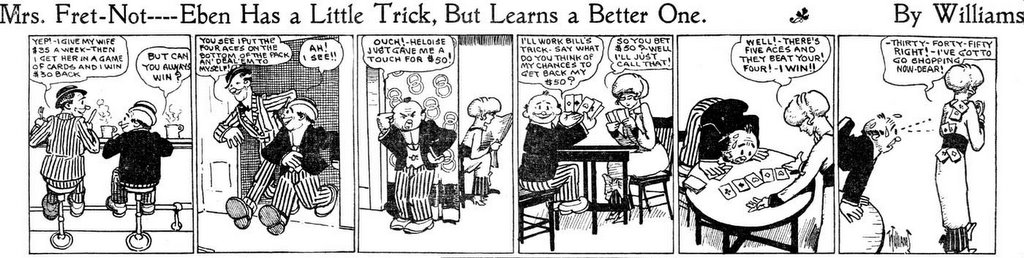
Mrs. Fret-Not is a delightfully funny strip that had a short but entertaining run; March 24 - August 16, 1913. The feature, and the one shown above is an excellent example, must be read in light of the era in which it appeared to be fully appreciated. The idea of an upstanding married woman being an accomplished card-sharp was, in these rather uptight post-Victorian years, scandalously wicked. This strip might have actually been worthy of a spit-take over a few breakfast tables in 1913.
The strip was distributed by Associated Newspapers, and that syndicate is eminently worthy of an extended discussion, but I'll leave that for another day. Today I want to focus on the cartoonist of this feature, a fellow by the name of Williams.
Now I know this signature as well as if it was tattooed on my forehead, because I love the guy's work. What I can't remember is how I came up with the notion that his slightly more complete moniker is O.P. Williams. I don't recall his signature ever being anything more than just 'Williams', and I don't recall a byline to that effect on any of his strips. However, that's how I have him listed, so I presume I discovered it in some way.
Anyway, his most memorable work was back in the mid-oughts when he took over the position once held by Winsor McCay at the Cincinnati Enquirer. Along with another fine cartoonist who has been lost to history, Apworth Adams, these two made Enquirer readers miss the great McCay a little bit less. If they didn't have quite the level of native ability of the master, they made up for it with imaginative concepts, good art and funny gags.
Williams seems to have been quite the gypsy. He first shows up on the comics pages in Boston, at first with the Herald in 1904, then doing strips for the Post and Globe. He then had his stint in Cincinnati in 1908-09, then returned to Boston again. Here he did a lot of work for the Post, and through them got syndicated with Associated Newspapers. In 1915 he shows up in Philadelphia working for the North American. Then he disappears for over a decade, only to reappear once last time in New York, doing a short-lived strip for the Evening Graphic.
Does anyone have additional information on O.P. Williams?
Labels: Obscurities
sold a 1914 sheet music insert from
the Boston Herald with cover art by
Orville P. Williams.
D.D.Degg
: 2/22/2006 10:00 PM Thanks, Allan
: 3/24/2009 6:48 AM : 11/21/2012 10:34 PM Yes, I now do have a positive ID of this fellow as Orville P. Williams, and thanks for the message to remind me to say so here. What is still wrong in the essay above is that Orville never worked in Cincinnati -- that turned out to be yet another Williams -- Carll B. Williams to be specific. That information was also determined too late to make it into my book, sadly.
--Allan
Friday, February 26, 2021
Obscurity of the Day: Gimpey


Here's one of those kid strips from the 1900s that number in the hundreds. This kid is named Gimpey, and if he's not careful he's going to lose his star status to this Judge Sobersides joker who is horning in on the fun.
Gimpey ran as an occasional feature of the Boston Globe Sunday comics sections from March 5 1905 to February 4 1906*. The strips are signed Williams, and I have long believed that they are by O.P. Williams; the art style is right, and he was in Boston, where he would later cartoon for the Herald and the Traveler. Oddly, though, Alex Jay didn't seem to find any mentions of his being at the Globe for his Ink-Slinger Profile. I'm sticking with the ID, though, until proven wrong.
* Boston Globe index by Dave Strickler.
Labels: Obscurities
I've very seldom come across Boston Globe material syndicated to other papers. When I have, it's just about always Billy the boy Artist. A sure way of identifying early syndicates is the type font, which almost always used by the client as offered by the syndicate. The font used here is rather distinctive, so I'm guessing that would be a sure indicator of a Globe strip if there have been other instances.
If Williams set out to do a knockoff of "Jimmy the Messenger Boy", He improved on it.
: 2/27/2021 10:45 AM Just to be clear, there's no question about it being a Boston Globe feature. That is definite. What I was questioning is my ID of "Williams" as O.P. Williams, who is not definitely known to have worked at the Globe.
--Allan
Monday, August 06, 2007
Obscurity of the Day: Mr. Bunny's Adventures
 Barely qualifying as a continuing strip, Mr. Bunny's Adventures ran just four times between April 26 and May 10 1913 in the Boston Post. H. Boyleston Dummer, discussed before on the blog, put his expertise at drawing cartoon animals to good use on this very short-lived feature.
Apparently Dummmer and the Post just couldn't fit together because in total he only cartooned for them for about two months, probably trying out for the spot that was being vacated by O.P. Williams. After a few more false starts with other cartoonists the Post pretty well settled on syndicated material for their daily comics.
Labels: Obscurities
Wednesday, May 11, 2011
News of Yore 1909: News Round-Up
January 2: The Outcault Advertising Company, Chicago, owners of the Buster Brown comic pictures, have begun a suit for $1,824.90 against the Smith Baking Company of Kansas City. This amount is alleged to be due the plaintiffs for the exclusive use in Kansas City of the Buster Brown service, which the bakers used.
January 9: The Toledo Times has followed the example of the Boston Herald and abolished the use of comic supplements.
January 23: Elmer Bache, cartoonist of the Spokane Orator-Outburst, has given up his position and returned to New York.
January 30: T.C. McClure has retired from the active management of the McClure Newspaper Syndicate. He is succeeded by R.B. McClure, who for a number of years has been associated with him in the management of this business. Mr. McClure intends to devote his attention in the future to work of an encyclopedic nature.
February 6: Ferdinand G. Long, a well known comic artist with the New York Evening World, is the originator of a new "Billikins." He has christened his funny little model, "Bub, the Cherub of Cheer."
February 20: The Star League newspapers of Indiana, comprising the Indianapolis, Terre Haute and Muncie Stars, have resumed the colored comic supplement service with their Sunday papers. The Star papers discontinued this feature some time ago, believing that they could increase their circulation and advertising business without it.
March 6: Homer Davenport, the well known cartoonist of the New York Evening Mail, was cut by broken glass Sunday when the taxicab in which he was riding crashed into a tree in Central Park.
March 20: O.P. Williams, the cartoonist who in 1904 went from the Boston Herald to the Philadelphia Public Ledger, is again drawing cartoons for the Boston Herald.
Labels: News of Yore
Tuesday, October 18, 2016
Obscurity of the Day: The Inventor


I've written about the pioneering daily comics page of the Chicago Daily News several times here on the blog, so I'll just quickly remind you that they were syndicating an almost full page of comics, panel cartoons and text gags well over a decade before Hearst and Pulitzer got on board.
The Daily News comics page lost much of its vigor in the 1910s. Two factors were to blame. First, obviously their product was no longer unique and had to compete in quality with very good daily comics from the big syndicates. Secondly, the News' strips were now syndicated through the Associated Newspapers co-op, rather than the News' own syndication efforts, and the profit motive had been substantially muted. No longer was there constant experimentation on the back page of the News, instead there was now a short list of much longer-running strips that inevitably outlived their potential for humor. The cartoonists in the News bullpen were bred for experimentation, and now were yoked to the same old plough every day, and it didn't suit them.
One of the great cartoonists at the Daily News was Ted Brown, who started signing his first name only to back page series in 1905. He was incredibly prolific, as were many in the News bullpen, and he stuck around until the page had been pretty thoroughly usurped by syndicated material from elsewhere in the mid-1910s.
His last new series for the Daily News was The Inventor, which started on July 22 1914. It was not a true daily, but came closer to that standard than anything he'd done before. It was a very repetitive strip (as was true of many Daily News series). but Brown has to be given kudos for coming up with an endless series of new inventions that backfire in one way or another. At the rate of one strip every few days, I can see readers finding it quite entertaining.
Tracking The Inventor becomes difficult because, in a move that would become increasingly common in the newspaper world later on, the Chicago Daily News quit running the strip but continued having it produced. Associated Newspapers offered so much material that the Daily News ended up running outside series more than its own.
In the Boston Globe, which liked The Inventor well enough to feature it regularly, the strip became a true daily starting September 1915. They too tired of the strip, though, and I have to track it to 1917 through the less reliable source of the Columbus Monitor, which began running it that year. By then, though, Ted Brown was gone, and it was being produced by Austin C. Williams. The series came to an end in the Monitor on June 30 1917.
Labels: Obscurities
Tuesday, December 31, 2013
Ink-Slinger Profiles by Alex Jay: Charles Pearson
Charles D. Pearson was born in Brooklyn, New York, on May 21, 1913, according to his New York World War II enlistment record. The 1915 New York State Census recorded Pearson, his parents, Milton and Emily, and older brother, Homer, in Brooklyn at 48 Richmond Street. Pearson would reside there long enough to be found in the 1940 U.S. Federal Census. His father was a traveling salesman. The census records at Ancestry.com link his mother to an “Emilie Dahl” in the 1900 census. Pearson’s middle name may have been his mother’s maiden name.

…Mr. Pearson was born in Brooklyn about 40 years ago and went to Jamaica High School where he started cartooning. After four years at Grand Central School of Art he began freelancing and made his first sale to the old Life magazine when that publication was devoted to cartoons instead of the news organ it has become since purchased by Time, Inc.
Later sales were made to Saturday Evening Post, Colliers, Ladies Home Journal, and American Legion Magazine among others. In between, there were 36 months in the South Pacific with the Army where he also cartooned and did editorial work for Yank. It was also at this time that he broke his bread and butter arm and was idled from the drawing board for a time.The Courier did not mention Pearson’s cartoons that were featured in Life magazine, January 8, 1945. Another one by him was included in a group with other cartoonists in Life, November 24, 1946. Pearson’s third appearance in Life was in the letters column of the August 26, 1957 issue. (He was credited on page two.)
About Pearson’s post-war career, the Courier said:
…After the war Mr. Pearson picked up where he left off, and soon conceived his idea for “Notes.” He wrote directly to the then Herald-Tribune publisher Whitelaw Reid, submitting a few sample panels. His idea was approved by Mr. Reid and he has been with the Tribune Syndicate ever since…
…Editorial page cartoons have long been an important feature of many of the nation’s newspapers and the above have been included among the hundreds turned out in the last few years by Charles Pearson, who now makes his home on a small farm in the Town of Greenport.
Once weekly Mr. Pearson turns out six small panels entitled “Notes on the News”, devoted to some segment of that week’s happenings and these, in turn, are distributed by the New York Herald Tribune Syndicate to 60 publications including the Oakland Tribune, San Diego Times-Union, New Orleans Times-Picayune, and other large metropolitan dailies throughout the nation.
“The cartoons themselves are simple, once I get the idea under way,” Mr. Pearson says, “but the toughest part is writing the caption lines for them. I do all my own captions.” Ideas for cartoons come for the most part from reading the news and retaining what is big enough and important enough that everyone will know about It two weeks or so hence when they see the cartoon on that particular subject. For instance, the recent Sputnik flurry which in turn helped create the panel of the “beeping” Russian.
One corner room in the upstairs of his farm home is Mr. Pearson’s studio where he has a drawing desk next to a window that furnishes a view of the Greenport countryside as he contemplates his next cartoon. Within easy reach of the southpaw artist are an assortment of pencils, brushes, inks, paper, and a few newspapers for research.
As he formulates an idea for a cartoon or caption, it is jotted op a piece of paper and placed under a large clip oh his drawing board. By the end of a week there may be 25 to 30 ideas for panels from which he eventually chooses the six best sounding ones and sets to work. “It takes a week to get things in order,” Mr. Pearson, told us, and I wait right until the last minute so I can be up to date on the news. Then I draw all six at one time, devoting the entire day to my work.”
…Last March Mr. Pearson moved from Westbury, L. I., to his present Greenport farm. Mrs. Pearson, originally from Sherman, Texas, is a graduate of Texas State College for Women at Denton, and was a reporter-photographer, for the Marshall News Messenger. She later came to New York City as a fashion photographer and there met her future husband. Their three budding cartoonists, all boys, attend Claverack Union Free School.
As for outside freelance work, “that’s out right now,” Mr. Pearson said. “I have plenty to do right here getting the farm in shape. There are still a few repairs and odds and ends to be completed, and that leaves very little outside time. And my six panels keep me busy the rest of the time. And then there's always those captions.”In the late 1940s into the mid-1950s, the Sunday paper magazine, This Week, published his cartoons; a photo of him appeared in the March 2, 1947 and July 31, 1949 issues. In 1952, his cartoons appeared in the Sunday paper magazine, Parade.


Pearson’s piece about himself was printed in Best Cartoons of the Year 1947.
What’s Funny About That? Cartoons from This Week (1954) had another story by Pearson:I was born 400 years ago in a life boat aboard the Mayflower. I’ve been drawing cartoons ever since. My first cartoons were drawn for a select group of subscribers. Each morning a cartoon was painted on the side of an educated elephant. During the day the elephant walked a route which took him past the home of each subscriber. He stopped in front of each one for three minutes. The elephant disappeared during a meat shortage. I suspected dirty work on the part of a diner that started to advertise ‘Jumbo Hamburgers’. Unfortunately I could never prove anything. Recently I was in Uncle Sam’s Marching and Chowder Club and right now I’m drawing left handed cartoons for magazines until such time as I invent the Elikafoobis. The Elikafoobis will revolutionize conditions here on the Universe. Wait and see.
“I was born in Brooklyn at least forty years ago. My family had already decided my brother would be President of the United States, so that left me unemployed. This annoyed me, so I decided to write nasty things about people on a fence but I didn’t yet know how to write so I drew pictures instead.”
Mr. Pearson’s brother is still not President, though he hopes to make it in 1956. Meanwhile Cartoonist Pearson is keeping his tuxedo pressed for the inaugural dinner, and he and his wife have raised three future presidents of their own. They all live in Carle Place, New York, wherever that is!A 1961 issue of Saturday Review mentioned Pearson’s invention:
The editor of the Look humor department, Gurney Williams, has had on display a mousetrap invented by Charles Pearson, a cartoonist of Hudson, New York. It is a large tin can, the open end of which is covered with wire mesh. Bolted partway inside the can is a conventional mousetrap with its lethal snapper securely wired upright to the mesh.
It is physically impossible for any mouse to enter this trap, and even more impossible that the immobilized snapper could pose any threat to man or beast….Sometime in the 1960s, Pearson was a cartoonist for the Albany, New York newspaper, the Knickerbocker News. The original art for a few of his cartoons are here and here.
...Work on our cover story (Heroes of the Christmas Bird Count) began in November 1973 when Samuel Yeaton of Bayside, a veteran of many Audubon bird censuses, agreed to write the story of the then upcoming bird-count. His article arrived in our office January 1974. Early in summer Charles D. Pearson of Hudson read the article and consented to prepare illustrations for it including a cover. The resulting combination of pictures and text is, we think, a most happy one.
…Mr. Pearson is widely known for his cartoons in the Knickerbocker News, which he draws with his left hand. He is also, he says, a left-handed farmer in Columbia County, where he serves on the Soil and Water Conservation Board. “I try to stir people up so they will be as enthusiastic about a countywide soil survey as I am,” he writes. “Actually I am not much of a birdwatcher. I’m more a bird talker-toer. I can warm up to those birds who will sit on a fencepost and say tweedletweedle at the proper times.”According to the Social Security Death Index, Pearson passed away March 16, 1991, in New York.
—Alex Jay
Labels: Ink-Slinger Profiles
