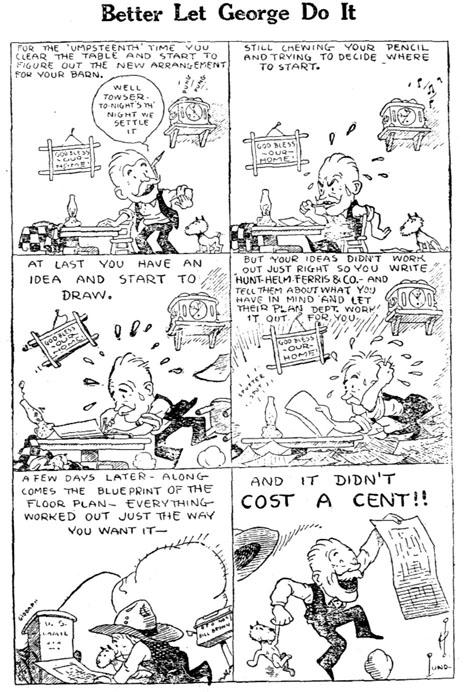
Monday, October 31, 2005


Halloween Special : Cartoonist Death, Dismemberment and Insanity

Here's a special edition of News Of Yore just for the ghoulish:

Fourth Estate 6/6/1914
Robert Bruce McClure, formerly head of the McClure Newspaper Syndicate. New York, was found dead in his Yonkers home Saturday of a gunshot wound. His family believes he was shot accidentally while cleaning a gun. Mr. McClure was a brother of S.S. McClure, publisher of McClure's Magazine, and the two founded the McClure Newspaper Syndicate which they disposed of a short time ago. [actually they were tricked into giving up control of the company by a group of sharp investors, which might explain that 'accident' - ed.]

Fourth Estate 4/4/1914
S. Frank Yeager, who has been connected as a cartoonist with the New York World, Boston Globe and St. Louis Republic, has been committed to the Western Washington Asylum for the Insane of Steilacoom by Court Commissioner Westover in Chehalis. Mr. Yeager was found on the streets acting queerly and with a bundle of pencil sketches under his arm of scenes in California.

Washington Post 11/26/1905
Louis Dalrymple, the cartoonist, whose wife is a Baltimore woman, was removed from his home at 138 East 29th Street this afternoon, to a Long Island sanitarium. He is said to be violently insane, and small hope is given for his recovery. His condition had given much anxiety to his friends for several weeks. He brooded, they say, over the troubles caused by his divorce from his first wife, formerly Miss Letitia Carpenter, of Brooklyn. He became violent to-day, and was found wandering in the street near his home.

Dalrymple was married to Miss Carpenter about fifteen years ago, at the time when his work was making him well known to the public. Shortly after the marriage Mrs. Dalrymple obtained a divorce. The court denied Dalrymple the right to marry again in this state and awarded $75 a week alimony to his wife.

Seven years later Dalrymple married Miss Ann Good of Baltimore. The wedding took place in New Jersey. He moved to Greenwich Connecticut. In the years that followed he worked at different times for papers in Chicago, Philadelphia and Baltimore. Then he drifted back to New York. He had become a prey to all kinds of hallucinations, and was so changed that his friends hardly knew him. [Dalrymple was one of the best artists working for Puck and Life in the 1890s-ed.]

Washington Post 8/18/1900
Ernest Wilkinson, cartoonist for the Atlanta Constitution, died suddenly of heart disease this morning at Afton, where he was spending the summer. He was about 25 years of age.

Washington Post 9/12/1910
John E. Scanlon, aged 47 years, a cartoonist, was found dead in his studio in the business section of the city today. He had evidently been dead for several days. Two bottles of laudanum, one filled and the other partially empty, were found in the room. It is not known whether Scanlon committed suicide or died from natural causes.

Fourth Estate 3/10/1917
Albert Beck Wenzell, painter and magazine artist, died on March 4 in Englewood N.J. in his fifty-third year. His work was well-known to readers of Life, Heart's, Truth, Scribner's, Ladies Home Journal and the Saturday Evening Post.

Fourth Estate 11/25/1916
DeVoss Woodward Driscoll, well-known cartoonist, died in a Dayton hospital on November 22, aged 43 years. He had been ill about a month. He originated the mule Maud cartoons. [no, he didn't, but he did have a very colorful career otherwise-ed]

Fourth Estate 7/15/1916
"Bud" Fisher, the creator of the Mutt And Jeff comic strip, escaped with a broken rib when his automobile overturned near Saratoga, N.Y., pinning him under the steering gear.

Washington Post 10/2/1904
George Kerr, famous a few years ago as a cartoonist and illustrator, is dead at the Soldiers Home in Dayton Ohio. He served in the Northern Army throughout the war, and at its conclusion became an illustrator for an eastern magazine, going later to a New York comic paper. He was a friend of Thomas Nast.

Washington Post 10/23/1914
Roy W. Taylor, a cartoonist, who has made thousands laugh and think, died at the home of his mother, Mrs. A.L. Marshall, on Tuesday. He was 36 years old. The funeral was held at 5 o'clock yesterday afternoon at the home, and the body was taken to Richmond Indiana, the old home of the family, for internment.

Mr. Taylor was on the staff of the Philadelphia North American. He had been suffering for some time from Bright's Disease, and a few weeks ago, when it was seen that he could not survive long, he came here. Mr. Taylor also had been attached to the staff of the Chicago Tribune and the New York World. His most popular work was done for the Sunday comic sections. [a descendant of Taylor tells me that he in fact died of alcoholism - ed.]

Washington Post 3/1/1918
Robert Carter, cartoonist of the Philadelphia Press, died suddenly in a hospital to which he was taken last night when he became suddenly ill from an arterial ailment. Mr. Carter was 44 years old.

Washington Post 10/10/1915
Stewart W. Carothers, a cartoonist for the Chicago Herald, fell to his death from a fifth story window of a downtown hotel early Monday. Two of his companions said he was sitting in the window seeking relief from a headache when they retired. It is believed he lost his balance. He was unmarried.

Washington Post 7/2/1922
Thomas Cyril Long, widely known among newspaper men of the South and East as "Cy" Long, creator of a new comic cartoon strip in which Southern negroes are the figures, was killed by lightning late today at Newton South Carolina, his home town, while participating in an amateur baseball game.

Washington Post 1/29/1919
Leon A. Searl, a newspaper and motion picture film cartoonist, who had been employed on the Kansas City Star, the Denver Rocky Mountain News, Chicago Tribune, Philadelphia Press and the Evening World and Evening Telegram of New York, died yesterday of acute indigestion at his home. Mr. Searl was 27 years old. He specialized in comics, and was the originator of "Bugs In Movieland" and "Mr. And Mrs. Homebreaker." [actually the features referred to are Bugville Closeups and Mrs. Timekiller-ed.]

Fourth Estate 2/7/1914
Henry Richard Boehm, an illustrator, shot himself through the heart Sunday in his home in Briarcliff Manor N.Y. Boehm was engaged in newspaper illustrating until about three years ago. He worked for the New York Herald, did some work for the Evening World and was employed on the New York American for several years.

Fourth Estate 12/27/1913
D. C. Bartholomew, better known as "Bart," a cartoonist for the New York Globe, died last Friday at his home in White Plains.

Washington Post 11/13/1890
Mr. James S. Goodwin, aged forty-five, employed as a cartoonist on Puck, and who lived with his wife and family in Mamaroneck New York, while walking along the track of the New Haven and Hartford road, last night, was struck and instantly killed by a train. His body was found this morning by one of the trackmen.

Fourth Estate 1/13/1917
Luther D. Bradley, for many years a cartoonist for the Chicago Daily News, died in Chicago on January 9, aged 64 years. [he was a perennial front page editorial cartoonist-ed]

Labels:


Comments:
Leon A. Searl died from "acute indigestion" at the age of 27? I wonder what the hell he'd been eating.
 
can somebody confirm that Thomas "Cy" Young was from and died in SC, rather than from Newton, North Carolina?
 
Hi Steven -
I just typed the article in as it appeared in the WashPost, but on checking my atlas I guess they made a little boo-boo since there is no city of Newton in SC. Can you share any info on Cy Long? I've not heard of him or this strip he supposedly did.
 
Post a Comment

Sunday, October 30, 2005


Obscurity of the Day : Good Scout Andy


This strip ran 1925 - 1926 and was created by Edward McCullough for the Cosmos Newspaper Syndicate. McCullough jumped ship very quickly after creating this strip and took his scouting strip concept to the New York World where he started a similar strip titled Good Scout Today. Cosmos continued the original version, substituting S. A. Booth as replacement cartoonist.

The sample strip is believed to be the final installment, from 11/20/1926. Booth seems like he might be saying goodbye here, though the possibility of continuation is left open. Having the main character head off into the sunset this way was a good way to hedge your bets on the possibility that the strip might be revived. Guess the public never clamored for more of Andy, 'cause he was gone for good.

By the way, karma didn't let McCullough get away with his syndicate jumping ways. Good Scout Today was cancelled after just two months. Good Scout Andy outlived it by over a year. Take that, Ed!

Labels:


Comments: Post a Comment

Saturday, October 29, 2005


Obscurity of the Day : Goofus Animals


Goofus Animals was a panel cartoon with verse series, a popular form before poetry in newspapers was deemed old-fashioned. Here the poet, one Herbert Kirk, supplies odes to imaginary creatures, while the great Nate Collier adds the visuals. The feature ran 1930-31.

Nate Collier is one of the great forgotten cartoonists. His obscurity, I suppose, is deserved since he never managed to produce anything of truly memorable value in his many years of producing magazine cartoons and newspaper art. He always seemed to be working for the grade-B magazines and newspaper syndicates, though his wonderful artwork should have led him to greener pastures. Ah, well, that's life.

Too bad on these samples his signature is printed so small. Collier's signature is a wonder to behold.

Labels:


Comments:
I ran across the Goofus Animals panels when I was working at the library in Troy, NY. I collected a number of them and cleaned them up to reprint in a pamphlet. Silly fun stuff.
 
Post a Comment


Ad Strips : Mrs. Van Thick


Here's a head-scratcher of an ad strip. These were run by Graybar Electric, a manufacturer of electrical components (like fuseboxes, outlets, etc) in 1926. If you read these you'll find that they really make no particular reference to the company's products. I guess this was the ol' soft-sell?

Anyway, reason I show these is because they're credited to one 'Dick Spencer', but I'd say they're actually by Jack Patton, who is most famous for his Texas History Movies strip. It was pretty much par for the course in those days to credit ad strips to fake generic names like that, and part of the fun of them is trying to figure out the identity of the cartoonist.

EDIT: Pablo Medrano Bigas writes to tell me that Dick Spencer really did exist, or at least is most likely not a pseudonym for Jack Patton. He sent me some other advertising art also signed by this Spencer chap. Thanks for setting me straight Pablo!

Comments: Post a Comment

Friday, October 28, 2005


Obscurity of the Day : Modish Mitzi


What do you get when you combine a fashion column with a comic strip? You get one really boring comic strip, that's what. Modish Mitzi was the first of the genre that married the two forms. As you can see from the sample (which is believed to be the very first strip, appearing on 11/19/1923), there is a polite nod to the convention of telling a story, but the strip is actually just a vehicle for discussing dress fashions. The orchestrator was one Jay V. Jay, presumably feeling safe from critics hiding behind a nom de plume. It is a pseudonym, I presume...

Believe it or not, someone must have actually liked this idea, because, incredibly, Modish Mitzi ran for over 15 years. On top of that it even spawned imitators. A few other titles of this genre are The Stylefinder Family, noteworthy for expanding its horizons to fashions for the whole family, and The Connoisseur, singled out for discussing etiquette and high society in addition to the fashion basics. But easily the most bizarre of the lot is Comrade Kitty, which discussed proletariat fashions in the socialist newpaper The Daily Worker.

Labels:


Comments:
Found out who "Jay. V. Jay" was.
An article in the August 13, 1926 Oakland Tribune (pg 21) identifies the creators as Laura Johnston (artist) and the writers as Virginia Vincent and Jeanette Kienkiveld. All associated with the fashion industry.
 
Make that Kiekinveld, with an "n".
 
Super find, DD!! Thanks for the info!

--Allan
 
Post a Comment

Thursday, October 27, 2005


Obscurity of the Day : Make-A-Comic


Here's a short-lived reader participation strip from 1925. Each strip first ran in the paper with empty balloons and readers were solicited to send in their captions, $5 to the winning entry. The strip would then run a second time with the winning captions added. As you can see from our sample, which is about par for the course, the competition was not particularly fierce. The strip's creator obviously recognized that the entries weren't too hot, so he added a text piece below each installment -- it displayed more humor than anything that appeared above.

The creator of this strip is Ray Hoppmann, a journeyman cartoonist who bounced around most of the lesser syndicates. Although he has many and varied credits, there's not one series in his resume that wouldn't easily qualify for our obscurity of the day.

Interesting tidbit - this is the only strip ever distributed by Readers Syndicate (at least that I've found). They had a few panel cartoons, but, as their name implies, they specialized more in text material.

Labels:


Comments: Post a Comment


More from Mencken

Came upon another interesting passage from H. L. Mencken's wonderful book Newspaper Days 1899-1906. Again, highly recommneded for any student of the newspaper game. Too bad Mencken hates cartoonists, though, as you'll see anon:

"Save on a few metropolitan papers, the Sunday editor of today is not much concerned about his pages of colored comics, for they are supplied by syndicates, and most of them are printed by outside contractors, far from the office. But in 1901 there were no syndicates [not true - ed.] and every paper had to prepare and print its own. This work, untrained as I was, gave me endless torment, for I quickly found that comic artists were a temperamental and nefarious class of men, that engraving departments were never on time, that pressmen had an unearthly talent for printing colors out of register, so that a blue spot intended to represent an eye usually appeared clear outside the cheek, and that plates plainly marked red were often printed as yellow, and vice versa. The first page of the color sheet, in those days, was seldom given over to comics [he means the color magazine section here, some papers had the the comics as part of the color magazine rather than as a separate section-ed], which were still regarded as somewhat infra dig.; its more usual adornment was a large picture of a damsel in an hour-glass corset and trailing skirts, labeled "The Summer Girl," "The Spirit of Thanksgiving," or something of the sort. The artists who drew these sugar-teats were even worse characters than the concocters of comics, and needed more policing. If one of them delivered a drawing on schedule he was sure to be non est when the time came to block out the color plates, and if he did the color plates promptly it always turned out that he had done them wrong. There were weeks when I spent at least two-thirds of my working hours wrestling with these criminals. They were, taking one with another, very affable fellows, and they used to try to mollify me by presenting me with large colored drawings of beautiful gals without any clothes on, but my professional relations with them were usually strained, and it never gave me any pain when I heard that one of them had broken a leg or got soaked for heavy alimony by his wife. Toward the end of 1902, happily for my sanity, syndicated comics began to appear, and I need not say that I subscribed to them with cheers.

"The very names of the first ones are now forgotten -- Simon Simple, Billy Bounce, the Teasers, the Spiegelburgers [these are all characters of the McClure Syndicate - ed.]. Finally came Fooxy Grandpa, and we were on our way. Even so, it was necessary to keep a comic artist or two on call, for now and then the business office sold a quarter-page ad on a comic page, and something had to be cooked up to go 'round it. I not only had to supervise the preparation of this home-made stuff, but also to supply the ideas for it. The only ideas that the comic artists of that age ever produced on their own were either too banal to be used, or too lascivious."

Comments: Post a Comment


Obscurity of the Day - Meet The Misses


Here's a neat Sunday magazine section feature that has a lot of appeal. Meet The Misses ran from 1927-1929, a product of the struggling McClure Syndicate and the pen of Jack Wilhelm. Wilhelm went on to do the art on Frank Merriwell's Schooldays and a few other strips. No one will accuse Wilhelm of being an exceptional cartoonist, and his pretty girls aren't all one might expect of a feature devoted to them, but Wilhelm does have one thing going for him - he knows how to design a page for visual interest. This is the first page in the series.

Labels:


Comments: Post a Comment

Wednesday, October 26, 2005


Adventures of Willie Green


I just started indexing the Philadelphia Record of the 1900s, primarily for the start and end dates of their long-running feature The Adventures of Willie Green by Harris Brown. I've never seen the strip before, just knew it existed from the reprint books cited in the Overstreet Comic Book Price Guide. Well, now that I've seen a few of these strips I have to comment that I'm really blown away by the art, and show you an example. What a lovely style! Reminds me a bit of Herge's almost clinically clean linework.

Bonus on this example is that we get a look inside the Record's building (pretty darn elegant, eh?), and we have a visit with the paper's editorial cartoonist, John De Mar. Note that Harris still needs to learn about reversing camera angles, as panel 5 doesn't read properly. On the other hand, what a masterful little touch in panel 2 of having the clerk's word balloon peeking out from behind the partition.

Labels:


Comments: Post a Comment

Tuesday, October 25, 2005


1895 Cartoonist Product Endorsement


I could be way off here, but could this be the very first time a famous cartoonist appeared as a product endorser? And what a product to endorse -- one of the patent medicines of the day! I'm not familiar with Paine's Celery Tonic in particular, but you can bet that this tonic was mostly alcohol, as were most of them. Might even have been a cocaine product. You can read about this and other snake oil products here.

As you can read in the ad, Bernard Gillam was a part-owner and chief cartoonist for the weekly humor and political comment magazine Judge.

Comments: Post a Comment

Monday, October 24, 2005


Early Ernie ("Nancy") Bushmiller Art


Here's a neat item I just found; an Ernie Bushmiller puzzle page from January 1925, just months before he would take over the Fritzi Ritz comic strip. As you can see, Ernie's art was somewhat more fussy in these early days of his career, he had not yet reached rubber-stamp nirvana. This puzzle page appeared in a Sunday magic and puzzle section supposedly edited by Houdini (yeah right...). The puzzles are really hard - I gave up on them pretty quick. Tell ya what - first person to post a correct solution to all the puzzles in this image will be sent a nice classic comic strip reprint book.

Comments: Post a Comment

Sunday, October 23, 2005


Printing Plates - Can You Help?


I'm requesting your assistance today. I recently purchased a large batch of printing forms for an ad comic strip called Cherry. While I can (barely) make out the strip on these intaglio cardboard plates (see above), it would be nice to get this collection into some more readable form.

Now my very shaky understanding of the printing process tells me that these little cardboard forms would probably be filled with a thin covering of molten lead. The image would transfer to the lead and then that hardened lead would be used as the printing plate. Have I got that right? If so, I may be stuck already since the idea of working with molten metal is a bit worrisome.

I tried scanning one of these and playing around with contrast etc. and I can get them a bit more readable, but still a long way from crisp linework.

So, can anyone provide suggestions for turning these little cardboard doohickeys into legible black-and-white strips?

Comments:
Very interesting - I thought all strips were hand drwan. guess not. very cool though. How many did you purchase of these?
 
The art was originally hand drawn. The syndicate/publisher/distributor uses it to make plates such as these that can be sent around to newspapers. The newspaper uses these forms to create metal printing plates. Of course, all this was before computers made all that guff unnecessary...
 
They're called matrix, Mats for short. They were sent to the paper along with a quality proof so the printer could tell what they were supposed to look like.

There were several ways of pouring them,all pretty much alike. My first job at a newspaper, after school, was sweeping up, running simple jobs on a small platen press, recycling the printers alloy in what was called a hellpot.

We dumped all the scrap into the pot which kept the alloy at a melting point. I skimmed the crud off the top, poured pigs for the linotypes, and clamped the mat into place, adjusted for size, and poured in the alloy by opening a tap. The result was called a stereotype. The mat could be used a number of times, so if a steretype went bad we could replace it. All kinds of graphics came this way, including clip art. There were also plastic forms that worked much the same way, but allowed for greater resolution. They were still in use about 35 years ago.


They were made by a press that forced the damp cardboard down onto a zinc engraving.

About the only way to get a good imaqge would be to pour something into them, then roll the top with an ink and press them onto paper.
 
Post a Comment

Friday, October 21, 2005


Obscurity of the Day: Classified Ad-Ventures


Here's an example of a strip genre that came on like gangbusters in the 1930s, matured by the 50s and was all but gone by the 60s. Many strips and panels that touted the wonders of classified advertising were created, though few did particularly well. I'd say that the most popular was Larry Reynolds' Quickies. Other popular features include Howard Baer's Too Late To Classify and Want-Ad Wonders, yet another Believe It Or Not imitator.

Classified Ad-Ventures had a short run (as far as I know) but is distinguished with excellent art by Ben Stahl, much in the Milton Caniff/Noel Sickles chiarascuro style. Unfortunately the nice details on the strip are all but lost in this scan from a microfilm newspaper. I have found runs of the strip from 1937 and 1940. I don't recall any other 'want ad' strips that mined the adventure strip genre. Neat stuff!

Labels:


Comments:
Very interesting strips, to think that there were so many the never made it for very long.
 
Post a Comment


The Last Winston Strip


This is the final Winston strip. There's few things I like better than finding a strip that heralds its end date like this. Not only does it put a definite punctuation on the end of the run, but often the final strip reveals something personal and intimate about the cartoonist and their feelings about the event. Some take it sadly, as Jim Burnettte and Johnny Sajem do here, others put on a brave face, still others find it in themselves to laugh about the demise of their brainchild.

Comments:
Allan, I enjoy this blog of yours. It is a wonderful thing you're doing. I really enjoyed this final strip. I liked this and similar gag strips of the era.
 
Post a Comment


Obscurity of the Day - The Dubbville Foursome


Alfred Brewerton, if known at all, is known for his soap-opera strip Pam that ran 1928-1943. Those who have seen that strip tend to assume that Brewerton was not a particular competent cartoonist. Not true - the problem was that he was trying to draw the strip in a more realistic style than he was used to. Here is a neat golf strip called The Dubbville Foursome he did as a weekly panel; typically used on Sunday sports pages. The strip ran at least 1922-1927 and started with the Thompson Service. In 1925 it switched over to McNaught Syndicate. I think you'll agree that the art is quite nice. Brewerton's career is a bit of a mystery - he first makes an appearance at the New York World in 1903 doing a few very short-running strips. In the early teens he pops up again and does a minor strip and sports cartooning. Then he disappears once again from my radar until the early 20s. Anyone have biographical information on this fellow?

Labels:


Comments:
Hi Allan: I stumbled on your wonderful site after doing a stab-in-the-dark Google of Alfred Brewerton. Another site had this biographical info: "Born in Kansas in 1881. Brewerton was a resident of Los Angeles in 1905 and a cartoonist for a newspaper in Atlanta, GA in 1910-20.
Source:
Edan Hughes, "Artists in California, 1786-1940"
City Directory; Census."

I remember Brewerton as an editorial cartoonist for The Atlanta Journal in the 1930s, perhaps later. If his "Pam" was syndicated, it surprises me because I thought he just did it as a sideline. My brother, a commercial artist, considered Brewerton a poor craftsman, said he couldn't draw hands, etc. Fascinating to see that he could do something better, like the "Dubbville Foursome." I'll pass this on to my brother, who will be most interested.

Bob Willis, Fincastle, VA
 
Hi Bob -
Yup, "Pam" actually was syndicated. And I concur with your brother that it was pretty bad. In fact, everything I've seen by Brewerton that breaks out of his pleasant bigfoot cartooning style is wince-worthy to say the least. I always thought it funny that the Sunday topper strip to "Pam", called "Donald Dare The Demon Reporter", which was done in his 'cartoony' style, was so much better than the main strip. When you look at the two strips next to each other it's hard to believe they're by the same guy.

--Allan
 
Brewerton was not only a cartoonist but a photographer as well. In some research I'm doing on a documentary, he was part of the 1909 Good Roads Tour, sponsored by the Atlanta Journal and New York Herald. He took some pretty remarkable photos on the tour as well as created some pretty insightful cartoons of the motorists. If someone has any idea as to where any archives of his photography my exist, I would be greatly interested.

Michael Britt
Georgia Public Broadcasting
mbritt@gpb.org
 
Some time ago I read the comic strips from the Buffalo Evening News from 1928 to 1945, including Ella Cinders, Bound to Win(later Ben Webster's Career) and Pam, among many others. Pam was carried from its inception to early 1941 in the Buffalo paper. Did the strip actually continue in papers until 1943? I found the drawing sketchy and memorable as a child when my aunt read this strip and others to me. I had a sentimental feeling toward these strips and enjoyed hearing them as a child and so reading them on microfilm was a labor of love. As one brought up on serials of that day I enjoyed it. The initial strip finds Pam coming to the big city to work! Later Pam and her friend David were involved in many dramatic situations and I grew to enjoy the drawings! I would love to see this strip reprinted, along with many others. I personally can not be critical of it! The strip was stylized and interesting to read. Compared to the poor artistry of so many contemporary strips, it is not without merit. I would love to see the Sunday edition of Pam since the News carried only the daily strip. Could someone name a paper where the Sunday strip appeared?
 
Hi Anon -
Not 100% sure, but I think the Sunday ran in the Chicago Times. I have quite a few Sunday tearsheets but not from complete sections, so don't know the various papers.

--Allan
 
Did a little more digging ... one paper that did run the Pam Sunday for sure was the Oregon Journal.

--Allan
 
Post a Comment

Thursday, October 20, 2005


News of Yore - Matrimonial Edition!

Here's another batch of news items from the magazine The Fourth Estate. These are all marriage announcements:

WEDDING BELLS (10/7/1916)
F. W. Hopkins, a Chicago cartoonist, and Miss Eleanor Matthews of Ludington Michigan, were secretly married in Chicago last week.

Hopkins was the creator of the daily strip Scoop The Cub Reporter.

ROHN'S MOVE NEXT? (8/26/16)
Six years ago three bachelors came to New York, and in their studio on Washington Heights swore that eternal celibacy would be their state in life, and that designing females would have no place in their scheme of things; and almost six years passed without any deviation from the letter or spirit of the oath.

When the summer of 1916 rolled around, however, H.T. Webster, a cartoonist with the New York Globe, and one of the trio, met Miss Ethel Worts, a Toledo girl, and after knowing her for two weeks, promised to love, honor and obey till death did them part.

The event was being celebrated at a dinner last Sunday evening at which O. O. McIntyre, a New York correspondent, was host. About the table were Mr. and Mrs. McIntyre, the bride and groom, Ray Rohn, an artist with Judge; R. M. Brinkerhoff, an Evening Mail cartoonist, and Miss Edna Patterson.

Then Webster rejoiced, for the company was told that Mr. Brinkerhoff, the second of the three eternal bachelors, had deserted the standard, and was betrothed to Miss Patterson. The wedding will take place in the fall, and meanwhile all eyes are turned to Mr. Rohn, whose next move is anxiously awaited along Park Row.

BRINKERHOFF WEDS (3/10/1917)
R. M. Brinkerhoff, cartoonist of the New York Evening Mail, and Miss Edna Patterson were married on March 3 in New York and immediately sailed for Havana, Cuba, to spend their honeymoon.

When Mr. Brinkerhoff came to New York six years ago from the Middle West, he lived with H. T. Webster, artist of the New York Globe, and Ray Rohn, also a knight of the brush, and the trio formed a compact to remain bachelors. The first to break the circle was Mr. Webster, who married Miss Ethel Wortz a few months ago.

Mr. Rohn, so far as is known, intends to remain in single harness, as he threw rice and old shoes at the honeymooners when they were leaving the pier.

WEDDING BELLS (2/10/1917)
John Knott, a St. Louis newspaper artist, and his former wife, who divorced him last July, took out a marriage license in New York on February 5.

Knott was the creator of the panel cartoon Penny Ante, also known as Eddie's Friends.

WEDDING BELLS (7/8/1916)
Sidney Joseph Greene, cartoonist on the New York Evening Telegram, and Mrs. Louise Lauder-Milch were married on July 6 in New York.

Sid Greene was sports cartoonist on the Telegram, and did a few very short-lived strips, including This Is The Life and Evening Telegram Movies.

WEDDING BELLS (3/28/1914)
Will Morgan DeBeck, a cartoonist on the Pittsburgh Gazette-Times, and Miss Marion Louise Shields of Youngstown Ohio, have announced their engagement.


WEDDING BELLS (1/17/1914)
Russell Henderson, cartoonist on the Chicago Record Herald, has been married to Miss Gladys Scott.

Henderson did an excellent daily strip for the Record-Herald titled The Adventures of Ziggy and Zim. Notice in this introductory strip that he refers to fellow Record-Herald cartoonists Ed Mack and French (whose first name I don't know).

WEDDING BELLS (2/14/1914)
Robin Grove, a cartoonist on the St. Louis Times, and Miss Cornelia Harrison have announced their engagement.

Assuming this is the cartoonist who signed his work Roy rather than Robin, he was a journeyman cartoonist who did a number of strips for the NEA syndicate from 1918-1925. His longer running features were Bugs and The Boys In The Other Car.

Labels:


Comments:
Any info available on Frank "Hop" Hopkins of Scoop the Cub Reporter and Snuggle Pups?
 
What in particular are you looking for; I do have info on the features, not much on Hopkins himself.

--Allan
 
Hello, I am two years late. Frank Hopkins was my grandfather. I have some of his other art in my house. I would like to find more cartoon work. He also did wood carvings of cowboys, bronze figures of golfers, engravings for golf trophies, and various whimsical items. I have a great print of two horsey women that he did.

Eleanor
 
Hi Oleander --
We'd be very much interesting in knowing more about Hopkins -- he had a very interesting career working for the oddball International Syndicate. Any info you have on his work life would be especially appreciated!

--Allan
 
Post a Comment


Early Syndicate a Shabby Business?

Just stumbled upon a little gem in H.L. Mencken's "Newspaper Days 1899-1906", a book I recommend highly. In a discussion of an artist friend, Mencken throws us comic strip nuts a snapshot of the earliest cartoon syndicate I know of that was not run by a newspaper:

"...the magazine [Dixie] was at least getting notice for some of its illustrations. They were done by a pen-and-ink artist named G. Alden Peirson, Turning away from the uptown prides and glories of Baltimore, he went down to the waterfront for his subjects, and there produced some very charming drawings. The newspaper artists of the town were naturally miles behind him, but they, too, had their quest for an earthly Grail. It took them to a dark office in an old building under the elevated in North street, where there lurked a syndicate man who was always ready to buy a comic drawing of the sort then in fashion. Unhappily, there had to be a he-and-she joke to go along with it, and inventing these jokes usually stumped the artists. When they could not find a literary reporter able to supply one, they went to the Pratt Library and dug it out of the back files of Puck, Judge or Texas Siftings. The market price for joke and drawing was $1." (page 61-62)

The syndicate, though unnamed here, is undoubtedly the International Syndicate. At the turn of the century this tiny syndicate did exactly what Mencken describes - they syndicated little panel cartoons with the so-called 'he-and-she jokes'. They provided these to newspapers in addition to a budget of general art cuts that could be used for sprucing up ads and fillers. Later on the International Syndicate would be one of the first to offer true daily comics, the first of which was Scoop The Cub Reporter.

Comments: Post a Comment

Monday, October 17, 2005


Weekend Research Trip


I went to the University of Florida on Saturday for a day of research. I completed my Christian Science Monitor index, which will be the source material for an article in the next issue of Hogan's Alley. In addition I continued my indexing of the Washington Post which I currently have indexed from 1936 to present. I got back to 1932 with no finds that really get into the momentous category, but here are some tidbits:

* found a run of the advertising-underwritten strip The Story Of Our Country in 1935. The closed-end strip ran 78 episodes. This is the only strip I've found from the Globe Feature Syndicate.

* found a start date for Are You Superstitious, a panel cartoon that was locally produced special for the Washington Post.

* also a start date on the weekly panel Now I Know, a Believe It Or Not type that ran only on Sundays in the kids section. I never found a syndicate stamp, but since it is by Robert Pilgrim I'm guessing that it was produced by Bell Syndicate.

* found a start date for the second run of Joe And Asbestos. The original run was in 1923-26, then it came back in 1932. It is a racing tip strip following in the tradition of A. Piker Clerk and A. Mutt. The numbers printed in the first panel are 'lucky numbers' for the numbers games that were populaar in those days.

* found Oddly Enough, a local interest strip produced, obviously, for newspapers in and around Washington. Weird part is that a feature of the same name was produced for Philadelphia papers in 1932-34. But that one was a weekly panel (this one is a daily) and by a different cartoonist. Not sure if there is any relation or if it is just a coincidence.

Comments: Post a Comment

Friday, October 14, 2005


Obscurities - Mister Gallagher And Mister Shean


Here's a neat strip that mines the vaudeville tradition. Gallagher and Shean were a vaudeville comedy duo of the teens and twenties. Their lasting claim to fame is the classic pop comedy song "Mister Gallagher And Mister Shean". You can read more about the comedy team in Wikipedia here.

Anyway, the strip started sometime in 1923 (my earliest examples are from October) and ended April 19, 1924. Jo Swerling was credited with the strip, and on a few occasions I find a signature on the strip "Done By Dunn", so this Dunn may have been the bullpen artist who did the art. Unfortunately I have no background info on Swerling, nor can I say with any certainty who Dunn is - Bob Dunn? Alan Dunn? Charles Dunn? They were all cartoonists working in the 1920s. My guess is Charles Dunn, but anybody have a suggestion?

Labels:


Comments:
Fantastic blog. Have all my envy and all my best wishes!
Alfredo
 
This is another site I need to keep an eye on and look at often. keep up the good work.
 
Jo Swerling (sometimes, or originally, Josef Swirling, born in Russia) was a friend of the Marx Brothers. (Another cartooning connection: Groucho married the sister of Will B Johnstone, New York World cartoonist who worked on Marx Bros scripts) Swerling did the story for a lost Marx Bros silent of 1921, and worked on a 1918 stage routine of Groucho's. Anyway, Al Shean the great vaudevillian was the Marx Bros' uncle. Perhaps that is the connection when Gallagher and Shean "became" a comic strip and Swerling wrote it. Short-lived. The art was Charles Dunn, Hearst (und anderer) bullpen stalwart; NOT Bob Dunn, whose and drawing style put the possibility out of possibility. Swerling's Hearst-bullpen connections -- a friendship with Damon Runyon -- possibly paid off when he wrote the book (with Abe Burrows) for Guys and Dolls, for which they won an Emmy. However Swerling had a separate career in the movies (even briefly as an actor) -- writing duties on "Gone With the Wind" (uncredited) and "It's a Wonderful Life." He also did the screenplay for Hitchcock's "Lifeboat," and the original "Pennies from Heaven." His son Jo Swerling Jr is a movie producer ("The Brothers-in-Law") and many Stephen J Cannell shows -- "Baretta," "A-Team," "Rockford Files," many more.
 
Hi Rick! Thanks for all the information on ol' Swerly (that had to be his nickname, right?). Any comic strip-related projects in the works right now, or are you concentrating on the country music or movie genres these days?
 
Thanks for intro to Gallagher and Shean comic strip. Best wishes.
 
Post a Comment


Obscurities - Mister Rumbles


Here's the first five installments of Mister Rumbles by Jack Sparling. The strip started on April 18 1955 and lasted until sometime in 1956. Can anyone supply a definite end date?

The Eisner influence on Sparling is obvious here, but good art wasn't enough to keep this strip afloat. I guess the world just wasn't ready for an adult version of Barnaby or Calvin And Hobbes.

Labels:


Comments:
Ver interesting Strip, do you have the complete run? Also what paper was this pulled from. Thanks
 
No, I don't have the complete run, just the first few months. My run came from the Washington Post, which dropped it early.
 
Post a Comment

Thursday, October 13, 2005


Cartoonist Convention Art


At newspaper industry get-togethers cartoonists often create some special art to commemorate the event. Since they’re cartoonists, they usually approach the job with humor and poke fun at their industry.

Here we have a treasure – three special comic strips created especially for a 1917 newspaper convention. The cartoonists are Rube Goldberg, Charles A. Voight and Robert Brinkerhoff, all with the New York Evening Mail at the time, and all in the early years of long prosperous careers. Here we get to see them poking fun at newspaper publishers and their penny-pinching ways. Here’s the write-up that accompanied these cartoons in the May 5 1917 issue of The Fourth Estate:

The ‘big surprise’ of the New York Evening Mail’s “gambol” to 800 newspapermen and advertisers, at Cocoanut Grove, atop the Century Theatre, on April 26, was the joint appearance of Goldberg, Brinkerhoff and Voight, the Evening Mail’s cartoonists, in a comedy skit written for the occasion by Roy K. Moulton, the Evening Mail’s columnist.

The sketch, billed on the program as “a tragedy,” told of the efforts of a newspaper publisher to buy a roll of print paper. “Paper King,” one of the characters, informed “Mr. P. Ubble Isher” that one roll of print paper would cost him exactly $9,000.00. In despair, the publisher turned to his cartoonists for assistance and after a whispered consultation they offered to help him out of his difficulty by lending him their “last week’s salary,” which happened to be the amount needed.

The above cartoons, by Goldberg, Voight and Brinkerhoff, are reproduced from the program of the Evening Mail’s party for its newspaper and advertising men friends.

Comments: Post a Comment

Tuesday, October 11, 2005


Obscurities from the Chicago Record-Herald


In 1914 the Chicago Record-Herald started a small comic strip syndicate. They had a mixture of second rate material, but they also printed early material by some cartoonists who would later go on to greatness. Among these are E.C. Segar (Popeye), Frank Willard (Moon Mullins) and Billy DeBeck (Barney Google).

Today I’m posting images from some 1915 Chicago Record-Herald Sunday strips that are probably deservedly forgotten. Movies Featuring Haphazard Helen is the best of the group, with decent art by Carothers. Notice that the feature captions are done in rhyme. This was a pretty common device back in the oughts and teens – my impression is that some cartoonists thought that no one would notice that their strips weren’t funny if they were in verse. By the way, the captions were so small and faded that I had to replace them on the scan – sorry purists!

Next is Old Sport Owl by a cartoonist named Clardy. I don’t like to be negative, but this is just a plain poor excuse for a strip. Believe it or not, this thing ran both daily and Sunday for almost four months.

Last is Roaming Rufus And Romeo by Joe Kohn. This is yet another take on the Katzenjammer Kids, but I’m not even sure if the protagonists are kids or adults. Although the art on this one is amateurish, I must admit to liking panel 7, where the old geezer’s pain is depicted with a thought balloon of him getting a tooth pulled.

If you’re wondering why these strips only have one or two colors, it’s because until the 1920s it was typical for newspapers to print only the outside wrap of their comic section in full four color. The inside was almost always like you see here. Typically you would get black plus one color. Sometimes papers would use a second color instead of black (you can see this on Old Sport Owl where a dark blue is used instead of black ink). Papers that were willing to shell out more dough would go with three colors (black plus two more). When the 3-color scheme is skillfully handled the casual reader may not even realize that they’re not getting full color.

As always, be sure to click on the images to see them at full readable size.

Labels:


Comments:
Wonderful!
As others have done, your site is now boolmarked and moved toward the top of the list.
But with the Classic Adventure Comic Strips/Classic Comic Strips/
PlatinumAgeComics Yahoos pages,
Coconino Classics, Toonopedia,
Andy's Bugpowder, RCHarvey.com,
Barnacle Press, Boondocks.net,
Arnold Wagner's and now your blog,
plus a few sites trying to keep up
with today's strips I don't know if
I can keep up with it all.
So forgive my ignorance when I ask:
if Carothers is the artist of
"Haphazard Helen" who is that Burroughs being credited with plot and pictures at the top of the page?

D.D.Degg
 
Good eyes, D.D.! Actually the posted strip is from late in the run after Carothers left. And therein lies great story that I'll relate one of these days. After Carothers' run, Burroughs took over, then Tom Rover, then someone who signed himself just "Bud", and then another semi-anonymous cartoonist who signed himself "Awrie". I also failed to mention that the bad versification was by none other than J. P. McEvoy, later a very well-respected writer whose credits include writing the "Dixie Dugan" strip.
 
Post a Comment

Sunday, October 09, 2005


Dorothy And The Killies


Here’s a sample of a great obscure strip, Dorothy And The Killies. It was written and drawn by B. Cory Kilvert for the New York Press in 1914-15. The premise is that anything sweet little Dorothy draws comes to life. Now Kilvert could have made this a strip full of sweet little unicorns and flowers, but instead his Dorothy is a little hellion with no time for drawing pink ponies and that sort of guff. Instead she draws homicidal beasts that she names, quite properly, Killies. They’re all bloodthirsty animals and she sets them on whoever is unlucky enough to be in the vicinity. In this example she sends a few of them after a cop. This, frankly, is one of the least grotesque strips of the series. I’ve seen a few examples that are downright disturbing.

Wondering what the heck the New York Press is? It was a second-class newspaper, really just a holdover from the nineteenth century, when it was purchased in 1912 by Frank Munsey. Munsey was a publishing millionaire who wanted to form a national chain of newspapers and the Press was to be his New York link. In 1914 he was talked into the idea of starting a Sunday comic section in the Press and syndicating the content to other papers. Munsey didn’t believe newspapers were a place for such frivolity, but he was talked into the venture. With little interest from the chief and a miniscule budget, the section was really on its deathbed from the start. The section lasted just a little over six months before going down the tubes. The newspaper itself only lasted until 1916 when it was combined with another paper (the Sun). The Sunday section contents were, if not of the highest quality, interesting from a historian’s standpoint. I’ll be posting more New York Press strips in the future.

Be sure to click on the strip above to see it at a readable size.

Labels:


Comments: Post a Comment

Saturday, October 08, 2005


The Billy Make-Believe Mystery


Billy Make-Believe was a short-lived Sunday strip by Harry Homan. The strip started 7/22/34, and the end date is why I’m writing this post. I have four conflicting pieces of evidence regarding the end date:

1. I’ve never found a single example later than 1935. In fact the one pictured (5/12/35) is the latest one I’ve seen.

2. According to the United Feature Syndicate’s internal records, the strip ended on 1/31/1937.

3, The Editor & Publisher annual syndicate feature listing for this strip ends in 1938, which means that the syndicate was apparently still offering it as of mid-1938.

4. I told a fib in #1. Actually I have one tearsheet of the strip that was printed in 1940. It runs in a comic section composed entirely of reprints of older strips. The syndicate that distributed this section (World Color Printing) was well known for buying up a complete run of a title from a syndicate and re-running it in their bargain priced comic sections.

Item #4 makes me wonder if this strip might have been offered in reprints much earlier, and the reason I have no original run tearsheets later than 1935 is that the strip went into reprints around that time. Naturally strips offered in reprints are seldom big sellers (if a newspaper editor liked the strip, they would have run it in its original run), so could this account for the lack of tearsheets later than 1935? My thesis is that the strip ended in 1935, then was offered in reprints until 1938 without much success. In fact the offer was not recorded in United Feature’s own records in 1938 as perhaps they had no clients at all buying it by then. By this time it was obvious to UFS that the strip was a dead issue for them, so they sold it outright to World Color Printing for use in their pre-print sections.

Of course this is all just guesswork. Does anyone have tearsheets of Billy Make-Believe from 1936 or later that would shed some light on this question?

Comments: Post a Comment

Friday, October 07, 2005


News Nuggets from the Past

Another batch of short news stories from the pages of the magazine The Fourth Estate:

TEACHER OF CARTOONING (8/26/1919)
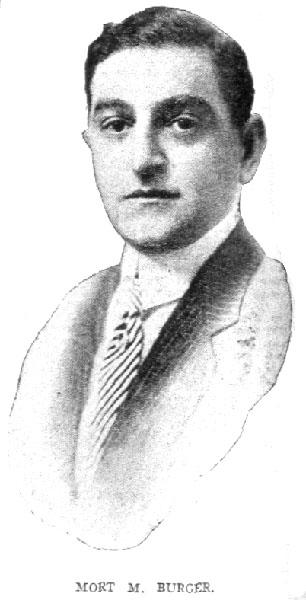
The art of cartooning may not be inherent in a person - one can learn it through the medium of a course at a local school or by correspondence. That many are interested in such a course is strongly attested by the results of the work of Mort M. Burger, director of the Associated Art Studios located atop the Flatiron Building of New York City.

Mr. Burger is a well-known artist, having been on the art staff of several leading newspapers, in which his drawings still appear from time to time. A number of years ago he was associated with the late Dan McCarthy in the World Building. As director of the Associated Art Studios he has met with great success, conducting what is claimed to be one of the largest practical art schools in the country.

Mort was a producer of small panel cartoons which peppered the daily papers of New York and other cities in the 1900s and 1910s. These mini-cartoons fell out of favor in the mid-teens and Burger turned to other cartooning pursuits like this school. His activities were reported often in the pages of The Fourth Estate. A rare photo of Mort accompanies the article (see above).

DEPEW MOVES UP (8/19/1916)
Walter Depew, formerly connected with the Capper Engraving Company of Topeka Kansas, and for several months staff photographer and artist of the Des Moines Tribune's editorial department, has been placed in charge of the art department of both the Register and Tribune.

Depew later became the artist on the long-running Ned Brant comic strip.

OBITUARIES
(9/16/1916) Leonard Lowson, formerly a cartoonist for the Winnipeg Manitoba Free Press, died last week in New York.
(9/30/1916) A. W. Oberlander, formerly a cartoonist for newspapers in Chicago and other western cities, died last week in Buffalo New York.


STAFF CHANGES (9/30/1916)
Percival Pearce, a young cartoonist of Waukegan Illinois has joined the staff of the Publicity Feature Bureau.

Pearce's claim to fame is his character Seaman Si. He did the strip while in the navy during WWI and a popular reprint book was published.

SEEKING GAMBLING FACTS, REPORTER IS BEATEN (11/4/1916)
Thomas A. Byrne, a cartoonist for the St. Louis Times, was recently attacked by a crowd of men in a St. Louis saloon, which, it is alleged, he had entered to secure evidence for a campaign against gambling and gambling houses being waged by the Times. It is said that a crap game was in full swing when Byrne's presence was noted by the proprietor and that the assault immediately followed the recognition.

GERRYMANDER CARTOON (8/12/1916)
Gilbert Stuart, who is best remembered for his portrait of Washington, was also a cartoonist, and it was he, according to James Melvin Lee in Cartoons Magazine, who designed the famous Gerrymander cartoon.

In 1811, writes, Mr. Lee, the struggle between the Democrats and the Federals for the control of Massachusetts was extremely bitter. The Democrats had elected Elbridge Gerry governor, and had carried both houses of the legislature. To retain this supremacy they remapped the senatorial districts and divided the power of their political adversaries by paying no attention to county boundaries.

In Essex County the relation of the district to the town was most absurd, and a map of the county thus laid out, hung in the office of the Massachusetts Sentinel. One day as Stuart gazed at the map, he remarked that the towns as they had been assembled looked like some monstrous animal. A few touches of his pencil added the wings and the claws, and he christened the creature a salamander.

At the suggestion of editor Russell the name was changed to Gerrymander. The cartoon thereafter frequently appeared in a 'broadside' while the term became one of reproach to the legislaturee that had distinguished itself by this act of political turpitude.

Labels:


Comments: Post a Comment


Way Cool Ad Strip Art


I was indexing the 1927 Moorhead (MN) Country Press when I came across this series of ad strips for farm equipment. I was impressed by the excellent art by a fellow named Art Lund. What a wonderful style - reminds me a bit of the work of F. G. Cooper. Lund never made a name for himself (at least I have no other record of him), but obviously he was a very talented cartoonist. Wonder what ever happened to him...

Ad strips were once a common sight in newspapers. They fell out of favor starting in about the 1970s. Not sure why; it is a great marketing gimmick since most anybody reading your paper will pause to read a well-drawn comic strip.

As always, click on an image to see it at a readable size.

Comments: Post a Comment

Thursday, October 06, 2005


Cartoonist Photos - J.R.Williams and Gene Ahern
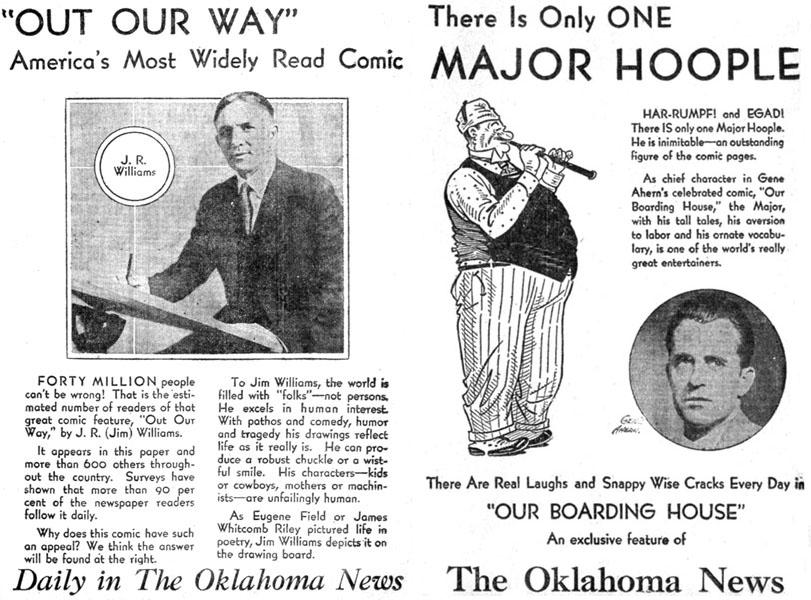

Here are Gene Ahern and J. R. Williams as they looked in 1931 from these syndicate-issued advertisements. Ahern was the creator of "Our Boarding House" (known to many by the name of its star, Major Hoople) and later "Room And Board" an essentially identical feature for a different syndicate.

J.R. Williams created "Out Our Way", and is still well-known among a small but serious fan base for his "Bull Of The Woods" cartoons. These were gags about workers in a machine shop and are fondly remembered by those who worked in such environments. The "Bull of the Woods" cartoons were one of the many topics covered by the "Out Our Way" feature.

I would note that today syndicates practically never produce and distribute such advertising materials as this for newspapers. Back in the 30s this sort of material was supplied constantly to papers. Just one more of the myriad reasons that comic strips are less popular than they once were.

As always, click on the image to see it at full size.

Comments: Post a Comment

Wednesday, October 05, 2005


Comic Strips from Black Newspapers


Uncommon now, newspapers that served the black community were available in most every city back in the pre-Civil Rights days. The Chicago Defender and Pittsburgh Courier were the most important and they both have a rich history of comic strips produced by the black community for the black community. Black papers in other cities often bought syndicate content from these two leading papers, but they also purchased from individual cartoonists and from the mainstream (white) syndicates.

The examples above are interesting anomalies. They appeared in the Atlanta World in 1944, both titles having short runs. The World was a very unusual black paper in that it was published daily, not weekly as most of these papers were. The daily frequency gave them a voracious appetite for material without the budget to pay for much. They used a lot of cheap reprints from King Features (including the bizarre choice of "Tim Tyler's Luck", a strip whose setting was 'darkest Africa', where young white boys ran around barking orders at the natives). The World also occasionally bought material from small syndicates like the Elmo Feature Syndicate - I believe that the above examples, though uncredited, are from that bargain basement syndicate. A second layer of interest comes from the fact that both strips were done by Al Smith, who uses pseudonyms on both. Al was not only the successor to Bud Fisher on "Mutt & Jeff", but he also started his own syndicate (The Al Smith Service) in the early 1950s. I guess he needed a bit of extra cash so he did these quickies for H.T. Elmo. Perhaps his experience with this grade-Z syndicate was the catalyst for his creation of the Al Smith Service just a few years later on.

Remember, you can see a larger view of each image by clicking on it. And sorry for the quality of reproduction - these images came from badly deteriorated microfilm.

Comments: Post a Comment


The Last Ace Drummond Sunday Strip


Sorry Ron Goulart and Maurice Horn, I have to disagree with you. Both of these estimable gents claim that the "Ace Drummond" strip ended in 1940, but here is the episode of July 2, 1939 very clearly signaling the end of the run. Rarely do we get lucky enough that the creators are given the opportunity to write a definite end to a strip. In this case they take the quick and dirty way out - "It was only a dream!". Not the most original of endings but at least we know the end date for certain for a change. There's no wiggle room here, either - you can't see it on this image but on the footboard of the bed in the last panel it says "The End". Oh, and by the way, the artist on the feature at the end of the run was none other than Royal King Cole - what a great name! Another by the way - can you imagine the fuss today if two guys were portrayed together in the same bed in a comic strip? Fetch the smelling salts Gertrude!

Sorry for the quality of the image. It is a scan of a photocopy of the microfilm of the Philadelphia Record. That's a 4th generation image! Original art, newspaper, microfilm, photocopy, scan! By the way, click on the image to see it at full (readable) size.

Comments:
Great work! Good to see the history of comic strips being precisely defined!
 
Post a Comment


Obscurity of the Day: O. Henry's Short Stories
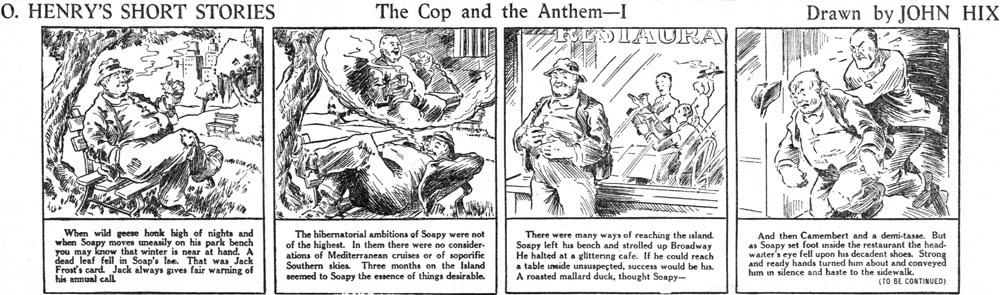

Well, here's a good test to see whether my scans will show up large enough on the blog. The original scan is plenty large enough to read, but is it here...? This is a sample strip from a very short-lived series from 1928. Syndicated by McClure, it features good art by John Hix, who later went on to considerable success with his "Strange As It Seems" feature. "Strange As It Seems" was a blatant copy of Ripley's "Believe It Or Not", but Hix injected enough of his own personality to make it his own. Strips that adapt popular novels have been tried many times in the history of comic strips, seldom with any great measure of commercial success.

EDIT: OK, turns out the image on this page is small, but if you click on the image it will show up full size in its own window. Glad we've got that straightened out.

Labels:


Comments: Post a Comment


Old, Old News : New "Roger Bean" Book Published
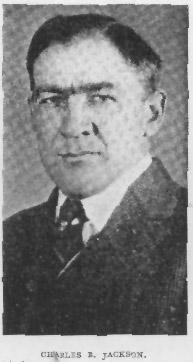

Well, here we go with a first quick comic strip history post. The following article was published in the December 23rd, 1916 issue of "The Fourth Estate". Unfortunately it doesn't provide much in the way of a biography but it does include a rare photo of Jackson:

MEET "CHIC" JACKSON

This year's "Roger Bean Book" by 'Chic' Jackson, cartoonist of the Indianapolis Star, is attracting widespread attention. There are 62 splendid illustrations, each one telling a story that will hold the readers' attention and interest.

To those who are familiar with Jackson's daily strip, which deals with everyday life as it really is, this book will appeal in particular, as it is like having the best parts of an interesting continued story compiled and ready to read.

Those who are not acquainted with Roger Bean will find it profitable to meet the square good natured 'regular guy' he is. His plump little wife, exquisitely feminine, the baby boy they adopted one Christmas eve, and Golduh Stubbins, the inexperienced maid of all work make up the rest of Roger's household. The title of the book is "Roger Bean On The Firing Line."


'Chic' Jackson hails from the state of Indiana, which has produced so many stellar lights in the literary field. His progress has been rapid, and today he is a household idol in Indiana.


Labels:


Comments:
I came across your blog while googling "Roger Bean". Which I was doing because Chic Jackson is my great-grandfather. Nice to see that his work is still remembered out here on the Net! We've been a newspaper family for years, but Chic was the only one of us that showed his talent in art rather than writing. If you are interested in any biographical information, let me know and I'll put some stuff together for you. Great blog!

Adam Jackson
 
Hi Adam -
I'm sure we'd all love to read some biographical material on Roger Bean's creator. I'd share it on the blog, natcherly.

I have one question in particular about "Roger Bean". Many years ago I read somewhere that the character was originally an advertising shill for a brand of coffee called Roger Bean. Any truth to that?

Best, Allan
 
chic jackson was my great grandfather as well. I recall 24 yearly additions of yearbooks following the Bean family. thanks for remembering. jeff jackson
 
Hello,
I also googled Roger Bean and came across your site. I am a junk hound and bought 5 boxes of old 78 records today at an estate auction. One box contained an old Roger Bean comic. The front cover says No. 2 of the twin Baby Grands. It is signed Chic Jackson and on the bottom it also has Politics, Pickles, People and Police... I am trying to find out something about it...if anyone can tell me more it would be great....thanks... randy baker
 
Allan and Others,

The comic strip came first, then the books, coffee, and other merchandise. Roger Bean was actually an attempt by the Indianapolis Star to draw attention to its classified advertisements, but Jackson proved such a good writer and creator of characters and situations that the strip took off among readers and was eventually syndicated.

TH
 
I am interested in exchanging information with Chic Jackson's relatives. I am seeking information about where he was born, where he grew up and where he was living in 1905. He painted a watercolor of my grandmother and gave it to her for a wedding present in 1905. I do not know how they knew each other and would like to see if I can find the connection.

Susan Updegraff
 
Post a Comment

This page is powered by Blogger. Isn't yours?

Subscribe to
Posts [Atom]

Tell me when this blog is updated

what is this?