Monday, May 07, 2012
Ink-Slinger Profiles: Charles Lederer
Charles Lederer was born in Lowell, Massachusetts on December 31, 1856, according to Who's Who in America 1910-1911 and The Book of Chicagoans 1911. In the 1860 U.S. Federal Census, he was the youngest of two children born to Jacob and Bettina; his father was a designer. The family lived in Lowell. In 1870 he and his parents resided in Brooklyn, New York; he was in school. The Book of Chicagoans said he was a "cartoonist and illustrator since 1875 for Frank Leslie's, Harper's, New York World, New York Herald…."
…About the only one who had the necessary skill and could give the required lightning action was Charles Lederer, of the Herald, who has the honor of having introduced this brand of newspaper enterprise in Chicago. The son of an artist residing in Lowell, Mass., Mr. Lederer, was born thirty-six years ago, and has been making pictures for a living for the past twenty. He could furnish a barrel of interesting incidents of a variegated career, but won't. He possesses an extraordinary facility, originality, and a gracefulness in drawing. Its most prominent characteristic is its large popularity with the masses, which has done much to place the Herald where it is in popular esteem. He is short, but won't admit it, has the hair and complexion of a stage villain, and has thus far escaped matrimony. He is a great club man, but claims to travel in the goody-goody class. He admits having $4.75 in the bank and $1.69 due and outstanding, under the impression that Mr. Bradstreet would see this notice. He speaks English in a North Clark street dialect. When pressed to give an account of himself he stated that he had struck out at 16 and worked on nearly all the New York illustrated papers and after having been discharged from the same number came to Chicago in 1877. Then he did general designing, illustrating publications from the pinkest of sporty papers to Sunday school books, with great impartiality. In 1883 newspaper illustration was introduced, and he worked on the Mail, Times, Tribune, News and Herald, remaining with the latter since 1885. Besides the regular run of newspaper illustration, he has done "comics," caricatures, and special and humorous writing which achieved much popularity.
…he is known all over the country as the great cartoonist of the old Chicago Herald, on which paper he made his reputation. He still contributes a story, for Lederer can write, with pictures to the Chicago Times-Herald on Sunday, but his principle work is now being done on the New York Mercury, the first page of which is daily illuminated with a cartoon from Lederer's pen. His illustrations of various phases of political life in the empire state are attracting considerable attention, and his pictures are already being copied, although he did not commence his work on the Mercury until the first of this month. Lederer's pen is a wicked one, and as a political cartoonist he is a terror to the opposition. Fortunately he is a democrat, from choice and principle, and therefore his thrusts are damaging to the enemy alone.
Atlantic, Ia., June 3.—Charles Lederer, formerly staff artist on the New York World, has purchased the Messenger printing plant of this city, and will run an independent newspaper, although personally he is a Democrat. Lederer takes possession Monday.
According to the Book of Chicagoans he married Bertha Adele Mitchell, of Chihuahua, Colorado, September 29, 1907. The couple spent time in Europe. According to a New York passenger list, they returned from Genoa, Italy to New York City on December 5, 1907. For a brief time, he and his wife performed together; a brochure for their performance, Fun with Chalk, can be viewed at the Iowa Digital Library.
Charles Lederer, the veteran Chicago cartoonist, accompanied by Mrs. Lederer, has been visiting the Pacific coast. He attended the meetings of the National Educational Association in Los Angeles, and looked in at the Panama-Pacific Exposition. Since his retirement from the active newspaper field, which he entered in the days of chalk plates, Mr. Lederer has been writing and illustration a series of art books for school use.
Lederer, Charles, 1856-
The Lederer art course; a complete, simplified system of drawing, design, cartooning and color work, by Charles Lederer. New York, Independent corporation [1920] 34 pt. illus., plates. 23cm.© Mar. 31, 1920: 2c. and aff. Apr. 8, 1920; A 565500; Sam S. Gerstle, Chattanooga. (20-6655) 1476
The Chicago Daily Tribune reported Lederer's passing on December 14, 1925; a snippet from the article: "Charles Lederer veteran newspaper cartoonist dies in county hospital at age of 70". Cole Johnson accessed the article and wrote, "Charles Lederer was attacked by Bright's Disease, and was initially hospitalized in Racine, Wis., from there he was moved to the Cook County Hospital in Chicago on Dec. 7. He died there on Dec. 13. 'So far as his friends know, he left no relatives'. A meeting of newspapermen was scheduled to raise funds for his funeral."
An earlier profile appeared in the Inland Printer, December 1893.
Labels: Ink-Slinger Profiles


 : 12/21/2014 11:12 AM
Tuesday, July 19, 2011
News of Yore: Charles Lederer

Labels: News of Yore
: 7/19/2011 11:38 AM 

After stumbling across an illustrated book by Lederer recently (called "Queertown"), I was searching for more info on him and his works and came across your site -- thanks very much for posting this bio! I was wondering if you would have any idea on possible resources for finding more of his work. For someone who sounds incredibly prolific, he's hard to find samples of, particularly of his newspaper cartooning... A couple instructional books and one or two broadsides are in some public institutions, but that seems to be it. ("Queertown", incidentally, was a book of illustrated humorous verse that seemed geared towards kids -- a lot of punnery, a lot of nonsensical creatures -- but also had a couple of gentle jokes at authority figures and the like that seemed to be meant a bit more for adults.)
Anyway, thanks again for this post, and any ideas would be greatly appreciated!
: 2/02/2012 4:10 PM : 6/05/2012 6:50 PM : 6/06/2012 4:55 PM Many thanks! Lynn
: 12/09/2012 2:42 PM : 1/08/2015 3:03 PM Tuesday, May 08, 2012
News of Yore: Charles Lederer's Calling
"It's one thing to make a caricature and quite another to find the subject, and my experience has been that a successful newspaper caricature artist must have plenty of nerve and carry it with him wherever he goes."
It was Charles Lederer who voiced this sentiment. You may judge of its truthfulness from the fact that there is not a man in all America better qualified to speak on the subject.
It is safe to put it even stronger—there is no man so well qualified, for Lederer is admittedly the best newspaper caricaturist in the country and the highest paid newspaper artist.
The Chicago Herald pays him double the salary of any other first-class artist. Other papers have offered him more, but he prefers Chicago.
He was talking to a Call reporter yesterday afternoon in his rooms at the Palace Hotel and all the while assisting a tall, stately looking, gray-haired lady—whom he introduced as "Mrs. Lederer, my mother"—to pack two stout-looking trunks that were already labeled "Monterey, Cal."
"You know you can't ask Governor So-and-so to sit down and let you make a caricature of him. You've got to engage him in conversation under the pretense of being a reporter, and while he thinks you are taking notes of what he has to say you can jot down some memoranda of his peculiarities and fix his general characteristics in your mind. That's why I say a successful caricaturist must never leave his cheek at home when he's going about on business.
"The best caricatures are made when the artist can have a sitting long enough to sketch the subject's portrait and make memoranda of his peculiarities.
"You see, it's a man's peculiarities of facial expression, or dress, or manner of talking that must be caricatured, for the caricature must be true to life, only exaggerated.
"Sometimes a well-known man's face is put on a very small body. That may make a humorous picture, but hardly a caricature.
"Take a man who wears his hair long and make it ridiculously long, but yet in such a way as not to spoil the likeness; that's a legitimate caricature. Or a man with a large mouth or a peculiarly shaped nose or a characteristic attitude in speaking, or any such things, may all be caricatured so long as the likeness is there."
"But suppose a man has no striking peculiarity? Do you meet such men?" asked The Call reporter.
"Yes; sometimes. A fair example of that is in Mayor Hempsted Washburne of Chicago. As he was the Republican candidate a year ago, of course it was my duty to caricature him. I had ample opportunity to see the man, but for the life of me could discover nothing about him to exaggerate.
"But the job had to be done somehow, so I put a monocle on one eye and a cigarette in his mouth. It made a great difference in him, and the picture caught on and stuck to him till after the election. Here, I'll show you," and taking up a hotel pen Mr. Lederer made some hurried sketches on The Call man's note paper.
In about the time it takes to tell it he had sketched a portrait of the Mayor of Chicago as he is and as he looks with the cigarette and monocle.

"The New York papers afterward said that Chicago had elected a Mayor who wore a monocle and smoked cigarettes.
"But even that didn't make him mad. He's a pretty good sort of fellow. I saw him after the election, when he told me he didn't mind my caricaturing him—it didn't anger him a bit; but he said it did make him a little tired to be continually accused of two vices that he had never indulged in, and he added:
" 'I wouldn't care if I did smoke cigarettes and wear a monocle, but not doing either, you know, it was tough.' Then he laughed and we shook hands, and I promised not to do it again.
"And the worst of it was I had to do all my work two days ahead at Minneapolis. Say the work I did on Wednesday couldn't reach the office and be printed before Friday, and when it was published it had to be timely.
"Then, too, the very men I wanted to draw most were the ones, usually, who only appeared in public, or where they could be seen, for perhaps five minutes at a time. Say Senator so-and-so offered a resolution in the convention. Well, my caricature of him must be sketched out in the five minutes, or more or less, it took him to read his resolution."
"Don't you draw from photographs?" asked The Call man.
"Well, that depends. If a man's picture is familiar to the public it is better to stick to it, for the caricature made from the original would probably not be recognized.
"But if his picture has not been printed often enough for him to be known by it then the best work can always be done from nature. I had an instance of this in Matt Quay. His photographs are always taken in profile, for very good reasons, too, for his face is positively ugly, though a strong one.
"Well, I made a caricature of him at the convention, using a full-face view, but never used it for fear it would not be recognized. It didn't look a bit like his pictures, though it was far more natural.
"Men like Joe Keppler of Puck are often misled by the photographs they work from. Keppler came out to Chicago during the convention and was my guest at the Fellowship Club dinner, just to see whether Wanamaker compared well with his picture. Some one had told him that the Postmaster-General's photographs were not natural. And Keppler found a big difference between them and the original.
" 'Why,' said he, 'I've been giving Wanamaker a small, puggy nose, and I find it ought to be large and bulbous.' "
"But most of the weekly paper caricaturists work altogether from photographs. Take Tom Nast, for instance. Do you know he never attended a national convention till he went to Minneapolis last summer? And when he got there he couldn't stay. The excitement made him too nervous, he said, and he went right back home."
"Are there any rules by which the young artist can learn to be a caricaturist?"
"Hardly. It's largely a matter of intuition, I think. It's a separate branch of the art of drawing, and I don't believe it can be taught in the art school. A great deal has been written about caricature, but I never found much of it applicable in practical work. It's born in a man, I think; at least, I couldn't tell you how to do it."
"Don't prominent men object to be caricatured sometimes?"
"Not a as rule. But that reminds me of Congressman Joe Cannon. He's quite a noted character in Washington. I was the first one to caricature him from life. The result was far different from those taken from his pictures. You can make a caricature more deadly, you know, if you do it from life.
"Well, I went all the way to Peoria to get a chance at Cannon from life. When I got to the hall where he was to speak I found the local reporters were to be seated at a table back of the speaker. That wouldn't do me much good, for I didn't care to caricature Cannon's back. So I bribed the janitor to fix me a little table in front of the speaker's stand, so that I could look right at him.
"Somehow or other the impression got abroad that I was the Tribune reporter, that being a Republican organ and this a Republican meeting.
"Now I'm willing to swear that I did nothing to originate that rumor, but I must confess, too, that when I heard it I did nothing to dispel it.
"Of course Cannon would rather have a column in the Chicago Tribune than a whole page in the little country papers. So when he began his speech he fixed his eyes on my table and talked right at me all the time.
"He thought I was taking notes of his speech, and sometimes during his eloquent periods he would stride right over to my table. On such occasions I would cover my drawings with a piece of note-paper and make a desperate bluff at writing hen tracks, which I fondly hoped he would think were shorthand notes.
"My caricatures of him must have been strong, for I heard afterward that he was greatly incensed at them. I'll show you what they were like."
Again the rapid pen flew over the reporters' rough paper, and presently—in less than ten minutes at most—"Cannon in repose" and "Cannon on the stump" were produced.

"But he wasn't angry long," continued Mr. Lederer. "One day an arm was thrown about my neck as I was walking along in Chicago. I looked up to see who it was, and almost trembled in my boots when I saw that great, yawning mouth of Joe Cannon—he has the most striking mouth I have ever seen.
"It was wreathed in smiles this time, however, and he shook hands and told me he forgave me. We talked a little as we walked along, and then, when I bade him good-by, he said, almost pathetically:
" 'Say, old man, when you draw me again please put some teeth in the mouth? I haven't so many, but I'm not really toothless.'
"And he opened his mouth to show me. Sure enough, there were four or five teeth, and I had entirely overlooked them.
"Whitelaw Reid was an easy mark for the caricaturist—tall and lean men usually are. This is the way I made him—"
A few movements with the scratchy hotel pen and the editor of the New York Tribune was produced.

"It's so long ago I don't know whether I can do it or not," he said in reply to The Call man's request for a blindfold sketch. But he tried, and you can see by comparing the two caricatures that there is a striking resemblance. (see top sketch)
"They're a great expense and annoyance to the management but an attractive paper can't be run without them. True, a few big papers like the New York Times and Philadelphia Ledger get along without illustrations, but they have rather exclusive circulations and are not so popular as the others.
"The pictures appeal strongly to the masses and no paper that caters to the people can get along without them.
"Yes; I look for improvement in newspaper illustration, but the improvement will be not so much in the artists' work as in the better methods of reproducing their sketches and in the better ink and paper used.
"By and by they will be able to make a cheap paper with a smooth surface. That will help newspaper illustrators immensely. And then I think the time will come when newspapers will be able to reproduce, perhaps by the half-tone process, the illustrations directly from the pen drawings.
"How do the San Francisco papers compare in illustrations with those in the East? Very favorably, I think. In many ways their sketches are greatly superior to some of the more pretentious New York dailies."
Mr. Lederer and his mother left the city yesterday afternoon for the south, and upon their return here will go back to Chicago. Mr. Lederer had the pleasure of meeting several of the San Francisco newspaper men and artists during his short stay here, and yesterday The Call's artist, Mr. Kohler, made his acquaintance.
At the request of The Call reporter, Mr. Lederer made a few hurried freehand sketches herewith presented.

Labels: News of Yore
Monday, July 18, 2011
Obscurity of the Day: Turn Me Over


Okay, enough shilling for Newell. Lederer is our subject today. Charles Lederer was an editorial and humor cartoonist, mostly working in New York and Chicago during his career. He never made a really big splash but seems to have been well-regarded. He published a cartoon course in the 1910s that seems to have made him some good money -- it was still being reprinted long after Charlie kicked the bucket.
Speaking of kicking the bucket, Charlie did that in 1925, which means that the Turn Me Over series was pretty much the last thing he published. As bad as it is (if you can make out the drawings both ways on all of these, you're doing at least 50% better than me), I guess we must forgive him since he was pushing 70 and maybe not feeling too great.
The feature, which seems to have run from about March - November 1923 (rather hard to track because papers tended to print it ROP), never carried a syndicate stamp. My guess is that it was self-syndicated, or possibly from Bell or McClure based on the other features I tend to see run with it.
As soon as the original run ended the series was bought up by Western Newspaper Union, and they offered the feature through about 1926 to their clients.
Thanks to Mark Johnson for the samples!
Labels: Obscurities
--Allan
Sunday, January 15, 2023
Wish You Were Here, from Charles Lederer

Here's a card from Charles Lederer, dated 1906, but presumably published in 1907 since it is a divided back. No maker is credited but it is likely to be the Monarch Book Company, which published his other cards of this same style.
These Lederer cards all offer gags using wordplay and slang. This one, I have to admit, mystifies me. If there's some slang meaning to "king full" I don't know what it is; in poker it would be a full house with kings high, but what that would have to do with a gag about drinking I dunno. Little help?
Labels: Wish You Were Here
That's my guess. It's a stretch, though. I don't find it after 1891.
I also wanted to look through some slang dictionaries of the period. Thought I had them bookmarked somewhere on my machine, but can't find them.
: 1/17/2023 5:05 PM Friday, February 01, 2019
Wish You Were Here, from Charles Lederer

Here's a postcard by Chicago cartoonist Charles Lederer. Although copyrighted in 1905, it was published in 1907 or later because it has a divided back. No maker is credited, but I wouldn't be surprised if it is the Monarch Book Company, which published other Lederer cards and used the same typeface for the copyright line.
For those wondering about the gag, it helps to know that old time slang for a really bad cigar was a "rope".
Labels: Wish You Were Here
: 2/01/2019 8:13 AM Coincidentally, I was a scavenger of old material back in my teens and created an eclectic collection of ads and cartoons that I glued to a 22"x 35" poster board that has sat in my stack of photos and art for 60 years. Today, 8-18-2020, I examined that old panel and was reminded of the pieces of Charles Lederer papers I found, and used as insulation in a dilapidated Colorado mining cabin. In that paste-up is a check dated 1908, written to Marshall Fields, for $49.00; signed by Charles Lederer. Also found in the walls were a few illustrations for the Grand old Flag. Today I Mode-Podged the collection to the original substrate, air bubbles and all, only to preserve the old paper.
Friday, November 09, 2018
Wish You Were Here, from Charles Lederer

Here's a Charles Lederer card, published in 1906 by the Monarch Book Company of Chicago.
Labels: Wish You Were Here
Friday, November 01, 2019
Wish You Were Here, from Charles Lederer

This Charles Lederer postcard is pretty lame, so maybe it's not too surprising that it is copyrighted 1905, but evidently wasn't printed until 1907, since it is a divided back. This example was postally used in 1908, and I bet the purchaser got it at a discount.
Labels: Wish You Were Here
Friday, June 23, 2006
1903 Chicago Chronicle Comics; Part III


Here are two more of the comic strip series from the Chronicle, Musical Maurice by Fred Lewis and Red Squab by Charles Lederer. Lederer kicked around in Chicago newspaper circles for many years and was also a long-time seller of 'how to draw' books. Lederer contributed more material to the Chronicle section than the others on staff, and usually did the cover drawing for the magazine.
Notice that the Red Squab story is to be continued next Sunday - that's a real rarity in such an early comic strip.
Labels: Obscurities
Friday, February 26, 2016
This is the Life by Walt McDougall Chapter 10 Part 1
Chapter Ten (Part 1) - THE TWILIGHT OF THE GODS

He managed after a time to seduce George Folsom into deserting us to manage his ridiculous art department, and about twice a month he would send George over to me to say that he "would give me as much per week as Joe did if I would come over to him!" The offer seemed so ludicrous that I never mentioned it to J. P. I was aware that the name of his brother exasperated him, and a comparison of the World with the Journal infuriated him. His standard, queerly enough, was the Herald. Yet upon this servant-girl's sheet did Hearst build his structure.
As city editor of the Evening World, he soon showed himself capable of holding his own in the peculiar scramble for distinction and power that was just beginning to be discernible in the daily motion of the World. He rose to the very top of the ladder and then took the sudden dive that every man had to who endeavored to match his will with Pulitzer's.
All the evening force were young fellows, but had been long enough on morning papers to lose all liking for early rising, hence few of them could get to bed early enough to meet J. P.'s requirements. I recall dropping in one morning about seven o'clock to catch Tracy Greaves, Freddie Duneka and N. A. Jennings asleep in their chairs with S. S. C. doing all the work and making a sketch of the three sleepers, which I threatened to send to the boss.
In 1888 I attended my first National Convention, at Chicago. Beyond the fact that Harrison and Morton were nominated, its proceedings are dimmed in a golden haze in which appear more or less dimly the forms of Eugene Field, Finley Peter Dunne, Altgeld, George Ade, Charles Lederer, Melville Stone, Bathhouse John, Charles Seymour, Art Young, Tom Powers and others, all vital, uproarious and vehement, and, in the background, the rowdy Whitechapel Club located several flights up creaky stairs above an obscure and noisome alley. What I had seen of the New York Bohemians was swiftly half-toned by the hospitable and entirely unrestricted Apaches of the pen and brush of Chicago. They seem to have been possessed by a wild and boyish yearning for the perverse and diabolic that found expression in such displays as the public cremation of a corpse on the lake front in the moonlight and similar barbaric excesses. A boy named John McCutcheon just about this time began to send me pen-and-ink drawings which led me into a habit of criticizing his work quite like a correspondence-school shark, drawings that even then showed marks of genius. All through this group of wild men was discernible the leaven of genius, aimless as yet and ebullient, just stepping out to supply the mixture of wisdom and nonsense which the new century would demand—and then abandon for puerile vapidity and jazz.
Just when I met Eugene Field I am uncertain, but I think it was this year. Nye, who knew him well, had often described his peculiarities, so that I felt familiar with him, and while visiting Charley Stone, my old roommate, in his office in, I think, the Herald, I learned that Field was in an adjoining room. When I entered, to find him reclining on the back of his neck with his feet upon a table, I seemed to see a resemblance to Nye in the lank, carelessly attired figure.
He looked up dreamily as I waded through a mass of papers, and a glint came into his eyes, caused, I knew, by my dude clothes, for Chicago was then far too dirty for anybody to be decent for three days. I made him a stiff bow and asked:
"Are you 'Gene Fields, the feller that writes poems?"
His eyes glittered as he corkscrewed himself upright and, pointing to a chair, said: "I am the man. Take a seat."
Now I had heard the story of that famous chair, seatless and carefully covered with newspapers, into which he would enveigle the unwary caller and wedge him disastrously, and I remained standing as I explained that I was a manufacturer of shoe polish, wanting eight or ten lines of good poetry to put on a label.
I explained that I was not buying any poetry without seeing it, as I had already tried out two poets, Ella Wheeler Wilcox and James Whitcomb Riley, who both fell down on the job.
"Please be seated!" he wheedled, all aquiver with his eagerness.
"Say, don't you suppose I've heard about that piece of comedy furniture?" I suddenly demanded. "Every hamfat actor in the country has fallen for it! What do you take me for?"
He looked me over, his expression altering, and asked: "Who are you anyway?"
When I revealed my identity, he seemed amazed and said: "Why, I understood that you were an old man with gray whiskers!" He had no realization of his own values. To his dying day he did not know that what he deemed mere trifles, idle fancies, would brighten his fame year by year, and as for making or managing money, he was far less able than I, for I often had eight or ten dollars of my salary left at the end of a week. His humor was always kindly, although some of his practical jokes seemed cruel to the victim, and one was never safe from his pranks. Of enemies he had none. His appetites were normal, his mind as clean as a dog's tooth.
He had certain comical hobbies, the funniest of which was a custom of collecting nightgowns. From every home he visited he purloined one of these now antique garments, gloating especially over such as were marked with the owner's initials. When he came East, nighties were already obsolete among the best dressers, but a timely hint from Nye enabled me to be prepared. We procured an ordinary muslin robe, embroidered it with a gorgeous monogram like the coat of arms of a Prussian prince, and hung it in my bedroom closet. It was pretty garish, really too ornate, and I feared he would suspect a trick, but when he departed the nightgown had vanished.
Field, like Nye, often deplored the fact that the best things were unprintable at present. I would give much to embody in this volume an imitation of one of Horace's odes done in spurious Latin one damp evening in old Germania Hall. I had for twenty years the only copy of this remarkable production. Nye and I went West with him after this visit, commissioned by Pulitzer to seduce him from his Chicago allegiance. I think J. P. had broached the subject to him but Field had shied. He had an absurd prejudice against New York, as many Westerners still have to this day. I remember Nye's niece, a clever and learned woman, declaring with a shudder that she feared New York more than any other place on earth!
I think it was about this period that P. F. Collier ventured upon a journalistic experiment that was novel but which, considering the psychological effect of the cartoon as an influence upon opinion, might have been expected to have nugatory results. This was the publishing of a Republican and a Democratic cartoon on opposite pages of Collier's Weekly. There always seemed something neutralizing in this effort, as if a catalyzer had entered into the mixture that reduced both cartoons to impotency, and if this impressed me thus, what effect must they have had upon earnest political partisans? I imagined it must seem a sort of sacrilege to the voter to see both parties ridiculed and by the same cartoonist, a two-fold shock. Nugent Robinson, the editor, one of the handsomest, ablest and most affable of cultivated Irishmen, sensed this psychological effect at the outset, but Collier, who would brook no opposition, ordered us to proceed.
Collier was a small, pudgy, rosy-faced man who was fuller of energy and conceit than a hydrogen atom and badly bitten by the social bug. He was for a while addicted to fox-hunting, and in a scarlet coat became a well-known figure in the hayfields around Goshen, N.Y. He presented me with a splendid bay hunter which was all that was desirable except for one little failing. This was an inability to refrain from running away whenever a dog barked! When he ran he shut his eyes, gathered up the bit, and a few yards of reins, in his mouth, and only stopped when back in the stable. I was never certain that Collier was aware of the animal's failing, but the fact that he never showed any desire to know how I had killed the horse makes me think he had an inkling that the beast was not adapted to fox-hunting. Of course, in a dogless land or where the hounds were dumb, he would have served his purpose, but a houndless fox hunt would be an anachronism, hence I was never able to learn even the rudiments of the game, as I was never long enough in the neighborhood of the hounds to even secure my score card.
Several times, when I have been airplaning with young and frolicsome aviators, I have thought of that horse and his unrestrained actions. Had I sent him to the Isle of Dogs he might have been cured, but I sold him to a Newark man whose leg he broke in a week.
The dogma once promulgated by Pulitzer, in a moment of superenthusiasm, that the rest hours of his employees belonged to him and should be devoted to recuperating for his service was, of course, never taken seriously, but like a growing dependence upon wall slogans placarded everywhere, it indicated a change that was coming over his disposition. As his sight became poorer he grew more impatient, and as he was obliged to depend more upon others he became more suspicious. Step by step with the assurance of unbounded wealth and success came the apprehension of blindness and dependence on others. To a man of his peculiar disposition and antecedents, this was calculated to render him irascible and peremptory, and as far as self-expression went, he had never been a patient man.
The usual contentions that arise when two such men as Pulitzer and Cockerill are associated, are subordinated when success is in abeyance; in this case success overwhelmed them before they were able to analyze its constituents. Ten years later neither of them would have wrangled over the trifles that divided them. I was fairly conversant with their dissensions, yet no one thing was important enough to remain in my memory except the matter of financial relations, and that is indefinite.
What I retain is the sense that Cockerill felt that he was as potent a factor in the World's success as was J. P., which probably was true enough. That he had entertained all along a conviction that he would ultimately share proportionately in a moderate success, was known to his friends. But a colossal success is never big enough to be shared. Pulitzer had apportioned a number of shares in the paper to Cockerill at the outset, but on condition that he was not to sell them without giving him the buying option at a certain price. Of course, when the value of these became apparent with the World's amazing progress, Cockerill realized that he had been securely hog-tied by a very common business device and being profanely outspoken, certain debates over the matter were vigorous and ebullient.
It is certain that Cockerill could have made a better bargain in the first place had he been a business man or even ordinarily shrewd, for it is improbable that J. P. would have undertaken the enterprise without him. But John was engrossed in the project itself, eager, for several reasons, to get away from St. Louis, and beside, he had nothing like Pulitzer's faith. Thus he made a bad bargain.
When they parted, it seemed that the bottom had fallen out of the World, nor did J. P. ever find another editor who was worthwhile until Frank Cobb arrived. Tall, handsome, fiery, dark with expressive eyes, Cockerill was a romantic figure upon whom the wear and tear of newspaper management had not made an abrasion, the typical Southwesterner, just the sort to be selected as Exalted Ruler of an Elk's Lodge. He was always debonair, even to audacity, drank freely, but I never saw him affected by liquor. He was intolerant of stupidity or conceit, but very helpful to his friends.
Cockerill's charm was marred by one defect that hampered his convivial intercourse with men of his own mental endowments. This was an unfortunate proclivity to be caustically witty at the expense of one who had just left the festive board. I have heard this trait commented upon by his boon companions, its memory persisting as though the fault were his main characteristic, whereas it was his only blemish and was unknown to those whom he encountered in business hours. The joyous cohesiveness of liberal drinkers is not materially improved by free or even pointed criticism; this has been demonstrated by the long and successful careers of many famous drinking clubs for ages, for few there be who do not quiver at the thought of poisoned arrows winging behind his back. Many a man's departure was delayed by the thought that he would be the next victim, and it also prevented the return on the morrow of sensitive wassailers. Hence one found the witty Colonel often surrounded by men far beneath him in mentality.
Pulitzer and Cockerill parted over differences which, I think, a few years later would have been adjusted, had John lived. The two would have come together from necessity. J. P.'s burden growing heavier every month, and vastly increased by approaching blindness, diabetes, insomnia and other complications due to overwork and anxiety, was now increased by the difficulty of finding a successor to Cockerill. Half his time was spent in devising traps and tests to ascertain the fitness of the men selected as his private secretaries, it seems.
Labels: McDougall's This Is The Life
Monday, April 23, 2012
Obscurity of the Day: Crazy Quilt


So that makes it even more special when, in 1914, a group of the Chicago Tribune's cartoonists got together and produced not just a one-off jam page, but an entire Sunday series of them, entitled Crazy Quilt. And when they decided to do jam pages, they really went all out. Each creator contributed a character, some already familiar, some new, and the strips they produced all intersected and interacted with each other. The effect is really impressive, more so if you take the time to really study what's going on in these complex pages. The amount of planning that went into each episode is really impressive, especially since they succeed so well.
Crazy Quilt ran from April 12 to June 7 1914. After the jam page was dropped, many of the series continued on a page which was for one week mastheaded with the Crazy Quilt name, but each strip was separate and not part of a unifying design. Here's a roll call of features that were patches in the Crazy Quilt:
And His Name is Mr. Bones by Everrett Lowry -- ran for a short time before Crazy Quilt, and for many years afterward, ending in 1920. Lowry was at the time of Crazy Quilt running a contest to name the dog, so the strip hasn't yet taken on it's eventual name.
Freddy Frappe Filosophizzes by Dean Cornwell -- new for Crazy Quilt, had a six month run afterward. This was a single panel feature.
Genial Gene by Quin Hall -- ran before and after Crazy Quilt, from January to October 1914.
Hi Hopper by Frank King -- Ran before and after its Crazy Quilt period, from February to December 1914.
Old Doc Quack by Charles Lederer -- a panel that was only used in Crazy Quilt.
Pinhead Pete by Quin Hall -- created for the Crazy Quilt page, it continued afterward, first as a panel feature, and then as a strip, ending in January 1915.
Simp Simpson by Lester J. Ambrose -- started in the Trib's Sunday section in February, it didn't continue after the jam pages.
Stone Age Stuff by Dean Cornwell -- another Cornwell panel, created for the Crazy Quilt page and then ran on its own until January 1915.
Thanks to Cole Johnson for the scans, and to Alex Jay, who will follow this post with a set of Ink-Slinger Profiles of the Crazy Quilt contributors.
Labels: Obscurities
Monday, September 23, 2013
News of Yore: The Green Book Magazine, Part 1
The Green Book Magazine was a monthly theater publication featuring photographs of stage actors, actresses, playwrights, and illustrated fiction. Some of the illustrators and cartoonists included Herbert Morton Stoops, James Montgomery Flagg, Charles Lederer, Dean Cornwell, Herb Roth, William Donahey, Frank Godwin, Ray Rohn, Rea Irvin, Fontaine Fox, R.F. James, Frank King, and B. Cory Kilvert. The 1916 issues stand out because several featured photographs and/or caricatures of the illustrators and cartoonists.
The February, March and April 1916 issues had the following cartoonists and illustrators: T.A. Dorgan, James Montgomery Flagg, Hal Coffman, L.D. Bradley, J.H. Donahey, George McManus, R.L. Goldberg, D.R. Fitzpatrick, R.D. Handy, Robert W. Satterfield, Harry Hershfield, and W.A. Rogers.


Labels: News of Yore
Saturday, February 01, 2020
What The Cartoonists Are Doing, October 1915 (Vol.8 No.4)
In November 1913 the magazine began to offer a monthly round-up of news about cartoonists and cartooning, eventually titled "What The Cartoonist Are Doing." There are lots of interesting historical nuggets in these sections, and this Stripper's Guide feature will reprint one issue's worth each week.]
LABELS AND CARTOONS
(by B. L. T., in Chicago Tribune)
The American cartoonist, an editorial colleague points out, labels everything—Bryan, Wilson, the Kaiser, every one, everything. “The real power of the cartoon is that its symbolism does not require exposition.” True enough, and the answer is that while there are many talented young men drawing pictures for the newspapers, there are almost no cartoonists.
In the first place, a cartoon ought to be savagely satirical, not good-natured. The dictionary defines it as something intended to affect public opinion. The public's opinion is not affected by good-natured pictorial comment, and the public person represented in the picture is not damaged in the least. A cartoonist like the elder Keppler could drive any of our political charlatans out of public life.
As for the practice of labeling everything, it is interesting because the spelling is so ingenious. The old school, which included such masters as Tenniel, Keppler, and Nast, were ingenious in idea and execution. The picture makers of today expend their ingenuity on their labels, few of which agree with the dictionary.

E. A. Bushnell, who for several years has been doing the cartoon work for the Central Press Association of Cleveland, Ohio, has accepted an offer from the New York Mail, and has joined the staff of the eastern newspaper. The offer came while Mr. Bushnell was away on his vacation in Michigan. “Bush’s” work is familiar to all readers of Cartoons Magazine. Syndicated from Cleveland, it appeared in about 100 American newspapers, and was copied frequently by foreign journals. About a year ago he began substituting crayon for pen and ink. Perhaps his best series is one entitled “When Father Was a Boy;” which has appeared intermittently for several months. Bushnell is a self-taught cartoonist, but by painstaking methods and an indomitable perseverance has won his way to the front. His first cartoon appeared in the Cleveland Press, and represented Mark Hanna as “the power behind the throne.” This was some 20 years ago. Since that time the artist has been connected with the Cincinnati Post, the Cincinnati Times-Star (where he did some of his best work in the local mayoralty campaigns) and the Memphis Scimitar.
A SOUTH AFRICAN TENNIEL
“Pictorial Politics” is the title of a cartoon portfolio by Herbert W. MacKinney, of Cape Town, South Africa. The book is published by the Cape Times, with which newspaper Mr. MacKinney is connected. Sir Maitland W. Parker, editor of the Times, says in the foreword:
“The essence of humor lies in incongruity and contrast. Perhaps that is why ‘Mac,' who is a droll fellow, asks me to write this at a time when the tumult and the shouting of the Union Parliament and of Union politics, the oddities and absurdities of which constitute the cartoonist's stock-in-trade, seem almost to have vanished from memory. But as the British cavalrymen yelled, as they knocked the improvised tackle with which they were fishing off the points of their bayonets, in order to get into the saddle, and ride 'hell for leather' at the German lines, 'Are we downhearted?' We shall not be better able to practice the precept 'business as usual' if we forget that a compassionate Providence has kindly placed the springs of laughter close by the well of tears.
“So go your way, friend 'Mac,' on your cheery mission. Your pencil drips no venom, and if it finds the weak spots of political adversaries, it is only to tickle them into laughter at their own faults and foibles.”
While the subject matter is unfamiliar to American readers, the style and treatment of the drawings recommend the book to any cartoonist who is building up a library.
WANTS “OLD FAVORITES”
From Portland, Ore., comes the request from a reader that Cartoons Magazine publish more “old favorites.” “In my judgment,” says the correspondent, “the best cartoon I ever saw was one published at the time of General Miles' retirement, and called “His First Surrender." The old Indian fighter was represented on horseback, and having reached the 64th milepost, was handing his sword over to Father Time. I have forgotten who was the artist, and in what paper it appeared, but would like to add it to my collection.”
~~~~~~~~~~~~~~~~~~
G. H. Chapin, the father of A. B. Chapin, cartoonist of the St. Louis Republic, died recently in Memphis, Tenn. His home for the last 20 years had been in Kansas City, Kansas.

AN INTERVIEW WITH UNCLE SAM
by Morris Miller, in Central Press Association Bulletin
“Is Uncle Sam in?”
“Ah! This way.”
We entered the inner sanctum of our favorite uncle. It was furnished in a tasteful and befitting manner. Stars and stripes, of course, were a chief part in the simple but handsome ornamentation. A rather slender, rather elderly man sat at a desk.
“Uncle Sam?”
Possibly that sounds like a foolish question. Anyone should know the old man at a glance. He had the well-known whiskers at his chin. He was fingering them nervously as we entered. His trousers were striped and arranged at his boots just as you've always seen them in the pictures. Anyone should have known it was Uncle Sam.
It was his manner that deceived us. There was something so weary and dejected in every line and angle of his figure as he draped himself over his desk that we could scarcely believe that this was the celebrated old man of cartoons. We had always thought him to be agile and vigorous.
“You would like to talk to me a while?” the old man asked. His voice, better than the pose of his figure and the deepening lines of his face, showed his weariness.
“A little more than a little --” he began.
We whipped out pencil and pad to get every word. “Yes?” we asked.
“—is much too much. I had never realized until lately that satiety was much more than just another word in the dictionary."
“You have had enough of something, it would seem?” with the rising inflection.
“This plaguey cartoon business.”
“It must be trying.”
“Trying? Hah!” The “hah” contained so much nervous irritability that we became at once more warmly sympathetic.
“Appearing daily in so many cartoons must be hard work,” we said. “To be up bright and early to pose for the cartoonists, and to be kept at it steadily through the day till late at night—why, how can one man do it? And in each one you must pose in a determined and convincing way, too. And take every side of things. And different people probably writing in at times to say that your behavior in this and that picture is wrong. When you had no word to say in the matter of a pose at all.”
“Yessir, there have been lots of times when I’ve just about concluded to throw it all up. Lately, especially since that darn war in Europe, they've been going altogether too far. I ain't afraid of work. I guess I wouldn't be where I am now if I was. But now that the cartoonists have me working overtime in the acts of presenting a firm front, and laying down the law, and protesting in the name of humanity, and waiting for the news from Germany, and rejoicing over the crops, I don't get a minute's rest." He leaned forward a bit and lowered his voice. “Do you know, several times I've thought seriously of resigning my job as artists' model.”
“That would be disastrous,” we reminded him. “The cartoonists say that you are absolutely necessary in depicting the national spirit. They must have some single figure or character, you know, to represent the thought and feeling of the nation. How could they get along without you? Just answer that.”
“Maybe so, maybe so,” answered the old man reflectively. “Some thoughtless people roast the cartoonists for using me so much —they say I'm a chestnut. But how else could the pen and ink boys represent the whole nation in one figure?” He paused to let the idea sink in.
“Of course, there's Miss Columbia,” he added. “But she can't appear in the heavy cartoons where there is stern work to be done. She is good on the sympathetic stuff and in peace and prosperity cartoons.”
Uncle Sam reached for a copy of one of the monthly reviews which was lying on his desk, and thumbed several of its pages.
“Now, here's what gets me,” he said in an irritated tone. “It's bad enough to be worked to a frazzle by the friendly cartoonists here at home, who make me look strong and snappy. But the thing that makes me boil is to have these supercilious foreign cartoonists make me look like a senile old tightwad. Blankety blank blank!”
Here the interesting old man was interrupted by the sharp bark of a puppy that romped playfully into the room. He approached us with ingratiating wiggles and we reached to pat him. “Cute little fellow,” we said. “Yours? What's its name?”
“Yes, it's mine, but do you think it's so little? He's been working with me in the cartoons quite a bit lately. Name's Army. Navy, his playmate, about his size, has been resting up lately. He was on exhibition, you know, and—”
“Oh! Ha, ha! The dogs of war!” We strangled the incipient snicker. Too hearty mirth at this point might have given offense.
“Yes, they've been working with me quite a bit lately. A lot of cartoonists make 'em littler and skinnier than they really are. I’ve taken quite a notion to the little fellows. Just at that cute age, you know.” “Yes, they're cute, for the matter of that,” we said, eyeing Army a bit critically. “Looks like the sort of dog that'll grow, don't you think?”
“Oh, yes, I think they'll grow. Yes, from the way they both been acting lately I think they're due to grow quite a bit.”
We rose to leave.
“Well, let us all sincerely hope so, Uncle Sam. If they do, it seems certain that your position will have a greater dignity, don't you know. People won't be so critical as they have been lately. And you won't be obliged to make so many daily appearances. That would suit you better, wouldn't it?”
“That's just what I would like. Come and see me again sometime, young fellow.”
THE “MUD DRIPPERS” AGAIN
Anent the charges of the “Editor and Publisher” that cartoon art in America is on the decline, and that masterpieces in “mud dripping” are about all that the artists achieve nowadays, Ryan Walker, cartoonist of socialism, adds that it is not only the cartoons that drip with mud, but the ideas, also.
“The cartoon of today,” says Mr. Walker, “is more or less a bit of deadly, meaningless stupidity.”
RACEY'S CARTOONS IN LONDON
An exhibit of cartoons by A. G. Racey, the Montreal Star cartoonist, at the London offices of the Canadian Pacific Railway, has proved quite a drawing card, according to a London correspondent. These cartoons, he says, “lay bare the soul of a valiant daughter, and interpret the real spirit of the Dominion to the British public.” One cartoon showing the murdered children of Scarborough was particularly admired.
~~~~~~~~~~~~~~~~~~~~

“The Fotygraft Album,” from which the pictures on this page are taken, is by Frank Wing, who for many years was head of the art department of the Minneapolis Journal. The “Album” is supposed to be shown to a new neighbor by Rebecca Sparks Peters, aged seven. Persons who have thus been given an insight into family history by a small daughter will appreciate this little book of Mr. Wing's. It is published by the Reilly and Britton Co. of Chicago.
THE GRAVES AT THE DARDANELLES
D. H. Souter, cartoonist for the Sydney (Australia) Stock and Station Journal, has written a number of inspiring verses on various war themes. The following appeared recently in the “Scottish Australasian.”
Why do you grieve for us who lie
At our lordly ease by The Dardanelles?
We have no need for tears or sighs;
We, who passed in the heat of fight
Into this soft Elysian night;
Proud of our part in the great emprise.
We are content; we had our day,
Brief but splendid, crowned with power,
And brimmed with action, every hour
Shone with a glory none gainsay.
Why will you grieve for us who passed
In our prideful strength at The Dardanelles?
Echoing still in our earth-stopped ears
Are victor's plaudit, or blood-choked cry
Of foe who falls at our feet to die:
We have no need for sighs or tears.
Once having made a sport of Death,
How could we turn to peaceful ways
Or tamely wait uneventful days -
For him at leisure to stop our breath?
How can you grieve? We are not lone;
There are other graves by The Dardanelles.
Men whom immortal Homer sang
Come to our ghostly camp fire's glow,
Greet us as brothers and tell us
“Lo, So to our deeds old Troy rang,”
Thus will the ages 'yond our ken
Turn to our story, and having read,
Will say, with proudly uncovered head
And reverent breath, “By God, they were Men.”
“WEB” ON A FISHING TRIP
H. T. Webster, cartoonist of the New York Globe, accompanied by G. H. Mitchell, who designs covers for Scribner's Magazine, has been spending several weeks in Maine on a combined auto and fishing tour. They had particular designs on six-pound trout. Mr. Webster is rather a renowned fisherman, having been born and raised in Tomahawk, Wis., in the center of the lake region. He announces incidentally that the George H. Doran Co. will offer for the fall trade his new cartoon book.
CARTOONS AS HAND GRENADES
A letter from a British soldier “somewhere in France” received by the New York Tribune, tells of the sensation created when the writer threw a bunch of Tribune cartoons into the German trenches.
“I wish you could have heard the Boches groan and shout and swear,” the letter continues; “they were nothing short of raving mad. One cartoon in particular—the one representing von Bernstorff addressing his country's sympathies to the American public over the 'Lusitania' victims—must have struck them harder than any shell ever did.”


Reproduced from a drawing presented by Mr. Virgil', of Melbourne, to Mme. Melba, as a souvenir, of her Polish concert held recently at the Town Hall, Sydney.
ON HIS MERRY WAY
“Like a beautiful dream,” writes Albert Dressler from New York, “my merry trip across the continent, which started from San Francisco in April, has now ended. New York City has so greatly impressed me that I shall remain here for several days before starting homeward full of merry ideas and love for every village and town I have passed through.”
Mr. Dressler, who likes to combine cartooning with tramping, completed his transcontinental tour late in August, having spent four months “on his merry way.” His ability to cartoon local celebrities gave him an open sesame to the many towns at which he stopped en route, and in every town, he says, he met a pretty girl. He gathered material, incidentally, for a book about his sentimental journey.\
~~~~~~~~~~~~~~~~~~~~~~
C. R. Macauley of New York has been drawing a series of weekly cartoons for the League to Enforce Peace, of which ex-President Taft is the head. The cartoons, however, are not of the “peace-at-any-price” variety.
CARICATURES BY LOW
A special edition of cartoons by Low, the cartoonist of the Sydney (Australia), Bulletin, has been published by Tyrrell's, of Sydney. This is Mr. Low's first collection, and includes 400 caricatures of famous persons. Several of the plates are in colors. The edition is limited to 250 copies, and sells at One guinea.

A recent cartoon by A. V. Buel, of the Sacramento Bee, representing Hudson Maxim addressing a procession of cripples from a Maxim gun factory, pocketing war profits, and telling them that “war does good,” has called forth a protest from the inventor.
“Please allow me to tell your readers,” says Mr. Maxim, “that I am not an advocate of war, but am a peace advocate, only I happen to be a more practical peace advocate than the advocates of disarmament. I believe in preparing against war, not for war. I believe that this country should get ready to defend itself and the liberties of its people just as our cities are defended by our police against burglaries, sneak thieves and highwaymen, and we need guns for the purpose, just as the police need guns.
“I am not interested in any manner in any concern manufacturing guns or war mater ials. I am not the inventor of the Maxim gun, and have not a cent's worth of financial interest in any gun factory.
“The present war has not brought profits to me, but, on the contrary, it has so interfered with my regular affairs, which have nothing to do with war supplies, that I have been a substantial loser from the war.”
CARTOONIST KING'S NEW UNCLE SAM
A brand-new type of Uncle Sam has been created by cartoonist King, who has taken McCutcheon's place on the Chicago Tribune during the absence of the latter in Europe.
The cartoon, while it is not flattering, is, in the opinion of the Tribune itself, a much truer portrait than any yet evolved. Says the Tribune editorially:

“In Mr. King's cartoons we have a real photograph of Uncle Sam. He has heretofore been sitting for his portrait before an imaginative artist who wished, rather than tell the truth, to please the gentleman who ordered the picture. Thus sitting and thus painted, he has appeared as an amiable, tolerant person whose tolerance and good nature had foundation upon his known ability to resent any affront which crossed the line of tolerance.
“The American nation has been fed upon such cartoons. The Uncle Sam of this fiction has filled the minds of the American people. He is kind, grim, gracious, indulgent, strong, terrible—whatever the occasion asked or permitted.
“Mr. King shows him for what he is—rich, fat, indolent, unready, unable to run a hundred yards, put up his fists, load a revolver, or accomplish successfully any act of self defense. If that suggestion of Uncle Sam should make any advance into American intelligence the American nation might go into training to become what it thinks it is.”
~~~~~~~~~~~~~~~~~~~~
James Walsh, cartoonist of the Scranton Times, has returned from a long canoe trip in the Adirondacks.
PUNCH CARTOONS IN BOOK FORM
Punch cartoons of the war, collected in book form, have been published by the George H. Doran Co. As a pictorial history of the war from the British point of view, these cartoons are unexcelled. “The New Rake's Progress,” a series with the kaiser as the central figure, and “The Unspeakable Turk,” the history of modern Turkey in cartoon, form important chapters. Students of world politics will find this volume almost indispensable to a full understanding of the War.
LEDERER VISITS WEST
Charles Lederer, the veteran Chicago cartoonist, accompanied by Mrs. Lederer, has been visiting the Pacific coast. He attended the meetings of the National Educational Association in Los Angeles, and looked in at the Panama-Pacific Exposition. Since his retirement from the active newspaper field, which he entered in the days of chalk plates, Mr. Lederer has been writing and illustrating a series of art books for school use.
~~~~~~~~~~~~~~~~~~~~~
George McManus, creator of “The Newlyweds,” was one of the star performers at the “Booster” entertainment, held recently at the Shrine Auditorium in Los Angeles. Mr. McManus pictorialized some of his famous characters, and auctioned them off to the highest bidders. He was a guest of the Los Angeles Press Club.
~~~~~~~~~~~~~~~~~~~~~~~
P. J. Kinder of Chicago, cartoonist for the Santa Fe Magazine, has been making a tour of the Pacific coast cities, and visiting the expositions.
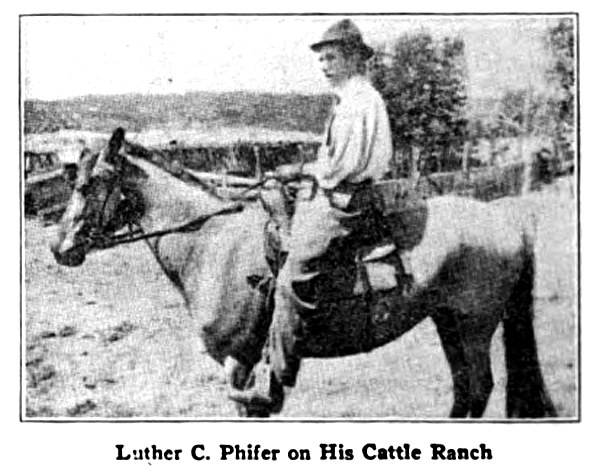
Luther C. Phifer has returned to Worcester, Mass., and resumed the making of “Phifebirds” and cartoons for the Telegraph of that city, after a summer's sojourn on his cattle ranch at Larkspur, Colo. Mr. Phifer, though an easterner, is no tenderfoot, but can rope and brand a steer as neatly as a professional cowboy. He was accompanied on his visit by Mrs. Phifer.
Labels: What The Cartoonists Are Doing
