Tuesday, March 02, 2010
News of Yore 1925: Bulletins, Gossip and Announcements
With The Cartoonists
(from Cartoons & Movies magazine #9, June 1925)
G. H. Binns, well known cartoonist of Jewett, Texas, gives us the following thumbnail sketch:
"Ed." Wheelan, who is in his early thirties, is one of George Matthew Adams' stand-bys and daddy of "Minute-Movies" which enjoys a remarkable vogue. Wheelan is a Californian by birth, but migrated to Brooklyn, N. Y., and secured a contract with Brooklyn Daily Standard-Union to draw sport cartoons, and, as the saying goes, made quite a hit. Hearst drafted him over to the New York American to do sports.
A two-column series called "Mid-Summer Dreams" was published by the New York World, and we all wish "Ed." would resurrect "Old Man Experience."
Wheelan and Albert Payson Terhune were neighbors for quite a while and both were attracted to each other by their mutual love of dogs. "Bugs" Baer worked in the Standard-Union with Wheelan, and likewise jumped to the New York American.
Zere, of the Brooklyn Daily Eagle and the New York Post, is another Brooklyn cartoonist who has made good with a bang!!
"Sid" Smith, originator of the Gumps, will illustrate the comic section of the Purdue University year-book this year.
Walter R. Bradford, of Philadelphia, "cartooner" of The North American for twenty years, died a few days after that newspaper suspended publication. He was familiarly known as "Brad."
Mr. Bradford was the creator of Enoch Pickleweight, the archtype of the henpecked husband; of Scow, the club-tailed cat; of John Dubbalong, the inventor whose name indicated his fumbling abilities, and of Jingling Johnson, the poet, whose ink-drawn outlines were a cartoon of Brad himself. There were other characters in his back-page strip that was a feature in The North American during two decades.
When the newspaper was purchased recently by Cyrus H. K. Curtis and its publication was discontinued, Bradford was its radio editor. He was as picturesque in Chat role as he had been in many others since he came out of a South Bend machine shop to be what he always called a "cartooner." That was his own name for his kind of job.
For months Bradford had been fighting against tuberculosis, putting up a fight that aroused the admiration of his associates on The North American. The closing down of that newspaper was a great blow to him, as his littered desk on the eighteenth floor had been as much a playground as a workshop.
"Almost immediately," Mrs. Bradford explained, "he went to White Haven, but he would not stay there and came home a few days later."
Bradford was fifty-three. His home was at 5551 Delancey Street, Philadelphia. He is survived by his widow, who was a native of England, and a son, William Bradford.
Bradford was born at Dayton, Ohio, and as a young man worked in the Studebaker carriage works at South Bend, Ind. He had a bent for drawing and started to attend night classes at Frank Holmes' school in Chicago, where he met John T. McCutcheon and other famous cartoonists, who encouraged him.
He worked on the Chicago Tribune, then on The North American, and shifted to the Baltimore Herald. When the Baltimore fire put him out of a job he returned to Chicago to work for the Journal. Then he went back to The North American for his last job.
"He loved his work there," Mrs. Bradford said. "He loved the characters he created and had fun out of them, Enoch, Maria, Dill and Pa Pickleweight — Ichabod, the old Injun fighter. The Scow cat was his mascot when he built his motorboat in our back yard in West Philadelphia about fifteen years ago and named it the Dubbalong. "He and Hugh Sutherland collaborated in his strip-comics over many years."
Bradford was protean with his hobbies. They included fishing, amateur photography and radio. In recent years he had written for a radio magazine, creating a new character, "Enoch, the Radio Doodlebug."
[Bradford is a 'cartooner' that we haven't seen much here on the blog, but he was a wonderful zany character; one of my all-time favorites is his Jingling Johnson. This short obit is the only biographical info I've ever seen on him. -- Allan]
Bernard Partridge, regarded by many admirers as the greatest cartoonist in the world, has been knighted by King George V. His name was included in a list of 600 persons honored on the British monarch's birthday. Mr. Partridge, as cartoonist for Punch, enjoys well-deserved popularity. He has that rare combination of powerful ideas and faultless technique. Nearly all of his work is done with pen and ink.
His cartoons on the World War— especially his clever satirical attacks on the former Kaiser—were reproduced in newspapers and magazines all over the world, and contributed substantially to the overthrow of William Hohenzollern. A noteworthy fact about Mr. Partridge's cartoons is that they are both dignified and forceful—there is very little caricature in them—so different from the grossly distorted cartoons of Germany, Italy, Spain and other foreign countries.
(from Cartoons & Movies magazine #9, June 1925)
G. H. Binns, well known cartoonist of Jewett, Texas, gives us the following thumbnail sketch:
"Ed." Wheelan, who is in his early thirties, is one of George Matthew Adams' stand-bys and daddy of "Minute-Movies" which enjoys a remarkable vogue. Wheelan is a Californian by birth, but migrated to Brooklyn, N. Y., and secured a contract with Brooklyn Daily Standard-Union to draw sport cartoons, and, as the saying goes, made quite a hit. Hearst drafted him over to the New York American to do sports.
A two-column series called "Mid-Summer Dreams" was published by the New York World, and we all wish "Ed." would resurrect "Old Man Experience."
Wheelan and Albert Payson Terhune were neighbors for quite a while and both were attracted to each other by their mutual love of dogs. "Bugs" Baer worked in the Standard-Union with Wheelan, and likewise jumped to the New York American.
Zere, of the Brooklyn Daily Eagle and the New York Post, is another Brooklyn cartoonist who has made good with a bang!!
~~~~
"Sid" Smith, originator of the Gumps, will illustrate the comic section of the Purdue University year-book this year.
~~~~
Walter R. Bradford, of Philadelphia, "cartooner" of The North American for twenty years, died a few days after that newspaper suspended publication. He was familiarly known as "Brad."
Mr. Bradford was the creator of Enoch Pickleweight, the archtype of the henpecked husband; of Scow, the club-tailed cat; of John Dubbalong, the inventor whose name indicated his fumbling abilities, and of Jingling Johnson, the poet, whose ink-drawn outlines were a cartoon of Brad himself. There were other characters in his back-page strip that was a feature in The North American during two decades.
When the newspaper was purchased recently by Cyrus H. K. Curtis and its publication was discontinued, Bradford was its radio editor. He was as picturesque in Chat role as he had been in many others since he came out of a South Bend machine shop to be what he always called a "cartooner." That was his own name for his kind of job.
For months Bradford had been fighting against tuberculosis, putting up a fight that aroused the admiration of his associates on The North American. The closing down of that newspaper was a great blow to him, as his littered desk on the eighteenth floor had been as much a playground as a workshop.
"Almost immediately," Mrs. Bradford explained, "he went to White Haven, but he would not stay there and came home a few days later."
Bradford was fifty-three. His home was at 5551 Delancey Street, Philadelphia. He is survived by his widow, who was a native of England, and a son, William Bradford.
Bradford was born at Dayton, Ohio, and as a young man worked in the Studebaker carriage works at South Bend, Ind. He had a bent for drawing and started to attend night classes at Frank Holmes' school in Chicago, where he met John T. McCutcheon and other famous cartoonists, who encouraged him.
He worked on the Chicago Tribune, then on The North American, and shifted to the Baltimore Herald. When the Baltimore fire put him out of a job he returned to Chicago to work for the Journal. Then he went back to The North American for his last job.
"He loved his work there," Mrs. Bradford said. "He loved the characters he created and had fun out of them, Enoch, Maria, Dill and Pa Pickleweight — Ichabod, the old Injun fighter. The Scow cat was his mascot when he built his motorboat in our back yard in West Philadelphia about fifteen years ago and named it the Dubbalong. "He and Hugh Sutherland collaborated in his strip-comics over many years."
Bradford was protean with his hobbies. They included fishing, amateur photography and radio. In recent years he had written for a radio magazine, creating a new character, "Enoch, the Radio Doodlebug."
[Bradford is a 'cartooner' that we haven't seen much here on the blog, but he was a wonderful zany character; one of my all-time favorites is his Jingling Johnson. This short obit is the only biographical info I've ever seen on him. -- Allan]
~~~~
Bernard Partridge, regarded by many admirers as the greatest cartoonist in the world, has been knighted by King George V. His name was included in a list of 600 persons honored on the British monarch's birthday. Mr. Partridge, as cartoonist for Punch, enjoys well-deserved popularity. He has that rare combination of powerful ideas and faultless technique. Nearly all of his work is done with pen and ink.
His cartoons on the World War— especially his clever satirical attacks on the former Kaiser—were reproduced in newspapers and magazines all over the world, and contributed substantially to the overthrow of William Hohenzollern. A noteworthy fact about Mr. Partridge's cartoons is that they are both dignified and forceful—there is very little caricature in them—so different from the grossly distorted cartoons of Germany, Italy, Spain and other foreign countries.
Labels: News of Yore


Comments:
Hi:
I came across a grouping of Cartoon pictures a little bigger than 9" x 11". The all depict scottish cavemen type characters playing golf in what I presume is prehistoric times as every drawing has a dinosaur of some type coming after the golfers. They are all dated 1925 and are all signed by what looks like Walter Rouff? Do you have any more information you could share on the cartoonist?
Post a Comment
I came across a grouping of Cartoon pictures a little bigger than 9" x 11". The all depict scottish cavemen type characters playing golf in what I presume is prehistoric times as every drawing has a dinosaur of some type coming after the golfers. They are all dated 1925 and are all signed by what looks like Walter Rouff? Do you have any more information you could share on the cartoonist?
# posted by  : 6/17/2012 11:43 AM
 Monday, July 01, 2013
Obscurity of the Day: Over Here

The one you see in the sample above (my apologies for the quality -- it is from photocopied microfilm) was titled Over Here, and concerned itself with the lighter side of being on the homefront. It was drawn by Earl Johnson, who sometimes signed himself "Jing" Johnson, presumably in tribute to the great comic strip Jingling Johnson. The rhymes were by a fellow by the name of Rupe Hainer.
The only place I've found this feature running is in the Pittsburgh Leader of 1917-18, and my very limited time with the microfilm of that paper made it impossible to get exact start and end dates. There were no syndicate stamps on these panels, and I assumed that they were produced locally for the Leader. This assumption becomes even more likely based on new research by Alex Jay, who not only uncovered biographical data on Earl Johnston, but also identified him as the son of F.E. Johnston, the creator of the important but little known strip Bobby the Boy Scout. Ink-Slinger Profiles of both cartoonists will follow this week.
Anyway, not much to be said about Over Here, except that if you are wondering about the knitting references, you can read this page which tells all about the big push that was put on during World War I to have women knit clothes for the troops.
PS: Happy Dominion Day, fellow Canucks!
Labels: Obscurities
Wednesday, September 21, 2011
News of Yore: Death of Walter R. Bradford
The Camera, July 1925
Walter R. Bradford, the creator of those inimitable cartoons of the "Pickleweights," "Scow," "John Dubalong" and "Jingling Johnson," which featured for so many years in the daily pages of the North American, died at his home in Philadelphia, June 4th, of tuberculosis, against the inroads of which he had courageously fought for months, arousing the admiration of his associates by his heroic cheerfulness and unabated flow of humor.
The closing down of the North American, however, was a severe blow to him, as it seemed like a separation from all that he had so delighted in for years. His desk had become his playground as much as his workshop. When his newspaper passed to the hands of the Public Ledger, Bradford was the radio editor, and his creations in that role were of the same subtle humor which characterized his exploits in other roles.
Walter Bradford was 53 years old. He was born in Dayton, Ohio, and began work in the Studebaker Carriage Works, at South Bend, Ind., but his inherent talent for sketching led him to attend the night classes for instruction in drawing and inadvertently to the [missing text] John T. McCutcheon [missing text].
He worked for some time on the Chicago Tribune and the North American, shifting to theBaltimore Herald, finally settling down again with the North American. Bradford's whole soul was in whatever he undertook and he enjoyed the children of his own brain probably as much as those who eagerly waited for their performance in the daily issue of the paper.

Leary and his Wonderful Tomato Can
Mr. Bradford said he loved his work and got fun out of his characters as if they had actuality. Enoch, Maria, Dill Pickleweight and Scow, the black cat. Walter Bradford's cartoon-sketches had an individuality. His characters remind us of the characters of Charles Dickens. They not only were intensely humorous, but they had that touch which made them real, reflecting the traits and frailties of human nature with geniality and sympathy, which made them more than comic representations, for Bradford had a fine mental organization and a subtle apprehension for the best in human nature, which he reflected in his cartoons. There was never anything cynical, for his sympathetic, kindly nature was foreign to anything pessimistic. Bradford was well read in English literature and could discourse on authors and analyze in a way that would have given him renown as a literary critic. He was an expert photographer and a pictorialist and his work possessed individuality of treatment, reflecting his peculiarity of temperament and his judgment in selection. He contributed papers to The Camera, written in his humorous style and illuminated by most original photographs, and arrangements were being made for his connection with the editorial staff when the sad news came of his death.
Walter Bradford's ability as a critic in art rendition by the camera gave occasion frequently for invitation to serve on jury awards, and his decision evinced sane judgment in analysis.
While insistent on the necessity of conformance to the time-honored rules and principles of art, he was broad in his views and appreciated all the advances made by the new photography, and was unbiased in his estimation of individuality of expression. Although he never put his own work in competition, it was characterized by possession of taste and originality and emphasized by the personal equation.
His literary contributions to the photographic journals were instructive, though instruction was conveyed in an Aristophanic way, which was most delightful, accompanied by illustrations intensely funny, but hitting off to perfection the idiosyncrasies of pictorial cults.
He is survived by his widow, who was born in England, and his son, William Bradford.
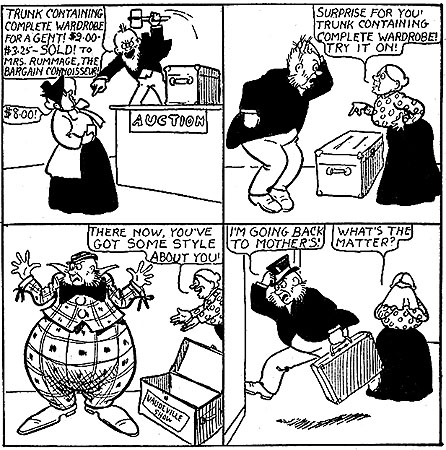
Mrs. Rummage
[Walter R. Bradford was born in Dayton, Ohio in May 1872, according to the 1900 U.S. Federal Census and numerous obituaries. In the 1880 census, Bradford was the youngest of five children born to Harry and Sarah. They lived in South Bend, Indiana at 46 General Taylor Street. His father was a painter.
In 1900 Bradford lived in Chicago, Illinois, at 301 Osgood Street, with his wife Sara, of six years, and son William. His occupation was recorded as typewriter. (Bradford's playful sense of humor at work!) At the Chicago Tribune, he produced Animal Land and Languid Leary and his Wonderful Tomato Can, and helped out on the strip Alice's Adventures in Funnyland. Some of his strips for the Philadelphia North American were Doctor Domehead, Tommy Tuttle, The Geteven Youngsters, and Fitzboomski the Anarchist.
In 1910 they were recorded in Philadelphia, Pennsylvania at 1245 56th Street. Bradford was a newspaper cartoonist, and ten years later, he was still cartooning but in Willistown, Pennsylvania on Monument Road. Bradford passed away on June 4, 1925, in Philadelphia. Cartoons & Movies published an obituary in its June 1925 issue, which has some of the art training information that is missing in The Camera article.]
Labels: News of Yore
