Friday, June 26, 2009
Obscurity of the Day: Just The Type

 Bob Dunn, who had the uncredited job of assisting/ghosting for Jimmy Hatlo on They'll Do It Every Time, got to take credit on this very similarly themed Sunday strip called Just The Type. Never a syndication success, King Features may well have let him do the feature just to keep him happy while working on the Hatlo cash cow feature.
Just The Type ran in the New York Journal-American and darn few other papers from May 5 1946 to November 24 1963, a very respectable run. When Hatlo died in 1963, though, Dunn's workload presumably got that much heavier and Just The Type was dropped. Dunn finally got an official byline on They'll Do It Every Time starting in 1966.
Thanks to Cole Johnson for the lovely scans from syndicate proofs.
Labels: Obscurities


Saturday, January 27, 2007
The Yellow Kid Blues
We all know the old tale, first spun by Moses Koenigsberg, that the Yellow Kid was originally colored yellow in order for pressmen to have a large space in which to test troublesome yellow ink. We also know that the story is almost certainly just that, a story. Two facts indicate that the story is false; first, that newspapers were printing yellows with no apparent problem before the advent of the Kid; and second, because the kid was initially colored blue, not yellow at all.
But most stories do have a grain of truth about them, and I wonder if I might just have stumbled across that grain. Below you will find an article from the June 1893 issue of American Pressman, in which a correspondent is complaining that they are having trouble with blue ink. The problem described is exactly that described by Koenigsberg, just not the color he claimed. And the date is telling, because this is just the time when the New York World was starting to print in color (albeit long before the Yellow Kid would make his appearance).
Did the World's early troubles with blue ink somehow get mixed up with the story of the initially blue Kid, and ended up combined as a single, somewhat mangled, tall tale? No way to tell, but interesting nevertheless.
Working Colors on Each Other (American Pressman, June 1893)
How to work a job in two, three or four colors, on top of each other, and keep the colors true, so that there shall be no amalgamation, is a problem that has so often puzzled pressmen.
We have before us an anxious inquiry from one who has a large cut on the press in three colors—certain shades of yellow, red and blue. He worked his yellow first, after striking his key-form; then he put on his red and ran that off. These two colors seemed to go all right, and to "stay put" but when he got on his blue the trouble showed itself, and he found he was stumped because, as he says himself, "the impression showed up with a fatty or mottled look, especially after it had lain for some time; and the color wasn't true, wasn't what was wanted."
The remedy is an easy one. Have your sheets thoroughly dusted over with powdered magnesia, in the same way as you use bronze powder, and you will find the trouble disappear, for the reason that the inks will be prevented from amalgamating.
This is precisely the same treatment as you would give either a black or colored form, whether cut or type, on top of which you had to print in gold bronze—powder it with magnesia dust. By this means you can print anything that goes on a press on top of a dozen colors.
The secret of the trouble of working colors on top of each other is that the oil of the fresh ink softens the oil of the ink that has already been worked, and which is supposed to be dry. There is life in oil, as there is life in water (though neither has affinity for the other, yet both work in many respects in the same way). As soon as the under ink is set free by its fellow, the fresh ink, both begin to caper about and spread and run together, and of course they carry with them the coloring matter they hold, which now also partially released, breaks up into particles and presents the "fatty or mottled look" which our correspondent complains of.
Blue is a hard color to work sometimes, even alone, as many pressmen have experienced, especially with type of heavy face or cuts with solid surfaces. If the operator would stop to consider, he would find that there is grease somewhere, on his rollers, on his form, or on his distributing plate. Blue ink of all kinds, and certain blues more than others, rebel against the slightest suspicion of foreign grease, and instantly show their dislike for the stranger by assuming a mottled or spotted character. Eternal vigilance is the price of liberty from dirt and everything else that injures. Keep everything clean.
But most stories do have a grain of truth about them, and I wonder if I might just have stumbled across that grain. Below you will find an article from the June 1893 issue of American Pressman, in which a correspondent is complaining that they are having trouble with blue ink. The problem described is exactly that described by Koenigsberg, just not the color he claimed. And the date is telling, because this is just the time when the New York World was starting to print in color (albeit long before the Yellow Kid would make his appearance).
Did the World's early troubles with blue ink somehow get mixed up with the story of the initially blue Kid, and ended up combined as a single, somewhat mangled, tall tale? No way to tell, but interesting nevertheless.
Working Colors on Each Other (American Pressman, June 1893)
How to work a job in two, three or four colors, on top of each other, and keep the colors true, so that there shall be no amalgamation, is a problem that has so often puzzled pressmen.
We have before us an anxious inquiry from one who has a large cut on the press in three colors—certain shades of yellow, red and blue. He worked his yellow first, after striking his key-form; then he put on his red and ran that off. These two colors seemed to go all right, and to "stay put" but when he got on his blue the trouble showed itself, and he found he was stumped because, as he says himself, "the impression showed up with a fatty or mottled look, especially after it had lain for some time; and the color wasn't true, wasn't what was wanted."
The remedy is an easy one. Have your sheets thoroughly dusted over with powdered magnesia, in the same way as you use bronze powder, and you will find the trouble disappear, for the reason that the inks will be prevented from amalgamating.
This is precisely the same treatment as you would give either a black or colored form, whether cut or type, on top of which you had to print in gold bronze—powder it with magnesia dust. By this means you can print anything that goes on a press on top of a dozen colors.
The secret of the trouble of working colors on top of each other is that the oil of the fresh ink softens the oil of the ink that has already been worked, and which is supposed to be dry. There is life in oil, as there is life in water (though neither has affinity for the other, yet both work in many respects in the same way). As soon as the under ink is set free by its fellow, the fresh ink, both begin to caper about and spread and run together, and of course they carry with them the coloring matter they hold, which now also partially released, breaks up into particles and presents the "fatty or mottled look" which our correspondent complains of.
Blue is a hard color to work sometimes, even alone, as many pressmen have experienced, especially with type of heavy face or cuts with solid surfaces. If the operator would stop to consider, he would find that there is grease somewhere, on his rollers, on his form, or on his distributing plate. Blue ink of all kinds, and certain blues more than others, rebel against the slightest suspicion of foreign grease, and instantly show their dislike for the stranger by assuming a mottled or spotted character. Eternal vigilance is the price of liberty from dirt and everything else that injures. Keep everything clean.
Friday, January 15, 2010
Strip Teasers: Capsule Book Reviews
 An Anthology of Captain and the Kids Comics
Published by CreateSpace
10 x 8 softcover, 50 pages, $14.99
ISBN 978-1449571504
If you troll about on Amazon looking for new strip reprint books you will have noticed in the last few months a burgeoning crop of titles from something called CreateSpace, a print on demand service.
Books published so far include collections of The Captain and the Kids, Bringing Up Father, Krazy Kat, Barney Google and several others. I was a bit leery of these publications just based on the Amazon listings -- the covers are black and white and amateurish in design. The descriptions, usually only a single sentence, also don't bode well. For instance, the description for the reviewed volume begins "An anthology of Captain and the Kids, later named the Katzenjammer Kids ..." So our anonymous editors aren't exactly comics scholars by any stretch.
However, incurable optimist that I am, my curiosity was piqued enough to go ahead and order one volume. I chose this one for no particular reason. Now I can report that the contents are very well-matched to the slapdash cover. What lurks inside are fifty Captain and the Kids Sundays, all either reproduced from microfilm photocopies, or, more likely, from the ProQuest online service.
Reproduction is exactly what you expect from microfilm photocopies. Acres and acres of muddy grey replaces all the color, film scratches mar many pages, and that curious dot-haze that characterizes laser-printed greyscale is spread like an algae bloom over everything. In the spirit of trying to say something nice, I do have to admit that the lettering is surprisingly legible. It's small enough that I need my reading glasses, but you can't expect anything more given the size of the book. There seems to have been absolutely no effort whatsoever made to clean up or restore the images.
Needless to say, I won't be purchasing any additional volumes in this series, and unless you are willing to shell out $15 for a stack of third-rate photocopies I recommend you take a pass, too.
A side note -- there's no editorial matter in this book, no credits and no copyright. Since some of the books in this series would appear to flout, at the very least, trademark laws, and possibly in some cases copyright laws, that's to be expected. However, is the presence of these books on Amazon for months now an indication that the syndicates have completely given up trying to uphold their rights to these characters? Are we now all free to publish old strips at will with no legal consequences? You would think with the state of the newspaper industry that syndicates would be enforcing their rights more jealously than ever, given that their current profit center is eroding away beneath them. In the very near future, character licensing may be the only thing that keeps these companies going. Are they waving the white flag?

Comics Revue #281/282 (October 2009)
Published by Manuscript Press
8" x 10.5" softcover, 128 pages $16.00
Whether you like Comics Revue or not, you've got to admire Rick Norwood for plowing forward with the magazine all these years. I can't imagine all the travails he's gone through with this publication, and despite further recent setbacks he just keeps on marching.
Recently, if I've got the story right, Norwood was threatened with losing his comic book store distribution due to low sales. The easy response probably would have been to thank the distributor for giving him an excuse to put the thing to rest. But not Norwood -- this glutton for punishment figured out that he could perhaps squeak by on the requirements if he reduced the magazine to bimonthly and doubled its size (hence the paired issue numbering).
I don't subscribe to Comics Revue because a great deal of the material reprinted in the magazine is just not my cup of tea. However, I received a review copy recently and so I'll put in my two cents.
The line-up in these new double-sized issues is vast -- featured in this one are Flash Gordon, Rick O'Shay, Buz Sawyer, Tarzan, The Phantom, Mandrake, Secret Agent Corrigan, Little Orphan Annie, Gasoline Alley, Steve Canyon, Alley Oop, Krazy Kat and Modesty Blaise. If your taste is for adventure strips then you've got quite a menu to choose from.
Now I make it no secret that when it comes to adventure strips my bar is sky high. Let's put it this way -- I think Caniff's Terry and the Pirates was over-written, and that the introduction of Captain Easy ruined the great Wash Tubbs strip. Given that, you can feel free to ignore my comments on this material, which in my estimation falls miles short of either of those strips.
The first problem I see with Comics Revue is that much of the material is from the 1950s to 1970s. If there was ever any doubt that the heyday of the adventure strip was over by the end of the 1930s, this magazine provides such definitive proof that I half-expected the final page to end with quod erat demonstrandum. The marquee item in this issue, a Flash Gordon story from 1960 written by the great SF novelist Harry Harrison, is just pathetic. The plot is nonsensical, the pacing is awful, the dialogue trite and characters are flat. If Harrison spent more than a few hours cooking up the whole story I'd be surprised.
Things don't improve thereafter. One bright spot is a cute little Buz Sawyer story, but it isn't complete in the issue. The delightful Alley Oop entry from 1938 goes by too quickly with just three weeks of dailies. Caniff's Steve Canyon was embroiled in an anti-feminist storyline that was embarrassing in its patronizing attitudes. Modesty Blaise had art so bad I couldn't bring myself to read it. Rick O'Shay, never a favorite of mine but usually a pleasant enough read, shows up with a surprisingly weak story that can't even seem to keep its facts consistent from day to day, a sign that the cartoonist disdains his readers and just plain doesn't care what he produces.
I assume Norwood is catering to completists here, those folks who are so in love with a character that they just have to read every strip in their favorite series no matter how bad it got in later years. Surely this can be the only explanation for printing some of this tripe. Where he's missing the boat, I humbly suggest, is that interspersed among these "for completist only" features he should print better material that might appeal to a general audience.
Reproduction is far from ideal on some of the features. While many are crisp and fresh-looking, others are washed out (Little Orphan Annie to a particularly bad degree) and some look like they were reproduced from pretty bad source material (Rick O'Shay and Mandrake).
The worst reproduction problem is on the color pages. The magazine's format is really too small to do justice to Sunday strips (which are often printed two to a page to add insult to injury), and the muddy, blotchy color full of moire patterns certainly doesn't help any. And frankly, there are so few color pages that I really don't see the point anyway. We get four Flash Gordon Sundays, four Tarzans, and a like amount of a few others. I can't imagine anyone buying the magazine specifically because of the color strips, yet I assume they cost an arm and a leg to print, explaining the magazine's lofty price. My advice would be to dump the color and slash the price of the magazine.
I'm sorry to say that this issue of Comics Revue did nothing to inspire me to subscribe. And I truly am disappointed because I take supporting efforts like this seriously as a part of being a good comic strip fan. I love the idea of a magazine that reproduces old comic strips, but there's just so darn little here that I want to read. If you are a big adventure strip fan, though, it could be worth your while to try it out. Me, I'll gladly take another look if the type of material changes -- and here's a few suggestions for adventure strips that would perk up my interest -- Barney Baxter, Oaky Doaks, Adventures of Patsy, The Red Knight, Dickie Dare, The Shadow, Roy Powers, Connie, Miss Fury, Bronc Peeler.
Labels: Strip Teasers
Comments:
Wow, Allan, must be extremely hard to please. Your review of the new Comics Revue makes it sound worse than the CreateSpace stuff, and I want to assure your readers that it's not. I think your surprising (at least to me) comments about Terry and the Pirates says a lot about where you are in terms of comic strips, and said view is one I'm sure most of your readers don't share. And unlike you suggest, the adventure strip was just getting off to a good start in the 1930s, not ending.
I'm also sure the Comics Revue line-up is far more of interest to both the serious and mainstream comic strip fan than the strips you mention as those that would perk up your interest (did you mean "pique" your interest?). With the exception of Oaky Doaks and Connie in their heyday, you're talking about unremarkable, throwaway stuff at best! As for source material, I would think you especially would understand, with all of the research you've done, that the availability of good source material to complete a story can sometimes be lacking. And how come when you refer to us Comics Revue readers as completists, it seems to be said with a sneer? As exhaustive as your Stripper's Guide research has been, it would seem as though you are the epitome of a completist, and wouldn't look down on the rest of us for being so.
One bar that I have that's sky-high is one that you have created for me, and that's the high quality of content I've come to expect from your Stripper's Guide blog. This review of Comics Review Presents (as it's now titled) goes so far in the other direction that it's hard for me to believe it comes from the same fair-minded, comic strip supporting author. Your description of the magazine, its content, its editors, its publisher, and its readers is so uncomplimentary, I can't help but wonder if Rick Norwood pushed you down on the playground when you were in elementary school and you never forgave him.
I'd like to add that with its second issue released in December, Comics Revue Presents uses a better cover stock as well as a gloss-finished paper that improves the quality of the Flash Gordon, Phantom, Mandrake, and Tarzan Sunday reprints. Production of the other strips is better overall in the second issue as well.
I'm also sure the Comics Revue line-up is far more of interest to both the serious and mainstream comic strip fan than the strips you mention as those that would perk up your interest (did you mean "pique" your interest?). With the exception of Oaky Doaks and Connie in their heyday, you're talking about unremarkable, throwaway stuff at best! As for source material, I would think you especially would understand, with all of the research you've done, that the availability of good source material to complete a story can sometimes be lacking. And how come when you refer to us Comics Revue readers as completists, it seems to be said with a sneer? As exhaustive as your Stripper's Guide research has been, it would seem as though you are the epitome of a completist, and wouldn't look down on the rest of us for being so.
One bar that I have that's sky-high is one that you have created for me, and that's the high quality of content I've come to expect from your Stripper's Guide blog. This review of Comics Review Presents (as it's now titled) goes so far in the other direction that it's hard for me to believe it comes from the same fair-minded, comic strip supporting author. Your description of the magazine, its content, its editors, its publisher, and its readers is so uncomplimentary, I can't help but wonder if Rick Norwood pushed you down on the playground when you were in elementary school and you never forgave him.
I'd like to add that with its second issue released in December, Comics Revue Presents uses a better cover stock as well as a gloss-finished paper that improves the quality of the Flash Gordon, Phantom, Mandrake, and Tarzan Sunday reprints. Production of the other strips is better overall in the second issue as well.
# posted by  : 1/15/2010 9:23 AM
: 1/15/2010 9:23 AM
I AM a big adventure strip fan, so this pub is much more to my taste. I too would love to see Barney Baxter and Roy Powers, but getting the rights to reprint is often a pain, and getting good souirce material is also tough. Still, I'd take even poor repros, rather than none.
I have high respect for both you and Rick, but I think you owe him a email of thanks and a follow-up review.
I have high respect for both you and Rick, but I think you owe him a email of thanks and a follow-up review.

Boy, do I ever agree with you about Captain Easy. Wash Tubbs made an excellent adventure character in his own right.
I couldn't agree with you more about that magazine. I want to love it, but it just focuses on too much mundane stuff. GreAt blog!
# posted by : 1/16/2010 10:25 AM
: 1/16/2010 10:25 AM
Every time I look at a copy of Comic Revue I put it back on the shelf again. Why?
The reproduction is simply awful. Even when they seem to have good source material they print it in what looks like grayscale.
(And I can tell you that reprinted properly Neville Colvin's version of Modesty Blaise looks just gorgeous. In CR it looks like crap.)
For me it seems rather pointless producing a magazine for hardcore comic strip reprint fans, when done without a single thought about reproduction.
The reproduction is simply awful. Even when they seem to have good source material they print it in what looks like grayscale.
(And I can tell you that reprinted properly Neville Colvin's version of Modesty Blaise looks just gorgeous. In CR it looks like crap.)
For me it seems rather pointless producing a magazine for hardcore comic strip reprint fans, when done without a single thought about reproduction.
Rather than Quod Erat Demonstratum, how about De Gustibus Non Disputandum.
But when you attempt to read my mind, you go too far. Not only do you try to read my mind, you profess to read Stan Lynde's mind, too. You're wrong in both cases.
I pick the very best strips I can get, and I get the best reproduction I can from the material I have, most of it from my own collection. Of course I wish syndicate proofs were available, but the syndicates threw away most of their proofs, and the proofs they do have (the Buz Sawyer you liked for example) require a lot of touch-up work. Anyway, I'm glad you enjoyed the Alley Oop.
Best,
Rick Norwood
Post a Comment
But when you attempt to read my mind, you go too far. Not only do you try to read my mind, you profess to read Stan Lynde's mind, too. You're wrong in both cases.
I pick the very best strips I can get, and I get the best reproduction I can from the material I have, most of it from my own collection. Of course I wish syndicate proofs were available, but the syndicates threw away most of their proofs, and the proofs they do have (the Buz Sawyer you liked for example) require a lot of touch-up work. Anyway, I'm glad you enjoyed the Alley Oop.
Best,
Rick Norwood
Monday, January 30, 2012
Stripper's Guide Bookshelf: Luks' Illustration Work Reviewed

by Robert L. Gambone
University of Mississippi Press, 2009
Hardcover, 284 pages, indexed.
ISBN 978-1-60473-222-1
Gambone's book, which seeks to recap George Luk's life as an illustrator, was published so far under the radar that I didn't stumble across it until just a few months ago, two years after it was published.
Of course I ordered it immediately, because the subject is right up my alley. Anything about the work of a cartoonist who was in the thick of the Sunday funnies phenomenon of the 1890s is like manna from heaven. Of course I do realize that the book would not have seen the light of day had Luks not been famous as a painter, but the blurb reassured me that this book is about his illustration and newspaper work, not his 'fine' art.
And so it is. Although Gambone certainly does discuss Luks' fine art here and there, he does an admirable job of sticking to the task he claims to be tackling in the title of the book. So huzzahs on that account to Gambone. And huzzahs again for the thoroughness of coverage, because Gambone discusses many of Luks' cartoons and illustrations in detail as to style, subject and background, and mentions seemingly practically every major piece he did for a newspaper. So regarding sticking to the subject and covering it thoroughly I give the book an unmitigated thumbs up.
Beyond that things unfortunately go downhill. My problem with the book is that I found myself mistrusting Gambone's judgment about Luks' artwork. In a book as sparsely illustrated as this (keep in mind this is no coffee table art book) it is quite disconcerting to find yourself wondering if the author is really able to judge and explain a piece of artwork realistically and accurately.
I first became concerned early on in the book when Gambone discussed a minor little multi-panel cartoon produced for Puck. This is a strip that is fairly well reproduced in the book. In it we see a dapper rich kid holding a balloon encountering a tough-looking street urchin. The urchin, who is smoking a cigarette, gives the kid a disdainful look and pops the balloon with his cigarette. Panel three finds the pair in a tumbling wrestling match, and in the final panel the foppish rich kid is stalking away with the tough kid's cigarette perched victoriously on his lip while the urchin slinks away, bloody and cowed.
Gambone makes much of a perceived difference in the way the two kids are drawn. He feels that the rich kid is "merely an outline" whereas the urchin is "carefully rendered". Looking at the strip, at least as it is reproduced in this book, it certainly looks to me like Luks put the same amount of effort and detail into both kids. Certainly there is more ink expended on the dirty urchin as opposed to the immaculately clean rich kid, but it takes more ink to show soiling than it does to indicate cleanliness.
Bringing this up would be hairsplitting, except that Gambone uses this perceived difference in the drawing to jump to an utterly ridiculous conclusion. He claims that the quality of the drawing on the urchin proves that it could only have been drawn from life and "this drawing demonstrates that at least three years prior to starting as a newspaper artist-reporter in 1894, Luks developed the habit of strolling about inner-city neighborhoods observing, sketching and devising compositions." Even if there were a vast difference in the quality of the drawing of the two kids, a difference I certainly don't see, drawing such a conclusion is like saying that Alex Raymond must have visited Mongo since he drew the creatures of that world so convincingly. While I certainly don't discount the possibility that Luks might have been sketching street urchins, I can offer a much simpler explanation for a cartoon in which the two characters seem to have a stylistic difference. How about this -- the cartoonist was swiping from different sources for the two characters and didn't make the effort to adapt them to a single unifying style.
For the remainder of the book, now having established his credentials as a spotter of such things, Gambone tells us with assurance many instances when a drawing must have been sketched from life. Another instance when the author's logic in this regard is highly questionable comes with an illustration from the New York Sunday World. The subject is bosses who take their secretaries to lunch, and Luks contributes a large illustration of a restaurant, filled with older men dining with attractive young women. According to Gambone, who notes that the dresses and varying body types seem fully realized, and that the furniture is of a specific design, concludes that the "degree of veracity indicates the World assigned Luks to dine at this establishment and record the scene or else had a photographer make a candid shot that served the artist as an exact model." Oh come now. First of all, any newspaper artist worth his salt could produce such an illustration without moving an inch from his drawing board -- artists were not employed by newspapers if they needed the crutch of live models in order to make a simple story illustration. Second, the illustration depicts a restaurant populated ONLY by twosomes, each consisting of a man and a gorgeous young lady. What are the chances of this ever happening in real life? What, not a single pair of guys or girls going out to lunch? No table just happens to have just a single person or three? The chances against such a congregation of businessmen and their secretaries is astronomical. Third, the women are dressed in such high style my guess is that they were copied out of a Godey's Lady's Book -- it seems very doubtful that a secretary would wear such finery to go to work or could afford to, even if they were the boss' 'special favorite'. And finally, for all the vaunted realism of the scene, Luks has made a royal mess of the perspective. If he were sketching from life, surely he was a good enough artist to not make such a mash-up of the drawing.
These are only two examples, but they're not the only ones. Look, I don't much care whether Luks sketched a given scene from life or not. To me it's not really an important distinction. However, I cannot help but wonder how often Gambone is leading me down the garden path about all sorts of details of Luks' other drawings, the ones that aren't reproduced in the book.Without an illustration which I can judge for myself (which is often since there are few illustrations reproduced), how much of Gambone's description and interpretation should I believe?
Also, to be a bit nitpicky, the book would have benefited from the services of a good proofreader. I don't blame Gambone for the many slip-ups I noted, because everyone has a few holes in their knowledgebase and fingers that sometimes type faster than the brain functions, but a proofreader certainly should have caught the instances of "grizzly" for "grisly", "ground-braking" for "ground-breaking", "sheers" instead of "shears", "lodge" instead of "loge", and so on.
I am impressed and enthused that people from the fine art world would see fit to look beyond Luks' paintings and delve into his commercial art career. Cross-pollination like that is thrilling to me, because I myself rarely think of cartooning in terms of just the lines on the paper or the stories that are told. I am fascinated by the whole universe of thoughts, events and viewpoints that swirl around every piece of newspaper cartoon art. The world reflects the art, and the art reflects the world. To read the perspective of someone like Gambone whose specialty is in fine art is instructive, as so are the perspectives of other disciplines when they intersect with my own personal passion for the history of cartooning. We can all learn something from each other, and increase the sweep of our perspective accordingly. The fact that I think Gambone's book fails on some counts is nothing compared with my delight that this kind of book is being published. More, please more!
Labels: Stripper's Guide Bookshelf
Comments:
Ran across this review when trying to locate Gambone. I agree with everything you say here. So glad he wrote the book, impressed by how comprehensive his treatment is, but also frustrated by the overly facile interpretations and hasty conclusions drawn. And the proofreading also drove me crazy!! Here's a question for you, which I am also hoping to ask Mr. Gambone: do you know if Luks worked alongside Outcault, either at Truth or at the World? I assume the answer is a definite "yes" with respect to the World, but I'm not sure if Truth had staff artists, or just used their artists on a freelance basis. Gambone hedges the question in his book.
I have heard Outcault being termed as a staff artist on Truth, but I don't know if the writer(s) were making assumptions, or if there is actual evidence that there was an artist's bullpen and that Outcault sat in it. There are enough interviews with Outcault floating about that maybe he mentions it somewhere; I don't know off-hand.
--Allan
Post a Comment
--Allan
Monday, November 08, 2010
Obscurity of the Day: Just Kids et al.


T.S. Allen's kid cartoons were a staple of no less than three different syndicates in the late 1890s and 1900s. His urban street kids seem to have been inspired at least in part by the more celebrated works of British/Australian cartoonist Phil May, whose guttersnipe cartoons were world famous. Allen's cartooning doesn't really compare in quality to May's, but his work does convey a gritty realism that really bring these street kids to life.
Although our Stripper's Guide obscurity postings are normally about a single series, to cover Allen's kid cartoons one at a time would keep us busy for over a week. Instead we'll cover Allen's entire kid oeuvre in one fell swoop. Allen's first kid cartoon appeared in Hearst's New York Evening Journal on October 2 1897, but his first real series, which unlike most of them featured a recurring character, was titled Adonis Jimmy -- as you might guess he was a bully type. That series ran in the Evening Journal from August 31 to November 15 1898.
Allen continued contributing many kid cartoons to the Hearst papers, but the next named series didn't come until March 11 1900. That was Them Kids, which established the pattern of multiple vignettes, like the samples above, with no recurring named characters. The series ran until December 29 1901.
The first series actually titled Just Kids began in the Evening Journal on February 13 1903. A mere two days later Allen can be found moonlighting from Hearst with a Sunday series titled Tads and Tykes, which ran in the New York World Sunday section just twice, on February 15 and 22 -- apparently Hearst quickly put a stop to Allen's appearances in the competing newspaper.
The first Just Kids series ran until June 3 1905, and then was replaced by a new title, When The World is Young. This was essentially more of the same but under a new title that bounced around between Hearst's Evening Journal and morning American papers. This series ran from June 6 1905 to May 18 1906. Allen then reverted back to the Just Kids title on November 8 1906, continuing it in the Hearst papers until May 18 1907. Allen and Hearst then parted company after an association of over a decade.
After taking a bit of a breather, Allen switched over to the Pulitzer camp where he continued Just Kids starting September 26 1907. At Pulitzer's World the series also went by a few other names, including Wisdom of the Young and Chimmie the Kid. Apparently Allen didn't get along as well with his new company, and the World series came to an end on October 13 1908 after just one year.
Before the World had even finished publishing all of Allen's cartoon backlog he found a new employer at the Cleveland-based NEA. This was a giant step down from his heydays in New York, and Allen's tough talking street kids looked like fish out of water appearing in the smalltown papers serviced by NEA. This final Just Kids series began on August 14 1908, but avoided using Allen's long-standing title at first, presumably to sidestep the wrath of Pulitzer. The Just Kids title was finally used regularly starting May 26 1909. The series continued with NEA until sometime in the second quarter of 1910. But that was the end of Allen's kid cartoons, which had found an appreciative audience for over a dozen years, an impressive achievement during those days when the lifespan of the average cartoon series was measured in weeks and months, not years.
All the series discussed above, except Tads and Tykes, were weekday features that ran regularly but not daily.
Labels: Obscurities
Comments:
I was reminded of Phil May the moment I saw the first strip. True, he's no May, but Allen's work isn't bad.
What language are these kids supposed to be speaking? I've heard plenty of "skeert" and "jest" in my life, but "dorg"?
Interesting features. Thanks for posting.
What language are these kids supposed to be speaking? I've heard plenty of "skeert" and "jest" in my life, but "dorg"?
Interesting features. Thanks for posting.
Part 1
On December 23, 2005, Allan posted this biographical sketch of T.S. Allen which was published in the book, "Little Visits With Great Americans" (1903; available as a PDF download at Google Books).
One of the artists whose purpose in life seems to be smile-breeding is
T. S. Allen. Well known in connection with his work in the columns of
the New York American, his studies of and contingent jokes on "youth"
youngsters, under the caption of "Just Kids" are full of genuine humor.
Mr. Allen was born in 1869, in Lexington, Kentucky, and was educated
at Transylvania university, of that state. After some years spent in
writing jokes, jingles, etc., for local and New York newspapers, he
began to illustrate the same in a manner which quickly caught the
attention of editors. To-day he has an established reputation as a
graphic humorist, and his work finds a ready and remunerative market.
Based on that information there is a Thomas S. Allen who was the second of six children born to Thomas N. and Harriet as recorded in the 1880 U.S. Federal Census. The family lived in Lexington, Kentucky. By the 1900 census Allen's family had moved to the territory of Washington. It is not known when Allen moved to New York but his cartoons began appearing in the late 1890s according to Allan.
Lambiek Comiclopedia also has a sketch of Allen's life. Here is an excerpt:
In the 1890s, he moved to New York to work as a clerc [sic] in his
father's law office. Around [the] same time, he started moonlighting
as an author and joke writer for magazine cartoonists, and eventually
also took on drawing.
Allen's father, Thomas Newton, was a lawyer according to the 1880 census; so Allen may have been a clerk. The New York City directories, of the time, list a clerk named Thomas Allen but the middle initial "S" is absent. A listing for a lawyer named Thomas has not been found. However there was a listing in "Lain and Healy's Brooklyn Directory 1898" for "Allen Thos. S. artist h 275 Carlton av"; he lived 7 blocks west of Pratt Institute.
The November 1902 issue of "The Bookman", an illustrated magazine of literature and art, published the second part of "American Caricature and Comic Art." The article included this quote by Allen.
"I do my work any old way, as a rule"–and one can imagine him lying
in a boat reading 'The Rubayiat'. "My ideas are my own, and no one
should be blamed for them except myself. As for inspiration–is a
comic artist ever inspired? I spend about half of every year bobbing
about in a fishing boat, and my happiest things–those I sell–have
come to me just after successfully negating a five-pound black bass
or a twelve or fourteen pound pickerel. My moments of inspiration
are very few and far between."
On December 23, 2005, Allan posted this biographical sketch of T.S. Allen which was published in the book, "Little Visits With Great Americans" (1903; available as a PDF download at Google Books).
One of the artists whose purpose in life seems to be smile-breeding is
T. S. Allen. Well known in connection with his work in the columns of
the New York American, his studies of and contingent jokes on "youth"
youngsters, under the caption of "Just Kids" are full of genuine humor.
Mr. Allen was born in 1869, in Lexington, Kentucky, and was educated
at Transylvania university, of that state. After some years spent in
writing jokes, jingles, etc., for local and New York newspapers, he
began to illustrate the same in a manner which quickly caught the
attention of editors. To-day he has an established reputation as a
graphic humorist, and his work finds a ready and remunerative market.
Based on that information there is a Thomas S. Allen who was the second of six children born to Thomas N. and Harriet as recorded in the 1880 U.S. Federal Census. The family lived in Lexington, Kentucky. By the 1900 census Allen's family had moved to the territory of Washington. It is not known when Allen moved to New York but his cartoons began appearing in the late 1890s according to Allan.
Lambiek Comiclopedia also has a sketch of Allen's life. Here is an excerpt:
In the 1890s, he moved to New York to work as a clerc [sic] in his
father's law office. Around [the] same time, he started moonlighting
as an author and joke writer for magazine cartoonists, and eventually
also took on drawing.
Allen's father, Thomas Newton, was a lawyer according to the 1880 census; so Allen may have been a clerk. The New York City directories, of the time, list a clerk named Thomas Allen but the middle initial "S" is absent. A listing for a lawyer named Thomas has not been found. However there was a listing in "Lain and Healy's Brooklyn Directory 1898" for "Allen Thos. S. artist h 275 Carlton av"; he lived 7 blocks west of Pratt Institute.
The November 1902 issue of "The Bookman", an illustrated magazine of literature and art, published the second part of "American Caricature and Comic Art." The article included this quote by Allen.
"I do my work any old way, as a rule"–and one can imagine him lying
in a boat reading 'The Rubayiat'. "My ideas are my own, and no one
should be blamed for them except myself. As for inspiration–is a
comic artist ever inspired? I spend about half of every year bobbing
about in a fishing boat, and my happiest things–those I sell–have
come to me just after successfully negating a five-pound black bass
or a twelve or fourteen pound pickerel. My moments of inspiration
are very few and far between."
Part 2
That issue of "The Bookman" is part of a bound volume which is available at Google Books. I recommend searching the first line of the quote to get the link.
If Allen really spent half the year fishing then this might explain his absence in subsequent census records. Perhaps the New York winter's were too much for him.
In the September 1903 issue of "The Literary Collector", an illustrated monthly magazine of book-lore and bibliography, Percival Pollard, a literary critic, wrote a tribute to the late Phil May. Near the end of the tribute Pollard took a swipe at Allen.
Our debt of gratitude to May for the lift he gave black-and-white art
in the general and critical estimation is so great that we can afford
to forgive him for unconsciously being the cause of much art that
was superfluous, When his style first began to attract attention, its
superficial mannerisms were at once seized by many lesser artists.
They forgot that in his work there was much that had been eliminated
to save the essential; they fancied it was mere outline work, easy,
yet effective. Some of these imitators owed their daily bread in this
way to May for years, notably one American illustrator, T. S. Allen.
Allen's work can be found in "Blue Pencil Magazine" (1900; available at Google Books); "Caricature: Wit and Humor of a Nation in Picture, Song and Story" (1911 edition; available at the Internet Archive); and at the web site, Chronicling America (chroniclingamerica.loc.gov), which has two samples of his strip, "Lucky Mike–He's Adopted"; the Sunday strip was printed in the "Los Angeles Herald" on May 10 and 17, 1908.
Lambiek Comiclopedia has Allen's death at 1930 with a question mark.
by Alex Jay
That issue of "The Bookman" is part of a bound volume which is available at Google Books. I recommend searching the first line of the quote to get the link.
If Allen really spent half the year fishing then this might explain his absence in subsequent census records. Perhaps the New York winter's were too much for him.
In the September 1903 issue of "The Literary Collector", an illustrated monthly magazine of book-lore and bibliography, Percival Pollard, a literary critic, wrote a tribute to the late Phil May. Near the end of the tribute Pollard took a swipe at Allen.
Our debt of gratitude to May for the lift he gave black-and-white art
in the general and critical estimation is so great that we can afford
to forgive him for unconsciously being the cause of much art that
was superfluous, When his style first began to attract attention, its
superficial mannerisms were at once seized by many lesser artists.
They forgot that in his work there was much that had been eliminated
to save the essential; they fancied it was mere outline work, easy,
yet effective. Some of these imitators owed their daily bread in this
way to May for years, notably one American illustrator, T. S. Allen.
Allen's work can be found in "Blue Pencil Magazine" (1900; available at Google Books); "Caricature: Wit and Humor of a Nation in Picture, Song and Story" (1911 edition; available at the Internet Archive); and at the web site, Chronicling America (chroniclingamerica.loc.gov), which has two samples of his strip, "Lucky Mike–He's Adopted"; the Sunday strip was printed in the "Los Angeles Herald" on May 10 and 17, 1908.
Lambiek Comiclopedia has Allen's death at 1930 with a question mark.
by Alex Jay
Wow, that Percival Pollard sure did get out of the wrong side of the bed, didn't he? Imagine, two guys drawing tough urban kid cartoons! Heavens.
Thanks for the info Alex!!
--Allan
Thanks for the info Alex!!
--Allan
Supplement 1
The Morning Olympian, a Washington newspaper, informed its readers on January 2, 1900 that Allen was the subject in the current issue of Broadway Magazine, "Phil May, of London, and Tom Allen, of New York: An Estimate of the Work of Two Famous Comic Artists." The newspaper published this excerpt:
Thomas Stamps Allen is the full name of the American artist, who
is assuredly a worthy successor to Michael Angelo Wolff. He is
twenty-nine years old, was born in Lexington, Ky., went to school
at Cincinnati, O., and was originally intended for the law, studying
that profession for one year in his father's office. Mr. Allen seems
to be a perfectly inexhaustible mine of ideas in his particular line.
No sooner does he finish one of his cute little sketches of street
'kids' that it suggests, another. His humor is obviously spontaneous,
and it is thoroughly, absolutely, New York all through. He writes
all the jokes underneath the drawings he does for the New York
Evening Journal, never being at a loss for the exact phraseology
in which to clothe his dialect.
The Morning Olympian, a Washington newspaper, informed its readers on January 2, 1900 that Allen was the subject in the current issue of Broadway Magazine, "Phil May, of London, and Tom Allen, of New York: An Estimate of the Work of Two Famous Comic Artists." The newspaper published this excerpt:
Thomas Stamps Allen is the full name of the American artist, who
is assuredly a worthy successor to Michael Angelo Wolff. He is
twenty-nine years old, was born in Lexington, Ky., went to school
at Cincinnati, O., and was originally intended for the law, studying
that profession for one year in his father's office. Mr. Allen seems
to be a perfectly inexhaustible mine of ideas in his particular line.
No sooner does he finish one of his cute little sketches of street
'kids' that it suggests, another. His humor is obviously spontaneous,
and it is thoroughly, absolutely, New York all through. He writes
all the jokes underneath the drawings he does for the New York
Evening Journal, never being at a loss for the exact phraseology
in which to clothe his dialect.
Supplement 1
The Morning Olympian, a Washington newspaper, informed its readers on January 2, 1900 that Allen was the subject in the current issue of Broadway Magazine, "Phil May, of London, and Tom Allen, of New York: An Estimate of the Work of Two Famous Comic Artists." The newspaper published this excerpt:
Thomas Stamps Allen is the full name of the American artist, who
is assuredly a worthy successor to Michael Angelo Wolff. He is
twenty-nine years old, was born in Lexington, Ky., went to school
at Cincinnati, O., and was originally intended for the law, studying
that profession for one year in his father's office. Mr. Allen seems
to be a perfectly inexhaustible mine of ideas in his particular line.
No sooner does he finish one of his cute little sketches of street
'kids' that it suggests, another. His humor is obviously spontaneous,
and it is thoroughly, absolutely, New York all through. He writes
all the jokes underneath the drawings he does for the New York
Evening Journal, never being at a loss for the exact phraseology
in which to clothe his dialect.
The Morning Olympian, a Washington newspaper, informed its readers on January 2, 1900 that Allen was the subject in the current issue of Broadway Magazine, "Phil May, of London, and Tom Allen, of New York: An Estimate of the Work of Two Famous Comic Artists." The newspaper published this excerpt:
Thomas Stamps Allen is the full name of the American artist, who
is assuredly a worthy successor to Michael Angelo Wolff. He is
twenty-nine years old, was born in Lexington, Ky., went to school
at Cincinnati, O., and was originally intended for the law, studying
that profession for one year in his father's office. Mr. Allen seems
to be a perfectly inexhaustible mine of ideas in his particular line.
No sooner does he finish one of his cute little sketches of street
'kids' that it suggests, another. His humor is obviously spontaneous,
and it is thoroughly, absolutely, New York all through. He writes
all the jokes underneath the drawings he does for the New York
Evening Journal, never being at a loss for the exact phraseology
in which to clothe his dialect.
Supplement 2
Allen's middle name was his mother's maiden name (1860 census). He mentioned his maternal grandfather, also named Thomas, in the Lexington newspaper, Morning Herald, which published, "Kentuckians Who Have Won Fame in New York", on May 18, 1902.
...Thomas S. Allen, whose studies of child life in the slums are so
clever as to have won him the title, "The Phil May of America."
"To begin I was born just as ordinary mortals are. This interesting
event took place thirty two years ago on my grandfather's farm near
Lexington, Ky., now the property of Major Thomas, the well known
horseman. From my grandfather I inherited a love of saddle horses,
which, alas! the business of comic picture-making has never
enabled me to gratify, and a very fine taste for whisky which I have
gratified as time and opportunity permitted.
"When I was a little lad I lived for four or five years in Louisville,
where my father practiced law with his brother, Major Bryant Allen,
and after that lived in Lexington. At Lexington I was a pupil of
James Lane Allen, the novelist. I have three gold medals he gave
me. I was a student of the Kentucky University, where I stood
fairly well, I believe, in English and the classics, but like many
another great man whose name has gone sounding down the
corridors of time gave no particular sign of that mighty genius
which has since set the world on fire.
"I read law in my father's office for a while, and a very brief while
it was, and then drifted into newspaper reporting in Chicago and
Spokane, Wash., and then came to New York and wrote jingles
and jokes for Judge and Truth for several years. Encouraged by
the late Bernard Gillman, of Judge, and Mr. P. W. Arthur, once
editor of Truth, I began to make my own sketches to go with my
jokes, and so gradually developed into the most wonderful artist
you know. Most of my stuff has to do with the little street gamins
of New York. Their lives interest me because they are the saddest
and bravest I know."
Allen's middle name was his mother's maiden name (1860 census). He mentioned his maternal grandfather, also named Thomas, in the Lexington newspaper, Morning Herald, which published, "Kentuckians Who Have Won Fame in New York", on May 18, 1902.
...Thomas S. Allen, whose studies of child life in the slums are so
clever as to have won him the title, "The Phil May of America."
"To begin I was born just as ordinary mortals are. This interesting
event took place thirty two years ago on my grandfather's farm near
Lexington, Ky., now the property of Major Thomas, the well known
horseman. From my grandfather I inherited a love of saddle horses,
which, alas! the business of comic picture-making has never
enabled me to gratify, and a very fine taste for whisky which I have
gratified as time and opportunity permitted.
"When I was a little lad I lived for four or five years in Louisville,
where my father practiced law with his brother, Major Bryant Allen,
and after that lived in Lexington. At Lexington I was a pupil of
James Lane Allen, the novelist. I have three gold medals he gave
me. I was a student of the Kentucky University, where I stood
fairly well, I believe, in English and the classics, but like many
another great man whose name has gone sounding down the
corridors of time gave no particular sign of that mighty genius
which has since set the world on fire.
"I read law in my father's office for a while, and a very brief while
it was, and then drifted into newspaper reporting in Chicago and
Spokane, Wash., and then came to New York and wrote jingles
and jokes for Judge and Truth for several years. Encouraged by
the late Bernard Gillman, of Judge, and Mr. P. W. Arthur, once
editor of Truth, I began to make my own sketches to go with my
jokes, and so gradually developed into the most wonderful artist
you know. Most of my stuff has to do with the little street gamins
of New York. Their lives interest me because they are the saddest
and bravest I know."
Supplement 3
Allen and his wife, Minnie, mailed announcements of their daughter's marriage, Genevieve to Rollin Wright, as reported in the Washington paper, the Olympia Record, on December, 30, 1914.
According to the 1920 U.S. Federal Census, Allen and his wife were living with their daughter's family in Rockledge, Florida; the Wrights had two sons, Thomas and Rollin Jr. Allen and his son-in-law were fruit growers. Minnie, a housewife, was born in New York.
In 1930 Allen was growing oranges while his son-in-law was a bookkeeper. They remained in Rockledge. The census revealed that Allen married when he was 23 years old.
The Allens and the Wrights were recorded in the 1935 Florida State Census. Allen continued growing oranges in Rockledge. He passed away some time later.
In the 1945 Florida State Census, Allen's wife continued living with their daughter's family.
Allen and his wife, Minnie, mailed announcements of their daughter's marriage, Genevieve to Rollin Wright, as reported in the Washington paper, the Olympia Record, on December, 30, 1914.
According to the 1920 U.S. Federal Census, Allen and his wife were living with their daughter's family in Rockledge, Florida; the Wrights had two sons, Thomas and Rollin Jr. Allen and his son-in-law were fruit growers. Minnie, a housewife, was born in New York.
In 1930 Allen was growing oranges while his son-in-law was a bookkeeper. They remained in Rockledge. The census revealed that Allen married when he was 23 years old.
The Allens and the Wrights were recorded in the 1935 Florida State Census. Allen continued growing oranges in Rockledge. He passed away some time later.
In the 1945 Florida State Census, Allen's wife continued living with their daughter's family.
This has all been so interesting. T.S. Allen was my great grandfather and this is the most information I have ever seen on him. The comments about bobbing about in a boat probably refer to the Indian River in FL and at Lake George, NY
I believe he died in 1940, because my grandmother always lamented that he never got to see me, born just two years after he died.
My father, Thomas Allen Wright is deceased, but my brother, Thomas Allen Wright still lives in Rockledge.
Post a Comment
I believe he died in 1940, because my grandmother always lamented that he never got to see me, born just two years after he died.
My father, Thomas Allen Wright is deceased, but my brother, Thomas Allen Wright still lives in Rockledge.
# posted by : 2/19/2013 5:17 PM
: 2/19/2013 5:17 PM Monday, November 05, 2007
Stripper's Guide Bookshelf: Meanwhile...

Meanwhile ... A Biography of Milton Caniff
by Robert C. Harvey
Fantagraphics Books, 2007
ISBN 978-1-56097-782-7
952 pages, indexed, $34.95
As cartoonist biographies go I daresay that there has never been, and will likely never be, another of the length and depth of R.C. Harvey's Meanwhile. Coming in just shy of a four digit page count it could scarcely be otherwise. Even more so when you consider that the impressive heft of the tome is not substantially padded with photos and art. To be sure the book is indeed well illustrated, but only with visual aids directly related to the narrative -- there are no long reprints of Caniff's strips here or lengthy portfolios of miscellaneous art.
It is the nature of any successful cartoonist that they spend the bulk of their life hunched over a drawing board, endlessly skrith-skratching away. This is not the sort of lifestyle that would seem to lend itself to a lengthy biography. When we consider that there are plenty of well-rounded biographies of political figures, film stars, activists, people whose lives are filled day by day with the fodder of the biographer, that manage to tell their stories in a shorter page count, we have to wonder just what in the world Harvey is on about in a page count that rivals the King James Bible.
I for one certainly approached the book with trepidation. I've been a fan of Harvey's work for years, but my enjoyment of his work is tempered with the caveat that he is on occasion guilty of going over the top. When he goes into critical analysis mode he is always perceptive and thoughtful, but he can also beat a horse within an inch of its life. I was concerned that here Harvey would be shooting the works, analyzing Terry, Steve and their creator ad nauseam.
That fear, I'm happy to say, was completely groundless. Despite the enormous page count this book is, wonder of wonders, a tightly written narrative. In the tradition of classic biography, what critical analysis there is is grounded in the opinions that Caniff himself discussed with Harvey and others in interviews. Given that Harvey says the book in its original form was some 700 pages longer (!) than the final revision, I'm guessing that any extended author's analysis fell victim to the editor's red pen. If so, the book is better for it.
So what exactly does lurk between the distantly separated covers of this volume? Well, Harvey was lucky enough to be tapped by Caniff himself as his offical biographer in the early 80s. This afforded the author with ample opportunity to question his subject at great length. While Caniff was, as Harvey relates, not a particularly forthcoming interview subject, by dint of persistence the author eventually ended up with a treasure trove of Caniffiana. The book is, as we might expect given the size, an impressively complete chronicle of Caniff's life and the times in which he lived. However, completeness doesn't necessarilty translate to interest-sustaining or entertaining, and that's where Harvey's book truly amazes. I've read plenty of long form biographies where it got to the point that I was rooting for the subject to kick the bucket to cut the narrative short. That's not the case here. While I couldn't say that every single page is riveting, edge-of-the-seat reading, Harvey does an expert job of keeping the reader involved and interested all the way through. Any reader who is at least moderately interested in comic strips, even those not particularly fans of Caniff, will undoubtedly find the book fascinating.
Speaking of being a fan of Caniff, I should admit that I am not numbered in that legion. Of course I recognize Caniff's importance in the history of comic strips and the artistry of the two strips for which he is most famous. However, I think Caniff's writing is far too precious, heavily laden with hokey slang and tortured vernacular that I find grating and distracting. His subject matter, primarily military adventure, is just not my cup of tea. His cartooning, after a relatively short but glorious period in the early 40s when he was first influenced by Sickles' innovation of chiaroscuro comic strip illustration, later takes things too far for my taste, turning the strip into a series of ink-blots (not entirely Caniff's fault, of course - the comic strip was shrinking more rapidly than he could adjust his art style to suit, finally ending up so small that no one, not even Caniff, could possibly do a realistically rendered adventure strip).
The point is that you don't need to be a Caniff fanatic to thoroughly enjoy the book. I recommend it not only to the ardent Terry or Canyon fan, but anyone with more than a passing interest in the art and business of the comic strip in America. Caniff's story is, after all, the history of the adventure comic strip in particular, and the newspaper comic strip in general. Harvey does a superb job of weaving all the various aspects of the story of American comic strips into the narrative. We see Caniff marketing his comic strips (and find out just how tireless a promoter he was), we see him coping with the miniaturization of his daily and Sunday spaces, we gain a deep understanding of the relationship between the creator and syndicate. We learn one cartoonist's reaction to the unforgiving daily deadline pressure, and how assistants and ghosts can become indispensible in the process of producing a strip that doesn't have the luxury of relying on simplistic art and daily gags. We learn the intricacies of producing an integrated daily and Sunday storyline, a balancing act that is one of greatest tests of skill that any writer could ever face. We see one cartoonist's bold reaction to the demonization of his art form when accused of being, bizarrely, a cause of juvenile delinquency. We see how a cartoonist deals with the use, and misuse, of his creations in other media like movies and television.
I have only a few minor criticisms of the book, most worth mentioning if only so that this review doesn't seem utterly slavish in its support. First, the book is divided into just nine epic length chapters. It would have been more reader-friendly had it been broken up into more manageable chunks that could be read at one sitting. And although there are illustrations throughout the book, usually well-placed to coincide with the related narrative, each chapter ends with a gallery of additional illustrations. These sections would have been better broken up and dispersed throughout the text, if only to relieve the long stretches of type-dense pages.
The narrative flow drags a bit for a hundred pages or so near the end of the book. By this time Caniff was constantly being lured away from his drawing board by an endless procession of accolades and honors from every organization under the sun. Harvey unwisely devotes a considerable amount of space to the details. This section, while it does have occasional interesting points, could have been shortened. If the purpose was to show that Caniff was revered by his peers and his fans, well, that wasn't much of a secret anyway.
Finally I have to question Harvey's use of invented conversations. In the first half of the book the author occasionally uses a device where he stages a conversation, usually set in Caniff's favorite watering-hole, in which we eavesdrop on a group of cartoonists shooting the bull. Harvey uses the device to impart some information in a presumably more entertaining method than dry prose. The device falls flat, though, because the conversations are stilted and too obviously staged for our benefit. And although Harvey makes no secret that the conversations are his own inventions, in a scrupulously researched work otherwise factual throughout I found these passages somehow discomforting from the standpoint of journalistic ethics. Call me a stick in the mud.
These are all picayune little quibbles, though. Harvey's work is, quite simply, a masterpiece of biography. He has set the platinum standard by which all future cartoonist biographies will be judged. Most, likely all, will be found wanting in comparison. It is one thing to produce a thick book, and not necessarily a good thing at that. It is an entirely different thing that Harvey has achieved here. He has produced a work of lasting merit, eminently readable, brimming with meticulous research, a work that must be atop the required reading list of every cartooning fan and cartoonist.
Labels: Bookshelf
Comments:
Alan,
Thanks for the review. I couldn't get through the early years myself, but maybe I'll pick it up later.
On a different note - I see in Hogan's Alley that an article is announced on Lee and deCarlo's My Friend Irma. Can you tell me who is writing that?
Thanks for the review. I couldn't get through the early years myself, but maybe I'll pick it up later.
On a different note - I see in Hogan's Alley that an article is announced on Lee and deCarlo's My Friend Irma. Can you tell me who is writing that?
"As cartoonist biographies go I daresay that there has never been, and will likely never be, another of the length and depth of R.C. Harvey's Meanwhile."
I can think of one exception: Harrison Kinney's 1200-page biography of James Thurber.
I was glad to read in your post that the book is tightly written; like you, I also am at times critical of Harvey's occasional tendency to overexplain a given idea. Even though the invented conversations you mention don't sound very appealing, I look forward to reading this book soon.
I can think of one exception: Harrison Kinney's 1200-page biography of James Thurber.
I was glad to read in your post that the book is tightly written; like you, I also am at times critical of Harvey's occasional tendency to overexplain a given idea. Even though the invented conversations you mention don't sound very appealing, I look forward to reading this book soon.
Hi Rodrigo -
Is it fair to call a bio of Thurber a cartoonist biography, though? That was a very minor part of what the man was famous for, sort of like saying the same for, say, a bio of Enrico Caruso.
And don't sweat those invented conversations, they take up maybe four or five pages in the whole book.
--Allan
Is it fair to call a bio of Thurber a cartoonist biography, though? That was a very minor part of what the man was famous for, sort of like saying the same for, say, a bio of Enrico Caruso.
And don't sweat those invented conversations, they take up maybe four or five pages in the whole book.
--Allan
There's also a 1006 page biography of Hergé ("Lignes de vie" by Philippe Goddin, published in 2007).
Post a Comment
# posted by : 8/28/2009 8:20 AM
: 8/28/2009 8:20 AM Tuesday, April 18, 2006
Obscurity of the Day: Little Lefty
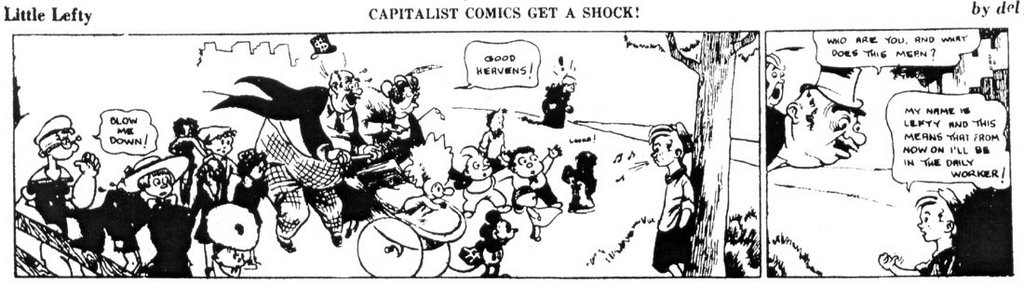
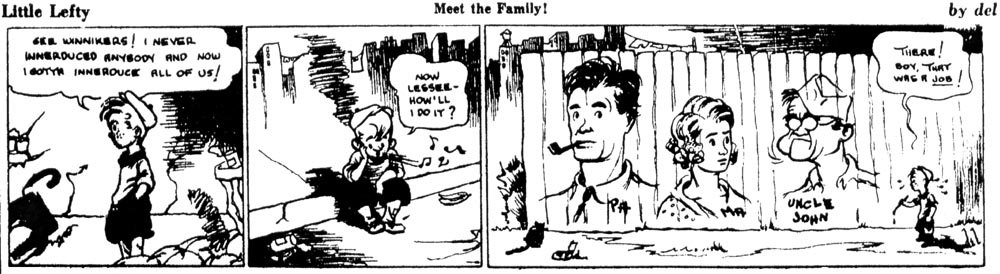
Now that the blog brain trust has supplied the correct ID for the Daily Worker's cartoonist 'del' as Maurice del Bourgo, let's take a look at his magnum opus, Little Lefty.
Little Lefty started on October 8, 1934, and was by far the longest running strip in the history of the socialist paper The Daily Worker. It ran daily, with occasional hiccups, through January 3, 1943. The star of the show would have gotten along well with Percy Crosby's Skippy. Both were fond of philosphizing at length over the sorry state of the world. Skippy preferred the all-American apple pie solutions of democracy, freedom and the golden rule as a cure for the ills of society, whereas Lefty was just as certain that a socialist state was the cure.
Lefty was unabashedly political, and the jokes, when they could be wedged in amongst the idealistic sloganeering, were weak at best. This made Lefty fit in perfectly with the rest of the Worker's so-called humor. As I've mentioned before, the folks who contributed to the Worker were far too earnest and idealistic to really allow themselves to let loose with a good 'slip on a banana peel' type knee slapper. "How can we laugh when the world is in such a state?" I can imagine them muttering at their drawing boards.
Little Lefty actually ran seven days per week for long stretches. When the Daily Worker added a Sunday edition, Little Lefty On Sundays was inaugurated. This version, essentially just an extra daily, ran 1/12/1936 - 5/28/1939, changing its title to Buttons on 11/6/1938.
In 1940, a new character was introduced named Marmaduke. He's hard to describe, sort of a flying eel with a handlebar moustache. I haven't read enough of this stretch of the strip to really understand the significance of his form, but one of these days I'll dig some strips out from that era to show. Marmaduke was less fond of spouting philosophy as Lefty, but he made up for it by earnestly showing the horrors of capitalism through longer contiuning storylines. The strip was sometimes renamed Adventures Of Marmaduke in 1940-41, and when Little Lefty appeared in this time the strip was often titled Little Lefty's Cartoonews. This title flagged the strip as even more earnestly political, as Lefty commented on the news of the day, making the strip verge on being a political cartoon.
The strip went on a long hiatus starting 6/8/1941, coming back for a short run 11/2/1942-1/2/1943. After this 'del' seems to have left the paper for greener pastures.
The samples shown are the first two installments of the strip from 1934.
Blog Note: I'm getting more and more spam comments on the blog so I've activated the comment verification feature of Blogger. If you leave a comment now, you'll just have to answer a very simple question to post (you just type the word shown in a graphic image). Hopefully this will cut down on the junk mail that I have to go around deleting every morning these days.
Labels: Obscurities
Comments:
Speaking of socialist papers... I just passed on a lot of 400+ 1940/45 copies of PM daily at $220. Did I miss much?
They ran a few good strips in that timeframe ... Patoruzu, Claire Voyant, Vic Jordan. And the great Dr. Seuss editorial cartoons.
Best, Allan
Post a Comment
Best, Allan
Saturday, February 01, 2020
What The Cartoonists Are Doing, October 1915 (Vol.8 No.4)
[Cartoons Magazine, debuting in 1912, was a monthly magazine
devoted primarily to reprinting editorial cartoons from U.S. and foreign
newspapers. Articles about cartooning and cartoonists often
supplemented the discussion of current events.
In November 1913 the magazine began to offer a monthly round-up of news about cartoonists and cartooning, eventually titled "What The Cartoonist Are Doing." There are lots of interesting historical nuggets in these sections, and this Stripper's Guide feature will reprint one issue's worth each week.]
LABELS AND CARTOONS
(by B. L. T., in Chicago Tribune)
The American cartoonist, an editorial colleague points out, labels everything—Bryan, Wilson, the Kaiser, every one, everything. “The real power of the cartoon is that its symbolism does not require exposition.” True enough, and the answer is that while there are many talented young men drawing pictures for the newspapers, there are almost no cartoonists.
In the first place, a cartoon ought to be savagely satirical, not good-natured. The dictionary defines it as something intended to affect public opinion. The public's opinion is not affected by good-natured pictorial comment, and the public person represented in the picture is not damaged in the least. A cartoonist like the elder Keppler could drive any of our political charlatans out of public life.
As for the practice of labeling everything, it is interesting because the spelling is so ingenious. The old school, which included such masters as Tenniel, Keppler, and Nast, were ingenious in idea and execution. The picture makers of today expend their ingenuity on their labels, few of which agree with the dictionary.
 BUSHNELL JOINS N. Y. MAIL
E. A. Bushnell, who for several years has been doing the cartoon work for the Central Press Association of Cleveland, Ohio, has accepted an offer from the New York Mail, and has joined the staff of the eastern newspaper. The offer came while Mr. Bushnell was away on his vacation in Michigan. “Bush’s” work is familiar to all readers of Cartoons Magazine. Syndicated from Cleveland, it appeared in about 100 American newspapers, and was copied frequently by foreign journals. About a year ago he began substituting crayon for pen and ink. Perhaps his best series is one entitled “When Father Was a Boy;” which has appeared intermittently for several months. Bushnell is a self-taught cartoonist, but by painstaking methods and an indomitable perseverance has won his way to the front. His first cartoon appeared in the Cleveland Press, and represented Mark Hanna as “the power behind the throne.” This was some 20 years ago. Since that time the artist has been connected with the Cincinnati Post, the Cincinnati Times-Star (where he did some of his best work in the local mayoralty campaigns) and the Memphis Scimitar.
A SOUTH AFRICAN TENNIEL
“Pictorial Politics” is the title of a cartoon portfolio by Herbert W. MacKinney, of Cape Town, South Africa. The book is published by the Cape Times, with which newspaper Mr. MacKinney is connected. Sir Maitland W. Parker, editor of the Times, says in the foreword:
“The essence of humor lies in incongruity and contrast. Perhaps that is why ‘Mac,' who is a droll fellow, asks me to write this at a time when the tumult and the shouting of the Union Parliament and of Union politics, the oddities and absurdities of which constitute the cartoonist's stock-in-trade, seem almost to have vanished from memory. But as the British cavalrymen yelled, as they knocked the improvised tackle with which they were fishing off the points of their bayonets, in order to get into the saddle, and ride 'hell for leather' at the German lines, 'Are we downhearted?' We shall not be better able to practice the precept 'business as usual' if we forget that a compassionate Providence has kindly placed the springs of laughter close by the well of tears.
“So go your way, friend 'Mac,' on your cheery mission. Your pencil drips no venom, and if it finds the weak spots of political adversaries, it is only to tickle them into laughter at their own faults and foibles.”
While the subject matter is unfamiliar to American readers, the style and treatment of the drawings recommend the book to any cartoonist who is building up a library.
WANTS “OLD FAVORITES”
From Portland, Ore., comes the request from a reader that Cartoons Magazine publish more “old favorites.” “In my judgment,” says the correspondent, “the best cartoon I ever saw was one published at the time of General Miles' retirement, and called “His First Surrender." The old Indian fighter was represented on horseback, and having reached the 64th milepost, was handing his sword over to Father Time. I have forgotten who was the artist, and in what paper it appeared, but would like to add it to my collection.”
~~~~~~~~~~~~~~~~~~
G. H. Chapin, the father of A. B. Chapin, cartoonist of the St. Louis Republic, died recently in Memphis, Tenn. His home for the last 20 years had been in Kansas City, Kansas.

AN INTERVIEW WITH UNCLE SAM
by Morris Miller, in Central Press Association Bulletin
“Is Uncle Sam in?”
“Ah! This way.”
We entered the inner sanctum of our favorite uncle. It was furnished in a tasteful and befitting manner. Stars and stripes, of course, were a chief part in the simple but handsome ornamentation. A rather slender, rather elderly man sat at a desk.
“Uncle Sam?”
Possibly that sounds like a foolish question. Anyone should know the old man at a glance. He had the well-known whiskers at his chin. He was fingering them nervously as we entered. His trousers were striped and arranged at his boots just as you've always seen them in the pictures. Anyone should have known it was Uncle Sam.
It was his manner that deceived us. There was something so weary and dejected in every line and angle of his figure as he draped himself over his desk that we could scarcely believe that this was the celebrated old man of cartoons. We had always thought him to be agile and vigorous.
“You would like to talk to me a while?” the old man asked. His voice, better than the pose of his figure and the deepening lines of his face, showed his weariness.
“A little more than a little --” he began.
We whipped out pencil and pad to get every word. “Yes?” we asked.
“—is much too much. I had never realized until lately that satiety was much more than just another word in the dictionary."
“You have had enough of something, it would seem?” with the rising inflection.
“This plaguey cartoon business.”
“It must be trying.”
“Trying? Hah!” The “hah” contained so much nervous irritability that we became at once more warmly sympathetic.
“Appearing daily in so many cartoons must be hard work,” we said. “To be up bright and early to pose for the cartoonists, and to be kept at it steadily through the day till late at night—why, how can one man do it? And in each one you must pose in a determined and convincing way, too. And take every side of things. And different people probably writing in at times to say that your behavior in this and that picture is wrong. When you had no word to say in the matter of a pose at all.”
“Yessir, there have been lots of times when I’ve just about concluded to throw it all up. Lately, especially since that darn war in Europe, they've been going altogether too far. I ain't afraid of work. I guess I wouldn't be where I am now if I was. But now that the cartoonists have me working overtime in the acts of presenting a firm front, and laying down the law, and protesting in the name of humanity, and waiting for the news from Germany, and rejoicing over the crops, I don't get a minute's rest." He leaned forward a bit and lowered his voice. “Do you know, several times I've thought seriously of resigning my job as artists' model.”
“That would be disastrous,” we reminded him. “The cartoonists say that you are absolutely necessary in depicting the national spirit. They must have some single figure or character, you know, to represent the thought and feeling of the nation. How could they get along without you? Just answer that.”
“Maybe so, maybe so,” answered the old man reflectively. “Some thoughtless people roast the cartoonists for using me so much —they say I'm a chestnut. But how else could the pen and ink boys represent the whole nation in one figure?” He paused to let the idea sink in.
“Of course, there's Miss Columbia,” he added. “But she can't appear in the heavy cartoons where there is stern work to be done. She is good on the sympathetic stuff and in peace and prosperity cartoons.”
Uncle Sam reached for a copy of one of the monthly reviews which was lying on his desk, and thumbed several of its pages.
“Now, here's what gets me,” he said in an irritated tone. “It's bad enough to be worked to a frazzle by the friendly cartoonists here at home, who make me look strong and snappy. But the thing that makes me boil is to have these supercilious foreign cartoonists make me look like a senile old tightwad. Blankety blank blank!”
Here the interesting old man was interrupted by the sharp bark of a puppy that romped playfully into the room. He approached us with ingratiating wiggles and we reached to pat him. “Cute little fellow,” we said. “Yours? What's its name?”
“Yes, it's mine, but do you think it's so little? He's been working with me in the cartoons quite a bit lately. Name's Army. Navy, his playmate, about his size, has been resting up lately. He was on exhibition, you know, and—”
“Oh! Ha, ha! The dogs of war!” We strangled the incipient snicker. Too hearty mirth at this point might have given offense.
“Yes, they've been working with me quite a bit lately. A lot of cartoonists make 'em littler and skinnier than they really are. I’ve taken quite a notion to the little fellows. Just at that cute age, you know.” “Yes, they're cute, for the matter of that,” we said, eyeing Army a bit critically. “Looks like the sort of dog that'll grow, don't you think?”
“Oh, yes, I think they'll grow. Yes, from the way they both been acting lately I think they're due to grow quite a bit.”
We rose to leave.
“Well, let us all sincerely hope so, Uncle Sam. If they do, it seems certain that your position will have a greater dignity, don't you know. People won't be so critical as they have been lately. And you won't be obliged to make so many daily appearances. That would suit you better, wouldn't it?”
“That's just what I would like. Come and see me again sometime, young fellow.”
THE “MUD DRIPPERS” AGAIN
Anent the charges of the “Editor and Publisher” that cartoon art in America is on the decline, and that masterpieces in “mud dripping” are about all that the artists achieve nowadays, Ryan Walker, cartoonist of socialism, adds that it is not only the cartoons that drip with mud, but the ideas, also.
“The cartoon of today,” says Mr. Walker, “is more or less a bit of deadly, meaningless stupidity.”
RACEY'S CARTOONS IN LONDON
An exhibit of cartoons by A. G. Racey, the Montreal Star cartoonist, at the London offices of the Canadian Pacific Railway, has proved quite a drawing card, according to a London correspondent. These cartoons, he says, “lay bare the soul of a valiant daughter, and interpret the real spirit of the Dominion to the British public.” One cartoon showing the murdered children of Scarborough was particularly admired.
~~~~~~~~~~~~~~~~~~~~

“The Fotygraft Album,” from which the pictures on this page are taken, is by Frank Wing, who for many years was head of the art department of the Minneapolis Journal. The “Album” is supposed to be shown to a new neighbor by Rebecca Sparks Peters, aged seven. Persons who have thus been given an insight into family history by a small daughter will appreciate this little book of Mr. Wing's. It is published by the Reilly and Britton Co. of Chicago.
THE GRAVES AT THE DARDANELLES
D. H. Souter, cartoonist for the Sydney (Australia) Stock and Station Journal, has written a number of inspiring verses on various war themes. The following appeared recently in the “Scottish Australasian.”
Why do you grieve for us who lie
At our lordly ease by The Dardanelles?
We have no need for tears or sighs;
We, who passed in the heat of fight
Into this soft Elysian night;
Proud of our part in the great emprise.
We are content; we had our day,
Brief but splendid, crowned with power,
And brimmed with action, every hour
Shone with a glory none gainsay.
Why will you grieve for us who passed
In our prideful strength at The Dardanelles?
Echoing still in our earth-stopped ears
Are victor's plaudit, or blood-choked cry
Of foe who falls at our feet to die:
We have no need for sighs or tears.
Once having made a sport of Death,
How could we turn to peaceful ways
Or tamely wait uneventful days -
For him at leisure to stop our breath?
How can you grieve? We are not lone;
There are other graves by The Dardanelles.
Men whom immortal Homer sang
Come to our ghostly camp fire's glow,
Greet us as brothers and tell us
“Lo, So to our deeds old Troy rang,”
Thus will the ages 'yond our ken
Turn to our story, and having read,
Will say, with proudly uncovered head
And reverent breath, “By God, they were Men.”
“WEB” ON A FISHING TRIP
H. T. Webster, cartoonist of the New York Globe, accompanied by G. H. Mitchell, who designs covers for Scribner's Magazine, has been spending several weeks in Maine on a combined auto and fishing tour. They had particular designs on six-pound trout. Mr. Webster is rather a renowned fisherman, having been born and raised in Tomahawk, Wis., in the center of the lake region. He announces incidentally that the George H. Doran Co. will offer for the fall trade his new cartoon book.
CARTOONS AS HAND GRENADES
A letter from a British soldier “somewhere in France” received by the New York Tribune, tells of the sensation created when the writer threw a bunch of Tribune cartoons into the German trenches.
“I wish you could have heard the Boches groan and shout and swear,” the letter continues; “they were nothing short of raving mad. One cartoon in particular—the one representing von Bernstorff addressing his country's sympathies to the American public over the 'Lusitania' victims—must have struck them harder than any shell ever did.”

 AUSTRALIA SUCCORING POLAND
Reproduced from a drawing presented by Mr. Virgil', of Melbourne, to Mme. Melba, as a souvenir, of her Polish concert held recently at the Town Hall, Sydney.
ON HIS MERRY WAY
“Like a beautiful dream,” writes Albert Dressler from New York, “my merry trip across the continent, which started from San Francisco in April, has now ended. New York City has so greatly impressed me that I shall remain here for several days before starting homeward full of merry ideas and love for every village and town I have passed through.”
Mr. Dressler, who likes to combine cartooning with tramping, completed his transcontinental tour late in August, having spent four months “on his merry way.” His ability to cartoon local celebrities gave him an open sesame to the many towns at which he stopped en route, and in every town, he says, he met a pretty girl. He gathered material, incidentally, for a book about his sentimental journey.\
~~~~~~~~~~~~~~~~~~~~~~
C. R. Macauley of New York has been drawing a series of weekly cartoons for the League to Enforce Peace, of which ex-President Taft is the head. The cartoons, however, are not of the “peace-at-any-price” variety.
CARICATURES BY LOW
A special edition of cartoons by Low, the cartoonist of the Sydney (Australia), Bulletin, has been published by Tyrrell's, of Sydney. This is Mr. Low's first collection, and includes 400 caricatures of famous persons. Several of the plates are in colors. The edition is limited to 250 copies, and sells at One guinea.
 MAXIM AND THE “BEE” CARTOON
A recent cartoon by A. V. Buel, of the Sacramento Bee, representing Hudson Maxim addressing a procession of cripples from a Maxim gun factory, pocketing war profits, and telling them that “war does good,” has called forth a protest from the inventor.
“Please allow me to tell your readers,” says Mr. Maxim, “that I am not an advocate of war, but am a peace advocate, only I happen to be a more practical peace advocate than the advocates of disarmament. I believe in preparing against war, not for war. I believe that this country should get ready to defend itself and the liberties of its people just as our cities are defended by our police against burglaries, sneak thieves and highwaymen, and we need guns for the purpose, just as the police need guns.
“I am not interested in any manner in any concern manufacturing guns or war mater ials. I am not the inventor of the Maxim gun, and have not a cent's worth of financial interest in any gun factory.
“The present war has not brought profits to me, but, on the contrary, it has so interfered with my regular affairs, which have nothing to do with war supplies, that I have been a substantial loser from the war.”
CARTOONIST KING'S NEW UNCLE SAM
A brand-new type of Uncle Sam has been created by cartoonist King, who has taken McCutcheon's place on the Chicago Tribune during the absence of the latter in Europe.
The cartoon, while it is not flattering, is, in the opinion of the Tribune itself, a much truer portrait than any yet evolved. Says the Tribune editorially:

“In Mr. King's cartoons we have a real photograph of Uncle Sam. He has heretofore been sitting for his portrait before an imaginative artist who wished, rather than tell the truth, to please the gentleman who ordered the picture. Thus sitting and thus painted, he has appeared as an amiable, tolerant person whose tolerance and good nature had foundation upon his known ability to resent any affront which crossed the line of tolerance.
“The American nation has been fed upon such cartoons. The Uncle Sam of this fiction has filled the minds of the American people. He is kind, grim, gracious, indulgent, strong, terrible—whatever the occasion asked or permitted.
“Mr. King shows him for what he is—rich, fat, indolent, unready, unable to run a hundred yards, put up his fists, load a revolver, or accomplish successfully any act of self defense. If that suggestion of Uncle Sam should make any advance into American intelligence the American nation might go into training to become what it thinks it is.”
~~~~~~~~~~~~~~~~~~~~
James Walsh, cartoonist of the Scranton Times, has returned from a long canoe trip in the Adirondacks.
PUNCH CARTOONS IN BOOK FORM
Punch cartoons of the war, collected in book form, have been published by the George H. Doran Co. As a pictorial history of the war from the British point of view, these cartoons are unexcelled. “The New Rake's Progress,” a series with the kaiser as the central figure, and “The Unspeakable Turk,” the history of modern Turkey in cartoon, form important chapters. Students of world politics will find this volume almost indispensable to a full understanding of the War.
LEDERER VISITS WEST
Charles Lederer, the veteran Chicago cartoonist, accompanied by Mrs. Lederer, has been visiting the Pacific coast. He attended the meetings of the National Educational Association in Los Angeles, and looked in at the Panama-Pacific Exposition. Since his retirement from the active newspaper field, which he entered in the days of chalk plates, Mr. Lederer has been writing and illustrating a series of art books for school use.
~~~~~~~~~~~~~~~~~~~~~
George McManus, creator of “The Newlyweds,” was one of the star performers at the “Booster” entertainment, held recently at the Shrine Auditorium in Los Angeles. Mr. McManus pictorialized some of his famous characters, and auctioned them off to the highest bidders. He was a guest of the Los Angeles Press Club.
~~~~~~~~~~~~~~~~~~~~~~~
P. J. Kinder of Chicago, cartoonist for the Santa Fe Magazine, has been making a tour of the Pacific coast cities, and visiting the expositions.
 PHIFER RANCHES IT
Luther C. Phifer has returned to Worcester, Mass., and resumed the making of “Phifebirds” and cartoons for the Telegraph of that city, after a summer's sojourn on his cattle ranch at Larkspur, Colo. Mr. Phifer, though an easterner, is no tenderfoot, but can rope and brand a steer as neatly as a professional cowboy. He was accompanied on his visit by Mrs. Phifer.
In November 1913 the magazine began to offer a monthly round-up of news about cartoonists and cartooning, eventually titled "What The Cartoonist Are Doing." There are lots of interesting historical nuggets in these sections, and this Stripper's Guide feature will reprint one issue's worth each week.]
LABELS AND CARTOONS
(by B. L. T., in Chicago Tribune)
The American cartoonist, an editorial colleague points out, labels everything—Bryan, Wilson, the Kaiser, every one, everything. “The real power of the cartoon is that its symbolism does not require exposition.” True enough, and the answer is that while there are many talented young men drawing pictures for the newspapers, there are almost no cartoonists.
In the first place, a cartoon ought to be savagely satirical, not good-natured. The dictionary defines it as something intended to affect public opinion. The public's opinion is not affected by good-natured pictorial comment, and the public person represented in the picture is not damaged in the least. A cartoonist like the elder Keppler could drive any of our political charlatans out of public life.
As for the practice of labeling everything, it is interesting because the spelling is so ingenious. The old school, which included such masters as Tenniel, Keppler, and Nast, were ingenious in idea and execution. The picture makers of today expend their ingenuity on their labels, few of which agree with the dictionary.

E. A. Bushnell, who for several years has been doing the cartoon work for the Central Press Association of Cleveland, Ohio, has accepted an offer from the New York Mail, and has joined the staff of the eastern newspaper. The offer came while Mr. Bushnell was away on his vacation in Michigan. “Bush’s” work is familiar to all readers of Cartoons Magazine. Syndicated from Cleveland, it appeared in about 100 American newspapers, and was copied frequently by foreign journals. About a year ago he began substituting crayon for pen and ink. Perhaps his best series is one entitled “When Father Was a Boy;” which has appeared intermittently for several months. Bushnell is a self-taught cartoonist, but by painstaking methods and an indomitable perseverance has won his way to the front. His first cartoon appeared in the Cleveland Press, and represented Mark Hanna as “the power behind the throne.” This was some 20 years ago. Since that time the artist has been connected with the Cincinnati Post, the Cincinnati Times-Star (where he did some of his best work in the local mayoralty campaigns) and the Memphis Scimitar.
A SOUTH AFRICAN TENNIEL
“Pictorial Politics” is the title of a cartoon portfolio by Herbert W. MacKinney, of Cape Town, South Africa. The book is published by the Cape Times, with which newspaper Mr. MacKinney is connected. Sir Maitland W. Parker, editor of the Times, says in the foreword:
“The essence of humor lies in incongruity and contrast. Perhaps that is why ‘Mac,' who is a droll fellow, asks me to write this at a time when the tumult and the shouting of the Union Parliament and of Union politics, the oddities and absurdities of which constitute the cartoonist's stock-in-trade, seem almost to have vanished from memory. But as the British cavalrymen yelled, as they knocked the improvised tackle with which they were fishing off the points of their bayonets, in order to get into the saddle, and ride 'hell for leather' at the German lines, 'Are we downhearted?' We shall not be better able to practice the precept 'business as usual' if we forget that a compassionate Providence has kindly placed the springs of laughter close by the well of tears.
“So go your way, friend 'Mac,' on your cheery mission. Your pencil drips no venom, and if it finds the weak spots of political adversaries, it is only to tickle them into laughter at their own faults and foibles.”
While the subject matter is unfamiliar to American readers, the style and treatment of the drawings recommend the book to any cartoonist who is building up a library.
WANTS “OLD FAVORITES”
From Portland, Ore., comes the request from a reader that Cartoons Magazine publish more “old favorites.” “In my judgment,” says the correspondent, “the best cartoon I ever saw was one published at the time of General Miles' retirement, and called “His First Surrender." The old Indian fighter was represented on horseback, and having reached the 64th milepost, was handing his sword over to Father Time. I have forgotten who was the artist, and in what paper it appeared, but would like to add it to my collection.”
~~~~~~~~~~~~~~~~~~
G. H. Chapin, the father of A. B. Chapin, cartoonist of the St. Louis Republic, died recently in Memphis, Tenn. His home for the last 20 years had been in Kansas City, Kansas.

AN INTERVIEW WITH UNCLE SAM
by Morris Miller, in Central Press Association Bulletin
“Is Uncle Sam in?”
“Ah! This way.”
We entered the inner sanctum of our favorite uncle. It was furnished in a tasteful and befitting manner. Stars and stripes, of course, were a chief part in the simple but handsome ornamentation. A rather slender, rather elderly man sat at a desk.
“Uncle Sam?”
Possibly that sounds like a foolish question. Anyone should know the old man at a glance. He had the well-known whiskers at his chin. He was fingering them nervously as we entered. His trousers were striped and arranged at his boots just as you've always seen them in the pictures. Anyone should have known it was Uncle Sam.
It was his manner that deceived us. There was something so weary and dejected in every line and angle of his figure as he draped himself over his desk that we could scarcely believe that this was the celebrated old man of cartoons. We had always thought him to be agile and vigorous.
“You would like to talk to me a while?” the old man asked. His voice, better than the pose of his figure and the deepening lines of his face, showed his weariness.
“A little more than a little --” he began.
We whipped out pencil and pad to get every word. “Yes?” we asked.
“—is much too much. I had never realized until lately that satiety was much more than just another word in the dictionary."
“You have had enough of something, it would seem?” with the rising inflection.
“This plaguey cartoon business.”
“It must be trying.”
“Trying? Hah!” The “hah” contained so much nervous irritability that we became at once more warmly sympathetic.
“Appearing daily in so many cartoons must be hard work,” we said. “To be up bright and early to pose for the cartoonists, and to be kept at it steadily through the day till late at night—why, how can one man do it? And in each one you must pose in a determined and convincing way, too. And take every side of things. And different people probably writing in at times to say that your behavior in this and that picture is wrong. When you had no word to say in the matter of a pose at all.”
“Yessir, there have been lots of times when I’ve just about concluded to throw it all up. Lately, especially since that darn war in Europe, they've been going altogether too far. I ain't afraid of work. I guess I wouldn't be where I am now if I was. But now that the cartoonists have me working overtime in the acts of presenting a firm front, and laying down the law, and protesting in the name of humanity, and waiting for the news from Germany, and rejoicing over the crops, I don't get a minute's rest." He leaned forward a bit and lowered his voice. “Do you know, several times I've thought seriously of resigning my job as artists' model.”
“That would be disastrous,” we reminded him. “The cartoonists say that you are absolutely necessary in depicting the national spirit. They must have some single figure or character, you know, to represent the thought and feeling of the nation. How could they get along without you? Just answer that.”
“Maybe so, maybe so,” answered the old man reflectively. “Some thoughtless people roast the cartoonists for using me so much —they say I'm a chestnut. But how else could the pen and ink boys represent the whole nation in one figure?” He paused to let the idea sink in.
“Of course, there's Miss Columbia,” he added. “But she can't appear in the heavy cartoons where there is stern work to be done. She is good on the sympathetic stuff and in peace and prosperity cartoons.”
Uncle Sam reached for a copy of one of the monthly reviews which was lying on his desk, and thumbed several of its pages.
“Now, here's what gets me,” he said in an irritated tone. “It's bad enough to be worked to a frazzle by the friendly cartoonists here at home, who make me look strong and snappy. But the thing that makes me boil is to have these supercilious foreign cartoonists make me look like a senile old tightwad. Blankety blank blank!”
Here the interesting old man was interrupted by the sharp bark of a puppy that romped playfully into the room. He approached us with ingratiating wiggles and we reached to pat him. “Cute little fellow,” we said. “Yours? What's its name?”
“Yes, it's mine, but do you think it's so little? He's been working with me in the cartoons quite a bit lately. Name's Army. Navy, his playmate, about his size, has been resting up lately. He was on exhibition, you know, and—”
“Oh! Ha, ha! The dogs of war!” We strangled the incipient snicker. Too hearty mirth at this point might have given offense.
“Yes, they've been working with me quite a bit lately. A lot of cartoonists make 'em littler and skinnier than they really are. I’ve taken quite a notion to the little fellows. Just at that cute age, you know.” “Yes, they're cute, for the matter of that,” we said, eyeing Army a bit critically. “Looks like the sort of dog that'll grow, don't you think?”
“Oh, yes, I think they'll grow. Yes, from the way they both been acting lately I think they're due to grow quite a bit.”
We rose to leave.
“Well, let us all sincerely hope so, Uncle Sam. If they do, it seems certain that your position will have a greater dignity, don't you know. People won't be so critical as they have been lately. And you won't be obliged to make so many daily appearances. That would suit you better, wouldn't it?”
“That's just what I would like. Come and see me again sometime, young fellow.”
THE “MUD DRIPPERS” AGAIN
Anent the charges of the “Editor and Publisher” that cartoon art in America is on the decline, and that masterpieces in “mud dripping” are about all that the artists achieve nowadays, Ryan Walker, cartoonist of socialism, adds that it is not only the cartoons that drip with mud, but the ideas, also.
“The cartoon of today,” says Mr. Walker, “is more or less a bit of deadly, meaningless stupidity.”
RACEY'S CARTOONS IN LONDON
An exhibit of cartoons by A. G. Racey, the Montreal Star cartoonist, at the London offices of the Canadian Pacific Railway, has proved quite a drawing card, according to a London correspondent. These cartoons, he says, “lay bare the soul of a valiant daughter, and interpret the real spirit of the Dominion to the British public.” One cartoon showing the murdered children of Scarborough was particularly admired.
~~~~~~~~~~~~~~~~~~~~

“The Fotygraft Album,” from which the pictures on this page are taken, is by Frank Wing, who for many years was head of the art department of the Minneapolis Journal. The “Album” is supposed to be shown to a new neighbor by Rebecca Sparks Peters, aged seven. Persons who have thus been given an insight into family history by a small daughter will appreciate this little book of Mr. Wing's. It is published by the Reilly and Britton Co. of Chicago.
THE GRAVES AT THE DARDANELLES
D. H. Souter, cartoonist for the Sydney (Australia) Stock and Station Journal, has written a number of inspiring verses on various war themes. The following appeared recently in the “Scottish Australasian.”
Why do you grieve for us who lie
At our lordly ease by The Dardanelles?
We have no need for tears or sighs;
We, who passed in the heat of fight
Into this soft Elysian night;
Proud of our part in the great emprise.
We are content; we had our day,
Brief but splendid, crowned with power,
And brimmed with action, every hour
Shone with a glory none gainsay.
Why will you grieve for us who passed
In our prideful strength at The Dardanelles?
Echoing still in our earth-stopped ears
Are victor's plaudit, or blood-choked cry
Of foe who falls at our feet to die:
We have no need for sighs or tears.
Once having made a sport of Death,
How could we turn to peaceful ways
Or tamely wait uneventful days -
For him at leisure to stop our breath?
How can you grieve? We are not lone;
There are other graves by The Dardanelles.
Men whom immortal Homer sang
Come to our ghostly camp fire's glow,
Greet us as brothers and tell us
“Lo, So to our deeds old Troy rang,”
Thus will the ages 'yond our ken
Turn to our story, and having read,
Will say, with proudly uncovered head
And reverent breath, “By God, they were Men.”
“WEB” ON A FISHING TRIP
H. T. Webster, cartoonist of the New York Globe, accompanied by G. H. Mitchell, who designs covers for Scribner's Magazine, has been spending several weeks in Maine on a combined auto and fishing tour. They had particular designs on six-pound trout. Mr. Webster is rather a renowned fisherman, having been born and raised in Tomahawk, Wis., in the center of the lake region. He announces incidentally that the George H. Doran Co. will offer for the fall trade his new cartoon book.
CARTOONS AS HAND GRENADES
A letter from a British soldier “somewhere in France” received by the New York Tribune, tells of the sensation created when the writer threw a bunch of Tribune cartoons into the German trenches.
“I wish you could have heard the Boches groan and shout and swear,” the letter continues; “they were nothing short of raving mad. One cartoon in particular—the one representing von Bernstorff addressing his country's sympathies to the American public over the 'Lusitania' victims—must have struck them harder than any shell ever did.”


Reproduced from a drawing presented by Mr. Virgil', of Melbourne, to Mme. Melba, as a souvenir, of her Polish concert held recently at the Town Hall, Sydney.
ON HIS MERRY WAY
“Like a beautiful dream,” writes Albert Dressler from New York, “my merry trip across the continent, which started from San Francisco in April, has now ended. New York City has so greatly impressed me that I shall remain here for several days before starting homeward full of merry ideas and love for every village and town I have passed through.”
Mr. Dressler, who likes to combine cartooning with tramping, completed his transcontinental tour late in August, having spent four months “on his merry way.” His ability to cartoon local celebrities gave him an open sesame to the many towns at which he stopped en route, and in every town, he says, he met a pretty girl. He gathered material, incidentally, for a book about his sentimental journey.\
~~~~~~~~~~~~~~~~~~~~~~
C. R. Macauley of New York has been drawing a series of weekly cartoons for the League to Enforce Peace, of which ex-President Taft is the head. The cartoons, however, are not of the “peace-at-any-price” variety.
CARICATURES BY LOW
A special edition of cartoons by Low, the cartoonist of the Sydney (Australia), Bulletin, has been published by Tyrrell's, of Sydney. This is Mr. Low's first collection, and includes 400 caricatures of famous persons. Several of the plates are in colors. The edition is limited to 250 copies, and sells at One guinea.

A recent cartoon by A. V. Buel, of the Sacramento Bee, representing Hudson Maxim addressing a procession of cripples from a Maxim gun factory, pocketing war profits, and telling them that “war does good,” has called forth a protest from the inventor.
“Please allow me to tell your readers,” says Mr. Maxim, “that I am not an advocate of war, but am a peace advocate, only I happen to be a more practical peace advocate than the advocates of disarmament. I believe in preparing against war, not for war. I believe that this country should get ready to defend itself and the liberties of its people just as our cities are defended by our police against burglaries, sneak thieves and highwaymen, and we need guns for the purpose, just as the police need guns.
“I am not interested in any manner in any concern manufacturing guns or war mater ials. I am not the inventor of the Maxim gun, and have not a cent's worth of financial interest in any gun factory.
“The present war has not brought profits to me, but, on the contrary, it has so interfered with my regular affairs, which have nothing to do with war supplies, that I have been a substantial loser from the war.”
CARTOONIST KING'S NEW UNCLE SAM
A brand-new type of Uncle Sam has been created by cartoonist King, who has taken McCutcheon's place on the Chicago Tribune during the absence of the latter in Europe.
The cartoon, while it is not flattering, is, in the opinion of the Tribune itself, a much truer portrait than any yet evolved. Says the Tribune editorially:

“In Mr. King's cartoons we have a real photograph of Uncle Sam. He has heretofore been sitting for his portrait before an imaginative artist who wished, rather than tell the truth, to please the gentleman who ordered the picture. Thus sitting and thus painted, he has appeared as an amiable, tolerant person whose tolerance and good nature had foundation upon his known ability to resent any affront which crossed the line of tolerance.
“The American nation has been fed upon such cartoons. The Uncle Sam of this fiction has filled the minds of the American people. He is kind, grim, gracious, indulgent, strong, terrible—whatever the occasion asked or permitted.
“Mr. King shows him for what he is—rich, fat, indolent, unready, unable to run a hundred yards, put up his fists, load a revolver, or accomplish successfully any act of self defense. If that suggestion of Uncle Sam should make any advance into American intelligence the American nation might go into training to become what it thinks it is.”
~~~~~~~~~~~~~~~~~~~~
James Walsh, cartoonist of the Scranton Times, has returned from a long canoe trip in the Adirondacks.
PUNCH CARTOONS IN BOOK FORM
Punch cartoons of the war, collected in book form, have been published by the George H. Doran Co. As a pictorial history of the war from the British point of view, these cartoons are unexcelled. “The New Rake's Progress,” a series with the kaiser as the central figure, and “The Unspeakable Turk,” the history of modern Turkey in cartoon, form important chapters. Students of world politics will find this volume almost indispensable to a full understanding of the War.
LEDERER VISITS WEST
Charles Lederer, the veteran Chicago cartoonist, accompanied by Mrs. Lederer, has been visiting the Pacific coast. He attended the meetings of the National Educational Association in Los Angeles, and looked in at the Panama-Pacific Exposition. Since his retirement from the active newspaper field, which he entered in the days of chalk plates, Mr. Lederer has been writing and illustrating a series of art books for school use.
~~~~~~~~~~~~~~~~~~~~~
George McManus, creator of “The Newlyweds,” was one of the star performers at the “Booster” entertainment, held recently at the Shrine Auditorium in Los Angeles. Mr. McManus pictorialized some of his famous characters, and auctioned them off to the highest bidders. He was a guest of the Los Angeles Press Club.
~~~~~~~~~~~~~~~~~~~~~~~
P. J. Kinder of Chicago, cartoonist for the Santa Fe Magazine, has been making a tour of the Pacific coast cities, and visiting the expositions.
Luther C. Phifer has returned to Worcester, Mass., and resumed the making of “Phifebirds” and cartoons for the Telegraph of that city, after a summer's sojourn on his cattle ranch at Larkspur, Colo. Mr. Phifer, though an easterner, is no tenderfoot, but can rope and brand a steer as neatly as a professional cowboy. He was accompanied on his visit by Mrs. Phifer.
Labels: What The Cartoonists Are Doing
Saturday, September 23, 2006
E&P 1939: Burris Jenkins Bio

Noted Preacher-Editor's Son Won Success in Cartooning
Burris Jenkins, Jr., Whose Father Edited K. C. Post, Noted for Sports Work, Sees Big Field for Pro and Con Editorial Cartoons
Burris Jenkins, Jr., of the New York Journal-American, who has an enviable reputation as a sports cartoonist and also does outstanding work on news assignments in his serious moments, is one of the few metropolitan newspaper artists who writes as cleverly as he draws.
Son of the one-time preacher-editor of the Kansas City Post who today is the Missouri metropolis' "first citizen," 42-year-old Burris Jenkins, Jr., inherited his father's ability to drive home a point. Dr. Jenkins still is spellbinding the largest congregation in Kansas City every Sunday. In New York, every day except Sunday, his son uses pen and ink to send home to readers his unusual sports ideas with the impact of a baseball against a catcher's mitt.
Literary Sentimentalist
A literary sentimentalist if ever there was one, Mr. Jenkins long ago left the beaten path of sports cartooning and many of his verses turned out with his daily cartoon sparkle with a spontaneity seldom displayed by writing artists.
His wide following among sports readers of the old New York World, where he broke into metropolitan journalism in 1921, and of the New York Journal and the Journal-American since 1931, has grown with a succession of rib-ticklers like one he did last May on the eve of the Kentucky Derby. Entitled "If Wishes Were Horses," it was Jenkins' parody of the current song hit, "Three Little Fishes," illustrated cleverly with Chico, Challedon and Technician in piscatorial roles as the "Three Little Wishes" looking down from the opening bars of the song on the verse and an equine shark named Johnstown. Here's how it ran:
Burp Burp Gittem Uppem Gettem Whoa!!
THREE LITTLE WISHES
(NOT by Saxie Dowell, to Whom We Apologize)
Down in a meadow where the grass grows blue
Stood three little WISHES (and a Big Wish too!)
"Run," said the little Wishes, "Run if you can,"
And dey ran and dey ran and dey ran and dey ran.
One little Wish is for "Chico" (So?)
One is a "Challedon" fan (Well!)
One loves a horsie called Technician (Whew!)
So dey ran and dey ran and dey ran and dey ran.
"Stop!" said a little Wishie, "This is far enough
"You must lay it on the line or I'll call your bluff!"
Then the three little Wishers went out on a spree
And dey dwank Mint Juleps till half past three.
One had Bourbon in his Julep (Bloop)
One had 40 year Rye (Gulp)
One had mountain dew corn (Burp)
And dey dwank and dey dwank without batting an eye.
"Whee!" yelled the little Wishes, "Here's where I win!"
"We'll dwink and we'll dwink till my wish comes in!"
So they dwank and they dwank from dawn till dark
Till all of a sudden they met The SHARK!
Clop clop whatten what-tha hel-lum (Whoa)
Clop clop-gettum up and gettem (Go)
Clop clop-just try-em ketchum (Oh)
And dey ran and dey ran and dey ran and dey ran.
"Help!" cried the little Wishes, "Gee! he's out for blood!
"He swept past us like the Johnstown flood!
"But we'll keep on running just as fast as we can."
So dey ran and dey ran and dey also ran.
Gulp gulp give-em up-em ketchem!
Gulp gulp justem gottem quittem!
Gulp gulp fillum up-em and drinkem!
So dey dwank and dey dwank until it didn't
make any difference any more . . .
Writes as Spirit Moves Him
A "daily double" like that may wow the sports fans, but it's a little too much to expect any newspaperman to do the trick every day. So his contract with the Journal-American - his fourth signed with the Hearst evening paper - requires Jenkins to do a twin trick at typewriter and drawing board only twice a week. In recent months, however, the artist has done fewer than two articles weekly. Instead of a story or verse he turns in an extra cartoon, under an arrangement with the newspaper. He writes as the spirit moves him, several times a month.
Because his batting average for timely topics is 1.000 and his cartoons with few exceptions pack the punch of a ring champion, it was surprising to hear that this outstanding sports cartoonist seldom attends sporting events. To him every baseball game is the same old story - something he's seen before. He hasn't seen many full baseball games in recent years, and even World Series games fail to interest him after the 7th inning.
Jenkins attends principally the championship fights and the most important races and football games, yet his cartoon always has the dramatic touch of a dyed-in-the-wool devotee of that particular sport.
His own sports cocktail consists of yachting and golf - and frequently he delays work on the next day's cartoon while he pursues the elusive pill and an even more elusive 80 on a golf course near his home in Pelham, N. Y. He has broken 80 but several times in his life and it's a sure bet his copy will arrive late at the Journal-American on the day he thinks he's going to break 80 again.
Deadline a Daily Adventure
Making his deadline is a daily adventure for Jenkins and his secretary, Herbert Storlie. His cartoon is supposed to be at the Journal-American office at 9 each evening, but it seldom arrives earlier than 11 p.m. Sometimes it's the wee small hours of the morning of publication that Storlie dashes into the Journal-American to catch a bit of engravers' hell to be passed on to his boss.
Jenkins has an unusual temperament when it comes to his drawing board. Often he cannot get started until darkness descends on the Hudson River and casts its peculiar spell on the artist fighting his deadline in a thirteenth floor studio on Riverside Drive. His mind works best at night, and the late sunsets now often find him just beginning his next day's cartoon after long pursuit of an idea through the afternoon.
Right now cartoonist Jenkins is trying to "reform" with respect to his unorthodox working hours, and has set 11 a.m. as the time for his arrival at the studio from his home at Pelham, Westchester county. He reports progress but the 9 p.m. deadline is still a daily bugaboo.
Occasionally Mr. Jenkins delves into serious topics. At such times he faces his ever-recurring dilemma- whether to hit heavy subjects daily or to continue skimming the cream off the sports subjects upon which his reputation has been built.
A night of indelible memory for newspapermen and parents, May 12, 1932, when the body of kidnapped Charles A. Lindbergh, Jr., was found, brought this cartoonist's pen into swift action. After hearing the radio bulletin in his home, Jenkins poured a father's hatred of the unknown murderer into a dramatic cartoon which he rushed to the Journal for publication the following day. It depicted Uncle Sam holding aloft Old Glory and the battered body of the Lindbergh child above the quotation:
"My Country 'Tis of Thee."
During the trial of Richard Bruno Hauptmann, Mr. Jenkins did a notable series of cartoons on courtroom scenes. For here he was in his element - interpreting the drama of a significant news event into a news cartoon with a few pungent captions to give the busy reader the entire situation for the day at a glance. Last year, at the trial of Jimmy Hines, he also found an opportunity to do his unusual reporting in keynote sketches and captions.
Sees Big Field for News Cartoons
Mr. Jenkins believes there is a big field for news cartoons and for pro and con editorial cartoons-giving both sides of a question presented to the reader.
"I couldn't say that cartooning in general needs a renaissance," he said in answer to a question, "but I do think a fresher and more forthright presentation in cartooning would be more convincing to a public educated above the old-fashioned school of cartooning."

Cartooning, he continued, is the "quickest way" of putting over an idea. "The visual reaction can hit you so much quicker than a column of type. A well thought out cartoon can tell the reader the story in a second. One that sticks out in my mind is one Rollin Kirby did after a submarine disaster some years back. It showed a diver tapping on the side of the lost submarine and was titled 'Taps.' One word and a picture, and you've got it all."
By an "educated public," the cartoonist explained, he means "a public, brought up on radio, that is greatly interested in and is familiar with politics." People have a more thorough knowledge of what is going on about them, "so that if you throw the old type of cartoon at them with only one viewpoint presented, they just don't believe it.
"The public's got to believe again that a newspaper can have ideals and a heart. There are two sides to any argument and the side a newspaper has decided is right can be stressed along with a fair presentation of the other side in such a way as not to insult the public's intelligence.
"Cartoonists should be on the level and not hold anything back from the public. Nowadays the readers often think there must be something in it for the paper or it would not be plugging a certain policy."
Two Brothers Are Newspapermen
Burris, Jr., is one of three sons of Dr. Jenkins, who was the Kansas City Star's war correspondent before he became editor and publisher of the Kansas City Post under the Bonfils and Tammens ownership. All three sons have become newspapermen. Burris' younger brothers, Paul A., 40, and Logan, 28, are owner-publisher and city editor, respectively, of the El Centra (Cal.) Imperial Valley Post-Press. Paul worked on the Post and Star in Kansas City before he went to California three years ago. Logan started as a reporter on the Denver Post under Bonfils.
Dr. Jenkins was president of the University of Indianapolis when Burris, Jr., was born Oct. 8, 1897. The preacher took the editorship of the Kansas City Post shortly after the war to fight the enemies of the Wilsonian ideals of international relationships. He quit at the end of 1920 when Bonfils fired his son "over his head" for a pessimistic Christmas cartoon which the paper's owner had described as "the last straw."
Burris, Jr., didn't know until 10 years later that he had been fired from his first newspaper job. The cartoonist, then on the road to success, was telling his father in New York that "every newspaperman should be fired from his first job because it does him good." He was expressing regret that he had never been fired, when Dr. Jenkins let the cat out of the bag. As his son explains the incident, Dr. Jenkins was apparently dissatisfied because Bonfils and Tammens had not given him the free hand that was promised in the conduct of the Post. When the editor heard that Bonfils had told Dick Smith, managing editor, "This is the end! Don't print another one of those cartoons," Dr. Jenkins told the owner, "You can accept my resignation, too," and then induced his son to make a trip abroad.
Got Job on N. Y. World
It was this trip to Europe and the Near East, long planned by young Jenkins, that finally landed him in metropolitan journalism. He had saved $900 from his pay on the Kansas City Post after his graduation from Harvard, and by traveling steerage most of the way he stretched the trip into eight months. He wrote an article, illustrated with his own cartoons, on the Jewish situation in Palestine, and this material was exactly what the New York World had been looking for, so he was hired to do a series.
The late Jack Tennant, managing editor, might have fired Jenkins when the last of the Palestine articles was written, but blustery Jack Rainey, then city editor, liked the newcomer and told him, "I'm going to make you or break you." He gave Jenkins a job as police reporter. For a year Jenkins covered the West Side and eventually he began to illustrate his own feature stories. Late in 1922 he started doing sports cartoons, modeling his creations after those of the famous Bob Edgren. Gradually he developed his own distinctive style, in which he mixes sentiment with an interpretation of the sports subject covered, and his rise became rapid as sports readers welcomed his deviation from the unemotional cartoons of the old school of artists.
Within a few years his police reporter's weekly stipend grew into $210, plus $25 for each column he wrote and illustrated-and there were usually two of these every week. His contract with the World had a year to run when the paper was acquired by Scripps-Howard.
Believing himself out of a job, Mr. Jenkins answered a call from E. D. Coblentz, of the New York American, to discuss terms, but landed instead in the office of William A. Curley, editor of the Evening Journal, when he got off at the wrong floor. A contract was signed with the Journal, instead of the American, but there followed a legalistic tug-of-war between the Journal and the World-Telegram over the cartoonist because of the unexpired contract with the old World. After three days Jenkins was released from the old contract and he has been with the Journal and Journal-American ever since.
Reunion in France
Two unusual incidents involving father and son are worth brief mention. While Dr. Jenkins was in France as war correspondent for the Kansas City Star writing stories on the numerous fatalities among aviators, his son was "somewhere in France" with the air service, completing his training before going to the front. Dr. Jenkins, fearing he might never see his son alive again, appealed to the night editor of the Paris edition of the New York Herald to publish a brief notice for his son to meet him for a final farewell. It brought them together.
Young Jenkins became so proficient in squadron flying that he remained behind the lines as an instructor for the duration of the war.
Labels: News of Yore
Comments:
Are you aware of any books specific to the drawings/ artwork of Burris Jenkins Jr?
# posted by : 7/17/2013 12:42 AM
: 7/17/2013 12:42 AM
I understand a gentleman in NY is writing a book about his life. He purchased a few of my original Burris art pieces for the book. I aquired about 10 of his original drawings concerning baseball, football, horse racing and boxing plus some insperational pieces. Tom
# posted by : 8/27/2013 12:56 PM
: 8/27/2013 12:56 PM
Nice piece.
I am looking to get in touch with someone from the Jenkins family to get permission to use a painting in a scholarly publication. Might anyone have some contact information?
Tom, you mentioned you were in contact with an author - perhaps he have family contacts? Feel free to email me a jarring at gmail.com. Cheers, AR
I am looking to get in touch with someone from the Jenkins family to get permission to use a painting in a scholarly publication. Might anyone have some contact information?
Tom, you mentioned you were in contact with an author - perhaps he have family contacts? Feel free to email me a jarring at gmail.com. Cheers, AR
Tom,
Do you have that person contact information?
I have some originals that he did for the NY State Police.
Do you have that person contact information?
I have some originals that he did for the NY State Police.
# posted by : 11/03/2013 8:30 PM
: 11/03/2013 8:30 PM
I realize this is significantly beyond the date but I am the granddaughter and I care for his daughter (my mother) the only living child of Burris Jenkins Jr. Please post how I can be of assistance. Thank you.
The British Museum has recently been given 23 of Burris Jenkins Junior's drawings and would like to have permission to reproduce them on-line and in possible future publications. Please can you send contact details to prints@britishmuseum.org.
# posted by : 8/18/2018 10:23 AM
: 8/18/2018 10:23 AM
I have a few originals from the Journal americium early 1960 my guess thing to link them to the articles in the newspaper
# posted by : 3/22/2020 9:22 AM
: 3/22/2020 9:22 AM
Hello Everyone. This is Danielle the Granddaughter of Burris Jenkins Jr. Burris Jenkins Sr. wrote an autobiography about himself and his son. If you're interested in reading further about how he became one of the greatest cartoonists in the world. follow the link.
https://www.amazon.com/Cartoonist-Burris-Jenkins-ebook/dp/B096HCJKXS/ref=sr_1_1?crid=284XDRJMSS1ZR&dchild=1&keywords=the+cartoonist+burris+jenkins&qid=1623256273&sprefix=the+cartoonist%3A+Burris+Jenkins%2Caps%2C1112&sr=8-1
https://www.amazon.com/Cartoonist-Burris-Jenkins-ebook/dp/B096HCJKXS/ref=sr_1_1?crid=284XDRJMSS1ZR&dchild=1&keywords=the+cartoonist+burris+jenkins&qid=1623256273&sprefix=the+cartoonist%3A+Burris+Jenkins%2Caps%2C1112&sr=8-1
Hello This is Danielle the granddaughter of Burris Jenkins Jr. you can contact the family at burrisjenkinsfamily@gmail.com
Thanks
Danielle and family
323-360-5698
Thanks
Danielle and family
323-360-5698
Hi,I'm eddie amodeo, I bought a drawing by your grandfather 17 yrs ago nobody has it.i donated it too cooperstown,n.y,my prints are limited .please contact me,,which go too charitieschildren's cancer hospitals,cancer and agent orange veterans suffering
# posted by : 11/20/2022 11:30 AM
: 11/20/2022 11:30 AM
Hi, looking for the source of this biography text and/or the photo of Burris. Is it in the E&P 1939 yearbook? or a weekly issue of E&P?
Post a Comment
# posted by : 10/03/2023 11:33 AM
: 10/03/2023 11:33 AM Tuesday, March 13, 2007
News of Yore: 1950 Insights on the Comic Strip Biz
Cartoonists, Editors Debate Comic Strips
The ASNE morning session April 22 1950 was devoted to a discussion of the question, "Are We Making the Best Use of Our Comic Space?" Felix R. McKnight, Dallas Morning News, was chairman of a panel which included: Milton Caniff, creator of "Steve Canyon;" Al Capp, "Li'I Abner;" Leslie Turner, "Wash Tubbs;" Norman Isaacs, St. Louis Star-Times; and James S. Pope, Louisville Courier-Journal. A digest of the discussion follows:
Mr. McKnight: I came today to get a few answers about comics. I am afraid that too many do not know the answer.
I cannot speak for the rest of you, but I took a recess from rather exhaustive budget discussions to come to this meeting. I would suspect, however, that there are others in this room who have been giving their operations more than a casual eye the past few months.
Romance for Reporters
Most of the romance in the newspaper business now belongs almost exclusively to the reporters. Editors must keep an eye on page 1, the other on mounting costs and space limitations born of one factor, production costs.
So it is that comics have become something more than just a brief interlude of so-called amusement each day. Comics to me as an editor mean about $60,000 in my budget and close to ten columns of very precious space in every edition, space that also must be counted in those same dollars and cents.
It means that in most American newspapers comic pages, through insistent circulation department demands and similar shouts from the public, now consume more reading matter space than opinion-molding editorial pages.
Shouldn't we be considering seriously what we are trying to do with that space? The primary purpose of comics is to entertain, but are there different levels of entertainment? Can we—or should we try to do anything more than entertain? Can comics, perhaps, effectively perform some other service, too? Is there any truth to the charge of some critics that there is too much blood and crime, too much sex for juvenile appetites?
Good questions to be answered, and today we hope to dive in head first and come up with concrete conclusions. We want it clearly understood that, regardless of the course this discussion might take, we are discussing an over-all problem and not endorsing or condemning individual features.
Some 70 million readers are daily entertained by approximately 100 cartoonists in this important field. In searching around for concrete material for the discussion, I came upon a piece written by the Baers, "Comic Cartoonists," that proved up rather pertinent points. One concerned the ever-present problem child, the crime strips.
It was their contention that to get around the censors (or their own consciences) the writers and producers of crime strips assume that, if the guilty man receives his due reward in the end—either being killed by a G-man or going to jail — the story is justified. Meanwhile, however, scenes are carefully laid to show children how clever crimes are planned and committed.
To the juvenile or the adolescent mind, the Baers contend, the endings of crime strips are inconsequential. All that the child understands is that the tough guy is exciting and has exciting adventures. The murderer or thief may even become almost a hero to the child. The juvenile mind, contend the Baers, absorbs only the thrills of the story.
No writer of a comic strip, crime comic strip, today can ignore the recent agitation against these cartooned crimes and criminals.
A Public Indictment?
Four out of every five adults read comic strips, in addition to the children. It is a huge slice of this American way of life. It is a tremendous responsibility the American cartoonist and editor now carries. And it is probably time for both of us to face up to it. Let's not kid ourselves about this matter. Producers of comic strips and complacent editors have some thinking to do, or we will face a public indictment charging dereliction of duty.
Lest it be said that I stand only as a prosecutor, I hasten to say that some comic strips and their artist creators have done exceedingly fine jobs in the field of entertainment. Some function rather nobly as good public servants in the furtherance of worthwhile projects. And some actually inject humor into the so-called funny papers of today.
We, as editors, are also to blame for much of the agitation. Frankly, I think few of us are qualified judges of comic strips.
I am going to call on an artist to open the discussion. Leslie Turner, the artist who draws "Captain Easy," in early 1949 did something which 600 American newspapers and a good part of the public acclaimed. He created, in an expert manner, a tremendously successful episode on Alcoholics Anonymous in "Captain Easy."
He did exhaustive research to get authentic material and the response was terrific. Today we have asked Leslie Turner to give us a ten-minute slide presentation of that alcoholic episode which demonstrates, rather powerfully, that a comic strip can be a potent instrument for the public good.
Mr. Turner: (Slide pictures of continuity.) The continuity ran 16 weeks in the newspapers. I'd like to point out that this was written in the spring of 1949, when mounting objections to certain comic books had many of the newspaper comic strip artists on the defensive. I wanted a human interest story with a strong appeal to women, that would help answer this criticism. Obviously, my problem was to unite Cathy with her father and bring about his rehabilitation. But so far, I had not committed myself definitely on what Gig Wilty's weakness was to be. If he had been just a bum or a weakling, it would have been hard to make his sudden rehabilitation convincing, and would have lacked novelty. An alcoholic, on the other hand, could be a fine person, basically, who was temporarily down. I had known several cases intimately, and I thought I saw dramatic and human interest possibilities, as well as opportunities for a really constructive effort, so I made my decision at this point.
At first I was afraid only of the taboo on liquor as a subject for comic strip narration. Later, after I had studied my material, I feared the presentation of certain facts, necessary to understand the character, might make dull reading. And while I was thoroughly sold on the good that Alcoholics Anonymous was doing and felt it was an uncontroversial subject that deserved publicizing, I knew that first of all I had to get an interesting story together.
Problem of Alcoholic
Another problem I had was to avoid offending either wets or drys, and to create sympathy for an alcoholic even on the part of those whose natural inclination is anything but sympathetic to anyone who uses liquor. So I had to make it clear that the alcoholic (in contrast to the average drinker) does not always drink from choice, and thus cannot quit on his own initiative without the right kind of help. And this information had to be put across without the sacrifice of narrative interest.
When it came to gathering my material, I first went to the secretary of an AA group in my home town of Orlando, Florida, and got an armful of pamphlets and books, pamphlets from the Yale Plan on Alcoholism, from the Yale Laboratory of Applied Psychology, from the Alcoholic Foundation, from doctors and ministers. Later I interviewed a number of AA members.
I soon saw that the subject was too complex to boil down for a comic strip without sacrificing much that should be said for a clear understanding. But there was a possibility that the smattering I used might create sufficient interest in a few to make them dig deeper for themselves. And the greatest compliment that I had on the handling of the chief character, Gig Wilty, was the large number of AA members who wrote to me asking if I weren't a member, too.
Wolf Girl's Diet
Chairman McKnight: Our second artist guest is a pretty good-sized chunk of America. He is known the world over and he has gained this reputation through phenomenal success of perhaps the most original comic strip in all history. He has introduced many an idiom into the English "slanguage" and he has entertained millions with his Dogpatch doings.
Not even in rugged Texas have we acquired cannibalistic tendencies. So it was that a few years ago even our toughest Texans winced a couple of times when they saw one of Al Capp's characters, the muscular Wolf Girl, casually grazing on the posteriors of some of her victims.
We are not against good sirloin out in the cattle country, but the Wolf Girl's lusty appetite was a little too much for our strong readership in the Bible Belt. The letters promptly piled in and I promptly baled them up and sent them along to Mr. Capp. Apparently the same reaction had set in, even in the vegetarian sectors, for the Wolf Girl soon changed menus.
Mr. Capp: The reason I draw a strip like "Li'l Abner" is because there is an atmosphere in America today that makes me afraid to do any other kind of strip. The kind of strip I could have drawn twenty years ago, the kind of strip I could have drawn even ten years ago is impossible today. Ten years ago I lovingly blasted the pants off of big business, big labor, big political windbags. Ten years ago I could lovingly kick whatever was kickable in American life, and nobody screamed that I was attacking the very foundations of American life—everybody just laughed. Twenty years ago Will Rogers could say, "America never lost a war or won a conference" without being damned as undermining public confidence in this Republic. All we did was laugh at what he said, love him for saying it and ruefully admit that he was right.
Fifty years ago Mark Twain could attack the hypocrisy of certain established American moralities. He could ridicule whatever was ridiculous in American Government. He could ask for pity for the helpless and the inarticulate. He could call a fake a fake, even if it was an important fake. All that happened to Mark Twain was that he was beloved, honored and made rich.
Mark Twain could not exist today. Will Rogers could not speak today as he spoke twenty years ago. I'm afraid to draw the kind of comic strip today that I drew ten years ago because I'm afraid that America is losing its most precious freedom - a freedom more unique and truly American than all other freedoms. I call it the Fifth Freedom, the freedom of Americans to laugh at themselves. As one who is in the business of laughter, I think that a nation that is willing to laugh at itself is a nation confident in its strength, its future and its rightness.
We have not lost that freedom here. We mustn't lose it. We mustn't lose the confidence in our rightness, our decency, and our strength that we as a nation had when Mark Twain, Artemus Ward, Petroleum V. Nasby, Tom Nast, Finley Peter Dunne, George Ade, Will Rogers - that whole great tradition of magnificent, shrewd, hard-hitting, hilarious American humorists looked at America, loved it, kicked it in the pants where it needed kicking, and were beloved for it.
These delightful and disrespectful and useful citizens didn't have to be afraid that, if they created a Shmoo, a perfectly ordinary li'l animal that both laid eggs and gave milk, both grade A, of course; a li'l animal that tasted like chicken when it was fried and came out steak when you broiled it, that this poor li'l critter would be suspected by labor of being an attack on the honest workingman (Capp, that black-souled capitalist) or an attack on big business by Capp, that dangerous liberal. They didn't have to be afraid, like I am, that if a character in "Li'l Abner," who eats regularly, owns his own business, employs people, turns out to be a stinker, it is a concealed attack on free enterprise.
What in thunder are we nervous about? We're a great and strong and good nation. We're so rich in strength and greatness and goodness that we can afford the luxury of laughing at ourselves. Let's not bankrupt our humorists. Let's not take away from them the privilege of making fun of the ridiculous and wonderful things that constitute American life.
Honestly, I'm so scared of offending anybody in the present atmosphere of American humor that I won't kid anybody at all that's real or can be twisted into meaning. I am so scared that I created a whole mythical world, that of Lower Slobbovia. I did that to protect myself. It's safe to kid them in Lower Slobbovia because they ain't.
Let's not so terrify our humorists that they don't dare poke fun at anything except Slobbovians, California weather and Bing Crosby. Let's give America back to 'em. And don't be afraid that the humorist has any bias - social, political or ideological. If he had any bias, he couldn't be a humorist. The humorist is a free-wheeling soul. He finds his fun in the entire American scene, in the highest places and in the lowest, in all kinds of people and ideas and groups and ways of being. The humorist finds the ridiculous wherever it is and laughs at it, and we laugh with him. And we're better for it. We're stronger for it.
America is one of the last countries where we can still enjoy the Fifth Freedom, the freedom of laughing at ourselves. Let's not lose that freedom, because, without it, the other freedoms aren't any fun.
Chairman McKnight: There is case No. 1 for the artists. The first batter up on the editorial side is one of the country's most able editors - a man who has devoted much of his life to sane editing and constant work for the betterment of the American press.
Mr. Pope: In this animated comic strip Marse Felix has whomped up for you, I suspect the only part I can play is that of a fine old Kentucky gentleman- Weakeyes Yokum. I stumble through this comic business with my hands out in front of me, bumping into hillbillies, heroes and gangsters, without being too sure which is which. As a matter of fact, the only way I can tell Daisy Mae from Three-Gun Carson is just simply a matter of arithmetic.
I queried a group of top editors around the country to see if there was a comic strip problem and what they thought it was. I am going very briefly to run over for you the problems that seem to be on their minds and quote one or two of the comments.
No. 1 is the matter of sex.
Somewhat to my surprise I found less concern about the treatment of sex in comic strips than I expected. Perhaps one of my correspondents had the answer because he seemed to think that sly and smirking references to sex and dude drawings had been greatly improved during the last few years, maybe by the weight of editorial and public opinion.
That may be perfectly true. I might say it doesn't quite satisfy me. I think maybe we are all afraid of seeming prudish if we complain about sex in comic strips.
I believe Mr. Caniff has been quoted as saying that they draw for the eye not of the managing editors, but of the circulation managers. Maybe one trouble is (and I don't mean this about Mr. Caniff at all) that they draw for either of us. God knows this group is beyond redemption. I don't think any comic strip can hurt us. But there is a time when boys and youngsters are supposed to have some reverence for females of the opposite sex.
I don't want to injure anybody's fun, but I still think there is a point we have to watch. Those kids in their teens are going through a period in which they are trying to find out about this explosive business and what it is all about, and sex is pretty tough on them. I just do not think we should make it any harder on them.
One of my correspondents said, "I really think comics have improved along the sex line. There was a time when the drawing was pretty extreme and we had to throw out some material in the bedroom line. Our worst offender is Al Capp. He seems to take delight in putting over a double meaning."
The second problem I ran into, of course, is that of torture and murder. One editor said: "I'd rather leave the gangsters, gun molls and murderers to radio."
I'm sure he'll make room there for television. I think television, with its facilities for realism, is going to put us out of the torture-murder racket, and I'm glad. All artists will have to resort to more originality and imagination in that field. Another editor said: "I think the crime and violence comics are the worst. We carry no crime or detective strips." That really surprised me. It is an immensely successful newspaper and I had an idea you had to carry crime and detective strips to be successful.
Here is the sleeper problem, to me at least - propaganda.
I expected some passion about one type of propaganda - an artist trying to peddle his own personal opinions through his character - but I found (and I was surprised at the extent and fervor of the feeling, in many cases) a sort of uprising against all propaganda in comic strips for any purpose.
The worthiness of the cause seems to be irrelevant. The idea is that they do not think propaganda belongs in a comic strip. The artist thinks that his characters belong to him and he can promote anything he wants, but the editors who will look calmly on while the hot-blooded Brooklyn girl tries to rape Li'l Abner and feel no compunction for their readers when the crudest sort of physical torture is being inflicted, will blow their tops completely if they see a torch being held up in a comic strip for, say, a cancer fund or any kind of propaganda at all.
I think that is something that they should think about. Here is a sample:
"Our comic and adventure strips have gone sour when their creators start carrying a torch or delivering a great message. When Ham Fisher or Al Capp undertakes to publicize a venture or movement unconnected with the continuity of his strip, he falls flat on his face. Example: 'Notice in a Palooka strip that Tonite on behalf of the Runyon Cancer Fund, Humphrey Pennyworth and H.F. will discuss the coming Joe Palooka - Humphrey title fight on the Jack Smith Radio Show'."
Another says: "The artists seem to think they're better than the newspapers they serve. A group of them will get together and decide to support a bond drive. The bond drive is all right, but it's up to the individual paper what it does about drives."
My own complaint is a little different than those. I do not like to see my comic friends commercialized. I do not like to see any of them recommending some soap flake or some breakfast food.
The last point I have is this, and it is more or less a summary: "Comic strips should be comicker."
Here is a comment of the managing editor of a top national newspaper:
"I am in favor of anything that will bring comics back to the funny pages. Readers want it, too. I have proof in our latest Continuing Study Survey. Our No. 1 comic is a daily humorous panel about women, but no accent on thighs or busts. No. 2 is a clean but amusing account of daily domestic trials. No. 3 is a perennial, corny but still funny (Mutt and Jeff). The killer-dillers were close behind these."
A Sunday editor's seminar at Columbia showed 42 percent of comic-strip readers want something light and funny; 24 percent, just over half, prefer adventure, like Canyon, Tracy, Terry, etc.; only 12 percent prefer tear-jerkers like Orphan Annie; and 12 go for slapstick. Li'l Abner, I suppose, is slapstick, but actually no label will hold it. Its appeal goes far beyond that of the conventional slapstick.
I guess what I actually resent about comics is that the artists are so much smarter than we are. We have all these polls that show that comics are so popular. We have to deal with life, with no limitations; yet we haven't been smart enough to take that material and find the technique for presenting it in a way that will compete with these ersatz drawings of people who go through rather wooden motions. I think we ought to worry about it. I would like to see ourselves getting a little closer to being the smart guys.
Mr. Caniff: I think we know our trade and one of the reasons I think we know our trade is because of the way we came into it. I wasn't so conscious until this morning when I looked at the people here how much I had reached my present job by way of picking the brains of men like you.
Our job is with you because it is a fact that we are not just people sitting in New York drawing pictures for you to syndicate and to pay us for, but to use us as local cartoonists. The minute we forget the fact that we are local cartoonists engaged in selling your newspapers, then we have missed our point altogether, because there is just no excuse at all for a low-priced or a high-priced comic strip being in the newspaper unless it sells tomorrow's paper. It is true of the cliff-hanger thing; it is true with Li'l Abner or Blondie. We have to try to get the nickel for tomorrow's paper or we have not justified our existence.
Never in the history of the newspaper business has the feature been as important as it is now. Our function of holding interest is to offset the fact that the news flash is no longer important. You do not sell extras on the street as you once did. The television news-reel has taken away the headline qualities of the newspaper's pictures. It becomes necessary for us to appear in the paper to hold the reader's interest. We are the liaison between you and your reader in the twenty-four hours between his purchases of your newspaper. That is what we attempt to do.
I do not attempt to attribute to the comic strip qualities they do not deserve. No comic strip has ever come close to that of a given news story or that of a given picture on a given day in human interest, but the greatest story or the most vivid photographic beat finally runs its course and, though well remembered, sooner or later ceases to have value to the publication as a certain holder of circulation.
It always gives me pleasure to hear some latter-day Anthony Trollope complain that "one cannot travel about America without encountering the veddy same little pictures in each newspaper."
Far from indicating assembly line thinking, it demonstrates the unity of basic markets that has enabled motor car manufacturers in Detroit to produce cars with interchangeable parts, obtainable at the remotest filling station 3,000 miles away without payment of duty, where gasoline and oil are chargeable on a credit card good in any state in the Union.
The sectionalized and localized differences in reader interest seem negligible when one considers that no syndicate has a written a rule or style sheet to guide the new cartoonist.
Granting this initial interest and his obvious value to the individual newspapers to which his feature is sold, the cartoonist is bound on his part to produce an entertainment device that is a vaudeville of attractions. Great humor strips such as "Blondie" and "Li'l Abner" seldom need more than the one facet to recommend them, but, as with any novelist, we who do the narrative cartoons have the use of all the human emotions to vary the fare and make ourselves valuable to individual clients in each city. It does not matter why the person buys the strip - for humor or for adventure or for escape or for the pleasure they get out of it - as long as he pays his money and we cause him to pay his money we have justified our existence in your newspaper.
Mr. Isaacs: I think there is a good deal wrong with comic strips. I do not say all comic strips - and I do not even say many comic strips. But I think there is enough wrong with enough comic strips to be a matter of grave concern to all of us here.
I speak for scores of my colleagues, many of whom have talked with me earnestly in the corridors adjoining this room and in some of the other retreats in this building. They are all concerned. Most of us devote about 10%, more or less, of our total news content to comic strips. That is a tremendous proportion given over to one, single type of presentation. Monopoly cities, of course, can get away with less space, but in competitive newspaper situations, it is generally true that the percentage runs higher - in some cases as high as 12%.
I suppose that is the greatest endorsement of comic strips possible. We consider them vital and necessary. Among the people here who have talked to me, one of their big complaints is that the comics are no longer funny. That has been answered in part today by the observations of what the people want being an adventure or escape comic strip. I am willing to agree. But the biggest complaint seems to center around the fact that in many comic strips the function of editorship has been surrendered to the syndicate and to the comic strip artist.
Mr. White on this platform yesterday during his magnificent picture demonstration spoke about prudery in news picture judgment, and I agree with him on many, many points; however, what is true in New York or Chicago or Los Angeles or St. Louis is not necessarily true in Sedalia, Missouri, or Crawfordsville, Indiana. These daily newspapers in cities of that size and larger cities are not edited by prudes, but I think it is fairly safe to say that the readership is not as sophisticated.
What recourse has an editor in these small cities or in even some of the larger ones when he thinks that the comic strip artist has gone over the line? He writes a letter to the syndicate. The question is: How is that letter treated? Usually he gets a nice placating answer saying that they are taking it up with the artist and that they hope to do something about it, but what they do with it, of course, is file, fumble and forget.
I think all of us are interested in the problem of the youngsters. The comics in many instances are their first introduction to mediocrity. Somehow, in some way, we are going to have to do something about this mental marijuana we feed our kids.
I am glad that Milt Caniff was on this panel because I can say that he is one comic strip cartoonist with a real sense of responsibility. I hope that Milt can convey to his fellow cartoonists in their society the need for some kind of responsible editing. Unfortunately, there are not very many in the cartoon business with that attitude, because we have other cartoonists about which I have written a good many letters which have been filed, fumbled and forgotten.
It seems to me that too many newspaper editors in this country and too many newspaper cartoonists are shutting their eyes to the agitation in many responsible organizations about comic strips, and I am not talking about comic books. I think many of you know about the diligent efforts made by the Criminal Law Section of the American Bar Association to come to grips with this matter. A good friend of many of us here is James V. Bennett, Director of Prisons of the Federal Government, who serves as Secretary of the Criminal Law Section of the American Bar Association. He is here in this room today. Jim has spent years studying this whole general problem and he sent me a letter and a lot of material showing the kind of things that are going on in the country. I would like to read a part of Jim's letter to you.
He says that he has heard debates on the same issue and lots of times there is a good deal of banter and wisecracking to put across the ideas of the comic strip cartoonist, which usually is to the effect that kids are pretty realistic people and are not taken in by the stuff they read in the comics, nor do they try to imitate the sort of things that are depicted in the script.
Here I quote directly:
"My feeling is that the best sort of answer to this type of approach is that some comic strips are in no sense harmful and give the young reader an escape from the sometimes stuffy and not infrequently sordid stories appearing in news columns, but to insist that the comics be carefully chosen, given careful editorial scrutiny, be not used as a propaganda medium as is frequently the case (e.g., "Little Orphan Annie"), and keep out of them realistic blood and thunder that can be imitated by young people. I think that the comics are very vulnerable on the point that none of them I have ever seen are really character-building, contain any attractive characters that the young person can hero-worship, or have any literary value. Most of them are trash from the literary standpoint, usually contain very little humor and not infrequently are a mark and measure of editorial and news standards."
It seems to me what the comic strip artist in America has to realize is that we and he are a team, that we deserve some voice in the editing or at least that we deserve an earnest hearing. What we need is a reform on the editing level. Newspaper cartoonists, generally speaking, have to grow up, and I think we have had enough of what amounts to a very bad case of progressive retrogression.
Richard Clarke, New York Daily News: I want to take exception to one of Mr. Isaacs' comments. He says that letters of complaint about comic strips are filed and forgotten. I cannot presume to speak for syndicates generally, but I can speak for one and we do not get many letters; not as many as we should get. But when we get them, we see that they go to the artist and we make a few editorial comments ourselves if we think the complaint is justified. As I said, we do not get enough letters and I think the editors who have thoughts on these matters would help us a lot if they would take a little more time to write.
Paul S. Walcott, Greenfield Recorder-Gazette: Would it be in order to ask for an expression of sentiment here on the question that was raised with respect to these commercial promotions. Do they help the strip or not?
Chairman McKnight: We will have a show of hands first on the "Li'l Abner" characters sold commercially as dolls by those who object.
[There were three.]
Chairman Mcknight: Now a show of hands by those who object to the use of "Li'l Abner" characters in advertising campaigns.
[There were approximately 40 to 50.]
Chairman McKnight: On the first issue you are out in the clear. On the second one it is fairly well divided.
The ASNE morning session April 22 1950 was devoted to a discussion of the question, "Are We Making the Best Use of Our Comic Space?" Felix R. McKnight, Dallas Morning News, was chairman of a panel which included: Milton Caniff, creator of "Steve Canyon;" Al Capp, "Li'I Abner;" Leslie Turner, "Wash Tubbs;" Norman Isaacs, St. Louis Star-Times; and James S. Pope, Louisville Courier-Journal. A digest of the discussion follows:
Mr. McKnight: I came today to get a few answers about comics. I am afraid that too many do not know the answer.
I cannot speak for the rest of you, but I took a recess from rather exhaustive budget discussions to come to this meeting. I would suspect, however, that there are others in this room who have been giving their operations more than a casual eye the past few months.
Romance for Reporters
Most of the romance in the newspaper business now belongs almost exclusively to the reporters. Editors must keep an eye on page 1, the other on mounting costs and space limitations born of one factor, production costs.
So it is that comics have become something more than just a brief interlude of so-called amusement each day. Comics to me as an editor mean about $60,000 in my budget and close to ten columns of very precious space in every edition, space that also must be counted in those same dollars and cents.
It means that in most American newspapers comic pages, through insistent circulation department demands and similar shouts from the public, now consume more reading matter space than opinion-molding editorial pages.
Shouldn't we be considering seriously what we are trying to do with that space? The primary purpose of comics is to entertain, but are there different levels of entertainment? Can we—or should we try to do anything more than entertain? Can comics, perhaps, effectively perform some other service, too? Is there any truth to the charge of some critics that there is too much blood and crime, too much sex for juvenile appetites?
Good questions to be answered, and today we hope to dive in head first and come up with concrete conclusions. We want it clearly understood that, regardless of the course this discussion might take, we are discussing an over-all problem and not endorsing or condemning individual features.
Some 70 million readers are daily entertained by approximately 100 cartoonists in this important field. In searching around for concrete material for the discussion, I came upon a piece written by the Baers, "Comic Cartoonists," that proved up rather pertinent points. One concerned the ever-present problem child, the crime strips.
It was their contention that to get around the censors (or their own consciences) the writers and producers of crime strips assume that, if the guilty man receives his due reward in the end—either being killed by a G-man or going to jail — the story is justified. Meanwhile, however, scenes are carefully laid to show children how clever crimes are planned and committed.
To the juvenile or the adolescent mind, the Baers contend, the endings of crime strips are inconsequential. All that the child understands is that the tough guy is exciting and has exciting adventures. The murderer or thief may even become almost a hero to the child. The juvenile mind, contend the Baers, absorbs only the thrills of the story.
No writer of a comic strip, crime comic strip, today can ignore the recent agitation against these cartooned crimes and criminals.
A Public Indictment?
Four out of every five adults read comic strips, in addition to the children. It is a huge slice of this American way of life. It is a tremendous responsibility the American cartoonist and editor now carries. And it is probably time for both of us to face up to it. Let's not kid ourselves about this matter. Producers of comic strips and complacent editors have some thinking to do, or we will face a public indictment charging dereliction of duty.
Lest it be said that I stand only as a prosecutor, I hasten to say that some comic strips and their artist creators have done exceedingly fine jobs in the field of entertainment. Some function rather nobly as good public servants in the furtherance of worthwhile projects. And some actually inject humor into the so-called funny papers of today.
We, as editors, are also to blame for much of the agitation. Frankly, I think few of us are qualified judges of comic strips.
I am going to call on an artist to open the discussion. Leslie Turner, the artist who draws "Captain Easy," in early 1949 did something which 600 American newspapers and a good part of the public acclaimed. He created, in an expert manner, a tremendously successful episode on Alcoholics Anonymous in "Captain Easy."
He did exhaustive research to get authentic material and the response was terrific. Today we have asked Leslie Turner to give us a ten-minute slide presentation of that alcoholic episode which demonstrates, rather powerfully, that a comic strip can be a potent instrument for the public good.
Mr. Turner: (Slide pictures of continuity.) The continuity ran 16 weeks in the newspapers. I'd like to point out that this was written in the spring of 1949, when mounting objections to certain comic books had many of the newspaper comic strip artists on the defensive. I wanted a human interest story with a strong appeal to women, that would help answer this criticism. Obviously, my problem was to unite Cathy with her father and bring about his rehabilitation. But so far, I had not committed myself definitely on what Gig Wilty's weakness was to be. If he had been just a bum or a weakling, it would have been hard to make his sudden rehabilitation convincing, and would have lacked novelty. An alcoholic, on the other hand, could be a fine person, basically, who was temporarily down. I had known several cases intimately, and I thought I saw dramatic and human interest possibilities, as well as opportunities for a really constructive effort, so I made my decision at this point.
At first I was afraid only of the taboo on liquor as a subject for comic strip narration. Later, after I had studied my material, I feared the presentation of certain facts, necessary to understand the character, might make dull reading. And while I was thoroughly sold on the good that Alcoholics Anonymous was doing and felt it was an uncontroversial subject that deserved publicizing, I knew that first of all I had to get an interesting story together.
Problem of Alcoholic
Another problem I had was to avoid offending either wets or drys, and to create sympathy for an alcoholic even on the part of those whose natural inclination is anything but sympathetic to anyone who uses liquor. So I had to make it clear that the alcoholic (in contrast to the average drinker) does not always drink from choice, and thus cannot quit on his own initiative without the right kind of help. And this information had to be put across without the sacrifice of narrative interest.
When it came to gathering my material, I first went to the secretary of an AA group in my home town of Orlando, Florida, and got an armful of pamphlets and books, pamphlets from the Yale Plan on Alcoholism, from the Yale Laboratory of Applied Psychology, from the Alcoholic Foundation, from doctors and ministers. Later I interviewed a number of AA members.
I soon saw that the subject was too complex to boil down for a comic strip without sacrificing much that should be said for a clear understanding. But there was a possibility that the smattering I used might create sufficient interest in a few to make them dig deeper for themselves. And the greatest compliment that I had on the handling of the chief character, Gig Wilty, was the large number of AA members who wrote to me asking if I weren't a member, too.
Wolf Girl's Diet
Chairman McKnight: Our second artist guest is a pretty good-sized chunk of America. He is known the world over and he has gained this reputation through phenomenal success of perhaps the most original comic strip in all history. He has introduced many an idiom into the English "slanguage" and he has entertained millions with his Dogpatch doings.
Not even in rugged Texas have we acquired cannibalistic tendencies. So it was that a few years ago even our toughest Texans winced a couple of times when they saw one of Al Capp's characters, the muscular Wolf Girl, casually grazing on the posteriors of some of her victims.
We are not against good sirloin out in the cattle country, but the Wolf Girl's lusty appetite was a little too much for our strong readership in the Bible Belt. The letters promptly piled in and I promptly baled them up and sent them along to Mr. Capp. Apparently the same reaction had set in, even in the vegetarian sectors, for the Wolf Girl soon changed menus.
Mr. Capp: The reason I draw a strip like "Li'l Abner" is because there is an atmosphere in America today that makes me afraid to do any other kind of strip. The kind of strip I could have drawn twenty years ago, the kind of strip I could have drawn even ten years ago is impossible today. Ten years ago I lovingly blasted the pants off of big business, big labor, big political windbags. Ten years ago I could lovingly kick whatever was kickable in American life, and nobody screamed that I was attacking the very foundations of American life—everybody just laughed. Twenty years ago Will Rogers could say, "America never lost a war or won a conference" without being damned as undermining public confidence in this Republic. All we did was laugh at what he said, love him for saying it and ruefully admit that he was right.
Fifty years ago Mark Twain could attack the hypocrisy of certain established American moralities. He could ridicule whatever was ridiculous in American Government. He could ask for pity for the helpless and the inarticulate. He could call a fake a fake, even if it was an important fake. All that happened to Mark Twain was that he was beloved, honored and made rich.
Mark Twain could not exist today. Will Rogers could not speak today as he spoke twenty years ago. I'm afraid to draw the kind of comic strip today that I drew ten years ago because I'm afraid that America is losing its most precious freedom - a freedom more unique and truly American than all other freedoms. I call it the Fifth Freedom, the freedom of Americans to laugh at themselves. As one who is in the business of laughter, I think that a nation that is willing to laugh at itself is a nation confident in its strength, its future and its rightness.
We have not lost that freedom here. We mustn't lose it. We mustn't lose the confidence in our rightness, our decency, and our strength that we as a nation had when Mark Twain, Artemus Ward, Petroleum V. Nasby, Tom Nast, Finley Peter Dunne, George Ade, Will Rogers - that whole great tradition of magnificent, shrewd, hard-hitting, hilarious American humorists looked at America, loved it, kicked it in the pants where it needed kicking, and were beloved for it.
These delightful and disrespectful and useful citizens didn't have to be afraid that, if they created a Shmoo, a perfectly ordinary li'l animal that both laid eggs and gave milk, both grade A, of course; a li'l animal that tasted like chicken when it was fried and came out steak when you broiled it, that this poor li'l critter would be suspected by labor of being an attack on the honest workingman (Capp, that black-souled capitalist) or an attack on big business by Capp, that dangerous liberal. They didn't have to be afraid, like I am, that if a character in "Li'l Abner," who eats regularly, owns his own business, employs people, turns out to be a stinker, it is a concealed attack on free enterprise.
What in thunder are we nervous about? We're a great and strong and good nation. We're so rich in strength and greatness and goodness that we can afford the luxury of laughing at ourselves. Let's not bankrupt our humorists. Let's not take away from them the privilege of making fun of the ridiculous and wonderful things that constitute American life.
Honestly, I'm so scared of offending anybody in the present atmosphere of American humor that I won't kid anybody at all that's real or can be twisted into meaning. I am so scared that I created a whole mythical world, that of Lower Slobbovia. I did that to protect myself. It's safe to kid them in Lower Slobbovia because they ain't.
Let's not so terrify our humorists that they don't dare poke fun at anything except Slobbovians, California weather and Bing Crosby. Let's give America back to 'em. And don't be afraid that the humorist has any bias - social, political or ideological. If he had any bias, he couldn't be a humorist. The humorist is a free-wheeling soul. He finds his fun in the entire American scene, in the highest places and in the lowest, in all kinds of people and ideas and groups and ways of being. The humorist finds the ridiculous wherever it is and laughs at it, and we laugh with him. And we're better for it. We're stronger for it.
America is one of the last countries where we can still enjoy the Fifth Freedom, the freedom of laughing at ourselves. Let's not lose that freedom, because, without it, the other freedoms aren't any fun.
Chairman McKnight: There is case No. 1 for the artists. The first batter up on the editorial side is one of the country's most able editors - a man who has devoted much of his life to sane editing and constant work for the betterment of the American press.
Mr. Pope: In this animated comic strip Marse Felix has whomped up for you, I suspect the only part I can play is that of a fine old Kentucky gentleman- Weakeyes Yokum. I stumble through this comic business with my hands out in front of me, bumping into hillbillies, heroes and gangsters, without being too sure which is which. As a matter of fact, the only way I can tell Daisy Mae from Three-Gun Carson is just simply a matter of arithmetic.
I queried a group of top editors around the country to see if there was a comic strip problem and what they thought it was. I am going very briefly to run over for you the problems that seem to be on their minds and quote one or two of the comments.
No. 1 is the matter of sex.
Somewhat to my surprise I found less concern about the treatment of sex in comic strips than I expected. Perhaps one of my correspondents had the answer because he seemed to think that sly and smirking references to sex and dude drawings had been greatly improved during the last few years, maybe by the weight of editorial and public opinion.
That may be perfectly true. I might say it doesn't quite satisfy me. I think maybe we are all afraid of seeming prudish if we complain about sex in comic strips.
I believe Mr. Caniff has been quoted as saying that they draw for the eye not of the managing editors, but of the circulation managers. Maybe one trouble is (and I don't mean this about Mr. Caniff at all) that they draw for either of us. God knows this group is beyond redemption. I don't think any comic strip can hurt us. But there is a time when boys and youngsters are supposed to have some reverence for females of the opposite sex.
I don't want to injure anybody's fun, but I still think there is a point we have to watch. Those kids in their teens are going through a period in which they are trying to find out about this explosive business and what it is all about, and sex is pretty tough on them. I just do not think we should make it any harder on them.
One of my correspondents said, "I really think comics have improved along the sex line. There was a time when the drawing was pretty extreme and we had to throw out some material in the bedroom line. Our worst offender is Al Capp. He seems to take delight in putting over a double meaning."
The second problem I ran into, of course, is that of torture and murder. One editor said: "I'd rather leave the gangsters, gun molls and murderers to radio."
I'm sure he'll make room there for television. I think television, with its facilities for realism, is going to put us out of the torture-murder racket, and I'm glad. All artists will have to resort to more originality and imagination in that field. Another editor said: "I think the crime and violence comics are the worst. We carry no crime or detective strips." That really surprised me. It is an immensely successful newspaper and I had an idea you had to carry crime and detective strips to be successful.
Here is the sleeper problem, to me at least - propaganda.
I expected some passion about one type of propaganda - an artist trying to peddle his own personal opinions through his character - but I found (and I was surprised at the extent and fervor of the feeling, in many cases) a sort of uprising against all propaganda in comic strips for any purpose.
The worthiness of the cause seems to be irrelevant. The idea is that they do not think propaganda belongs in a comic strip. The artist thinks that his characters belong to him and he can promote anything he wants, but the editors who will look calmly on while the hot-blooded Brooklyn girl tries to rape Li'l Abner and feel no compunction for their readers when the crudest sort of physical torture is being inflicted, will blow their tops completely if they see a torch being held up in a comic strip for, say, a cancer fund or any kind of propaganda at all.
I think that is something that they should think about. Here is a sample:
"Our comic and adventure strips have gone sour when their creators start carrying a torch or delivering a great message. When Ham Fisher or Al Capp undertakes to publicize a venture or movement unconnected with the continuity of his strip, he falls flat on his face. Example: 'Notice in a Palooka strip that Tonite on behalf of the Runyon Cancer Fund, Humphrey Pennyworth and H.F. will discuss the coming Joe Palooka - Humphrey title fight on the Jack Smith Radio Show'."
Another says: "The artists seem to think they're better than the newspapers they serve. A group of them will get together and decide to support a bond drive. The bond drive is all right, but it's up to the individual paper what it does about drives."
My own complaint is a little different than those. I do not like to see my comic friends commercialized. I do not like to see any of them recommending some soap flake or some breakfast food.
The last point I have is this, and it is more or less a summary: "Comic strips should be comicker."
Here is a comment of the managing editor of a top national newspaper:
"I am in favor of anything that will bring comics back to the funny pages. Readers want it, too. I have proof in our latest Continuing Study Survey. Our No. 1 comic is a daily humorous panel about women, but no accent on thighs or busts. No. 2 is a clean but amusing account of daily domestic trials. No. 3 is a perennial, corny but still funny (Mutt and Jeff). The killer-dillers were close behind these."
A Sunday editor's seminar at Columbia showed 42 percent of comic-strip readers want something light and funny; 24 percent, just over half, prefer adventure, like Canyon, Tracy, Terry, etc.; only 12 percent prefer tear-jerkers like Orphan Annie; and 12 go for slapstick. Li'l Abner, I suppose, is slapstick, but actually no label will hold it. Its appeal goes far beyond that of the conventional slapstick.
I guess what I actually resent about comics is that the artists are so much smarter than we are. We have all these polls that show that comics are so popular. We have to deal with life, with no limitations; yet we haven't been smart enough to take that material and find the technique for presenting it in a way that will compete with these ersatz drawings of people who go through rather wooden motions. I think we ought to worry about it. I would like to see ourselves getting a little closer to being the smart guys.
Mr. Caniff: I think we know our trade and one of the reasons I think we know our trade is because of the way we came into it. I wasn't so conscious until this morning when I looked at the people here how much I had reached my present job by way of picking the brains of men like you.
Our job is with you because it is a fact that we are not just people sitting in New York drawing pictures for you to syndicate and to pay us for, but to use us as local cartoonists. The minute we forget the fact that we are local cartoonists engaged in selling your newspapers, then we have missed our point altogether, because there is just no excuse at all for a low-priced or a high-priced comic strip being in the newspaper unless it sells tomorrow's paper. It is true of the cliff-hanger thing; it is true with Li'l Abner or Blondie. We have to try to get the nickel for tomorrow's paper or we have not justified our existence.
Never in the history of the newspaper business has the feature been as important as it is now. Our function of holding interest is to offset the fact that the news flash is no longer important. You do not sell extras on the street as you once did. The television news-reel has taken away the headline qualities of the newspaper's pictures. It becomes necessary for us to appear in the paper to hold the reader's interest. We are the liaison between you and your reader in the twenty-four hours between his purchases of your newspaper. That is what we attempt to do.
I do not attempt to attribute to the comic strip qualities they do not deserve. No comic strip has ever come close to that of a given news story or that of a given picture on a given day in human interest, but the greatest story or the most vivid photographic beat finally runs its course and, though well remembered, sooner or later ceases to have value to the publication as a certain holder of circulation.
It always gives me pleasure to hear some latter-day Anthony Trollope complain that "one cannot travel about America without encountering the veddy same little pictures in each newspaper."
Far from indicating assembly line thinking, it demonstrates the unity of basic markets that has enabled motor car manufacturers in Detroit to produce cars with interchangeable parts, obtainable at the remotest filling station 3,000 miles away without payment of duty, where gasoline and oil are chargeable on a credit card good in any state in the Union.
The sectionalized and localized differences in reader interest seem negligible when one considers that no syndicate has a written a rule or style sheet to guide the new cartoonist.
Granting this initial interest and his obvious value to the individual newspapers to which his feature is sold, the cartoonist is bound on his part to produce an entertainment device that is a vaudeville of attractions. Great humor strips such as "Blondie" and "Li'l Abner" seldom need more than the one facet to recommend them, but, as with any novelist, we who do the narrative cartoons have the use of all the human emotions to vary the fare and make ourselves valuable to individual clients in each city. It does not matter why the person buys the strip - for humor or for adventure or for escape or for the pleasure they get out of it - as long as he pays his money and we cause him to pay his money we have justified our existence in your newspaper.
Mr. Isaacs: I think there is a good deal wrong with comic strips. I do not say all comic strips - and I do not even say many comic strips. But I think there is enough wrong with enough comic strips to be a matter of grave concern to all of us here.
I speak for scores of my colleagues, many of whom have talked with me earnestly in the corridors adjoining this room and in some of the other retreats in this building. They are all concerned. Most of us devote about 10%, more or less, of our total news content to comic strips. That is a tremendous proportion given over to one, single type of presentation. Monopoly cities, of course, can get away with less space, but in competitive newspaper situations, it is generally true that the percentage runs higher - in some cases as high as 12%.
I suppose that is the greatest endorsement of comic strips possible. We consider them vital and necessary. Among the people here who have talked to me, one of their big complaints is that the comics are no longer funny. That has been answered in part today by the observations of what the people want being an adventure or escape comic strip. I am willing to agree. But the biggest complaint seems to center around the fact that in many comic strips the function of editorship has been surrendered to the syndicate and to the comic strip artist.
Mr. White on this platform yesterday during his magnificent picture demonstration spoke about prudery in news picture judgment, and I agree with him on many, many points; however, what is true in New York or Chicago or Los Angeles or St. Louis is not necessarily true in Sedalia, Missouri, or Crawfordsville, Indiana. These daily newspapers in cities of that size and larger cities are not edited by prudes, but I think it is fairly safe to say that the readership is not as sophisticated.
What recourse has an editor in these small cities or in even some of the larger ones when he thinks that the comic strip artist has gone over the line? He writes a letter to the syndicate. The question is: How is that letter treated? Usually he gets a nice placating answer saying that they are taking it up with the artist and that they hope to do something about it, but what they do with it, of course, is file, fumble and forget.
I think all of us are interested in the problem of the youngsters. The comics in many instances are their first introduction to mediocrity. Somehow, in some way, we are going to have to do something about this mental marijuana we feed our kids.
I am glad that Milt Caniff was on this panel because I can say that he is one comic strip cartoonist with a real sense of responsibility. I hope that Milt can convey to his fellow cartoonists in their society the need for some kind of responsible editing. Unfortunately, there are not very many in the cartoon business with that attitude, because we have other cartoonists about which I have written a good many letters which have been filed, fumbled and forgotten.
It seems to me that too many newspaper editors in this country and too many newspaper cartoonists are shutting their eyes to the agitation in many responsible organizations about comic strips, and I am not talking about comic books. I think many of you know about the diligent efforts made by the Criminal Law Section of the American Bar Association to come to grips with this matter. A good friend of many of us here is James V. Bennett, Director of Prisons of the Federal Government, who serves as Secretary of the Criminal Law Section of the American Bar Association. He is here in this room today. Jim has spent years studying this whole general problem and he sent me a letter and a lot of material showing the kind of things that are going on in the country. I would like to read a part of Jim's letter to you.
He says that he has heard debates on the same issue and lots of times there is a good deal of banter and wisecracking to put across the ideas of the comic strip cartoonist, which usually is to the effect that kids are pretty realistic people and are not taken in by the stuff they read in the comics, nor do they try to imitate the sort of things that are depicted in the script.
Here I quote directly:
"My feeling is that the best sort of answer to this type of approach is that some comic strips are in no sense harmful and give the young reader an escape from the sometimes stuffy and not infrequently sordid stories appearing in news columns, but to insist that the comics be carefully chosen, given careful editorial scrutiny, be not used as a propaganda medium as is frequently the case (e.g., "Little Orphan Annie"), and keep out of them realistic blood and thunder that can be imitated by young people. I think that the comics are very vulnerable on the point that none of them I have ever seen are really character-building, contain any attractive characters that the young person can hero-worship, or have any literary value. Most of them are trash from the literary standpoint, usually contain very little humor and not infrequently are a mark and measure of editorial and news standards."
It seems to me what the comic strip artist in America has to realize is that we and he are a team, that we deserve some voice in the editing or at least that we deserve an earnest hearing. What we need is a reform on the editing level. Newspaper cartoonists, generally speaking, have to grow up, and I think we have had enough of what amounts to a very bad case of progressive retrogression.
Richard Clarke, New York Daily News: I want to take exception to one of Mr. Isaacs' comments. He says that letters of complaint about comic strips are filed and forgotten. I cannot presume to speak for syndicates generally, but I can speak for one and we do not get many letters; not as many as we should get. But when we get them, we see that they go to the artist and we make a few editorial comments ourselves if we think the complaint is justified. As I said, we do not get enough letters and I think the editors who have thoughts on these matters would help us a lot if they would take a little more time to write.
Paul S. Walcott, Greenfield Recorder-Gazette: Would it be in order to ask for an expression of sentiment here on the question that was raised with respect to these commercial promotions. Do they help the strip or not?
Chairman McKnight: We will have a show of hands first on the "Li'l Abner" characters sold commercially as dolls by those who object.
[There were three.]
Chairman Mcknight: Now a show of hands by those who object to the use of "Li'l Abner" characters in advertising campaigns.
[There were approximately 40 to 50.]
Chairman McKnight: On the first issue you are out in the clear. On the second one it is fairly well divided.
Labels: News of Yore
Comments:
Hi Allan,
You have a lot of interesting notes in your blog, I really enjoy it!
I work with comic strips in Brazil, and I´ve just started to translate it to english in this blog:
http://railroadcomics.blogspot.com
Thanks for your time,
Raphael Salimena
You have a lot of interesting notes in your blog, I really enjoy it!
I work with comic strips in Brazil, and I´ve just started to translate it to english in this blog:
http://railroadcomics.blogspot.com
Thanks for your time,
Raphael Salimena
Yeah, Tom, but you can begin to see what soured Al Capp, what with constantly having to battle pinhead editors. Who would ever think that the biggest headache in authoring a comic strip is to have to listen to these knuckle-headed blowhards?
--Allan
--Allan
Hi, I found your site while researching Leslie Turner. I found a comic strip engraving with his name on it @ a local junk yard. Its made of lead and weighs quite a bit and is surprisingly in great condition. I ran a test copy with some ink and it worked leaving me with a nice print of a comic strip. Do you have info on these things?
Post a Comment
# posted by : 6/04/2008 6:26 PM
: 6/04/2008 6:26 PM 