Monday, February 13, 2012
Ink-Slinger Profiles: Wilbert Holloway
 |
| First Sunny Boy Sam in color, 8/19/50 |
Wilbert Louie Holloway was born in Indiana on August 11, 1899, according to his World War I draft card. In the 1900 U.S. Federal Census, he was the only child of John and Lucy, who lived in Jeffersonville, Indiana. His father was a day laborer.
In 1910, the family remained in the same city where he was the oldest of three children. His father was involved in car work. The date of their move to Indianapolis, Indiana is not known. Holloway signed his World War I draft card on September 12, 1918. His address was 1413 East 16th in Indianapolis, and attended the Indianapolis Technical Institute. His description was medium height and build with brown eyes and black hair.
Holloway, his father and brother Neely were recorded in the 1920 census. They lived in Indianapolis, Indiana at 1413 East 16 Street. His father had divorced and worked at a brass foundry. His brother was employed at a meat packing company. He was unemployed. At Ancestry.com, the Indiana Marriage Collection recorded Holloway's marriage, on June 12, 1922, to Fannie Belle Smith. In Hale Woodruff: 50 Years of His Art (1979), "Woodruff shared a small studio with Wilbert Holloway who also had attended the Herron Art School." In Notable Black American Men: Volume 1 (1998), Jessie Carney Smith wrote about artist Hale Woodruff, and said he was "…Sharing evening studio expenses with artists Wilbert Holloway (who was the only other African American student in the class of about 40 students at Herron) and John Wesley Hardrick…" From an interview in Hale Woodruff: 50 Years of His Art, Woodruff recalled his time with Holloway.
Wilbert Holloway, who was a cartoonist for the "Pittsburgh "Courier," and I went to art school together. We had a funny little studio together back in Indianapolis in the early 1920's. One day he said, "Man, this fine art is too much for me. I'm going to get into something where I can deal with the people." So he wrote to Mr. Robert L. Vann, who was editor of the "Courier" in Pittsburgh, and got a job that paid him $50 a week as cartoonist.
The date of his move to Pittsburgh, Pennsylvania is not known. In 1928, his strip Sunny Boy Sam began in the Courier.
In the 1930 census, he, Fannie and two daughters lived in Pittsburgh at 1238 Monticello Street. A Black National News Service: The Associated Negro Press and Claude Barnett, 1919-1945 (1984) published this account of Holloway's attempt to get his strip syndicated.
In January 1930, Wilbert Holloway, who was drawing "Sunny Boy Sam" for the Pittsburgh Courier, wrote the director asking if ANP [Associated Negro Press] could handle "my strip which embodies clean, wholesome humor." While lauding the imagination and execution of the strip, Barnett turned down Holloway's proposal. "For some time we have been attempting to work out a plan whereby we might syndicate cartoons and pictures. Thus far we have not been successful. The papers have not shown an interest. We shall continue our efforts and if we succeed, you shall be one of the first we will contact."
With America's entry into World War II, the January 31, 1942 issue of the Courier printed a letter to the editor from James C. Thompson of Wichita, Kansas. The letter was reprinted in the April 11, 1942 issue. Staff artist Holloway's contribution was described at America's History in the Making.
The Pittsburgh Courier's "Double V" idea, created in the mind of James G. Thompson of Wichita, Kansas, and brought to glowing light through the brilliant pen of Wilbert L. Holloway, Courier staff artist, has swept the nation like wildfire.
An image of the Double V is at Double Victory Campaign. Weeds: An Environmental History of Metropolitan America (2011) reprinted one of his editorial cartoons from 1943.
Holloway was still drawing Sunny Boy Sam when he passed away in April 1969, in Pittsburgh, according to the Social Security Death Index. A photo of him is at Salute to Pioneering Cartoonists of Color, and a newspaper award is named after him.
Labels: Ink-Slinger Profiles


Thursday, July 16, 2009
News of Yore 1950: Pittsburgh Courier Expands
New Sections In Pittsburgh Negro Weekly
(E&P, 8/26/50)
A 16-page magazine section and an 8-page colored comic insert, aimed directly at Negro interests, came out this weekend with the regular news section of the Pittsburgh (Pa.) Courier, national Negro weekly.
The new sections, reportedly a "first" in the Negro press, were launched at a luncheon for newspapermen and magazine editors at the Ambassador Hotel in New York this week.
In the magazine, spot color ads cost 20% more than black-and-white, plus special charges for color plates. Sidney Smith, advertising director of the Courier indicated it was not yet known whether such charges were sufficient to pay off, considering the added services required. Some spot color advertising has already appeared in the Courier.
Circulation at 310,000
Circulation of the weekly now runs about 310,000 in 16 editions, Mrs. Robert L. Vann, publisher, said at the luncheon.
New York newspaper and magazine men expressed special interest in the comic section. All the heroes and heroines, businessmen, soldiers, cowboys, athletes, private-eyes, pilots and glamor girls, were Negroes. Courier editors said eventually white characters would be added.
"These are not new comics," said George S. Schuyler, associate editor. "They have been presented over the years in our columns, and our readers are thoroughly familiar with them. It is the addition of color that makes them new, and of course more appealing."
[Allan here -- we've talked about the Pittsburgh Courier's color comics section here before (links: Torchy in Heartbeats, The Chisholm Kid, Don Powers, Sunny Boy Sam, Lohar, etc.); a tip of the hat to Nancy Goldstein, author of Jackie Ormes - The First African American Woman Cartoonist who providing the pics below from one of these rare sections]


(E&P, 8/26/50)
A 16-page magazine section and an 8-page colored comic insert, aimed directly at Negro interests, came out this weekend with the regular news section of the Pittsburgh (Pa.) Courier, national Negro weekly.
The new sections, reportedly a "first" in the Negro press, were launched at a luncheon for newspapermen and magazine editors at the Ambassador Hotel in New York this week.
In the magazine, spot color ads cost 20% more than black-and-white, plus special charges for color plates. Sidney Smith, advertising director of the Courier indicated it was not yet known whether such charges were sufficient to pay off, considering the added services required. Some spot color advertising has already appeared in the Courier.
Circulation at 310,000
Circulation of the weekly now runs about 310,000 in 16 editions, Mrs. Robert L. Vann, publisher, said at the luncheon.
New York newspaper and magazine men expressed special interest in the comic section. All the heroes and heroines, businessmen, soldiers, cowboys, athletes, private-eyes, pilots and glamor girls, were Negroes. Courier editors said eventually white characters would be added.
"These are not new comics," said George S. Schuyler, associate editor. "They have been presented over the years in our columns, and our readers are thoroughly familiar with them. It is the addition of color that makes them new, and of course more appealing."
[Allan here -- we've talked about the Pittsburgh Courier's color comics section here before (links: Torchy in Heartbeats, The Chisholm Kid, Don Powers, Sunny Boy Sam, Lohar, etc.); a tip of the hat to Nancy Goldstein, author of Jackie Ormes - The First African American Woman Cartoonist who providing the pics below from one of these rare sections]


Labels: News of Yore
Comments:

Sure do, see this post:
http://strippersguide.blogspot.com/2006/07/comics-of-smith-mann-syndicate-part-i_05.html
Post a Comment
http://strippersguide.blogspot.com/2006/07/comics-of-smith-mann-syndicate-part-i_05.html
Tuesday, June 12, 2007
Comic Book Experts - Can You Help Us?
I'm currently corresponding with a researcher who, as part of an ongoing project, is trying to track down some background material on the Smith-Mann Syndicate. This is the syndicate that produced the color comics for the Pittsburgh Courier newspaper from 1950-55, a national paper for black audiences (you'll find a series of posts about this comics section in the blog archives for July 2006).
I always assumed that the Courier was administering the Smith-Mann Syndicate in-house, but this researcher has found a very interesting and informative article in the July 21 1951 issue of Editor & Publisher that shows otherwise. But, as usual, when we learn new information it just creates a new set of questions. I believe that, unlike me, some of you folks are comic book experts, and we're hoping someone with that background can shed some light on Ben B. Smith and John J. Messman, both of whom apparently were in the comic book business in the 1940s.
We're also looking for any information on the Carousel comics section, of which we've never seen a copy. It was advertised in E&P 1951-54. Just a wild guess, but I wonder if this was also known as the Arrow Family Comic Weekly, an insanely rare preprint Sunday section that ran in only one known paper in 1953. The roster of features dovetails rather well.
Here's the article that prompted the questions:
Smith-Mann to Launch Comics Supplement
by Erwin Knoll
Carousel, an eight-page tabloid comics section with a set of entirely new comics, will make its entrance into the syndicate field this fall.
Intended primarily for the general group of smaller newspapers, Carousel will be distributed in mat form or as a pre-printed four-color supplement.
Distributors of Carousel will be Smith-Mann Syndicate, New York, established 18 months ago by Ben B. Smith and John J. Messmann. The syndicate prepares a weekly comics section for the Pittsburgh Courier and distributes several weekly and semi-weekly columns.
According to Mr. Messman, the syndicate's aim in establishing Carousel is "to supply a top-notch 4-color comics supplement to papers which previously could not afford it because of prohibitive costs or because top features were not available in their areas."
The supplement will include 11 features covering the major comic strip categories, including secret agent adventure, science fiction, sea adventure, historical romance, private eye, fairy tales, jungle adventure, a page of puzzles and games and three "fact" panels. All features will be written in the Smith-Mann office and farmed out to cartoonists for the artwork only.
As for advertising in Carousel, Mr. Smith pointed out that "we are not going in with the intention of soliciting advertising. If advertisers wish to buy space, however, we will sell it and share the profits with the participating newspapers."
Mr. Smith's experience before entering the syndicate field includes ten years' work in distribution and general management of comic magazines. He originated the Negro comics supplement which Smith-Mann services to the Pittsburgh Courier.
Mr. Messmann is also a veteran of the comic book field, and utilized the comic strip technique in an education program conducted for the UN information office.
I always assumed that the Courier was administering the Smith-Mann Syndicate in-house, but this researcher has found a very interesting and informative article in the July 21 1951 issue of Editor & Publisher that shows otherwise. But, as usual, when we learn new information it just creates a new set of questions. I believe that, unlike me, some of you folks are comic book experts, and we're hoping someone with that background can shed some light on Ben B. Smith and John J. Messman, both of whom apparently were in the comic book business in the 1940s.
We're also looking for any information on the Carousel comics section, of which we've never seen a copy. It was advertised in E&P 1951-54. Just a wild guess, but I wonder if this was also known as the Arrow Family Comic Weekly, an insanely rare preprint Sunday section that ran in only one known paper in 1953. The roster of features dovetails rather well.
Here's the article that prompted the questions:
Smith-Mann to Launch Comics Supplement
by Erwin Knoll
Carousel, an eight-page tabloid comics section with a set of entirely new comics, will make its entrance into the syndicate field this fall.
Intended primarily for the general group of smaller newspapers, Carousel will be distributed in mat form or as a pre-printed four-color supplement.
Distributors of Carousel will be Smith-Mann Syndicate, New York, established 18 months ago by Ben B. Smith and John J. Messmann. The syndicate prepares a weekly comics section for the Pittsburgh Courier and distributes several weekly and semi-weekly columns.
According to Mr. Messman, the syndicate's aim in establishing Carousel is "to supply a top-notch 4-color comics supplement to papers which previously could not afford it because of prohibitive costs or because top features were not available in their areas."
The supplement will include 11 features covering the major comic strip categories, including secret agent adventure, science fiction, sea adventure, historical romance, private eye, fairy tales, jungle adventure, a page of puzzles and games and three "fact" panels. All features will be written in the Smith-Mann office and farmed out to cartoonists for the artwork only.
As for advertising in Carousel, Mr. Smith pointed out that "we are not going in with the intention of soliciting advertising. If advertisers wish to buy space, however, we will sell it and share the profits with the participating newspapers."
Mr. Smith's experience before entering the syndicate field includes ten years' work in distribution and general management of comic magazines. He originated the Negro comics supplement which Smith-Mann services to the Pittsburgh Courier.
Mr. Messmann is also a veteran of the comic book field, and utilized the comic strip technique in an education program conducted for the UN information office.
Comments:
I checked Jerry Bails' Who's Who web site and found the following that may help:
MESSMAN, ERIC
Name and vital stats
MESSMAN, ERIC JON (editor; writer)
Pen names
On novels: CLAUDIA NICOLE; JON SHARPE; PAMELA WINDSOR
Print Media (non-comics)
Writer: Novels: Romances; Westerns; Adult Books
Syndication
Various features (own/) 1950-55 through Smith-Mann Syndicate > 50 51 52 53 54 55
Various features (own/) 1955-58 through Eric Jon Associates > 55 56 57 58
Comics Studio (Shop)
FUNNIES INC. (wr/) c1943 > 43
DELL PUBLICATIONS
Text (wr/) c1942-c46 > 42 43 44 45 46
FAWCETT COMICS
CAPTAIN MARVEL JR. (wr/) mid 1940s > 40 41 42 43 44 45 46 47 48 49
DON WINSLOW OF THE NAVY (wr/) mid 1940s- > 40 41 42 43 44 45 46 47 48 49 50 51
GABBY HAYES (wr/) late-1940s > 47 48 49
TEX RITTER (wr/) c1950 > 50
Text (wr/) 1947 > 47
TOM MIX (wr/) late-1940s > 47 48 49
MARVEL COMICS
HUMAN TORCH (wr/) c1943 > 43
SUB-MARINER (wr/) c1943 > 43
FUNNIES INC.
Studio personnel
MESSMAN, JOHN (wr/) c1943 > 43
my best
-Ray Bottorff Jr
MESSMAN, ERIC
Name and vital stats
MESSMAN, ERIC JON (editor; writer)
Pen names
On novels: CLAUDIA NICOLE; JON SHARPE; PAMELA WINDSOR
Print Media (non-comics)
Writer: Novels: Romances; Westerns; Adult Books
Syndication
Various features (own/) 1950-55 through Smith-Mann Syndicate > 50 51 52 53 54 55
Various features (own/) 1955-58 through Eric Jon Associates > 55 56 57 58
Comics Studio (Shop)
FUNNIES INC. (wr/) c1943 > 43
DELL PUBLICATIONS
Text (wr/) c1942-c46 > 42 43 44 45 46
FAWCETT COMICS
CAPTAIN MARVEL JR. (wr/) mid 1940s > 40 41 42 43 44 45 46 47 48 49
DON WINSLOW OF THE NAVY (wr/) mid 1940s- > 40 41 42 43 44 45 46 47 48 49 50 51
GABBY HAYES (wr/) late-1940s > 47 48 49
TEX RITTER (wr/) c1950 > 50
Text (wr/) 1947 > 47
TOM MIX (wr/) late-1940s > 47 48 49
MARVEL COMICS
HUMAN TORCH (wr/) c1943 > 43
SUB-MARINER (wr/) c1943 > 43
FUNNIES INC.
Studio personnel
MESSMAN, JOHN (wr/) c1943 > 43
my best
-Ray Bottorff Jr
Hi Ray -
Thanks very much for the Bails info! I wonder which name is right -- Eric Jon Messman or John J. Messman? My bet is on the former, since the Smith-Mann Syndicate definitely was renamed Eric Jon Associates later.
--Allan
Thanks very much for the Bails info! I wonder which name is right -- Eric Jon Messman or John J. Messman? My bet is on the former, since the Smith-Mann Syndicate definitely was renamed Eric Jon Associates later.
--Allan
Allan,
My name is Eric Jon Messmann. (you have my named spelled incorrectly) My father John Joseph, created Eric Jon Associates, which was named after me. In his later years, he went by Jon J Messmann, using my middle name, however his first name was John. Some of his close friends even called him "Eric Jon". He passed away a little over 4 years ago.
Post a Comment
My name is Eric Jon Messmann. (you have my named spelled incorrectly) My father John Joseph, created Eric Jon Associates, which was named after me. In his later years, he went by Jon J Messmann, using my middle name, however his first name was John. Some of his close friends even called him "Eric Jon". He passed away a little over 4 years ago.
Wednesday, July 05, 2006
Comics of the Smith-Mann Syndicate; Part I
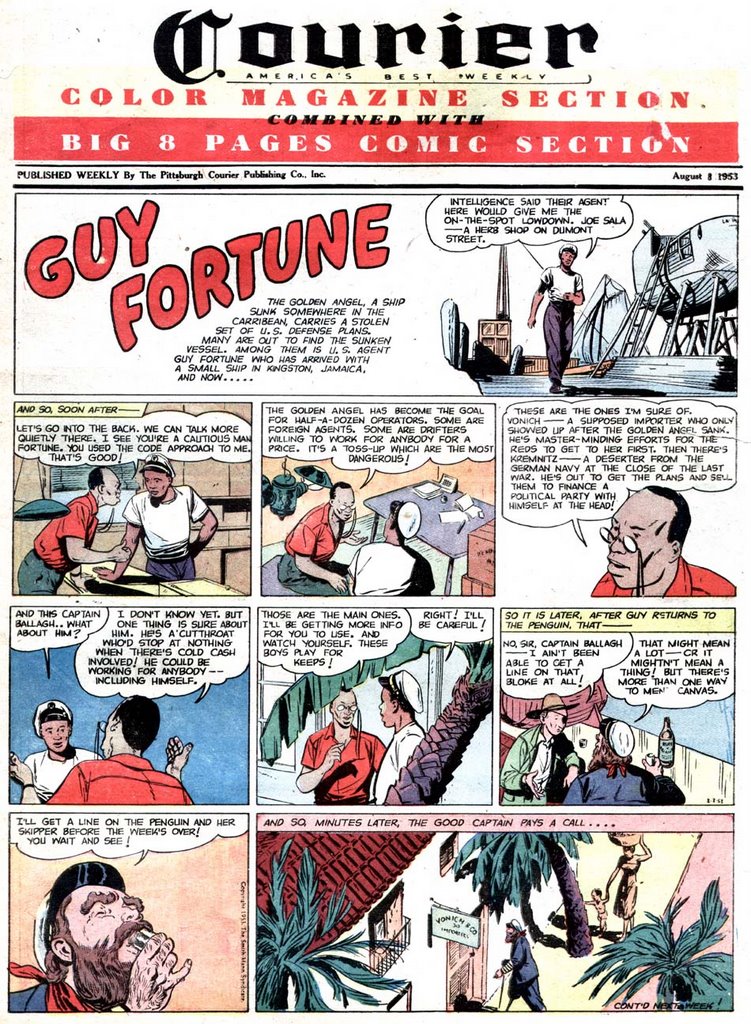
An interesting genre of newspaper comic strips are those that ran in the black papers; that is, newspapers intended to serve the African-American segment of the population.
Most larger cities have a black paper, or did at one time. Some of the biggies were the Chicago Defender, the Pittsburgh Courier, the Atlanta World, the Baltimore Afro-American and the New York Amsterdam News. All these papers dabbled to one degree or another in comic strips, and several of them even syndicated their comic strips to the smaller papers of other cities.
Unfortunately the history of black comic strips is necessarily sketchy. Most of the creators are long dead without having published memoirs or given interviews, and the microfilm records of the papers themselves are in a terrible state. I have done what I could by indexing the material in most of the major papers; but even my indexes are incomplete because microfilm versions of the papers are incomplete, mutilated, or just so badly photographed as to be indecipherable.
The comic strips of the Smith-Mann Syndicate, apparently run with or through the Pittsburgh Courier, have suffered because of the poor microfilm record. The Smith-Mann color comic section is the only such section ever to be attempted for black papers, and the microfilm of the Pittsburgh Courier (at least the version I've indexed), the only paper known to have run it, is missing the majority of these sections. The Smith-Mann color section was definitely offered in syndication, though, so perhaps lurking out there is another paper that ran it, and perhaps in that case it made it intact through the microfilming process. I hope so, but I think the chances are slim.
Over the next week or so I'm going to present all the comics from a rare copy of the section that I recently acquired (only the third I've found, though I've been searching them out for years). The date of this section is August 8, 1953. Our first strip, from the cover page of the section, is Guy Fortune by Edd Ashe. This strip ran from the inception of the section on August 19, 1950 through October 22, 1955. The color section ended in 1954, but the strip continued in black and white after that.
Labels: Obscurities
Wednesday, February 15, 2012
Ink-Slinger Profiles: Sam Milai
Ahmed Samuel Milai was born in Washington, DC on March 23, 1908, according to a family tree at Ancestry.com. In the 1910 U.S. Federal Census, he was the youngest of three children born to Mohamed and Sarah; his name was recorded as Elisha S.H. Milai. The family lived in Locust Dale, Virginia. The census said his father, a traveling artist, was born in "Spain Hindi"; he immigrated in 1898. Milai's paternal grandparents were born in "India Hindi." His mother and maternal grandparents were born in Virginia; in the 1880 census under the column, Color of Race, her family was classified as mulatto. In 1910 the Milai family was described as mulatto.
Milai's father painted the murals for the Central Baptist Church in Charleston, South Carolina. A report documented the history of the church with photographs of the church exterior and interior, and the murals.
In 1920 the family lived in Pittsburgh, Pennsylvania at 174 Auburn. Milai's name was recorded as Samuel, and his father's name was Amohamed, who was born in India. According to the family tree, Milai's father passed away on March 1, 1924 in Detroit, Michigan.
Milia has not been found in the 1930 census. Shortly after the census, Milai married Bernice Rucker. The family tree said their son, Ahmed Samuel Jr., was born in Pittsburgh on August 23, 1931. According to the Delaware Death Records at Ancestry.com, Milai's mother passed away on April 15, 1932 in New Castle.
Milai found work as a cartoonist at the Pittsburgh Courier, which published his strips Bucky (1937), Your History (1940), Don Powers (1950) and others.

Your History
Milai passed away on April 30, 1970 in Pittsburgh. A photo of Milai was published in African Americans in Pittsburgh (2006). The Billy Ireland Cartoon Library & Museum, at Ohio State University, mounted the exhibition, Sam Milai of the Pittsburgh Courier in 2008.
Labels: Ink-Slinger Profiles
Thursday, June 19, 2008
Miscellany Day
Gordon Campbell's Collection Found!
Regular blog readers know that I've been bemoaning the disappearance of Gordon Campbell's incredible vast collection of early tearsheets and original art. He'd talked to me shortly before his death and said he still hadn't made any final decisions about the final disposition of his collection. I suggested Ohio State University, but I knew that they hadn't been the lucky recipients.
I've been asking around for years now, trying to find out what exactly did happen to it, but no one seemed to have an inkling. My worst fear was that the whole collection ended up in a landfill, a fate that would have been a loss almost too horrible to bear.
Finally an anonymous source has come forward to tell me that Steve Geppi, owner and president of Diamond Comic Distributors, now has the collection. It is reportedly all boxed up at his Geppi's Entertainment Museum, presumably someday to be used in the displays. No word on how exactly Geppi came to be the owner; whether Gordon or his heirs sold it to Geppi, or if it was a donation (highly doubtful, I think).
I can't say I'm exactly happy about the new ownership. I would have much preferred to have it end up in a research facility rather than a ballpark pop culture attraction. It seems to be without any facilities or, apparently, interest in serving researchers (I note that the Educational Programs link is empty, for instance). On the other hand, it's better than a landfill. But it seems a little like having Neil Armstrong's spacesuit end up at an MTV museum if you know what I mean.
Jackie Ormes Book
I had originally planned to review Nancy Goldstein's fabulous book Jackie Ormes - The First African American Woman Cartoonist on the blog but instead I will be reviewing it for the next issue of Hogan's Alley. Given the publication schedule of HA and the speed at which books go out of print these days, I just wanted to give you folks a heads-up that you will definitely want to purchase a copy. It's a first rate piece of research, entertaining, and reproduces wonderful material that is about as rare as it comes.
Pittsburgh Courier on Proquest
I know at least a few blog readers have access to Proquest, the digitized newspaper archives. If you do I'd like to ask you a favor. I'm currently in need of good quality comic strip reproductions from the Pittsburgh Courier and the microfilm is in terrible condition. I know that Proquest recently added the Courier to its list of digitized newspapers.
The nearest facility to me that has the Courier from Proquest is about 120 miles away, and with the price of gas these days I'd rather not make that trip only to find out that the digitized version is no better than the microfilm. If you have access could you please do a little spot-check for me (I'm mostly interested in the 1930s-50s) and report back regarding the quality of the scans? Some Proquest material is stunningly good, others are so low resolution and pixilated that they're of no use for my purposes.
Regular blog readers know that I've been bemoaning the disappearance of Gordon Campbell's incredible vast collection of early tearsheets and original art. He'd talked to me shortly before his death and said he still hadn't made any final decisions about the final disposition of his collection. I suggested Ohio State University, but I knew that they hadn't been the lucky recipients.
I've been asking around for years now, trying to find out what exactly did happen to it, but no one seemed to have an inkling. My worst fear was that the whole collection ended up in a landfill, a fate that would have been a loss almost too horrible to bear.
Finally an anonymous source has come forward to tell me that Steve Geppi, owner and president of Diamond Comic Distributors, now has the collection. It is reportedly all boxed up at his Geppi's Entertainment Museum, presumably someday to be used in the displays. No word on how exactly Geppi came to be the owner; whether Gordon or his heirs sold it to Geppi, or if it was a donation (highly doubtful, I think).
I can't say I'm exactly happy about the new ownership. I would have much preferred to have it end up in a research facility rather than a ballpark pop culture attraction. It seems to be without any facilities or, apparently, interest in serving researchers (I note that the Educational Programs link is empty, for instance). On the other hand, it's better than a landfill. But it seems a little like having Neil Armstrong's spacesuit end up at an MTV museum if you know what I mean.
Jackie Ormes Book
I had originally planned to review Nancy Goldstein's fabulous book Jackie Ormes - The First African American Woman Cartoonist on the blog but instead I will be reviewing it for the next issue of Hogan's Alley. Given the publication schedule of HA and the speed at which books go out of print these days, I just wanted to give you folks a heads-up that you will definitely want to purchase a copy. It's a first rate piece of research, entertaining, and reproduces wonderful material that is about as rare as it comes.
Pittsburgh Courier on Proquest
I know at least a few blog readers have access to Proquest, the digitized newspaper archives. If you do I'd like to ask you a favor. I'm currently in need of good quality comic strip reproductions from the Pittsburgh Courier and the microfilm is in terrible condition. I know that Proquest recently added the Courier to its list of digitized newspapers.
The nearest facility to me that has the Courier from Proquest is about 120 miles away, and with the price of gas these days I'd rather not make that trip only to find out that the digitized version is no better than the microfilm. If you have access could you please do a little spot-check for me (I'm mostly interested in the 1930s-50s) and report back regarding the quality of the scans? Some Proquest material is stunningly good, others are so low resolution and pixilated that they're of no use for my purposes.
Comments:
Having gotten to know Gordon in his later years, I'm glad to see this. However, I'm curious at what exactly has turned up, as I know at least some of the originals from his collection were sold a few years ago in one of Russ Cochran's comic art auctions. Gordon's favorite part of his collection was the set of scrapbooks in which he was hoping to mount one published example of every comic strip ever created. He spent a lot of time in his retirement years trying to track down obscure titles he didn't have. This is what I'm hoping has turned up in the museum for people to view. As for his many file cabinets full of collected strips and the attic full of unclipped newspaper pages, maybe those will spark the publishing by Diamond of some reprint collections that would otherwise have not found their way to market. He used to sell strips from this stock for "pocket money" after he retired, and I can't help but wonder if somewhere in the collection there's still a bunch of Batman strips in an envelope with my name written on the outside, which he had pulled together to sell to me before he became too ill to continue his hobby. As for how Geppi got the collection, I only know that the materials most likely went to a nephew who helped him a lot after his wife passed away, as the Campbells had no children. I do remember Gordon saying there were several who were interested in getting his collection as a donation, but that he was hoping the collection could bring a financial reward to him or his nephew. Unfortunately, it was several months after his death before I learned he had died, so I do not know the story of what happened to the collection, and of how parts of it got to Cochran and Geppi.
Post a Comment
# posted by  : 6/20/2008 9:02 AM
: 6/20/2008 9:02 AM Thursday, February 16, 2012
Obscurity of the Day: Don Powers


One black creator who did get space was Courier regular Sam Milai. Milai's work appeared in the paper for over three decades, starting in 1937. By 1950, when the color section began, Milai was already practically an institution at the paper. He was an ambidextrous cartoonist, quite at home with both bigfoot humor and straight illustration. Milai sought to show off his ability to do a realistic adventure strip for the color section, and came up with a sports feature titled Don Powers. The strip featured a clean-cut hero who is the Joe DiMaggio of baseball, Muhammad Ali of boxing, and Red Grange of football all rolled into one. He gets into all sorts of scrapes with gamblers, gangsters, rivals and so on, and triumphs mainly by being so pure and faultless.
The strip debuted with the new color section on August 19 1950, and outlived the section by many years. After the color section was dropped in August 1954 the strip switched to black and white, slowly reduced in size to a daily-style strip, and lasted in the Courier until November 1 1958.
Thanks to the University of Michigan Special Collections Library for photos of their collection of Courier color sections. They have the only known run of the early color sections from 1950-51, and were very gracious in sharing photos of the strips in their collection with me. Above are the 1st, 2nd and 4th strips in the Don Powers series.
* There was one other color comic strip, but it was just a single strip, not a section.
Labels: Obscurities
Comments:
Post a Comment
Saturday, August 12, 2006
Obscurity of the Day: Bucky
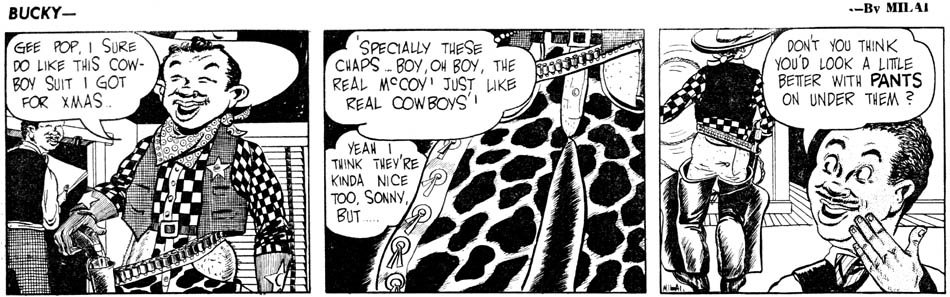
We talked quite a bit about the Pittsburgh Courier a few weeks ago, in regard to their color comics section. Here's an earlier Courier strip which actually died as a casualty to the creation of that section. Bucky first ran on July 31 1937, credited pseudonymously to 'Bobby Thomas'. Samuel Milai, the actual creator of the strip, was doing so much work for the Courier that he would occasionally sign his material with other names. This was probably at the behest of the paper. It's my guess that the Courier wanted to appear to have more cartoonists working for it than it actually did. The pseudonym didn't last for long on Bucky, though, and Milai took credit for most of the run.
Bucky wasn't particularly memorable, being yet another precocious kid strip, but Milai's artwork was of better quality than the typical fare found in the black papers.
The strip ran until August 12 1950, ending the week before the inauguration of the new color comics section. Thirteen years is a marathon run for any feature in the 'race press', where strips came and went quickly, often because the artists failed to get paid for their work. Milai wasn't out of work, though - he started the Don Powers strip for the color comics section.
Bucky was resurrected for a short while in Milai's John Henry and his Friend Bucky which ran in the Courier in 1960-61.
Labels: Obscurities
Tuesday, February 14, 2012
Obscurity of the Day: Woody Woodenhead


The creator, Edo Anderson, I know nothing about except that he did a few things for Smith-Mann Syndicate and the Courier, chief among them being Woody. He certainly did have an interesting drawing style -- note for instance the noses on the characters which look like they were chiseled out of a block of wood.
Woody Woodenhead debuted along with the Smith-Mann color comics section on August 19 1950 and ran until August 4 1956, outliving the color section in the Courier by two years. After the first few years the title of the strip was often abbreviated to just Woody.
Thanks to the University of Michigan Special Collections Library for photos of their collection of Courier color sections. They have the only known run of the early color sections from 1950-51, and were very gracious in sharing photos of the strips in their collection with me. Above are the first two strips in the Woody Woodenhead series.
Labels: Obscurities
Comments:
Post a Comment
Monday, February 20, 2012
Obscurity of the Day: Lohar


By far the most unusual of the new strips that debuted in the Pittsburgh Courier's color comics section in 1950 was Lohar. I believe this may be the only dramatic newspaper strip ever to star a wild animal in its natural habitat. Not only was the premise unusual, but the strip was really well-written and drawn.
Lohar is the story of a leopard in northern India, and the title of the strip comes from the name of a warrior caste there. Eventually the strip gets rather strange -- the leopard at one point ends up in the Arctic -- but I have read only isolated episodes so I just can't say if the storytelling was loopy or if the plot developments were organic.
Paradoxically, although Lohar was the most intriguing (at least to me) strip in the comics section, it was rarely or perhaps never signed. The credit on the strip I determined through the Editor & Publisher listing, which cited someone named Tom Brady. I know nothing of this person, and wonder if it was one of the other section contributors working under a pseudonym. However, the art style is different enough that I really don't think so.
Lohar debuted with the new Courier color section on August 19 1950, and outlived the section, eventually becoming a daily-style strip in the Courier. The strip ended on October 18 1958.
Thanks to the University of Michigan Special Collections Library for photos of their collection of Courier color sections. They have the only known run of the early color sections from 1950-51, and were very gracious in sharing photos of the strips in their collection with me. Above are strips 1-3 in the Lohar series.
Labels: Obscurities
Comments:
Hi
The artist name is Bill Brady.
If you want to see more images of Lohar go to this link.
http://museumofuncutfunk.com/2014/02/16/when-we-were-colored-exhibition/
Alan Messmann
501 922 3366
Son of Mann of Smithmann
The artist name is Bill Brady.
If you want to see more images of Lohar go to this link.
http://museumofuncutfunk.com/2014/02/16/when-we-were-colored-exhibition/
Alan Messmann
501 922 3366
Son of Mann of Smithmann
# posted by : 2/21/2014 1:54 AM
: 2/21/2014 1:54 AM
Hi Alan --
Sorry, I see no Lohar images in that post, or any art signed by Brady. How did you determine that the artist on Lohar was named Bill Brady? Do you have any biographical information on this artist? Any idea why the strip was credited to Tom Brady in Editor & Publisher?
Sorry, I see no Lohar images in that post, or any art signed by Brady. How did you determine that the artist on Lohar was named Bill Brady? Do you have any biographical information on this artist? Any idea why the strip was credited to Tom Brady in Editor & Publisher?
I new him when I was a child he (Bill Brady ) was a good friend of my father.In a few weeks a comic section will be added to this sit in it you will see many more Lohar.
Could you e mail me I have a few questions for you?
Thanks Alan Messmann
amessmann@aol.com
Post a Comment
Could you e mail me I have a few questions for you?
Thanks Alan Messmann
amessmann@aol.com
# posted by : 2/27/2014 7:00 PM
: 2/27/2014 7:00 PM Friday, April 22, 2011
Obscurity of the Day: Your History


Your History was a delightful and yet instructive mix of Ripley's-style items and more serious history. The feature began on November 10 1934, with art initially by George L. Lee. Lee wasn't much of an artist, or at least was a bad choice for a feature that depended on realistic illustrations. He doggedly stuck with it, though, until July 31 1937 when the feature went on a long hiatus.
On November 16 1940 the feature returned to the pages of the Courier under the more professional collaborative brush of Samuel Milai. Milai was better able to handle the art chores, though even he was much more at home with more traditional cartooning.
The title of the feature changed to Facts About the Negro in 1962, for unknown reasons (my guess is that the title change signaled that the feature had gone to reprints). Rogers died in 1966, but the feature was carried by the Courier regularly until February 13 1971, and popped up occasionally after that.
Your History is a rarity among black newspaper features in that it was actually published in book form. Rogers self-published quite a few books of his prose work, so it was only natural that he also published Your History in book form as well. The first book, titled Your History, was published in 1940, and Facts About the Negro around 1960 (it carried no publication date).
Labels: Obscurities
Wednesday, June 29, 2016
Obscurity of the Day: Ain't It The Truth?

Sam Milai was one of the anchor cartoonists at the black-owned and operated Pittsburgh Courier from the 1930s to 60s. In addition to his long-running series Bucky, Sunnyboy Sam and Your History, he did a few short-lived ones, like Ain't It The Truth?
This panel, which ran in the weekly Courier from December 17 1938 to June 10 1939, was apparently written for Milai by a fellow named Jack Rutledge. I know nothing about him, but he did seem to have a slightly more sophisticated ability to write cartoon comedy than Milai, as displayed in the sample above. That left Milai to do what he did best -- draw delightful cartoons.
Labels: Obscurities
Tuesday, December 15, 2015
Ink-Slinger Profiles by Alex Jay: Jay Jackson

In the 1910 U.S. Federal Census, Jackson was the fourth of five children whose father was a photographer. The family resided in Delaware, Ohio at 41 Ohio Street.
According to the 1920 census, Jackson and his younger sister lived with their parents in Delaware at 119 David Street.
Who’s Who said Jackson married Adeline C. Smith in 1925. Jackson attended Ohio Wesleyan University from 1925 to 1926. Beginning in 1926 Jackson was a feature artist with the Pittsburgh Courier newspaper. American Newspaper Comics (2012) said Jackson produced two weekly panels, Seeing Ourselves As Others See Us and The Jingle Belles, for the Courier in 1928. That same year Jackson began studies at the Chicago Art Institute. Jackson was a poster artist for the Warner Brothers’ theaters from 1928 to 1933. Jackson also contributed illustrations to the digest, Abbott’s Monthly, in 1928 and 1929. Abbott’s publisher was Robert S. Abbott who also published the weekly newspaper, Chicago Defender, which printed editorial cartoons by Jackson. In MELUS, Summer 2014, Amy M. Mooney said Jackson formally joined the Defender staff in 1933. The short-lived Abbott’s Weekly was another periodical with Jackson’s art.
The 1930 census recorded Jackson, a widower, as a lodger in Chicago at 465 Oakwood Boulevard. His occupation was commercial artist for theaters.
According to Who’s Who, Jackson painted the mural, Old Mexico, for the 1933 Chicago World’s Fair. In 1934, Jackson began a fourteen year relationship with the New York Amsterdam News newspaper. Jackson’s second marriage was to Eleanor K. Poston of Republican, Nebraska, in 1935.
According to American Newspaper Comics, Jackson produced several comics strips, panels and advertising strips throughout the 1930s: As Others See Us (1933); The Adventures of Bill (1934); Bungleton Green (1934; the third artist on Leslie M. Rogers’ creation); Fan Tan Anne (1935); Society Sue (1935); Bibsy (1935); Between Us (1936); Memphis Blue (1936); Cream Puff (1936); Tish Mingo (1937); Ben Franklin (1938); So What? (1939); and Billy Ken (1939).
Some of Jackson’s commercial work was featured recently at the Chicago Cultural Center.
In 1940, cartoonist Jackson, his wife and thirteen-year-old daughter, Carrie, resided at 6011 South May Street in Chicago. The census record said Jackson earned $1,800 in 1939. Who’s Who said Jackson did fashion art, layout, and catalog design or the National Clothing Company throughout the 1940s. During World War II Jackson produced cartoons for the Office of War Information and The Sergeant for Office of Price Administration in 1945. Jackson received a citation from Henry Morgenthau, Secretary of the U.S. Treasury, for the cartoons and posters backing the war bond campaign.
American Newspaper Comics said Jackson drew Exposition Follies (1940); Speed Jaxon (1942–1947); Ravings of Professor Doodle (1947); and Glamour Town (1948).
The Real Pepsi Challenge: The Inspirational Story of Breaking the Color Barrier (2008) explains Jackson’s role in the company’s 1948 advertising campaign which ran in Ebony magazine. Who’s Who said Jackson was art director at Negro Digest and Ebony.
Some time in the late 1940s, Jackson moved to Los Angeles, California. In 1949, Norman Rockwell lectured at Art Center College of Design. Who’s Who said Jackson studied with Rockwell that year.
The Arkansas State Press, September 8, 1950, reported Jackson’s two-page illustration for the latest edition of Who’s Who in Colored America.
The montage represents the manifold callings and interests of the over 3,000 persons whose biographical sketches will be carried in the publication—from Army officers to United Nations officials. The layout, printed in sepia, will decorate the inside covers…The article went on to say that Jackson “also did special work, summers, under Rockwell Kent and at the Los Angeles Art Institute….He now conducts a national art service for advertisers from his Los Angeles studios (2306 West 23rd Street). In 1951 Jackson provided artwork for Who’s Who in the United Nations.
American Newspaper Comics said the Jay Jackson Features Syndicate produced Girligags and Home Folks in the 1950s.
According to Who’s Who, Jackson received two Guild awards for newspaper cartoons. He was a member of the American Newspaper Guild and the National Association for the Advancement of Colored People.
Jackson passed away May 16, 1954 in Los Angeles, according to the California Death Index at Ancestry.com. His death was reported in Jet, May 27, 1954.
—Alex Jay
Labels: Ink-Slinger Profiles
Comments:
Some might know Jackson for his illustrations for Ziff-Davis magazines in the early 1940s. He was a regular in the pages of Amazing Stories and Fantastic Adventures. His dynamic drawing style was instantly recognizable.
Post a Comment
Tuesday, September 05, 2006
Obscurity of the Day: Patty-Jo 'n' Ginger

Jackie Ormes has acquired some interest from comic strip fans for her Torchy Brown series (see a sample here), mainly because of the strip reproduced in an old issue of Nemo. But Torchy was hardly more than a blip on Ormes' map. Patty Jo 'n' Ginger was her bread-and-butter cartoon, and it lasted more than a decade in the Pittsburgh Courier and other papers. I trust that the appeal of the panel needs no explanation.
Patty-Jo 'n' Ginger started on September 1 1945 and ended on September 22 1956. Near the end of the run the panel appeared only sporadically in the Courier.
Labels: Obscurities
Sunday, July 09, 2006
Smith-Mann Syndicate IV: The Chisholm Kid
 Here on page four of the Pittsburgh Courier's comic section we find the delightfully drawn Chisholm Kid. The strip was by Carl Pfeufer. His credits include the Flash Gordon clone Don Dixon, done for the Brooklyn Eagle-based Watkins Syndicate, and Bantam Prince for the New York Herald-Tribune Syndicate (blogged here).
The Chisholm Kid was a new strip created for the Courier's color section on August 19, 1950. As with many of the other strips, it outlasted the color section and was demoted to daily-style black and white format. The Kid rode into the sunset on August 11, 1956.
Labels: Obscurities
Comments:
Hi Allan Holtz, I just wanted to tell you the information on my grandfather Carl Pfeufer is incorrect. You have :The strip was by Carl Pfeufer, a black cartoonist whose outstanding facility with the pen had allowed him to cross over the color line and draw for the mainstream syndicates.
Carl Pfeufer was not black but German.
Carl Pfeufer was not black but German.
# posted by : 4/11/2007 7:06 PM
: 4/11/2007 7:06 PM
Hi Anonymous -
I've just been having a private discussion with some other comics scholars where we were kicking around just this question. We'd really love to know more about Carl so if you could contact me I'd be very grateful. My email address is stripper@rtsco.com.
--Allan Holtz
Post a Comment
I've just been having a private discussion with some other comics scholars where we were kicking around just this question. We'd really love to know more about Carl so if you could contact me I'd be very grateful. My email address is stripper@rtsco.com.
--Allan Holtz
Friday, July 07, 2006
Smith-Mann Syndicate III: Don Powers

Here's page three of our Pittsburgh Courier section featuring the adventures of Don Powers by Sam Milai. Milai was was one of the mainstays at the Courier; he did comics for them from 1937 through at least the early 1960s (his work appeared there until the early 70s but the later material was most likely reprints).
In this strip Milai shows himself to be a fan of George Wunder; many of the faces are drawn in Wunder's distinctive style.
Don Powers is yet another strip that was created especially for the color section - it started with the first issue August 19, 1950 and ran through the end of the color section in 1954. The strip then continued on as a black and white daily style feature until November 1, 1958.
Labels: Obscurities
Thursday, July 06, 2006
Smith-Mann Syndicate part II: Torchy in Heartbeats
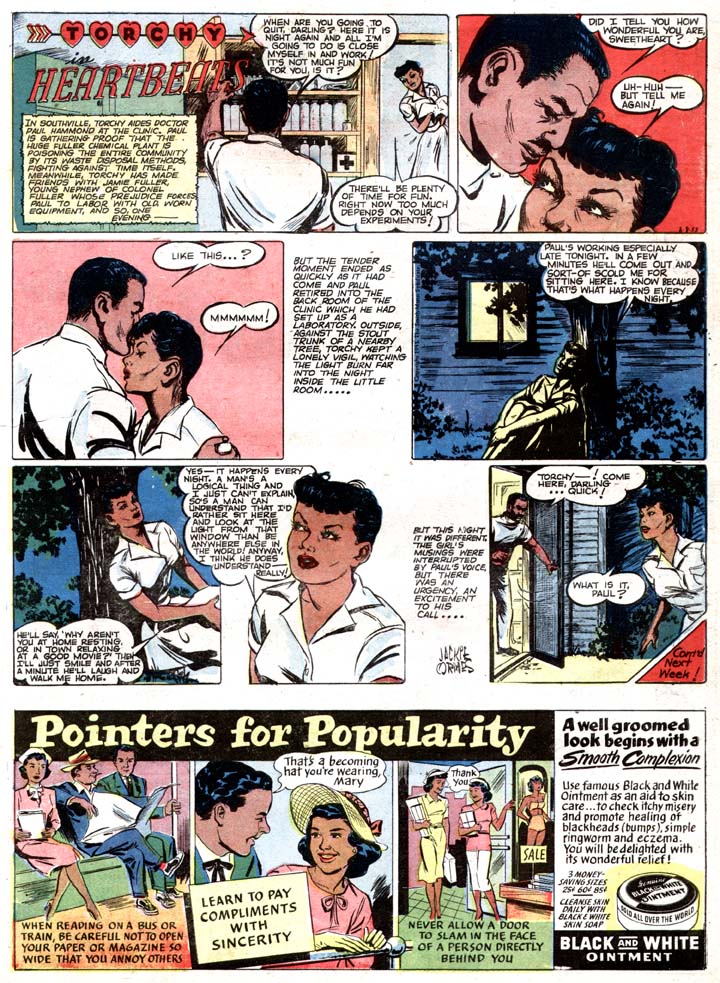
Jackie Ormes' Torchy in Heartbeats hits on all cylinders as an interesting obscurity. Ran in a black newspaper, written and drawn by a woman, and the subject is romance. That's like the unassisted triple play of rarity in newspaper comics. Torchy in Heartbeats started with the color section on August 19, 1950, and outlasted the color section by a while, ending September 18, 1954. The strip also had a paper doll topper called Torchy Togs, which here in our example was bumped in favor of an ad (the ad is pretty interesting, though).
Jackie Ormes created her Torchy character much earlier in a series titled Torchy Brown in Dixie to Harlem. This strip ran in the Pittsburgh Courier 5/1/37 - 4/30/38. Ormes' longest-running series, though, was a humor panel titled Patty-Jo 'n' Ginger - that one ran in the Courier for over a decade starting in 1945.
The ad for Black and White Soap is a typical example of the preaching that went on in the black papers of the time. All through these papers -- not just in ads -- were constant reminders to use good manners, dress properly and generally behave in a manner that reflected well on the black community. Most papers took the philosophy that good manners were vital in the cure for the racism endemic to the U.S. This preaching went out of favor in the newspapers by the 60s, but was harped on constantly before that. Quite a few comic panels in the black papers had this as their subject matter, for instance As Others See Us and Folks We Can Get Along Without.
Labels: Obscurities
Comments:
Hi, Allan!
It's been years (since that reprint in Nemo No. 28, in fact) that I've wanted to see this strip in color. Thank You! I still hope somebody will reprint this someday.
It's been years (since that reprint in Nemo No. 28, in fact) that I've wanted to see this strip in color. Thank You! I still hope somebody will reprint this someday.
# posted by : 7/06/2006 12:13 PM
: 7/06/2006 12:13 PM
I never knew this woman or her comic strips existed. As an African American woman, it was a such a treat to read about her during her pioneer years and then to come across her comic strip. Thank you for posting this up Allan! A rare fine indeed that I will be sure to share! I would also love to see this reprinted some day. :-)
Post a Comment
# posted by : 8/09/2007 4:31 AM
: 8/09/2007 4:31 AM Tuesday, February 28, 2012
Ink-Slinger Profiles: George L. Lee

George L. Lee was born in Jamestown, New York on July 27, 1906. In the 1910 U.S. Federal Census, Lee was the youngest of two sons born to George and Grace. They lived in Jamestown at 839 North Main Street. His father owned and operated a barber shop. In 1914, Grace took her two sons to Spokane, Washington, and later to Wenatchee and Seattle, where Lee graduated, in 1925, from Garfield High School. As a senior he was interested in art but had little formal training after high school, just a few months at the Chicago Art Institute.
Lee has not been found in the 1920 census. He moved to Chicago, in 1927, where he worked, for five years, as a messenger at the Pure Oil Company. The company magazine recognized his talent and he drew some of the covers. His interest in sports illustrations led him to the boxing publication, Bang, which published his first drawings on its cover in 1929. In a short time, Lee met Chicago Evening American sports editor, Eddie Geiger, who liked his work. The front page of the August 24, 1930 sports section was his debut in a major publication. He also contributed sports drawings to the Chicago Tribune.
Lee has not been found in the 1930 census. A syndication deal fell through, in March 1933, when it was learned that he was black. He rebounded quickly when Chicago Defender editor, Lucius Harper, collaborated with him on a series called Sporting Around. The following year, the Pittsburgh Courier engaged Lee to work on the feature, Your History, with text by J.A. Rogers, a black historian.
In 1936 Lee married Jennie Hicks; they had a son. He continued to freelance while employed, beginning in 1937, at the Postal Service. His series, Interesting People, combined portraits and brief biographies of black Americans. The series ran from 1946 to 1948. In the 1950s the International Boxing Club used Lee's talents for their publicity cartoons for the big fights in Chicago.

Interesting People, Chicago Metro News, 9/25/1976
In 1969 he retired from the Postal Service. The following year, he returned to Interesting People, which ran until 1986, the year he retired; he was 80. The Chicago Metro News (Illinois) published the panel from September 25, 1976 to June 2, 1990 (probably included reprints after his 1986 retirement); he was profiled (see photo) in the October 2, 1976 issue. His work was collected in four books from various publishers: Interesting People (1976, 1989, 1992, 1999), Interesting Athletes (1990, 1993), Inspiring African Americans (1991) and Worldwide Interesting People (1992).
I believe Lee passed away on November 3, 1999 in Columbia, Maryland. The Social Security Death Index has a "George L. Lee" with the same birthdate and his Social Security number was issued in Illinois.
Sources:
African American Biographies: Profiles of 558 Current Men and Women (1992).
Chicago Metro News (Illinois), October 2, 1976, "Author of Interesting People Highlighted", p. 5.
Labels: Ink-Slinger Profiles
Wednesday, August 21, 2013
Ink-Slinger Profiles: Louis Richard
Louis Joseph Richard was born in Bardstown, Kentucky, on May 3, 1885, according to his World War I and II draft cards at Ancestry.com. In the 1900 U.S. Federal Census he was the second of five children born to Richard and Nannie. They resided in Columbus, Indiana at 508 California Street. Richard was a bell boy and his father, a French emigrant, was chief hotel cook. The census recorded Louis’ date of birth as May 1885.
The book, Indiana’s Laughmakers (1990), profiled Richard and said: “...Cartooning ‘came to me by chance,’ he once said, ‘while a bellhop at the St. Denis Hotel, when I caricatured guests in unusual or amusing poses on the backs of menu cards….’ By the time he was 17 years old he was making money with his cartooning…” In the early 1900s, he was cartoonist for The Evening Republican.
The 1910 census recorded the family in the same city, a few houses from their old address, at 602 California Street. His mother’s name was recorded as “ Margarette”. Richard was an assistant claim agent for a railroad company.
Richard’s Indiana Daily Times cartoons of the 70th Indiana General Assembly were collected in a book and published in 1917.
According to American Newspaper Comics (2012), Richard produced the strip Squire Edgegate, which was distributed by World Color Printing beginning in 1918.
.jpg)
Elkhart Truth 3/25/1918
.jpg)
Rockford Republic 3/25/1919
In 1919 Richard was one of several artists to contribute drawings to the Louisville Courier-Journal’s “Marse Henry Edition”. The Literary Digest, April 12, 1919, said: “…Harry C. Temple and Louis Richard, both of the World Color Printing Company, St. Louis, contributed drawings…the latter picturing Uncle Sam thanking ‘Marse’ Henry for the many volumes his genius had filled.”On September 12, 1918 he signed his World War I draft card. He was employed as a claim agent by the Pennsylvania, Railroad Company. His description was medium height and build with blue eyes and brown hair.
Indiana’s Laughmakers said: “…when he was transferred to Pittsburgh around 1920, he became chief claim agent of the railroad’s Central Region.” Richard has not yet been found in the 1920 census.
In 1927 he filed to trademark Squire Edgegate. The Official Gazette of the United States Patent Office, September 13, 1927, published this notice:
Ser. No. 252,662. Louis Richard, Pittsburgh, Pa.
Filed July 28, 1927.
SQUIRE EDGEGATE
Particular description of goods. — Cartoons in Newspaper Publications.
Claims use since Jan. 1, 1918.
In 1930 Richard lived with his wife, Justine, and two daughters, Louise and Justine, in Crafton, Pennsylvania at 24 Creighton Avenue. He married when he was 39 years old and continued as a railroad claim agent.
Bellevue, Pennsylvania, at 18 Kenndell [sic] Avenue, was the home of Richard, his wife and three daughters in the 1940 census. They had lived there since 1935. The census said he had six years of schooling and remained a claim agent for the railroad. He signed his World War II draft card on April 27, 1942. He was described as five feet five-and-a-half inches, 165 pounds, with blue eyes and gray hair.
Indiana’s Laughmakers said: “…He retired from the railroad in 1951 following a heart attack and died in Pittsburgh on October 31, 1959.” One source for the book was a number of articles in The Republican (Columbus, Indiana) dated October 8, 1930, October 10, 1930, August 10, 1935, February 24, 1936, October 14, 1936, and October 31, 1959.
Princeton University Library has a collection of American comic strip printing plates and drawings which includes “…200 aluminotype plates for the six panel strip called Squire Edgegate by Louis Richard.”
Labels: Ink-Slinger Profiles
Monday, March 11, 2019
Ink-Slinger Profiles by Alex Jay: Brandford
Edward Joscelyn Brandford was born on August 17, 1905 in Richmond, Saint Mary, Jamaica according to the Jamaica Civil Registration Birth Record at Ancestry.com. His parents were Luther Brandford and Edith Young. Brandford filed a Petition for Naturalization, on May 14, 1940, and said he was born at Highgate.
On April 10, 1924, Brandford was a passenger on the steamship Tivives when it departed Kingston, Jamaica. He arrived in the port of New York City on April 15. The passenger list said his occupation was clerk. His final destination was New Rochelle, New York where his aunt, Miss E. Milbourne, resided at 170 Elm Street.
Brandford was profiled in the April–June 1947 issue of Opportunity which said “In Jamaica he had been apprenticed to a British academician, with whom he studied painting. He had also taken a correspondence course from an American art school…..”
Brandford was also profiled in The Crisis, January 1947.
After completing the course, he felt he was ready to apply for a job, so he approached the firm that was then Doubleday, Doran & Co., in the hope of getting employment as a commercial artist. “As I look back now,” he said, “I still can’t understand why they didn’t throw me out bodily along with my very amateurish drawings. Instead, they were most kind and told me I should study some more and work very hard.”On January 31, 1929, Brandford and “Thelma O'Conahan” obtained a marriage license in Manhattan, New York City as recorded at the New York, New York, Marriage License Index at Ancestry.com. The New York, New York, Extracted Marriage Index said Brandford and “Thelma L Conohan” married on February 3, 1929 in Manhattan.
The 1930 census said the couple lived in Manhattan at 258 West 117th Street. Brandford was employed as a shipping clerk.
Opportunity said Brandford worked as an elevator operator, messenger and factory hand to earn enough money for tuition at Cooper Union where he graduated in 1930.
Brandford’s work was included in the Harmon Foundation’s An Exhibition of Work by Negro Artists, at the Art Center, February 20 to March 4, 1933.
Edward Joscelyn Brandford, New York—Born 1905 in Jamaica, B. W. I., and came here in 1924. Worked in lampshade factory; financed his study at the Barile School and Cooper Union as elevator operator. Had one man show at 135th Street Branch of New York Public Library. Work shown in Harmon Exhibit of 1931.The Brooklyn Daily Eagle (New York), February 15, 1931, said the judges for the Harmon Award and exhibition, at the Art Center, awarded an honorable mention to Brandford, 1031 E. 217th St., New York, for his “Broken Toys” painting. This painting, according to the Pittsburgh Courier, December 18, 1931, was included in the Harmon Foundation’s traveling exhibition of Black artists at the Spooner-Thayer Museum of Art at the University of Kansas. The next stop was the Milwaukee Art Institute as reported by the Milwaukee Journal, January 10, 1932.
In 1932 Brandford wrote about the Black artists for the newspaper, New York Age. On June 25, 1932 the paper announced the following.
The New York Age is pleased to announce the addition of Edward J. Brandford to its staff as cartoonist and artist, and will present in the near future an original comic strip by Mr. Brandford. Mr. Brandford will head the newly established art department.
A graduate of Cooper Union, Mr. Brandford has also studied under Xavier J. Barile, well known artist. Last year, this rising young artist presented an independent showing of his works at the West 135th Street Public Library and received favorable comment by critics.
Competing for the Harmon Award, his exhibition at the Art Center, 65 East 56th Street, won honorable mention for him with his study of “Broken Toys” and his work has been on tour since with the exhibition for the past year.
Versatile in his work, Mr. Brandford has done commercial work—in label designs, layouts and advertising—and his work in color is just as fascinating as his black and white illustrations and cartoons.Brandford drew editorial cartoons from July 9, 1932 to May 5, 1934. On July 16, 1932 Brandford’s comic strip Sam debuted and ended on May 19, 1934.


Brandford was included in the Harmon Foundation publication Negro Artists: An Illustrated Review of Their Achievements (1935).
American Newspaper Comics (2012) said Brandford created two series for the International Negro Press. With writer Rosie Nelson, Brandford drew Food for Thought from June 30 to August 26, 1936. His second feature was The Jones Family which ran from August 4 to 26, 1936.
In The Crisis, Brandford said “Since the city was full of unemployed artists I thought I’d try my hand as a freelance cartoonist. I soon discovered that being a cartoonist involves more than originating a funny situation and thinking up a gag line to go with it. Besides, every other artist out of a job was tryig [sic] the same thing. So, I had to give up that idea.”
Brandford was hired at the Burland Printing Company which handled the printing and advertising accounts of several New York business firms. The exposure to commercial art influenced his decision to pursue a career in this field. Brandford went on to learn lithography at Lutz and Sheinkman Corporation.
The 1940 census recorded commercial artist Brandford, his wife, nine-year-old daughter and seven-year-old son in the Bronx, New York at 2700 Bronx Park East.
On May 5, 1941 Brandford became a naturalized citizen.
Brandford’s freelance work grew steadily which included brochures, posters, publication design, book jacket, illustration and packaging design.
Brandford’s most well-known achievement was co-founding a Black modeling agency on July 30, 1946. A 1946 issue of Printers’ Ink published the following.
New Negro Model Agency to Appeal to All MarketsA 1948 issue of Advertising & Selling noted Brandford’s agency expansion.
New York:—An all-Negro modeling agency that aims to appeal to both the Negro and the White markets has been formed here. Known as Brandford Models, Inc., the agency’s first step will be to supply models for products going solely to the Negro trade but will “eventually lead to the use of them in all markets,” according to Barbara Watson, one of the founders of the company.
The agency claims to have the first all-inclusive modeling school for Negroes Edward Brandford, commercial artist and president of the group, says, “All models are students, artists and writers, many of them working their way through school. I have been dreaming for years of a project like this where national advertisers can get copy befitting the Negro trade. Negroes represent vast spending power in America (according to latest figures, population-wise, the Negro market represents 10% of the entire American market) and yet never have had their wants or tastes consulted. Negro women, in their buying, never have had proper guidance, always have been neglected.”
Miss Watson explains that in the past famous Negro personalities and sketches have been used to illustrate ads with a Negro appeal. “But now our advertising can be brought to greater advantage by a full-time use of live models,” she stated.
Before the models can be used in a white market, “a subtle and non-flambuoyant [sic] promotion campaign must be pursued to point up the marketing advantages of a Negro model to sell merchandise to all color groups,” Miss Watson believes.
The third incorporator of the new modeling agency, which expects to get underway in “three or four weeks,” is Mary Louise Yabro, fashion editor of Our World. Offices are temporarily located at 55 W. 42 St.
An outgrowth of his Negro model service, “Brandford Models,” Edward Brandford has established a new advertising agency at 107 West 43 St., New York, specializing in the $16 billion Negro market. The new agency offers complete facilities, including merchandising and public relations, art and production and model services.New York Age, May 13, 1950, reported changes at Brandford Models, Inc.
Miss Barbara Watson, executive director of the Brandford Models, Inc., last week announced extensive plans for the well known agency following completion, of its reorganization. A stepped-up program of activities will include concentration on developing wider opportunity for Negro models in photographic and fashion work, she said.Fashioning Models: Image, Text and Industry (2012) said “By 1953, Brandford Models changed ownership and name to Barbara Watson Models, although the nomenclature 'Brandford Girls' continued to be used for pioneering African American models….”
Some consideration is also being given to changing the name of the agency in view of the withdrawal from the concern of Edward Brandford who, with Miss Watson, founded the corporation in 1946.
New York Age, June 2, 1951, published an advertisement for “The Ed Brandford Mannequins”, “distinctively styled Negro Mannequins”.
The New York Amsterdam News, September 21, 1963, said Brandford was treasurer of the newly formed Kingston Technical Alumni Association in New York City.
The New York Amsterdam News, August 30, 1969, said Brandford conceived the production “Colorama USA”, a musical and fashion narrative “about the experiences of a young black girl in her quest for identity.” The goal was to raise funds for West Indian scholars. “Colorama USA” premiered September 6 at Town Hall, in New York City, and was scheduled to tour the Caribbean and Latin America.
Brandford passed away May 1980 in New York City.
Further Reading
Afro-American Artists: A Bio-bibliographical Directory
Madison Avenue and the Color Line: African Americans in the Advertising Industry
—Alex Jay
Labels: Ink-Slinger Profiles
