Thursday, June 29, 2006
Ryan Walker, Part II
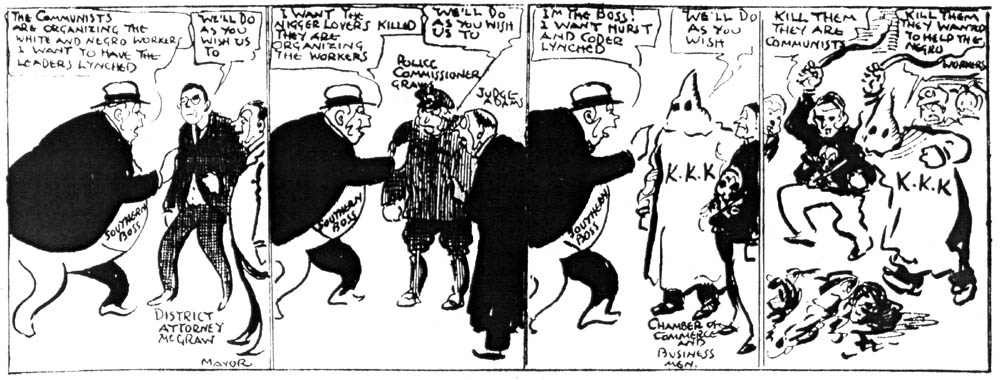
Hello again, comrades! Here is part two of our look at Ryan Walker. Above you'll find another Bill Worker strip from the Daily Worker; below you'll find his obituary and another memorial article, both real heavy on the whole proletariat-bourgeoisie-revolutionary jazz. Not to mention the occasional non sequiturs due to bad editing. Can you imagine anyone reading a daily paper where every single article every single day was written just the same way? It's exhausting, I tell ya!
As mentioned in the obit, Walker was indeed a big wheel for awhile at the St. Louis Republic - he was responsible for much of the content of their locally produced color comics circa 1901. There he created a comic strip title that makes me giggle any time I think of it -- The Automopig Family. The strip itself isn't much to speak of, but I do love that title. I'll have to dig one out sometime to share with you. Y'know, I can't help but think that it might be a good premise today. Big fat porkers driving around in their gas-guzzling Escalades. An idea whose time has come!
6/25/32
Ryan Walker's Life and Work Built Around Struggles of American Labor
Revolutionary Artist Was Known to Thousands of U.S. Workers
Born at Springfield, Ky., on December 26, 1870, Ryan Walker's early life was spent on a hilly, rolling farm. His people were of the early English settler stock, with a dash of Scotch and Irish.
Early Talented
At a very early age Ryan Walker developed the traits which had such a decided influence upon his career. To think for himself and express his own ideas, to read and reach out beyond his narrow environment, to draw pictures on every scrap of paper he could find, and to have a warmth for working folk -- the twenty miles from a railroad in the days before the telephone, radio or automobile.
Ryan's particular delight was to print with a pencil and draw cartoons for a little newspaper, and his mother used to help him print the words. From his mother he acquired that fine sympathy and understanding which made him rebel against the hidebound religious bigotry and rotten injustice, which later found a definite expression in his intensity as a Communist.
Studies Art
Ryan went to Texas with his parents. Later his father died and his mother remarried and went to Kansas City. Ryan attended the public schools in Kansas City and then spent two years studing art in New York.
He sold his first political cartoon to Judge when he was sixteen years old. Upon finishing his art schooling, he returned to Kansas City, where he took his first newspaper job with the Kansas City Star. It was on the Kansas City Times that Ryan's cartoons began to attract national attention and be copied in publications all over the world. The country was at high pitch over the Bryan-McKinley campaign, and Ryan's pictures of McKinley as puppet Napoleon on a hobby-horse and Mark Hanna dressed in a dollarmark checked suit created a great demand and many copies were distributed in the campaign.
Ryan then went to the St. Louis Republic and developed the first color section for that paper. His work by this time was well-known throughout the newspaper world and he began to get offers to come east. About this time he married Maud Davis.
Comes East
Ryan came to New York in 1901, and during the following years contributed work to a large number of newspapers and magazines. Later for three years he was the art director of the New York [Evening] Graphic.
For a number of years he was a regular contributor to the Appeal To Reason, creating the comic strip Henry Dubb which became famous. Henry Dubb was reprinted in booklet form and hundreds of thousands of copies were distributed. He illustrated many tracts and booklets which were sent out by thousands. Ryan developed a series of chalk talks which went over big with thousands of workers and farmers all over the U.S. and Canada. These talks were very popular and rolled up thousands of subscriptions for the Appeal To Reason. Then Ryan devoted his efforts to the New York Call, before the left wing split in 1919.
The Truth Seeker printed many of Ryan's cartoons and he illustrated a booklet for them entitled Funny Bible Stories which was widely circulated.
While Ryan had no children of his own, he was very fond of children. He used to have great fun in mill and mining towns, drawing little Henry Dubb sketches for crowds of children who would gather round him. The frightful condition of children in these towns touched him very deeply, and stirred him to greater activity.
Joins Communist Party
In the autumn of 1930 after several years of isolation from the revolutionary movement, Walker joined the Communist Part of the United States.
Several months previously he had already come to the Daily Worker as one of its staff artists. With characteristic fervor and enthusiasm, he threw himself into his work creating the new character Bill Worker which became known to thousands of miners, farmers and workers in the shops and mills.
Loved By Children
His juvenile characters Red Pepper and Joe Jr. were especially loved by the children, and the Young Pioneers of the country claimed Ryan Walker as their own. At the time, too, his chalk talks again were in great demand among the workers.
Will Be Remembered
Ryan Walker will live in the hearts of the workers and particularly those who knew him. He had a most lovable and charming personality. He was unselfish and a loyal fighter in the ranks of the working class. His visit to the Soviet Union , though being then quite ill, was the crowning adventure of his colorful career. He had travelled 16,000 miles over the U.S.S.R., seeing the great work of Socialism, and glorying in the realization of his dream, the triumph of the workers.
6/25/32
A Co-Worker Writes About Ryan Walker
Jacob Burck, "Daily" Staff Artist, Tells of His Day-to-Day Work With Him
In the rush of daily struggle we do not always stop to think of the qualities of those working with us. The death of a comrade brings home sharply what we have lost. In the last couple of years of acute strife, many of our comrades have fallen on picket lines, in protest demonstrations and on the no-man's land of the coal barons. Ryan Walker would have preferred to have died that way. He was that sort of revolutionist. Instead he daily stuck to his drawing board and sent out his Bill Worker, Red Pepper and John Henry to carry on the fight with those comrades.
Ryan Walker is dead. He died in the Soviet Union, the land where Bill Worker rules. Born on a small Kentucky farm in 1870, he grew up with the labor movement which was beginning to assert itself alongside the rise of big industry. He was still in his 'teens when the Haymarket martyrs went to the scaffold. Thomas Nast was making the Tammany tiger squirm with his savage drawings. Ryan Walker had just begun to draw. There were practically no art schools then; no young artists with false grandiose notions removed from actual life. If there were, the social consciousness and fire in young Walker could not have been drowned out by fallacious teachings. He was Irish-American -- a fighter. His homespun technique expressed exactly what he felt with no frills or trimmings.
Quite naturally he found himself in the company of other American fighters. Mother Jones, Bill Haywood, Mother Bloor [?] and Eugene Debs. There he found his real function. And so Henry Dubb the strip character known to all old revolutionaries was created and lived for years.
The war was over. The socialist party divided into two camps; the red and the yellow. Things were moving fast. The Soviet Union became an established fact. Ryan Walker found himself in a whirlwind of emotions. Old friendships proved disillusioning, old ideas had to give way to new. Ryan Walker had to readjust himself. He stopped drawing until he could see his way clear again.
The big ,crash came -- 1929. The Communist Party organized the big March 6th demonstration against hunger and unemployment. Workers and intellectuals became aware that the Party showed the only way out of this insane, vicious system. The rebellious spirit in Comrade Walker could not be quieted. Almost 60, he decided to cut himself completely off with old friends and strike out on a new revolutionary road continuing where he left off after the war. He joined the...
[microfilm illegible for most of a paragraph]
...of the Daily Worker and was admitted to the Communist Party.
It was then that I met him. The surprise was that this peppy, youthful man with a head that resembled very much that of a curly-headed child, was well past middle age.
Walking to Thompson's for a coffee and hamburger, it was I, less than half his age, who felt the older, hearing him get explosive at seeing a young bootblack chased by a cop, or a young girl slaving away in a restaurant. Like most artists he was extremely emotional, but unlike them he was keenly aware of the sort of world in which he lived. His work showed the same blending of qualities. He was like a mischievous kid running after a person it disliked and taunting him with embarrassing truths. Full-Belly-Hoover, Lord Cut-The-Dole-MacDonald, Hey-Gin-Broon, etc.
His cartoon strips were drawn in his own inimical [sic] manner. They were carefree, full of spirit, untainted by any art snobbery, uninfluenced by any of the stereotyped techniques characterizing most strip artists. They were not 'great' drawings according to the standards of the art critics. But they were genuine; part of the man himself. And what is more, part and parcel of the lives and struggles of thousands of workers. I say that is real art!
We have lost an artist and fighter. The younger artists who are now working in the movement can learn from Ryan Walker what qualities make working-class art.
Labels: Obscurities


Wednesday, June 28, 2006
The Last Hurrah of Ryan Walker
 Ryan Walker, the Communist cartoonist, was well known in their circles for his tireless cartooning in service of The Cause. His Henry Dubb character, created in the 1910s, was considered a classic of the genre. His last comic strip offering was The Adventures of Bill Worker, which ran in the Daily Worker 9/8/1930 - 10/21/1931. Submitted here for your perusal, an example from that series.
In my latest work at indexing the Worker I also found Walker's death notice, obituary and an article of remembrance by a friend. The microfilm is almost unbelievably bad, but I've managed to transcribe the material. Here's the death notice; tomorrow I'll post the other material and another Bill Worker cartoon.
A few sites of note; here's one that has Henry Dubb cartoons (long load time; dial-ups beware!), and here's one that reprints an article written about Walker in 1905.
6/24/32
Ryan Walker Is Dead
Revolutionary Artist for 32 Years
Moscow, U.S.S.R., June 23 -- Ryan Walker died yesterday in Rotkinsky hospital of pleuro-pneumonia. He was a staff cartoonist for the Daily Worker and a member of the Communist Party of U.S.A.
Ryan Walker had been active in the revolutionary movement for 32 years. He worked on the New York Call and the old Leader and other Socialist Party dailies. He toured the United States for the Socialist Party giving chalk talks on current political topics.
After the Bolshevik revolution in Russia, Ryan Walker broke with the Socialist Party and gave his support to the Soviet Union and the program of Lenin.
In the autumn of 1930 Ryan Walker joined the Communist Party. He became also an active member of the John Reed Club and gave all his great talent and energy to the revolutionary movement.
In October 1931 Walker went to the Soviet Union, being then quite ill, but determined to see the Worker's Fatherland. After a tour of the U.S.S.R. he contracted pneumonia in Moscow, and was sent to the hospital where four months later he died.
Labels: Obscurities
Comments:
Blah, the Boondocksnet.com link is dead (as is the whole domain), and it's not on archive.org; I don't suppose you remember what the original source of the 1905 article was?
Post a Comment
# posted by  : 2/01/2015 11:10 PM
: 2/01/2015 11:10 PM Thursday, November 07, 2013
News of Yore: Ryan Walker

The Inland Printer, August 1900

The Inland Printer, November 1900

The Inland Printer, March 1901

The New Adventures of Henry Dubb can be viewed here.
Walker’s life was examined in the Daily Worker, which also published his obituary. The 1850 U.S. Federal Census listed Walker’s mother, Dulcina, whose maiden name was Ryan.
Labels: News of Yore
Wednesday, February 02, 2011
News of Yore 1908: Sssh! You'll Get Me in Trouble!
Special Press Service Big Newspapers
Will Include Fiction, Humor, Dramatic Criticism and Circulation Boosters
The Fourth Estate, 7/18/1908
Henry Edward Warner, general press representative of the Shubert enterprises, leaves that position August 1 to establish a novel newspaper enterprise.
Donald Morris Jones, who has been Mr. Warner's assistant, will be associated with him in the venture, which will furnish specials and circulation boosters to the larger newspapers of New York and the country generally.
Ryan Walker will be in charge of the cartoon department.
The matter to be sent out will be known as the Wardon Specials and will include fiction, humor, dramatic criticism, photographs and occasional humorous articles by Mr. Warner, who formerly wrote over the nom-de-plume of "Sidelights" for the Denver Times and Baltimore News and who organized and was first president of the American Press Humorists.
Mr. Warner was born in Ohio thirty-four years ago and was educated at the University of California and U.S. Grant University, Chattanooga, Tenn. When about twelve years old he published a paper of his own, called the University Sun. He became city editor of the Chattanooga Times, Knoxville Journal and Tribune, Baltimore News and Denver Times; acted as press agent for Sarah Bernhardt and was appointed general press representative of the Shubert enterprises.
Mr. Jones, who is a graduate of the Temple College, Philadelphia, was born twenty-seven years ago and began his business life with the Ireland Advertising Agency. He made a tour of the best part of the world as a representative of Eugen Sandow, the strong man, and this season became assistant general press representative of the Shubert enterprises.
Letters to the Editor
July 25 1908
Sir: Howard Miller, president of the International Syndicate, Baltimore, Md., requests me to write you regarding the announcement which appeared in the last issue of The Fourth Estate relative to my being engaged by the Wardon News Syndicate as their cartoonist. The announcement was a slight mistake, and I sanction Mr. Miller's request to have it corrected. I am at present cartooning for the International Syndicate, and anticipate doing no cartoons for any other organization.
In justice to Mr. Warner, however, allow me to explain that I promised him some time ago to do theatrical caricatures for a theatrical feature, provided it did not conflict with any service put out by the syndicate I am now connected with. Doubtless Mr. Warner made the simple mistake in using the word "cartoons" instead of "caricature."
Signed, Ryan Walker
Labels: News of Yore
Tuesday, May 12, 2015
Ink-Slinger Profiles by Alex Jay: Doc Bird Finch

In the 1880 U.S. Federal Census, Finch was the youngest of two children born to James and Ella (Helen). His father was a “dealer in stock”. They resided in Richland Township, Indiana. The 1940 census said Finch’s highest level of education was the eight grade.
According to Dekalb County 1837–1987 (DeKalb Sesquicentennial, 1987), Finch attended “Valparaiso where he studied art over his parents objections. He also attended the Art Institute and Academy of Art in Chicago.”
The 1900 census recorded Finch in his parents’ household in Richland Township. His occupation was cartoonist. Dekalb County said he began his newspaper career in Terre Haute, Indiana on the Gazette. Finch worked next at the News in the Dayton, Ohio, then the News-Press in St. Joseph, Missouri.
While at the News-Press, the Inland Printer, May 1905, published Finch’s report on the mascot convention. The cartoonists included Brett Griswold, P.A. Plaschke, W.P. Bradford, C.K. Berryman, R.D. Handy, E.A. Bushnell and Ryan Walker.


Finch moved on to the Denver Rocky Mountain News, where he created The Troubles of Forgetful Joseph. According to American Newspaper Comics, it debuted October 11, 1906.
Dekalb County said Finch started at the Denver Post in 1908. Denver city directories for 1908 and 1909 list Finch’s address as 1160 Downing and occupation as Denver Post artist. The same address was recorded in the 1910 census. Finch’s occupation was newspaper cartoonist and his son, Joseph, was three years old.
Finch told the story of the bird, who appears with his signature, in the Denver Post, October 23, 1908:
…Little Doc was born in St. Joseph, Mo., Oct. 23, 1903. It was while drawing a cartoon one day condemning a statue which had graced or disgraced a small park in that good old city for fifteen years or more….
One day while drawing a cartoon roasting the statue there happened to be a corner of it which took up a lot of “hungry canvas” as the old profs. say in art school—meaning there was too much space going to waste. So I ran a small stream from the foot of the statue and had a queer looking bird drinking out of this stream and remarking that ”it was the hottest ice water he ever tasted.”
It was a foolish-looking bird and the office boy roasted me to a turn and said “he could draw a better one.”
So that is the birthplace of “Little Doc,” at the foot of this bum statue. Not a very noble birthplace when it might have been at the feet of Teddy Roosevelt to smiling up at Bill Bryan of Taft or even sitting on the bald head of John D.
The next day I placed the same bird in the cartoon just to jolly the office boy.
The society editor saw it and she thought it was the “cutest thing.” The society editor being unmarried I ran it the next day to please her. The business manager saw it and told me to use it in all of my cartoons.
One day a fellow inquired if the “thing” was a take off on my name.
“Why?” I asked.
“Isn’t it a bull finch?”
“Sure,” I replied, and have stuck to it ever since.
After coming to Denver it discovered an uncle living here by the name of Doc Bird and is seen with him every Sunday.

On December 24, 1910, Denver Post cartoonist Fay King wrote: “‘Doc Bird,’ whose real name is Frank Finch, is a blue-eyed little feller, that sees something funny in everything. Everybody loves ‘little Doc.’ He can reel off more cartoons a minute than any other cartoonist I have ever known.” The following day, Finch reported on Victor Gillam’s visit to Denver where Gillam drew some of the local officials. Then the cartoonists drew each other.


Dekalb County said Finch was at the Kansas City Post, in Kansas City, Missouri, from 1912 to 1915. According to Thunder in the Rockies: The Incredible Denver Post (1976), F. G. Bonfils and H. H. Tammen, owners of the Denver Post, bought the Kansas City Post.
The Insurance Field, July 30, 1915, mentioned Finch: “Only one blotter has been issued so far-one in which ‘Doc Bird’ Finch, former cartoonist for the ‘Kansas City Post’ portrays ‘Ed’ and ‘Frank’— otherwise Mr. Grant himself and Frank S. Lipscomb, special agent of the Continental….”
Finch returned to the Denver Post and stayed to 1931.
On September 12, 1918, Finch signed his World War I draft card. His address was 1158 Ogden in Denver. He was a cartoonist for the Denver Post. His description was short and slender with blue eyes and light-colored hair. Finch’s address was the same in the 1920 census.
American Newspaper Comics said Finch produced full-page Sunday panels throughout the 1920s into 1930.
Finch resided in Columbia Heights, Colorado at 5701 West 35th Avenue, as recorded in the 1930 census. Finch appeared in a Daisy Air Rifle advertisement in Boys’ Life, May 1930. According to Dekalb County, Finch retired in 1931.
Finch also produced cartoons for advertising. The Early Bird ran from January 19 to February 23, 1933. American Newspaper Comics said the strip ran in conjunction with a full-page of merchant ads.
A 1935 Denver city directory said Finch lived at 5907 West 35th Avenue, and had a cartoon service.
The 1940 census said Finch and his wife lived with her mother, Alice Keene, in Elkhart, Indiana at 1316 Willowdale. The same address was found on his World War II draft card and 1942 city directory. Finch’s occupation was landscape gardener. The 1945 directory listed “hustler” as his occupation.
Dekalb County said: “He came out of retirement and went to work during WWII at Adams and Westlake Co. While there he drew as a hobby, posters and cartoons for the plant. There attracted wide attention.”
Finch passed away September 1, 1950, in Elkhart, Indiana. Dekalb County said: “He had been ill with cancer for 3 years and his larynx had been removed….During his career as a cartoonist, Frank worked with such names as Damon Runyon, Gene Fowler, George Creel and Courtney Riley Cooper….” The Kansas City Star reported his death September 3.
—Alex Jay
Dekalb County said Finch was at the Kansas City Post, in Kansas City, Missouri, from 1912 to 1915. According to Thunder in the Rockies: The Incredible Denver Post (1976), F. G. Bonfils and H. H. Tammen, owners of the Denver Post, bought the Kansas City Post.
…Charles A. Bonfils, F. G.’s personable and mild-mannered younger brother, was named managing editor but it was obvious Bon and Tam would be making policy. Otto Floto, who had developed a considerable reputation as a boxing writer, was dispatched to run the sports pages. Charles Bonfils’ wife, Winifred Black, and cartoonist Doc Bird Finch headed a list of staff stars who would shuttle between Denver and Kansas City.
 |
| 1913 |
Finch returned to the Denver Post and stayed to 1931.
On September 12, 1918, Finch signed his World War I draft card. His address was 1158 Ogden in Denver. He was a cartoonist for the Denver Post. His description was short and slender with blue eyes and light-colored hair. Finch’s address was the same in the 1920 census.
American Newspaper Comics said Finch produced full-page Sunday panels throughout the 1920s into 1930.
Finch resided in Columbia Heights, Colorado at 5701 West 35th Avenue, as recorded in the 1930 census. Finch appeared in a Daisy Air Rifle advertisement in Boys’ Life, May 1930. According to Dekalb County, Finch retired in 1931.
Finch also produced cartoons for advertising. The Early Bird ran from January 19 to February 23, 1933. American Newspaper Comics said the strip ran in conjunction with a full-page of merchant ads.
A 1935 Denver city directory said Finch lived at 5907 West 35th Avenue, and had a cartoon service.
The 1940 census said Finch and his wife lived with her mother, Alice Keene, in Elkhart, Indiana at 1316 Willowdale. The same address was found on his World War II draft card and 1942 city directory. Finch’s occupation was landscape gardener. The 1945 directory listed “hustler” as his occupation.
Dekalb County said: “He came out of retirement and went to work during WWII at Adams and Westlake Co. While there he drew as a hobby, posters and cartoons for the plant. There attracted wide attention.”
Finch passed away September 1, 1950, in Elkhart, Indiana. Dekalb County said: “He had been ill with cancer for 3 years and his larynx had been removed….During his career as a cartoonist, Frank worked with such names as Damon Runyon, Gene Fowler, George Creel and Courtney Riley Cooper….” The Kansas City Star reported his death September 3.
Elkhart, Ind., Sept. 2. (AP)—Frank J. Finch, 71 years old, for many years a cartoonist for the Denver Post over the signature “Doc Bird Finch,” died last night in his home here. He also had worked for the old Terre Haute, Ind., Gazette; the Dayton, O., News; the St. Joseph, Mo., News-Press; the Denver Rocky Mountain News and the Kansas City Post from 1912 to 1915. Finch retired in 1931, but worked in an Elkhart war plant during World War II.
—Alex Jay
Labels: Ink-Slinger Profiles
Comments:
Gene Fowler mentions Doc Finch and Runyon in his superb memoirs A SOLO IN TOM-TOMS and SKYLINE. TIMBER LINE is a must-read on Bonfils and Tammen, a real-life FRONT PAGE of a book.

Do you know who might hold the books of Mr. Finch. He published one titled Cartoons of Nodaway County before 1906 and I was wondering if a copy of it still exists?
WorldCat has two listings for Finch. https://www.worldcat.org/search?q=au%3AFinch%2C+Frank+J.%2C&qt=hot_author
A copy of “Cartoons of Nodaway County” may be in a private collection.
A copy of “Cartoons of Nodaway County” may be in a private collection.
My husbands grandfather knew him ,we still have some of his (dont know what you call it) I'll say test sheets on large card board, years ago we had got rid of some have 3 left ,I'm shocked to finally find who did them his grandfather was into oil wells, and had a lot of papers ect. fr the Denver post ect, its a long story, I know now what iv been wondering for well way over 40 years since his mother died (my husband) wish I wouldn't of colored on with colored pencils years ago
Post a Comment
Thursday, September 06, 2018
Early Comics of the International Syndicate Part IV: Marriner, Fenderson and a Mystery Cartoonist

Mr. Absent Minde (or Mr. Absen T. Minde) by William F. Marriner is one of those many strips about an absent-minded man. These things sprouted like weeds in a garden back in the day. It ran from September 4 to October 9 1904*.
In the upper lefthand corner of the sample above you'll see one of the earliest contributions of Ryan Walker to the International Syndicate page.

On the page above we have samples of two series. Mr. B.Z. Boddy by William F. Marriner appeared only twice, on October 30 and November 20 1904*. The interesting thing about this series is that Marriner had already done a short-lived series of this title for the New York Evening Journal in 1902. Not having access to those strips outside a microfilm room, I can't say if Marriner was reselling the same strips to International, or if he came up with new installments of the same series.
Also on this page is a series by a mystery cartoonist. Adventures of the Merry Dingbat, a panel and rhyme series featuring fanciful animals, 'officially' ran from October 30 to December 12 1904*, but the same creators contributed panels about bizarre animals on many additional pages. This is some really weird and wacky stuff, both art and poetry, and its a shame that the creators saw fit only to sign themselves as H & L,when they bothered to sign at all.

Here we come to the latest of the series that I found in the International Syndicate page. For some reason (change of editor?), series material pretty much stopped dead in 1905. I tracked the page through most of 1906 and never saw another series.
This last series, Mr. City Man Tries the Country, is appropriately half-hearted, running a grand total of two times, on June 11 and 18 1905*. Mark Fenderson was the cartoonist.
Next week we'll continue this series on the International Syndicate, now working backward from where I started my search in early 1903.
* Source: Rochester Democrat-Chronicle
Labels: International Syndicate
Thursday, November 27, 2014
A Cornucopia of Cartoonist Self-Portraits
Alex Jay unearthed this great page from the Literary Digest issue of April 12 1919:

Let me see how many full names I can provide for you -- this is made tougher because my files are all in storage and unavailable at the moment, so I'll depend on memory and the web. Starting at upper left and going across and down:
Carey Orr (Chicago Tribune)
Clifford Berryman (Washington Star)
Jay N. "Ding" Darling (New York Tribune)
W.A. Rogers (New York Herald)
??? Morris (George Matthew Adams Service) -- not sure I've ever known this guy's first name
E.A. Bushnell (Central Press Association)
Maurice Ketten (New York Evening World)
E.W. Kemble (freelance)
Jean Knott (Dallas News)
Burt Thomas (Detroit News)
Rube Goldberg (New York Evening Mail)
Clare Briggs (New York Tribune)
Gaar Williams (Indianapolis News)
Guy Spencer (Omaha World-Herald)
Billy Ireland (Columbus Dispatch)
John T. McCutcheon (Chicago Tribune)
Oscar Cesare (New York Sun at this time?)
Otto Hartman (St. Louis Times)
R.O. Evans (Baltimore American)
H.T. Webster (New York Globe)
Eugene "Zim" Zimmerman (freelance)
C.H. Sykes (Philadelphia Public Ledger)
Lute Pease (Newark Evening News)
Ryan Walker (New York Call)
Daniel Fitzpatrick (St. Louis Post-Dispatch)
??? McDowell (St. Louis Republic)
Doane Powell (Omaha Bee)
McKee Barclay (Baltimore Sun)
Jimmy Murphy (Chicago Herald-Examiner)
Harry Tuthill (St. Louis Star)
G.A. Bronstrup (San Francisco Chronicle)
Paul Plaschke (Louisville Times)
Kenneth Chamberlain (Cleveland Press)
A.B. Chapin (St. Louis Republic)
Tige Reynolds (Tacoma Ledger)
Nelson Harding (Brooklyn Eagle)
Edwin Marcus (New York Times)
Ted Brown (Chicago Daily News)
Milton Halladay (Providence Journal)
Harry Westerman (Ohio State Journal)
J. Campbell Cory (Denver News-Times)
Claude Shafer (Cincinnati Post)
Stuart (?) Morris (Seattle Post-Intelliencer)
William F. Hanny (St. Joseph News-Press)
Bob Satterfield (NEA)
Paul Fung (Seattle Post-Intelligencer)
R.M. Brinkerhoff (New York Evening World)
Kemp Starrett (Philadelphia Public Ledger)
Ben F. Hammond (Wichita Eagle)
Fred O. Seibel (Albany Knickerbocker News)
J.H. Donahey (Cleveland Plain Dealer)
Tom (?) Thurlby (Seattle Times)
Let me see how many full names I can provide for you -- this is made tougher because my files are all in storage and unavailable at the moment, so I'll depend on memory and the web. Starting at upper left and going across and down:
Carey Orr (Chicago Tribune)
Clifford Berryman (Washington Star)
Jay N. "Ding" Darling (New York Tribune)
W.A. Rogers (New York Herald)
??? Morris (George Matthew Adams Service) -- not sure I've ever known this guy's first name
E.A. Bushnell (Central Press Association)
Maurice Ketten (New York Evening World)
E.W. Kemble (freelance)
Jean Knott (Dallas News)
Burt Thomas (Detroit News)
Rube Goldberg (New York Evening Mail)
Clare Briggs (New York Tribune)
Gaar Williams (Indianapolis News)
Guy Spencer (Omaha World-Herald)
Billy Ireland (Columbus Dispatch)
John T. McCutcheon (Chicago Tribune)
Oscar Cesare (New York Sun at this time?)
Otto Hartman (St. Louis Times)
R.O. Evans (Baltimore American)
H.T. Webster (New York Globe)
Eugene "Zim" Zimmerman (freelance)
C.H. Sykes (Philadelphia Public Ledger)
Lute Pease (Newark Evening News)
Ryan Walker (New York Call)
Daniel Fitzpatrick (St. Louis Post-Dispatch)
??? McDowell (St. Louis Republic)
Doane Powell (Omaha Bee)
McKee Barclay (Baltimore Sun)
Jimmy Murphy (Chicago Herald-Examiner)
Harry Tuthill (St. Louis Star)
G.A. Bronstrup (San Francisco Chronicle)
Paul Plaschke (Louisville Times)
Kenneth Chamberlain (Cleveland Press)
A.B. Chapin (St. Louis Republic)
Tige Reynolds (Tacoma Ledger)
Nelson Harding (Brooklyn Eagle)
Edwin Marcus (New York Times)
Ted Brown (Chicago Daily News)
Milton Halladay (Providence Journal)
Harry Westerman (Ohio State Journal)
J. Campbell Cory (Denver News-Times)
Claude Shafer (Cincinnati Post)
Stuart (?) Morris (Seattle Post-Intelliencer)
William F. Hanny (St. Joseph News-Press)
Bob Satterfield (NEA)
Paul Fung (Seattle Post-Intelligencer)
R.M. Brinkerhoff (New York Evening World)
Kemp Starrett (Philadelphia Public Ledger)
Ben F. Hammond (Wichita Eagle)
Fred O. Seibel (Albany Knickerbocker News)
J.H. Donahey (Cleveland Plain Dealer)
Tom (?) Thurlby (Seattle Times)
Comments:
Hi Allan!
Great post! One quick correction: the Bronstrup pictured here is actually Gustavo Adolph (G.A.) Bronstrup, who drew for the San Fransisco Call in the turn of the century and later was on the SF Chronicle staff for decades.
Great post! One quick correction: the Bronstrup pictured here is actually Gustavo Adolph (G.A.) Bronstrup, who drew for the San Fransisco Call in the turn of the century and later was on the SF Chronicle staff for decades.
I believe it is William Charles Morris (1874-1940), was with the Spokane Review around 1903-13.
D.D.Degg
D.D.Degg
This is a really well done collage of the cartoons! I'd like to get one to keep in a mobile self storage pod for a bit and take it out to remember all the different characters!
I have an original picture/cartoon of Teddy Roosevelt by Gustavo A. Bronstrup. It belonged to my grandfather. Is there any information available about the artist or his work?
Post a Comment
# posted by : 5/02/2016 10:35 PM
: 5/02/2016 10:35 PM Tuesday, May 22, 2007
Info Request: Herbert Kruckman
Daniel Vuillermin, a PhD student at La Trobe University, Melbourne, Australia, is writing a biography of artist Herbert Kruckman. He is requesting that you contact him with any information you can share on Kruckman or related subjects. You can contact him at dvuillermin@gmail.com.
Vuillermin contributes the following brief bio of Kruckman. The gallery of Kruckman works are all from him with the exception of the two Happy Hunch comic strips, which are the only samples I have from this rare strip (sorry for the horrid condition):
Herbert (Herb) Kruckman (1904-98) was a New York-born cartoonist, illustrator, artist and author. Kruckman’s early comics include Gimpel Beinish for Warheit (1925) and Happy Hunch (1926) for the New York Evening Graphic, a strip about a rich young boxer named Clarence. [ed - our admittedly very limited samples don't seem to bear this out as the subject]
When Kruckman was 10 years old he worked as an office boy in the Sun Building on Nassau Street and studied under the cartoonist Jeff Travers. Later, he was an associate of Milt Gross and Gus Edson. After his time at the Graphic (Kruckman was fired by the art editor, Ryan Walker, for bursting a paper bag in the office), he studied under Boardman Robinson at the Art Students League. During the 1930s and 1940s, Kruckman became a frequent contributor to several left wing magazines including New Masses, The Hat Worker and Art Front, as well as mainstream media magazines and newspapers including New Republic, PM, New York Times and Post.
Following World War II, Kruckman became active in Jewish children’s education, creating the strip Joey and his People that was featured in the newspaper World Over for more than 40 years. As an artist, Kruckman worked as part of the WPA, regularly exhibiting throughout the 1930s and 1940s at the ACA Gallery, and he was part of the New York Group that featured such artists as Alice Neel, Jacob Kainen, Louis Nisonoff, Herman Rose, Max Schnitzler and Jules Halfant.


Vuillermin contributes the following brief bio of Kruckman. The gallery of Kruckman works are all from him with the exception of the two Happy Hunch comic strips, which are the only samples I have from this rare strip (sorry for the horrid condition):
Herbert (Herb) Kruckman (1904-98) was a New York-born cartoonist, illustrator, artist and author. Kruckman’s early comics include Gimpel Beinish for Warheit (1925) and Happy Hunch (1926) for the New York Evening Graphic, a strip about a rich young boxer named Clarence. [ed - our admittedly very limited samples don't seem to bear this out as the subject]
When Kruckman was 10 years old he worked as an office boy in the Sun Building on Nassau Street and studied under the cartoonist Jeff Travers. Later, he was an associate of Milt Gross and Gus Edson. After his time at the Graphic (Kruckman was fired by the art editor, Ryan Walker, for bursting a paper bag in the office), he studied under Boardman Robinson at the Art Students League. During the 1930s and 1940s, Kruckman became a frequent contributor to several left wing magazines including New Masses, The Hat Worker and Art Front, as well as mainstream media magazines and newspapers including New Republic, PM, New York Times and Post.
Following World War II, Kruckman became active in Jewish children’s education, creating the strip Joey and his People that was featured in the newspaper World Over for more than 40 years. As an artist, Kruckman worked as part of the WPA, regularly exhibiting throughout the 1930s and 1940s at the ACA Gallery, and he was part of the New York Group that featured such artists as Alice Neel, Jacob Kainen, Louis Nisonoff, Herman Rose, Max Schnitzler and Jules Halfant.


Saturday, November 30, 2019
What The Cartoonists Are Doing, February 1915 (Vol.7 No.2)
[Cartoons Magazine, debuting in 1912, was a monthly magazine
devoted primarily to reprinting editorial cartoons from U.S. and foreign
newspapers. Articles about cartooning and cartoonists often
supplemented the discussion of current events.
In November 1913 the magazine began to offer a monthly round-up of news about cartoonists and cartooning, eventually titled "What The Cartoonist Are Doing." There are lots of interesting historical nuggets in these sections, and this Stripper's Guide feature will reprint one issue's worth each week.]
CARTOONS OF HATRED
Peace between the nations will remain an idle dream as long as cartoonists consider the ridicule of foreigners their chief reason for existence. For years the crayon and pencil artists of Europe have spread before their public the distorted images and hateful impressions of neighboring peoples. They have traded on hate and taught contempt. Just now they are at it harder than ever, with an ever increasing vindictiveness which panders to national prejudices and holds off the day of armistice.
Chickens come home to roost. London Punch is now heartily ashamed of Tenniel's slanderous cartoons on Lincoln, printed at the time of the Civil war, when the moneyed classes in England favored the south. Tenniel, in later years, upbraided himself more than once for the immaturity of judgment which led him to lend his art to the abasement of a great and good man whose aims, purposes and character he could not understand. The Spanish cartoonists no longer depict the United States as a hog with both feet in the trough, their favorite conception of us in the late nineties. They have learned that they are better off without colonies; the only real benefit Spain gained from the Philippines during the last century of her occupation was the $15,000,000 Uncle Sam paid into the Madrid treasury in return for that responsibility. And for our part we have given up representing Spain as a Weyler in a matador suit, spitting babes on his sword-point. Time has shown us that the Spaniard is a gentle manly fellow whose ways may not be our ways, but whose manners may well be copied.
Similarly the time may come when German, French and British cartoonists are heartily ashamed of the encouragement they are giving the old Adam of national bias in his efforts to barbarize a civilized continent. Unless restrained by conscience or the public need, this mobile, slap-stick art of Europe is more dangerous than militarism itself, since armies must have public sanction and that arises from the circulation and pressure of hostile ideas.
— Grand Rapids Press.
~~~~~~~~~~~~~~~~~~~~~~~~~~
Some of the war maps in the metropolitan papers are evidently drawn by cartoonists. — Plattsmouth (Neb.) Journal.
 SCHOOLMASTERS HONOR SHAFER
Claude Shafer, of the Cincinnati Post, has been granted an honorary membership by the Cincinnati Schoolmaster's Club in recognition of his cartoon campaign in the interest of a special school-tax levy. Mr. Shafer is the first person, not a school master, who has been thus honored.
In proposing the cartoonist for the honorary membership, Principal E. W. Wilkinson, of the Dyer School, said:
"Mr. Shafer's cartoons presented in concise, graphic form the best arguments for the school levy, and I believe that our victory in a large measure was due to his drawings. A man who so effectively aids the cause of education deserves the appreciation of teachers."
Mr. Shafer was for many years the sport cartoonist of the Cincinnati Enquirer, and it was on that paper that he originated his now famous "Old Man Grump." Grump was a "knocker" par excellence, a blacksmith by trade, and typified in a way the attitude of a certain class of Cincinnatians toward their national-league ball team.
WITH DONAHEY IN EGYPT
"Abroad with Donahey," is the title of a volume of cartoons just published by the Cleveland Plain Dealer. The book is in the form of a "cartoon diary" kept by Mr. J. H. Donahey on his recent trip abroad. Donahey found humor in the most trying situations, and his apt manner of expression makes the volume a classic.
Donahey got much amusement on board ship by observing his fellow passengers. A native of Pittsburgh confided that he had discovered that a collar might be worn a whole day on the bounding main. Another Pittsburgher wanted to die of sea sickness but was disappointed. The cartoonist discovered that "extracting" is the chief industry of Madeira and declares that a toboggan slide has been built to jar visitors loose from any cash that the merchants and beggars have overlooked.
After creating a riot on the dock at Naples by tossing a penny into a swarm of children and mendicants, Donahey proceeded to Cairo. He called upon the Pyramids and also gave the Sphinx the "once over." Three husky Arabs pried the artist free from several hard-earned dollars, but he finally made his escape and went to Naples. On the return journey a bunch of Italian immigrants furnished material for several cartoons of a more serious trend. Donahey made a dash for the nearest cafe, when he landed at New York, and put in a large order for apple pie.
HENDERSON AIDS ANTI-SALOON CAMPAIGN
Mr. Russell Henderson has been retained by the National Anti-Saloon League and will have entire charge of the art department. His headquarters will probably be at Washington. Mr. Henderson is one of the youngest artists in the cartoon field. His first work was done on the Charlotte News, while he later served on the staffs of the Pittsburgh Post and Chicago Herald. Lately he has been doing some free-lance work for the New York Tribune.
CARTOONS AS RECRUITING AIDS
Punch, in order to aid Lord Kitchener in his efforts to recruit more men for the British Army, has reprinted some of its strongest cartoons and poems on handbills for distribution throughout the United Kingdom. The cartoons have also been prepared on lantern slides and are flashed at the "movie" theaters.
"Nothing appeals more strongly to the imagination than a striking cartoon or a telling poem," says Punch, "and the more widely these are disseminated among those whom it is desired to influence, the greater, undoubtedly, will be the result secured."
 "CARTOONS BY HALLADAY"
This is the title of a book containing 100 of the best cartoons by Mr. Milton R. Halladay, senior cartoonist of the Providence Journal, which has just come from the publishers. The Journal has issued the volume in appreciation of the work of its star artist and in order to record in permanent form some of the more notable of his drawings. The volume is a de-luxe edition and will make a handsome addition to any library.
The first group of cartoons in the book is based upon affairs of the nation. The second group is made up of cartoons on the present conflict in Europe, and the third has to do with Rhode Island politics. There are several other groups dealing with business subjects, while the final series is of a general nature. The editors of the Journal pay a high tribute to Mr. Halladay's genius in the introduction. They say in part:
"There is a fine quality of sincerity and frankness in Mr. Halladay's work, and, while his pencil has necessarily cut deep at times into the sham and dishonesty of the hour, the whole spirit of his cartoons is one of kindliness.
"We feel that thousands of people will be glad of the opportunity to own a book of this kind, typifying the work of a man who has endeared himself to all the readers of the Journal for the past fifteen years."
~~~~~~~~~~~~~~~~~~~~~~~~~~~~~~~~~~
Ryan Walker has bought an acre of ground at Great Notch, N. J., upon which he intends eventually to erect a home for worn-out cartoonists and artists.
"DING'S" CARTOONS IN BOOK FORM
The Des Moines Register and Leader has printed a volume containing the cartoons drawn during the past year by its cartoonist, Mr. Jay N. (Ding) Darling. The book is attractively bound and printed and is certain to prove popular.
Mr. Darling has covered almost every conceivable subject in his drawings, ranging from local happenings to cartoons based upon topics of world interest. His best work is that in which the "home folks" play a prominent part, as he seems to possess the knack of portraying them exactly as they are. He gets a deal of humor into his work, but it is not the variety of humor that is likely to "bite."
Mr. Darling has completely recovered the use of his drawing arm, which was partially paralyzed for a time, and continues daily to delight his large family of Iowa readers with his cartoons.
BAN ON KAISER POSTCARDS
The Central News learns that the British authorities, acting in conjunction with the French military censorship, intends to discourage sending to the front, from friends at home, picture postcards ridiculing or caricaturing the kaiser or the German crown prince.
It has been discovered that where such productions have been found on prisoners or wounded soldiers, the men have, according to the German military code, rendered themselves liable to summary treatment.
In some cases they have been maltreated or even shot.
Nothing apparently annoys a German more, a representative of the agency was informed today, than to discover that a captured enemy possesses pictures derogatory to the kaiser or his family.
For that reason it is better not to ridicule the kaiser — "certainly not at the front."
CARTOONS ILLUSTRATE PASTOR'S LECTURE
The Rev. James D. Dingwell made use of seventy of the best cartoons relative to the European war to illustrate his lecture on the great conflict, at Fall River, Mass., recently. The drawings had been arranged on lantern slides, and were very effective when thrown on the screen. The Rev. Dingwell was careful in his selection of the cartoons, and consequently his illustrated lecture did not give offense to any partisans in the audience. The Fall River News declares that the lecture was "unique, interesting and instructive."
CARTOONS USED TO INSPIRE SOLDIERS
A German captured recently by French troops, told his captors that a biweekly bulletin had been published for some time by the Germans for circulation among the soldiers and prisoners of war, depicting the progress of the great European conflict, according to a special cable dispatch to the New York Tribune, the other day.
A number of cartoons were produced in the bulletin, the correspondent said, showing the fall and destruction of Paris, a Zeppelin attack on London, as well as the sudden death of the czar of Russia, on hearing of a great German victory in Poland weeks ago. One of the drawings depicted King George in company with the king of the Belgians, sitting on a form, in what purported to be a cellar beneath Buckingham Palace, looking apprehensively up into the face of a huge Prussian guardsman, who, with sword drawn, directed a terrified servant to place a large bowl, labeled "gruel," on the floor beside the two unfortunate monarchs. There was also a map on the wall, with the words "Great Germany and Ireland" scrawled across the British Isles.
Another cartoon showed the crown prince riding out of the gateway in a white hat, mounted sentries on either side being German imperial guards, while in the background a body of men, supposed to be British life guards, were being fitted out with German uniforms and knocked into shape by German drill instructors.
"This same prisoner said that up to a short time ago he and the majority of German soldiers had believed these things true," the correspondent wrote, "but owing to the capture of several English newspapers a tiny seed of doubt was sown among the Kaiser's helmeted hordes."
 EXPRESS PUBLISHES "KAISER'S KALENDER"
The Daily Express of London has published a volume of cartoons depicting imaginary events during "Demented Willie's Conquest of England," in the form of a calendar. The official title of the publication is, "The Kaiser's Kalender for 1915; or, The Dizzy Dream of Demented Willie." Each month in the calendar has a title, and the series for that period is based upon the general caption. For instance, January: "Willie Lands at Dover;" February: "Willie's Triumphal Procession through London," etc.
The first edition of the "Kalender" was sold out within an hour after it had been placed on sale on the London streets.
~~~~~~~~~~~~~~~~~~~~~~~~
Mr. and Mrs. William Ireland of Columbus, Ohio, announce the birth of a daughter. Mr. Ireland is cartoonist of the Columbus Dispatch.
CARTOON ANGERS GERMAN WAITER
Objecting recently to a cartoon in the Manchester Guardian, an English newspaper, Oswald Lippoldt, a German waiter, tore the paper out of a file in the New York City Public Library and destroyed it. He was arrested and later was fined.
"I thought that picture was doing harm to Germany and that's why I tore the page up," was the only defense offered by the waiter when he was arraigned in court.
~~~~~~~~~~~~~~~~~~~~~~~
Sidney Smith, cartoonist of the Chicago Tribune, has purchased a $10,000 residence in Kenmore Avenue.
 CANADIAN ARTIST GOES TO WAR
Louis Keene, whose work as cartoonist and war artist has placed him in the first rank of Canadian artists, is now at Salisbury Camp with the first Canadian contingent, a member of the Canadian Automobile Machine-Gun Battery.
He has made a specialty of army and navy cartoons, and his recent work in Beck's Weekly has attracted widespread comment. Mr. Keene is an Englishman by birth, but he has lived in many lands. On one occasion he traveled all over Europe on foot. His walking tour through Germany proved not the least interesting part of this trip. He also lived for ten years in South Africa, traversing the Congo, the Union of South Africa, and Portuguese West Africa before going to Canada, where he has since made his home.
The Canadian artist is expected to prove a valuable acquisition at the front, speaking, as he does, fluent German and being thoroughly conversant with the Franco-German frontier.
STEINKE'S HISTORY OF SCRANTON
W. S. Steinke, cartoonist of the Scranton Tribune-Republican and Truth, has published a cleverly written history of the founding and growth of Scranton. The book is entirely different in its method of treatment of dry historical facts. It is profusely illustrated by the author.
Mr. Steinke refuses to treat his history seriously, and his account from the birth of Scranton when "Jonathan Slocum, Will Park, Thomas Picket, 'Hank' Bush and Daniel Marvin got tangled in the briars," up to the present day is a rare combination of wisdom and mirth. He thus describes the discovery of coal in the Pennsylvania city:
"In the winter of 1812, H. C. L. Von Storch found himself up against a hard proposition. Mrs. Von Storch, in getting a baking ready for the oven, had just discovered that the woodshed was empty. She bade H. C. L. get busy with the bucksaw and ax. Mr. Von was unable to find the saw or ax and then remembered that the next-door neighbor, whose place was half a mile away, had borrowed the weapons. Groping in the cellar he recalled that Judge Jesse Fell, of Wilkes-Barre, had been bragging that he burned anthracite, but Von had never taken much stock in Fell's claim.
"However, when a man is out of wood and his wife is crying for kindling, he will do most anything. So Von Storch kicked loose from the cellar wall a bucket of black rock, and hiking back to the kitchen, threw it under the oven. Then he went down to the exchange and gathered the day's whittlings. These, too, he cast under the oven and when Mrs. Von S. had struck the flint he looked on and saw that while the black rock was not much for blazing, it was a sizzler for heat.
"An hour and a half was Mrs. Von's time limit for the baking over a wood fire, but an hour after H. C. L. had set the black rocks glowing, she looked into the oven to see how the pans were coming on. All that was left was charred and brittle crusts. H. C. L. had discovered that coal would burn, but Mrs. H. C. L. had to set another sponge."
GRAPHIC PUBLISHES WALKER'S DRAWINGS
The London Daily Graphic announces the publication of a volume of war cartoons by its popular artist, Mr. Jack Walker. Mr. Walker has added greatly to his fame as a cartoonist since the outbreak of the European war, through his satirical drawings of the kaiser. Most of the London artist's cartoons have the German emperor as the central figure, while the crown prince comes in for his share of ridicule.
In November 1913 the magazine began to offer a monthly round-up of news about cartoonists and cartooning, eventually titled "What The Cartoonist Are Doing." There are lots of interesting historical nuggets in these sections, and this Stripper's Guide feature will reprint one issue's worth each week.]
CARTOONS OF HATRED
Peace between the nations will remain an idle dream as long as cartoonists consider the ridicule of foreigners their chief reason for existence. For years the crayon and pencil artists of Europe have spread before their public the distorted images and hateful impressions of neighboring peoples. They have traded on hate and taught contempt. Just now they are at it harder than ever, with an ever increasing vindictiveness which panders to national prejudices and holds off the day of armistice.
Chickens come home to roost. London Punch is now heartily ashamed of Tenniel's slanderous cartoons on Lincoln, printed at the time of the Civil war, when the moneyed classes in England favored the south. Tenniel, in later years, upbraided himself more than once for the immaturity of judgment which led him to lend his art to the abasement of a great and good man whose aims, purposes and character he could not understand. The Spanish cartoonists no longer depict the United States as a hog with both feet in the trough, their favorite conception of us in the late nineties. They have learned that they are better off without colonies; the only real benefit Spain gained from the Philippines during the last century of her occupation was the $15,000,000 Uncle Sam paid into the Madrid treasury in return for that responsibility. And for our part we have given up representing Spain as a Weyler in a matador suit, spitting babes on his sword-point. Time has shown us that the Spaniard is a gentle manly fellow whose ways may not be our ways, but whose manners may well be copied.
Similarly the time may come when German, French and British cartoonists are heartily ashamed of the encouragement they are giving the old Adam of national bias in his efforts to barbarize a civilized continent. Unless restrained by conscience or the public need, this mobile, slap-stick art of Europe is more dangerous than militarism itself, since armies must have public sanction and that arises from the circulation and pressure of hostile ideas.
— Grand Rapids Press.
~~~~~~~~~~~~~~~~~~~~~~~~~~
Some of the war maps in the metropolitan papers are evidently drawn by cartoonists. — Plattsmouth (Neb.) Journal.

Claude Shafer, of the Cincinnati Post, has been granted an honorary membership by the Cincinnati Schoolmaster's Club in recognition of his cartoon campaign in the interest of a special school-tax levy. Mr. Shafer is the first person, not a school master, who has been thus honored.
In proposing the cartoonist for the honorary membership, Principal E. W. Wilkinson, of the Dyer School, said:
"Mr. Shafer's cartoons presented in concise, graphic form the best arguments for the school levy, and I believe that our victory in a large measure was due to his drawings. A man who so effectively aids the cause of education deserves the appreciation of teachers."
Mr. Shafer was for many years the sport cartoonist of the Cincinnati Enquirer, and it was on that paper that he originated his now famous "Old Man Grump." Grump was a "knocker" par excellence, a blacksmith by trade, and typified in a way the attitude of a certain class of Cincinnatians toward their national-league ball team.
WITH DONAHEY IN EGYPT
"Abroad with Donahey," is the title of a volume of cartoons just published by the Cleveland Plain Dealer. The book is in the form of a "cartoon diary" kept by Mr. J. H. Donahey on his recent trip abroad. Donahey found humor in the most trying situations, and his apt manner of expression makes the volume a classic.
Donahey got much amusement on board ship by observing his fellow passengers. A native of Pittsburgh confided that he had discovered that a collar might be worn a whole day on the bounding main. Another Pittsburgher wanted to die of sea sickness but was disappointed. The cartoonist discovered that "extracting" is the chief industry of Madeira and declares that a toboggan slide has been built to jar visitors loose from any cash that the merchants and beggars have overlooked.
After creating a riot on the dock at Naples by tossing a penny into a swarm of children and mendicants, Donahey proceeded to Cairo. He called upon the Pyramids and also gave the Sphinx the "once over." Three husky Arabs pried the artist free from several hard-earned dollars, but he finally made his escape and went to Naples. On the return journey a bunch of Italian immigrants furnished material for several cartoons of a more serious trend. Donahey made a dash for the nearest cafe, when he landed at New York, and put in a large order for apple pie.
HENDERSON AIDS ANTI-SALOON CAMPAIGN
Mr. Russell Henderson has been retained by the National Anti-Saloon League and will have entire charge of the art department. His headquarters will probably be at Washington. Mr. Henderson is one of the youngest artists in the cartoon field. His first work was done on the Charlotte News, while he later served on the staffs of the Pittsburgh Post and Chicago Herald. Lately he has been doing some free-lance work for the New York Tribune.
CARTOONS AS RECRUITING AIDS
Punch, in order to aid Lord Kitchener in his efforts to recruit more men for the British Army, has reprinted some of its strongest cartoons and poems on handbills for distribution throughout the United Kingdom. The cartoons have also been prepared on lantern slides and are flashed at the "movie" theaters.
"Nothing appeals more strongly to the imagination than a striking cartoon or a telling poem," says Punch, "and the more widely these are disseminated among those whom it is desired to influence, the greater, undoubtedly, will be the result secured."

This is the title of a book containing 100 of the best cartoons by Mr. Milton R. Halladay, senior cartoonist of the Providence Journal, which has just come from the publishers. The Journal has issued the volume in appreciation of the work of its star artist and in order to record in permanent form some of the more notable of his drawings. The volume is a de-luxe edition and will make a handsome addition to any library.
The first group of cartoons in the book is based upon affairs of the nation. The second group is made up of cartoons on the present conflict in Europe, and the third has to do with Rhode Island politics. There are several other groups dealing with business subjects, while the final series is of a general nature. The editors of the Journal pay a high tribute to Mr. Halladay's genius in the introduction. They say in part:
"There is a fine quality of sincerity and frankness in Mr. Halladay's work, and, while his pencil has necessarily cut deep at times into the sham and dishonesty of the hour, the whole spirit of his cartoons is one of kindliness.
"We feel that thousands of people will be glad of the opportunity to own a book of this kind, typifying the work of a man who has endeared himself to all the readers of the Journal for the past fifteen years."
~~~~~~~~~~~~~~~~~~~~~~~~~~~~~~~~~~
Ryan Walker has bought an acre of ground at Great Notch, N. J., upon which he intends eventually to erect a home for worn-out cartoonists and artists.
"DING'S" CARTOONS IN BOOK FORM
The Des Moines Register and Leader has printed a volume containing the cartoons drawn during the past year by its cartoonist, Mr. Jay N. (Ding) Darling. The book is attractively bound and printed and is certain to prove popular.
Mr. Darling has covered almost every conceivable subject in his drawings, ranging from local happenings to cartoons based upon topics of world interest. His best work is that in which the "home folks" play a prominent part, as he seems to possess the knack of portraying them exactly as they are. He gets a deal of humor into his work, but it is not the variety of humor that is likely to "bite."
Mr. Darling has completely recovered the use of his drawing arm, which was partially paralyzed for a time, and continues daily to delight his large family of Iowa readers with his cartoons.
BAN ON KAISER POSTCARDS
The Central News learns that the British authorities, acting in conjunction with the French military censorship, intends to discourage sending to the front, from friends at home, picture postcards ridiculing or caricaturing the kaiser or the German crown prince.
It has been discovered that where such productions have been found on prisoners or wounded soldiers, the men have, according to the German military code, rendered themselves liable to summary treatment.
In some cases they have been maltreated or even shot.
Nothing apparently annoys a German more, a representative of the agency was informed today, than to discover that a captured enemy possesses pictures derogatory to the kaiser or his family.
For that reason it is better not to ridicule the kaiser — "certainly not at the front."
CARTOONS ILLUSTRATE PASTOR'S LECTURE
The Rev. James D. Dingwell made use of seventy of the best cartoons relative to the European war to illustrate his lecture on the great conflict, at Fall River, Mass., recently. The drawings had been arranged on lantern slides, and were very effective when thrown on the screen. The Rev. Dingwell was careful in his selection of the cartoons, and consequently his illustrated lecture did not give offense to any partisans in the audience. The Fall River News declares that the lecture was "unique, interesting and instructive."
CARTOONS USED TO INSPIRE SOLDIERS
A German captured recently by French troops, told his captors that a biweekly bulletin had been published for some time by the Germans for circulation among the soldiers and prisoners of war, depicting the progress of the great European conflict, according to a special cable dispatch to the New York Tribune, the other day.
A number of cartoons were produced in the bulletin, the correspondent said, showing the fall and destruction of Paris, a Zeppelin attack on London, as well as the sudden death of the czar of Russia, on hearing of a great German victory in Poland weeks ago. One of the drawings depicted King George in company with the king of the Belgians, sitting on a form, in what purported to be a cellar beneath Buckingham Palace, looking apprehensively up into the face of a huge Prussian guardsman, who, with sword drawn, directed a terrified servant to place a large bowl, labeled "gruel," on the floor beside the two unfortunate monarchs. There was also a map on the wall, with the words "Great Germany and Ireland" scrawled across the British Isles.
Another cartoon showed the crown prince riding out of the gateway in a white hat, mounted sentries on either side being German imperial guards, while in the background a body of men, supposed to be British life guards, were being fitted out with German uniforms and knocked into shape by German drill instructors.
"This same prisoner said that up to a short time ago he and the majority of German soldiers had believed these things true," the correspondent wrote, "but owing to the capture of several English newspapers a tiny seed of doubt was sown among the Kaiser's helmeted hordes."

The Daily Express of London has published a volume of cartoons depicting imaginary events during "Demented Willie's Conquest of England," in the form of a calendar. The official title of the publication is, "The Kaiser's Kalender for 1915; or, The Dizzy Dream of Demented Willie." Each month in the calendar has a title, and the series for that period is based upon the general caption. For instance, January: "Willie Lands at Dover;" February: "Willie's Triumphal Procession through London," etc.
The first edition of the "Kalender" was sold out within an hour after it had been placed on sale on the London streets.
~~~~~~~~~~~~~~~~~~~~~~~~
Mr. and Mrs. William Ireland of Columbus, Ohio, announce the birth of a daughter. Mr. Ireland is cartoonist of the Columbus Dispatch.
CARTOON ANGERS GERMAN WAITER
Objecting recently to a cartoon in the Manchester Guardian, an English newspaper, Oswald Lippoldt, a German waiter, tore the paper out of a file in the New York City Public Library and destroyed it. He was arrested and later was fined.
"I thought that picture was doing harm to Germany and that's why I tore the page up," was the only defense offered by the waiter when he was arraigned in court.
~~~~~~~~~~~~~~~~~~~~~~~
Sidney Smith, cartoonist of the Chicago Tribune, has purchased a $10,000 residence in Kenmore Avenue.

Louis Keene, whose work as cartoonist and war artist has placed him in the first rank of Canadian artists, is now at Salisbury Camp with the first Canadian contingent, a member of the Canadian Automobile Machine-Gun Battery.
He has made a specialty of army and navy cartoons, and his recent work in Beck's Weekly has attracted widespread comment. Mr. Keene is an Englishman by birth, but he has lived in many lands. On one occasion he traveled all over Europe on foot. His walking tour through Germany proved not the least interesting part of this trip. He also lived for ten years in South Africa, traversing the Congo, the Union of South Africa, and Portuguese West Africa before going to Canada, where he has since made his home.
The Canadian artist is expected to prove a valuable acquisition at the front, speaking, as he does, fluent German and being thoroughly conversant with the Franco-German frontier.
STEINKE'S HISTORY OF SCRANTON
W. S. Steinke, cartoonist of the Scranton Tribune-Republican and Truth, has published a cleverly written history of the founding and growth of Scranton. The book is entirely different in its method of treatment of dry historical facts. It is profusely illustrated by the author.
Mr. Steinke refuses to treat his history seriously, and his account from the birth of Scranton when "Jonathan Slocum, Will Park, Thomas Picket, 'Hank' Bush and Daniel Marvin got tangled in the briars," up to the present day is a rare combination of wisdom and mirth. He thus describes the discovery of coal in the Pennsylvania city:
"In the winter of 1812, H. C. L. Von Storch found himself up against a hard proposition. Mrs. Von Storch, in getting a baking ready for the oven, had just discovered that the woodshed was empty. She bade H. C. L. get busy with the bucksaw and ax. Mr. Von was unable to find the saw or ax and then remembered that the next-door neighbor, whose place was half a mile away, had borrowed the weapons. Groping in the cellar he recalled that Judge Jesse Fell, of Wilkes-Barre, had been bragging that he burned anthracite, but Von had never taken much stock in Fell's claim.
"However, when a man is out of wood and his wife is crying for kindling, he will do most anything. So Von Storch kicked loose from the cellar wall a bucket of black rock, and hiking back to the kitchen, threw it under the oven. Then he went down to the exchange and gathered the day's whittlings. These, too, he cast under the oven and when Mrs. Von S. had struck the flint he looked on and saw that while the black rock was not much for blazing, it was a sizzler for heat.
"An hour and a half was Mrs. Von's time limit for the baking over a wood fire, but an hour after H. C. L. had set the black rocks glowing, she looked into the oven to see how the pans were coming on. All that was left was charred and brittle crusts. H. C. L. had discovered that coal would burn, but Mrs. H. C. L. had to set another sponge."
GRAPHIC PUBLISHES WALKER'S DRAWINGS
The London Daily Graphic announces the publication of a volume of war cartoons by its popular artist, Mr. Jack Walker. Mr. Walker has added greatly to his fame as a cartoonist since the outbreak of the European war, through his satirical drawings of the kaiser. Most of the London artist's cartoons have the German emperor as the central figure, while the crown prince comes in for his share of ridicule.
Labels: What The Cartoonists Are Doing
Saturday, December 07, 2019
What The Cartoonists Are Doing, March 1915 (Vol. 7 No.3)
[Cartoons Magazine, debuting in 1912, was a monthly magazine devoted primarily to reprinting editorial cartoons from U.S. and foreign newspapers. Articles about cartooning and cartoonists often supplemented the discussion of current events.
In November 1913 the magazine began to offer a monthly round-up of news about cartoonists and cartooning, eventually titled "What The Cartoonist Are Doing." There are lots of interesting historical nuggets in these sections, and this Stripper's Guide feature will reprint one issue's worth each week.]
THE POWER OF NEWSPAPER CARTOONS
We wonder that no sustained outside effort has been made to hold in check the tremendous power of newspaper cartoonists, whose pictures were characterized a few days ago by Frank I. Cobb of the New York World as “pictorial editorials.” This is not saying that cartoonists are not answerable to managing editors, or that they are given unlimited license. Rather, we mean that they are permitted to say in pictures what managing editors would not permit in words.
There is a general impression that the cartoonists of certain opposition newspapers so stirred enmity against President McKinley that morally they could be charged with complicity in his assassination. For two decades cartoonists have been potent instruments in arraying class against class. Newspapers that have made the greatest use of cartoons have very generally made their appeal directly to persons who do not think closely, and whose minds can be inflamed more easily by vision than by reason.
The European war has inspired many cartoons of doubtful propriety, some of positive viciousness. Newspapers of the East are not as careful to maintain neutrality as those of Minnesota. Some of them are almost violently partisan and they admit editorial expression not calculated to help the President in keeping free from foreign entanglements. These cartoons serve as a somber background for what their editors say.
Cartoonists generally are genial men, and many are men of liberal education and broad reading. Perhaps most of them are artists first, and as artists they are trained to distort faces and to accentuate defects in order to give their cartoons the desired “punch.” In their pictures they permit themselves far more extravagance of expression than any editorial writer or special correspondent would dare. They do not stop short of sacrilege in their efforts to make their ideas telling.
Frankly we do not believe in allowing such fateful power in the hands of men whose training has not tended to bring out the qualities of judicial interpretation. The keen instruments of a surgeon belong in the hands of men qualified to use them; firearms, in the hands of those who can use them with discretion or under competent direction. Cartoons are “loaded” else they have little value; the man who aims them should have the coolest head.—Minneapolis Journal.

THE BIGGEST CARTOON
The “Wonders of Science,” reproduced on another page of this issue, was drawn by Will Dyson, of the London Daily Herald, and is said to be the largest cartoon ever published in an English newspaper. It was printed in the London Daily Mail, and has since been put on exhibition among a number of Mr. Dyson's other war cartoons at the Leicester Galleries, London.
Mr. Dyson came into the limelight several years ago when his cartoons in the Sydney Bulletin attracted widespread comment. Later he went to London, but failed to gain recognition until his labor cartoons began to appear daily in the London Herald. Mr. Dyson gained the name of “the cartoonist of revolt,” because of his opposition to all existing conditions. Since the outbreak of the war, he has turned his satirical talents against Germany. H. G. Wells, the famous novelist, has this to say of the Australian artist:
“Mr. Dyson perceives in militaristic monarchy and national pride a threat to the world, to civilization, and all that he holds dear; and straightway he sets about to slay it with his pencil, as I, if I could, would kill it with my pen. He turns his passionate gift against Berlin.”
A NEW “INDOOR SPORT"
T. A. Dorgan, “Tad” the cartoonist, was dining alone in a restaurant in Fulton Street the other night. A stranger dropped into the seat opposite and fell to discussing cartoons.
“Now take my old friend Tad,” said the stranger. “I like him personally. In fact we are the best of friends, but as an artist he is punk.”
“You know Tad then?” Tad asked.
“Know him ! I should say I do.”
“I’ll bet you $5 you don’t know him,” said Tad, reaching for his wallet. The $10 was deposited on the table.
“Now,” said the cartoonist, “how are you going to prove that you would know Tad if you saw him?” “That's a cinch,” chuckled the stranger, as he gathered in the money. “You are Tad.”—St. Joseph Gazette.
FRANCE HONORS “HANSI”
The Alsatian caricaturist, M. Waltz, who is known as “Hansi,” has been decorated with the cross of the Legion of Honor, says a recent dispatch to the Associated Press from Paris. Some time before the war broke out, Hansi was sentenced to one year's imprisonment at Leipzig for cartoons he drew ridiculing everything German in Alsace-Lorraine. He escaped, however, and volunteered as an interpreter in the French army. He has been mentioned in dispatches for his courage and as being a splendid example for his comrades.
WEBSTER DONS SPIKETAILS
Mr. H. T. Webster was roped and then branded with a full evening dress suit the other night and carted away to a swell musical event in Carnegie Hall, says the Passaic (N. J.) News.
When he was awakened after the first intermission by his companion he was told that the next number on the bill was the great Efram Zimbalist, the violinist.
“Do you mean to say there is such a person as Efram Zimbalist?” inquired the cartoonist. “I always thought he was a typographical error.”
TEACH CARTOONING IN PUBLIC SCHOOL
Ambitious young men will find an excellent opportunity to pursue work in cartooning at the South Brooklyn Evening High School, according to the Brooklyn Eagle. Anyone with any talent in drawing is admitted to the class, and expert instruction is being given. The attractive features of the instruction are free tuition and free materials with which to work. The class is expected to be one of the largest in the evening high school.
“The advantages of this work,” says the instructor, “lie in the fact that there is no time wasted. A student is advanced according to his ability. The instruction is absolutely individual, and there is no fake encouragement given. If a pupil does good work, he will be told so, and if he does poor work and shows no improvement, we will not encourage him to continue the work.”

These verses by Mary Moncure Parker were suggested by Mr. Bradley's cartoon, reproduced elsewhere in this issue.
What ho! Grim War! I, I am here. I, Earthquake, the Mighty One!
Beneath your chariot's lumbering wheels, these mankind things you've crushed,
Drunk with this warm, young human blood, along the highway rushed,
Calling above the cannon's roar, “War, War, the Mighty One.”
In egoistic orgie wild, a challenge you have hurled
To forces of the Universe, the tidal wave, the lurid fire
Unglutted, you have laughed to scorn. On and on, in mad desire
For blood of men, for power supreme, you’ve plunged o'er half the world.
Your bloody gauntlet I have seized. What, ho! The fight's begun!
With my great hands I cleave the earth. Behold the trenches wide and deep!
Into the yawning, ghastly gap whole busy, pulsing towns I sweep.
What ho! Grim War! I, I am here. I, Earthquake, Mighty One!
~~~~~~~~~~~~~~~~~~~~~~~~
A West St. Paul paper speaks of the noted cartoonist of another generation as “Petroleum V. Nast.” Both Nast and Nasby will shudder at this mix-up and its source.—St. Paul Pioneer Press.
~~~~~~~~~~~~~~~~~~~~~~~~

Clare Briggs, of the New York Tribune, has profusely illustrated a new book by Mrs. Charlotte Hay Meredith, of Peoria, which has just been published.
~~~~~~~~~~~~~~~~~~~~~~~~
Mrs. John F. John has been secured as a special cartoonist by the New York World. Mrs. John’s home is in Bloomfield, N. J.
RAILROADMAN CARTOONIST
Sam M. Copp, an employee of the Illinois Central Railroad at Fort Dodge, Iowa, has broken into the limelight as a cartoonist, according to the New Orleans Times-Picayune. Mr. Copp proves his good nature by directing his satirical drawings at his own line of railroad work—that of a claim agent.
“The railroadman-artist pictures the ‘downs' of a claim agent,” says The Picayune, “as he declares that there are no 'ups.' Among the ‘downs' portrayed in a recent issue of the Illinois Central Magazine, is a picture of the claim agent sleeping, or attempting to sleep, in a village tavern; flirting with acute indigestion at the railroad lunch counters; trying to convince irate farmers that their hogs would have died anyhow if the train had not hit them, and in various other positions that go with his job.”
BRITISH ADMIRE CANADIAN CARTOONS
A display of war cartoons from the pen of A. G. Racey, of the Montreal Star, has been attracting a good deal of attention in London, according to the London Times. Mr. Racey has drawn some striking cartoons on the war and his work is said to be on a par with the best that has been produced in England since the start of the world conflict.
~~~~~~~~~~~~~~~~~~~~~~~~
The Chicago Daily News has issued, in book form, a collection of war cartoons by L. D. Bradley. The cartoons date from the beginning of the war, and form a pictorial history of the first five months of the conflict. The cartoonist has taken a neutral stand in his drawings, although much of his work indicates that he is a bitter foe of militarism.
~~~~~~~~~~~~~~~~~~~~~~~~
Ryan Walker, socialist cartoonist, recently purchased a neat little bungalow at Great Notch, N.J., and does most of his work far from the “busy marts of trade.”
ROYALTY'S CHECK ON CARTOONS
Apprehensive lest royalty fall into disrepute, and socialism assert itself too strongly, if the license of the cartoonists goes unchecked, King George and Queen Mary of England, according to a dispatch to the New York World, are using their influence to suppress some of the grosser caricatures of the kaiser which have appeared in certain London newspapers. The “Kaiser's Kalendar,” published by the London Daily Express, and reproduced elsewhere in this issue, and the “Adventures of the Two Willies,” in the London Mirror, on which were modeled the amusing “cartoon dolls” shown also in this issue, and some of Jack Walker's drawings in the Daily Graphic, will probably be found among the offenders. The censor has been given instructions to prohibit further publication of one series, and to keep his eye on others. The war office already has made a ruling that the cartoons cannot be sent to soldiers in the field, and publishers have been obliged to make statements to that effect.
Emperor William, the dispatch states, has been repeatedly represented as a butcher and as a man whose character is so detestable that the slum boys and girls ought to be applauded for throwing mud at him. The crown prince has been almost universally referred to as “the Clown Prince” and drawn by the cartoonists for the newspapers and magazines as a half-witted fellow with no claim whatsoever to the consideration and esteem of anyone.
The Iron Cross, with which the emperor decorates his soldiers for bravery on the battlefield, has had its mock representation offered for sale in the London streets, a death's head and the emperor's name upon it. Hucksters dressed in fantastic German garb made sales with “Old iron, who will buy?”
Never since the French Revolution was precipitated by the slanderous and satirical lampoons of Louis XVI and Marie Antoinette has there been such a campaign of offensive abuse as the London press has indulged in against the German royal family; and as King George and Queen Mary are both members of the same family, with hardly a drop of blood in their veins which is anything but German, the wave of scorn and hatred of German royalty whipped into fury by the newspaper writers and artists of the English capital is bound to surge up to the very steps of the British throne unless drastic action is taken by the British authorities themselves.
~~~~~~~~~~~~~~~~~~~~~~~~
R. M. Brinkerhoff, magazine illustrator, and former cartoonist of the Cincinnati Post, has embarked in the confectionery business in New York.
DOCTOR'S CARTOON CAUSES ROW
Dr. Ernest Amory Codman, a prominent surgeon of Boston, angered the surgical section of the Suffolk District Medical Society, of which he was chairman, by displaying a cartoon he had drawn, satirizing the “Harvard Medical Ring,” as he labeled it. The cartoon so offended the members of the society that Doctor Codman was forced to resign as chairman of the body.
In the offending cartoon, an ostrich, representing the Back Bay population, was shown feeding on a “Hill of Humbug” and laying “Golden Eggs” for the “Medical Ring,” represented by figures labeled with names prominent in the “ring.” President Lowell of Harvard University, the Harvard Medical School, the Massachusetts General Hospital, and the Peter Bent Brigham Hospital were thus singled out.
In explanation Doctor Codman accused the medical ring of operating at fancy prices for appendicitis, on the slightest excuse. He announced that it was easier to remove the appendix than to determine before the operation if there was really anything the matter with the organ.
~~~~~~~~~~~~~~~~~~~~~~
Clare A. Briggs, of the New York Tribune, has yielded to the blandishments of musical comedy, and his famous “Skinnay” is to be dressed up, as to book, by Ring W. Lardner, and set to music by Aubrey Stauffer. The production will open soon in Chicago.
CALL FOR DOCTOR YAK!
A newly employed bell boy at the Hotel LaSalle, Chicago, recently created a laugh in the lobby of the hostelry by paging “Doctor Yak,” Sidney Smith's comic-section character. The “green” bell hop evidently had not seen a comic section of the Chicago Tribune, as he took his order to page the doctor seriously, and kept up his call for nearly fifteen minutes. Finally he reported back to the desk clerk.
“Doctor Yak isn't here.”
“Why, Doc Yak is a goat,” said the clerk. “He appears in the funny papers.”
The new bell hop got red about the ears and remarked that he guessed he was the “goat” instead of Old Doc Yak.
~~~~~~~~~~~~~~~~~~~~~
A cartoon by Mr. Blackman, of the Birmingham Age-Herald, was used recently by the Rev. Willis G. Clark of that city, to illustrate a sermon on Christianity.
“FAMOUS CARTOONIST DEAD”
Under this caption the London News and Leader, in a recent issue, announces to its readers the startling fact that “Mr. Eugene Zimmerman, the famous American caricaturist, is dead.” The News and Leader continues:
“The deceased, who was 52 years of age, started life as a boy on a farm doing odd jobs, and was successively assistant fish peddler, baker, and sign painter. He was connected with “Puck,” and afterwards as cartoonist for ‘Judge.” Mr. Zimmerman is perhaps better known to the public as ‘Zim.’”
Which reveals the remarkable fact that the News and Leader does not know its own aristocracy. Mr. Eugene Zimmerman, the Cincinnati railroad magnate, was the man who died. He was the father-in-law of the Duke of Manchester. “Zim,” who also enjoys the name of Eugene Zimmerman, refused to take the announcement of his death seriously and drew the accompanying cartoon of himself attending his own funeral.

Labels: What The Cartoonists Are Doing
Wednesday, May 08, 2013
News of Yore 1900: Newspaper Editorial Cartoonists Profiled
Cartoonists of America
The Funny Fellows who Furnish Pictorial Political Sermons to the Newspapers
by Miller P. Culvek
Originally published on October 21 1900 in the Dubuque Sunday Herald

Although the modern cartoonist has not exactly pushed the spellbinder and the leader writer from the stool of chief importance, he has given these worthies a hard battle in the race for popularity, and the victor is yet to be declared. The up to date reader now takes a glance at the cartoon in his dally paper as an appetizer for the elaborate details of the news column and the clinching arguments of the editorial page. A happy depiction of the subject of current interest is the great cartoonist's forte. Since the days of Tom Nast, who did "Boss" Tweed to an untimely death with his little pencil, the cartoonist has been an indispensable feature of progressive American journalism. It was the popularity of the cartoon, a popularity due to Nast's brilliant genius, which gave rise to the humorous weekly printed in colors, and as Nast's power waned, more for want of a subject than.a lapse of energy, the public looked with longing for the appearance of Puck and Judge, with their rival cartoons from the hands of Keppler, Wales, Glllam and Opper.
Opper, now one o£ the New York Journal's staff, is among the last of the old school cartoonists, yet few of his admirers would admit that he is any the worse for that. His character studies fairly talk .from the printed sheet, his tramps are redolent of trampdom and his ward politicians seem ready to step out of the saloon and haul the reader up to vote straight. Frederick Opper was born In 1857 and began work for the New York papers at the age of 20. After doing comics for Leslie and Harper, he joined the staff of Puck, where his cartoons alternated from week to week with those of, Keppler and Wales.
Homer Davenport, the westerner whom the New York Journal has been starring, is ten years younger than Opper and has been in journalism only eight years. Born and reared .in a small town, in Oregon, he had. few advantages, and owes his skill to natural genius, supplemented by hard work. There are judges who place Davenport at the head of the American cartoonists of today, but in any contest for honors in that field Mr. Pulitzer would beg to present as a rival, The World's well known artist, Charles Green Bush.
Bush is a worker who at least did not come up in the irregular way. He believes that the cartoon should be an editorial in picture form, with a dash of humor thrown In. Before Bush found his element he studied art three years in Paris, and even after that was compelled to give lessons in drawing to make both ends meet In his little household, for while abroad he found an American girl courageous enough to marry a struggling artist. While drawing weekly cartoons for the New York Telegram, Bush made a few hits that brought him fame. One of these was his "Klondike," a powerful sermon against the lust for gold which even the religious papers copied. Then he gave David B. Hill the little hat with its big streamer bearing the legend, "I am a Democrat." Being well read in the classics, Bush draws upon history and mythology for characters and settings, while the main idea of the cartoon is often developed in a chance conversation or even worked up after the artist sits down to his task with the feeling that something must be done. "Study, application and hard work" is his stereotyped advice to beginners who burn for fame and yearn for emoluments around the art sanctums of the New York press.
The career of Charles Nelan, cartoonist of the New York Herald, is an illustration of the fact that the cartoon is an old feature breaking into a new field. The press is growing, and the cartoon is essential to the new development. Nelan was an Ohio boy, and says that, after losing several positions for drawing funny pictures, he concluded that funny pictures must be his forte. He made his first cartoon for a weekly paper published in his native town of Akron. This drew the attention of Cleveland editors to the budding genius, and he got regular work there. Finally he engaged with a league of papers and manipulated the chalk in Cincinnati, St. Louis, Kansas City and Chicago, by which time his work was known in the east, and The Herald took him on the strength of his western reputation three years ago.
For a real free lance cartoonist one instinctively turns to Leon Barrit, now of the New York Tribune, hence a free lancer no longer. Barritt, like Topsy, "jest growed." He began active life as a newsboy in his native town of Saugerties, N. Y. From selling newspapers to reporting, editing and publishing was a natural step, but meanwhile young Barritt kept his eye upon art. He had learned wood and photo engraving, and, working at that in Boston for a year, returned to journalism and finally launched his bark upon the troubled sea of Gotham life as a contributor of cartoons to any paper which would buy. His name appeared regularly in nearly every daily of consequence, and, his ideas not being narrowed down to the requirements of a single sheet, his work had a wide range.
A newspaper man whose, name is known to the public as a clever correspondent from the seat of war in the Philippines and South Africa is John T. McCutcheon of the Chicago Record. His letters have been extensively copied, but it was only the accident of happening to be in the Pacific when Dewey sailed to Manila that caused him to put pen to paper as a journalist. He says that while at school in his native town of Lafayette, Ind., he developed cartoon symptoms, and they have stuck to him ever since.
Crane, the Boston Herald man. is new to that paper, but his work is well known In New York, having appeared in The Recorder, now defunct; The World and The Herald. He was art editor of the Philadelphia Press four years and held the same position on the New York Herald two years.
The traditions of life in America are rather reversed by the career of Felix Mahony, cartoonist of the Washington Star. Born In New York of cultured ancestry, he passed through school and college and began the study of art in Washington. Mahony Is now 30 years old and has delighted readers of The Star with cartoons and caricatures for the past three years.
A. J. Van Leshout now enlivens the Chicago Inter Ocean with a pencil once devoted to rough caricatures of railroad men who came under his notice while a telegraph operator. Finally his contributions to the press were accepted and he abandoned the key to become a cartoonist. After working two years on the staff of the New York Press, he engaged with The Inter Ocean.
Ryan Walker, whose signature—a black cat—has become famous in the St. Louis Republic, where he is the all round "funny man," is a Kentuckian 30 years old. He worked at everything from engraving to pork packing, from publishing to reporting, in order to study human nature. He turns out two or three cartoons a day, besides managing the comic supplement and doing outside work.
W. R. Bradford, who contributes an occasional cartoon to tho Chicago Tribune, is a machinist by trade and a cartoonist by nature, having inherited skill with the pencil from his father.
Hedrick of The Globe-Democrat has had a varied career as a. self-taught newspaper artist. He emigrated from the Texas prairie to the St. Louis sanctum three years ago.
"Donnie", J. H. Donahey of the Cleveland Plain Dealer, began work as the "devil" of the Ohio Democrat, and by hard study has won reputation for high art in his cartoons.
A glance at a cartoon signed "Bart" (C. L. Bartholomew) in the Minneapolis Journal is like a hasty survey of a well ordered dinner table: the beholder is conscious of being up against a feast, details of which may be left for future investigation. He is the pioneer cartoonist of the northwest, and The Journal set the pace in the matter of printing a daily cartoon.
Harper's Weekly clings to the feature which made it a power in the fight against Tweed 30 years ago. The cartoons now appearing- in that journal are the work of one of the editors—W.A. Rogers—who, like Opper, is something of an old timer. Rogers worked on The Daily Graphic in the seventies. He made a hit with a political cartoon in the Garfield-Hancock campaign, and his pencil has never since been idle. He is an all round illustrator for the weeklies and magazines.
[thanks to Cole Johnson for submitting this article]
Labels: New of Yore
