Wednesday, June 26, 2013
The Chicago Tribune Comic Book: A Wrap-Up
I really enjoyed getting the feedback on this series as I learned a lot from you folks as well. Given the level of knowledge out there in the readership, it has long ago stopped surprising me that you folks took me behind the woodshed on a few points.
First there was the question about the identity of the Bucks McKale creator. Used to be that the smart money was on Vin Sullivan, until Alex Jay practically pulled a rabbit out of his hat, finding a cartoonist named E.B. Sullivan who was known to sign his work as Sullie. Although we don't know for sure if either of these gents is the creator, at least the puzzle is now on the web, where perhaps others will continue to weight in with evidence.
The bigger bombshell, and it only came to light very recently so that the posts do not reflect it, is that the Chicago Tribune Comic Book lasted longer than I believed. Y'see, I had this crazy idea that the research about the Comic Book features was best done with the microfilm of the Chicago Tribune. Foolish, foolish me. Turns out that while the Tribune itself gave up on the comic book format itself in April 1943, and the former comic book features petered out in their regular comics section over the next six months, the Tribune's clients weren't quite so cavalier.
Only a few papers other than the Trib are known to have run the comic book. The Los Angeles Times and the Boston Post did, and I would bet that the Detroit Free Press did, although I don't have any samples from that paper. It never occurred to me to spend any time with these papers in regard to researching the comic book, and that was a mistake.
The Los Angeles Times comic strips are indexed on Dave Strickler's website. If I'd bothered to just pay attention to what is there in black and white, it appears that the Times ran the comic book section intact for three months longer than the Tribune, cancelling it and all the features on July 4 1943. That means that while for many of the comic book features I still have later end dates, for the ones that the Trib dropped shortly after the end of the comic book section itself, like Bucks McKale, the Times is a source for additional episodes.The other difference in the Times is that they did not run Lew Loyal except on one isolated occasion. It appears that in the LA Times comic book, Brenda Starr stuck around much longer than in the Chicago Tribune version, and Lew Loyal was not needed.
 |
| Boston Post Comic Book, courtesy Cliff Erickson |
I only realized this because of a message from reader Cliff Erickson -- and Cliff had bigger news than that. He told me that he also had later dates on Tribune Comic Book strips from the Boston Post as well. Turns out that the Post, while they apparently had given up on the comic book format per se, kept the comic book features in their own separate section, not printed on a space-available basis in the regular comics section like the Tribune, to the bitter end.
As you may have noticed, many of the Chicago Tribune comic book strips ended in that paper at the end of October. Here's a tally of Chicago Tribune end dates:
Bucks McKale - 4/11
Fighting with Daniel Boone - 5/9
Speed Berry - 8/29
Mr. Ex/The Whizzer - 9/26
Hy Score - 10/31
Lew Loyal - 10/31
Rocky the Stone-Age Kid - 10/31
Streamer Kelly - 10/31
Vesta West - 10/31
Gertie O'Grady - 11/14
Cliff told me that of his four scattered dates of the Boston Post comic book section, his latest was October 3, and that the section still ran Bucks McKale, Speed Berry and The Whizzer, all of which had been gone for varying times from the Tribune. Like the LA Times, the Post did not run Lew Loyal, but rather used Brenda Starr as their headline strip.
It seems obvious then that the Chicago Tribune, while having given up on the comic book section itself, was meeting the demand (or contract requirements) of a few client newspapers for it. Based on the last episodes that run in the Tribune itself, it seems likely that October 31 might very well have been the final edition of the comic book section offered to clients. Or maybe November 14, or maybe even later. The only way we could know for sure is to; first, determine when the Boston Post last ran its comic book section, and second, cross-reference the last episodes printed between the Tribune and the Post, And third, hope that no other paper was still running the doggone thing!
Although I have spot-indexed the Boston Post of the 1940s, I have nothing in my notes indicating that I saw these comic book sections. That may be because they weren't microfilmed, or it might be because I had no interest in them since I thought I was already in possession of definitive information from the Tribune. For now the research path is cut off as I don't see myself getting back to Boston anytime soon to check that information. Any Boston folks reading this who would like to try their hands at some research work?
By the way, Cliff Erickson tells me that the sort-of-superhero that took over the Mr. Ex strip, The Whizzer, appeared to be printed on a consistent basis in the Post. Here is the last episode he has, from October 3, Thanks again Cliff!!

Labels: Chicago Tribune Comic Book


Brad Sultan

Thursday, May 09, 2013
The Chicago Tribune Comic Book: Introduction
Most contented themselves with purchasing a comic strip that originated or resembled those in the comic books. The new Superman comic strip, of course, was the obvious choice and a hot property. But some papers wanted to go further. Enter Bell Syndicate, Will Eisner, and their Spirit 'comic book' section. More than a few major papers decided to bite on this attempt to piggyback on the popularity of comic books. However, believe it or not (as Mr. Ripley might say), the Spirit comic book section was not the first of its kind.
No, the first came from the Chicago Tribune, which published their inaugural Comic Book Magazine section, in addition to the regular comics section, on March 31 1940 (the Spirit section debuted on June 2 of that year). However, it is my guess that the Trib was not in any sense a real originator. Bell Syndicate needed time to round up clients for their proposed comic book, while the Trib, alerted by Bell's marketing, only needed to throw together a few features and fast-track the production of a couple extra color pages in order to beat the originators to market.
It was ridiculously simple, too. The 'comic book' was simply a few color newspaper sheets that kids were supposed to cut up and form into an unbound 'comic book'. With a few simple cuts and folds kids would have a 16-page (and for awhile, 24-page) comic book. The cost to the Tribune was comparatively small, especially if they could hold down the costs of producing the material.
 And boy did they do a great job of holding down creative costs. In the first issue of Comic Book Magazine, the outlay was about as close to zero as possible. The kiddies were treated to Old Doc Yak and Bobby Make-Believe strips from the 1910s; a couple of current topper strips from Tribune properties -- Tiny Tim's Dill and Daffy and Smokey Stover's Spooky; and photo montage comics from a pair of movie serials -- Drums of Fu Manchu and Overland with Kit Carson. The former was in theatres at the time, and its appearance here was almost certainly underwritten by Republic Pictures. On the other hand, the Columbia Kit Carson serial probably wasn't even in theatres anymore in Chicago, making its appearance here very odd indeed.
The Comic Book contents varied from week to week. Also regularly on tap were the Harold Teen topper Josie, Sweeney and Son topper Them Days is Gone Forever, and Corky from the Gasoline Alley Sunday. A new addition in the second week's issue was Texas Slim and Dirty Dalton. Although I long presumed these to be reprints from the 1920s series, I now wonder if Ferd Johnson might have been begun producing new episodes of the series somewhere down the line in its Comic Book run.
The inclusion of topper strips in the Comic Book would continue all through the run, but the 1910s reprints, thankfully, were replaced with other material by the end of June. The photo comics, too were phased out. Both Kit Carson and Fu Manchu changed to regular drawn comic strips before being replaced with other strips within the first three months
In June the rival Spirit section debuted, and that seems to have been a red flag to the Tribune to put their game into a higher gear. At the end of June new features were added to the section, replacing all or most of the reprint material, and cutting back the quantity of toppers. The new features definitely had a comic book flavor to them, and no wonder -- many of the creators had been pulled from those ranks. In fact, after researching the comic book careers of the creators, it seems that many had connections with Magazine Enterprises. That brings up the question of whether ME editor Vin Sullivan was perhaps acting as the packager for some of the content of the Comic Book.
Some new features were designed to please the kids, others an older demographic. Brenda Starr was one of the new entries on June 30, and the series created for the Comic Book that had by far the longest and most successful run. Brenda seems meant primarily to appeal to a female audience, but creator Dale Messick knew how to attract the males as well -- Brenda had a habit of spending a lot of her on-panel life adjusting her stockings, running around in negligees and taking bubble baths.
The next year saw the Comic Book section grow incrementally stronger, with more comic book-style strips appearing. Although there was occasional backsliding into reprints, they were at least entertainingly weird choices -- for instance, to absolutely no one's demand, Tack Knight's early-1930s strip Little Folks was offered for three weeks. Even W.E. Hill's sophisticated Among Us Mortals spent a month between Comic Book covers.

The Comic Book was originally meant to serve as competition for The Spirit, but both comic book-style newspaper inserts failed to make much of a splash. The Spirit section definitely won the skirmish for subscribing papers, but was never a real cash cow. The Tribune, however, soon found that they had another reason to be offering circulation-builders. In December 1941, after a great deal of fanfare, Marshall Field's Chicago Sun newspaper debuted on the newsstand as a liberal alternative to the Tribune's arch-conservative editorial policy. Along with the different slant came a surprisingly strong Sunday comics section, also appealing to the comic book readers -- Buckskin Lad, Navy Bob Steele, Captain Midnight and True Comics were obviously meant to appeal to the Chicago Tribune Comic Book readers.
If not for the Chicago Sun, the Tribune Comic Book probably would have been phased out by the end of 1941. But with additional competition for the junior hearts and minds, its lease on life was extended. The page count, though, was reduced back from 24 to 16 in 1942. That was a minor loss, because the new material was continued while more of the secondary material was dropped.

Starting Monday, and running for about a month, we will shine the spotlight on most of the original features that ran in the Chicago Tribune Comic Book. Alex Jay has uncovered interesting biographical material on many of the creators, too, for some excellent Ink-Slinger Profiles.
I do have a favor to ask. You notice that I said *most* features? I haven't been able to do posts on two features due to lack of samples. If anyone out there can provide sample scans of the 1940 series Kit Carson (both photo and drawn versions) and the drawn version of Drums of Fu Manchu, I would be most appreciative!
Labels: Chicago Tribune Comic Book
--Allam
Monday, May 13, 2013
The Chicago Tribune Comic Book: Bucks McKale


Bucks McKale is a story about a fabulously rich kid. How he gained his money I don't recall, not having seen the first installments since I reviewed the material on microfilm about twenty-five years ago. However, what I can say is that despite the superficial resemblance, the feature was nothing like Richie Rich. Bucks McKale's money was rarely an important plot point, except that it sometimes gave him a convenient springboard to adventure with his buddy/mentor/manager, Smoothie. Bucks liked to fly off to exotic locales in his own planes, star in Hollywood movies that he financed, and the like. But once the money got him started on an adventure, there was rarely anything more said about it.
Bucks gained himself a sweetheart on one of his cross-country flights when he and Smoothie crash-landed in a hillbilly area. April May, one of the local yokels, fell instantly and deeply in love with him, and accompanied him on adventures from that point on.She also got to appear with him on the cover of the comic book on Sundays when he got that featured spot.
Signing the strip was someone named Sullie. I was long ago told by researcher Paul Leiffer that this was Vin Sullivan, famously primarily for having been the comic book editor responsible for Action Comics, the birthplace of Superman.
In my book I mentioned this possible ID without much comment. However, I have now looked into the matter some more. I re-read an interview with Sullivan in Alter Ego #27, and looked at the samples of his art there and on various websites. The artwork seems to be an excellent match, no doubt about that. My only problem with the ID lies in that interview. While Sullivan did leave DC Comics in 1940, right around the time Bucks McKale began, it sounds like Sullivan went pretty quickly into other comic book-related endeavors. He also states, in response to the question of whether he considers himself a cartoonist, "I haven't tried to sell comic strips of my own stuff, not as a success, really. So, yes, I think you could call me a cartoonist, because I've done some cartoons for the newspapers and also for the magazines themselves."
That doesn't sound to me like the response of a guy who had a Sunday comic strip running in the Chicago Tribune for three years. Self-effacing, perhaps? Anyway, he's so vague that the comment certainly doesn't shut the door. Unfortunately, the portion of the interview in which he discusses his career immediately after leaving DC, and which might have answered the question definitely, apparently happened during a tape recorder malfunction.
It wasn't actually Sullivan's words or art that ended up clinching it. It was the fact that as research went on with the other contributors to the Comic Book, I kept encountering cartoonists who would later be associated with Magazine Enterprises, the comic book company run by Sullivan. It seemed too great a coincidence that so many ME hands were in the Comic Book, and that a guy who went by Sullie, and drew like Vin Sullivan, was there too.
** EDIT: D.D. Degg has pointed out that Editor & Publisher, which for some reason I never checked while researching this strip, lists the creator as one E.B. Sullivan. This E.B. Sullivan fellow even has two other credits (albeit on strips so obscure they have not yet been found actually running anywhere). So the Vin Sullivan story is now all of a sudden looking a little less likely. Yes, Vin has a convenient gap in his work history (which D.D. Degg now seems to be able to fill -- see below), and yes, his style is compatible with that used on Bucks McKale, but the last thing we want to do is blithely steal a credit from another cartoonist just because the peg happens to fit well in the slot. Does anyone know of a cartoonist by the name of E.B. Sullivan who might have lived in the Chicago area?
** EDIT2: Alex Jay has found a cartoonist named E.B. Sullivan, and a profile is now on the blog. Is this our man? There is no primary source that definitely ties him to Bucks McKale, or the other two features, but he seems to be in the right place at the right time.
**EDIT3 (9/28/15): Now we have additional proof that E.B. Sullivan is our guy. I received this letter from Steve Joynt:
I was looking for info on a strip called Bucks McKale and found your entries really helpful.I think that what I have can help you settle, once and for all, the mystery of the cartoonist.My wife was digging through boxes of her deceased parents' belongings and ran across an original piece of art that was made for her dad, probably at the request of her grandfather.In the 1940s, her father (Kent Godwin) was a young boy in Chicago. His father (Gaylord Godwin) worked for United Press in Chicago.In this piece of artwork, the character, Bucks McKale says, "Your dad (Gaylord) and my boss (the creator of the cartoon, no doubt) were school mates at Ole Mizzou." Bucks is wearing a sweater with a big gold M on it.E.B. Sullivan, according to the bio you posted, attended the University of Missouri in the mid-20s, as did Gaylord.I would think that would settle the question that the strip's creator was E.B. and not Vin Sullivan.By the way, the bottom of the artwork is personalized with "Best wishes to Kent Godwin from Bucks McKale and Sullies."
Labels: Chicago Tribune Comic Book, Obscurities
http://www.comicsaccess.com/TitlesAlpha.php?Grp=B
Serendipitously your "G" listing of Mystery Strips has a Gargoyle And Gadget by E.B. Sullivan as a daily strip from 1936-45.
Also you say that E&P lists the National Newspaper Syndicate as distributor of Gargoyle and Gadget.. If I'm not mistaken that would place it in Chicago.
That would put E. B. Sullivan in the same place and time as Bucks McKale.
Who is this mysterious E. B. Sullivan?
D.D.Degg
I don't have a clue who Mr. E.B. Sullivan is, but with him having another credit (albeit a mystery one) I definitely need to rethink this being Vin Sullivan. Very weird, though, that Vin's drawing style is similar, and there's a convenient timeframe of apparent inactivity in his life.
Thoughts, anyone????
--Allan
But he definitely was partnered with the McNaught Syndicate setting up and editing their comic book division:
http://en.wikipedia.org/wiki/Columbia_Comics
(Okay, it's Wikipedia, but google Columbia Comics Corporation for more.)
D.D.Degg
Ah, I see; interesting that we come up with a newspaper syndicate connection -- but to a different syndicate! So, with perfectly circular logic, we can say that it is because of his association with McNaught that he went by the pseudonym 'Sullie' on Bucks McKale. Yippee!
Seriously though, Alex Jay has jumped into action and he has a profile of E.B. Sullivan coming up today. No definite connection established, but he was a cartoonist and spent time in Chicago. Have we found our man?
--Allan
 : 6/18/2013 3:26 PM
 Thanks, Allan
I just purchased a copy of Comic Book Magazine (Los Angeles Times, December 15, 1940) featuring our pal Bucks McKale at a flea market for $1. I found your article very informative. Do you happen to know a value for said comic?
My $1 also yielded a selection of vintage newspaper comic sections from 1937 to 1962. Included in the 1937 issue is a very well preserved Mickey Mouse strip art/story by one Walt Disney.
FYI, that Comic Book Magazine also includes the strips Spooky, Bobby Make-Believe, Rocky, Dill & Daffy, Hy Score, Captain Storm, Texas Slim, Gertie O'Grady, Them Days, Brenda Starr, Streamer Kelly and Daniel Boone.
: 4/22/2014 12:21 PM : 2/18/2015 10:41 PM : 4/15/2016 12:41 PM Monday, May 20, 2013
The Chicago Tribune Comic Book: Streamer Kelly


This strip makes me wonder -- kids were (and are?) definitely fascinated by firemen, so why weren't there more features telling the tales of the profession? I guess I answered that question for myself when I read a big batch of Streamer Kelly strips in preparation for this post, and found that the most of the plots revolved around firebugs. When push comes to shove, I guess there's not all that many different plots available that involve firefighting. Oh well, so much for yet another of my million dollar ideas.
One of Streamer Kelly's firebugs is noteworthy, though, for their nom de guerre -- The Joker (see sample #2). The Batman's nemesis predates Streamer Kelly's villain by a good solid year, but still, kinda neat. Unfortunately, given that the creator, Jack Ryan, was also producing comic books in the early 1940s, I have the sinking feeling that he did not come up with the idea independently.
The Streamer Kelly strip had two separate runs. The first, in the Chicago Tribune Comic Book, survived after that section ended by graduating to the main comic section, but the flame was put out on October 31 1943.
This might have been because Jack Ryan was called into service, because after the war was over Streamer Kelly reappeared in the Chicago Tribune, starting April 7 1946. The strip ran there until December 31 1950. Considering that I have never seen the strip running in any other paper, I think it's safe to say that the Tribune was uncharacteristically liberal in affording it comic section space all that time.
PS -- the term 'joker' -- used in two different senses in our samples -- deserves explanation (well, at least I was confused). Turns out that the most popular municipal fire alarm system in the U.S., until the 1970s or so, was the Gamewell system. For reasons unknown it was known as the 'Gamewell Joker'. Okay, so maybe Jack Ryan did come up with his Joker character independently after all, taking a cue from the Gamewell device's name.
PPS -- the top sample has been reformatted for this blogpost -- originally the top and bottom halves appeared on separate pages of the Chicago Tribune Comic Book.
Labels: Chicago Tribune Comic Book, Obscurities
: 5/21/2013 8:33 AM : 9/28/2014 9:43 PM Wednesday, November 27, 2013
The Chicago Tribune Comic Book: The Drums of Fu Manchu


Waaaaaayyy back in the summer, when we were young and life was gay, I published a long series of posts covering the comic strip series that ran in the Chicago Tribune Comic Book. Unfortunately, that blog series was not absolutely complete, as there were two titles for which I did not have the necessary samples to do a proper show and tell.
Luckily for us, Kurt Gore has come along and offered me scans of one of those series, making us 50% closer to our goal. Thanks Kurt!
The Drums of Fu Manchu was a comic strip adaptation of a Republic movie serial of the same name. The first episode of the movie serial was released on March 15 1940, and the first episode of the comic strip, which told the first episode's story via stills from the movie, was printed in the March 31 Chicago Tribune Comic Book -- the inaugural edition of the new Tribune feature.
Each episode was recounted in three pages of the comic book. The stills didn't work all that well because the printing was quite muddy. Although Tribune retouchers worked hard to make the photos reproduce better, often by removing backgrounds and outlining the characters, the results were less than spectacular. This method was finally dropped, and starting on June 2 the feature was drawn, probably by a Tribune bullpenner. The only clue the cartoonist gives us to his identity, beyond his style, are the initials N.P. on each strip. The new strip was much more attractive, but the movie serial only had so many episodes, so the strip had no place to go after adapting the whole run. The last comic book episode ran on June 23 1940.
Those N.P. initials don't match anyone at the Trib that I can think of. In fact the only American cartoonist of the era with those initials I can come up with is Nick Penn. But I doubt it was him. The style has sort of a generic Tribune look to it. Gus Edson, Stanley Link, Al Posen, Carl Ed ... any of those Tribune guys could, I think, have whipped off this sort of thing. In fact, the second panel looks like a Caniff swipe. Hey, could it be? Nah. Caniff couldn't draw this mediocre on a bet.
Oh, by the way. If you'd like to see a good helping of the movie serial, head on over to The Serial Squadron, where they offer a half-hour video clip from the serial, and have a fully restored DVD available for sale when you just can't survive without knowing what happens next.
P.S. Before you expend a lot of brain juice trying to figure out the secret identity of N.P., I have to tell you that our resident super-sleuth, Alex Jay, has come up with nearly incontrovertible proof of the artist's identity. I have to say, when he revealed it to me, I was rather pleased. But that's all I'm going to say -- you can wait for Jay's Ink-Slinger Profile tomorrow to learn ... the rest of the story. Good day!
Labels: Chicago Tribune Comic Book
: 9/01/2024 1:13 AM : 9/01/2024 1:20 AM : 9/01/2024 1:21 AM Wednesday, June 05, 2013
The Chicago Tribune Comic Book: Hy Score

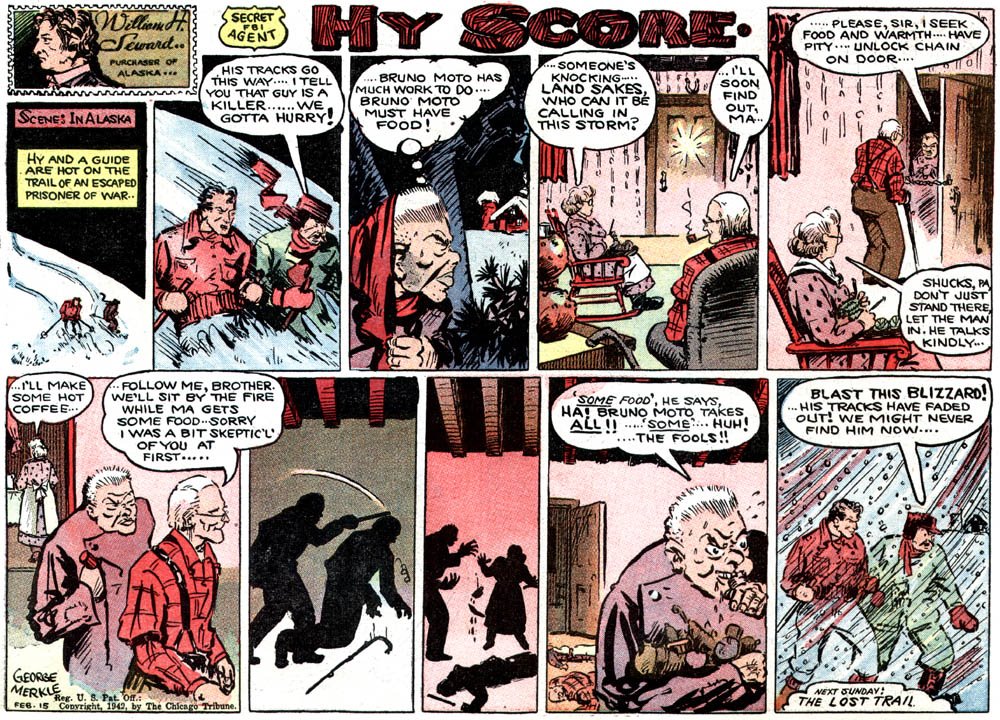
Hy Score was one of the new features introduced in the Chicago Tribune Comic Book. I guess the comic book was somewhat of a success because it remained a part of the Tribune for three years. The gimmick had to be what kept it alive, because the contents tended to be less than inspired. Case in point is Hy Score, which was added to the comic book on June 30 1940. At first this feature was truly awful, with ridiculously text-heavy narratives and exposition laden plots.
The strip was also at times titled Secret Agent Hy Score, Adventures of Hy Score and Hy Score in Arabia. An unmemorable one-panel 'topper' called Hy Score Comic Book Quiz was added in October 1942.
Mr. Score was an FBI agent who got into all the familiar scrapes of the genre. He solved murder mysteries, foiled espionage, and generally brought all sorts of miscreants to justice. The strip was penned by someone signing themselves as George Merkle, of whom I know nothing. Merkle's stories improved over the life of the strip, as he slowly but surely pared away at the paragraphs long captions. His art was alright, except that he had a real blind spot (heh) about drawing eyes. Most of his characters run around with eyes firmly shut, and when he did attempt to draw them open you can understand why. The strip looked best when the cartoonist was swiping from Alex Raymond, which he did often. According to Jerry Bails, there never really was a George Merkle -- he says that this is a pseudonym of George Marko, a fellow who worked in comic books.
Hy Score managed to outlast the Tribune comic book, albeit for just half a year. The strip was put to bed on 10/31/43.
Labels: Chicago Tribune Comic Book, Obscurities
Wednesday, May 22, 2013
The Chicago Tribune Comic Book: Lew Loyal

Creator Milt Youngren gave the Trib a lot for their money, too. Those four page adventures read like an over-excited kid trying to tell a story. The events pour out at breakneck speed, and in the process cause and effect become jumbled and important plot points are missed and muddled.
Another apt comparison that can be made is with the typical lesser grade comic book stories of this period. And, of course, that's basically what the Chicago Tribune wanted in their Comic Book section. They must have been tickled pink when Youngren's submissions got the thumbs up as being "just like comic books" from the editors' kids.
Although there is precious little expository material in the strip, I surmise that Lew Loyal (the fellow in the red sweater) is a youngish teen. He and his Uncle Mack, who seems to be some sort of government agent, are constantly stumbling onto nefarious criminal plots to kick-start their adventures, and then when the war begins, Axis saboteurs pop out from every dark doorway and abandoned warehouse. Lew's friend Becky tags along on most of his adventures. The kids are often ducking hails of bullets, while fighting back with their wits alone, usually doing more to bring the villains to justice than their uncle.
Lew Loyal got a demotion in 1942, down to two half-tab pages per issue. The strip outlived the Comic Book section, which ended in April 1943, but didn't last long in the Tribune's regular comic section. Lew Loyal went into retirement as of the October 31 1943 episode.
Labels: Chicago Tribune Comic Book, Obscurities
Wednesday, May 29, 2013
The Chicago Tribune Comic Book: Kit Cabot


Kit Cabot was added to the Chicago Tribune Comic Book section on June 8 1941. At first it might have seemed an odd choice, because the strip has a lot in common with Brenda Starr, with which it shared space in the Comic Book section. Both were strong female 'working girl' characters, and both always seems to have a moment to peel down to their skivvies in the middle of the action. However, after three weeks sharing space, Brenda was graduated from the Comic Book section into the regular comic section, making it obvious that Kit Cabot had been intended as her replacement here in the Comic Book when the elder strip went on to bigger and better things.
However, Kit Cabot didn't last long. The strip was dropped from the Comic Book on April 26 1942, less than a year later, when the section was downsized from 24 to 16 pages. Ah, all the undergarments we never got to see...
The strip was penned by someone named Gene McNerney, a name that means little to me. All I know is that he (?) also tried syndicating a couple features through the elusive Watkins Syndicate, neither of which have ever turned up in my research.
Labels: Chicago Tribune Comic Book, Obscurities
He left the Marina Corps as a Major. Upon leaving the Marine Corps he went to work as a sketch artist for 20th Century Fox and Columbia. Upon his retirement he moved to Huntington Beach CA and for a few years taught art at Orange Coast College, as well as giving art lessons. Many of his portraits of Marine Generals are housed at the Marine Base in San Diego. Fo He was a painter as well as an illustrator and cartoonist.For further information: my email is 4nlehman@gmail.com
: 2/23/2014 5:14 PM Monday, June 10, 2013
The Chicago Tribune Comic Book: Captain Storm


The strip was nominally about the skipper of a freighter ship, but the heroic Captain Storm seemed to spend more time everywhere else, because the first story arc has him losing his ship to thieves.The writing, the art and the plot are all top-notch work and I don't doubt that they were reader favorites.
The strip is by Ed Moore, whose work resembles another Chicago-trained cartoonist, Dick Moores, enough that I get the two confused. Ed Moore did some assisting work on Dan Dunn and Don Winslow prior to creating Captain Storm, the only newspaper strip on which he got credit. However, Moore was also working at the same time in comic books. Perhaps he found that to be more lucrative or less demanding than Captain Storm, and that explains its short run. Moore worked in comic books and assisted on newspaper strips into the 1960s, then switched to advertising work, according to Ron Goulart in The Great Comic Book Artists, Volume 2.
Labels: Chicago Tribune Comic Book, Obscurities
: 7/10/2023 1:11 PM : 7/10/2023 1:13 PM Monday, June 03, 2013
The Chicago Tribune Comic Book: Rocky the Stone-Age Kid


Frank Engli, better known to comic strip fans as Milton Caniff's long-time letterer, was at the helm for this strip, which ran in the Chicago Tribune's Comic Book section starting August 25 1940. It ran there until the Comic Book section folded, and then graduated to the main Tribune comic section, ending October 31 1943.
Labels: Chicago Tribune Comic Book, Obscurities
: 6/03/2013 11:04 AM Monday, October 16, 2006
Obscurity of the Day: Hy Score
This post was written in pain. A certain fast food joint (whose logo just might include a red-haired girl) served me a caesar salad today. Said salad was apparently made by an employee who thought those signs in the restroom about washing hands were mere suggestions. So if this post is made in haste my apologies. The porcelain goddess calls (and calls and calls...).
Hy Score was one of the new features introduced in the Chicago Tribune Comic Book. In 1940 the Trib inaugurated a new Sunday feature in addition to their regular comic section, a pair of standard newspaper sheets that when folded and cut formed a 16 page "comic book". The new addition was presumably added in response to the burgeoning popularity of newsstand comics. I guess the Trib thought they could connive kids into begging dad to buy the Tribune just because they'd be able to cut apart the funnies to make a little booklet.
As unlikely as it seems, I guess the comic book was somewhat of a success because it remained a part of the Tribune for three years. The gimmick had to be what kept it alive, because the contents tended to be less than inspired. Case in point is Hy Score, which was added to the comic book on June 30 1940. At first this feature was truly awful, with ridiculously text-heavy narratives and exposition laden plots.
Mr. Score was an FBI agent who got into all the familiar scrapes of the genre. He solved murder mysteries, foiled espionage, and generally brought all sorts of miscreants to justice. The strip was penned by George Merkle, of whom I know nothing. Merkle's stories improved over the life of the strip, as he slowly but surely pared away at the paragraphs long captions. His art was alright, except that he had a real blind spot (heh) about drawing eyes. Most of his characters run around with eyes firmly shut, and when he did attempt to draw them open you can understand why.
Hy Score must have had a little bit of a following, because it actually managed to outlast the Tribune comic book, albeit for just half a year. The strip was put to bed on 10/31/43.
And now if you'll excuse me, I must once again call Ralph on the commode-a-phone.
Labels: Obscurities
Marko did comic books from the late 30s to the mid 40s. His comic strip credits include also include something called "Mighty O'Malley" 1947 - 1949.
From elsewhere he supposedly did a 1945 comic strip called "Underground".
By the way, though it is belated, I want to wish your high entertaining and educational blog a happy one year anniversary and thank you for the effort for the past year.
: 10/16/2006 8:56 PM As for Merkle, you caught me in the throes of intestinal distress, unable in my delirium to do proper research. Yes, you're absolutely right, Markle did indeed do "Underground". He also did "Stories Stamps Tell" back in 1935. I haven't, however, heard of "Mighty O'Malley". Anyone?
--Allan
Wednesday, May 15, 2013
The Chicago Tribune Comic Book: Speed Berry


The Sunday-only comic strip began in the Chicago Tribune Comic Book section on April 27 1941, then titled Bush Berry. The strip was intended to be about baseball. As is typical of baseball strips, we began with a farm boy who has a rocket for an arm. Called up by a major league team, he seems to be on the road to fame and fortune as the star hurler of the Chicago Eagles. Naturally there are some unforeseen bumps in the road, but 'Bush' Berry has everything going for him.
However, creator Evans Krehbiel apparently saw the writing on the wall in mid-1941, and he had Bush Berry enlist in the Army, where his nickname received a promotion, on October 12 1941, to Speed Berry. At first Speed's life doesn't change all that drastically. His chums and enemies from the Chicago Eagles all seem to have enlisted with him, and his job in the Army is -- what else -- to play baseball.
Then Pearl Harbor happened, and the tone of the strip quickly changed. Soon Speed and his entourage were on their way across the Pacific, baseball all but forgotten. The strip now became a red-blooded war strip, with Speed and his buddies seemingly single-handedly winning the war. So fine a job did Speed do in the Army that he was mustered out early. The strip was cancelled on August 29 1943, about four months after it was graduated from the Comic Book section, which was cancelled, to the regular Tribune Sunday comics section.
Evans Krehbiel, son of respected artist Dulah Evans Krehbiel, either had a quickly evolving style, or he got a lot of help on this strip. The art varies from cartoony to sketchy to finely delineated over its short three year life. Krehbiel got at least one more syndicated comic strip job, the 1944-45 Wilbur Wackey. Lambiek cites two additional features, Bitsy and Becky's Senior, neither of which I have ever seen. Bitsy is only known to exist as a set of originals, none of which have copyright dates or syndicate slugs. Becky's Senior was advertised by American International Syndicate, which claimed a whole slew of features that no one's ever seen actually running in a newspaper.
Labels: Chicago Tribune Comic Book, Obscurities
Monday, June 24, 2013
The Chicago Tribune Comic Book: Gertie O'Grady


Gertie O'Grady concerns a middle-aged Irish woman, whose role in life is never really spelled out in any great detail. She seemed to be a maid in early episodes, then a boardinghouse proprietor, but through most of the series she had no clear career. Her comedic foils started off on the zany end, with a mad professor and a giant ape, but later switched to a poor Irish immigrant girl named Fortune, and then she finally hooked up permanently with Uncle Shanty, an Irishman of the old school. The Irish humor in the strip was stereotypical, of course, but 180 degrees away from the coarse, racist Irish humor you would have seen in strips thirty years earlier. In Gertie O'Grady, the Irish are treated as loveable in their picturesque, idiosyncratic ways.
Cartoonist Paul McCarthy was at the helm of the Sunday-only strip. I know little about him other than that apparently he later went on to be one of the artists behind the extremely successful Sad Sack line of comic books.
EDIT 12/31/2017: Just found a half-tab example of Gertie O'Grady dated 3/20/1949 -- six years after the end of the original series. Although there's no overt clue on the tearsheet, my guess is that this is from the New York Sunday News, and they commissioned this as one of their filler strips. It is apparently new material, because Gertie has slimmed down and prettied up considerably, while Uncle Shanty has become more decrepit looking. Has anyone seen any other later examples?
Labels: Chicago Tribune Comic Book, Obscurities
Thanks for the info. I checked the online archives of the Sunday News, and the strip is not there on 5/1/49. However, the one online appears to be the city edition, and these fillers generally ran only in the national edition as far as I know. So Gertie may or may not have actually run on 5/1/49. Michael Vassalo, the NY Sunday News expert, might well know. If you are a Facebook user (I am not), you might ask him. Please pass it along if you get an answer. --Allan
I am also not a FB user and so am unable to ask Mr. Vassalo about the strip.
If I learn anything further about the strip, or Mr. McCarthy (1910-196?), I will pass it along.
As an aside, I LOVE your American Newspaper Comics An Encyclopedic Reference Guide. As a collector of original strip art, it is my collecting "bible", and I refer to it on a pretty much daily basis. Thanks for all your efforts in putting it together, as well as with this blog, which is both entertaining and informative. Bob Carlin
Tuesday, June 18, 2013
The Chicago Tribune Comic Book: Vesta West and her Horse Traveler


The strip was a pretty conventional present-day Western, with a little added sex appeal from a girl heroine. The strip was created by Fred Meagher, whose excellent bio on Yesterday's Papers is highly informative, except on the point of why he turned the strip over to Ray Bailey after just two months. I'm afraid I'm no more in the know on that issue. The fact remains, though, that Bailey took over with the strip of October 11 1942, and stuck with it until the end. Before this assignment Bailey had primarily been an assistant, working on Terry and the Pirates and The Gumps, both Chicago Tribune-New York News Syndicate properties.
Labels: Chicago Tribune Comic Book, Obscurities
Wednesday, February 27, 2013
Obscurity of the Day: Captain Storm
The strip was nominally about the skipper of a freighter ship, but the heroic Captain Storm seemed to spend more time everywhere else, because the first story arc has him losing his ship to thieves.The writing, the art and the plot are all top-notch work and I don't doubt that they were reader favorites.
The strip is by Ed Moore, whose work resembles another Chicago-trained cartoonist, Dick Moores, enough that I get the two confused. Ed Moore did some assisting work on Dan Dunn and Don Winslow prior to creating Captain Storm, the only newspaper strip on which he got credit. However, Moore was also working at the same time in comic books. Perhaps he found that to be more lucrative or less demanding than Captain Storm, and that explains its short run. Moore worked in comic books and assisted on newspaper strips into the 1960s, then switched to advertising work, according to Ron Goulart in The Great Comic Book Artists, Volume 2.
Labels: Obscurities
: 2/28/2013 10:48 AM Thursday, June 13, 2013
Ink-Slinger Profiles: Bert Whitman
Bertram “Bert” Whitman was born in Brooklyn, New York on July 27, 1908. His birthplace was determined by examining the census records, and his birth date was at the Social Security Death Index.
In the 1910 U.S. Federal Census, he was the youngest of two children born to Joseph and Sadie. They resided in Brooklyn at 554 Seventh Street. His father was the manager of a jewelry company.
Ten years later they were recorded in Chicago, Illinois at 4521 Michigan Avenue. His father was an auctioneer. In his book, The Comics, Coulton Waugh said: “…Bert Whitman was an office boy for the Chicago Herald-Examiner and the Los Angeles Times; then, like so many other strippers, he became a sports cartoonist in Detroit….” The Los Angeles Times (California), December 15, 1990, said Whitman “taught himself to draw, and in 1924, at age 16, began working for the Los Angeles Times.”
The 1930 census said he and his parents lived in Detroit, Michigan in the Warwick Apartments, 730 Whitmore Road. Syracuse University Library said: “…He drew for the Detroit Mirror from 1929 until 1932 and was on the staff of the Cincinnati Enquirer during 1937. Whitman then began working on comic books….” Who’s Who of American Comic Books 1928–1999, said he did cartoons for Ken Magazine.
Whitman lived in New York City when the 1940 census was enumerated. His address was 150 Riverside Drive, and occupation, artist. Ron Goulart, in The Comics Journal #249, December 2002, wrote about comic art shops and said:
…Bert Whitman, later an award-winning political cartoonist, launched his small operation in 1940. Calling it Bert Whitman Associates, he rented office space in the New York Times building. Artists working for him included Jack Kirby, Frank Robbins and Irwin Hasen along with newspaper veteran George Storm. Whitman packaged comic books for smaller publishers such as Frank Temerson. His Tem Publishing Co. brought out the Whitman-produced Crash Comics, which contained work by Kirby, Hasen and Storm plus some covers by Whitman. Strongman the Perfect Human was not a compelling hero and his star position was taken over by Cat-Man in the fourth issue. Hasen drew the feature. Crash, living up to its name, went out of business after the fifth issue….In a meteorological mood, Whitman next put together Whirlwind Comics starring Cyclone. That lasted three issues.
Whitman always felt that his biggest coup during his shop-owner period was licensing the popular radio masked man, the Green Hornet, for comics. He’d arranged a long term deal with Detroit radio producer George W. Trendle. The first issue consisting entirely of Green Hornet stories, appeared at the end of 1940 and was published by Helnit. After six issues over the next eight months, the book went on hiatus. It was revived in the spring of 1941 under the Harvey Publications colophon. Whitman had sold his licensing agreement to Harvey. He once told me that he was certain he’d made more money selling the comic-book rights to the character than any publisher ever made from the comics. Shutting down his shop in 1941, Whitman drew for Fawcett for a time, then did a comic strip called Debbie Dean before moving on to editorial cartoons.

Whitman left comics and drew cartoons for a succession of newspapers: the New York Post from 1944 to 1948; the Miami Herald (Florida) from 1948 to 1952; the Stockton Record (California) from 1952 to 1969; and the Phoenix Gazette (Arizona) from 1969 to 1982. He wrote and illustrated a book about newspaper editorial cartooning.


Labels: Ink-Slinger Profiles
Only short posts from nwo!
Damn, foiled again!
I blame those identity words you have to type. They scramble your sense of language.
: 10/14/2015 12:24 PM I'm writing an article about Bert Whitman (for a Scorchy Smith dossier) in the french comics fanzine HOP !
Can you give me the date and place of his marriage with your aunt ? And, if it doesn't bother, her first name.
Thank you very much.
http://dumonteil.marc-andre.perso.sfr.fr/numeros-6.htm
my best
-Ray Bottorff Jr
Tuesday, May 21, 2013
Ink-Slinger Profiles: Jack Ryan
John J. “Jack” Ryan was born around 1912. His name was in the Chicago Tribune, March 12, 1975, obituary which said he was 63 at the time. The 1940 U.S. Federal Census recorded his birth in Illinois. Ryan has not yet been found in the 1920 and 1930 censuses.
In Garyn G. Roberts’s book, Dick Tracy and American Culture (2003), Chester Gould’s first assistant, Dick Moore, was profiled and said he attended the Chicago Academy of Fine Arts in the early 1930s. Before he was kicked out, he met Ryan at the academy. The Tribune said Ryan graduated. Years later Moore recalled seeing Ryan: “…I met him on the street one day and he had just seen the ‘X-Nine’ drawn by Alex Raymond. He felt I would be out of a job in a month or so because ‘X-Nine’ was so much better than ‘Tracy.’ ”
Robert said about Ryan: “…In the early 1930s, Jack Ryan, along with Ed Moore, assisted Norman Marsh on Dan Dunn, a comic strip which debuted on September 25, 1933, and which was highly derivative of Dick Tracy….”
In the 1940 census, Ryan, his wife Johanna had two sons, James and John Jr., lived in Chicago at 408 East 74th Street. He had four years of high school and his occupation was cartoonist for a publishing syndicate. On September 8, 1940, his strip, Streamer Kelly, debuted in the Chicago Tribune Comic Book. His strip ended, temporarily, on October 3, 1943.
Life magazine, August 14, 1944, devoted several pages and photographs on Chester Gould, whose assistant was Ryan. A typical work week was described:
On Monday morning he [Gould] bounces into his studio, a cluttered room on the 14th floor of the Tribune Tower in downtown Chicago, at 8:15. His assistant, a capable young artist named Jack Ryan, has arrived before him. After lighting a cigar, removing his coat, loosening his tie, unbuttoning his shirt, unbuckling his belt, dropping his garters and untying his shoelaces, Gould shuffles over to his drawing board on which Ryan has placed a piece of clean white Bristol board into ruled rectangles. This will become the Sunday page that readers will see 10 weeks hence….His first step is to write, in longhand, all of the dialog for the Sunday page. By lunchtime he has finished an hands the page to Ryan, who letters the dialog in ink. Gould next writes dialog for the six daily strips…
With the creative chore out of the way, Gould spends the rest of his work week at the rather tedious and mechanical job of drawing….Working in his downtown studio, Gould devotes Tuesday to sketching in pencil and then finishing in ink, the characters in the Sunday page….After drawing the other characters, Gould hands the page back to Ryan who completes it by filling in background objects such as lampposts and buildings, and inking in solid black spaces…
The article revealed that Ryan had named the villain, The Brow. Volume 7 of the Complete Chester Gould’s Dick Tracy (2009) has a photograph with this caption: “Jack Ryan (left) and ‘Andy’ Anderson (right) flank Chester Gould in his Tribune office, as the cartoonist works on the ‘Vollman’ story included in this volume. Both assistants also worked in the Trib’s art department.” How long he assisted Gould is not known. Streamer Kelly resumed in the Tribune on April 7, 1946 and ended December 31, 1950.
The Tribune said Ryan also drew Harold Teen for a time. He worked for the Chicago Sun-Times from 1952 to 1961. For a period in 1961, he returned to Dick Tracy then went back to the Sun-Times. In 1971 he received the Chicago Newspaper Guild Stick-O-Type award for best work by an artist. Ryan passed away March 10, 1975, at his home in Evergreen Park, Illinois.
Labels: Ink-Slinger Profiles
His older brother, Matthew, b 1910, & a young man, Joseph, listed as a son of Michael & Delia, are listed in the 1940 census as police officers. Michael, Delia, & Joseph lived in one part of the family home, with Matthew, wife Genevieve, & 2 kids, Mary Ellen & Michael, in the other part. This was at 7921 S Loomis Blvd, in Chicago. That was their address in 1930, also. In 1920, the family was at 5438 S Wells St, in Chicago. Both homes can be seen on Google’s street view. That son, Joseph, was not in the previous censuses, although he would have been born @1914. Perhaps he was a relation, taken in by the Ryans.
Jack’s dad is consistently listed as a foreman and/worker for the Parks Board or Park District. Jack had an uncle, Patrick Ryan, born @1882 in Ireland, living with the family in 1920. Jack’s grandfather was Patrick Ryan, born @1850, in Ireland. He is listed in the 1920 census as a patient in the Oak Forest Institution. That was a poor hospital that also took in many mental patients, & people with dementia. He died in 1921, with his death info listing his parents as Michael Ryan & Bridget Coney (might be Carney), both born in Ireland.
Thursday, June 06, 2013
Ink-Slinger Profiles: George Merkle
George Merkle was the pseudonym of George A. Marko according to Who’s Who of American Comic Books 1928–1999. Anton George Marko was the name on his World War I draft card and his birthdate was recorded as September 2, 1900. I believe the year is incorrect because a passenger ship list, at Ancestry.com, listed a Slovakian, “Antal Marko”, who arrived in New York on July 13, 1903. His age was 10 months old so his birth was in September 1901. Also, his age in the censuses made his birth year either 1901 or 1902. I would say his birth was September 2, 1901.
The 1910 U.S. Federal Census recorded his name as Antonio who was the oldest of three children born to Antonio and Helen; he and his parents were Hungarian emigrants while his siblings were born in New Jersey. They lived in Elyria, Ohio at 129 Quincy Street. His father was a factory machinist.
Marko signed his World War I draft card on September 12, 1918. He lived at home which was in Cleveland at 10050 Hulda Avenue, and his occupation was a clerk employed by W.P. Southworth. Marko’s description was tall and slender with blue eyes and brown hair.
In 1920 he, as Anton, was the oldest of five. The family remained in Cleveland but at a different address, 10412 Hulda Avenue. Marko was a timekeeper at a furniture factory. The Cuyahoga County, Ohio, Marriage Records and Indexes, 1810-1973, at Ancestry.com, recorded his marriage to Florence Nickel on January 30, 1924; on the certificate his name was “George A. Marko.” The 1926 Cleveland City Directory listed him at 10412 Hulda Avenue, the same address as his parents, and his occupation was a clerk at the Kroger Grocery & Baking Company. The 1928 directory had the same address but his job was “assembler”, the same as his father.
Who’s Who said he was a mimic in vaudeville. That was confirmed several times in the Cleveland Plain Dealer, beginning May 23, 1926: “…The women’s auxiliaries of the Brooklyn and Deckert-Watterson posts of the American Legion will sponsor a joint entertainment for the ex-service men at Warrensville Thursday evening….Those participating in the program are Miss Nova B. Nahm, soprano; George Marko, mimic; Earl G. Guscott, magician; Howard De Gant, violinist….; August 19, 1928: “…George Marko of Cleveland got a big hand with his barnyard imitations….”; December 15, 1929: “…Cleveland Post No. 2 band will play carols and Christmas numbers. Earl Guscott, magician of Brooklyn Post No. 223, and George Marko, barnyard impersonator, will perform, and Erling C. Theller of Glenville Post No. 130 will substitute for Santa Claus….; December 23, 1929: “…They listened to the Legion band, heard George Marko imitate animal calls…”
In 1930 Marko and his wife had two daughters and lived in Cleveland at 1444 East 93 Street. He was a retail salesman who sold silk.
Information on his education and art training has not been found. He may have taken correspondence courses or may have known some Cleveland cartoonists and gotten advice from them. In the late 1930s his comic book career began. Using the name George Merkle, his first creation was the Master Mind which appeared in Detective Picture Stories, January 1937; Funny Pages, January 1938; Amazing Mystery Funnies, August 1938; and Keen Detective Funnies, August 1939. The sporadic appearances of the Master Mind suggests the stories were used as fillers.
It's not known how often he performed during the 1930s, but he was mentioned in the Plain Dealer, November 17, 1939: “Patricia Bloor, tap dancer, headlines the new stage show at the Metropolitan Theater tomorrow night. Others in the show include George Marko, master of ceremonies; Lou Welston, harmonica player, and Betty Ferrell, contortionist.”
According to the 1940 census, Marko was in Cleveland at this address, 9521 Lamontier Avenue. He had an eighth grade education and was currently employed as a paint sprayer at a manufacturer of pipe threading equipment. A World War II draft card or military record has not been found for him. He was naturalized March 26, 1943 under the name, Anthony George Marko.
With some comic book work under his belt, Marko sold Hy Score to the Chicago Tribune Comic Book; his character ran from June 30, 1940 to October 31, 1943. Next, he found work with comic book publisher Fawcett and produced a large volume of Dopey Danny Dee filler material that occupied a page or less. The character continued to appear five years after Marko’s death. It’s not known he if traveled to Chicago and New York City to sell his works. Evidently, he kept his comics credits to himself, as any mention of it has not been found in the Plain Dealer.
In addition to a day job and freelance comic book work, he continued his stage appearances according to the Plain Dealer.
.jpg)
June 13, 1943
Cost’s Theater Observes Its Fourth Anniversary
Celebrating its fourth anniversary the Shore Theater at E. 225th Street and Lake Shore Boulevard, is offering a gala birthday program beginning today.
Five acts of vaudeville are being booked by Frank L. Cost, manager, for the occasion. Appearing on the stage today through Tuesday are Paul Kohler, xylophonist; Lucille Mahoney, dancer; George Marko, barnyard imitator; Marion Kerrigan, in songs and taps; Billy Hill at the piano and Bert Dagmar as master of ceremonies.
July 8, 1944
Restauranteur Frank Monaco will bring back Placida, an operatic songstress, for his floor show at Monaco’s Cafe tonight. With her are appearing George Marko, a hillbilly performer, and Gwen McClellan in dances.
Marko passed away March 12, 1948 in Cleveland. A death notice appeared two days later in the Plain Dealer:
Marko, George, 12602 Gay Ave., beloved husband of Florence (nee Nickel); father of Agnes and Genevieve; grandfather; son of Mr. Anthony Marko; brother of Edward, Elizabeth, Mrs. Marie Stolear, Mrs. Helen Swartz and Mrs. Ethel Cugini(?); passed away Friday, March 12. Friends received at P. Coreno Funeral Home, 10514 Kinsman Rd. Services Tuesday March 16, at Holy Family Church at 10 a.m.
Labels: Ink-Slinger Profiles
Monday, June 17, 2013
Ink-Slinger Profiles: Evans Krehbiel
Evans Llan Krehbiel was born in Chicago, Illinois on April 5, 1914, Chicago, Illinois, according to Who’s Who in the Midwest (1945) and the Cook County, Illinois, Birth Certificates Index at Ancestry.com. He was the only child of Albert Henry and Dulah Marie Llan Evans. An undated photograph of Krehbiel and his father in Park Ridge, Illinois is here.
His earliest published work were poems. Poetry, July 1918, published four poems by him: “That Little Girl Next Door”, “Logic,” “Travels” and “Trees.” In the end notes it said: “Evans Krehbiel, who was not yet four years old when he reeled off his poems to his mother, is the son of two Chicago artists who lived partly in Santa Monica, Cal.” “Trees” was the first poem in Mabel Mountaler’s book Singing Youth, published by Harper’s in 1927. The Springfield Republican (Massachusetts), September 15, 1927, reviewed the book and printed Krehbiel’s “Trees.”
In the 1920 U.S. Federal Census, he was recorded with his mother and aunt in Santa Monica, California at 1248 Fourth Street. His father was in Park Ridge where he had his own painting studio.
Krehbiel has not been found in the 1930 census. Who’s Who said he was a student at the American Academy of Art in 1936, and the School of the Art Institute of Chicago from 1936 to 1940; while attending the Institute he met his future wife, Rebecca Falconer.
The 1940 census recorded him and his parents in Maine, Illinois at 315 Touhy Avenue. His father was a professor at the Art Institute, and he and his mother were artists. Krehbiel had three years of college.
Krehbiel found work at the Chicago Tribune which published his Bush Berry in its comic book section. The strip began April 27, 1941 then underwent a slight name change to Speed Berry on October 12, 1941. It ended August 29, 1943. For Publishers Syndicate he produced Wilbur Wackey, which ran from 1944 to 1945. Original art for his unsold strips Bitsy and Little Halo can be viewed here.
Shortly after Berry began, his future wife was getting her start in the Tribune. According to the Daily Herald (Arlington Heights, Illinois), April 19, 2000: “…Beginning in March 1941 under the name ‘Becky,’ Rebecca [Falconer] illustrated the nationally syndicated Chicago Tribune feature, ‘Dear Diary,’ for 15 years.”
His engagement to Rebecca was announced in the Tribune, June 5, 1946. Just over two years later, July 14, 1948, they were married, according to the Tribune, July 22, 1948.
Who’s Who said he was an artist of magazine cartoons, water colors, and lithographs; and a writer of short story continuities for syndicates. His memberships included the Art Institute of Chicago Alumni Association, and the Chicago Magazine Cartoonists’s Association, the Museum of Modern Art (New York) and the Artist Guild of Chicago. He was a Republican and Episcopalian.
His mother passed away July 24, 1951 in Evanston, Illinois.
The Daily Herald said: “…In 1963, the couple moved with their four children to Geneva [Illinois].”
Krehbiel passed away November 1976, in Illinois, according to the Social Security Death Index. An obituary has not been found. On April 22, 2000, the Tribune reported his wife’s passing. She had devoted time promoting and restoring the work of her artistic father-in-law, Albert Krehbiel, who passed away in 1945.
Labels: Ink-Slinger Profiles
: 6/17/2013 1:57 PM : 6/18/2013 10:35 AM Sounds like the Boston Post was doing a better job of printing all the Trib strips in this period than the Trib itself (no great surprise there -- the Trib regularly dropped lots of stuff in favor of ads). I'll have to put the Boston Post of those months back on my research list for the next time I get to Boston. I'm amazed that I missed this stuff as I did a pretty thorough spot-check index of Boston Post Sundays in that era.
Thanks, Allan
Top of the comic section states "Boston Sunday Post", then below that is "Comic Book Magazine". Cliff
: 6/18/2013 12:54 PM Wednesday, June 12, 2024
Ink-Slinger Profiles by Alex Jay: Frank Willard

%20p4.jpg)
“Nothing much happened there. Got tossed out of the local high school for something or other and was promptly placed in a now defunct institution—Union Academy. After being a sophomore for several years, they decided that the only way of getting me through school was to give me the old heave-ho. Which they did to our mutual delight. After all, I do not think a college education would be a great help in making Moon. …… “My father had moved to Chicago back in 1909 [sic] for business and social reasons. And since my dough was running low, I thought it would be a good idea to do the same, as I was always very fond of eating.“I told him I was going to be a cartoonist but he didn’t believe me and neither did anyone else … Then the World War broke out in August, 1914. I noticed they had no cartoon on the front page of the Chicago Tribune, so I went home and drew one.“Mr. Beck, the managing editor bought it for $15.00 and ran it on the front page. So I got out a pencil and figured if you could make that sort of dough drawing, why work for a department store for eleven bucks a week, and hurried across the street and quit my job. Mrs. Woodrow Wilson died the next day so I made another cartoon about that. Then Mr. McCutcheon, the real cartoonist, came back and there wasn’t much need for my talent.“Mr. James Keeley over on the Herald talked to me for five minutes and said, ‘Boy, you haven’t enough brains to be a political cartoonist!’ I said how about a comic artist. Mr. Keeley said, ‘Well, maybe you’re dumb enough for that. So he gave me a job. Did a kid page called, ‘Tom, Dick and Harry’ and another called ‘Mrs. Pippins Husband,’ and a so-called humorous cartoon.“America got into the war. I got into the first draft. Was a pretty punk soldier, had a pretty good time. Out outfit built roads and did no fighting. And we thought they’d left us in France for a souvenir when they finally shipped us home in July, 1919. …
Frank Willard, western cartoonist, has joined King Features Syndicate. He has created a new comic strip entitled “Outta-Luck” which will be generally syndicated throughout the United States and Canada.The title of Willard’s new comic was suggested to him in France during the war when he was with the 343d Infantry. It was the common expression of doughboys covering a multitude of various unfortunate things that happened them from missing mess to missing mail. Returning to America Willard found an infinite number of humorous situations in civil life where somebody was correspondingly “Outta Luck.” So he sat down and pictured them.He is a graduate of the Chicago Academy of Fine Arts, and for five years his comic drawings appearing in the Chicago Herald and other western papers have been exceedingly popular.
“Then I got a job with King Features Syndicate. Did a very appropriately named strip called ‘The Outta Luck Club,’ which was just that. At the same time doing the Penny Ante series and about everything but carry water for the elephants.“Perley Boone, a pal of mine, told me that Mr. Patterson was looking for a new comic for the Chicago Tribune-New York News Syndicate and to see Mr. Arthur Crawford, who told me to see Mr. Patterson. After talking to me a few minutes, Mr. Patterson said I should do a roughneck strip. There never had been a roughneck, low life sort of strip and he thought it might be a good idea. And, incidentally, he’s given me plenty of ideas since. [A violent version of the story was told in The Art of the Funnies: An Aesthetic History (1994).]
Frank H. Willard of Sarasota, Fla., and Chicago, widely known as the creator of the comic strip “Moon Mullins,” and Miss Marie O’Connell, of Springfield, Mo., were married at Tampa, Fla., January 7.
%20p8.jpg)

Frank H. Willard, 64, creator of the comic strip Moon Mullins, is critically ill at Cedars of Lebanon Hospital.Willard suffered a heart attack in 1954, another in 1956 and had a stroke Dec. 27 at his Beverly Hills home. His wife, Marie, has been constantly at his side at the hospital since his admission there Tuesday night. ...
Labels: Ink-Slinger Profiles
: 6/12/2024 10:20 PM : 6/13/2024 1:48 PM 