Thursday, January 16, 2014
Ink-Slinger Profiles by Alex Jay: Roy Grove

In the 1900 census, Grove was the oldest of three children born to James and Zella. The head of the household was his paternal grandmother, Mary. Also residing there were his three aunts. The address was in Center, Indiana at 408 East Ohio. Grove’s father was a house painter.
The 1910 census recorded Grove, his parents and two siblings in Cleveland, Ohio at 6505 Quimby Avenue NE. The Cleveland Plain Dealer, December 3, 1958, said he was a graduate of East Technical High School, and Pratt Institute in New York City.
Grove was a staff cartoonist for the National Enterprise Association. His passport application (see photo), dated May 27, 1918, said he started there on September 23, 1916. Grove’s first work, a panel called What Has Become Of, debuted January 9, 1917. He also provided art for the NEA publication Pep.

Grove signed his World War I draft card June 5, 1917. His passport application had a letter, from the local draft board, that said Grove had “Deferred Classification 2-D”. The purpose of his overseas travel was: “To supply war cartoons and art to the corporation which furnishes same to three hundred twenty six daily newspapers in the United States.” That corporation was the NEA which sent a letter, dated May 31, 1918, to the Department of State:
This is to certify that Mr. James Roy Grove, now applying for passports for the countries of Great Britain, France, Switzerland and italy, and for the A.E.F. [American Expeditionary Force] in France, has been appointed artist correspondent in those countries for this organization, The Newspaper Enterprise Association. It is most imperative that Mr. Grove be allowed to obtain his passports as soon as possible, as the duties he is to perform in those countries for this concern are most urgent.
Your prompt attention in this matter is solicited and will be gratefully noted. This organization vouches for Mr. Grove’s responsibility and loyalty in every particular.A passenger list showed Grove returning on November, 23, 1918 at the port of New York.
.jpg)
.jpg)
According to American Newspaper Comics (2012), Grove’s work included Boys in the Other Car, Bugs, Girliettes, Here’s Looking at Us, Putting the Grin into the Fight, and What’s News Today which was written by Will Rogers. The Cleveland Memory Project said he produced sports cartoons for the Jeburn Features Syndicate in the 1930s. It is not clear if those cartoons were ever published.
Grove continued to live with his parents and siblings, in Cleveland, as recorded in the 1920 census. Their address was 2933 Coleridge Road, which would be Grove’s home for the rest of his life. Cartoonist Walter R. Allman was his neighbor who lived at 2959.
Grove and his parents were recorded together in the 1930 census. He was a proprietor in the business of “publishers services.” In 1940, Grove was a self-employed commercial artist.
On April 25, 1942, Grove signed his World War II draft card. He named his mother as the person who would always know his address. Grove’s art studio was located at 706 Citizens Building. According to the Plain Dealer, he was employed, some time later, at the Carpenter Advertising Company.
A family tree at Ancestry.com said Grove married Hazel M. Altland in 1956.
Grove passed away December 2, 1958, in Cleveland. His death was reported the next day in the Plain Dealer:
J. Roy Grove, a commercial artist, died yesterday in Hanna House at the age of 65.
Currently he had been with the Scheel Advertising Agency, Inc., and previously with the Carpenter Advertising Co.
In earlier years Mr. Grove was an artist and cartoonist for the National Enterprise Association. He made action sketches in Europe in World War I and did sports cartoons and sketches for NEA.
Born in Indianapolis, he was brought here and and was a graduate of East Technical High School. His advanced art training was at Pratt Institute in New York City.
He was a member of Euclid Avenue Christian Church.
Surviving him are his wife, Hazel, and nieces and nephews. His home was at 2933 Coleridge Road, Cleveland Heights.
Services will be at 2 p.m. tomorrow in the Bennett-Sharer funeral home, 11212 Euclid Avenue. Burial will be in Knollwood Cemetery.—Alex Jay
Labels: Ink-Slinger Profiles


Wednesday, January 15, 2014
Obscurity of the Day: Putting the Grin in the Fight


Putting the Grin into the Fight was a fairly good but not outstanding panel cartoon series about soldiers in World War I. What was indeed very, very good was the marketing gimmick used on the feature that had newspaper readers snookered back then, and still has people misunderstanding this series almost a hundred years later.
First, though, some general explanation, because this is a pretty weird series all around. Though above I called the series Putting the Grin into the Fight, that title is just one of the common ones. The feature actually went through three phases -- first the early cartoons about basic training, then second, cartoons about actually fighting in Europe, and finally, cartoons about returning home. In each phase the series went by various names. For example, during the period when the feature was set in the European battlefront, it was often titled Over There with the Yanks. Later on it was Coming Home with the Yanks, then finally, Sketches About Town (resettling into normal life).
When the series started, in January 1918 or perhaps a little earlier (I haven't been able to determine exactly since the N.E.A. archives are missing the entirety of this series), it seems to have been offered with two title options. There was Putting the Grin into the Fight, and Comedies of Camp [fill in the blank].
And there's the marketing gimmick. If your newspaper was published anywhere near a military camp, you were supposed to personalize the feature with its name. You can see that concept in action on the top two samples, which came from the Augusta Herald newspaper. Augusta Georgia was near Camp Hancock.
Now that seems like an innocent enough little ruse, but it worked a little better than intended. Newspaper readers, especially the boys in camp, sometimes got pretty stoked up about the idea that a real life cartoonist was in their midst, drawing cartoons for the local paper. Naturally some ambitious types sought out this fellow, J.R. "Roy" Grove, only to find it hard to pin him down. There's no telling how many newspaper editors had to sheepishly admit to puzzled inquirers that Mr. Grove was not at the camp at all, but was safely ensconced in his bullpen seat at N.E.A. in Cleveland.
The ruse worked so well that it is still working a century hence. I have been contacted on two occasions by historians anxious to learn more about this fellow Grove, who drew boot camp cartoons for their local papers. Ouch!
In fairness to Grove, he wasn't always at his drawing board in Cleveland. He does seem to have gone to Europe to do the cartoons set there, or at least in his signature he often adds a location in France. Whether he was there as a combatant or not I don't know.
...But I bet we'll know more tomorrow, because I believe Mr. Grove is going to get the Ink-Slinger Profile treatment by Alex Jay.
UPDATE 9/22/2022: I believe I've now pinned down a start date of November 5 1917, based on the Knoxville Sentinel and a few additional sources. The end, in March 1919, is still questionable because either it wasn't being produced regularly, or newspapers lost interest in it; the first week of March is probably the end of the series. Oh, and those last weeks added yet another title variant, Hot Skteches About Town.
Labels: Obscurities
Tuesday, September 22, 2009
Obscurity of the Day: Bugs

 The early years of home radio, the days when pop and Junior would sit around endlessly rewiring and tuning their homebrew crystal sets in the evening, spawned a lot of features vying for a place on the newspaper's radio pages. The radio page proved not to be as big a circulation builder as expected because few people really wanted the techie articles that were its staple. Those that were building radios preferred to buy magazines that covered the subject in depth. The features created especially for the newspaper radio pages thus came and went pretty quickly, too. Bugs is one of the longer-lived ones.
NEA offered this once-a-week strip under the initial direction of syndicate stalwart Roy Grove. Grove had a pleasing style and a pretty good sense of humor that was put to the test by coming up with endless variations on gags about building and tuning radios. The strip started on March 12 1924, and Grove signed off on November 5 1925. Irving S. Knickerbocker took up the gauntlet and continued the strip until April 7 1926, when he wriggled out of the assignment by starting a new strip, The Papers Say. Next up at the plate was Charles D. Small, whose Mudd Center Folks panel got the shaft so that he could take over Bugs. After a little less than a year, Small handed the assignment off to George "Swan" Swanson, whose first appearance was on February 16 1927. (Oddly enough, this is the same pair who did the opposite hand-off on the Salesman Sam strip.)
On June 22 1927 a mystery man by the name of Sefcik took over. NEA seemed awfully confused about the creator of Bugs at this point (who could blame them?) -- during Sefcik's short tenure the title bar on Bugs tried to credit, at least once each, every other cartoonist who had worked on the strip.
The credit conundrum just got worse as the strip finally wound down. On August 10 1927 Don Wootton took over, but his strips were credited to Sefcik for the first few weeks! Poor Sefcik finally got his due; all he had to do was quit. Finally someone at NEA decided they'd had enough of this foolishness and the feature was retired on September 7 1927.
By the way, all the dates given above are -- hmm, what's a good way to put this -- 'creative interpretations'. NEA distributed the Bugs strip once a week with their package, but it was up to the client newspaper when they were going to run the feature. Those with weekly radio pages would run it on whatever day that was, those without one pretty much threw it in as space permitted. The dates cited above are all Wednesdays. That doesn't mean I found a paper that ran the strip consistently on Wednesdays, or any other day of the week for that matter. I just picked a good day of the week (Wednesday seems a fine day for a radio page don't you think?) and 'normalized' all the divergent dates I had to use from a dozen or so different papers. Even in comic strips, sometimes you just have to massage the raw data a little.
Labels: Obscurities
 : 9/22/2009 11:46 AM
Friday, January 11, 2008
Obscurity of the Day: The Boys in the Other Car


 Roy Grove, a cartoonist in the NEA stable from 1917 until the mid-20s, did his best work on this daily panel, The Boys In The Other Car. The cartoon was derivative, taking its cue from features like Indoor Sports and Eddie's Friends, but a good read nevertheless.
The cartoon was about the ribbing and playful banter that occurred on commuter trains. In those days when the suburbs were beginning to sprawl across the American landscape businessmen seldom owned cars, so their daily commutes were by rail. Each car on the train evolved into an informal club with twice daily get-togethers.
Grove had a good ear for dialog and the slang-laden snarky badinage rings true. It's also pretty darn funny stuff. I wonder, though, if anyone other than a few of us retrospective types can even make sense of the subject matter and archaic jargon in this feature.
The Boys in the Other Car ran from November 26 1919 through August 6 1920.
Labels: Obscurities
As J. Roy Grove he has a page at the Cleveland State University Library where they reproduce some of his WWI cartoons as published in Scripp's Cleveland Press.
http://images.ulib.csuohio.edu/cdm4/results.php?CISOBOX1=cartoonists&CISOFIELD1=CISOSEARCHALL&CISOOP1=any&CISOROOT=all
or http://tinyurl.com/ywj6w9
He also seems to have been a sports writer for NEA, specializing in golf. Later, in 1930, he was doing an illustrated golf column for Central Press titled "From Tee to Green".
That Library page above has some later attempts by him to get syndicated in the 1930s with something called the Jeburn Features Syndicate. You got anything on that JFS?
: 1/12/2008 10:40 AM --Allan
Thursday, March 09, 2017
Ink-Slinger Profiles by Alex Jay: Sefcik
Arthur Milton Sefcik was born in Cleveland, Ohio, on May 29, 1901, according to the Ohio Births and Christenings Index at Ancestry.com. His parents were James J. Sefcik and Anna Pirka. The 1900 U.S. Federal Census said James, a Bohemian emigrant, and Anna resided in Cleveland at 315 Humboldt.
In the 1910 census, Sefcik was the oldest of three siblings. Their father was a tailor. The family resided in Cleveland at 5225 Buettner Court.
According to the 1920 census, Sefcik was a moulder at a foundry. He lived with his parents at 16229 Madison Avenue in Lakewood, Ohio. Sefcik’s mother passed away 18 days after the census enumeration.
Information about Sefcik’s art training has not been found. A listing in the 1923 Cleveland city directory said Sefcik’s address had not changed and he was an artist at the Landon School.
American Newspaper Comics (2012) said Ol’ Trusty was created by Charles D. Small It started in November 1926. Succeeding Small was George “Swan” Swanson. Next was Sefcik who filled in during July 1927. Don Wootton was the artist when it ended. Sefcik was one of six artists on the weekly strip, Bugs, which started on March 12, 1924. The first four artists were Roy Grove, Irving Knickerbocker, Charles D. Small and George “Swan” Swanson. Sefcik drew Bugs in July 1927. Don Wootton was the last artist.
A city directory for 1926 recorded Sefick’s address as 4417 Douse Avenue and occupation as NEA Service artist.
The same address was in the 1930 census. Newspaper artist Sefcik lived with his father who was still working. Sefcik’s father passed away in September 1937. Sefcik’s address did not change in 1940. His occupation was artist. In the census industry column was written, “Fashion Artist, Sewing Projects”. Sefcik had completed two years of high school.
Sefcik passed away August 26, 1954. A death notice appeared in the Cleveland Press, August 28.
Sefcik, Arthur M., passed away suddenly Thursday, Aug. 26, brother of Helen R. Pickard and Roy of Silinas, Calif. Friends may call at A. Nosek & Sons, 3282 E. 55th St., where services will be held Monday, Aug. 30, at 2 p. m.Sefcik was laid to rest at Woodland Cemetery.
Labels: Ink-Slinger Profiles
Tuesday, February 07, 2017
Ink-Slinger Profiles by Alex Jay: Irving S. Knickerbocker

The 1910 census said Knickerbocker had two more siblings, and his maternal grandmother was part of the household. Auburn was still their home. The Plain Dealer wrote about Knickerbocker’s activities in this decade.
He started out to find adventure when a youth and worked on a farm in New York state, was a saw flier in a lumber camp, worked on a railroad and did many things. He served with the medical corps in France in the World War.The Rockford Morning Star (Illinois), January 29, 1930, said, “After the war he spent some time as a sailor on an ocean liner and then came ashore and studied art.” Additional information was found in the Seattle Daily Times (Washington), January 30, 1930: “He graduated from Auburn High School in 1916 and served overseas during the two years following. Returning he became active in Seattle shipping and commercial life, until going to Ohio.”
The War Department O.Q.M.G. Form 623, Application for Headstone, recorded Knickerbocker’s military service. He was a sergeant in Signal Corps, #116, Field Signal Battalion, 41st Division in Washington.
According to the 1920 census, Knickerbocker, unemployed, and two younger siblings lived with their parents in Auburn at 700 West Second.
In the mid-1920s, Knickerbocker moved to Cleveland, Ohio. Cleveland city directories listed him at 2019 Brown Road, in 1926, and 1351 West 76th, in 1929. Knickerbocker worked for the Newspaper Enterprise Association (NEA). He signed his work “Knick”.
American Newspaper Comics (2012) said Knickerbocker created and worked on several projects for the NEA. Knickerbocker was the second of six artists on the weekly strip, Bugs, which started on March 12, 1924. Following Roy Grove, Knickerbocker’s run was from November 11 1925 to April 7, 1926. He was followed by Charles D. Small, George “Swan” Swanson, Arthur Sefcik and Don Wootton. Little Joe Says was started by Storm, who was followed by Larry Redner. Next was Knickerbocker who worked on it in 1926 to March 7, 1930.
Knickerbocker’s The Papers Say started April 21, 1926 and ended January 13, 1927. The Tinymites was written by Hal Cochran and debuted October 8, 1926 with artist Larry Redner. Knickerbocker took over from January 10, 1927 to February 18, 1930. He was followed by Joe King and George Scarbo. The art on Ad Fables (1928) resembles Knickerbocker’s style.
Knickerbocker drew J. Disraeli (Dizzy) Dugan (aka Dizzy Dugan), which was the Sunday topper to Salesman Sam, from October 9, 1927 to March 23, 1930. Mac (aka The McCoys) was created by Knickerbocker who produced it from May 10, 1929 to March 7, 1930. It was continued by Munch, Howard Boughner and Bob Moyer.
Knickerbocker passed away January 26, 1930, in Cleveland, as reported the following day in the Plain Dealer. In an automobile accident, his “...skull and jaw were fractured and his lung punctured.“ “…He died in St. John’s Hospital several hours after the accident.”
The Morning Star added the following about Knickerbocker’s death.
Two coincidences, striking in the light of the tragedy that befell him, marked his last day of life.Knickerbocker was laid to rest at Mountain View Cemetery in Auburn, Washington.
Just before leaving his office for the last time, “Knick” dropped five “Tinymite” drawings on the desk of Hal Cochran, NEA art director, and remarked, “Well, that’s ‘30’ for me.” “Thirty” is the newspaper expression for “the end.”
The last sports cartoon Knickerbocker drew appeared on the day of his death. Over it Knick had written the heading, “It Was Fun While It Lasted.”
Labels: Ink-Slinger Profiles
Tuesday, October 14, 2014
Ink-Slinger Profiles by Alex Jay: Walter R. Allman

Walter Reese Allman was born in Toledo, Ohio. His obituary said he was 42 years old at the time of his death in 1924, which made his birth year 1882. However, his World War I draft card has the birth date February 27, 1884.
At some point during his childhood, Allman’s mother, Mary, remarried. The 1900 U.S. Federal Census listed him as “Allman Krumling” and his birth as “Feb 1884.” He resided in Toledo at 2439 Vermont. His step-father, Frederick, was a telegrapher. In the 1910 census his name was recorded as “Walter Krumling”. His family remained in Toledo but at a different address, 115 Columbia Street.
The Muskegon Chronicle (Michigan), September 8, 1917, published the story of Allman’s start in cartooning.
Sketch on Box Starts Art Career of Duff Originator
Boys were setting up quotations in grain and other produce on the board in a Toledo grain broker’s office back in 1902, when a man named Clark strolled in.
Clark had come from Chicago and being editor of the Grain Dealers’ Journal, had business in this office. He noticed a box at the side of the board on which was a sketch of a man’s head an artistic clerk, in his leisure moments, had penciled.
Struck by the originality of the drawing, Clark immediately “drafted” the perpetrator, and that is how Walter R. Allman, originator of the Duffs for the Chronicle, started on his career toward fame in the comic art world.
Allman was 18 years of age at the time and all the drawing he had then had been born with him. He worked one month for Clark in Chicago, after which he shifted about from place to place, working at anything in the art line until in 1905, he went to the Toledo News-Bee as local cartoonist….

The Toledo News-Bee, July 8, 1924, published its account of Allman’s early career:
Mr. Allman was cartoonist and artist on The News-Bee for 10 years. Shortly after leaving high school he took a job with a Toledo grain company. While there he practiced for his future work by drawing on the sides of boxes and crates. Later he went to the Franklin Printing and Engraving Co. and then came to The News-Bee.
His work received special recognition and he was appointed to the NEA Service staff of artists on May 16, 1914. Mr. and Mrs. Allman had resided in Cleveland since that time. They lived at 11843 Lake av.A number of city directories at Ancestry.com tracked Allman’s whereabouts and occupations. The 1903 Toledo city directory listing said: “Allman, Walter R, clk [clerk] Reynolds Bros, bds [boards] 2439 Vermont av.” The 1905 directory said he had moved to Chicago. In 1906 Allman was in Toledo at 115 Columbia Street, and an artist at the Franklin Printing & Engraving Company. He remained at the same address in the 1911 directory which had his occupation as cartoonist at the Toledo Newspaper Company. The 1916 Cleveland city directory listed Allman as a cartoonist residing at 8012 Carnegie Avenue.
On September 12, 1918, Allman signed his World War I draft card. His address was the same as the Cleveland directory listing and he was a cartoonist for Newspaper Enterprise Association (NEA).

For years the Duff family cartoon appearing on the comic page of The News-Bee had endeared itself to thousands of readers in Toledo alone. This cartoon also appeared daily in hundreds of other newspapers thruout the country.
The Duff family as portrayed by Mr. Allman was “regular” family life.
Hundreds of Duff fans have called The News-Bee to inquire why the strip had been discontinued. They were told of Mr. Allman’s illness.


.jpg)
.jpg)
.jpg)
In the 1920 census Allman and his wife, Theresa, lived in Cleveland at 2959 Coleridge Road. The News-Bee said he married Theresa Reardon in Toledo shortly before they moved. Allman was an artist who worked at an office. His neighbor, at 2933, was 25 year-old cartoonist, Roy Grove, who lived with his parents.
A 1923 Cleveland directory said Allman resided at 2970 East 83rd Street and worked for NEA.
Allman passed away July 8, 1924, in Cleveland. The News-Bee reported his death the same day:
Walter R. Allman, 42, noted News-Bee cartoonist, creator of the Duff family, died on Tuesday at 8:15 a.m. in St. John’s Hospital, Cleveland. Death followed a nervous breakdown. Mr. Allman had been ill for more than a year.
The body will be brought to Toledo on Thursday morning for burial. Services will be held in the Couldwell Funeral Parlors. His mother, Mrs. Mary A Crumling [sic] of Toledo, and his widow, Mrs. Theresa Reardon Allman, former Toledo girl, survive….
...Last winter the cartoonist suffered a nervous breakdown. Accompanied by Mrs. Allman, he went to Miami, Fla., to regain his health. In February he returned to Cleveland. Shortly after he was taken to the hospital where he died Tuesday.American Newspaper Comics said Doings of the Duffs resumed with W.O. Fitzgerald on January 30, 1925. He was followed by Ben Batsford, June 8, 1925, and Buford Tune, July 23, 1928.
—Alex Jay
Labels: Ink-Slinger Profiles
Thursday, October 10, 2019
Ink-Slinger Profiles by Alex Jay: Max Newberry
Max Wilford Newberry was born on July 13, 1868, in Rochester, Michigan, according to the Michigan, Births and Christenings Index at Ancestry.com. His father was Francis D. Newbury and a family tree said his mother was Fannie Ellsworth Stone. Newberry was baptized in Oakland, Michigan.
In the 1870 U.S. Federal Census, Max and his parents resided in Union, Michigan, where his father was a school teacher.
The 1880 census said Newberry was the oldest of four children. The family of six lived on Washington Street in Coldwater, Michigan.
Information about Newberry’s education and art training has not been found.
In the 1880s Newberry moved to Chicago, Illinois. The Daily Inter Ocean (Chicago, Illinois), March 20, 1890, published an article about the stockholders of the 1892 World’s Exposition and listed Newberry’s investment of twenty dollars.
On July 11, 1891 Newberry married Elinor Wallis in Cook County, Illinois.
The Chicago, Illinois, Voter Registration, at Ancestry.com, said Newberry was registered in 1892.
Newberry’s wife, Elinor, was a member of the Illinois Women’s Press Association. The Daily Register-Gazette (Rockford, Illinois), June 20, 1895, listed her as “Mrs. Max W. Newberry, artist, Chicago Evening Mail”.
The 1896 California Voter Register, at Ancestry.com, said Newberry was in San Francisco, California. The Los Angeles Herald (California), April 24, 1896, noted the newspaper people, who registered at the press headquarters in the Hollenbeck hotel, including Newberry of the San Francisco Chronicle. The Los Angeles Herald reported Newberry and his wife stayed at the Hollenbeck in December 1896.
An 1897 San Francisco city directory listed Newberry at 515 Turk. He was an artist at the San Francisco Examiner newspaper.
The New York Herald hired Newberry to supply drawings for the newspaper’s Klondike expedition. The August 30, 1897 New York Herald said
With the Herald’s special expedition to the Klondike gold region aboard and followed by the shouts and good wishes of five thousand persons, the steamer Excelsior sailed from San Francisco for St. Michael on July 28. She carried one hundred and ten passengers, among whom were Mr. John D. Gillivray, a mining expert employed by the Herald to personally investigate and write of the wealth of the Northwest, and Mr. Max Newberry, an artist and writer, also a member of the Herald’s special expedition. …Below are some of Newberry’s drawings.


The New York Herald, January 6, 1898, explained how documents were sent to the newspaper.
From Klondike in a Can.
Despatches and Pictures for the Herald Come Through Safely.
The Herald to-day prints a picture of a tin can which came all the way from Dawson City over the pass to Juneau, and by registered mail to the Herald in New York. The can, which contained despatches, sketches and photographs, is about twelve inches long and two inches in diameter.
John D. McGillivray and Max Newberry, the Herald’s correspondent and artist respectively in the Klondike, adopted this means to protect their despatches and pictures from the snow and rain while on the way to Juneau. The can was made by a tinsmith in Dawson City, and the letters and sketches were put inside. Then the tinsmith soldered the can so tight that water could not get in.
The can was given to an Indian courier, or runner, who carried it over the trail to Juneau, six hundred miles distant.
The Herald’s correspondent in Juneau received the can from the courier and sent it by registered mail to the Herald.
The cut will show evidence of the rough treatment the can received on its way out. When the tin envelope was opened with a can opener in the Herald’s office its contents were found to be in as good condition as when they left Dawson City.

The San Francisco Chronicle, March 1, 1898, hired Newberry to return to Klondike.

The Oregonian (Portland, Oregon), April 2, 1898, said “Max W. Newberry, the newspaper artist, who was sent to Dawson last fall by the New York Herald, has sold his claim, No. 97 above discovery, on Bonanza Creek, for $5000.”
Below are some of the San Francisco Chronicle drawings by Newberry from August and September 1898.


The 1899 San Francisco directory said Newberry resided at 525 Ellis Street. His address was unchanged in the 1900 census. The 1900 directory said Newberry was the manager of the Examiner art department.
Newberry was a member of the artists and writers group known as the Nyght Byrds. The San Francisco Call, January 21, 1900, named the Nyght Byrds members of the Examiner: “Herbert Igoe, Max Newberry, B. March Hare, R.E. Edgren and wife, L. Samish, C.W. Ronrhand, W. McKinnon, Henry Nappenbach and George Aspden, George Murphy and wife.”
City directories for 1901 and 1903 listed artist Newberry at 1683 Post Street.
The Daily Nevada State Journal (Reno, Nevada), July 21, 1903, broke the news of Newberry’s second marriage.
Newberry of “Examiner”At some point Newberry moved to Boston, Massachusetts, where he headed up the art department of the Boston Herald. Boston city directories from 1908 to 1910 listed his address as “80 Summer boards at Scituate”.
Gets Married and No One Heard It
The Boys That Work with Him Won’t Know a Thing About the Wedding Till Newberry Tells Them
Who of The Journal readers has not noticed at the lower right hand corner of the handsomest illustrations that appear in the Examiner the familiar signature, “Newberry.” Max W. Newberry is the man who used the pencil that produced those pictures and the hand that held the pencil with all firmness trembled a trifle last evening when he went to the county clerk’s office in this city and signed the application for a marriage license.
Mr. Newberry is chief of the art department of that paper and rather than be joshed by the boys on the Examiner, all of whom are paid up subscribers of The Journal, he came to Reno to wed Elizabeth Hay Wiley, a fair San Franciscan. Mr. and Mrs. Newberry will spend today in this city and leave for San Francisco this evening, where the fly couple will be met at the ferry by Count dePeanut’s swine band.
Mr. Newberry was taken somewhat by surprise last night when a Journal representative asked him to make a drawing of himself and bride for publication this morning.
The Newspaper Feature Service produced a long-running series of romantic cartoons, by several artists, beginning in 1913. Newberry contributed at least one drawing in 1915.
The 1915 New York state census recorded Newberry, his wife and daughter in Tomkinsville [Staten Island], New York at 71 Central Avenue.
A 1918 Yonkers, New York directory said Newberry was at 127 Cassilis Avenue.
Chicago was Newberry’s home, at 4760 Lake Park Avenue, in the 1920 census. The whereabouts of his family is not known.
Newberry was living alone in 1930 census. The illustrator was lodging at 37 Madison Avenue in Manhattan, New York City.
Newberry found work in his childhood home town of Coldwater, Michigan. He was living with his brother, Roy, the managing editor Daily Reporter newspaper. Also in the household was their mother. Their names and address, 11 East Chicago, were found in Coldwater directories from 1932 to 1936.
Newberry passed away June 10, 1938 according to the Detroit Free Press
(Michigan), June 12, 1938.
Max W. Newberry, 69, for several years associated with Hearst newspapers as a commercial artist, died of a heart attack at his home here Friday night. Surviving him are his widow, Fay, a daughter, Mrs. Robert Foster, the former Barbara Newberry of the Ziegfield [sic] Follies, of London, England; his mother, Mrs. Fannie Newberry of Coldwater; a sister, Mrs. Grace Kitchel, one of the owners of the Coldwater Daily Reporter, and two brothers, Roy Newberry of Coldwater and Perry, of Carmel, Calif. Funeral services will be Tuesday.Newberry was laid to rest at Oak Grove Cemetery.
—Alex Jay
Labels: Ink-Slinger Profiles
Thursday, October 20, 2005
News of Yore - Matrimonial Edition!
WEDDING BELLS (10/7/1916)
F. W. Hopkins, a Chicago cartoonist, and Miss Eleanor Matthews of Ludington Michigan, were secretly married in Chicago last week.
Hopkins was the creator of the daily strip Scoop The Cub Reporter.
ROHN'S MOVE NEXT? (8/26/16)
Six years ago three bachelors came to New York, and in their studio on Washington Heights swore that eternal celibacy would be their state in life, and that designing females would have no place in their scheme of things; and almost six years passed without any deviation from the letter or spirit of the oath.
When the summer of 1916 rolled around, however, H.T. Webster, a cartoonist with the New York Globe, and one of the trio, met Miss Ethel Worts, a Toledo girl, and after knowing her for two weeks, promised to love, honor and obey till death did them part.
The event was being celebrated at a dinner last Sunday evening at which O. O. McIntyre, a New York correspondent, was host. About the table were Mr. and Mrs. McIntyre, the bride and groom, Ray Rohn, an artist with Judge; R. M. Brinkerhoff, an Evening Mail cartoonist, and Miss Edna Patterson.
Then Webster rejoiced, for the company was told that Mr. Brinkerhoff, the second of the three eternal bachelors, had deserted the standard, and was betrothed to Miss Patterson. The wedding will take place in the fall, and meanwhile all eyes are turned to Mr. Rohn, whose next move is anxiously awaited along Park Row.
BRINKERHOFF WEDS (3/10/1917)
R. M. Brinkerhoff, cartoonist of the New York Evening Mail, and Miss Edna Patterson were married on March 3 in New York and immediately sailed for Havana, Cuba, to spend their honeymoon.
When Mr. Brinkerhoff came to New York six years ago from the Middle West, he lived with H. T. Webster, artist of the New York Globe, and Ray Rohn, also a knight of the brush, and the trio formed a compact to remain bachelors. The first to break the circle was Mr. Webster, who married Miss Ethel Wortz a few months ago.
Mr. Rohn, so far as is known, intends to remain in single harness, as he threw rice and old shoes at the honeymooners when they were leaving the pier.
WEDDING BELLS (2/10/1917)
John Knott, a St. Louis newspaper artist, and his former wife, who divorced him last July, took out a marriage license in New York on February 5.
Knott was the creator of the panel cartoon Penny Ante, also known as Eddie's Friends.
WEDDING BELLS (7/8/1916)
Sidney Joseph Greene, cartoonist on the New York Evening Telegram, and Mrs. Louise Lauder-Milch were married on July 6 in New York.
Sid Greene was sports cartoonist on the Telegram, and did a few very short-lived strips, including This Is The Life and Evening Telegram Movies.
WEDDING BELLS (3/28/1914)
Will Morgan DeBeck, a cartoonist on the Pittsburgh Gazette-Times, and Miss Marion Louise Shields of Youngstown Ohio, have announced their engagement.
WEDDING BELLS (1/17/1914)
Russell Henderson, cartoonist on the Chicago Record Herald, has been married to Miss Gladys Scott.
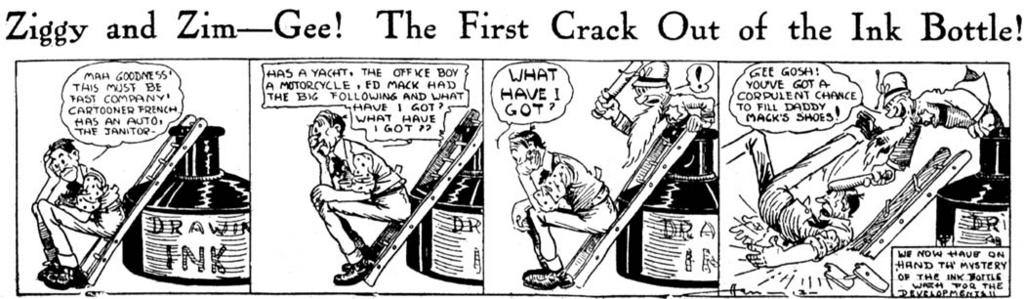
Henderson did an excellent daily strip for the Record-Herald titled The Adventures of Ziggy and Zim. Notice in this introductory strip that he refers to fellow Record-Herald cartoonists Ed Mack and French (whose first name I don't know).
WEDDING BELLS (2/14/1914)
Robin Grove, a cartoonist on the St. Louis Times, and Miss Cornelia Harrison have announced their engagement.
Assuming this is the cartoonist who signed his work Roy rather than Robin, he was a journeyman cartoonist who did a number of strips for the NEA syndicate from 1918-1925. His longer running features were Bugs and The Boys In The Other Car.
Labels: News of Yore
: 8/07/2006 10:31 PM --Allan
Eleanor
We'd be very much interesting in knowing more about Hopkins -- he had a very interesting career working for the oddball International Syndicate. Any info you have on his work life would be especially appreciated!
--Allan
Thursday, October 13, 2005
Cartoonist Convention Art


At newspaper industry get-togethers cartoonists often create some special art to commemorate the event. Since they’re cartoonists, they usually approach the job with humor and poke fun at their industry.
Here we have a treasure – three special comic strips created especially for a 1917 newspaper convention. The cartoonists are Rube Goldberg, Charles A. Voight and Robert Brinkerhoff, all with the New York Evening Mail at the time, and all in the early years of long prosperous careers. Here we get to see them poking fun at newspaper publishers and their penny-pinching ways. Here’s the write-up that accompanied these cartoons in the May 5 1917 issue of The Fourth Estate:
The ‘big surprise’ of the New York Evening Mail’s “gambol” to 800 newspapermen and advertisers, at Cocoanut Grove, atop the Century Theatre, on April 26, was the joint appearance of Goldberg, Brinkerhoff and Voight, the Evening Mail’s cartoonists, in a comedy skit written for the occasion by Roy K. Moulton, the Evening Mail’s columnist.
The sketch, billed on the program as “a tragedy,” told of the efforts of a newspaper publisher to buy a roll of print paper. “Paper King,” one of the characters, informed “Mr. P. Ubble Isher” that one roll of print paper would cost him exactly $9,000.00. In despair, the publisher turned to his cartoonists for assistance and after a whispered consultation they offered to help him out of his difficulty by lending him their “last week’s salary,” which happened to be the amount needed.
The above cartoons, by Goldberg, Voight and Brinkerhoff, are reproduced from the program of the Evening Mail’s party for its newspaper and advertising men friends.
