Friday, December 07, 2012
Ink-Slinger Profiles: Carl Schultze

Carl Emil “Bunny” Schultze was born in Lexington, Kentucky, on May 25, 1866, the son of Charles and Jane, according to Who’s Who in America, 1903–1905. The Encyclopedia Americana (1919) said his surname was pronounced with two syllables. The 1870 U.S. Federal Census recorded his full name; he was an only child who lived in Lexington, where his father was a music teacher. Little Visits with Great Americans (1904) said he was educated in the public schools of Lexington, Kentucky (not New York) and Cassel, Germany.


The vaudeville feature underwent title changes and ended in 1901. Schultze has not been found in the 1900 census. Soon Foxy Grandpa was adapted for the stage as mentioned in the New York Tribune, August 4, 1901:


Labels: Ink-Slinger Profiles


which explains my interest in the character, and I posted about him again today: https://www.facebook.com/deathandmrpickwick/posts/1100834763383708
I thought you might be interested. All the best Stephen Jarvis
Monday, March 18, 2013
Obscurity of the Day: The Handy Man from Timbuctoo


The series initially seemed to have really interesting possibilities when it debuted on August 14 1904 (top sample) in Hearst's New York American. A mysterious man, so hairy that only his eyes peek out from under the thatch, along with his pet tiger, emerge from the ocean onto an American beach. According to the title they have presumably just swum over from Africa -- never mind that Timbuctoo is over a thousand miles inland, or that tigers are not native to Africa at all. Such niggling details aren't important, because the series immediately devolves into the familiar plot where kids try to pull a prank, and the handy man and his tiger, as stand-ins for Foxy Grandpa, turn the tables. Ho hum.
Schultze signed this strip as CAW for some reason. In my book I contended that, based on what I'd seen of the strip, I didn't think that CAW was Schultze. That was based on looking at these strips on microfilm, far from optimal for art spotting. Seeing these samples from Cole Johnson, though, I can now see that they are indeed Schultze, and so retract my earlier statement. That leaves open a mystery as to why the cartoonist elected to do the strip under a pseudonym. Perhaps, and this is just a wild guess, he was assisted on the series and didn't feel he should take credit -- I do note on some strips a certain lack of finish that might go along with that theory.
The series sputtered out quickly, the last episode under the title running on November 6 1904. However, Schultze brought the handy man and his tiger into the Foxy Grandpa strip for two episodes, on November 13 and 20 (see bottom sample), before banishing the pair back to the middle of the Sahara.
Thanks to Cole Johnson for the samples!
Labels: Obscurities
 : 3/18/2013 9:13 AM
Cole sent me a Foxy Grandpa ad strip from 1904, but it wasn't signed CAW. It does, however, have that same vaguely unfinished look about it. Schultze's style certainly, but just slightly rough in the details. I could easily believe that the roughness is because Schultze didn't have his heart in it (much like with the Handy Man strip).
--Allan
--Allan
: 2/27/2023 2:03 AM : 2/27/2023 2:14 AM Friday, July 29, 2022
Obscurity of the Day: Grandma and her Little Black Blossoms

The popular comic strip Foxy Grandpa was about a jolly old codger and his young nephews. The typical plot of the strip was that the nephews would try to pull a trick on Foxy Grandpa, but he'd outsmart them and turn the gag right back on them.
Like most popular strips, Foxy Grandpa inspired imitators, and today we have one that recasts the characters as black, and grandpa is changed to a grandma. Because it ran as a small quarter-page strip, the gags were simplified such that the kids don't get to plan a trick -- grandma just plays a trick on them unprovoked. Grandma and her Little Black Blossoms ran occasionally in the Boston Globe Sunday comics section from November 1 1903 until January 31 1904*. The creator was James J. Maguinnis, who offered up quite a few forgettable series for the Globe in the 1900s.
* Source: Dave Strickler's Boston Globe index
Labels: Obscurities
Were the Boston Globe's cartoons syndicated at all in these earlier years? I've understood the tried maybe in the 1930s, but if they did, it was a feeble effort.
: 7/29/2022 8:26 PM So pathetic as the effort was, yes, they were shopping their wares around!
--Allan
Monday, March 28, 2022
Obscurity of the Day: Grandpa's Story
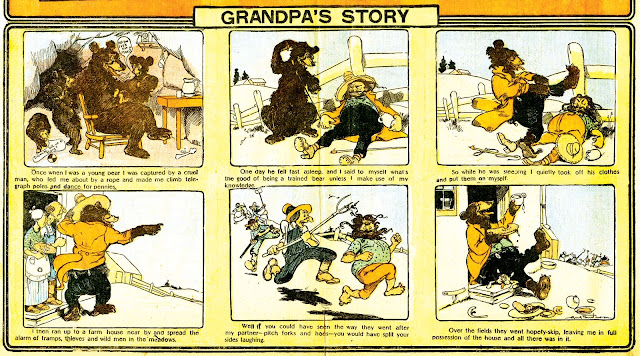
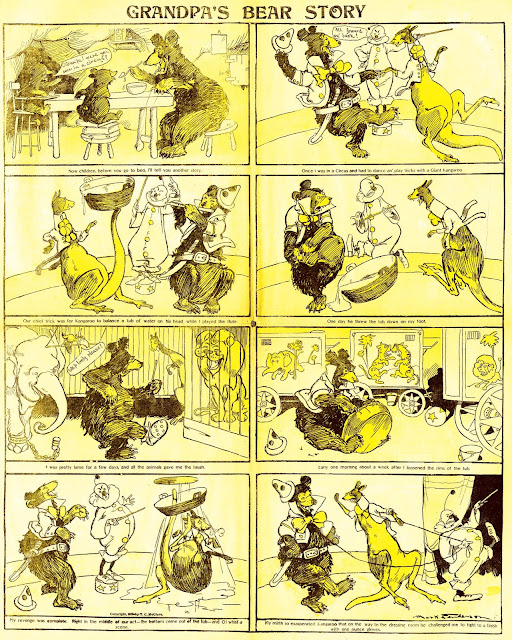
Grandpa's Story by Mark Fenderson ran three times, on February 2, 16 and 23rd 1902* (first and last shown above). It offers a slightly out of the ordinary perspective on animal strips, starring a bear who tells tales of his younger exploits to the grandkids.
I'd wonder why Fenderson didn't stick with this series longer, but not only were long running series uncommon in these early comics sections, but Fenderson in particular didn't seem to like to tie himself down to the same idea each week. Nonetheless, I think in this case there was a richer vein to mine in Grandpa's Story, and it's too bad Fenderson dropped it after a mere three episodes.
* Source: New York Press
: 3/29/2022 12:13 PM Monday, April 28, 2008
Dell Publishing's "The Funnies" Part 6
 Weekend's over, time to return to The Funnies. Today we have Foxy Grandpa, Carl "Bunny" Schultze's classic strip that first appeared in the New York Herald way, way back in 1900.
Foxy Grandpa was the Whack-a-Mole of comic strips. Schultze produced it for syndicate after syndicate, and every time a syndicate editor gave it the axe it would, sooner or later, pop up elsewhere. This, however, would be it's last appearance in anything approaching a newspaper. Schultze lived until 1939, though, and supposedly worked for awhile in the fledgling comic book industry -- I wouldn't be at all surprised if Foxy Grandpa made its last stand in the funnybooks.
Labels: Dell's The Funnies
: 4/28/2008 12:36 PM --Allan
PS - Hope this isn't a dry run for a certain HH essay! Ooh, bad bad....
Monday, January 07, 2013
Ink-Slinger Profiles: Charles Biro
Charles Biro was born in New York City, May 12, 1911, according to the Social Security Death Index and census records. He was not in the 1920 U.S. Federal Census because he was in Europe. A February 1921, Philadelphia passenger list recorded the return of Biro and his parents from Le Havre, France to New York City. The list said his parents, Anton and Josephine, were of the Hebrew race, Czechoslovakian nationals who spoke German. Their last permanent residence was Wien, Austria, and they were in New York City from 1909 to 1914. The Monthly Supplement 1951, to Who’s Who in America, said Biro attended the New School in 1918.
The 1925 New York State Census said the family of five lived in Queens County, New York at 148th Street and Grand Central Parkway. His father was a machinist and his older brothers, Michael and Louis, were a plumber and decorator. In 1928 Biro was sports cartoonist for the Long Island Daily Press, according to Who’s Who in America. As a Jamaica High School student, he was an assistant to the art editor on the school’s yearbook, The Oracle, June 1929.

In the 1930 census the Biros resided in Queens at 147-52 Grand Central Parkway. His Hungarian parents emigrated in 1898; his father was an engineer at a hotel. Biro’s brother Louis was an advertising artist. At this time, the earliest documentation of Biro’s professional career was found in the Daily Star, (Long Island City, New York), September 9, 1932:
Brooklyn Girl Betrothed to Queens Song WriterWho’s Who of American Comic Books 1928–1999 said Biro worked for the Fleischer animation studio in the 1930s, however the Who’s Who in America entry does not include Fleischer; it said he was an animator at Van Beuren Productions, R.К.О., from 1933 to 1936; then animation director of Audio Productions, from 1936 to 1937, and the Hastings Studio in 1937. He left animation to become art director at the Harry “A” Chesler Syndicate, from 1937 to 1938, and he drew the Foxy Grandpa comic strip (note from Allan: the only Chesler strip known to have actually run in newspapers was a revival of Little Nemo -- this version of Foxy Grandpa has as far as I know not yet been found actually running in a newspaper). The cover of Syndicate Features, December 15, 1937, featured a portrait of Carl E. Schultze, Foxy Grandpa and Biro. Around the same time he produced another strip, Goodbyland, and it’s not known if it was ever published. From the Chesler Syndicate he went to the comic book publisher MLJ from 1938 to 1939.
Mr. and Mrs. Anton Biro, 147-02 Grand Central parkway, North Jamaica, announced the engagement of their eldest son, Mitchell, to Miss Ceil Bayer, daughter of Mr. and Mrs. A.A. Bayer of Brooklyn, at a formal dinner.
Young Mr. Biro is a well-known song writer. Among the guests were Charles Biro, sketch artist for the Van Beuren Film Corporation of Manhattan, Mr. and Mrs. Lou Biro of Beechhurst, Miss Contia Biro of Brooklyn, Mr. and Mrs. Isadore Jacobwitz of Flushing-Hillcrest, Mr. and Mrs. Meyer Luther of Brooklyn and Al Koenency of Brooklyn.


In the 1940 census the couple lived in Sunnyside, New York at 4542 41st Road. He had four years of high school and his occupation was artist in the publishing industry. In the column for 1939 income, he earned 700 dollars, and his wife $1,250. Biro continued work in the comic book industry: editor-in-chief of Comic House, Inc., from 1939 to 1940; editorial director and editor-in-chief of Gleason Publications, since 1945; and president of Biro-Wood Productions, since 1945. Some of his comic book credits are here. He was credited with another comic strip, Judge Sterling, that may or may not have been published in 1946. The Kingston Daily Freeman (New York), October 12, 1946, noted one of his visits: “Mr. and Mrs. Carl Hubbell had as their week-end guests Mr. and Mrs. Charles Biro. Mr. Biro is Mr. Hubbell’s editor.” He contributed illustrations to Pat the Pilot, first published in 1949.
The New York Times, July 14, 1951, reported the Society of Amateur Chefs duck dinner at the Savoy-Plaza Hotel, the organization’s headquarters; two brief excerpts:
Among the co-conspirators at the range with Mr. Melchior were cartoonists Ham Fisher of “Joe Palooka” fame and Charles Biro, who left the fate of Pee Wee, Scare Crow and the other “Little Wise Guys” in midair to don his starched chef’s cap and apron. The latter costume, gay with red and black inscriptions, was worn by members over their conservative business suits. It was designed by fellow member and assistant chef of the day, Russell Patterson, the illustrator….During the month of October 1952, Stars and Stripes, September 21, 1952, reported that nine cartoonists were scheduled to visit American bases in Great Britain and France. They were “…Russell Patterson, the famed beautiful-girl illustrator (‘Mamie’); Dick Wingert (‘Hubert’), C.D. Russell (‘Pete the Tramp’), Bob Dunn (‘Just the Type’), all of King Features Syndicate; Al Posen (‘Sweeney and Son’), Bill Holman (‘Smoky Stover’ and ‘Nuts and Bolts’) and Gus Edson (‘The Gumps’), all of the Chicago Tribune-New York News Syndicate; Bob Montana (‘Archie’), McClure Newspaper Syndicate, and Charles Biro (comic books, ‘Dare Devil’ and ‘Peewee’).” Their Christmas greetings were published in the December 24, 1952, Stars and Stripes; Biro’s greeting is below.
Bill of fare for the evening (selected by Mr. Biro):
Anchovy twists
Mint juleps
Petite marmite
Wild duckling with sauce smitaine
Wild rice
Whole glazed cranberries
Mixed salad
French pancakes
Demi tasse

The Times, October 1, 1953, noted Biro’s leasing of space in the Steinway Building, 109 West 57th Street, in Manhattan. Maybe it was this location where he produced an eight-page comic book about the State Training School for Boys at Warwick, New York. The school was established to help juvenile delinquents. The April 17, 1954, Times reported the use of the comic book and printed two panels (below).

When his career in comics ended in the mid-1950s, he made the switch to graphic design in television. From 1962 to 1972, he was employed at NBC. Biro passed away March 4, 1972. The Comics Journal #245, August 2002, published an interview with Creig Flessel who recalled a couple of incidents regarding Biro. Photos of Biro are here. An issue of Uncle Charlie’s Fables can be viewed here.
Labels: Ink-Slinger Profiles
Mark Kausler
: 1/08/2013 1:48 AM : 9/23/2013 8:21 PM First, do we know where Biro died and is, presumably buried?
And what is known about his post-comics work at NBC and elsewhere?
Friday, December 23, 2005
Little Visits With Great Americans -- Part II

Continuing our excerpts (see previous post). Sample above is a typical T.S. Allen Just Kids cartoon.
T.S. Allen
One of the artists whose purpose in life seems to be smile-breeding is T. S. Allen. Well known in connection with his work in the columns of the New York American, his studies of and contingent jokes on "tough" youngsters under the caption of "Just Kids" are full of genuine humor. Mr. Allen was born in 1869, in Lexington, Kentucky, and was educated at Transylvania university, of that state. After some years spent in writing jokes, jingles, etc., for local and New York newspapers, he began to illustrate the same in a manner which quickly caught the attention of editors. To-day he has an established reputation as a graphic humorist, and his work finds a ready and remunerative market.
R. F. Outcault
In the world of illustrators, the man who can originate an idea which excites the laughter and holds the attention of the public is indeed fortunate. Such an individual is R. F. Outcault, the artistic father of the "Buster Brown" series which appear in the Sunday New York Herald. He is also the author of the "Yellow Kid" and "Hogan's Alley" pictures of the Sunday New York World, and of equally laughable creations in the New York American and other publications. Born in Lancaster, Ohio, January 14, 1853, he was educated in that town. In 1888 he secured a position with Edison, and went to Paris in the inventor's employ. Returning to this country, he illustrated for some time with a fair degree of success, but it was not until 1894 that he made his first distinctive hit as a comic artist. Mr. Outcault's personal description of his daily life is interesting. He says: "I have flowers, a garden, a dog and a cat, good music, good books, light stories, draw pictures, smoke a pipe, talk single tax theories, am a member of a couple of clubs, lead the Simple Life."
Carl E. Schultze
Humor, strenuous and wholesome, marks the work of Carl E. Schultze. His name is literally a household word in this country by reason of that quaint conceit, "Foxy Grandpa," of which he is the creator. He was born on May 25, 1866, Lexington, New York, and was educated in the public schools of that town and at Cassel, Germany. On his return to America he studied art under Walter Satterlee, of New York. For some time later he seems to have been undecided as to how to apply his gifts, but an accidental sketch submitted to a Chicago paper, resulted in his being forthwith engaged by that publication. After remaining in Chicago on several newspapers for some years, he took a trip to California, doing further artistic work in San Francisco. At length he determined to beard the metropolitan journalist lions in their dens. After a struggle, during which he did work on Judge and other New York publications, he became a member of the staff of the Herald, where, thanks to an accidental inspiration, "Foxy Grandpa" came into existence. Later he became connected with the New York American. Mr. Schultze is a man of magnificent physique, and is held in high esteem by those who know him. He is the author of several works of comic drawings, and "Foxy Grandpa" has been dramatized.
Eugene Zimmerman
Eugene Zimmerman's cartoons in Judge are characterized by an insight into the political questions of the hour which is assisted rather than hindered by the sheer humor of his work. He was born at Basel, Switzerland, May 25, 1862. While yet a baby his parents came to the United States and settled at Paterson, New Jersey, where he received his education in the public schools. After leaving school, he was in turn a farmer's boy, an errand boy in a store, a fish peddler, a baker and a sign painter, but sketched and drew continuously. In 1882 he secured a position in the art rooms of Puck, and after doing considerable work for that publication left it in order to join Judge. He has also illustrated books and articles by Bill Nye and James Whitcomb Riley. As a caricaturist pure and proper he is almost without a rival in this country.
Tuesday, January 13, 2009
Excerpts from Louis Sobol's "The Longest Street"
I did, however, find a few interesting passages about cartoonists and I figured I'd save you from reading a 450 page book yourself in order to ferret out these little gems.
The Sad Declining Years of Carl Schultze
"In an earlier book of mine, Some Days Were Happy, I dwelt briefly on a long-forgotten cartoonist, Carl E. Schultze. Now I'd like to present the complete story.George Luks a Pariah among Cartoonists?
Back in April of 1935, I ran a line to the effect that Schultze, creator of the highly popular comic strip "Foxy Grandpa" which was originated in the New York Herald at the turn of the century and then moved on to the New York American and other Hearst papers, was reported eking out a meager living drawing posters for YMCAs.
Two days later came a letter from Schultze, confessing that for more than a year he had lodged at the Twenty-third Street YMCA turning out cards and posters for the branch. "But," he added, "things look brighter now, and I'm planning to modernize the old character and give him new life in book form."
In the same mail arrived a note from Karl T. Marx, Secretary of the German-American Conference Relief Committee, advising that the veteran cartoonist had applied at the office for help and been assigned to interview applicants for jobs.
I was filled with melancholy over the plight of an artist who in his day ranked with the top-drawer cartoonists—as readers of my generation certainly should recall—for many of us had been ardent fans of the genial, philosophical character Schultze had created.
A week later, another note arrived from Schultze. "Your 'Voice of Broadway' certainly started something. The latest is the Associated Press which came in here yesterday with a fine hurray—pictures and everything. From the quiet tranquil life, I have suddenly found myself in a whirlwind of activity—a sort of dust storm—but gold dust. Even if none gathers down around me, I've certainly got the old works tuned up and am happily on my way. Anyway I have known for quite a few years past the things most worthwhile in life and haven't a single kick to register. Life can always be good—it's silly to mind the bumps."
And, indeed, feature stories appeared in several of the Manhattan newspapers, detailing his earlier career, praising his acceptance of his current obscurity and financial distress. He was sixty-nine then.
I lost contact with the fine, cheerful old gentleman until one day in January of 1939, while I was on the Coast, accumulated mail was forwarded to me, and among the items was a postcard from Schultze with a brief little message. "A smile from Foxy Grandpa. So nice to be alive with nice people who are alive. So happy days." It was signed with a drawing of Foxy Grandpa— and then Schultze's own signature.
The card was dated January 12. It reached me January 19, the very day that the newspaper carried the news of the artist's death of a heart attack at the age of seventy-two. According to the obituaries, the once dominant and high-earning cartoonist had been subsisting for a year or so on a $95-a-month job as an illustrator in the reading materials project of the WPA."
This passage includes several factoids worthy of a raised eyebrow.
"The Artists & Writers Club, as its label indicates, was originally organized to gather certain members of the literary and art sets for occasional dinners and chatter, though often outsiders were admitted to our esoteric clan. Usually, we congregated in the upstairs dining room of "21."
Sports columnist Grantland Rice, one of the original organizers, was president. After his death, cartoonist Rube Goldberg succeeded him. Goldberg usually was the master of ceremonies at our gatherings.
An account of just one meeting may convey some idea of what took place at these sessions. This one took place on December 7, 1944, and, of course, since December 7 was a memorable date in our history, there were solemn toasts to our fighting lads.
Then we turned to lighter subjects. Artist James Montgomery Flagg revealed his minor problems when he began painting that famous and much-discussed mural of the Dempsey-Willard fight that was to be hung in Jack Dempsey's restaurant.
"I didn't even know how sensitive some folks could be," he lamented. "Why, this fight was held back in 1919, and I painted in some folks who never were at that fight simply because Jack thought they were important and should be included. Do you know something? Some of them, and I'm not kidding, actually squawked because they didn't like the seats I put them in! And my friend Damon Runyon told me he wasn't too sure he even liked the people I put next to him in that painting."
Producer John Golden was another speaker. He discussed old-time chaps who drew and wrote and got together occasionally for fun and light imbibing. Among those he mentioned was that cartoonist genius, Dick Outcault, who had created the popular cartoon, "Yellow Kid." He said Outcault hadn't originally intended that the "kid" should be yellow, but there was a slight mishap in the coloring process. Golden confessed that it was he who used to write the balloon captions for the cartoon. "I got more of a kick out of them," he insisted, "Than when I wrote 'Poor Butterfly' years later."
"Well, William Randolph Hearst came along and coaxed Outcault to bring 'Yellow Kid' over to the Journal. Whereupon Joe Pulitzer, irked by this theft of one of his artists, had a certain newcomer imitate the strip, and for quite a while we had two 'Yellow Kids' running. Everybody in the business considered this highly unethical, and in fact many of the boys stopped talking to the young imitator artist.
"The years passed, and I became a producer. One day my secretary came in and said there was a man outside to see me, and, of course, as you must guess, it was the ostracized cartoonist. By this time, I wasn't as peeved with him as I had been in those earlier days, so I told the girl to show him in.
"He said: 'Look here, John Golden, you don't have to be so high-hat with me. I don't do any silly cartoons anymore. I move around with the best of them. I paint kings and queens, and I get more for a single painting than I did for a whole year's cartooning. So don't be so stuck up with me. I'm just as important as you are.'"
Golden went on to tell us that indeed the fellow had become as important as he claimed. He was George B. Luks whose paintings were hung in national museums around the world, and whom James Huneker once described as "a Puck, a Caliban, a Falstaff, a tornado."
A Rare Photo

"A rare photo when Healy's on Broadway was a popular rendezvous. This gathering was a "welcome back to freedom" for Hype Igoe, famed Hearst sports columnist who had been jailed for some minor infraction of the law. Among the assembly: bottom row, starting with the fourth from the left, we spot Wilson Mizner, noted raconteur oft profiled man-about-town of the twenties; then "Tad" (T. A. Dorgan), famed Hearst sports cartoonist, Hype Igoe, composer Irving Berlin, cartoonist Tom McNamara ("Us Boys"), also cartoonists Walter Hoban, Hal Coffman, Cliff Sterett ("Polly and Her Pals"). In the row above, we lead off with Victor Watson, Hearst editor who committed suicide, then third from left, cartoonist Winsor McCay ("Nemo" and "Lady Bountiful"). Fifth from right, cartoonist Jimmy Swinnerton, and third from right, cartoonist humorist Harry Hershfield.Not mentioned in Sobol's caption are 'Stanley' (blurry, on the left edge) who might have been cartoonist Lee Stanley of "The Old Home Town" and "Duke" Wellington who I'm guessing is Charles H. Wellington of "Pa's Son-In-Law", Can you identify any others?
Healy's has long joined the Tombs of Broadway—and for that matter Hype Igoe has passed on. And so have most of those in this gay assembly, although Hershfield and Berlin long beyond the threescore-and-ten mark remain very much alive and active."
Sunday, March 27, 2022
Wish You Were Here, from Carl "Bunny" Schultze
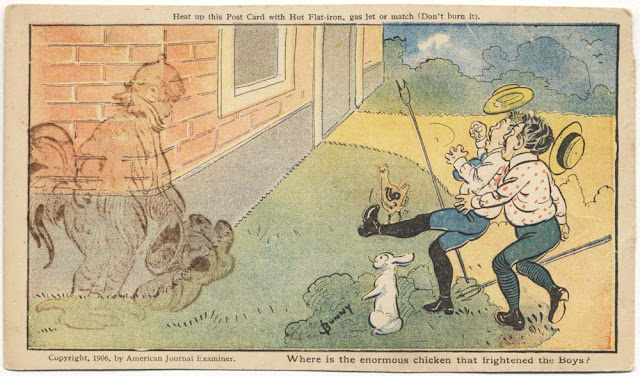
Another entry from the 1906 Little Arsonist series of Hearst freebie cards, this one featuring the characters from Foxy Grandpa. This one at least holds a slight surprise for the flatiron wielding kids, who might not immediately guess that an "enormous chicken" could be Grandpa.
Labels: Wish You Were Here
This is the first card I've seen where it would seem a mistake, albeit a subtle one, is made. Obviously the figure to be revealed is actually a seperate drawing, to be superimposed on the background, printed in the wax or chemical that is used for ink. But here, the Grandpa figure isn't a perfect fit.
Notice the gaze of the boys don't align with the sight they behold, they are looking above him. You'll also note they are nearly the same size as he is, not as we see in the strip.
My guess is that the Foxy figure was, though the correct size to match the boys, was somehow shrunk a bit by an art editor.
: 3/27/2022 10:48 AM Thursday, December 05, 2019
Toppers: Cousin Juniper

Under the direction of its original creator, Sidney Smith, The Gumps was the gold standard for comedy - soap opera strips, a genre that it created. When Smith died in 1935, however, the Chicago Tribune - New York News Syndicate made what is pretty universally considered an error in judgment by handing the strip over to Gus Edson.
The heir apparent for The Gumps was Stanley Link, but according to legend, Link thought he had the syndicate by the short hairs. He made some pretty big demands and acted as if he was indispensible. According to a story told to me by Jim Ivey, Link put the final nail in his coffin when he came to a meeting with syndicate chief Joe Patterson and put his feet up on the Captain's desk. Apparently Link was not totally out of favor, because he continued Ching Chow, Tiny Tim and originated other features for the syndicate for many years hence.
I find Edson's version of The Gumps to be really tiresome, but perhaps through inertia alone the strip maintained a very healthy list of newspaper clients through the 1940s and even into the 50s.
The Sunday page of the strip had a topper for awhile in the Sidney Smith years, a revival of Smith's popular Old Doc Yak strip that was his first big hit back in the teens. But Smith or his syndicate seemed to have little interest in it, and it was dropped in early 1934. From then on the strip ran without a topper at all (a rarity in the 1930s) until the first Sunday of 1944, when the Gus Edson version suddenly added a one-tier topper called Cousin Juniper. Juniper was a pre-existing character in the strip, a bald sailor who had befriended young Chester Gump. In the topper he became a bland vehicle for weak gags.
The topper made The Gumps function better in the newly popular third page size; rather than trying to shoehorn a whole tab's worth of strip into that small format, the main strip was shortened so as not to end up with a very busy looking three tier third.
The new strip was emininetly forgettable, but appeared as a part of the half-page and tab versions of the strip for over a decade. In 1955 Edson for some reason dropped Cousin Juniper in favor of a new topper strip titled Grandpa Noah. Unfortunately, finding The Gumps Sundays in either of those formats by 1955 is so unusual that I can't give you a specific end date for Cousin Juniper, and I don't know how long Grandpa Noah ran. (I can say that based on original art for the feature, the topper seems to have disappeared by 1957.) Any information readers can give would be much appreciated.
Labels: Topper Features
--Allan
Tuesday, April 29, 2008
Dell Publishing's "The Funnies" Part 7
 Just slightly more youthful than Foxy Grandpa, Percy and Ferdie made their debut in 1904 under the title The Hall-Room Boys. H.A. MacGill, who had shortly before caused a minor sensation in New York newspaper circles by producing the very first true sustained daily comic strip, followed up with this rather less interesting feature starring a pair of would-be gay rakes. Percy and Ferdie were always on the prowl for ladies and they usually tried to attract the fair sex by pretending to be well-off, a tactic that invariably blew up in their faces. The strip was reasonably funny, but suffered from a ridiculous surfeit of dialogue (a problem MacGill seemed finally to remedy in this incarnation).
Percy and Ferdie has much the same history as Foxy Grandpa as a matter of fact. MacGill jumped syndicates pretty often, usually taking the boys along with him. But they'd not appeared for half a decade before being revived one last time in The Funnies.
Labels: Dell's The Funnies
Monday, November 28, 2022
Selling It: Foxy Grandpa for Tuxedo Tobacco

In the April 28 1912 edition of Hearst's American Weekly the back cover was given over to a full page ad from Tuxedo Tobacco. Someone at that tobacco company must have been a big cartooning fan, because cartooning and cartoonists were frequent subject matter for their ads. This early one repurposes a Foxy Grandpa strip that has nothing to do with tobacco. Given how much a full page 4-color ad in a magazine section that ran in every Hearst paper must have cost, it's surprising that the Tuxedo advertising department didn't put some effort into finding a strip that had some connection to their product, or tobacco in general.
: 11/29/2022 7:29 PM Friday, July 13, 2007
Ivey and Holtz Take On DC, Part Three
Can't say that there was much excitement in these papers to report. I did find start and end date for Chester Gould's The Girl Friends, a rare strip that ran only in the Chicago Daily News. Turned out to be a pretty good strip, too. I also finally got all my ducks in a row on Foxy Grandpa. The last Sunday version of that series, which ran in the New York Herald, was for some reason omitted in Ken Barker's index of that paper. Foxy Grandpa was also recently pinned down further when Cole Johnson reported the existence of yet another series, this one a daily, that ran in the Philadelphia Bulletin in 1922 (by the way, Cole, please send me an email -- I can't find your email address).
For those with an interest in science fiction strips I'll report the discovery of what might be the most obscure one yet. The Brooklyn Eagle ran a sci-fi adventure titled The Mysterious Island in their Sunday kiddie section for just two months in 1935.
Another good find was an absolutely certain end date for Keeping Up With The Joneses. I'd always been perplexed that the standard references all place the end of this strip in the 1940s, yet I've never seen any from later than 1938. The Brooklyn Eagle put an end to any question by running the last strip on 4/16/38 which has Pop Momand and his characters officially announcing their retirement.
For those who are interested in photo-comics, as I know several blog readers are, I have one to add to the list. I knew that there was a comic strip series titled Two Black Crows (featuring a popular blackface comedy team of the era) but what I didn't know is that the strip used photographic images of the main characters' faces in the strip, which otherwise was drawn in the normal manner.
After a productive three days at the Library of Congress I swooped back into the convention festivities for the final reception and dinner. In previous days I'd gone through the list of convention attendees and made a list of those who have done strips or panels. My mission at the party was to corner those whose information was sparse in the index. I realized that I wouldn't get particularly specific information out of anyone in the middle of a cocktail party, but I did want to touch base.
I started with Paul Fell who did the art on a feature titled Mulch. Mulch was a strip about a handicapped Vietnam vet. It was written by Bob Shill for whom the strip was semi-autobiographical. Shill created the concept and shopped it around to syndicates with no takers, so he resolved to syndicate it himself through his own company, Signature Features, with a relative beating the newspaper bushes to find takers. Fell was brought on board to handle the art chores and worked on the feature from June 2000 until sometime in 2002. Seeing little progress in the number of papers taking the feature Paul finally had to drop out from the art chores. He recalls that Shill was trying to find another cartoonist to take over for him but never heard if they had any success in that search.
I next cornered Elena Steier, who was on my list for her strip Dinosaur Circus. The strip was distributed by the tiny syndicate DBR Media from 2001 until 2003. I was particularly interested in finding out how DBR Media operates. It turned out that Elena confirmed my guess -- DBR paid creators a flat fee so they never received any feedback about the number or identity of papers running the features. This was unfortunate but expected, as I've had a heck of a time tracking DBR's output until recently. I now subscribe to a newspaper called the Lake Region Times out of Minnesota which runs their complete output every week.
With cocktail hour waning I managed to find Vance Rodewalt, who did a strip titled Chubb And Chauncey. I learned that it was only available in the US for one year, but that it continued outside this country for an even dozen. Rodewalt initially placed the strip with Tribune Media but found the sales in the US disappointing. He switched over to the Toronto Star syndicate (Rodewalt is Canadian) and had much better success. The Toronto Star apparently had an agreement not to sell into the US market, so Rodewalt lost all his US papers (a fact of which he wasn't aware when he switched syndicates). All turned out okay, though, because he also placed the strip with Editors Press, a syndicate that sells worldwide. Rodewalt told me that the strip was very popular in far-flung places such as India, where it ran for many years in the India Times.
Rodewalt and I were still in a huddle after the reception was over, and we ended up having to take it on the run to find the banquet. I do regret very much never having a chance to talk with some of the others who were on my hit list. I missed my last chance to talk to Tom Toles, Jack Ohman, Mike Luckovich, Scott Stantis, Ed Stein, Gary McCoy, Bruce Plante, comics legend Jerry Robinson and many others who were all due for a Holtz inquisition. One I particularly regret is Daryl Cagle -- I wanted to let him know that his very short-lived panel cartoon True! is one of my all-time favorites.
Arriving late at the banquet I found my customary place alongside Ivey and Harvey was unavailable, but was lucky enough to find a seat at the table with Lucy Caswell and Steve Greenberg. Greenberg brought me up to date on the long sad tale of the San Francisco Examiner's demise. Steve had the questionable distinction of being their last staff editorial cartoonist before the grand old paper was remade as a rather pathetic freebie. Greenberg and I found that we had something else in common - I'm embarrassed to admit that I had completely forgotten that Greenberg is a fellow Hogan's Alley magazine regular. He writes the excellent column in each issue about editorial cartooning. So we both got to complain about editor Tom Heintjes (kidding Tom!).
The dinner program was packed with interesting stuff, enough so that no one got to do more than take a few quick gulps of the dinner fare in between speakers. The founding fathers, Ivey among them, were all asked to speak again, this time with a properly working microphone. Rob Rogers had produced a cartoon depicting the founding members as cavemen which gave everyone a good laugh.
David Wallis spoke about his book Killed Cartoons, including his fight with the book's publisher. The publisher, showing an amazing lack of backbone, refused to reproduce a cartoon by Doug Marlette featuring a Mohammed caricature in the book. Considering the subject of the book, this was not only pathetic but also downright bizarre. Wallis told the publisher that their decision would come to haunt them, and apparently media reaction has borne him out on that prognostication.
The featured speaker for the evening was Democratic presidential candidate Dennis Kucinich. Although his campaign hasn't exactly garnered a groundswell of support, I for one maintain a soft spot for Dennis. Beyond his being the only candidate completely and unabashedly committed to peace and an end to the Iraq debacle, I've always liked him simply because on a previous trip to Washington, hanging out in my usual haunts at the Library of Congress, I saw him strolling to work, briefcase in hand one morning. No limo, no security, no aides. Just Dennis. And here's the kicker - it was a Saturday! That's the kind of guy we need in Washington. Not to mention that his wife is a total babe.
Kucinich was in danger of losing the crowd right off the bat. He led off talking about his love of old comic books, and how his hometown of Cleveland produced Siegel and Shuster. The editorial cartoonists were grumbling, wondering if Kucinich didn't know the difference between comic books and editorial cartoons. Luckily his next schtick went over much better, a very funny plea for the cartoonists to cover his campaign. He showed some cartoons drawn especially for the event showing the cartoonists how easy it is to caricature him, playing on the old "Draw Me" matchbook cartoon course ads. Everyone got a big kick out of it. Kucinich then closed with a very moving story of visiting gravesites on a recent trip to the mideast.
That was it for the big show. Jim and I turned in immediately because we had an early plane flight, but we found the next morning that editorial cartoonists really know how to party. We were up at 6 AM and ran into cartoonists in the hall who were just them stumbling to their rooms after an all-night beer bash.
So that was our trip. Hope I didn't bore you with too many details, but Jim and I really had a great time, and I'd like to once again thank the AAEC, Rob Rogers and R.C. Harvey for making it all possible. See you guys again for the 60th anniversary?
BELATED EDIT: Matt Fletcher tells me the rest of the story regarding "Mulch":
I was recruited by Bob Shill to do the artwork for Mulch, which continued via self-syndication, for another two and a half years. Bob had seen one of my strips on a website Tribune Media had set up to feature new artists.You may not be aware, but Bob Shill is a quadriplegic. He would write the scripts and e-mail them to me for artwork. It was a real pleasure working with Bob. Towards the end, I think Bob became more interested in other creative pursuits, so the scripting duties fell to me. Self-syndication ultimately proved too difficult, and in the end we chose to pull the plug on the strip in May, 2004.
> science fiction strips I'll
> report the discovery of what
> might be the most obscure one
> yet. The Brooklyn Eagle ran a
> sci-fi adventure titled The
> Mysterious Island in their
> Sunday kiddie section for just
> two months in 1935.
Can you tell me anything about this?? Advanced technology, Lost World/ King Kong adventure?
Art Lortie
: 2/22/2010 6:36 PM --Allan
Friday, August 07, 2009
The Stripper's Guide Super-Quiz Day 10
1. Cartoonists don't usually come out of the womb with a syndicate contract in hand. Here are some odd jobs that cartoonists claimed to have before they became successful in the toon profession. Which cartoonist was a bus driver (and proudly proclaimed so on his feature)? Who was a glass blower? Who was half of a husband-and-wife vaudeville dancing team? Who was a reporter for the Wall Street Journal? Who was a Yellowstone Park tour guide?
2. Margaret Mitchell of "Gone With The Wind" fame reportedly considered taking on the writing duties of what new strip of 1953?
3. Which American newspaper is responsible for the very first four-color printing on newsprint using a high speed newspaper press? Which newspaper was second? And which cartoonist was instrumental in inventing the new process?
4. A successful comic strip is bound to inspire imitators. Some take it too far, though. The success of Foxy Grandpa inspired a certain newspaper to bring out an imitation called ... Foxy Grandpa. Which newspaper was it that apparently never heard of the concept of plagiarism?
5. Socialism and fashionable clothing don't seem to mix. But mix they did in a fashion strip that ran in the Daily Worker. What was the title of the strip?
Labels: Super-Quiz
But let try for this last time:
1-???
2-THE HEART OF JULIET JONES (but M. Mitchell died in '49...)
3-New York World + New York Journal American + R.F. Outcault?
4-???
5-???
Worthy of an Obscurity of the Day posting a few years ago:
http://strippersguide.blogspot.com/2005/10/obscurity-of-day-modish-mitzi.html
Monday, September 04, 2023
Ink-Slinger Profiles by Alex Jay: Charles Biro

Medal WinnersThe winners of medals for last term’s advanced art classes have finally been selected.The Alexander medal, for five [sic] draftsmanship in elementary representation, will be awarded to Charles Biro. Charles is continuing his art in high school, and will probably take up art seriously after graduating. ...

Brooklyn Girl Betrothed to Queens Song WriterMr. and Mrs. Anton Biro, 147-02 Grand Central parkway, North Jamaica, announced the engagement of their eldest son, Mitchell [sic], to Miss Ceil Bayer [sic], daughter of Mr. and Mrs. A.A. Bayer of Brooklyn, at a formal dinner.Young Mr. Biro is a well-known song writer. Among the guests were Charles Biro, sketch artist for the Van Beuren Film Corporation of Manhattan, Mr. and Mrs. Lou Biro of Beechhurst, Miss Contia Biro of Brooklyn, Mr. and Mrs. Isadore Jacobwitz of Flushing-Hillcrest, Mr. and Mrs. Meyer Luther of Brooklyn and Al Koenency of Brooklyn.


Among the co-conspirators at the range with Mr. Melchior were cartoonists Ham Fisher of “Joe Palooka” fame and Charles Biro, who left the fate of Pee Wee, Scare Crow and the other “Little Wise Guys” in midair to don his starched chef’s cap and apron. The latter costume, gay with red and black inscriptions, was worn by members over their conservative business suits. It was designed by fellow member and assistant chef of the day, Russell Patterson, the illustrator….Bill of fare for the evening (selected by Mr. Biro):Anchovy twistsMint julepsPetite marmiteWild duckling with sauce smitaineWild riceWhole glazed cranberriesMixed saladFrench pancakesDemi tasse


Pat the pilot. Grade 6. Eleanor M. Johnson, editor-in-chief. Editorial board for the revised series, William E. Young & others. Illustrated by Charles Biro. (New Reading Skilltext series) Appl. author: Charles E. Merrill Books, Inc., employer for hire. © Charles E. Merrill Books, Inc., 12Jan61; A502070.

Pat, the Pilot. Editorial review board: Murray Anderson, Millard H. Black, Evelyn B. Taylor & George R. Turner. Illustrated by Charles Biro & Bill Mohler. Columbus, Ohio, C.E. Merrill Pub. Co. 88 p. (Merrill reading Skilltext series) Based on the original Reading Skilltext series. NM revisions. © Charles E. Merrill Pub. Co.; 4Sep70; A228925.Pat, the Pilot. Editorial review board: Murray Anderson, Millard H. Black, Evelyn B. Taylor & George R. Turner. Illustrated by Charles Biro & Bill Mohler. Teacher’s ed. Columbus, Ohio, C.E. Merrill Pub. Co. 88 p. (Merrill reading Skilltext series, grade 6) Based on the original Reading Skilltext series. NM revisions. © Charles E. Merrill Pub. Co.; 4Sep70; A228926.
Labels: Ink-Slinger Profiles
