Thursday, June 27, 2019
Ink-Slinger Profiles by Alex Jay: Ralph Wolfe
Ralph Allison Wolfe was born on August 19, 1894, in Cherokee Nation, Indian Territory in present-day Oklahoma. His full name and birth date were on his World War I and II draft cards, and his birthplace was based on the 1900 U.S. Federal Census. His father, James, was Caucasian and a farmer, and his mother, Kate, half-Cherokee. Wolfe was the fourth of six children and described as “three-quarter white”.
The Vinita Chieftain, July 31, 1907, reported the following, “Ralph Wolfe, son of Rev. J.E. Wolfe, is at home of Mrs. William Tigar where he is receiving medical treatment for a chronic case of sprained ankle. He has been afflicted for about two years.”
In the 1910 census, Wolfe, his parents, two younger siblings, uncle, maternal grandmother and aunt resided in Vinita, Oklahoma at 101 Miller Street.
Wolfe’s talents was noted in the Chieftain, July 2, 1912, “A great deal of amusement has been created among the crowds awaiting returns from Baltimore by cartoons drawn by Ralph Wolfe, a Vinita boy who possesses a remarkable talent along this line.”
On November 15, 1912, the Chieftain described Wolfe’s artistic contributions.
One night last week during the course of Dr. Bulgin’s sermon he said he was sorry he was not an artist when he thought of the church members of Vinita, for he would like to make a cartoon of each of the ministers to show how the church was supporting them. He then pictured each one in attitudes representative of their individual struggles. A few evenings later a roll was handed the doctor and opening it he found two cartoons, perfectly drawn, giving his exact ideas of two of the ministers expressed before. The artist is Ralph Wolfe of this city a young man eighteen years old, and one who has remarkable talent for work of this kind. One of the cartoons pictured Rev. Roper with bent back, the perspiration dripping from his brow and evidence of care and fatigue written on his face. He was carrying the church building on his back. It was easy to see it was Rev. Roper and the church was faithfully drawn. The other represented Rev. Burger shouldering a heavy load of ardent worshippers who sang “There is a fountain filled with mud;” for the minister was represented as standing in a pool of water very muddy, with stepping stones marked “ungodliness,” and “non-support” and “unbelief.” Above the heads of the people who stood in an ornamented vase to form the top, were notes in the air to represent the melody. This young man has done some work which is better that a great deal we see in city newspapers and he certainly has a future before him and will make a splendid success when he accepts a position in this line of work.Wolfe was in California by 1915 if not earlier. He lived in the westside of Los Angeles according to an entry in the Catalog of Copyright Entries, Part 4, Works of Art, Etc. 1915, New Series, Volume 10, No. 1.
Wolfe (Ralph) Sawtelle, Cal. [653Wolfe signed his World War I draft card on June 5, 1917. His occupation was caddie at the Los Angeles Country Club. His description was medium height and build with green eyes and light hair.
Chollychap. [Grotesque drawing of statuette of man wearing derby hat,
tight-fitting coat and large trousers, standing with heels together and
toes turned outward.] © 1 c. Mar. 16, 1915; G 49221.
Wolfe’s widow mother was the head of the household in the 1920 census. The household included Wolfe, his mother, three siblings and his mother’s sister. They were Los Angeles residents at 1260 West 51st Street. Wolfe’s occupation was cartoonist in the moving pictures industry. Wolfe had the same address in the 1921 Los Angeles city directory.
Wolfe was involved with producing stop-motion animation shorts under the name, Plastic Art Productions Presents Ralph Wolfe’s Mud-Stuff; here are links to three shorts, Green Pastures, Long Live the Bull, and The Penwiper.
In the first half of the 1920s, American Newspaper Comics (2012) said Wolfe produced Robin’s Son Krusoe for the C-V [Cornelius Vanderbilt, Jr.] Newspaper Service, and Around the Studios for the Los Angeles Daily News. In the second half, Wolfe drew Flying Circus from June 11 to July 2, 1927 for the San Francisco Daily News. He was followed by Sweigert. For United Feature Syndicate, Wolfe started The Outline of Polar Exploration in October 1928. Wolfe continued The Pioneers which began with Lovrien Gregory on February 12, 1928. Wolfe’s stint started July 22, 1928 and ended January 13, 1929. He also wrote it from September 23, 1928 to July 22, 1928. The Bell Syndicate was the distributor. Wolfe’s Animal Wise Cracks, for the Graphic Syndicate, appeared from 1929 to 1930.
Wolfe’s bi-coastal travels were reported in the San Francisco Chronicle, September 11, 1927.
Ads and Art to Be Lecture TopicIn the 1930 census Wolfe was a lodger at 14 West 68th Street in Manhattan where his occupation was newspaper cartoonist. At some point Wolfe moved back to Los Angeles.
Ralph Wolfe to discuss Interesting Subject
Of interest to artists and art students is the lecture on “The Opportunities for Commercial Artists in San Francisco,” which will be given by Ralph A. Wolfe tomorrow evening at 8:30 in the studios of the Advertising Art School, 450 Geary street. Wolfe is familiar with the field of art and advertising through his connection with one of the daily papers and with one of the largest art studios in San Francisco in the capacity of solicitor.
Although he will treat his subject from the point of view of a business man, he is also an artist. In New York, with the Century Publishing Company, and in Hollywood, where he made animated cartoons, he gained the experience which enables him to speak with authority. The meeting is open to the public.
Who’s Who of American Comic Books, 1928–1999 lists Wolfe’s animation employment at Disney, Warner Bros., and Fleisher studios in the 1930s. During Wolfe’s time at Warner Bros., his name was “hidden” in the cartoons, Have You Got Any Castles?, and Speaking of the Weather.
Wolfe wrote “and now — The Painted Voice” for Art Instruction, June 1939, “an article describing the new ‘shorthand’ of hand-drawn sound invented and patented by Dave Fleischer of Fleischer Studios, Inc., Miami, Florida…”
Undoubtedly one of the strangest inventions on record in the United States Patent Office is Patent Number 1888914. It has been issued to Dave Fleischer, directorial cartoon genius who is producing “Gulliver’s Travels” for Paramount — a full length feature cartoon in Technicolor. While Mr. Fleischer’s invention is awaiting commercial development, it awakens many conjectures as to its ultimate and fascinating possibilities.In Artists in California, 1786–1940 Edan Hughes wrote “…He worked for 40 years as a cartoonist for Disney Studios.”
One day while studying a sound track which went with one of his animated cartoons, it occurred to Dave Fleischer that it might be amusing to copy some of the queer little forms by hand! So he picked out certain forms and had his art director, Erich Schenk, paint them on a vertical strip which were later reduced and photographed on a sound track. The first hieroglyphics or forms in halftone produced the words, “Where am I?” With this as a starter, Dave Fleischer went ahead and drew up several simple bars of music which, when run through the projector, produced tones the same as, or comparable to those, made by a musical instrument. After many such attempts Fleischer was positive that an alphabet of sound could be developed if he went far enough into the subject. Today his research has convinced him that he has only scratched the surface in a fascinating new field of science which may add much to the world of amusement. Who knows? He may develop his method to a point where the amateur maker of movies can do his own sound writing and have it developed in a commercial laboratory.
Think of the possibilities of hand-drawn sound in the service of the Army Intelligence Corps, such as sending code sound tracks to be translated into lights and darks which would produce sound messages.
Dave Fleischer tells me that his hand-drawn sound is as clear as that produced by the voice or musical instruments. A hard lead pencil produces clear sound and a soft lead pencil brings out sound that is “fuzzy.” The best sound drawings can be created by opaque water color and the shapes they take are similar to those made by children when they write their names on slips of paper, fold the paper, then open it up again to see the inky butterflies which have been formed. These butterflies always come in pairs slightly joined, like Siamese twins.
As I talked with Dave Fleischer, many questions came to mind. I asked him if sounds could be caricatured as one caricatures the features of a subject in a photograph. He assured me that it was quite an easy thing to accomplish; in fact one has to be careful to avoid caricaturing sound, or drawing a sound out or stretching or twisting it produces all sorts of weird effects. The drawing of a screech or a scream, or a brogue is something on the order of a caricature and experimenting in such offers an endless variety of sound effects. I asked him if sound drawing is tedious or difficult. He answered, “Difficult, but hardly tedious if one is really interested.”
He believes that sooner or later a sound shorthand will be developed to the point where musicians will be drawing their compositions instead of playing them on instruments! The use of rubber stamps for sound writing is also within the range of possibility. Perhaps even foreign language lessons may be given a certain acceleration which may be an aid to oral teaching.
Certainly, Dave Fleischer is leading us into strange by-ways which may take us into undreamed-of worlds of interest, as did Edison with his invention of the phonograph disc, or Marconi with his wireless.
On April 27, 1942, Wolfe signed his World War II draft card. His address was 7084 Hawthorne in Los Angeles, California and he was a freelance cartoonist at the Whitman Publishing Company. Wolfe’s description was five feet ten and three-quarters inches tall, 200 pounds with hazel eyes and brown hair. Wolfe said he was a disabled war veteran.
According to Who's Who, Wolfe free-lanced in the comic book industry during the 1940s into the early 1950s; some of the titles include Barnyard Comics, Dizzy Duck, O.K. Comics and Supermouse.
The California, County Marriage Records, at Ancestry.com, said Wolfe married Enola Agnes Richardson (1905–1987) on June 12, 1947.
Wolfe passed away on June 20, 1985 in Los Angeles, according to the California Death Index at Ancestry.com. He was laid to rest at the Los Angeles National Cemetery.
—Alex Jay
Labels: Ink-Slinger Profiles


Comments:
Ralph Wolfe was in the in-betweening bullpen at Warners by the summer of 1934, according to animator Phil Monroe. The studio's in-house newsletter THE EXPOSURE SHEET announced that Wolfe left the studio to move to Florida around January/February 1939. Later on, Chuck Jones named his Ralph Wolf character after the man himself in his series with Ralph and Sam the Sheepdog.
Post a Comment
Monday, May 16, 2011
Obscurity of the Day: Animal Wise Cracks


So anyway, today we've got Animal Wise Cracks by Ralph Wolfe. This was a New York Evening Graphic strip, begun in September or early October 1929, that didn't fit the mold of their usual material. The Porno-Graphic readership was pretty much limited to adults (we hope), so why run an animal strip obviously aimed at children (and rather dull ones at that)?
Well, to ask why the Graphic did anything is to assume a level of intelligence and planning that simply didn't exist at that zany paper. So I'm also not going to ask why the strip was renamed Animal Wisecracks in 1930, or why it was advertised in E&P as Animal Antics. Or why the strip was apparently distributed both by the Graphic (as MP Inc.) and McNaught Syndicate. No, I'm just going to say that it expired sometime in 1930, and that it seems to have been Ralph Wolfe's last syndicated newspaper strip.
Thanks to Cole Johnson for the scans!
Labels: Obscurities
Comments:
Part 1
Ralph Allison Wolfe was born in Cherokee Nation, Indian Territory (Oklahoma) on August 19, 1894 as recorded in the 1900 U.S. Federal Census. His father, James, was Caucasian, and his mother, Kate, was half-Cherokee. Ralph was recorded as "three-quarter white"; he was the fourth of six children.
In 1910 Wolfe's older siblings had moved; he and two sisters remained with their parents in Vinita, Oklahoma at 101 Miller Street. Some time later, the family moved to Los Angeles, California. Wolfe signed his World War I draft card on June 5, 1917; his occupation was caddie at the Los Angeles Country Club. His description was medium height and build with green eyes and light hair.
Wolfe's mother was the head of the household in 1920; they lived in Los Angeles at 1260 West 51st Street. His occupation was cartoonist in the moving pictures industry. Apparently in the late 1920s he moved to New York City where he worked on a number of comic strips.
Ralph Allison Wolfe was born in Cherokee Nation, Indian Territory (Oklahoma) on August 19, 1894 as recorded in the 1900 U.S. Federal Census. His father, James, was Caucasian, and his mother, Kate, was half-Cherokee. Ralph was recorded as "three-quarter white"; he was the fourth of six children.
In 1910 Wolfe's older siblings had moved; he and two sisters remained with their parents in Vinita, Oklahoma at 101 Miller Street. Some time later, the family moved to Los Angeles, California. Wolfe signed his World War I draft card on June 5, 1917; his occupation was caddie at the Los Angeles Country Club. His description was medium height and build with green eyes and light hair.
Wolfe's mother was the head of the household in 1920; they lived in Los Angeles at 1260 West 51st Street. His occupation was cartoonist in the moving pictures industry. Apparently in the late 1920s he moved to New York City where he worked on a number of comic strips.

Part 2
In the 1930 census Wolfe was a lodger at 14 West 68th Street in Manhattan; his occupation was cartoonist for a newspaper. Who's Who of American Comic Books, 1928-1999 lists his animation employment at Disney, Warner Bros., and Fleisher studios in the 1930s; when he returned to Los Angeles is not known. During his time at Warner Bros., his name was "hidden" in the cartoons, Have You Got Any Castles?, gregbrian.tripod.com/hidden/hid03.html; and Speaking of the Weather, gregbrian.tripod.com/hidden/hid01b.html.
Wolfe wrote "and now — The Painted Voice" for the Watson-Guptill publication, Art Instruction (1939); "an article describing the new 'shorthand' of hand-drawn sound invented and patented by Dave Fleischer of Fleischer Studios, Inc., Miami, Florida…" Edan Hughes (Artists in California, 1786-1940) wrote, "…He worked for 40 years as a cartoonist for Disney Studios."
According to Who's Who, Wolfe free-lanced in the comic book industry during the 1940s into the early 1950s. The date of his marriage to Enola Richardson (1905-1987) is not known. Wolfe was 90 years old when he passed away on June 20, 1985 in Los Angeles; he was buried at the Los Angeles National Cemetery.
In the 1930 census Wolfe was a lodger at 14 West 68th Street in Manhattan; his occupation was cartoonist for a newspaper. Who's Who of American Comic Books, 1928-1999 lists his animation employment at Disney, Warner Bros., and Fleisher studios in the 1930s; when he returned to Los Angeles is not known. During his time at Warner Bros., his name was "hidden" in the cartoons, Have You Got Any Castles?, gregbrian.tripod.com/hidden/hid03.html; and Speaking of the Weather, gregbrian.tripod.com/hidden/hid01b.html.
Wolfe wrote "and now — The Painted Voice" for the Watson-Guptill publication, Art Instruction (1939); "an article describing the new 'shorthand' of hand-drawn sound invented and patented by Dave Fleischer of Fleischer Studios, Inc., Miami, Florida…" Edan Hughes (Artists in California, 1786-1940) wrote, "…He worked for 40 years as a cartoonist for Disney Studios."
According to Who's Who, Wolfe free-lanced in the comic book industry during the 1940s into the early 1950s. The date of his marriage to Enola Richardson (1905-1987) is not known. Wolfe was 90 years old when he passed away on June 20, 1985 in Los Angeles; he was buried at the Los Angeles National Cemetery.
Hello.
These are Wolfe's animation credits as they appear on my "Albertopage" website:
WOLFE, Ralph Ellison (19 Aug 1884-20 June 1985)
Inbetweener: DISNEY 31-33
Animator/Story: DISNEY 33-
Animator: WARNER BROS.; FLEISCHER c40
I'd like to add that at Warners Wolfe's name inspired the character Ralph Wolf, who appeared in several Chuck Jones-directed cartoon shorts along with Sam Sheepdog.
Best,
Alberto
These are Wolfe's animation credits as they appear on my "Albertopage" website:
WOLFE, Ralph Ellison (19 Aug 1884-20 June 1985)
Inbetweener: DISNEY 31-33
Animator/Story: DISNEY 33-
Animator: WARNER BROS.; FLEISCHER c40
I'd like to add that at Warners Wolfe's name inspired the character Ralph Wolf, who appeared in several Chuck Jones-directed cartoon shorts along with Sam Sheepdog.
Best,
Alberto
# posted by  : 5/17/2011 12:17 PM
: 5/17/2011 12:17 PM
Apparently Wolfe was in California before 1915; here is his entry in the Catalog of Copyright Entries. Part 4. Works of Art, Etc. 1915, New Series, Volume 10, No. 1:
Wolfe (Ralph) Sawtelle, Cal. [653
Chollychap. [Grotesque drawing of statuette of man wearing derby hat,
tight-fitting coat and large trousers, standing with heels together and
toes turned outward.] © 1 c. Mar. 16, 1915 ; G 49221.
In the mid-1920s Wolfe was involved with producing stop-motion animation shorts under the name, Plastic Art Productions Presents Ralph Wolfe's Mud-Stuff. Three shorts can be viewed here:
Green Pastures, www.archive.org/details/GreenPas1926
Long Live the Bull, www.archive.org/details/LongLive1926
The Penwiper, www.archive.org/details/Penwiper1926
Wolfe (Ralph) Sawtelle, Cal. [653
Chollychap. [Grotesque drawing of statuette of man wearing derby hat,
tight-fitting coat and large trousers, standing with heels together and
toes turned outward.] © 1 c. Mar. 16, 1915 ; G 49221.
In the mid-1920s Wolfe was involved with producing stop-motion animation shorts under the name, Plastic Art Productions Presents Ralph Wolfe's Mud-Stuff. Three shorts can be viewed here:
Green Pastures, www.archive.org/details/GreenPas1926
Long Live the Bull, www.archive.org/details/LongLive1926
The Penwiper, www.archive.org/details/Penwiper1926
It sounds like the "Chollychap" statue is an unlicensed Charlie Chaplin figure.
Post a Comment
# posted by : 5/17/2011 10:10 PM
: 5/17/2011 10:10 PM Thursday, April 24, 2008
Dell Publishing's "The Funnies" Part 4
 Here's Sancho and the Don by Ralph Wolfe. It sometimes appeared in the section as a color page, in my issue it's a half-tab black and white. Wolfe was a good cartoonist and storyteller -- he had a knack for coming up with good strip ideas. Unfortunately he also had a knack for picking out bad companies to work for. In addition to this Dell project he also worked for the Graphic Syndicate and Cornelius Vanderbilt's C-V Syndicate. I understand he finally managed to pick a winner when he went to Warner Brothers, working in their animation studio.
Labels: Dell's The Funnies
Comments:
Hello, Allan---Is it possible that this was actually drawn by Gordon "Boody" Rogers? It certainly looks like his style, shading, and lettering. Even the initials "RG" ("Rogers Gordon"?) look like his signature. -----Cole Johnson.
# posted by : 4/24/2008 1:49 PM
: 4/24/2008 1:49 PM
Hi Cole -
It certainly could since Rogers was involved with The Funnies. His (signed) strip will be shown here anon. I can see elements of both Wolfe's and Roger's styles here -- maybe Boody inked Wolfe's pencils or something to that effect?
--Allan
It certainly could since Rogers was involved with The Funnies. His (signed) strip will be shown here anon. I can see elements of both Wolfe's and Roger's styles here -- maybe Boody inked Wolfe's pencils or something to that effect?
--Allan
Ralph actually lives on, in that the Ralph Wolf (versus Sam Sheepdog) character at WB was named for him. (Source: Steve Schneider, "That's All Folks!", page 231, though the name is spelled Wolf there)
Post a Comment
Saturday, April 22, 2006
Obscurity of the Day: The Pioneers
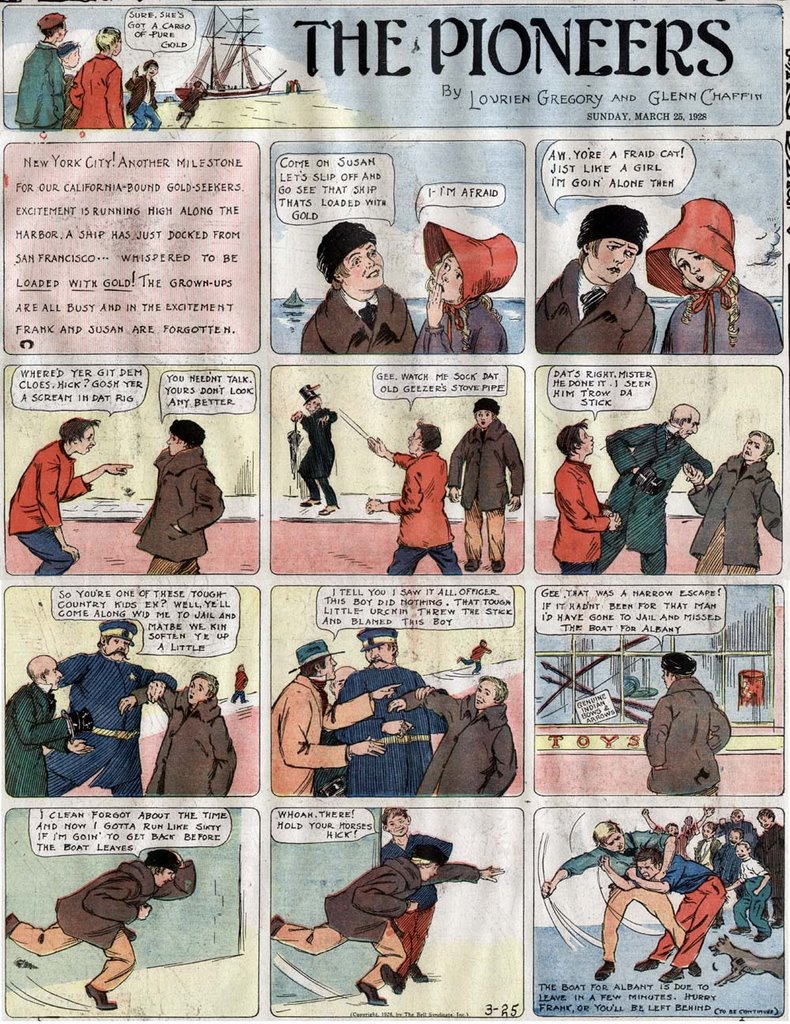 The Pioneers should be mentioned in any discussion of early adventure strips, though its short run and storybook style writing is enough to keep it from being much more than a curiosity. It is, though, only mentioned in one of the standard references, Goulart's Encyclopedia of American Comics (of which more shortly).
The story concerned itself with the trek of a group of families who leave the wilds of Maine to strike it rich in the California gold rush. This is a tale full of possibilities, but in the hands of writer Glenn Chaffin (later to create Tailspin Tommy) it is a real yawner. The art by someone named Lovrien Gregory (also sometimes spelled Louvrien) doesn't do much to help the cause. Initially the story was told exclusively in captions, but occasional word balloons began popping up later. Our sample strip is one of the few that used word balloons for most of the strip.
The Pioneers began its run on February 12, 1928 and ended January 13, 1929. Ralph Wolfe took over the art chores on 7/22/28, and then the writing on 9/23. Wolfe improved the strip on the art front, but the writing didn't get much livelier.
I must confess that I've not read the strip through to the end, despite having the opportunity, so I can't say whether it concluded with the group arriving in California or got cancelled in mid-odyssey; my guess is that the strip was intentionally closed-end. The run of the strip comprises 49 episodes based on my dating, so I wonder if there was perhaps an even 50 episodes in actuality (my dates come from a run in the Columbus Dispatch). Being from Bell Syndicate, it should come as no surprise that the strip continued to be sold after its initial running dates, so you may find later ones; the latest I've seen run in late 1929.
Jay Maeder, writing in Goulart's Encyclopedia of American Comics, claims that the strip was running in 1926, and that Glenn Chaffin was not the first writer. If Jay is reading the blog, perhaps he could tell us if this was indeed the case. I've never found the strip running earlier than the cited running dates, but maybe I have just never come upon the right sources. Jay, you out there?
Labels: Obscurities
Comments:
Hi Allan -- From an interview someday to appear in Hogan's Alley, here's Glenn Chaffin on THE PIONEERS:
"It wasn't much of a page. It was this historical drama. Lester Lear was writing the thing and he had this girl cousin who was drawing it, and then Bell took it over and Lester got too busy to write it and he asked me to do it. At the time I took it over the story had to do with the Erie Canal. I bought a book and read up on the Erie Canal. Can't remember much else about the thing. As I recall, the girl became ill and caved in or something. The page wasn't making any money anyway, and Bell just dropped it."
Lester Lear was Bell's Los Angeles rep, previously the guy who had hired Chaffin to write a Hollywood gossip column, subsequently the guy who introduced him to Hal Forrest. "Bell took it over" perhaps suggests the page might have earlier been running just locally someplace. Anyway, I guess I can't at this moment firmly document the 1926 start date, but that was certainly my impression.
jm
"It wasn't much of a page. It was this historical drama. Lester Lear was writing the thing and he had this girl cousin who was drawing it, and then Bell took it over and Lester got too busy to write it and he asked me to do it. At the time I took it over the story had to do with the Erie Canal. I bought a book and read up on the Erie Canal. Can't remember much else about the thing. As I recall, the girl became ill and caved in or something. The page wasn't making any money anyway, and Bell just dropped it."
Lester Lear was Bell's Los Angeles rep, previously the guy who had hired Chaffin to write a Hollywood gossip column, subsequently the guy who introduced him to Hal Forrest. "Bell took it over" perhaps suggests the page might have earlier been running just locally someplace. Anyway, I guess I can't at this moment firmly document the 1926 start date, but that was certainly my impression.
jm
# posted by : 4/25/2006 1:59 PM
: 4/25/2006 1:59 PM
Ah! Very, very interesting! So Forrest was just emulating the fractured prose of Lester Lear, eh? Lear later did Inspector Day, another *ahem* classic.
I guess the thing must have been running in some paper out in California, which makes sense then that the story is about trying to get there for the gold rush.
Just goes to show, for every question you answer you generate more to replace it.
Thanks very much for the great info Jay!
--Allan
I guess the thing must have been running in some paper out in California, which makes sense then that the story is about trying to get there for the gold rush.
Just goes to show, for every question you answer you generate more to replace it.
Thanks very much for the great info Jay!
--Allan
Well, come to think of it, the mid-20s would have been the 75th anniversary of the 1849-52 gold rush, yes? I suppose any number of boom communities would have been proudly celebrating their diamond jubilees, and I'd bet there's half a chance Lear sold his strip to more than just one small-town paper.
jm
jm
# posted by : 4/25/2006 3:57 PM
: 4/25/2006 3:57 PM
Just for the record, Lovrien Gregory (1888-1972) was the half sister of Lester Lear's wife, Isadora Schmidt Lear. Lovrien's husband, master architect Julius Gregory, was the grandson of French immigrants who came to Sacramento during the Gold Rush, which may have inspired the story. Julius's father, Eugene, was briefly mayor of Sacramento. Lovrien is my grandmother, and to read about her life and artistic achievements, google "annogram" and "lovrien price".
Post a Comment
Tuesday, June 25, 2019
Ink-Slinger Profiles by Alex Jay: Lovrien Gregory
Lovrien Gregory was born Mary Lovrien Price on July 19, 1888, in Philadelphia, Pennsylvania. Her birth date is from the Social Security Death Index and the birthplace was recorded on passenger lists.
Gregory’s granddaughter, Ann Cefola, has a blog called annogram and said Gregory “attended the Pennsylvania Academy of Fine Arts in 1893.”
The 1900 United States Federal Census recorded Gregory as the youngest of three siblings. The head of the household was Alfred Lawrence, Gregory’s maternal grandfather, who was married to Amanda. The census said Gregory, her mother, Isadora, siblings, and maternal grandparents resided in Philadelphia at 3332 Walnut Street.
Cefola said Gregory “won a 1906–1907 scholarship to the School of Industrial Arts at the Pennsylvania Museum”.
In the 1910 census, Gregory’s mother had remarried to Louis Schmidt, a university artist. Gregory’s half-sister was six-year-old Isadora. Gregory was an artist in the publishing field. They were Philadelphia residents at 4828 Hazel Avenue.
At some point Gregory moved to New York City where she married architect Julius Eugene Gregory in Manhattan on September 18, 1918.
The 1920 census counted the couple as Manhattan residents at 36 East 49th Street. She was a self-employed magazine illustrator.
A family tree at Ancestry.com said Gregory’s brother, Lawrence, passed away June 26, 1923, in Highland Park, Pennsylvania.
Gregory was also a decorative painter. The New York Sun, March 10, 1925, featured Gregory with one her murals.

“One develops the agility of the mountain goat,” said Lovrien Gregory sedately.
She was speaking as a mural painter to whom lofts, ladders and canvases eight feet in height are all a part of the day’s work. Comparatively few women do murals, perhaps because they are not painted from the household type of stepladder mother uses when she hangs the curtains.
Mrs. Gregory has Just completed three panels for the new Calvary Methodist Episcopal Church, University avenue, New York, of which her husband, Julius Gregory, is the architect. It is to be dedicated early this spring. Two of her paintings measure eight feet in width, the other twelve. The drawing and color, welded with a spirituality that is rather remarkable in its appeal for even the untrained eye, are attracting much favorable attention. …
It may be that the [illegible] of this particular artist’s success is most clearly revealed in the word “Teamwork.” It is altogether inspiring the way she and her husband work together, he designing the lovely edifies; she decorating it. It is to this spiritual and artistic unity, to this sympathy and encouragement, fostered by the similarity of their artistic tastes and aims, that Mrs. Gregory attributes much of the sheer pleasure she finds in her work. Certainly Mr. Gregory is as proud of the mural decorations she did for the Church of All Nations in this city as she is of his work.
She keeps house—not an apartment—but a hospitable home with the rare city luxuries of a garden and a linen closet. When she plays she plays joyously; and when she works she is at it from 9 o’clock till dark, scaling ladders in a loft in Grand Central Palace, where she has found the studio space she requires.
For the rest, she is young and eager and vivid—compellingly radiant, with bobbed ha!r that is red in the right light and clear eyes that mirror a sweet and sunny spirit. You’ve noticed—who hasn’t?—the discontented mouths of the women of to-day. Lovrien Gregory’s mouth is that lovely feature, the smiling mouth of a happy woman. The strength, reverence and serenity she puts on canvas are not found ready mixed on any palette.
Old fashioned? H’m—not exactly!
She, uses her name without the prefix, and when asked, admitted that while she believes in the tenets of the Lucy Stone League she has not joined as a member.
“But,” she remarked, contemplatively, “I suppose I ought to!”

American Newspaper Comics (2012) said Gregory was the first artist to draw The Pioneers, from February 12, 1928 to July 15, 1928. She was followed by Ralph Wolfe, from July 22, 1928 to January 13, 1929. The series writers were Glenn Chaffin, who was followed by Wolfe. The Bell Syndicate distributed the strip.
On March 27, 1928, Gregory and her husband returned from Bermuda. The passenger list said their home address was 3 Church Lane, Scarsdale, New York.
Their address was unchanged in the 1930 census and they had two sons, Jules and Alfred.
Cefola said Gregory “won a scholarship, offered by France in gratitude for US assistance during WWI, to attend L’Ecole de Beaux-Arts in Fontainebleau. Leaving her sons in a care of a nanny, she shipped off in the summer of 1931.” A passenger list recorded her return home on October3, 1931.
According to the 1940 census, Gregory and her husband were living in Manhattan, New York City, at 71 Park Avenue. She was a self-employed painter. The census said she completed four years of college and earned five hundred dollars in 1939.
A family tree at Ancestry.com said Gregory’s brother, Norman, passed away November 28, 1944, in Nashville, Tennessee.
Gregory had a listing in the 1945 Manhattan, New York city directory: 350 Madison Avenue.
Cefola said ”Gregory and her husband Julius bought a cottage in Greensboro, Vermont near Caspian Lake. This home inspired Lovrien to create a series of landscapes, delicate watercolors and oils, as varied as the location itself. Driving up Route 5 was an all-day trip from Manhattan back then but a perfect gathering place for their adult children, Alfred and Jules, and their new respective brides. They sold the Greensboro house before Julius passed away in 1955.”
Gregory’s husband passed away December 4, 1955, according to an obituary in The New York Times, December 6.
Julius Gregory, architect of homes, died Sunday night in the Amity Nursing Home, Ringoes, N.J., after an illness of several months. His age was 80.Gregory passed away in August 1972. Cefola said Gregory “spent her last years in an eldercare community in Navesink, New Jersey.” She was laid to rest at Lake Park Cemetery.
Mr. Gregory, whose designs for home magazines caused some of his houses to be reproduced widely across the country, was essentially a transactional architect. His work, often adapting newer concepts to traditional types, was a budge to the designs of later, modern architecture.
His New York practice, first at 2 Park Avenue and later at 66- Madison Avenue, spanned forty-two years, up to his retirement two years ago. At that time he moved to New Hope, Bucks County, Pa.
Born in Sacramento, Calif., he attended the University of California and studied abroad before establishing his practice in New York.
He served as architectural consultant for House and Garden magazine, for whom he designed the Ideal House, and for Home Beautiful, whose Pacesetter House he developed. Over the years his plans frequently won awards from professional societies.
During his career he designed many church structures. Among these were three Methodist edifices in New York: the Church of All Nations, 9 Second Avenue; Calvary Church, 1885 University Avenue, the Bronx an the Methodist Home, an institution for the aged on Spuyten Duyvil Parkway in the Bronx.
Surviving are his widow, Lovrien, and two sons, Jules of Lambertville, N.J.; and Alfred Lawrence.
Further Reading and Viewing
annogram
Part 1
Part 2
Part 3
Part 4
Part 5
eBay, portrait of Becky Lear
—Alex Jay
Labels: Ink-Slinger Profiles
Comments:
Alex, some of this is new to me, especially the charming newspaper article. Many thanks for your comprehensive research!
Ann Cefola
Ann Cefola
Alex, do you have a title for the New York Sun article and a page number? Where did you source that online?
Thanks,
Ann
Thanks,
Ann
The article is on page 22: Mural Painter Needs Agility of Mountain Goat After That, All Is Easy, Says Charming Artist
The newspaper is at Old Fulton New York Post Cards.
https://www.fultonhistory.com/Fulton.html
The newspaper is at Old Fulton New York Post Cards.
https://www.fultonhistory.com/Fulton.html
Alex, the Old Fulton Postcard site led to an article that helped defeat the demolition of one of my grandfather's houses! If you email me privately, I can send you the defense I wrote if you have any interest
Post a Comment
Tuesday, May 06, 2008
Dell Publishing's "The Funnies" Part 10

 Now that I have Cole Johnson's early copy of The Funnies (#10) in hand it reveals a few problems in Beerbohm's Overstreet listing for the title, at least in my several year old edition, #36. Perhaps the problems have already been cleared up in later editions.
- the section was originally 24 pages, not 16 -- sometime between Cole's copy and mine the size dropped, probably when the price dropped from 10 cents to 5 cents.
- the publication was not always a weekly; Cole's is dated September 1929, the indicia states monthly publication and a blurb says the next issue will be available on October 15. Assuming monthly frequency for the first ten issues, that puts #1 published December 1928, not in 1929, which is borne out in the indicia which states "entered as second class matter December 27 1928".
For today's strips, we have another of Ralph Wolfe's Sancho and the Don, plus a newcomer, Eveready Eddie by Moe Leff. Mo, as he would later sign himself, supplied the art for a couple of Joes (Jinks and Palooka) and as a ghost on who knows how many other features.
Labels: Dell's The Funnies
Wednesday, June 26, 2019
Obscurity of the Day: Around the Studios


Cornelius Vanderbilt IV had a pasion for journalism, though it antagonized his rich and publicity-shy family. He wanted desperately to publish his own newspaper, and when he started the Los Angeles Illustrated Daily News in 1923 his parents disinherited him and he was shunned by the high society into which he was born.
Vanderbilt also managed to antagonize the newspaper business when he started his papers in LA, San Francisco and Miami -- competitors in those cities, led by Hearst, vowed to put him out of business. One way they hobbled him was to block access to a wire service, and tie up all the major syndicates in these cities so that material was unavailable.
Vanderbilt, who was the newspaper business's Don Quixote, vowed to overcome all these hurdles. When it came to cartoon features, he brought a small cadre of cartoonists in-house and told them to fill his papers with drawings.
One of the better cartoonists to get on board was Ralph Wolfe. He was definitely the star of Vanderbilt's LA Daily News during its short life, producing lots of spot illustrations, a daily comic strip and today's obscurity, Around The Studios. This weekly feature appeared in the Sunday edition on a page devoted to movies, and offered up fannish humor about the pictures currently being shot.
I can only say for certian that Around The Studios was running in April 1924, the only month of the Daily News I've seen, but it may have run for the whole short life of the newspaper under Vanderbilt's leadership (September 1923 - about the end of 1924*).
As far as I know the only microfilm available of the newspaper is in the Los Angeles Public Library, and if you are in the vicinity it would make for some very interesting perusing. Anyone want to index it?
* The paper was sold and continued to be published under new management afterward.
Labels: Obscurities
Comments:
Seems pretty doubtful. Ralph Wolfe was a real guy, as will be shown tomorrow in Alex Jay's Ink-Slinger Profile.
--Allan
Post a Comment
--Allan
Thursday, March 06, 2014
Ink-Slinger Profiles by Alex Jay: Creig Flessel
Creig Valentine Flessel was born in Huntington, Long Island, New York, on February 2, 1912. His full name was found in his hometown newspaper, The Long Islander, and the Social Security Death Index. His birth information was confirmed in a July 2002 interview in the Comics Journal #245.
In the 1920 U.S. Federal Census, Flessel was the second of four children born to Frank (1883–1944) and Ida (1884–1971). The census recorded his father’s birth in Germany and occupation as blacksmith. The family resided in Huntington on Southdown Avenue. They remained in the same place according to the 1925 New York State Census. Flessel’s paternal grandmother, Fannie, lived with them. In 1930, the Flessel family remained in Huntington but on Prospect Avenue.
In the Comics Journal, Flessel said his family lived on a five-acre farm about a mile from town. His father could draw; an aunt was an art teacher; his mother was musical and his brother could draw and was “an electronics genius.” Flessel named cartoonist Vic Forsythe, of Joe Jinks fame, as his idol.
The life of Flessel, from his early teens to to his early twenties, was chronicled in the Long Islander: he was a scout, high school athlete and cartoonist, art student, occasional performer, and scoutmaster.
April 30, 1925: Last Tuesday evening, April 27, Troop One, Boy Scouts of America, received their charter for the next year, at the Huntington High School gymnasium. The charter was presented by Scout Executive A.R. Wolfe, at a banquet attended by many of the scouts’ parents.
The following scouts received their registrations: …second class, …Creig Flessel...
June 17, 1927: The funeral service was held in the Catholic Church Wednesday morning, about forty Scouts being in attendance. The pallbearers were members of his patrol, Creig Flessel, Albert Flathtnan, Harry Mathison, Ralph Lewis, Jack Klauer and LeRoy Glosten.
September 30, 1927: The Ketewamoke Patrol of Troop No. 1, of Huntington held a banquet at the Methodist Episcopal Church on Friday evening, September 16. The eight Scouts of the Ketewamoke Patrol of which Creig Flessel is leader and Clifford Trainer is sponsor, celebrated their first Patrol birthday by entertaining their parents and friends present with a fine meal. After the tables had been cleared the Scouts presented a sketch entitled, “Pee Wee Harris’s Patrol to the Rescue.” This bit of Scout work was put across in a very amusing manner. The Handicraft exhibit was very interesting. It included some fine sketchings, leaf printing and soap carving.
November 2, 1928: This Friday the first edition of the “Mirror” is to be sold to the students. It has made quite an improvement over the first edition of last year.…The illustrations were furnished by Louise Kjellander, ’29; Lydo Petersen, ’29; Mary Shantler, ’29; Creig Flessel, ’30 and Florence Hoag, ’30.
(The Standard Union, in Brooklyn, April 12, 1929, reported the following: “Capt. Carroll E. Welch of the citizens’ military training camp has issued a statement that to April 1 forty-four applications from Suffolk County for the training camps this summer have been accepted…[including] Creig V. Flessel, Huntington…”)
September 6, 1929: Creig Flessel returned home Saturday from the Military Training Camp at Plattsburg.
September 13, 1929: Romney Wheeler is editor-in-chief of the school magazine. The Mirror, this year. The other editors include…Creig Flessel, art...
November 8, 1929: The first issue of the Huntington High School Magazine the “Mirror” was put on sale last Wednesday.…Illustrations also, are in profusion, especially in the humor section.
The staff is as follows: Romney Wheeler, Editor-in-Chief; Nat Elkins, Business Manager; Clifford Phillips, Humor, Editor; Phillis Fredericks, Literary Editor; Creig Flessel, Art Editor; Lyle Carson and Helen Hubbs, Sport Editors; Jean Carter, Alumni Editor; Evelyn Hart, Exchange Editor; Herman Wientjes, Circulation Manager and Mortimer Kassel, Advertising Manager.
November 22, 1929: Those who played their last game for the Blue and White were…Creig Flessel, end…
(The Brooklyn Daily Eagle, November 25, 1929, published a photograph, below, of the football players, including Flessel, who received letters.)
.jpg)
May 9, 1930: The annual election of Epworth League officers was held at the church last Monday night with the following results: Eugene Dittmar, president; Crieg Flessel, first and second vice-president; Glady Bunce, third vice-president; Natalie Suydam, fourth vice-president; Estelle Miller, secretary; Helen Velsor, treasurer; Gladys Bunce, organist.
June 27, 1930: Prizes and honors for the year were announced by Superintendent Toaz as follows: …Alumni Drawing Prizes—Creig Valentine Flessel and Florence Hazel Hoag...Those who received their diplomas were…Creig Flessel...
September 12, 1930: Creig Flessel starts Monday for a course in the Grand Central Art school in New York.
September 26, 1930: Creig Flessel, Huntington High 1930, won the poster prize for Nassau and Suffolk counties sponsored by the New York State Educational Department, on the topic Vacation Days. A little boy, strutting along with a tiny fish on the end of a pole, Is not more excited than the dog that is with him. Mr. Flessel is a student at the Grand Central Art School this fall.
November 7, 1930: Creig Flessel entertained the members of his Sunday School class at a Halloween party Friday night.
April 24, 1931: Creig Flessel, who is a student at the Grand Central Art School, received second prize of $10 for illustration, and third prize of $5 for life drawing.
(The New York Times, April 20, 1932: “Awards at School of Art.” The eight annual exhibition of the Grand Central School of Art…Medals for Illustration—To Creig Flessel, George Cook, Dorothy Deyrup, Harry Rossoll and Tom Harter.)
April 29, 1932: Creig Flessel, of this place, was awarded first prize for an illustration at the Grand Central Art School in Manhattan last week.
Creig Flessel who is a student in the Grand Central Art School received first prize for illustration last week.
June 3, 1932: Creig Flessel has organized a Boy Scout patrol.
June 24, 1932: Creig Flessel, who has just finished his second year at Grand Central Art School, entered Monday for the summer course in that institution. (In the Comics Journal interview, Flessel said he attended Harvey Dunn’s night class and met Charles Addams, the future New Yorker cartoonist.)
September 2, 1932: Arrangements are being perfected for an exhibit of the work of Huntington amateur artists at the Flessel Building on Main street from September 5 to 10, inclusive. Among the artists making exhibits are Woodhull Young, Alphonse Bare, Creig Flessel and Miss Anna Flessel.
April 21, 1933: “Troop 12 Has Ten Year Reunion”; ...Through the efforts of Pete Whipple assisted by Wilbur Percy, Woodhull Young, Creig Flessel and Bob Alexander is due a large part of the success of this enjoyable gathering.
April 21, 1933: Saturday night Was a red letter day for our Boy Scouts. In their bright new uniforms they were on hand to welcome their friends and their neighboring Boy Scouts from Huntington and Greenlawn.
Jack Levy then presented Creig Flessel with his credentials and Scout pin for Scout Master of Troop 113 of Centerport. The Scouts then received their badges from their Scout Master, Creig Flessel.
…All boys, twelve years or over, who are in any way interested in Boy Scouting, may Join, this troop by reporting to Creig Flessel or Jack Levy at the Centerport Fire House on any Thursday evening between 7:30 and 9 o’clock.
April 13, 1934: The second event was a Parents’ Night held by Centerport Troop 113, of which Creig V. Flessel is Scoutmaster and Jacob Levy chairman of the Troop Committee.
Under the direction of Scoutmaster Flessel the Scouts put on a splendid demonstration of Scouting, also some interesting skits depicting Scout life. There was an excellent display of Scout handicraft. The meeting was held in the new school building on Little Neck road and was attended by over fifty parents and friends of the troop. Refreshments were served at the close of the meeting.
January 10, 1935: Creig Flessel was a guest of Miss Marie Marino in Brooklyn for New Year’s Day.
January 31, 1935: Creig Flessel and his troop of Boy Scouts enjoyed a grand day of hiking and coasting Saturday.
March 1, 1935: The Centerport M. E. Church in place of the Centerport Fire Department will sponsor the Boy Scout Troop in the future. With a; troop, committee comprised of James Van Alst, Rev. Edgar N. Jackson, Creig Flessel, Arthur B. West and George A. Bunce, they expect to have one of the liveliest troops in Suffolk County.
March 13, 1935: “Minstrels Enjoyed”; ‘Kentucky Daze’ drew a large crowd to the Centerport School Friday night. The minstrels kept the audience in an uproar throughout the performance.
Much applause was given to Creig Flessel as Old Black Joe and Natalie Suydam as Aunt Jemima. The ballet dancers wore not to be beaten by any professionals.
June 28, 1935: Friday evening, June 21, was one of the happiest in our school year, when thirteen, wide awake boys and girls received their diplomas to enter high school.…Creig Flessel was master of ceremonies in giving the flag donated by the combined basketball teams, the Sea Gulls and Sea Girls.
April 3, 1936: Creig Flessel was a week-end guest of Miss Marie Marino in Brooklyn who is home for her spring vacation from Alfred University.
May 29, 1936: “Memorial Day Plans”; ...At the park on the newly erected pole will be unfurled the Stars and Stripes by the Boy Scouts under Scoutmaster Creig Flessel.
November 1936: Creig Flessel was a guest of Miss Marino for the week-end. They attended the Alfred-Upsalla game in East Orange, Saturday.
Flessel’s engagement to Marino was announced in the Brooklyn Daily Eagle, March 9, 1937.
.jpg)
MARINO-FLESSEL
Mr. and Mrs. Peter Marino of 293 Clermont Ave. announce the engagement of their daughter, Miss Marie Grace Marino, to Creig Valentine Flessel of Manhattan and Centerport, son of Mr. and Mrs. Frank Flessel.The New York, New York, Marriage Indexes, at Ancestry.com, said Flessel and Marino married on November 20, 1937 in Brooklyn. The Alfred Sun (New York), April 14, 1938, noted their marriage: “ ’36—Marie Marino to Creig Valentine Flessel in Brooklyn on November 20, 1937.” The Marin Independent Journal (California), March 17, 2007, said Flessel met Marie “during a function at a Long Island yacht club gathering.”
Miss Marino was graduated from Alfred University, Alfred, N. Y., with the class of 1936. Mr. Flessel studied at Grand Central School of Art in Manhattan.
Some sources said Flessel attended Alfred University and even graduated from there. I have found no evidence that he was a student at Alfred University. Surely, his hometown paper, the Long Islander, would have reported his enrollment there. In the Comics Journal interview, Flessel never mentioned the university as part of his education. The confusion, I believe, centers on his wife, Marie, who graduated from Alfred University in 1936. Flessel’s attendance at the university was as a visitor seeing his future wife. The Alfred University alumni news mentioned Flessel because he was Marie’s husband.
Flessel was part of the first wave of Golden Age comic book artists. He was hired to produced art work for Major Wheeler-Nicholson’s More Fun Comics. Flessel recalled:
Later in 1937 Flessel worked for the advertising studio Johnstone and Cushing. At Hogan’s Alley, Flessel explained how he entered the advertising industry after a stint on a comic strip.
After Streibel, Flessel returned to Johnstone and Cushing and began work on the Nestlé Toll House cookies and R.C. Cola accounts.
The Alfred Sun, October 17, 1940, explained the story behind the Nestle’s advertisement (below) that ran in the Sunday comics section October 13, 1940.


In American Newspaper Comics, Flessel is credited with two-week stints on Apartment 3-G (Sundays) and Friday Foster in 1973.
In the 1980s for Playboy magazine, Flessel drew, for about eight years, The Tales of Baron von Furstinbed and explained, in the Comics Journal, how he got involved:
In 2000, Flessel and his wife moved to The Redwoods retirement community in Mill Valley, California, to be closer to their children and their families. Flessel passed away July 17, 2008. His death was reported in the Marin Independent Journal, July 26.
Flessel was remembered at several comic book-related sites, here, here and here. Photographs of Flessel and samples of his artwork are here. An overview of Flessel’s career is here. He was a member of the National Cartoonists Society.
Flessel’s wife, Marie passed away January 20, 2011 in Mill Valley.
—Alex Jay
Flessel was part of the first wave of Golden Age comic book artists. He was hired to produced art work for Major Wheeler-Nicholson’s More Fun Comics. Flessel recalled:
…they were desperate so I had to go out and buy a drawing table. They had just one table that they were doing all of the mechanical work on. So I got a table and managed to find a chair and sat down and they said, “Here. Do this.” I think I did a couple of center spreads for More Fun….Detective [Comics] was created while I was there.”Flessel drew the covers for Detective Comics numbers two through 19. He worked with editors Vince Sullivan and Whitney Ellsworth. In 1937, Flessel moved on and worked a couple weeks for Harry Chesler. Some of Flessel’s comic book credits are here.
Later in 1937 Flessel worked for the advertising studio Johnstone and Cushing. At Hogan’s Alley, Flessel explained how he entered the advertising industry after a stint on a comic strip.
“In 1936, I went to J. Walter Thompson looking for work, because they had been doing a lot of comic ads,” he said. “All the secretaries there knew Tom Johnstone, and one of them told me I should go to Johnstone and Cushing.” Flessel went to the Johnstone and Cushing offices, then in the Commerce Building at 145 East 44th Street, and he took the elevator to the thirty-sixth floor penthouse suite that housed the offices. Flessel was in awe of the staff, which was a cartooning Who’s Who: “There was Albert Dorne, Austin Briggs, Bill Sakren, Joe King, Stan Randall, Paul Fung, Milt Gross, Milt Caniff, Lou Fine, Stan Drake, Noel Sickles, Ralston Jones, Katie Osann…everybody went through there at some point. The talent level was just intimidating,” Flessel said.
…“They had a lot of work and they needed artists,” Flessel said, “but they felt my work was a little crude, so they recommended me to John Striebel.”Striebel hired Flessel to assist on Dixie Dugan. Flessel also had the opportunity to work on Streibel’s characters Vic and Sade, who appeared in Farina Wheat cereal advertisements. In Alter Ego #45, February 2005, Jim Amash interviewed Flessel who said: “In 1937, I was ghosting for John Streibel on Dixie Dugan for Liberty magazine, as well as ad work for him. And then Dixie turned into a newspaper strip. Dixie was a showgirl, but Blondie proved that a showgirl strip didn’t fly in the newspapers, so Dixie Dugan became a single secretary. I did that for one year. I was also doing ad worked for Johnstone and Cushing, pulp work, and comics for National Comics.”
After Streibel, Flessel returned to Johnstone and Cushing and began work on the Nestlé Toll House cookies and R.C. Cola accounts.
The Alfred Sun, October 17, 1940, explained the story behind the Nestle’s advertisement (below) that ran in the Sunday comics section October 13, 1940.
Alfred Banner Seen in Sunday Section
In the funny section last week in the Sunday paper, there appeared an advertisement for Nestle’s which was of great interest to Alfred people and students. The adv. carried the theme of the girl who won a pledge to a sorority by her mother sending her baked goods that suited the taste of some of the girls, who in turn pledged her to their sorority. In this girl’s room was seen an Alfred banner, although the colors were orange and green, the word “ALFRED” was very much in evidence. It was learned that the author, Creig Flessel is the husband of Marie Jean Marino, who graduated from Alfred with the class of 1936 and was a member of the Sigma Chi Nu Sorority. If you were familiar with the sorority pin you would know at a glance the pin in question belonged to Sigma Chi Nu.
According to Who’s Who of American Comic Books 1928–1999, Flessel worked on the Vimms vitamins account.

Another advertising campaign, illustrated by Flessel, was for New York state savings banks; the advertisements ran in 1944 and 1945.
.jpg)
.jpg)
.jpg)
.jpg)
Flessel also did illustrations for pulp magazines by publishers such as Street & Smith, and Martin Goodman.
According to American Newspaper Comics (2012), Flessel illustrated the Book-of-the Month adaptation of Colonel Effingham’s Raid, which was published in 1943.
.jpg)
Flessel has not yet been found in the 1940 census. In an April 2006 letter to Mike Lynch, Flessel wrote: “I (We) lived in Brooklyn, near Pratt Institute in 1937. My son was born in Brooklyn in 1940.” According to the Marin Independent Journal, February 4, 2011, Flessel moved back to his hometown of Huntington in 1943.
In the 1950s, Flessel produced illustrations for Boys’ Life magazine and the Sunday Pictorial Review supplement. Boys’ Life covers and comics are here, here, here and here. A couple of Sunday Pictorial Review covers are here. At Johnstone and Cushing, Flessel worked on the Eveready battery account. Samples are here, here, here and here.
From 1958 to 1960, Flessel assisted on the Li’l Abner strip. In the Comics Journal interview, Flessel said:

From 1969 to 1977 Flessel drew This Week in Astrology which was written by Carl Payne Tobey; Flessel signed the feature with his middle name, Valentine, which was his paternal grandmother’s maiden name.
Cleveland Plain Dealer 6/28/1942
Star Journal 5/25/1944
Perry Record 6/29/1944
Nunda News 10/13/1944
Cortland Standard 1/24/1945
Flessel also did illustrations for pulp magazines by publishers such as Street & Smith, and Martin Goodman.
According to American Newspaper Comics (2012), Flessel illustrated the Book-of-the Month adaptation of Colonel Effingham’s Raid, which was published in 1943.
Rockford Register-Republic 9/13/1943
In the 1950s, Flessel produced illustrations for Boys’ Life magazine and the Sunday Pictorial Review supplement. Boys’ Life covers and comics are here, here, here and here. A couple of Sunday Pictorial Review covers are here. At Johnstone and Cushing, Flessel worked on the Eveready battery account. Samples are here, here, here and here.
From 1958 to 1960, Flessel assisted on the Li’l Abner strip. In the Comics Journal interview, Flessel said:
…The best part of that job was that we sat there and worked and we had Andy Amato, and Harvey Curtis and Walter Johnson was the inker. Curtis was the manager of the office and Amato was the man who created all the crazy things—crazy penciler—but the reason why I was there was no one could draw a pretty girl. I knew how to draw big tits. If they made them the size of a grapefruit, I’d make them bigger. So that was it….Flessel took over the David Crane strip from Winslow Mortimer from October 31, 1960 into 1972. Several samples can be viewed here, here and here.
8/6/1961; scan courtesy of the Fabulous Fifties
11/26/1972; original art courtesy of Heritage Auctions
In American Newspaper Comics, Flessel is credited with two-week stints on Apartment 3-G (Sundays) and Friday Foster in 1973.
In the 1980s for Playboy magazine, Flessel drew, for about eight years, The Tales of Baron von Furstinbed and explained, in the Comics Journal, how he got involved:
...The guy that I worked with on Friday Foster wrote stuff for Playboy. They needed stuff for the Playboy Funnies, and he was writing and they would send it back, so we arranged to do stuff together. I would get notes from Hefner that said, “I like your drawing, but the story’s not good.” So finally I asked the writer if he would mind if I wrote my own copy. So I did and sent off a color page and they wrote back and said that they liked it, and would like to see some more. So, almost immediately, I was in business.
…I went from David Crane to The Tales of Baron Von Firstinbed [sic]— piety to pornography in one lifetime…
Flessel was remembered at several comic book-related sites, here, here and here. Photographs of Flessel and samples of his artwork are here. An overview of Flessel’s career is here. He was a member of the National Cartoonists Society.

Flessel’s wife, Marie passed away January 20, 2011 in Mill Valley.
—Alex Jay
Labels: Ink-Slinger Profiles
Comments:
Berkely cartoonist Lee Marrs was an assistant to Flessel in the seventies and could be helpful for anyone doing Flessel scholarship.
The Library of Congress has daily David Crane comic strip drawings signed by Mortimer and copyrighted by the Toronto Star that date to 1968.
Sara W. Duke,
Curator, Popular & Applied Graphic Art
Prints & Photographs Division
Library of Congress
Washington, DC 20540-4730
(202) 707-3630
sduk@loc.gov
http://www.loc.gov/pictures/
Post a Comment
Sara W. Duke,
Curator, Popular & Applied Graphic Art
Prints & Photographs Division
Library of Congress
Washington, DC 20540-4730
(202) 707-3630
sduk@loc.gov
http://www.loc.gov/pictures/
# posted by : 1/09/2019 7:56 AM
: 1/09/2019 7:56 AM Saturday, October 12, 2019
What The Cartoonists Are Doing: July 1914, Vol.6 No.1
NOTE: We are bypassing the issue of June 1914 because the online sources are missing this issue, and my collection of Cartoons Magazine is still in storage. We'll come back to it when my collection is accessible.
[Cartoons Magazine, debuting in 1912, was a monthly magazine devoted primarily to reprinting editorial cartoons from U.S. and foreign newspapers. Articles about cartooning and cartoonists often supplemented the discussion of current events.
In November 1913 the magazine began to offer a monthly round-up of news about cartoonists and cartooning, eventually titled "What The Cartoonist Are Doing." There are lots of interesting historical nuggets in these sections, and this Stripper's Guide feature will reprint one issue's worth each week.]
CARTOON PLEASES DANIELS
So pleased was Josephus Daniels, Secretary of the Navy, with the cartoon on the abolishment of the wine mess in the navy, drawn by G. R. Spencer, cartoonist of the Omaha World-Herald, that he wrote to the artist, requesting the original copy.
The Spencer cartoon pictured John Barleycorn walking the plank, while a horn pipe-dancing sailor sang "Yo, ho, ho, and a bottle of soda pop."
Another cartoonist to win the approbation of a cabinet officer is Luther C. Phifer of the Worcester (Mass.) Telegram. Franklin K. Lane, Secretary of the Interior, has been decorating a room in the Home Club at the National Capital with original cartoons, and has asked Mr. Phifer, together with other artists, to send representative drawings.

SUES THE BALTIMORE SUN
Thomas Parran, formerly Representative and recently appointed a member of the Maryland State Roads Commission, has instituted an action for damages against the A. S. Bell Company and Charles H. Grasly, president and general manager of the Baltimore Sun.
The claim for alleged libel is based on a news article, an editorial, a cartoon and a news item, all of which were published in the Sun. These publications criticised the naming of Mr. Parran as a member of the State Roads Commission.
~~~~~~~~~~~~~~~~~~~~~~~~~~~~
Richard Outcault, creator of "Buster Brown," was among the entertainers at the annual banquet of the Pulp, Sulphite, and Papermill Workers, at the Marlborough-Blenheim hotel, New York.
IRELAND HAS AN IDEA
"Billy" Ireland, cartoonist of the Columbus Dispatch, returned recently from an alligator-shooting trip to the Florida Everglades, with Governor Cox of Ohio and a party of friends on the yacht of R. F. Wolfe, proprietor of the Dispatch. The Everglades did not impress Ireland particularly. He writes:
"The Everglades are the most barren and hopeless stretch of the world's surface that I have ever seen, and in my opinion will never be turned into a commercial proposition, yet we ran into camps of land agents selling this hopeless stuff to tourists from the West. I wouldn't give my back yard for all of it." Meeting John Burroughs, Thomas A. Edison and Henry Ford in Florida impressed Ireland more than the scenery did. And somewhere along the route he picked up a thought that is worth considering seriously. Let him tell it:
"What will be the fate of the cartoonist when the woman in politics commences to hold office? At present we are surrounded with this suffrage thing, which is merely an offshoot of the big feminist movement. Surely we cartoonists have something to consider here. My thought is this — no woman can stand caricature! This is an absolutely established, fundamental inside formation of a woman's get-up. Just imagine our turning up a little further the already pugged nose of the good lady mayor, or making the embonpoint of the lady president of council, who is really putting in all of her spare time banting, more noticeable. Can't you see what we cartoonists are up against? The lady mayor bursts into tears and the president of council, who is surely no lady, introduces an ordinance prohibiting cartoonists from handling political subjects! I know what I am talking about. Only twice in my life have I had to make a cartoon of a woman, and upon both occasions there was h*** in camp and I lost two friends. I tell you, they can't stand it, and here they are fairly 'bustin' ' into our public life and we cartoonists sit idly by thinking we are secure in our position. Can't Cartoons Magazine start a discussion on the question: 'Will the woman in politics be able to stand caricature?' I say, 'No!'"
There is the basis for a lively interchange of opinion in Ireland's suggestion. Cartoons Magazine would be glad to hear from other cartoonists on the subject.
A NEW FIELD FOR CARTOONS
Frank Hammond, cartoonist of the Wichita Eagle, has drawn a series of cartoons to be used on the cover of the Official Bulletin published by the International Circulation Managers' Association. Sidney D. Long, circulation manager of the Eagle, and president of the association, writes:

"In striving to make the Bulletin more attractive, we looked about for features that would furnish the desired effect. We decided to use a cartoon for the cover, and the idea was a winner from the start. The cartoons served not only as a diversion, but gave at a glance the trend of the contents of the Bulletin, and emphasized the salient point made therein. I am convinced that in almost any line of publication the cartoon can be used to enhance the clarity of the printed word."
One of Mr. Hammond's cartoons is herewith presented. The circulation managers held their annual convention in June this year on a lake steamship.
~~~~~~~~~~~~~~~~~~~~~~~~~~~
Clare Briggs, of the New York Tribune, has furnished the illustrations for Charlotte Hay Meredith's recent book, "Mrs. Linthicum and Mary Jane." The volume, which is a collection of newspaper sketches, is published by the Donohue Company, Chicago.
~~~~~~~~~~~~~~~~~~~~~~~~~~~
Al Demaree, pitcher for the New York Giants, is drawing a series of cartoons for the Chicago Tribune, of which this is a sample.
 CARTOONS IN PUBLIC SERVICE
Sponsors of various public betterment and uplift movements have begun to realize the fact that the cartoon can be used to great advantage. The appeal of a single cartoon that tells its story at a glance is wider and more striking than that of entire pamphlets of printed matter. Clare Briggs' cartoon for "Baby week" in Chicago was one that touched a universal chord.
In the "Safety first" movement that has spread across the country lately, the cartoon has been playing an important part. A rather gruesome but nonetheless telling cartoon is that of the "Pointing hands" drawn by Tom Vidor of the Grand Rapids Press. This cartoon, calling attention to the need of safety appliances, has been published widely throughout the United States, and is being sent out with the literature of the National Council for Industrial Safety.
STARRETT IN A NEW FIELD
After chewing up a box or two of cigars a day, pulling out his hair in tragedy-queen fashion, doing Marathons around the office while in quest of an idea, and bending for hours over a drawing board in the editorial rooms of the Knickerbocker Press, W. K. Starrett has for several months been paddling his own canoe as a free lance.

The accompanying sketch of Col. Henry Watterson, Kentucky's grand old editor, clipped from a recent issue of "The Editor and Publisher," will give erstwhile followers of Starrett an idea as to the kind of work he's doing now.
~~~~~~~~~~~~~~~~~~~~~~~
A series of color cartoons has been drawn by A. S. Harkness of Springfield, lll., to be shown in the Topeka social-survey exhibit. Walter Storey of New York provided sketchy outlines, which were developed by Mr. Harkness into unusually clever and attractive cartoons, emphasizing important suggestions or criticisms of the survey reports.
~~~~~~~~~~~~~~~~~~~~~~~~~
One of the featured acts in the recent Lambs' Gambol was the lightning crayon work of four cartoonists. They were Winsor McCay, R. F. Outcault, Hy Mayer, and George McManus. The exhibition of their skill was said to be one of the most pleasing bits on the program.
"PROF." DONAHEY NOW
James H. Donahey, cartoonist of the Cleveland Plain Dealer, has been appointed lecturer in cartooning and caricature at the new School of Journalism established by the Western Reserve University at Cleveland.
Mr. Donahey went to Cleveland eighteen years ago from West Chester, where he had been a printer. He became cartoonist on the Cleveland World when he was only twenty years old. Mr. Donahey has been cartoonist on the Plain Dealer for the past fifteen years. In addition to his work there he has for years been instructor in the Cleveland School of Art, and has drawn extensively for magazines and other publications.
~~~~~~~~~~~~~~~~~~~~~~~~
Mr. Hearst has stopped his cartoon brigade from appearing in vaudeville. It seems that some of the cartoonists had more of a liking for the plaudits of the theater than real work, and Mr. Hearst politely informed the booking agents he was displeased. Result — canceled contracts.
~~~~~~~~~~~~~~~~~~~~~~~~~
Clifford Knight, cartoonist of the Hartford Post, appeared on the same bill with Governor Baldwin of Connecticut at the annual banquet of St. John's Club at the Hartford Golf Club. Mr. Knight told stories about cartoonists and drew pictures.
OBJECT TO "OLD GLORY"
A protest against the use of the American flag in cartoons was voiced recently at a meeting of the American Flag Day Association at Chicago. Mrs. Katherine Swikard, president of the association, contended that so long as the federal laws prevented the use of the national emblem for commercial purposes, it should be unlawful to employ the Stars and Stripes as a cartoon subject. If the Department of Justice, which has been asked for a ruling on the matter, should decide in favor of the flag enthusiasts, it is to be presumed that Uncle Sam, who for so many years has been before the public in his familiar "Old Glory" costume, will disappear forever from the prints. How the cartoonists could manage to get along without him is a problem which the Flag Day Association doesn't undertake to solve.
RESENTED THE CARTOONS
Because certain cartoons appearing in the Lynn (Mass.) Telegram, directed against Ralph S. Bauer, "made life unpleasant for his son" to such an extent that the latter refused to attend school, Mr. Bauer recently obtained a judgment against Frederick W. Enright, publisher of the newspaper in question. Mr. Bauer was one of three plaintiffs, all of Lynn, who contended that the cartoons were malicious.
Mr. Enright pleaded guilty in the Superior court at Salem, Mass., and paid a fine of $300.
WHEN THE CYCLONE STRUCK
With the consolidation of the Chicago Inter Ocean and the Chicago Record-Herald, Russell S. Henderson, the sport cartoonist of the latter paper, began looking for new worlds to conquer. The coming in of the new management is referred to by Henderson as a cyclone which swept him, together with others, overboard.
During his connection with the Record-Herald Henderson had gained a wide following, mainly through his "Poker" series, picturing various phases of the national pastime. Before joining the staff of the Chicago paper he was connected with the Pittsburgh Post and the Sun. He filled the vacancy on the Record-Herald left by Ed Mack, who went with the Hearst syndicate in New York.

[Cartoons Magazine, debuting in 1912, was a monthly magazine devoted primarily to reprinting editorial cartoons from U.S. and foreign newspapers. Articles about cartooning and cartoonists often supplemented the discussion of current events.
In November 1913 the magazine began to offer a monthly round-up of news about cartoonists and cartooning, eventually titled "What The Cartoonist Are Doing." There are lots of interesting historical nuggets in these sections, and this Stripper's Guide feature will reprint one issue's worth each week.]
CARTOON PLEASES DANIELS
So pleased was Josephus Daniels, Secretary of the Navy, with the cartoon on the abolishment of the wine mess in the navy, drawn by G. R. Spencer, cartoonist of the Omaha World-Herald, that he wrote to the artist, requesting the original copy.
The Spencer cartoon pictured John Barleycorn walking the plank, while a horn pipe-dancing sailor sang "Yo, ho, ho, and a bottle of soda pop."
Another cartoonist to win the approbation of a cabinet officer is Luther C. Phifer of the Worcester (Mass.) Telegram. Franklin K. Lane, Secretary of the Interior, has been decorating a room in the Home Club at the National Capital with original cartoons, and has asked Mr. Phifer, together with other artists, to send representative drawings.

SUES THE BALTIMORE SUN
Thomas Parran, formerly Representative and recently appointed a member of the Maryland State Roads Commission, has instituted an action for damages against the A. S. Bell Company and Charles H. Grasly, president and general manager of the Baltimore Sun.
The claim for alleged libel is based on a news article, an editorial, a cartoon and a news item, all of which were published in the Sun. These publications criticised the naming of Mr. Parran as a member of the State Roads Commission.
~~~~~~~~~~~~~~~~~~~~~~~~~~~~
Richard Outcault, creator of "Buster Brown," was among the entertainers at the annual banquet of the Pulp, Sulphite, and Papermill Workers, at the Marlborough-Blenheim hotel, New York.
IRELAND HAS AN IDEA
"Billy" Ireland, cartoonist of the Columbus Dispatch, returned recently from an alligator-shooting trip to the Florida Everglades, with Governor Cox of Ohio and a party of friends on the yacht of R. F. Wolfe, proprietor of the Dispatch. The Everglades did not impress Ireland particularly. He writes:
"The Everglades are the most barren and hopeless stretch of the world's surface that I have ever seen, and in my opinion will never be turned into a commercial proposition, yet we ran into camps of land agents selling this hopeless stuff to tourists from the West. I wouldn't give my back yard for all of it." Meeting John Burroughs, Thomas A. Edison and Henry Ford in Florida impressed Ireland more than the scenery did. And somewhere along the route he picked up a thought that is worth considering seriously. Let him tell it:
"What will be the fate of the cartoonist when the woman in politics commences to hold office? At present we are surrounded with this suffrage thing, which is merely an offshoot of the big feminist movement. Surely we cartoonists have something to consider here. My thought is this — no woman can stand caricature! This is an absolutely established, fundamental inside formation of a woman's get-up. Just imagine our turning up a little further the already pugged nose of the good lady mayor, or making the embonpoint of the lady president of council, who is really putting in all of her spare time banting, more noticeable. Can't you see what we cartoonists are up against? The lady mayor bursts into tears and the president of council, who is surely no lady, introduces an ordinance prohibiting cartoonists from handling political subjects! I know what I am talking about. Only twice in my life have I had to make a cartoon of a woman, and upon both occasions there was h*** in camp and I lost two friends. I tell you, they can't stand it, and here they are fairly 'bustin' ' into our public life and we cartoonists sit idly by thinking we are secure in our position. Can't Cartoons Magazine start a discussion on the question: 'Will the woman in politics be able to stand caricature?' I say, 'No!'"
There is the basis for a lively interchange of opinion in Ireland's suggestion. Cartoons Magazine would be glad to hear from other cartoonists on the subject.
A NEW FIELD FOR CARTOONS
Frank Hammond, cartoonist of the Wichita Eagle, has drawn a series of cartoons to be used on the cover of the Official Bulletin published by the International Circulation Managers' Association. Sidney D. Long, circulation manager of the Eagle, and president of the association, writes:

"In striving to make the Bulletin more attractive, we looked about for features that would furnish the desired effect. We decided to use a cartoon for the cover, and the idea was a winner from the start. The cartoons served not only as a diversion, but gave at a glance the trend of the contents of the Bulletin, and emphasized the salient point made therein. I am convinced that in almost any line of publication the cartoon can be used to enhance the clarity of the printed word."
One of Mr. Hammond's cartoons is herewith presented. The circulation managers held their annual convention in June this year on a lake steamship.
~~~~~~~~~~~~~~~~~~~~~~~~~~~
Clare Briggs, of the New York Tribune, has furnished the illustrations for Charlotte Hay Meredith's recent book, "Mrs. Linthicum and Mary Jane." The volume, which is a collection of newspaper sketches, is published by the Donohue Company, Chicago.
~~~~~~~~~~~~~~~~~~~~~~~~~~~
Al Demaree, pitcher for the New York Giants, is drawing a series of cartoons for the Chicago Tribune, of which this is a sample.
 CARTOONS IN PUBLIC SERVICE
Sponsors of various public betterment and uplift movements have begun to realize the fact that the cartoon can be used to great advantage. The appeal of a single cartoon that tells its story at a glance is wider and more striking than that of entire pamphlets of printed matter. Clare Briggs' cartoon for "Baby week" in Chicago was one that touched a universal chord.
In the "Safety first" movement that has spread across the country lately, the cartoon has been playing an important part. A rather gruesome but nonetheless telling cartoon is that of the "Pointing hands" drawn by Tom Vidor of the Grand Rapids Press. This cartoon, calling attention to the need of safety appliances, has been published widely throughout the United States, and is being sent out with the literature of the National Council for Industrial Safety.
STARRETT IN A NEW FIELD
After chewing up a box or two of cigars a day, pulling out his hair in tragedy-queen fashion, doing Marathons around the office while in quest of an idea, and bending for hours over a drawing board in the editorial rooms of the Knickerbocker Press, W. K. Starrett has for several months been paddling his own canoe as a free lance.

The accompanying sketch of Col. Henry Watterson, Kentucky's grand old editor, clipped from a recent issue of "The Editor and Publisher," will give erstwhile followers of Starrett an idea as to the kind of work he's doing now.
~~~~~~~~~~~~~~~~~~~~~~~
A series of color cartoons has been drawn by A. S. Harkness of Springfield, lll., to be shown in the Topeka social-survey exhibit. Walter Storey of New York provided sketchy outlines, which were developed by Mr. Harkness into unusually clever and attractive cartoons, emphasizing important suggestions or criticisms of the survey reports.
~~~~~~~~~~~~~~~~~~~~~~~~~
One of the featured acts in the recent Lambs' Gambol was the lightning crayon work of four cartoonists. They were Winsor McCay, R. F. Outcault, Hy Mayer, and George McManus. The exhibition of their skill was said to be one of the most pleasing bits on the program.
"PROF." DONAHEY NOW
James H. Donahey, cartoonist of the Cleveland Plain Dealer, has been appointed lecturer in cartooning and caricature at the new School of Journalism established by the Western Reserve University at Cleveland.
Mr. Donahey went to Cleveland eighteen years ago from West Chester, where he had been a printer. He became cartoonist on the Cleveland World when he was only twenty years old. Mr. Donahey has been cartoonist on the Plain Dealer for the past fifteen years. In addition to his work there he has for years been instructor in the Cleveland School of Art, and has drawn extensively for magazines and other publications.
~~~~~~~~~~~~~~~~~~~~~~~~
Mr. Hearst has stopped his cartoon brigade from appearing in vaudeville. It seems that some of the cartoonists had more of a liking for the plaudits of the theater than real work, and Mr. Hearst politely informed the booking agents he was displeased. Result — canceled contracts.
~~~~~~~~~~~~~~~~~~~~~~~~~
Clifford Knight, cartoonist of the Hartford Post, appeared on the same bill with Governor Baldwin of Connecticut at the annual banquet of St. John's Club at the Hartford Golf Club. Mr. Knight told stories about cartoonists and drew pictures.
OBJECT TO "OLD GLORY"
A protest against the use of the American flag in cartoons was voiced recently at a meeting of the American Flag Day Association at Chicago. Mrs. Katherine Swikard, president of the association, contended that so long as the federal laws prevented the use of the national emblem for commercial purposes, it should be unlawful to employ the Stars and Stripes as a cartoon subject. If the Department of Justice, which has been asked for a ruling on the matter, should decide in favor of the flag enthusiasts, it is to be presumed that Uncle Sam, who for so many years has been before the public in his familiar "Old Glory" costume, will disappear forever from the prints. How the cartoonists could manage to get along without him is a problem which the Flag Day Association doesn't undertake to solve.
RESENTED THE CARTOONS
Because certain cartoons appearing in the Lynn (Mass.) Telegram, directed against Ralph S. Bauer, "made life unpleasant for his son" to such an extent that the latter refused to attend school, Mr. Bauer recently obtained a judgment against Frederick W. Enright, publisher of the newspaper in question. Mr. Bauer was one of three plaintiffs, all of Lynn, who contended that the cartoons were malicious.
Mr. Enright pleaded guilty in the Superior court at Salem, Mass., and paid a fine of $300.
WHEN THE CYCLONE STRUCK
With the consolidation of the Chicago Inter Ocean and the Chicago Record-Herald, Russell S. Henderson, the sport cartoonist of the latter paper, began looking for new worlds to conquer. The coming in of the new management is referred to by Henderson as a cyclone which swept him, together with others, overboard.
During his connection with the Record-Herald Henderson had gained a wide following, mainly through his "Poker" series, picturing various phases of the national pastime. Before joining the staff of the Chicago paper he was connected with the Pittsburgh Post and the Sun. He filled the vacancy on the Record-Herald left by Ed Mack, who went with the Hearst syndicate in New York.
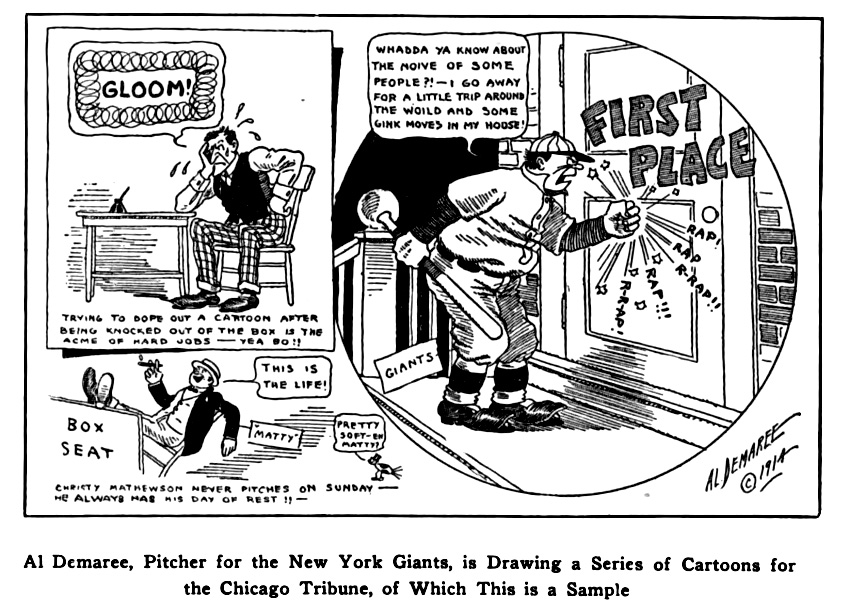
Labels: What The Cartoonists Are Doing
Comments:
Whoever said everything can be found on the Internet hasn't tried following up some of these cartooning stories. I did learn that publisher Frederick W. Enright started a number of papers in the 1920s, including dailies in Boston and New York. The latter had gone out of business by 1928. I found an article in a North Carolina paper from that year, recounting how Enright accused his chauffeur of kidnapping him and threatening to murder him if he didn't cough up $1000.
Maybe a reader who can afford to penetrate the newspaper archive paywall can discover how this "sensational story" turned out.
Maybe a reader who can afford to penetrate the newspaper archive paywall can discover how this "sensational story" turned out.
You can find a bio of Demaree here: https://sabr.org/bioproj/person/fff74cf7 Spoiler: it doesn't end particularly well.
Post a Comment
