Friday, October 14, 2005
Obscurities - Mister Gallagher And Mister Shean
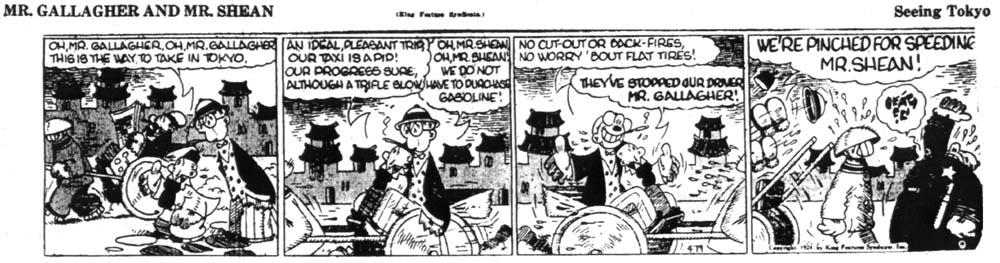
Here's a neat strip that mines the vaudeville tradition. Gallagher and Shean were a vaudeville comedy duo of the teens and twenties. Their lasting claim to fame is the classic pop comedy song "Mister Gallagher And Mister Shean". You can read more about the comedy team in Wikipedia here.
Anyway, the strip started sometime in 1923 (my earliest examples are from October) and ended April 19, 1924. Jo Swerling was credited with the strip, and on a few occasions I find a signature on the strip "Done By Dunn", so this Dunn may have been the bullpen artist who did the art. Unfortunately I have no background info on Swerling, nor can I say with any certainty who Dunn is - Bob Dunn? Alan Dunn? Charles Dunn? They were all cartoonists working in the 1920s. My guess is Charles Dunn, but anybody have a suggestion?
Labels: Obscurities


Comments:

Jo Swerling (sometimes, or originally, Josef Swirling, born in Russia) was a friend of the Marx Brothers. (Another cartooning connection: Groucho married the sister of Will B Johnstone, New York World cartoonist who worked on Marx Bros scripts) Swerling did the story for a lost Marx Bros silent of 1921, and worked on a 1918 stage routine of Groucho's. Anyway, Al Shean the great vaudevillian was the Marx Bros' uncle. Perhaps that is the connection when Gallagher and Shean "became" a comic strip and Swerling wrote it. Short-lived. The art was Charles Dunn, Hearst (und anderer) bullpen stalwart; NOT Bob Dunn, whose and drawing style put the possibility out of possibility. Swerling's Hearst-bullpen connections -- a friendship with Damon Runyon -- possibly paid off when he wrote the book (with Abe Burrows) for Guys and Dolls, for which they won an Emmy. However Swerling had a separate career in the movies (even briefly as an actor) -- writing duties on "Gone With the Wind" (uncredited) and "It's a Wonderful Life." He also did the screenplay for Hitchcock's "Lifeboat," and the original "Pennies from Heaven." His son Jo Swerling Jr is a movie producer ("The Brothers-in-Law") and many Stephen J Cannell shows -- "Baretta," "A-Team," "Rockford Files," many more.
# posted by  : 11/15/2005 7:17 PM
: 11/15/2005 7:17 PM
Hi Rick! Thanks for all the information on ol' Swerly (that had to be his nickname, right?). Any comic strip-related projects in the works right now, or are you concentrating on the country music or movie genres these days?
Done by Dunn is my grandfather- from my understanding he mainly did the racing form cartoon for the newspaper-
Post a Comment
# posted by : 2/21/2024 7:02 PM
: 2/21/2024 7:02 PM Tuesday, June 16, 2009
Obscurity of the Day: And Then He Changed His Mind

 Here's a short-lived panel cartoon that was syndicated by the Ledger Syndicate. I once assumed that signature, "Done by Dunn", was indicating the work of Bob Dunn, but I was set straight by a family member that anything from that era signed in this manner is by actually the work of Charles J. Dunn.
Charles was apparently a mischievous fellow, because his other favored signature was "GAR". His relatives haven't a clue why he chose that pseudonym.
And Then He Changed His Mind, an eminently forgettable effort, ran from sometime in 1921 to December 16 1922.
Labels: Obscurities
Comments:
"GAR" was a substitue for "GOD" to be used in mixed company, or in family publications, as a componant of the oath; "By god, I swear that..." Note how often we see some stuck fellow in a hundred year old cartoon exclaim, "By Gar!". This is not to say that Mr. Dunn saw himself in such a lofty state or such, it's just that the expression was so commonplace that it had lost it's original meaning, and now was as harmless as the similar "By Gum!" It must have seemed like an irresistable Nome de PUN.
Post a Comment
# posted by : 6/16/2009 11:27 AM
: 6/16/2009 11:27 AM Tuesday, July 05, 2016
Ink-Slinger Profiles by Alex Jay: Nicholas Afonsky
Nicholas Dimitrievitch Afonsky was born in Kovno, Russia, on February 17, 1892. His full name and birth information were recorded on his World War II draft card.

The New York Times, June 17, 1943, said:
Afonsky…studied art under Selesneff and Pimonenko. During the first World War he was wounded five times and received eleven decorations. While a soldier he passed the graduation examination at the University of Moscow, and became a criminal lawyer.Afonsky has not been found in the 1925 New York census. He may have been in the 1925 New York City directory which listed an “N Afonsky” at 388 3rd Avenue.
When the Russian revolution occurred, he went to Constantinople and worked for Greek, Turkish, Armenian and French newspapers and magazines….
Afonsky’s comics career began in 1925. American Newspaper Comics (2012) said he drew the Adventures of Vivian Vanity, under the pseudonym, Meetrich, from September 29, 1925 to January 30, 1926. He was followed by Delevante. N. Brewster Morse was the writer. Wheeler-Nicholson Inc. handled the distribution. Afonsky and Morse also produced the Great Mystery and Adventure Series for Wheeler-Nicholson Inc. Again, Afonsky used his pseudonym, Meetrich, from October 19, 1925 to January 30, 1926. Afonsky used his name from February 1 to October 7, 1926. Ruth Jane Williams assumed the writing from January 25 to October 7, 1926.


The Bottle Imp (7/3/1926), The Gold Bug, and Ali Baba and the Forty Thieves (7/30/1926)
by Williams and Afonsky for Wheeler-Nicholson. Images courtesy of Art Lortie.
Afonsky and Morse’s departure from Wheeler-Nicholson was explained in Variety, January 27, 1926.
Syndicates BattlingAfonsky’s next series was In the Footsteps of Abraham Lincoln which was written by Ida M. Tarbell. It was from the McClure Syndicate in early 1927. Afonsky drew two more McClure series: Famous Love Romances and Conquest of the Air. Both began in 1927.
Two newspaper syndicates are in legal battle over the artistic output of Nicholas Afonsky and the writings of N. Brewster Morse.
Wheeler-Nicholson. Inc., claim a prior contract with Morse for both his and Afonsky’s output and is suing the McClure Syndicate, alleging it is damaging them through having wrongfully entered into another agreement with Morse to release through the McClure channels. An accounting is asked for to determine the amount of damages.
Afonsky took over the drawing on Ed Wheelan’s Minute Movies some time in 1929 and stopped in 1934. Dunn explained how Afonsky got involved.
Through a letter of introduction from Chaliapin, the great opera star, to Wheelan, Afonsky went to work drawing backgrounds on “Minute Movies”. Wheelan really didn’t draw well. After two days Afonsky took over all the art work, leaving Wheelan to devote all his time to seeing the new motion pictures and writing parodies of the best of them for his feature.In Biographical Sketches of Cartoonists & Illustrators in the Swann Collection of the Library of Congress (2012), Sara Duke wrote, “Upon seeing his [Afonsky’s] work, William Randolph Hearst hired him to work in his ‘bull pen,’ where artists customarily drew panels, finished strips, an cleaned up the work of other artists.”
Beginning February 11, 1934, Afonsky produced the Little Annie Rooney Sunday page which began with Ed “Verd” Verdier in 1927. Afonsky also did the topper, Fablettes, which was followed by the Ming Foo topper on March 17, 1935. Brandon Walsh was the writer of the King Features strip. Afonsky’s Little Annie Rooney and Ming Foo also appeared in comic books.
The 1936 Heroes of American History was by Afonsky. Later, he was the third artist to draw Alex Raymond’s Secret Agent X-9. Afonsky’s stint was from April 11 to November 5, 1938. Both series were for King Features.
According to Drawing Power: A Compendium of Cartoon Advertising (2011), Afonsky drew some of the Prince Albert pipe tobacco advertisements featuring Ol’ Judge Robbins.
The 1930 U.S. Federal Census recorded Afonsky at 45 West Avenue in Meadowmere Park, Hempstead, Nassau, New York. The newspaper cartoonist had a three-year-old daughter, Anastasia. Afonsky’s address and occupation were unchanged in the 1940 census. Afonsky also had an address in Rockville Centre, New York. Directories dated 1938, 1940 and 1942 listed 24 Harold Street for the artist.
Afonsky passed away at home June 16, 1943. The following day the Times said Afonsky lived at 557 West 148th Street and became a citizen nine years ago. Afonsky was survived by his daughter Anastasia.
—Alex Jay
Labels: Ink-Slinger Profiles
Comments:
I have the full run of Afonsky's CONQUEST OF THE AIR (and a few other science fact strips) at http://totu.wikispaces.com/Science+in+All+the+Wrong+Places
Great stuff
Post a Comment
Great stuff
Friday, June 26, 2009
Obscurity of the Day: Just The Type

 Bob Dunn, who had the uncredited job of assisting/ghosting for Jimmy Hatlo on They'll Do It Every Time, got to take credit on this very similarly themed Sunday strip called Just The Type. Never a syndication success, King Features may well have let him do the feature just to keep him happy while working on the Hatlo cash cow feature.
Just The Type ran in the New York Journal-American and darn few other papers from May 5 1946 to November 24 1963, a very respectable run. When Hatlo died in 1963, though, Dunn's workload presumably got that much heavier and Just The Type was dropped. Dunn finally got an official byline on They'll Do It Every Time starting in 1966.
Thanks to Cole Johnson for the lovely scans from syndicate proofs.
Labels: Obscurities
Saturday, May 10, 2014
Herriman Saturday

Monday, July 6 1908 -- J. J. Dunn will offer the nominating speech for William Jennings Bryan at the Democratic National Convention in Denver. It was so stirring a speech that it was following by no less than 70 minutes of cheering and rejoicing from the floor.
Here's a powerful passage from Dunn's speech:
Without an organization to urge his claim; without a campaign fund to circulate literature in his behalf; without patronage to bribe a single voter; without a predatory corporation to coerce its employees into his support; without a subsidized newspaper to influence the public mind; this extraordinary man has won a signal victory at the primaries and has become the free choice of the militant Democracy of the nation.The amazing thing is that in the case of Bryan, this isn't 100% baloney, nor did it make him a minor candidate to be easily bulldozed aside by the monied forces. You can see why the Democrats, though already bitten twice by nominating him, would just keep on trying, thinking that they must have lightning in a bottle.
Labels: Herriman's LA Examiner Cartoons
Tuesday, July 14, 2009
Obscurity of the Day: Hunter Keene


 Norman Marsh, the creator of that 'me too' detective strip Dan Dunn in the 1930s, came back from the war to find that his strip had been a stateside casualty. Undaunted, he jumped right back on the horse and created Hunter Keene, yet another hardboiled detective strip. It first appeared on April 15 1946 and was distributed by King Features as a daily only strip.
Dan Dunn had achieved a measure of success in the thirties mainly because it was one of the first Dick Tracy imitators in a crime drama field not yet crowded with lantern-jawed sleuths. Hunter Keene, on the other hand, had no such leg up on the competition and sales were abysmal. King pulled the plug on the strip at the end of a one-year contract. The strip last ran on April 12 1947.
Marsh was a smart cookie, though, and didn't let this setback keep him on the sidelines for long. After a survey of the field Marsh came right back with Danny Hale, a strip about pioneer days. While not a major success (it merited an Obscurity of the Day posting) it did keep Marsh busy for the next fifteen years, riding the tide of the Western craze.
Labels: Obscurities
Comments:
If I'd seen this strip by itself I'd have sworn it was from the early to mid-1930s. It must have looked ancient to the postwar audience.
Post a Comment
Wednesday, February 17, 2010
Q & A Time

Jeffrey Lindenblatt, publishing impresario, microfilm maven and good friend of Stripper's Guide, has a few questions on his mind. Can you assist?
* Jeff is looking for early Archie dailies for an upcoming publishing project. The early years of the strip, especially the daily, are extremely hard to find and he is looking to fill gaps in 1946. If you can help, reply here or email me for Jeff's contact info. Jeffrey is not only looking for tearsheets but even any leads to newspapers that ran the strip in that first year. According to a 1946 E&P ad it was picked up in a lot of major cities in 1946, but it seems like many of them paid for it but didn't run it (not all that unusual in the days of exclusive territories).
* Jeffrey is also a little perplexed about the comic strip Dan Dunn. While doing some research on NewspaperArchive.com, he found that, as is well-known, the strip was dropped in favor of Alfred Andriola's new strip, Kerry Drake, by Publishers Syndicate, in October 1943. However, detective Dan didn't rest. Instead his adventures were reprinted in quite a few newspapers as late as 1950. Jeff and I agree that this isn't really typical of Publishers Syndicate to sell a strip in reprints -- so why did Dan Dunn have this long reprint run? Anyone have any ideas?
* Last but not least, Jeffrey wonders if anyone has seen copies of an odd weekly newspaper called Favorite Features that was published in New York City starting July 12 1967. It ran pretty much just syndicated columns and comics. It seems to have been short-lived.
Comments:
A googlenews search shows a Pittsburgh Post-Gazette promo saying that Archie will start in that paper beginning February 4, 1946.
http://tinyurl.com/ylnlufm
Viewing that paper dated later in 1946 shows it actually was running there in that year.
http://tinyurl.com/ylnlufm
Viewing that paper dated later in 1946 shows it actually was running there in that year.
Hello, Allan----"Archie" was running in the Saturday CHICAGO AMERICAN comic section in 1946. Also try the Manchester (N.H.)LEADER, Bob Montana's hometown paper.----Cole Johnson.
# posted by : 2/17/2010 12:49 PM
: 2/17/2010 12:49 PM
Hello. Allan----Bob Montana was one of the all-time greats. He had a wonderful talent for timing, expressions, and positioning. Best of all was his consistant and truly funny writing on the strip. Many successful, long-running comics waddle on for years without ever being really funny. I can't imagine anyone ever actually laughing at a WINTHROP, SMITTY, NANCY, SHORT RIBS, and about a million more. ARCHIE, however, gave me many real laughs under Montana's stewardship. he aggressively tried to be funny. He depicted jealousy, vengeance, stupidity, and slapstick----all thrown away after Montana's death in 1975. Today it's just an unsigned hack job, a humor-free parade of copyrighted trade marks, strictly politically correct. To effect this holy goal, those Riverdale rascals just don't do anything anymore. (If your characters just stand around and make puns, you can be safe not to offend anyone. ) It's as bland as most modern strips.----Cole Johnson.
# posted by : 2/18/2010 3:13 PM
: 2/18/2010 3:13 PM
Allan, You observe that it wasn't typical for Publishers Syndicate to sell a strip in reprints, as it did with DAN DUNN, but was such a practice typical with other syndicates back in the day? Any idea of how many strips, like PEANUTS today, have lived on for years as reprints?
# posted by : 3/01/2010 3:57 PM
: 3/01/2010 3:57 PM
Hi Dave --
Surprisingly, not many strips were sold in reprints 'back in the day', and when they were they were rarely classics like Peanuts. Syndicates sold their backstock of lackluster strips mostly to hole-in-the-wall type outfits who then resold the material cheap to small rural papers. International Cartoon Company, for instance, bought from several syndicates -- George Matthew Adams, Associated Newspapers and even occasionally a minor feature from the big boys like Hearst and Pulitzer (which leads me to think that maybe the cartoonists took their drawings with them after their series was cancelled and sold it to International themselves).
Only Bell Syndicate seemed to make it an established practice to sell reprint rights; they had a deal with Western Newspaper Union that lasted for many years.
--Allan
Surprisingly, not many strips were sold in reprints 'back in the day', and when they were they were rarely classics like Peanuts. Syndicates sold their backstock of lackluster strips mostly to hole-in-the-wall type outfits who then resold the material cheap to small rural papers. International Cartoon Company, for instance, bought from several syndicates -- George Matthew Adams, Associated Newspapers and even occasionally a minor feature from the big boys like Hearst and Pulitzer (which leads me to think that maybe the cartoonists took their drawings with them after their series was cancelled and sold it to International themselves).
Only Bell Syndicate seemed to make it an established practice to sell reprint rights; they had a deal with Western Newspaper Union that lasted for many years.
--Allan
Thanks for the info, Allan. My local weekly paper (one of those community giveaway papers; I live in suburban Cleveland, Oh.) occasionally will toss in a few comic strips in the back pages, and sometimes they'll use POPEYE, which always amazed me because they were just using a single daily strip on a random basis. But then I learned the POPEYE daily itself has been in reruns for nearly 20 years, so it must be available pretty cheap these days.
# posted by : 3/02/2010 11:26 AM
: 3/02/2010 11:26 AM
Was FAVORITE FEATURES just something put out during a newspaper strike to keep the strips and columns in print in N.Y.? Something to do with copyrights or something?---Cole Johnson.
# posted by : 10/14/2010 8:47 AM
: 10/14/2010 8:47 AM
Hi Cole --
That may well be the case. That WAS a bad time to be a newspaper reader in NYC with all those strikes!
--Allan
Post a Comment
That may well be the case. That WAS a bad time to be a newspaper reader in NYC with all those strikes!
--Allan
Friday, February 23, 2024
Ink-Slinger Profiles by Alex Jay: Shorty Shope
(An earlier profile was posted in 2019.)

Henry Irvin “Shorty” Shope was born on May 11, 1900, in Boulder, Montana, according to Shope’s birth certificate at Ancestry.com. His parents were Ira Daniel Shope and Emily Alvis Shope.
In the 1900 United States Census, month-old Shope was the youngest of three children. Their father was a stationery engineer. The family resided in Boulder.
According to the 1910 census, Shope was the third of seven siblings. The family resided in township six of Jefferson County, Montana. Shope’s father was a farmer.
The Great Falls Tribune (Montana), November 23, 1977, said the family moved to Missoula, Montana when Shope’s father died.
It was there, in his formative years of 13 throughout 18, that he came under the influence of E.S. Paxson, painter of native Americans and the frontier West.“He gave me my first lesson in anatomy and would correct and trim up my drawings, illustrated on the side of my paper and even let me watch him paint,” he later said….His formal art education began in 1919, when he attended both Portland Art Academy and Reed College in Portland….
Shope graduated in 1932 from the University of Montana with a bachelor’s degree in fine arts. The Missoulian Sun, September 4, 1966, said Shope met artist Charles M. Russell and studied with Harvey Dunn in New York City.
Shope was mentioned in the Missoulian newspaper on September 5, 1913, “Irvin Shope, 13 years old and a nephew of Mrs. W. W. Wickes, was operated upon for appendicitis yesterday morning at St. Patrick’s hospital.” In the May 27, 1914 issue, Shope was one of several speakers in the Roosevelt School’s declamation contest. Shope was listed as an honor student in the February 23, 1917 Missoulian. Shope was a guest at the Christmas party hosted at the Wickes home.
Farmer Shope signed his World War I draft card on September 12, 1918. His address was 425 West 5th Street in Missoula. His description was short, medium build with blue eyes and light brown hair.
The 1920 census said Fargo, North Dakota was Shope’s home at 1043 Tenth Street North. The head of the household was his widow mother’s brother-in-law, Carl Greenwood. Shope was unemployed.
In the 1920s Shope was a correspondence student with the Federal School in Minneapolis, Minnesota. His art was printed in the school’s publication, The Federal Illustrator, Winter 1925–1926 and Fall 1926.


In the department of Animal Drawings, Irvin Shope, with his “Stage Coach,” carried away the bacon, as the vulgar say. The picture is full of action. Shope is always good at that—so good that he sometimes, like that great original draughtsman of the moving horse, Frederic Remington, sacrifices drawing to movement. I have seen better things of his than this, yet it deserved a prize. The lad is, I think, very promising.
Shope was one of several artists who wrote about the late Charles Russell in The Federal Illustrator, Winter 1926–1927.


Shope wrote about his painting in The Federal Illustrator, Summer 1927.

The Poplar Standard (Montana), November 18, 1927, said
Irvin Shope, of the State university, is exhibiting oil paints of Glacier national park and the Canadian rockies. He was formerly with the forest service.
Shope appeared in The Federal Illustrator, Summer 1928.

Illustrator of Western Life Busy on Mural Paintings for Glacier ResortIrvin Shope’s realism in picturing of Western life secured him a place among the prize winners with a pen line drawing nicely adapted to illustrative uses.Altho adept in drawing of horses and horsemen, Mr. Shope does not confine himself to drawing them.“I have just pleased a young husband and was paid liberally for a portrait sketch of his pretty wife,” he writes in a recent letter which also reports good returns in a cover design for a catalogue, an illustration of a vicious broncho to advertise high power gas for a new Montana gas company; two pen drawings for decorative use in a new Spanish home in Los Angeles and another cover design for Triple-X.The letter continues, “My old friend Justin and Company have asked me to do a painting to be used on a window card advertising their boots, giving me full sway as to subject.“Then I have been doing some drawing to advertise a new lodge or dude camp just over the edge of Glacier park on beautiful St. Mary’s lake. I am going up there in June to paint a couple of large pictures for the lobby.“Four years and some odd months of work under encouragement of the old Federal Schools has brought me thus far and now I suppose I can keep going alone but I still want a word from you now and again for a long time.“I paid my last ten dollars in the first installment for the course and was Wass out of work too. The path between then and now has been rough but I’ll never regret the course I took nor cease to wonder what chance made me write to Federal Schools as I had no first hand information of you folks nor on one to ask who knew anything about you. I was lucky that’s all.”The late Charles M. Russell gave Mr. Shope high commendation on early drawings in the course and assured him that he was on the right track studying with the Federal Schools.
The 1930 census listed Shope, his mother and three brothers in Missoula, Montana at 425 South Fifth Street West. Shope was a self-employed artist.
The Great Falls Tribune said Shope married Erva Vivian Love, on June 23, 1932 in Missoula.
Shope received his University of Montana fine arts degree in 1933.
The 1934 Missoula city directory listed artist Shope at 517 Connell Avenue.
American Newspaper Comics (2012) said Shope drew Rusty Rawlins, Cowboy which was written by Glenn Chaffin. The McClure Syndicate strip began in late 1934 and ended in early 1936. The last three weeks were drawn by Tom Maloney.
Shope was mentioned in The Federal Illustrator, Spring 1935.

The 1940 census recorded Shope, his wife and three daughters in Helena, Montana at 1337 9th Avenue. The advertising artist worked for the Montana Highway Department. The census said Shope had lived in Los Angeles, California in 1935.
During World War II Shope registered with the draft on February 16, 1942. The Helena resident was employed at the Montana Highway Department.

1956 and 1964 Helena city directories said Shope’s occupation was artist whose address was 1337 9th Avenue.
The Missoulian Sun, September 4, 1966, said several paintings by Shope were to be exhibited at the Cowboy Hall of Fame. Shope was a member of the Cowboy Artists of America, Inc. Shope had three dioramas at the Charles M. Russell Historical Society Museum in Helena. Shope “painted many portraits of Indians, mainly from the Blackfeet tribe in Browning who adopted him as a ‘blood-brother’ in 1937 and gave him the name ‘Wolf Bull.’”
The Independent Record Sun (Montana), August 24, 1969, said between 1950 and 1965 Shope painted murals for the Highway Department, Western Life Insurance Company, First National Bank, Helena Junior High, St. Paul Fire & Marine Building, and the Federal Building in Webster, South Dakota. He contributed a painting every year to the Shedd-Brown Calendar Company starting in 1956.
Shope passed away November 22, 1977, in Burlington, Massachusetts. The Great Falls Tribune said Shope and his wife were visiting their daughter when he suffered a stroke. He was laid to rest at Boulder Cemetery.
Further Reading and Viewing
How About the Roads?: Montana’s Highway Maps 1934–2004
Montana’s Historical Highway Markers; cover art by Irvin Shope
Meadowlark Gallery; signature
Montana Historical Society, Museum Collections Online
University of Montana; Irvin “Shorty” Shope Oral History Collection
Surveys and Surveyors of the Public Domain, 1785–1975, Photograph from an oil painting by Montana artist Shorty Shope
Labels: Ink-Slinger Profiles
Wednesday, February 27, 2013
Obscurity of the Day: Captain Storm


The strip was nominally about the skipper of a freighter ship, but the heroic Captain Storm seemed to spend more time everywhere else, because the first story arc has him losing his ship to thieves.The writing, the art and the plot are all top-notch work and I don't doubt that they were reader favorites.
The strip is by Ed Moore, whose work resembles another Chicago-trained cartoonist, Dick Moores, enough that I get the two confused. Ed Moore did some assisting work on Dan Dunn and Don Winslow prior to creating Captain Storm, the only newspaper strip on which he got credit. However, Moore was also working at the same time in comic books. Perhaps he found that to be more lucrative or less demanding than Captain Storm, and that explains its short run. Moore worked in comic books and assisted on newspaper strips into the 1960s, then switched to advertising work, according to Ron Goulart in The Great Comic Book Artists, Volume 2.
Labels: Obscurities
Comments:
EXTREME TRIVIA: Fontaine Fox was the first cartoonist to appear in a sound film, in a 1928 FOX MOVIETONE NEWSREEL segment.
Post a Comment
# posted by : 2/28/2013 10:48 AM
: 2/28/2013 10:48 AM Thursday, February 28, 2019
Ink-Slinger Profiles by Alex Jay: Shorty Shope

In the 1900 U.S. Federal Census, month-old Shope was the youngest of three children. Their father was a stationery engineer. The family resided in Boulder.
According to the 1910 census, Shope was the third of seven siblings. The family resided in township six of Jefferson County, Montana. Shope’s father was a farmer.
The Great Falls Tribune (Montana), November 23, 1977, said the family moved to Missoula, Montana when Shope’s father died.
It was there, in his formative years of 13 throughout 18, that he came under the influence of E.S. Paxson, painter of native Americans and the frontier West.
“He gave me my first lesson in anatomy and would correct and trim up my drawings, illustrated on the side of my paper and even let me watch him paint,” he later said….
His formal art education began in 1919, when he attended both Portland Art Academy and Reed College in Portland….Shope graduated in 1932 from the University of Montana with a bachelor’s degree in fine arts. The Missoulian Sun, September 4, 1966, said Shope met artist Charles M. Russell and studied with Harvey Dunn in New York City.
Shope was mentioned in the Missoulian newspaper on September 5, 1913,
“Irvin Shope, 13 years old and a nephew of Mrs. W. W. Wickes, was operated upon for appendicitis yesterday morning at St. Patrick’s hospital.” In the May 27, 1914 issue, Shope was one of several speakers in the Roosevelt School’s declamation contest. Shope was listed as an honor student in the February 23, 1917 Missoulian. Shope was a guest at the Christmas party hosted at the Wickes home.
Farmer Shope signed his World War I draft card on September 12, 1918. His address was 425 West 5th Street in Missoula. His description was short, medium build with blue eyes and light brown hair.
The 1920 census said Fargo, North Dakota was Shope’s home at 1043 Tenth Street North. The head of the household was his widow mother’s brother-in-law, Carl Greenwood. Shope was unemployed.
The 1930 census listed Shope, his mother and three brothers in Missoula, Montana at 425 South Fifth Street West. Shope was a self-employed artist.
The Great Falls Tribune said Shope married Erva Vivian Love, on June 23, 1932 in Missoula. The 1934 Missoula city directory listed them at 517 Connell Avenue. Shope’s occupation was artist.
American Newspaper Comics (2012) said Shope drew Rusty Rawlins, Cowboy which was written by Glenn Chaffin. The McClure Syndicate strip began in late 1934 and ended in early 1936. The last three weeks were drawn by Tom Maloney.
The 1940 census recorded Shope, his wife and three daughters in Helena, Montana at 1337 9th Avenue. The advertising artist worked for the Montana Highway Department. In 1935 Shope lived in Los Angeles, California.
During World War II Shope registered with the draft on February 16, 1942. The Helena resident was employed at the Montana Highway Department.
1956 and 1964 Helena city directories said Shope’s occupation was artist whose address was 1337 9th Avenue.
The Missoulian Sun, September 4, 1966, said several paintings by Shope were to be exhibited at the Cowboy Hall of Fame. Shope was a member of the Cowboy Artists of America, Inc. Shope had three dioramas at the Charles M. Russell Historical Society Museum in Helena. Shope “painted many portraits of Indians, mainly from the Blackfeet tribe in Browning who adopted him as a ‘blood-brother’ in 1937 and gave him the name ‘Wolf Bull.’”
The Independent Record Sun (Montana), August 24, 1969, said between 1950 and 1965 Shope painted murals for the Highway Department, Western Life Insurance Company, First National Bank, Helena Junior High, St. Paul Fire & Marine Building, and the Federal Building in Webster, South Dakota. He contributed a painting every year to the Shedd-Brown Calendar Company starting in 1956.
Shope passed away November 22, 1977, in Burlington, Massachusetts. The Great Falls Tribune said Shope and his wife were visiting their daughter when he suffered a stroke. He was laid to rest at Boulder Cemetery.
Further Reading and Viewing
Montana Historical Markers
How About the Roads?: Montana’s Highway Maps 1934–2004
Montana’s Historical Highway Markers; cover art by Irvin Shope
Meadowlark Gallery; signature
Montana Historical Society
Museum Collections Online
Map: Montana Highway Dept. Frontier & Pioneer Montana, 1937
University of Montana; Irvin “Shorty” Shope Oral History Collection
Surveys and Surveyors of the Public Domain, 1785–1975; photograph from an oil painting by Montana artist Shorty Shope
—Alex Jay
Labels: Ink-Slinger Profiles
Thursday, July 09, 2009
Mystery Strips of E&P - "P" Listings
As you'll no doubt recall from previous installments of this series, the following features were all listed in the Editor & Publisher annual Syndicate Directory listings. Problem is that I have not been able to find these ones in any American newspaper. I'm looking for positive proof that (1) these features did indeed exist, (2) they are actually comics of some sort and weren't just mislabeled in E&P, and (3) they ran in U.S. newspapers. If you have any information about any mystery strip on this list please, please, please tell me all about it. And if you can provide positive proof that the mystery feature did indeed run in U.S. newspapers (a tearsheet is ideal proof) and qualifies for listing in the Stripper's Guide index, you can be the recipient of a goodie box chock full of all manner of comic strip ephemera -- could be reprint books, old tearsheets, magazines, original art or all of the above. Trust me that my goodie boxes do not disappoint! (SORRY - as of 2018 goodie boxes
are sadly no longer available - I now live in Canada and our postal
rates are so outrageous that I cannot afford to send out goodie boxes -
SORRY!)
If you prefer to contact me privately rather than posting a comment on the blog, send it to strippersguide@gmail.com. Please be sure to mention Stripper's Guide in your subject line or I may miss your message in amongst all the spam.
Here's the mystery features starting with letter "P" as in "please get me off this list!". Each listing has the title, years advertised, creator(s), syndicate and format. Sorry, I'd put these in a more attractive tabular form, but Blogger plays havoc with tables:
P.J. Abominable, 1968, John Gallagher, United Feature Syndicate, daily strip
The PO Box, 1993-97, Earl T. Musick, self-syndicated, weekly (author says it sold primarily to specialty publications - thanks Earl!)
Pa and Abie, 1926, Russell, Wheeler-Nicholson, daily strip
Pa and Ma, 1926, Voorhees, John F. Dille, daily strip
Padded Cell, 1942, Charles J. Dunn, Watkins Syndicate, daily panel
Paddy Pigg, 1937, Richard Decker, Allied Features, daily and Sunday strip
A Page For Every Age, 1936, G. Melikov, Nu-Way Features, weekly strip
Pan-Dee-Monium, 1982, Jackson Gray, Mid-Continent Features, daily strip
Pandora, 1948, Kaye Spence, Press Features, daily panel
Panel of Fun, 1939, C. Decker, Bell SYndicate, daily panel
Pantomime, 1975, Sara Black, Spadea Syndicate, daily panel
Paperclips, 1981, Doug Brunner, Community Features, thrice weekly
Paradise Park, 1994-99, R. Claude, Singer Media, weekly strip
Parents Plus, 1968-69, Justin Manning, Four Corners Syndicate, weekly panel
Parking Space, 1931, Russell Askue, McClure Syndicate, daily panel
Party Gators, 1998-2004, Elaine Sandra Abramson, A&A, weekly strip
Party Ranks, 1986-87, Mike Pascal and Joe Stuart, JSA Publications, daily/weekly strip
Pat the Paris Shopper, 1932-35, Joan Carson, John F. Dille, daily strip (fashion feature?)
Patent Nonsense, 1999, Roy Doty, Paradigm-TSA, daily strip
The Patsy, 1933-34, Irma Harms, Thompson Service, daily strip
Patterson's People, 1968-73, Gene Patterson, Allied Features, daily panel
Patty Lee, 1933, Edwin Finch, Henle Features, daily
Peanut Butter Soup, 1990-92, Joe Amadeo and Tom Kerr, Syndicated News Service, weekly
Pebbles, 1951, Henry Boye, McClure Syndicate, daily panel
Pee Wee's Pencil, 1979, Joe Rice, Copley News Service, daily and Sunday panel (found by Charles Brubaker, activity panel, doesn't qualify for SG)
Peeping Tom, 1981, C. Crist, Globe Syndicate, weekly strip
Peg, Ann & Barbara, 1928-30, Mabel Whitney, International Syndicate, daily panel
The Pennypockets, 1939, Wes Dennis, Consolidated News Features, daily strip
People & Things, 1940, Prescott Chaplin, Bell Syndicate, daily/weekly strip (likely illustrated column)
PeraNormal, 1996-98, Jim Pera, Second Ring Syndicate, weekly strip
Percy's World, 1961, Howie Schneider, Page One Syndicate, daily strip
Perfect Couple, 1986, Rick Geary, Copley News Service, twice weekly strip
Peter Panic, 1973-2003, Lo Linkert, Singer Media, daily/weekly panel
Peter Pupp, 1937-39, Bob Kane, Eisner-Iger Associates, weekly strip
Petey, 1935, Lou Darvas, Thompson Service, daily panel
Pews, 1982-85, Joe McKeever, Copley News Service, weekly panel [Charles Brubaker reports that McKeever says he never saw the panel in print -- Copley told him they didn't know which papers, if any, actually ran it]
Phil Ossifer, 1934-36, Clyde Campbell and O. DeCaillet, Thompson Service, daily panel
Phillip's Flock, 1968-85, Doc Goodwin, Dispatch Features, Sunday strip (found in Columbus Dispatch, actually a weekly strip in daily format)
Phoney Photos, 1925, Bret Hart Jr., Readers Syndicate, daily panel
Phrog, 1985-86, George Albitz, Al Smith Service, weekly strip (Found! in Laurel Outlook)
Phyllis, 1939, Bernard Baily, Keystone Press Features, daily strip
Pig Newton, 1983, Mal Hancock, Field Newspaper Syndicate, daily panel/Sunday strip (found! in Philadelphia Daily News)
Pilot Storm, 1959-72, Henk Sprenger, Douglas Whiting, daily strip (Dutch - appeared in U.S.?)
Pinhead Pete, 1928-31, uncredited, Premier Syndicate, weekly panel (found! by Bill Mullins in Cleveland Plain Dealer and Portland Oregonian -- thanks Bill!)
Pinny and his Pals, 1937, Barney Bravman, Foreign Press Syndicate, daily/weekly strip
Pipe Dreams, 1957-63, Rud, Sun News Features, daily/Sunday panel
The Pit, 1957, Morris Turner, Pioneer Press Service, daily panel
Pixel, 1985, Frank Hill and Ted Mancuso, Al Smith Service, weekly strip
Playmates, 1924-25, Lloyd Jones and H.F. Voorhees, John F. Dille, daily strip
Plympton, 1978-81, Bill Plympton, self-syndicated/Universal Press Syndicate, weekly-4 times weekly panel (possibly political cartoon, originated in Soho Weekly News before syndication)
Pollutocrats, 1972, Larkin and Gordon, Allied Feature Syndicate, daily panel
Polly Esther, 1971, Ed McNally, Chicago Tribune-NY News Syndicate, daily panel
Polymericks, 1978, Steve McKinstry, Enterprise Features, 3 times weekly panel
Ponder This, 1965, Leonard Andrews, Chicago Tribune-NY News Syndicate, daily [Charles Brubaker finds this was a poetry feature, incorrectly categorized in E&P - thanks Charles]
Poor Little Rich Man, 1948, Courtney Dunkel, Chicago Tribune-NY News Syndicate, daily panel (found! by Michael Vassallo in New York News)
Pop Winters, 1935, Cliff Knight, Triton Syndicate, daily panel
Possum Holler, 1936, Boody Rogers, McClure SYndicate, daily strip
Pre-Columbian Mysteries, 1976, Mario Bertolini, Ed Marzola & Associates, daily strip
Prince, 1986, Winthrop Prince, Chronicle Features, weekly panel (author says it was syndicated as Free Zone to several papers and appeared in the SF Chronicle under this title - thanks Winthrop!)
Private Stuff, 1953, Jack O'Brien, Editors Syndicate, daily panel (found, but only in military base paper The Hilltop Herald -- still unfound in a mainstream paper)
Professor Naturebug, 1971, John Hazlett and Edward Thomas, Dispatch Features, Sunday strip (found in Columbus Dispatch, but very text heavy and doesn't qualify)
Professor Pi, 1959-72, V.T.Born, Douglas Whiting, daily strip (Dutch - appeared in U.S.?)
Professor Unquote, 1948, Bill Henry, Globe Syndicate, daily strip
Proven Proverbs, 1962, Bill Zaboly and William Davy, Select Features, daily panel
Pud, 1989-98, Steven Nease, Southam Syndicate/Liberty Features, daily strip (Canadian - appeared in U.S.?)
Punch Line, 1975-78, Palbo, Community Press Service, weekly panel
Punchline, 1995-96, Tim Newlin, self-syndicated, Sunday strip
Punchy and Judy, 1945, Loy Byrnes, NY Post, daily strip (found! in NY Post)
Puzzy, 1953, Jack Fitch, Editors Syndicate, daily panel
If you prefer to contact me privately rather than posting a comment on the blog, send it to strippersguide@gmail.com. Please be sure to mention Stripper's Guide in your subject line or I may miss your message in amongst all the spam.
Here's the mystery features starting with letter "P" as in "please get me off this list!". Each listing has the title, years advertised, creator(s), syndicate and format. Sorry, I'd put these in a more attractive tabular form, but Blogger plays havoc with tables:
P.J. Abominable, 1968, John Gallagher, United Feature Syndicate, daily strip
The PO Box, 1993-97, Earl T. Musick, self-syndicated, weekly (author says it sold primarily to specialty publications - thanks Earl!)
Pa and Abie, 1926, Russell, Wheeler-Nicholson, daily strip
Pa and Ma, 1926, Voorhees, John F. Dille, daily strip
Padded Cell, 1942, Charles J. Dunn, Watkins Syndicate, daily panel
Paddy Pigg, 1937, Richard Decker, Allied Features, daily and Sunday strip
A Page For Every Age, 1936, G. Melikov, Nu-Way Features, weekly strip
Pan-Dee-Monium, 1982, Jackson Gray, Mid-Continent Features, daily strip
Pandora, 1948, Kaye Spence, Press Features, daily panel
Panel of Fun, 1939, C. Decker, Bell SYndicate, daily panel
Pantomime, 1975, Sara Black, Spadea Syndicate, daily panel
Paperclips, 1981, Doug Brunner, Community Features, thrice weekly
Paradise Park, 1994-99, R. Claude, Singer Media, weekly strip
Parents Plus, 1968-69, Justin Manning, Four Corners Syndicate, weekly panel
Parking Space, 1931, Russell Askue, McClure Syndicate, daily panel
Party Gators, 1998-2004, Elaine Sandra Abramson, A&A, weekly strip
Party Ranks, 1986-87, Mike Pascal and Joe Stuart, JSA Publications, daily/weekly strip
Pat the Paris Shopper, 1932-35, Joan Carson, John F. Dille, daily strip (fashion feature?)
Patent Nonsense, 1999, Roy Doty, Paradigm-TSA, daily strip
The Patsy, 1933-34, Irma Harms, Thompson Service, daily strip
Patterson's People, 1968-73, Gene Patterson, Allied Features, daily panel
Patty Lee, 1933, Edwin Finch, Henle Features, daily
Peanut Butter Soup, 1990-92, Joe Amadeo and Tom Kerr, Syndicated News Service, weekly
Pebbles, 1951, Henry Boye, McClure Syndicate, daily panel
Pee Wee's Pencil, 1979, Joe Rice, Copley News Service, daily and Sunday panel (found by Charles Brubaker, activity panel, doesn't qualify for SG)
Peeping Tom, 1981, C. Crist, Globe Syndicate, weekly strip
Peg, Ann & Barbara, 1928-30, Mabel Whitney, International Syndicate, daily panel
The Pennypockets, 1939, Wes Dennis, Consolidated News Features, daily strip
People & Things, 1940, Prescott Chaplin, Bell Syndicate, daily/weekly strip (likely illustrated column)
PeraNormal, 1996-98, Jim Pera, Second Ring Syndicate, weekly strip
Percy's World, 1961, Howie Schneider, Page One Syndicate, daily strip
Perfect Couple, 1986, Rick Geary, Copley News Service, twice weekly strip
Peter Panic, 1973-2003, Lo Linkert, Singer Media, daily/weekly panel
Peter Pupp, 1937-39, Bob Kane, Eisner-Iger Associates, weekly strip
Petey, 1935, Lou Darvas, Thompson Service, daily panel
Pews, 1982-85, Joe McKeever, Copley News Service, weekly panel [Charles Brubaker reports that McKeever says he never saw the panel in print -- Copley told him they didn't know which papers, if any, actually ran it]
Phil Ossifer, 1934-36, Clyde Campbell and O. DeCaillet, Thompson Service, daily panel
Phillip's Flock, 1968-85, Doc Goodwin, Dispatch Features, Sunday strip (found in Columbus Dispatch, actually a weekly strip in daily format)
Phoney Photos, 1925, Bret Hart Jr., Readers Syndicate, daily panel
Phrog, 1985-86, George Albitz, Al Smith Service, weekly strip (Found! in Laurel Outlook)
Phyllis, 1939, Bernard Baily, Keystone Press Features, daily strip
Pig Newton, 1983, Mal Hancock, Field Newspaper Syndicate, daily panel/Sunday strip (found! in Philadelphia Daily News)
Pilot Storm, 1959-72, Henk Sprenger, Douglas Whiting, daily strip (Dutch - appeared in U.S.?)
Pinhead Pete, 1928-31, uncredited, Premier Syndicate, weekly panel (found! by Bill Mullins in Cleveland Plain Dealer and Portland Oregonian -- thanks Bill!)
Pinny and his Pals, 1937, Barney Bravman, Foreign Press Syndicate, daily/weekly strip
Pipe Dreams, 1957-63, Rud, Sun News Features, daily/Sunday panel
The Pit, 1957, Morris Turner, Pioneer Press Service, daily panel
Pixel, 1985, Frank Hill and Ted Mancuso, Al Smith Service, weekly strip
Playmates, 1924-25, Lloyd Jones and H.F. Voorhees, John F. Dille, daily strip
Plympton, 1978-81, Bill Plympton, self-syndicated/Universal Press Syndicate, weekly-4 times weekly panel (possibly political cartoon, originated in Soho Weekly News before syndication)
Pollutocrats, 1972, Larkin and Gordon, Allied Feature Syndicate, daily panel
Polly Esther, 1971, Ed McNally, Chicago Tribune-NY News Syndicate, daily panel
Polymericks, 1978, Steve McKinstry, Enterprise Features, 3 times weekly panel
Ponder This, 1965, Leonard Andrews, Chicago Tribune-NY News Syndicate, daily [Charles Brubaker finds this was a poetry feature, incorrectly categorized in E&P - thanks Charles]
Poor Little Rich Man, 1948, Courtney Dunkel, Chicago Tribune-NY News Syndicate, daily panel (found! by Michael Vassallo in New York News)
Pop Winters, 1935, Cliff Knight, Triton Syndicate, daily panel
Possum Holler, 1936, Boody Rogers, McClure SYndicate, daily strip
Pre-Columbian Mysteries, 1976, Mario Bertolini, Ed Marzola & Associates, daily strip
Prince, 1986, Winthrop Prince, Chronicle Features, weekly panel (author says it was syndicated as Free Zone to several papers and appeared in the SF Chronicle under this title - thanks Winthrop!)
Private Stuff, 1953, Jack O'Brien, Editors Syndicate, daily panel (found, but only in military base paper The Hilltop Herald -- still unfound in a mainstream paper)
Professor Naturebug, 1971, John Hazlett and Edward Thomas, Dispatch Features, Sunday strip (found in Columbus Dispatch, but very text heavy and doesn't qualify)
Professor Pi, 1959-72, V.T.Born, Douglas Whiting, daily strip (Dutch - appeared in U.S.?)
Professor Unquote, 1948, Bill Henry, Globe Syndicate, daily strip
Proven Proverbs, 1962, Bill Zaboly and William Davy, Select Features, daily panel
Pud, 1989-98, Steven Nease, Southam Syndicate/Liberty Features, daily strip (Canadian - appeared in U.S.?)
Punch Line, 1975-78, Palbo, Community Press Service, weekly panel
Punchline, 1995-96, Tim Newlin, self-syndicated, Sunday strip
Punchy and Judy, 1945, Loy Byrnes, NY Post, daily strip (found! in NY Post)
Puzzy, 1953, Jack Fitch, Editors Syndicate, daily panel
Labels: Mystery Strips
Comments:
Allan, in the case of more recent features, is it very useful to approach the cartoonists themselves? For instance, The PO Box's Earl T. Musick lives in Ohio, apparently in the same town he did when he worked on his strip. Since he self-syndicated, he would have a better idea of which newspaper ran his feature. Or do you find that actually trying to contact people doesn't turn out very well?
Hi Hugo -
When I can find someone on the web who seems to be the author of a mystery strip I do email them with questions. Its a hit and miss proposition. Out of the 'P' batch I did email Earl Musick (no response yet) and found a websites for Tim Newlin and Jim Pera but with no email links. Winthrop Prince has a Facebook page but I'm not a member and am not keen on becoming one.
--Allan
When I can find someone on the web who seems to be the author of a mystery strip I do email them with questions. Its a hit and miss proposition. Out of the 'P' batch I did email Earl Musick (no response yet) and found a websites for Tim Newlin and Jim Pera but with no email links. Winthrop Prince has a Facebook page but I'm not a member and am not keen on becoming one.
--Allan
Winthrop Prince also has a web page with an e-mail link at princeillustration.com if you think it's worth a try.
Oh, PILOOT STORM did exist. I was a big fan of the French language translation PILOTE TEMPETE back in the 60s in LE SOLEIL newspaper. Haven't had much luck tracking it down since, though.
norichan01@gmail.com
norichan01@gmail.com
# posted by : 8/15/2009 9:34 PM
: 8/15/2009 9:34 PM
I just saw this, but Piloot Storm did indeed exist. It has recently been republished by Dutch publisher Boumaar (http://www.boumaar.com/). This website tell that Storm was distributed through Swan Syndicate, who did a lot of bussiness in Europe. But maybe abroad as well? http://home.planet.nl/~staten/sprenger.htm
re: Pollutocrats, 1972, Larkin and Gordon
Gordon Larkin has passed away.
http://www.legacy.com/obituaries/examiner-enterprise/obituary.aspx?n=Gordon-Larkin&pid=163648087
From the above obituary: "In the early 1970's he drew the enviromentally themed, syndicated cartoon strip, The Pollut-o-crats, with his brother Mark."
There is a sample of the panel on his Facebook page with a printed credit of "by the Larkin brothers" while Gordon Larkin signed the panel GOLARK.
The creators of the panel were Gordon Larkin and his brother Mark Larkin.
Unfortunately I couldn't find any instance of it appearing in a newspaper, though the obituary says "It ran in 20 newspapers nationwide for 5 years."
D.D.Degg
Gordon Larkin has passed away.
http://www.legacy.com/obituaries/examiner-enterprise/obituary.aspx?n=Gordon-Larkin&pid=163648087
From the above obituary: "In the early 1970's he drew the enviromentally themed, syndicated cartoon strip, The Pollut-o-crats, with his brother Mark."
There is a sample of the panel on his Facebook page with a printed credit of "by the Larkin brothers" while Gordon Larkin signed the panel GOLARK.
The creators of the panel were Gordon Larkin and his brother Mark Larkin.
Unfortunately I couldn't find any instance of it appearing in a newspaper, though the obituary says "It ran in 20 newspapers nationwide for 5 years."
D.D.Degg
I remember seeing Pig Newton as a voting candidate for am August 1983 Stamford (CT.) Advocate comics voting poll. It was a candidate with 4 other new comics, but didn't make the cut.
I have a Mostly Male, Easter with Phillip's Flock by Doc Goodwin that has a paste-on for the Columbus Dispatch Tab, March 29, 1970, with a second strip "Bascomb" drawn below. Working my way through the Art Wood Collection alphabetically, now up to Goodwin!
Sara Duke
Curator, Popular & Applied Graphic Art
Prints & Photographs Division
Library of Congress
Washington, DC 20540-4730
sduk@loc.gov
Sara Duke
Curator, Popular & Applied Graphic Art
Prints & Photographs Division
Library of Congress
Washington, DC 20540-4730
sduk@loc.gov
# posted by : 12/21/2015 8:17 AM
: 12/21/2015 8:17 AM
Hmm. So it sounds like Philip's Flock may have just been a recurring feature within the Mostly Male Sunday page. I'll take it under advisement, and hopefully I'll get to look at the Columbus Dispatch microfilm one of these days. Thanks Sara!
--Allan
--Allan
Hey Allan,
Poor Little Rich Man, 1948, Courtney Dunkel, Chicago Tribune-NY News Syndicate, daily panel
It is no longer unknown!. Michael J. Vassallo in his The New York Sunday News Comics History Group on Facebook posted an appearance of this strip appearing on August 16, 1948, in the New York Daily News. He states the only other instance he has seen it appear was a May 15, 1949 Sunday News comic section.
FYI
-Ray Bottorff Jr
Poor Little Rich Man, 1948, Courtney Dunkel, Chicago Tribune-NY News Syndicate, daily panel
It is no longer unknown!. Michael J. Vassallo in his The New York Sunday News Comics History Group on Facebook posted an appearance of this strip appearing on August 16, 1948, in the New York Daily News. He states the only other instance he has seen it appear was a May 15, 1949 Sunday News comic section.
FYI
-Ray Bottorff Jr
Thanks Ray, for some reason I don't have acces to that Facebook page, but I was able to find the strip at newspapers.com. It does appear that the Sunday was a one-shot filler, and the daily ran January - September 1948.
--Allan
--Allan
Hi Allan,
Since Vassallo's The New York Sunday News Comics History Group on Facebook is a private group, you would need to submit to join the group (I am sure he would approve you in a heartbeat).
Speaking of Michael, he recently stumbled across a brand new comic strip not previously know per your book and Ger Apeldoorn:
Pee Wee by Ray Bailey, appeared in the New York Sunday News only twice known, 25 December 1938 and 1 January 1939. It is listed as being syndicated by Chicago Tribune-NY News Syndicate, so it might have made appearances in the Chicago Tribune at some point. I checked Newspapers.com and confirmed it was there in the NY News too in the main edition.
my best
-Ray
Since Vassallo's The New York Sunday News Comics History Group on Facebook is a private group, you would need to submit to join the group (I am sure he would approve you in a heartbeat).
Speaking of Michael, he recently stumbled across a brand new comic strip not previously know per your book and Ger Apeldoorn:
Pee Wee by Ray Bailey, appeared in the New York Sunday News only twice known, 25 December 1938 and 1 January 1939. It is listed as being syndicated by Chicago Tribune-NY News Syndicate, so it might have made appearances in the Chicago Tribune at some point. I checked Newspapers.com and confirmed it was there in the NY News too in the main edition.
my best
-Ray
Thanks for the info on Pee Wee, Ray. I'm not on FB, so sadly I have no access to Vassallo's very interesting sounding work there.
--Allan
--Allan
There are multiple pages dealing with comic book and comic strip history on Facebook, including Michael's work. One can join Facebook just to join those lists only and receive its content. You do not have to do any of the rest if you do not want to. FYI.
my best
-Ray Bottorff Jr
my best
-Ray Bottorff Jr
Hello Allan-
Here's an odd "P"one- "PICKLES" by L. V. Keegan Jnr. Syndicate line:
(Copyright 1921 by L. V. Keegan)Seen in two issues of the News-Dispatch, (Endicott, NY)) 4 Aug 21 & 8 Sep 21. No idea when it starts or stops, or even if it's a daily. It's daily sized.
"Pickles" is a black cariciture character that trades wisecracks with customers at his grocery store. Keegan is a very mediocre cartoonist, and obviously this is a self-synicated series.
Here's an odd "P"one- "PICKLES" by L. V. Keegan Jnr. Syndicate line:
(Copyright 1921 by L. V. Keegan)Seen in two issues of the News-Dispatch, (Endicott, NY)) 4 Aug 21 & 8 Sep 21. No idea when it starts or stops, or even if it's a daily. It's daily sized.
"Pickles" is a black cariciture character that trades wisecracks with customers at his grocery store. Keegan is a very mediocre cartoonist, and obviously this is a self-synicated series.
# posted by : 10/06/2021 11:36 PM
: 10/06/2021 11:36 PM
I find Pickles starting earliest on 5/9/21, and the strip was sometimes numbered, seeming to end at #60. It was sold (or given) to weeklies as well as dailies and was often printed late and out of order.
Thanks for putting me on the case of this one Mark!
--Allan
Thanks for putting me on the case of this one Mark!
--Allan
Hello Allan,
While combing through the lists here, I ran into a daily comic strip that appeared in numerous smaller newspapers from the WNU Service from 1936 to 1949, a total of 2,286 Matches on Newspapers.com, here are the search results:
https://www.newspapers.com/search/#query=%22Peter+B.+Peeve%22&dr_year=1935-1950&sort=facet_year_month_day+desc%2C+score+desc
Newest example is from June 13, 1949:
https://www.newspapers.com/clip/91018520/peter-b-peeve/
Oldest example is from Thursday, September 3, 1936:
https://www.newspapers.com/clip/91018617/peter-b-peeve/
my best
-Ray Bottorff Jr
While combing through the lists here, I ran into a daily comic strip that appeared in numerous smaller newspapers from the WNU Service from 1936 to 1949, a total of 2,286 Matches on Newspapers.com, here are the search results:
https://www.newspapers.com/search/#query=%22Peter+B.+Peeve%22&dr_year=1935-1950&sort=facet_year_month_day+desc%2C+score+desc
Newest example is from June 13, 1949:
https://www.newspapers.com/clip/91018520/peter-b-peeve/
Oldest example is from Thursday, September 3, 1936:
https://www.newspapers.com/clip/91018617/peter-b-peeve/
my best
-Ray Bottorff Jr
Peter B. Peeve is an alternate title for Magnus Kettner's cartoons, though somehow that title didn't make it into the book. The 1949 appearance is a red herring I think, that paper did not seem to be subscribing to WNU. As best I can tell Kettner's multi-titled cartoon series ended sometime in 1947.
--Allan
--Allan
Here's one I spotted in the dear old Pittsburgh Press:
Polly Pippen by Hugh Chenoweth, Publisher's Syndicate. It's a highly average Blondie knockoff. It's debut was definately 3 May 1943, and it's demise was sometime between 20 May and 7 July 1944, where we find the Press had replaced it with yet another of the same, Dotty Dripple.
Someone has raided the WWII issues in the online Press files, but I found it ran as late as 9 June 1944 in Brooklyn Eagle.The artwork by then does not look like Chenoweth, and it's unsigned.
Polly Pippen by Hugh Chenoweth, Publisher's Syndicate. It's a highly average Blondie knockoff. It's debut was definately 3 May 1943, and it's demise was sometime between 20 May and 7 July 1944, where we find the Press had replaced it with yet another of the same, Dotty Dripple.
Someone has raided the WWII issues in the online Press files, but I found it ran as late as 9 June 1944 in Brooklyn Eagle.The artwork by then does not look like Chenoweth, and it's unsigned.
# posted by : 5/20/2022 12:10 AM
: 5/20/2022 12:10 AM
My end date on Polly Pippen is 6/24/44 based on the Oakland Tribune; the strip was replaced then on the Publishers roster by Dotty Dripple. There was a Sunday, too.
I found "Pee Wee's Pencil" running in The Charlotte News, although they only ran them on Saturdays in the comics section. Again, seems to be an activity comic. Here are samples
https://imgur.com/a/5PXnvV5
https://imgur.com/a/5PXnvV5
I found "Ponder This" in New York Daily News. It's actually a text feature, not a comic. Here are some samples: https://imgur.com/a/J8HFBAe
I found "Patterson's People" running in The Record (Hackensack, NJ). First spotted in the paper on September 10, 1968. The latest is August 17, 1969 https://imgur.com/a/tZZVKye
Post a Comment
Wednesday, November 14, 2018
Toppers: Bos'n Hal

The Don Winslow comic strip began in March 1934, sailing into newspapers under the command of writer Frank Martinek and artist Leon A. Beroth. Martinek created the strip in order to publicize the U.S. Navy, hoping that the glorification it received in the strip would lead to more recruits signing up for the service.To that end, Winslow engaged in dramatic adventures against spies and saboteurs all over the world, just exactly like the typical Navy recruit would.
The strip, distributed by Bell Syndicate, enjoyed a very good launch and it wasn't long before Winslow's adventures were the the subject of Big Little Books, radio shows, movie serials and comic books. Naturally a Sunday page needed to be added to the mix, and it debuted on April 21 1935*. As was the case with a few other Bell strips, the Sunday page was divided in half, with the topper equal in size to the main strip. Martinek came up with a separate Sunday adventure hero named Bos'n Hal, Sea Scout. I haven't seen the earliest Don Winslow Sunday pages, but I presume that Bos'n Hal started at the same time as the main Sunday strip (can anyone lend a hand on that important point?).
A Sea Scout is apparently a special sort of Boy Scout who specializes in boating activities. Although Hal looks considerably older than Boy Scout age, I gather that's how he started out. It wasn't long before Hal made it out to sea as an observer on a Navy ship, and from that start his adventures began. Unlike Winslow, who mostly kept evil-doers at bay, Hal's adventures tended to be lighter fare centered on treasure hunting and exotic locales.
Although Martinek was credited for writing the strip, most of the material was apparently written by Carl Hammond through 1942. Hammond was semi-officially credited as the "layout and research" man, although he never got a byline on the strip itself. As for the art, Beroth was apparently assisted by Ed Moore, and the pencilling on Bos'n Hal was turned over to him entirely, according to Ron Goulart. This most likely would have been from 1938 (when Moore stopped assisting on Dan Dunn) until 1940 (when Moore got his own sea-faring strip, Captain Storm).
The Bos'n Hal topper was cancelled with the Sunday of December 15 1940**, probably because Ed Moore was leaving. The decision seems to have been made pretty quickly, because the final Bos'n Hal strip offers up the ultimate groaner of a conclusion. Hal is drowning as a volcanic island sinks under the sea, and then he wakes up and is told that all of his adventures have been a dream.
Stayed tuned for Alex Jay's Ink-Slinger Profiles of the Don Winslow creators, coming up this week and next.
* Source: Jeffrey Lindenblatt based on Brooklyn Times-Union.
** Source: Arizona Republic.
Labels: Topper Features
Comments:
That final Bos'n Hal strip reminded me of the last Ace Drummond strip that came out earlier of the year!!! That one also ended up in a dream!!!
Good point. I'd forgotten about that, but here it is:
http://strippersguide.blogspot.com/2005/10/last-ace-drummond-sunday-strip.html
--Allan
http://strippersguide.blogspot.com/2005/10/last-ace-drummond-sunday-strip.html
--Allan
The final strip mentions that the dream started when Hal fell overboard from Captain Gawk's ship. That was shown in the final panel of the March 10, 1949 strip. So everything from March 17, 1949 to December 8, 1949 was a dream but everything prior is unaffected and "real".
Post a Comment
Monday, June 23, 2008
Obscurity of the Day: The Little Woman, Way Out West and Jimmy And The Tiger
 Buckle up, folks, this one's going to be a bumpy ride.
Vic Forsythe first made his presence known to comic strip readers back in the 1910s with a string of features for the New York World. In those days he divided his time between strips and sports cartoons. Late in the teens he struck a minor vein of gold when he created Joe's Car. The strip, starring Joe Jinks, was initially about the trials and tribulations of car ownership, but Forsythe branched out pretty quickly to have Joe engaging in various minor-key humorous adventures. The strip was renamed Joe Jinks in 1928 and Joe got himself into the boxing game, managing a fighter named Dynamite Dunn.
In 1931 the New York World was consolidated by Scripps-Howard and effectively ceased to be, and all its features were picked up by United Feature Syndicate. Perhaps Forsythe chafed at the new management or maybe his pay envelope took a turn south (Scripps-Howard was notoriously cheap), but in 1933 he abandoned Joe Jinks to Pete Llanuza and sought greener pastures.
Apparently he found some hay in the Hearst camp, where he created a new strip that was somewhat similar to Joe Jinks. It was titled Way Out West, and starred a Joe Jinks clone named Jimmy who goes west hoping to find gold. What he finds instead is a rootin'-tootin' cowboy who goes by the name "The Texas Tiger". Way Out West started on January 7 1934.
Though this Sunday strip often reads as if there was a daily adjunct I've never found any evidence of a daily from early in the run. Almost a year in, though, a daily does finally appear. It's not titled Way Out West, though, it's called Jimmy and the Tiger. This badly titled strip (sounds more like a kiddie strip to me) seems to have premiered on November 12 1934. In the daily version Jimmy grooms Tiger as a boxer -- deja vu! The Sunday strip, meanwhile, focuses more on the wild west exploits of Tiger, and Jimmy is left out of the mix more and more.
The Sunday strip initially ran with a topper titled Bunker Bugs, a strip about golfing. But on April 21 1935 a new topper premiered titled The Little Woman. This strip brought Jimmy home where he played the harried husband in a domestic comedy. Although I call this a topper, Forsythe divided his two Sundays as a pair of half-pagers, a marketing ploy that made it easy to replace one or the other with a half-page ad, something that often happened with this strip.
Two months later Forsythe's daily, Jimmy and the Tiger, was renamed The Little Woman. This replacement premiered on June 17 1935. Though the title was changed, the storyline stayed the same, with Jimmy and Tiger still in the boxing game. The daily strip ended December 5 1936 with the Tiger getting married.
The Sunday versions of Way Out West and The Little Woman both supposedly ran until November 22 1936 according to the King Features Microfilm Catalog, but I've never seen one later than June 21st. Given its status as a filler strip, the November date may be right. Has anyone seen the later ones?
And that's the convoluted story of Vic Forsythe at King Features. He returned to doing Joe Jinks for United in 1937 but that didn't last long. According to Ron Goulart he gave it up, this time for good, because of illness.
Thanks to Mark Tague who sent me an email asking about Forsythe's stint at King. I had the timeline all balled up in my Stripper's Guide index, but his questioning led me to do some further research to neaten things up considerably, even if there are still some unknowns.
Labels: Obscurities
Comments:
Allan, when I sent the email off to you asking for information about Vic Forsythe and his King Features strips, I was surprised and pleased by your very quick reply. Now I'm even more surprised that your very next blog entry was a further explanation. All seems much clearer now. Thank you.
In the time since I emailed you with the questions, I managed to pick up April 1-June 15, 1935 of Jimmy and the Tiger. The story was barreling along with Jimmy (last name is Goober, by the way) trying to get fights lined up to build up Tiger's record so they can get a big payday in New York. Jimmy even picks up another fighter, a comical counterpoint to The Tiger, Jawbone Jerry. Then suddenly on May 14th, with no foreshadowing whatsoever, The Tiger decides to quit the fight game. The Tiger wants to go to the ranch owned by Jimmy's dad, where he had been a ranch hand and use his boxing winnings to buy into the ranch. As soon as that's accomplished Jimmy heads back east and reunites with his wife, Dilly, The Little Woman herself.
So, abruptly between May 14 and June 4, the strip completely drops the boxing storyline, returns The Tiger to the ranch to be available for the Way Out West Sundays and Jimmy returns to his wife so that the daily can now be The Little Woman. The last strip I have, June 15th, is still titled Jimmy and the Tiger, but it has become a domestic strip. This abrupt change has the flavor of strong editorial pressure from the syndicate.
Thanks again.
In the time since I emailed you with the questions, I managed to pick up April 1-June 15, 1935 of Jimmy and the Tiger. The story was barreling along with Jimmy (last name is Goober, by the way) trying to get fights lined up to build up Tiger's record so they can get a big payday in New York. Jimmy even picks up another fighter, a comical counterpoint to The Tiger, Jawbone Jerry. Then suddenly on May 14th, with no foreshadowing whatsoever, The Tiger decides to quit the fight game. The Tiger wants to go to the ranch owned by Jimmy's dad, where he had been a ranch hand and use his boxing winnings to buy into the ranch. As soon as that's accomplished Jimmy heads back east and reunites with his wife, Dilly, The Little Woman herself.
So, abruptly between May 14 and June 4, the strip completely drops the boxing storyline, returns The Tiger to the ranch to be available for the Way Out West Sundays and Jimmy returns to his wife so that the daily can now be The Little Woman. The last strip I have, June 15th, is still titled Jimmy and the Tiger, but it has become a domestic strip. This abrupt change has the flavor of strong editorial pressure from the syndicate.
Thanks again.
Hi Mark -
It didn't stick, though. Reading through some dailies of The Little Woman I find that Jimmy and Tiger were still setting up boxing matches. In fact they are going to New York in December to set up a match when Tiger sort of out of the blue gets married and the strip concludes.
--Allan
It didn't stick, though. Reading through some dailies of The Little Woman I find that Jimmy and Tiger were still setting up boxing matches. In fact they are going to New York in December to set up a match when Tiger sort of out of the blue gets married and the strip concludes.
--Allan
Hi,
I am a local historian, and I have what I think is a strip written for the local by Vic. The strip was publised in 1925. If you are interested please contact me.
Thanks,
Eileen
Post a Comment
I am a local historian, and I have what I think is a strip written for the local by Vic. The strip was publised in 1925. If you are interested please contact me.
Thanks,
Eileen
Saturday, May 24, 2014
Herriman Saturday

Friday, July 10 1908 -- I. J. Dunn's nominating speech, as we discussed in an earlier post, was a real barn-burner, giving him a momentary bit of national celebrity.
Labels: Herriman's LA Examiner Cartoons
Wednesday, August 13, 2008
Obscurity of the Day: Danny Hale


After Norman Marsh's modest success with the Dick Tracy clone Dan Dunn comic strip, a stint in the Marines, and a short run on the detective strip Hunter Keene, he finally found the niche that suited him with Danny Hale.
After World War II William Randolph Hearst became increasingly interested in features about American history and Danny Hale was one of a group of offerings in this vein that started in the late 40s. Danny was a kid frontiersman who found himself tagging along with revolutionary war heroes, accompanying the Lewis and Clark expedition, and generally being in the right place at the right time (even if those times were widely separated) to be a first person observer of history. Marsh had a light touch with the educational aspect of the strip, though, and Danny Hale can be comfortably categorized as a rollicking adventure yarn, much more palatable to kid readers who can smell an educational strip from a mile off.
Norman Marsh's artwork was never his strong point, but you have to give him points for never giving up. His Danny Hale strips often feature dramatically designed if not all that impressively executed crowd scenes, vistas and action panels.
King Features introduced Danny Hale to a relatively indifferent audience of newspaper editors on October 27 1947. After a little over three years the strip still didn't seem to be catching on and King was ready to pull the plug, but Marsh decided he could go it alone and started self-syndicating the feature, apparently with King's blessing, starting with the January 15 1951 episode. Marsh took it upon himself to aggressively market the strip through personal appearances, devoting almost as much time to selling the strip as he did to producing it. Hard work paid off and Danny Hale managed to no only keep many of its clients from the King days but also to add more. He proved particularly adept at signing up smaller papers.
A year after the switch to self-syndication Marsh changed the strip title to Dan'l Hale and aged his hero a bit into a young man. His adventures continued in the same vein, mixing light dollops of history with lots of good adventuring for over ten years, finally coming to an end on October 13 1962, a very impressive run for any strip, much less an awkwardly drawn self-syndicated one.
A 1951 news story about Norman Marsh's marketing campaign can be found here.
Labels: Obscurities
Comments:
Hi Richard --
Could very well be that Danny got hitched later in the run, I haven't read a whole lot of the strip.
Best, Allan
Could very well be that Danny got hitched later in the run, I haven't read a whole lot of the strip.
Best, Allan
Occasionally think about childhood cartoons Danny Hale spring forward. But seemingly the strips were obscured. Until now! I read about Danny in a comics magazine named Kong Kylie (The Little King) in the late forties in Copenhagen, Denmark.
Post a Comment
